“NO INVESTIGATION, NO RIGHT TO SPEAK”
“Speaking specifically, people engaged in practical work must at all
times keep abreast of changing conditions, and this is something for which no Communist
Party in any country can depend on others. Therefore, everyone engaged in practical work
must investigate conditions at the lower levels. Such investigation is especially
necessary for those who know theory but do not know the actual conditions, for otherwise
they will not be able to link theory with practice. Although my assertion, ‘No
investigation, no right to speak’, has been ridiculed as ‘narrow empiricism’, to this
day I do not regret having made it; what is more, I still insist that without
investigation there cannot possibly be any right to speak.” —Mao, “Preface and Postscript
to Rural Surveys” (March-April 1941), Selected Works, vol. 3, p. 13. [But see
another quotation below for some dialectical counterpoint, also from Mao! —Ed.]
“‘Without investigation, there is no right to speak.’ This was said to
dogmatists. I still think this sentence is correct. Don’t be biased in your understanding
of this sentence. Objective things are constantly developing and changing, and people’s
understanding can never keep up with this change. Understanding always lags behind reality.
If you require that everything be investigated before speaking or doing things, then you
will never be able to speak or do anything. Once you understand the main situation and the
essential situation, you can make a judgment and make up your mind.” —Mao,
“Conversation After the Restoration of the United Nations Seat”, section 2, November 8,
1971. This high quality machine translation was made by Nick G. of the Communist Party of
Australia (Marxist-Leninist), and the whole volume is available at:
https://bannedthought.net/China/Individuals/MaoZedong/Books/1971-Writings-Mao-Eng.pdf
“Freedom of science is taken to mean that people write on every subject
which they have not studied, and put this forward as the only strictly scientific method.”
—Engels, criticizing Eugen Dühring and those like him, Anti-Dühring,
Preface, 1878, MECW 25:6.
“NOBEL PRIZE” IN ECONOMICS (So-called!)
A phony, erroneously-called “Nobel Prize”, awarded by the Swedish Central Bank each year to
one or more right-wing bourgeois economists, in an attempt to reinforce the lying bourgeois
conception of what economics actually is. For Marxist revolutionaries this “prize” should be
merely scoffed at as the disgusting travesty that it obviously is.
“In October 2016, the Sveriges Riksbank (Swedish Central Bank) Prize in
Economic Sciences in Memory of Alfred Nobel—commonly but incorrectly called the Nobel
Prize in Economics—was awarded to two European-born, U.S.-based economists, Oliver Hart
and Bengt Holmström, for their work on contracts related to executive pay. Hart and
Holmstroöm were lauded for having theorized what was thought to be the optimal mix
of risk and incentives in pay packages for corporate executives, thereby determining the
appropriate combination of basic salary, bonuses, and share options. In other words,
they received the Riksbank Nobel Memorial Prize for their efforts to rationalize the
exorbitant paychecks of CEOs and other corporate leaders—a direct service to big
business. In most cases, however, the prize has not been given for such practical
services to business, but has been granted rather to those extending neoclassical
economic ideology.
“In 1901, Alfred Nobel established
five prizes: in physics, chemistry, literature, peace, and physiology or medicine. It
was not until sixty years later, in 1969, that the Swedish Central Bank separately
sponsored the economics prize, with the reluctant acquiescence of the Nobel family,
which nevertheless insisted it be given a different name, to emphasize both the
different source of funding and the fact that it was a memorial award ostensibly in
Nobel’s honor (though in reality simply grabbing onto the prestige associated with the
Nobel prizes), and not one of the original prizes.
“The reasons for the funding of
the economic prize were purely political. In 1968, neoclassical or ‘marginalist’
economics was threatened as never before. The Swedish Social Democratic Party was at
its height. Meanwhile, rebellions were breaking out everywhere against orthodox
economics. The Union of Radical Political Economics (URPE) was formed in the United
States that year. The Riksbank, advised by a young Swedish Social Democrat turned
conservative economist, Assar Lindbeck, opted to establish the prize as a device to
enhance the prestige of neoclassical economics—giving it a monopoly over ‘economic
science’—in its war against Swedish Social Democrats and radical economists. The
original selection committee for the Riksbank Prize included two leading members of
the Mont Pelerin Society (associated with arch-conservative economists Friedrich
Hayek and Milton Friedman), but its driving force then and for the next quarter
century was Lindbeck. In 1971, he published his most popular book, The Political
Economy of the New Left (with a foreword by Paul Samuelson, who had received the
prize the year before). Lindbeck’s book was directed against URPE, and focused its
attacks on Paul Baran and Paul Sweezy’s Monopoly Capital and the radical
economics of Monthly Review.
[The editorial then goes on to
document and complain about the fact that this so-called “Nobel Prize” in economics
has been given almost exclusively to “right-wing, ‘free market’ Chicago School”
economists, and that for the last 40 years, at least, not even social democrats or
even genuine Keynesian economists have won the prize—let alone any supposedly real
“leftists” like Joan Robinson or Paul Sweezy. —Ed.]
“Economic historians Avner Offer
and Gabriel Söderberg, in their valuable new book The Nobel Factor: The Prize
in Economics, Social Democracy, and the Market Turn (Princeton University Press,
2016), from which much of the above analysis is taken (see also Yasha Levine, ‘There
is no Nobel Prize in Economics,’ Alternet, October 12, 2012), argue that the Riksbank
Prize was embraced by the mainstream media and academia as a genuine Nobel Prize,
carrying the same prestige as all the others. It paid off: the Riksbank and the
conservative economists associated with it achieved their objectives to an extent
that must have exceeded their wildest dreams. The prize has been enormously successful
in narrowing the conception of what constitutes economics—a field that was previously
much wider. The ideology of an economics serving the 1 percent has become entrenched
in academic, policy, and media discourse, with all other approaches downgraded as
eccentric and ‘non-scientific.’ Winners of the Riksbank Prize form a kind of ‘Nobelity’
in economics that has elevated some approaches while practically extinguishing others.
Economics in its hegemonic version has turned quite blatantly and unashamedly into the
‘bad conscience and evil intent of apologetic,’ as Marx wrote of marginalist or
‘vulgar economics.’ An ideological coup indeed!”
—“Notes from the Editors” [John
Bellamy Foster], Monthly Review, December 2016. [It should be added that it has
always gone without saying that no true Marxist economist could ever be considered for
a moment as someone appropriate to award this “Nobel prize in economics” to. And perhaps
it would only have served to further legitimize this totally pro-capitalist Riksbank
prize if it had actually been awarded to a wider range of bourgeois economists, such as
social democrats (in addition to the lone example of Gunnar Myrdal) or to genuine
Keynesians like Joan Robinson. —Ed.]
“NOBODY CARES”
When we revolutionary Marxists talk to people—especially young people—about the problems in
society, both within our own country and around the world, we sometimes get the response
“Nobody cares about that!” Of course that really just means that the particular person and his
or her milieu don’t presently care about that particular problem. In that case, we need to focus
our discussion with them on the social problems they do personally care about!
But what if they don’t seem to care much about anything beyond themselves and their personal
concerns? Here is a portion of a letter that I received recently from a young friend:
“People have been shoving ‘nobody cares’ in my face in response to my
speech and writing since I was a little kid. When I bring up anything beyond the most
puerile level of politics, people say that nobody cares. If it’s related to Palestine,
nobody cares. If it’s related to China, nobody cares. If it’s related to the country that
the person I’m speaking to is from, they don’t care. If it’s related to the United States,
nobody cares. If it’s related to the lot of the people of the ghetto, the people that I
am surrounded by and go to school with, nobody cares. And if it’s related to a book, then
people really don’t care.
“The implications for a revolutionary
Marxist are obvious. If the very people who are supposed to liberate themselves cannot
devote even a moment of their time to independent consideration of the world they live in,
then our work is impossible. If people care more about having sex, getting drunk, and
generally having a good time than they care about improving their own lives, then they
cannot be expected to respond to Marxism.
“My question is thus: What, in your
opinion, is the cause of this apathy? What can be done to combat it? Is it new and specific
to the most affluent parts of the world, or has it been around for a long time?” —M.K.
A partial response to this could perhaps be sort of along these lines:
It is true that if people, young or old, really
do not care about some social problem or existing outrage, they will not want to discuss
it, let alone participate in any activity or struggle against that particular injustice. This is
why our approach to the masses is to first try to determine what issues particular people
or groups of people do already care about, and try to draw them into struggle around those
issues. As they then participate in that one or a few areas of struggle we try to get them to
understand that it is the capitalist system which is responsible for not only the one or
a few issues which do concern them, but for most of the other major problems in contemporary
society as well. That is, we try to broaden and deepen their understanding, and develop them into
people strongly opposed to the whole capitalist-imperialist system.
However, we also understand that there are many
people today who are not sufficiently concerned with any of the very serious problems and
outrages in contemporary society to the point where they are even willing to investigate the
causes of those problems let alone actively join the struggle against them. In a few cases these
will be people who actually benefit from these injustices and will probably never come to be
personally victimized by them nor come to oppose them. This includes members of the enemy
bourgeoisie and those directly working for them (such as the
police and most politicians), for example, but also some members of other classes, such as the
petty bourgeoisie and even some of the better off
working-class sections of the so-called “middle class”.
But the largest part of those who today are
apathetic toward injustice and other social problems will likely be forced by the evil
workings of the capitalist system to eventually become very concerned indeed. If the capitalist
system were really capable of satisfying the needs and interests of the great majority over the
long run, then very few individuals would ever consider rising up against it. But the actual
fact is that the ruling capitalist class, and their system, is in growing economic and political
crisis and is driving more and more millions of people down in this country and around the world.
(See for example the entry on BILLIONAIRES
for one set of statistics about this.)
For those who are not at present consciously
victimized by the capitalist system, we will do what we can to raise their consciousness, but
mostly we will just have to wait for the system which they do not yet recognize as their enemy
to turn against them personally in a much more vicious way. And that day is rather quickly
approaching. In the meanwhile we have to focus our attention on organizing and further politically
educating the sections of the population who are already under attack economically, or because of
national, racial, sexual or gender discrimination, or in the many other possible ways.
It is true that bourgeois society does try, with
considerable success, to get people to focus only on their own individual interests and to be
concerned only with their own private lives. It tries to get them to push out of their minds the
misery of other people in this country and around the world, to forget about U.S. imperialist
wars, global warming and the growing environmental problems, the fact that the working class is
being driven down with declining real wages and benefits and disappearing jobs. But people can
no longer push these things out of their minds when it hits home to them personally, their family
or their friends. And that is what is beginning to happen more and more at the present time.
With regard to the youth specifically, there
are already many youth who are starting to become politically concerned and active. Black and
other minority youth cannot avoid racial discrimination or stop thinking about it even if they
would like to. Still, it is true that many youth in this society at present—including quite
a few who are out of school—are in a situation where they do not yet have to be concerned
about finding a good job and supporting themselves, and who at present have little personal
reason to be concerned about U.S. imperialist wars, environmental destruction, and other major
problems of capitalist society. But most of them will soon be on their own and wondering what
hit them as the current crises of the system intensify. At that point they will no longer be
saying “nobody cares” about those problems, but rather “what in the hell can we do about all of
these problems and disasters?” —S.H.
“When Guatemalan guerrillas enter a village, they don’t hand out tracts
by Marx or Mao; instead they talk to the villagers about their own lives: about how they
see themselves and how they came to be who they are, about their deepest longings and the
things they’ve striven for and hope for, about the way in which their deepest longings
were frustrated by the society in which they lived. Then the guerrillas encourage the
villagers to talk about their lives. And then a marvelous thing begins to happen. People
who thought that their deepest problems and frustrations were their individual problems
discover that their problems and longings are all the same.... and, finally, that out of
the discovery of their common humanity comes the decision that men must unite together
in the struggle to destroy the conditions of their common oppression. That, it seems to
me, is what we are about.” —Greg Calvert, National Secretary of SDS, in a 1967 speech,
quoted in Steward Burns, Social Movements of the 1960s: Searching for Democracy
(1990), p. 77.
NOMENKLATURA [In the U.S.S.R.]
1. [Originally:] A list of important government
and industry positions requiring appointments by one or another committee of the Communist Party of the
Soviet Union.
2. [Derived from the above, and more commonly:]
The group of people holding one of these appointments, or in line to hold such an appointment,
who thus held important positions in the Soviet government and/or the CPSU, and in the control and
direction of economic production, and who therefore collectively constituted a powerful and privileged
social stratum. While Stalin was alive, this stratum was kept under his control, working mostly for
the benefit of the proletariat. But after Stalin’s death in 1953 the nomenklatura quickly
reconstituted itself as the core of a new bourgeoisie, a class which then ruled the new
state-capitalist Soviet Union completely for its own collective
benefit and not for the central benefit of the working class. The takeover of the Soviet Union by this
newly arisen bourgeoisie in the still nominally proletarian revolutionary party was, of course, a truly
terrible historical disaster for the people of the Soviet Union and for the entire world.
See also the entry below on the very serious matter of
just how the nomenklatura was turned into a new bourgeois ruling class.
A vital, pervasive, and complex part of the Soviet system, nomenklatura
was often spoken of as the list of positions under the control of the Communist Party but is more
fully defined as the apparatus by which the party assigned jobs and distributed privileges (cars,
apartments, travel, access to elite stores). Nomenklatura lists existed on the local as well as
the republic and national levels and within individual organizations, such as the KGB and the
Academy of Sciences, but the most significant list was that of the Central Committee of the
Communist Party of the Soviet Union. Actually, three lists were involved, all of them secret: one
of jobs, one of candidates for jobs, and one of “reserve” candidates—those who, if lucky, would
in due course be moved up to the candidate list.
Every sort of position, from ambassador to Great
Britain to metropolitan [a top leader] of the Orthodox Church to coach of a soccer team appeared
on some nomenklatura listing. Essentially, the system was designed to enable the Communist Party
to keep tight control over Soviet society by centering the dispensing of positions and privilege
in party headquarters in Moscow. Inevitably, such a system encouraged bureaucratic conservatism
and gave rewards to mediocrity.
—Thomas Parrish, The Cold War Encyclopedia
(NY: Henry Holt, 1996), pp. 238-9.
A striking Russian precedent for the nomenklatura system existed in the table of
ranks established by Peter the Great in 1722; this listing set up 14 levels for military officers
and civil servants, all of them under central control—in this case, the will of the czar. As the
historian B. H. Sumner commented, the table of ranks “set the stamp on the hierarchical,
bureaucratic ordering of the upper class in military and state service, which during the next two
centuries became so prominent a feature of the social structure of Russia.”
—Thomas Parrish, ibid., p. 239.
[How very appropriate, indeed, that the organizational
structure of the “new tsars” (as we term the Soviet revisionist rulers) followed the organizational
example of the old tsars! However, the parallels here included not just appointment lists
and people appointed from the top, but far more importantly the fact that those appointed were
themselves either already, or soon became, part of a very privileged section of the upper crust of
society. —Ed.]
NOMENKLATURA — Transformation Into a New Bourgeoisie
As the second quotation above from Thomas Parrish mentions, a precedent (of sorts) for the nomenklatura
system and stratum of society in the revisionist Soviet Union can be traced as far back as Peter the
Great in 1722. However, what is actually more important for anti-capitalist revolutionaries to come to
specifically understand is just how such a stratum of people came to exist in the early revolutionary
Soviet Union, and especially how that new governing stratum then got gradually transformed into the core
of a new state-capitalist ruling class!
Bourgeois commentators on the nomenklatura focus mostly
on the fact that it was the Communist Party of the Soviet Union (CPSU) which set up the list of the most
important government and industry positions and then which itself appointed the people to hold
those positions. What these bourgeois commentators think was most centrally wrong with the nomenklatura
system was the control of it by the CPSU. However Marxist-Leninist-Maoists, who champion the idea
of the dictatorship of the proletariat understand very well that the proletarian
revolutionary party must in fact be the primary tool of the masses in creating and maintaining the
dictatorship of the proletariat. (See: Dictatorship of the
Proletariat—As the Dictatorship of the Communist Party) It is true that as socialist society advances,
more and more direct roles and even some considerable spontaneous participation by the broader proletariat
must come to directly run society. And it is quite reasonable and highly desirable that genuinely fair mass
elections from among exclusively pro-socialist (and therefore pro-communist!) candidates will then also
take place to fill more and more positions in government, the management of economic production, and within
public organizations of all kinds. But this will not usually be fully possible in the very beginning of
socialist society and in its earliest period. And, in any case, the overall guiding role of a (genuine!)
Communist Party must continue throughout the entire socialist era.
From the earliest days of their rule after the success of
the October Revolution (though they were still in the desperate period of civil war), Lenin and the
Bolsheviks employed the practice of appointing loyal and reliable Party members to key posts in the new
revolutionary government and the management of the economy, and continued this policy from that point on.
Lenin wrote that appointments were to take the following criteria into account: reliability, political
attitude, qualifications, and administrative ability. [Lenin’s comments on this topic are spread
throughout numerous articles, including “Better Fewer, But Better” (March 2, 1923), in LCW 33.] In
1919-1922, as General Secretary of the CPSU, Stalin oversaw the creation of the Uchraspred, or
Registration and Distribution Department within the CPSU’s Central Committee, along with similar agencies
at lower levels, to manage the registration and appointment of officials. However, at this point being
an official in the Party, government, or industry, in the midst of the chaos of revolution, the
destruction caused by World War I, the Civil War, the terrible famine, and the foreign invasion by
multiple imperialist countries, was by no means a cushy job. Quite the opposite! The tasks and the
conditions were excruciatingly difficult.
Contrary to what some people might suppose, Lenin’s
original focus on staffing key positions with loyal Party members was not at all incorrect, nor was it in
itself the source of the ultimate problem (i.e., of the eventual rise of the new bourgeoisie within the
Party). Nor were Stalin’s efforts to continue Lenin’s appointment policies the problem. But as the early
desperate conditions the Bolsheviks faced finally began to qualitatively ease, and things began to settle
down, the overall situation began to gradually change.
The real central problem—the desperately serious problem,
as it turned out, with the nomenklatura system in the Soviet Union—was due to the ever-increasing wages
and privileges which people in that strata were increasingly given over the years, especially from
the mid-1930s on. Thus the problem was really that the people being put into positions of authority (in
the Party, the government, economic production and elsewhere in society) were from that point on
gradually being turned into a new privileged class because they were being given qualitatively
higher incomes and all sorts of other privileges and advantages and special treatment for themselves and
their families.
This all started out as a temporary and partial expedient.
Finding sufficient numbers of people who were both qualified administers or technicians and
also working class and/or Marxist revolutionaries was in the early days often impossible. So, in
effect, the new revolutionary Soviet government had to for a time “hire” a great many bourgeois
administrators and specialists from the old regime, and that required hiring them at the going rate for
salaries for those sorts of jobs. That is to say, at salaries far above those of ordinary workers. This
of course went jarringly against the system promoted and established in the Paris Commune, where all
officials of the government were to receive wages or salaries no greater than that of the average
worker! So these high wages (and often accompanying privileges which the “hired” bourgeois administrators
and technicians were to receive) was properly viewed as a mere short-term concession forced on the
revolutionary regime by the backwardness of Russian and Soviet society.
The compromise that was actually soon settled on was to set
up a two-tiered wage system for government and industry employees. Bourgeoise experts, for the expected few
years that they would still be needed, would indeed have to be paid wages greatly exceeding the wages of
ordinary workers. But Party members holding jobs as officials would either be directly paid wages no greater
than those of a skilled worker, or else (if their nominal wage along with other income, such as from paid
writings for example) was greater, they would be expected and required to turn over to the Party most or all
of their income greater than that of a skilled worker. This was called the “Party
Maximum” policy. (See that entry for a lot more information.)
However, no doubt many Party members really hated the fact
that many members of the “overthrown” bourgeois class were now being paid a lot more than they were
for doing essentially the same sort of work! Certainly, not all Party members could really be expected to
fully understand, and completely support, the necessity for doing this, even for just a limited period.
The plan was for the bourgeois experts to be gradually
replaced by revolutionary proletarians (Party members or otherwise). But what actually happened was that,
especially from the mid-1930s on, the Party members in official positions were economically raised up to be
well-paid, privileged, and in effect often more and more bourgeois themselves in their objective position
and in their thinking! Stalin definitely deserves the greatest blame for this, since he was in charge at the
time. But even so, Stalin’s supervision and orders kept this growing new well-paid and ever more privileged
nomenklatura strata from fully reconstituting itself as an actual openly functioning new bourgeoisie—as long
as Stalin was alive and keeping an eye on them. But once Stalin died (in 1953) there was no stopping the
political rise of the new state-capitalist bourgeois class headed by class traitors to the proletariat such
as Khrushchev and Brezhnev.
It is difficult to find reliable information about how
effective this Party Maximum wage rate for government salaries was at different times even in the early
years, or about how those salary rates actually compared with the wages of ordinary workers in different
times. There is some evidence that this Party Maximum system was not as good of a restraint on bourgeois
impulses as it initially sounds, even in the early days! Nevertheless, it does seem that this policy did at
least for a decade or more serve to help prevent the development of a new relatively wealthy stratum within
the Party, the government, and other social institutions in the new revolutionary society. However, the
Party Maximum rule was formally abolished by the Politburo (in February 1932 we think), and was then further
ignored and dismantled in actual practice over the next couple decades, for one section of the party elite
after another.
In addition to this basic problem of increasing wages or
salaries for officials ever farther beyond those of ordinary workers, there was the accompanying factor of
more and more special social privileges which this nomenklatura proto-class began to receive, and
which became ever greater over the decades. Some of the more important of these privileges are further
discussed below.
Apartments and furnishings: In all class societies
having either a large and expensive private home or a lavish and ritzy apartment tends to be something
reserved for the very most upper crust of society. And this was certainly the case in the state-capitalist
Soviet Union. By the time of Gorbachev, the nomenklatura lived in exclusive, very fancy housing that was
far superior to anything the working class had available to it. This included luxury apartments in Moscow
and private country estates called dachas in restricted areas such as Rublyovka (a scenic forested
area west of Moscow) and the Crimean coast. The House on the Embankment, in downtown Moscow, was reserved
for the housing of many of the top-ranking government and military officials. Other luxurious apartments
in Moscow were in exclusive apartment complexes, such as along Kutuzovsky Avenue, a very prestigious road,
where many of those of high status lived. All of this luxurious living contrasted sharply with the crowded
communal apartments and mass-produced housing blocks occupied by ordinary citizens.
Early in the state-capitalist era (after Stalin’s death)
the ownership of a dacha (vacation home) in the countryside was one of the most exclusive perks for the
nomenklatura elite, and something that dated back to the tsarist officials. But by the final Gorbachev era
of the USSR the possession of dachas had become almost a “necessity” for the new ruling class to prove
their “arrival”. Still, Gorbachev and the top figures in the nomenklatura had especially lavish dachas.
His own dacha in Foros, on the Crimean coast, was built in 1988 and is said to have cost $20 million
(which might be the equivalent of $50 million in today’s money). “This lavish residence, where he was
held under house arrest during the 1991 coup attempt, featured marble floors, a billiard room, a movie
theater, and a secluded grotto.” Not a bad place to spend a little home-jail time!
All Soviet cities had quite high security and plentiful
police forces to guard the new ruling class, especially in the exclusive (nomenklatura) neighborhoods. But
there were also a number of “closed cities”, for those who were involved in sensitive work, such as the
top scientists, military personnel, and those working on secret programs. Though their lives were quite
restricted, the residents of these closed cities (such as Arzamas-16, now called Sarov), enjoyed a much
better quality of life than most Soviet citizens, with a greatly superior access to housing, food and
other goods.
Automobiles: In the Soviet Union during the
revisionist or state-capitalist era from the late 1950s on, the new privileged class in society known as
the nomenklatura had access to both chauffeur-driven government limousines and could also obtain private
cars, bypassing the notoriously long waiting lists which ordinary people faced, even most of those
relatively few with sufficient money. The type of vehicle depended on the individual’s rank and status
within the new bourgeoisie.
The top bureaucrats and Party leaders of course had almost
immediate access to the fanciest chauffeur-driven limousines. The most high ranking officials were
transported in luxurious ZIL and Chaika limousines, which were completely unavailable to the general public.
Boris Yeltsin, for example, was driven around in a Chaika during his time as First Secretary of Sverdlovsk
Oblast. Mid-level party and government officials typically had access to a chauffeured Volga, a still quite
prestigious Soviet car. This limousine service was supposed to be for official use only, but in practice
it was often for personal activities as well, and publicly demonstrated the power and status of their
position.
Private automobiles were difficult to obtain in the USSR,
even well into the state-capitalist era (long after Stalin’s death). During the 1960s-1970s there was a
many year waiting period in order to purchase a private car. However, those in the nomenklatura could skip
the queue and obtain a private car through special, non-public channels. Even so, the ordinary Soviet
citizen could not purchase a high-end Volga even if they did have the money. Someone who had connections
in the nomenklatura also had a better chance to buy a used car. Even just having a used car was something
of a luxury in the Soviet Union.
Special Stores for the Nomenklatura Only: In the
U.S. and most capitalist countries, stores and shops are usually open to anyone with the money to buy the
products there (even though vast numbers of people don’t have the necessary money!). However, because of
the long-term economic difficulties (perpetual semi-stagnation of the state-capitalist economy) in the
Soviet Union, a system of private stores (or special shops known as spetsraspredeliteli) was
established to exclusively provide the nomenklatura with access to goods which were in short supply or
off-limits to ordinary people. These shops sold a wide assortment of high-quality commodities, including
imported goods and other scarce products. Moreover, these stores for the new ruling class were pleasant
to visit and did not have the notorious long lines, frequent shortages of goods, and other inconveniences
which ordinary people had to suffer in the stores for the masses.
Why did the USSR have this system of special stores in the
first place? Every ruling class needs to reinforce ruling class privilege; and these stores were one of
many ways in which the rulers expressed their class solidarity against the working class, and proved to
the nomenklatura that the Soviet system was in their own interests to support and continue. I.e., it was
yet another method of expressing and rewarding nomenklatura class loyalty. While government propaganda
directed at the masses constantly extolled “equality”, the existence of these much better stores
exclusively for the new ruling class proved to them the real sort of privileged existence that they were
given, and continually demonstrated to them their special status.
Travel: The new ruling class in the nomenklatura
had significantly more travel privileges than ordinary Soviet citizens. While travel for the general
population was severely restricted, the elite enjoyed special access to foreign travel and high-quality
vacation facilities within the USSR. (See also the reference to dachas above.) “Travel to Western countries
was extremely rare and reserved for a very select group, often for work purposes and after heavy scrutiny
by the KGB.” Pro-Soviet political reliability was very widely monitored in the USSR during the Cold War
era. “For ordinary Soviet citizens, obtaining permission to travel outside the country, especially to the
West, was an arduous and often impossible task. For the nomenklatura, however, travel was a major perk of
their status.” (From a ChatGPT summary.) The members of the nomenklatura were almost automatically
considered to be patriotic and “ideologically trustworthy”. This greatly smoothed their approval for
foreign travel.
Education and Rapid Advancement for Their Children:
Although the general educational system in the USSR during the state-capitalist era was generally better
than the poor average level in the U.S., there were still considerable difficulties for the children of
workers to get into college, and to obtain good jobs. The children of the nomenklatura, on the other hand,
had huge advantages in both respects, including even private schools for their children.
Other Privileges, and Summary: Of course there were
numerous other privileges which those who were part of the nomenklatura benefited from. For example, there
was vastly superior medical care available for the elite, at special clinics and hospitals, just as there
is for the ruling class in the United States. And an endless number of smaller things too, such as the
kremlyovkas, or special food parcels frequently given to high party and government officials,
usually at a symbolic price. Just being part of the trusted ruling strata of society had constant advantages
in itself, especially for those looking for favors or special treatment. The great contrast between the
living standards of the nomenklatura and the rest of society was clear enough to everyone, even during the
supposed “glasnost” (openness) era under Gorbachev. The top rulers did, however, discourage the elite from
openly flaunting their luxurious lifestyle to too great a degree! After all, you wouldn’t want to give the
masses the idea that they needed another social revolution! But as things developed, the Soviet
state-capitalist economic system failed first, even beating American style monopoly capitalism into the
trash heap.
[Note: ChatGPT was used to help research some of the
specifics about nomenklatura privileges. —S.H. (Nov. 22, 2025)]
“NONFUNGIBLE TOKEN” (NFT)
An absurd ultra-bourgeois project to make digital versions of works of art, or anything else which is
in digital form, into a guaranteed single individual copy, which can then be bought and sold for
profit.
Digital files, whether they represent images, music,
documents, or anything else, can easily be reproduced at essentially no cost. If you have a digital
file of a painting by Leonardo da Vinci, for example, it can easily and cheaply be made available
to everyone who wants a copy on their computer or other device. But in capitalist society the owners
of expensive paintings, or music rights, etc., do not like this, nor do many of those who create new
works of art or music in present-day capitalist society. The capitalist ideal for art, music, and
anything else that can be put in digital form, is to find ways to profitably sell the digital copies
(even if it costs virtually nothing to create those copies). Thus in capitalist society it is deemed
a serious crime to make a digital copy of a book, photograph or piece of music without paying the
copyright owners whatever they demand.
But in the case of NFTs things go even beyond this.
The idea here is to create one single digital file (such as one containing a new work of art,
photograph, piece of music, etc.) which alone “is” the work of art, and to only allow another
person to possess or even see that work (except perhaps for a crude rough image of it) if they buy
it from the current owner! So nonfungible tokens are in fact bourgeois
intellectual property gone absolutely mad! Only in
bourgeois society would someone even think about doing something as wildly selfish as this.
The method used to register the ownership of a
particular NFT is though the distributed blockchain accounting scheme so beloved by
cryptocurrency fans. In the same way that the ownership of
Bitcoins can be tracked and proven through blockchains, so can the
ownership and transfer of NFTs. And, presumably, only the owner will have the security code allowing
them to view the work of art, listen to the music, etc.
In early 2021, around when NFTs were first developed,
there was an initial fad that arose. However, since then much of the buzz has disappeared, and
they may now have diminished into a tiny corner of bourgeois snobbishness.
“Nonfungible tokens, or NFTs, [are] the newest frontier in the cryptocurrency
gold rush....
“An NFT, in layman’s terms, is a new kind
of digital collectible item that is stamped with a unique bit of code that serves as a permanent
record of its authenticity and is stored on a blockchain, the distributed ledger system that
underlies Bitcoin and other cryptocurrencies. These collectibles can be bought and sold like
trading cards, and the nature of blockchain technology means that once a token is created, it
can’t be deleted or counterfeited. That makes it useful for artists, musicians and others who
want to create limited edition digital goods.
“The NFT market is exploding right now, as
early adopters and cryptocurrency enthusiasts try to cash in on the trend.”
—Kevin Roose, “The Shift”, New York
Times, March 25, 2021.
[The printed copy of Mr. Roose’s full
column that day was available to anyone with access to that issue of the New York Times.
But, as an experiment, he prepared a digital version of the column as an NFT, and presumably
“sold” that one-and-only digital NFT to some “collector” (with the funds going to charity).
We haven’t heard of anyone else doing this, or caring whether or not they do so! —Ed.]
NON-GOVERNMENTAL ORGANIZATION (NGO)
Local, national, or international organizations or associations which are not set up
by governments. They may have been established for, and pursue, any sort of purpose or agenda,
from health and charitable work, environmental causes, cultural pursuits, or more overtly
political sorts of agendas. While these are not government organizations, it must not be
forgotten that we live in a bourgeois world, and therefore most of these organizations are
still financed and run primarily by the rich ruling bourgeois classes of the world, and serve
the interests of the bourgeoisie of one or another country first of all. There are indeed
health NGOs such as Doctors Without Borders, environmental NGOs such as the World Wildlife
Fund, Greenpeace, and Friends of the Earth, and charitable NGOs such as Oxfam, which all do a
lot of work for the benefit of the people. However, few if any of these sorts of NGOs make any
real effort to change this capitalist-imperialist world which gives rise to the awful
problems in the first place, the problems which they are only attempting to ameliorate. But
besides these well-intentioned (but largely ineffective) reformist NGOs, there are also much
richer and far more influential NGOs such as the Ford Foundation, which in words support
some of these same good causes, but whose actual primary focus and purpose is to keep
the world pacified and under control of U.S. imperialism and their local agents. Because this
is the real central core of contemporary NGOs in general, we revolutionary Marxists tend to be
suspicious of NGOs, and even downright hostile and totally opposed to the most sinister of
them like the Ford Foundation.
“The contemporary Indian economy is unduly influenced by the activities
of carpetbaggers, a ruthless mafia, rapacious mining interests and giant speculators, all
linked to the politics of criminality. The degeneration is so deep, the rot so acute that
these same moneybags are floating thousands of non-government organizations (NGOs) in
order to trivialize the ills of the system so that people are diverted from seeing that
these are endemic to the very system itself and not due to just some bad individuals or
policies.” —Azad, spokesperson for the Communist Party of India (Maoist), “Maoists in
India: A Rejoinder”, Economic and Political Weekly, October 14, 2006.
NONPROFIT SECTOR (Of the U.S. Economy)
The nonprofit sector of the economy includes all sorts of organizations and bodies of many
different types, including religious organizations, charitable groups, professional
associations, business associations, lobbying associations, political pressure groups,
political parties, organizations concerned with certain health issues, environmental (and
anti-environmental!) groups, reactionary indoctrination groups, educational and
scientific associations and many educational institutions themselves,
think tanks, and on and on. And some nominally non-government
organizations (NGOs) are actually de facto agencies of the
U.S. government (and are largely funded by the government); some officially “nonprofit”
health, insurance or other organizations are actually for-profit business organizations.
(Their profits are distributed in the form of high salaries and perks for their top
management, for example.)
In an advanced capitalist-imperialist
country such as the United States, the nonprofit sector is actually quite large. Many
former governmental services are now left to be handled (often very inadequately) by
nonprofits, for example. In 2009 the greatest portion of nonprofit expenditures (which are
improperly included in the GDP statistical sub-category known as “Personal Consumption
Expenditures”) came to about 2% of total GDP. However, a much
larger section of the workforce is employed in the non-profit sector, around 10%. (See the
quotation below.) This large nonprofit workforce is necessary to both further
indoctrinate the population in views acceptable to the ruling bourgeoisie, and also to
co-opt and buy-off a large number of those who would otherwise be dissidents and “trouble
makers” agitating against the bourgeoisie. And this great expenditure on nonprofits is
possible because of all the wealth being ripped off from both exploited American
and foreign workers.
“According to a 2012 report by the Center for Civil Society Studies
at Johns Hopkins University, nonprofit employment represents 10.1 percent of total
employment in the United States in 2010, with total employees numbering 10.7 million.
The nonprofit workforce is the third largest of all U.S. industries behind retail
trade and manufacturing.
“During the Great Recession
(2007 to 2009), the nonprofit sector gained jobs at an average rate of 1.9 percent
per year, while the private sector lost jobs at a rate of 3.7 percent per year.
“The average annual growth rate
for employment has been higher for nonprofits during the 2000-2010 period at 2.1%
whereas the for-profit sector shrank by -0.6%.
“Nonprofit employment by sector
is approximately 57% for health services, 15% for education, 13% for social assistance,
7% for civic associations, 4% for other, 3% for arts and culture, and 2% for
professional services.” —From a posting on Grant Space/The Foundation Center, at
http://www.grantspace.org (accessed April 23, 2013).
NORTH ATLANTIC TREATY ORGANIZATION (NATO)
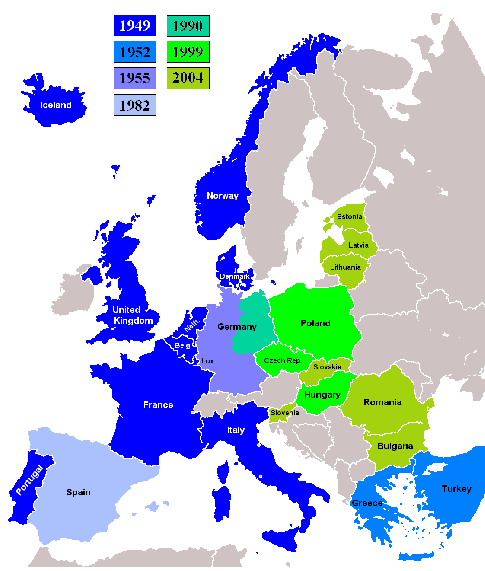 An imperialist military alliance created and dominated by the United States, originally for
the primary purpose of opposing and threatening the Soviet Union, and since the fall of the
U.S.S.R. for more general imperialist hegemonic purposes. In the map at the right we see how
this U.S.-dominated imperialist bloc has continued to expand to the east since the collapse
of the Soviet Union, as part of its continued inter-imperialist contention with Russia. Two
member countries not shown on the map are the U.S. and Canada. And since this map was drawn
two more countries were brought into NATO in 2009: Croatia and Albania. As of early 2017,
the comprador rulers of the small country of Montenegro are also seeking to join NATO.
An imperialist military alliance created and dominated by the United States, originally for
the primary purpose of opposing and threatening the Soviet Union, and since the fall of the
U.S.S.R. for more general imperialist hegemonic purposes. In the map at the right we see how
this U.S.-dominated imperialist bloc has continued to expand to the east since the collapse
of the Soviet Union, as part of its continued inter-imperialist contention with Russia. Two
member countries not shown on the map are the U.S. and Canada. And since this map was drawn
two more countries were brought into NATO in 2009: Croatia and Albania. As of early 2017,
the comprador rulers of the small country of Montenegro are also seeking to join NATO.
See also:
CHINESE EMBASSY BOMBING BY U.S./NATO (1999)
“When NATO was founded, Lord Ismay, the distinguished British General
who served as NATO’s first secretary general, said its purpose was ‘to keep the Russians
out, the Americans in, and the Germans down.’” —Scott Ritter, The Washington
Spectator, Aug. 1, 2016, p. 1.
“It was always recognized [by the U.S. rulers] that Europe might choose
to follow an independent course; the North Atlantic Treaty Organization (NATO) was
partially intended to counter this threat. As soon as the official pretext for NATO
dissolved in 1989 [with the collapse of the Soviet Union and its sphere of control], it
was expanded to the east, in violation of verbal pledges to Soviet leader Mikhail
Gorbachev. It has since become a U.S.-run intervention force with far-ranging scope, as
spelled out by NATO Secretary General Jaap de Hoop Scheffer, who informed a NATO
conference that ‘NATO troops have to guard pipelines that transport oil and gas that is
directed for the West,’ and more generally protect sea routes used by tankers and other
‘crucial infrastructure’ of the energy system.” —Noam Chomsky, Who Rules the World?
(2016), p. 45.