UAPA
See: UNLAWFUL ACTIVITIES PREVENTION ACT
UAV (Unmanned Aerial Vehicle)
A common term used by the U.S. military to refer to military drones.
UKRAINE — Corruption In
As far back as the advent of the state-capitalist era of the Soviet Union in the 1950s, and certainly
since the independence of the country after the collapse of the U.S.S.R. in 1991, Ukraine has been
notorious for the pervasive extent of corruption within its government and society. This is probably
connected with the notorious history of pro-bourgeois and pro-fascist movements within the country.
“According to a survey conducted this summer by the Center for Social and Marketing Research in Kyiv, Ukraine’s capital, a majority of Ukrainians see corruption as having a stronger impact on the country than Russian bombings.” —New York Times, “Ukraine Upset by Tape of Aide to a Prosecutor Praising Ambitious Graft”, September 17, 2026. [This is despite the massive Russian bombings of Kyiv and the rest of Ukraine during the ongoing war. —Ed.]
UKRAINE-RUSSIA WAR
The war between Ukraine and Russia, which started in a preliminary way in 2014 in the Russian-speaking
Donbass region, went into hiatus for a number of years, and then resumed in a much more serious way in
2022 with a Russian invasion of Ukraine. The war is nominally between Ukraine and Russia over whether
a Russian-speaking, and largely pro-Russia region of Ukraine (Crimea and the Donbass), should actually
be a part of Russia rather than Ukraine. (Bourgeois nations always feel their boundaries are sacrosanct
regardless of the dominant views of the people in various regions.) Since both Russia and Ukraine today
are fascist or at least semi-fascist countries, this war might be viewed as an inter-fascist nationalist
war! However, the war also has much broader and more international implications, reflecting—as it does—the
struggle between two imperialist blocs, the “Western” Bloc led by the United States and including the
European nations in NATO, versus Russia and its allies. This was once the Soviet Union and its sphere,
but is now just Russia and its small remaining area of influence. When looked at from this international
point of view, the war has clearly been provoked by a long series of steps by U.S. imperialism and NATO
to gradually weaken and eat away the Russian sphere of control or influence. What appears at first to
be merely a war caused by the attack of one country (Russia) on another country (Ukraine), is actually
more like a proxy war of American imperialism (and its allies) against
an opposed imperialist country or bloc.
Ever since the collapse of the
state-capitalist Soviet Union in 1991, U.S. imperialism has been
eroding the remaining Russian imperialist sphere of influence or control for decades. One primary
method of doing this is by bringing more and more former satellites of the
social-imperialist Soviet Union into NATO. Why is the U.S. so
concerned to continue to weaken Russia when it has already been weakened and eroded so much? It is
actually because of the rise of China as a new superpower and imperialist contender against U.S.
imperialism! Russia, and its area of influence, is an important ally to the new Chinese superpower, and
the U.S. needs to attempt to further weaken Russia as part of its plan to work toward an eventual
military showdown with China. This is why it is important to understand the “Ukraine-Russia” war as not
simply being about the small regions of Ukraine, such as the Donbass. We are actually talking about
long-term preparations of imperialist blocs getting ready for a new world war in the not too distant
future!
At this point in mid-2026 the war seems to have
settled into being pretty much a stalemate, largely because of the advent of drone warfare which
strengthens the defenses on both sides. This is not a case of a small nation defeating a big nation
because it has “justice” on its side; rather it is a case of new technology (drones) greatly
strengthening defenses against offenses seeking to occupy new territory.
For another analysis, see: “Russia’s Invasion of
Ukraine, the Maneuvers of the U.S. Ruling Class and Some Tasks for U.S. Communists”,
by the Maoist Communist Union, in Red Pages journal, #3 (Feb. 2023), at:
https://bannedthought.net/USA/MCU/RedPages/issue_three/russia-invasion-ukraine-key-tasks/
“Back when the full-scale Russian invasion of Ukraine in 2022 was in its early
stages, the cry from the West was to supply Ukraine with enough artillery shells and tanks to
blunt the Russian onslaught. Now, well into the war’s fifth year, this is a far different fight...
“The ground war is at a stalemate. Russia
is still clawing away at Ukrainian territory, but at a snail’s pace and extraordinary cost.
Ukraine says it killed or wounded almost 40,000 Russians in June, or about 1,300 casualties per
square kilometer ‘seized or infiltrated,’ according to the Institute for the Study of War — an
attrition rate 19 times what it was a year earlier. ‘Ukrainian forces are becoming increasingly
effective at simultaneously slowing Russian advances and inflicting heavier losses,’ the institute
said.
“The battle in the sky, by contrast, is not
for territory: It is a grinding duel of attrition, destruction and death, intended to erode the
enemy’s ability and will to carry on.
“Russia is pummeling Ukraine with salvo
after deadly salvo of drones, cruise missiles and ballistic missiles; Ukraine is using ever more
sophisticated drones to drive Russia’s fleet away from Ukraine in the Black Sea, starve
Russia-occupied Crimea and, most effectively, strike oil facilities and military installations
deep inside Russia. Long lines for gas in Moscow and black smoke billowing from a refinery in
distant Omsk, and images of victims being pulled out of demolished apartment blocks in Kyiv, tell
the rest of the story.”
—Serge Schmemann, “The Ukraine-Russia War
Reaches a New Phase”, New York Times, July 15, 2026.
UKRAINIAN FASCISM TODAY
The long reactionary tradition of pro-fascist elements within, and often dominating, the Ukrainian
nationalist movement still continues to the present time, and has even had a major resurgence since
the break-up of the Soviet Union. This fascist trend has further strengthened because of the war
between Ukraine and Russia (see entry above), which began in a major way in 2022. This war is a
nationalist war by Ukraine to hang onto Russian-speaking regions of Ukraine, which is strongly
backed by U.S. imperialism and NATO for their own imperialist reasons. Within Ukraine, the war,
along with all the attending growth of nationalism and hatred for Russians, has led to powerful
new fascist trends. Many Ukrainian military units openly wear uniforms and insignia glorifying
past fascist movements in that country.
Top government officials, and especially the
war-time Ukrainian President, Volodymyr Zelensky, have mostly tried to discount this blatant
pro-fascist trend in the country. But it is so powerful that he also has to sometimes openly bow
toward it. (See quote below.)
[More to be added.]
“With a Ukrainian military honor guard standing ramrod straight beside his
coffin, Andriy Melnyk, a leader of a Ukrainian nationalist movement who died six decades
ago—and who has been no less divisive after death than in life—lay in state in Kyiv before
his reburial on Sunday [May 24th, 2026].
“President Volodymyr Zelensky provided
full state honors for the ritual, signaling a deep shift in Ukrainian politics after Russia’s
invasion in 2022. Before then, Mr. Zelensky had kept nationalist politics at arm’s length;
in the reburial, he embraced them.
“The remains of the long-dead World
War II-era Ukrainian leader were exhumed in Luxembourg, where he had been buried after dying
in exile in 1964, and returned to Ukraine. There was none of the raw grief of today’s war
war funerals.
“Melnyk led one of two factions of the
Organization of Ukrainian Nationalists, including through a period of alignment with the
Nazi army during its occupation of Ukraine, which was one of the bloodiest chapters of World
War II...
“[When the Nazis invaded Ukraine many
Ukrainians] initially saw the Nazis as liberators. Factions from the Organization of
Ukrainian Nationalists and its insurgent army fought alongside the Nazis in what they viewed
as a struggle for Ukrainian sovereignty. Members of those groups also took part in atrocities
against Jewish and Polish civilians. Later in the war, some of the groups fought against the
Nazis.
“As he was under arrest in Germany
through most of the war, Melnyk’s degree of culpability in the Holocaust and a murderous
fight with ethnic Poles in western Ukraine in 1945 has divided historians ever since. [There
are always plenty of bourgeois historians around who are inclined to forgive fascists. —Ed.]
...
“Before Russia’s all-out invasion the
ceremony would have been a risky move by an Ukrainian politician who wanted to win votes
from Russian speakers. But during the war, Ukrainians have embraced more tightly all the
symbols of Ukrainian independence, and Mr. Zelensky moved with them.”
—Andrew E. Kramer, “Divisive
20th-Century Hero Reburied in Ukraine: Nazi Collaborator and Anti-Soviet Leader is Given
Full State Honors by Zelensky”, New York Times, May 27, 2026.
UKRAINIAN NAZI COLLABORATORS IN WORLD WAR II
Most Ukrainians during World War II fought against the Nazis and in defense of the then-socialist
Soviet Union. However, there was a long tradition of anti-Soviet nationalism in Ukraine, including
a long tradition of outright pro-fascist nationalism there, going back at least to the World War I
period. And elements of this fascist tradition and heritage still existed during the World War II
period (and indeed also through the state-capitalist period of the Soviet Union and since then!).
See also the entry above.
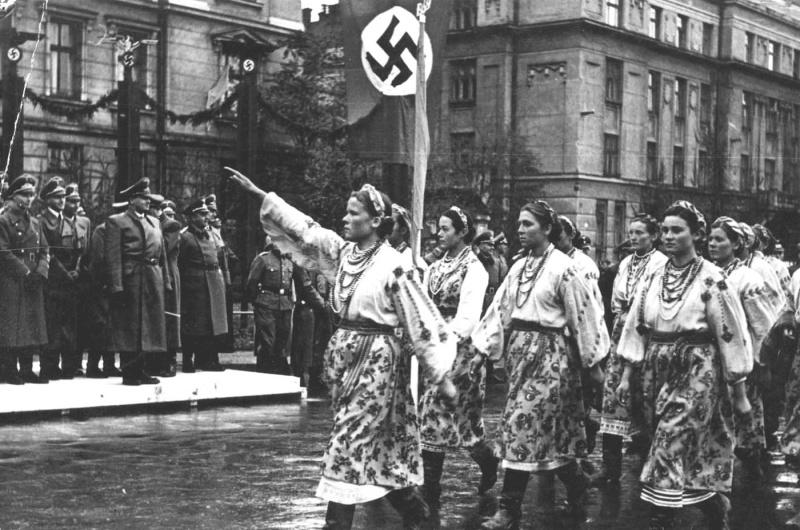
“Ukrainian collaboration with Nazi Germany took place during the occupation
of Poland and the Ukrainian SSR, USSR, by Nazi Germany during the Second World War.
“By September 1941, the German-occupied
territory of Ukraine was divided between two new German administrative units, the District of
Galicia of the Nazi General Government and the Reichskommissariat Ukraine. Some Ukrainians
chose to resist and fight the German occupation forces and joined either the Red Army or the
irregular partisan units conducting guerrilla warfare against the Germans. Some Ukrainians
worked with or for the Nazis against the Allied forces. Ukrainian nationalists hoped that
enthusiastic collaboration would enable them to re-establish an independent state. Many were
involved in a series of war crimes and crimes against humanity, including the Holocaust in
Ukraine, and the massacres of Poles in Volhynia and Eastern Galicia.
“Ukrainians, including ethnic minorities
like Belarusians, Russians, Tatars and others, who collaborated with Nazi Germany did so in
various ways including participating in local administrations, in the German-supervised
auxiliary police, Schutzmannschaft, in the German military, or as guards in the concentration
camps.” —Introductory paragraphs of the Wikipedia article “Ukrainian Collaboration with
Nazi Germany”, online at
https://en.wikipedia.org/wiki/Ukrainian_collaboration_with_Nazi_Germany (accessed July 14,
2026).
UKRAINIAN COMMUNIST PARTY [UKAPISTS]
An opposition party to the Communist Party (Bolsheviks) of Ukraine from 1920 to 1925. The
nickname “Ukapists” comes from the Anglicized Ukrainian initials of this party, UKP. The
Ukapists were a split-off from the Ukrainian Social Democratic Labor Party in January 1919,
and initially called themselves the Socialists-Sovereignists. They had a strong nationalistic
orientation, though they did favor some type of an alliance with other Soviet republics in a
sort of European socialist federation. In its newspaper Chervony Prapor the UCP
strongly criticized the Ukrainian Bolsheviks as being subservient to the Russian Bolsheviks
in Moscow.
Besides their initial Sovereignist core the
Ukapists included many former left-Socialist Revolutionary Borotbists,
and some people, such as Yuri Lapchinsky, who had left the CP(B)U for nationalist reasons.
In 1923 a faction of the UCP requested unification with the Bolshevik party. In 1920 and again
in 1924 the UCP asked the Communist International for affiliation
as the representative of Ukraine. The Comintern rejected this application and said that since
Ukraine was already a sovereign state within the USSR, the UCP should dissolve itself
and merge into the CP(B)U. At its Fourth Congress the UCP did formally dissolve itself, and
some members, including its leader Andri Richitsky, did join the CP(B)U. During the early
1930s at least some of the former Ukapists were purged from the Bolsheviks, and some were
apparently exiled to Siberia or else executed.
Dictionary Home Page and Letter Index