G-7 (Group of Seven)
An economic forum of the seven leading advanced industrial economies in the world, whose
finance ministers have met several times a year to discuss problems in the world capitalist
economy and to arrange for co-ordination of economic policies. It was formed in 1976 when Canada
was added to the previous “Group of Six” (France, Germany, Italy, Japan, United Kingdom and the
U.S.). In 2009 the G-7 decided that it no longer had sufficient economic power to coordinate
(or completely dominate!) the entire world capitalist economy, and decided that the G-20
group (see below) would be the more appropriate forum for that purpose. The G-7 continues,
however, perhaps more as a semi-independent “faction” within the G-20. G-7 meetings are now
planned to be more informal and to be scheduled just before G-20 meetings.
G-20 (Group of Twenty Finance Ministers and Central Bank Governors)
An expanded forum created by the G-7 (see above) in 1999, for consultations on the international
financial system and the world capitalist economy, and for coordination of national economic
policies. It consists of the biggest developed and “emerging” world economies which represent
90% of global GNP, 80% of world trade (including European Union internal trade), and roughly
two-thirds of the world population. Its members are: Argentina, Australia, Brazil, Canada,
China, France, Germany, India, Indonesia, Italy, Japan, South Korea, Mexico, Russia, Saudi
Arabia, South Africa, Turkey, the U.S., the United Kingdom and the European Union.
Before 2009, the G-20 was subordinate to the G-7
in importance. But because of the growing economic power of China and other members of the G-20
who are not members of the G-7, in late September 2009, in the midst of the intensified world
economic crisis, the G-20 was formally designated as the primary international consultation and
coordination body for the economic policies of the major capitalist countries.
GAIA HYPOTHESIS
The theory that the Earth itself (or at least its surface) can be viewed as a single biological
organism which has the ability to regulate its own body temperature and chemistry. In other
words, this supposed superorganism is claimed to be able to regulate the conditions for
its own continued existence! This rather nutty idea was proposed by the NASA atmospheric scientist
James Lovelock and others starting in 1972. Scientific critics pointed out that the theory was
teleological and perhaps even implied some sort of consciousness
for the Earth; that it suggested religious motives and thinking; and that it seemed to be in
serious conflict with Darwinian evolution. Lovelock tried to defend and patch up the idea,
implicitly watering it down, but the basic theory still seems extremely dubious at best to most
biologists.
It is true, however, that biological life-forms
have caused some major changes to the Earth and its atmosphere. Before life came into existence
there was no considerable and sustainable amount of the very reactive element oxygen in the
atmosphere, for example. And there may indeed be various natural feedback systems that tend
to stabilize the levels of oxygen and carbon dioxide in the atmosphere. It is also conceivable
that there are similar sorts of feedback mechanisms for the ocean chemistry. However, it has
proven to be quite difficult to specify exactly what all these feedback mechanisms are and to
demonstrate that they must remain effective over long periods of time. Thus even the small
aspect of scientific truth that might possibly exist in the Gaia Hypothesis is far from well
established.
GALEN [GALEN OF PERGAMON, known in Latin as Aelius Gaenus] (129 - c. 216 C.E.)
Famous Greek physician of the later Roman Empire, and personal physician to several Roman
Emperors including Marcus Aurelius. Often viewed as the greatest medical researcher of antiquity,
though he did not dissect human cadavers. He upheld the “four humors” theory [black bile, yellow
bile, blood and phlegm] which originated with earlier Greek physicians such as Hippocrates. He
taught that blood was formed in the liver and went in and out from the liver in sort of a tidal
ebb and flow, and that in the heart the blood was purified and mixed with air from the lungs,
thus taking up “vital spirits” in the process. Galen’s views were revived in the late Middle Ages
and continued to influence Western medicine as late as the 19th century.
See also:
HARVEY, William
GALILEO GALILEI (1564-1642)
Great Italian scientist and founder of modern experimental physics. He was put under house
arrest by the Roman Catholic Church and threatened with being burned at the stake (as was done
to Giordano Bruno in the year 1600) if he did not renounce
the Copernican theory that the earth revolves around the sun (rather than vice-versa). This is
a famous episode in the perpetual war between science and religion.
See also:
“DOCTRINE OF THE TWO BOOKS”
“The discovery and use of scientific reasoning by Galileo was one of the
most important achievements in the history of human thought, and marks the real beginning
of physics.” —Albert Einstein & Leopold Infeld, The Evolution of Physics
(1938), p. 6.
“Lest we forget: Galileo, the greatest scientist of his time, was forced
to his knees under threat of torture and death, obliged to recant his understanding of
the Earth’s motion, and placed under house arrest for the rest of his life by steely-eyed
religious maniacs. He worked at a time when every European intellectual lived in the
grip of a Church that thought nothing of burning scholars alive for merely speculating
about the nature of the stars.... This is the same Church that did not absolve Galileo
of heresy for 350 years (in 1992).” —Sam Harris, “The Language of Ignorance”, Aug. 15,
2006.
“GANG OF FOUR”
The so-called “Gang of Four” consisted of Mao’s wife Jiang Qing
(Chiang Ching), Zhang Qunqiao (Chang Chun-chiao), Wang Hongwen (Wang Hung-wen), and
Yao Wenyuan (Yao Wen-yuan). The name comes from a friendly,
and perhaps half-joking warning from Mao to these four close supporters not to form themselves
“into a gang of four”; in other words it was comradely advice to avoid sectarianism and seek
wider support and alliances within the Party. After Mao’s death and the coup d’état by
the capitalist roaders, this friendly warning by Mao to close comrades was reinterpreted by
these rightists as an excuse to oppose and arrest not only these four, but thousands of other
close revolutionary followers of Mao.
For obvious reasons, the opponents of the
capitalist-roaders in and outside of China often prefer
to refer to these close comrades of Mao as “the Four”, rather than the “Gang of Four”.
“It should be noted that the Gang of Four—which is to say, the
concerted actions of the four while in top leadership positions—cannot be carried back
earlier than 1973. Yet political positions and choices were commonly attributed to them
that go back to 1965. In the most recent propaganda [of the capitalist-roaders, circa
1978], even the policy line subsequent to 1956 has been challenged....
“To represent the Four as close
associates and, what is more, dominant leaders during the years of the Cultural
Revolution [meaning 1966-1969 —Ed.] is to perpetrate a pure fabrication.” —Edoarda Masi,
China Winter: Workers, Mandarins, and the Purge of the Gang of Four (1978),
p. 22.
GAZA — Destruction Of
When the oppressed Palestinian people in Gaza rose up in the Hamas-led revolt beginning on October 7,
2023, the Israeli Zionists began a ferocious genocidal war against them
in response, that continued until January 2025, when there was a short-term cease fire. And then it
soon resumed again. The Israeli plan was to kill at least many tens of thousands of Palestinians there,
and drive out all the rest. Their basic method of committing this horrendous crime was to bomb and
destroy as much of Gaza as possible. In other words, to completely obliterate Gaza and make it unlivable.
Although this nearly complete destruction was carried out, the courageous people of Gaza still refused
to meekly surrender. However, whether the Zionists will actually allow them to rebuild Gaza is a highly
doubtful question, as is the level of necessary international help required to rebuild. For now the
Zionists have again been defeated in their basic plan to push all the Palestinians out of their own
country. However, the Zionists have by no means given up on their monstrous central goal of the complete
ethnic cleansing of Palestine. [January 28, 2025]
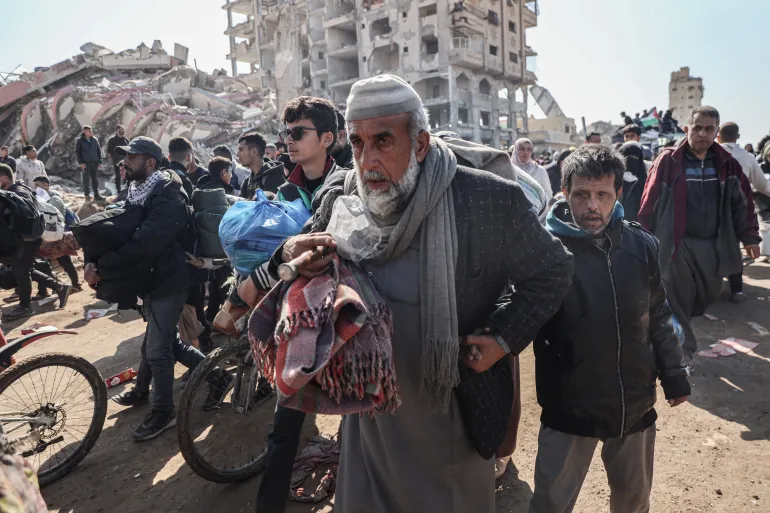
The photo below shows Palestinians walking back from
the southern parts of Gaza into the mostly destroyed Gaza City. [Al Jazeera photo]
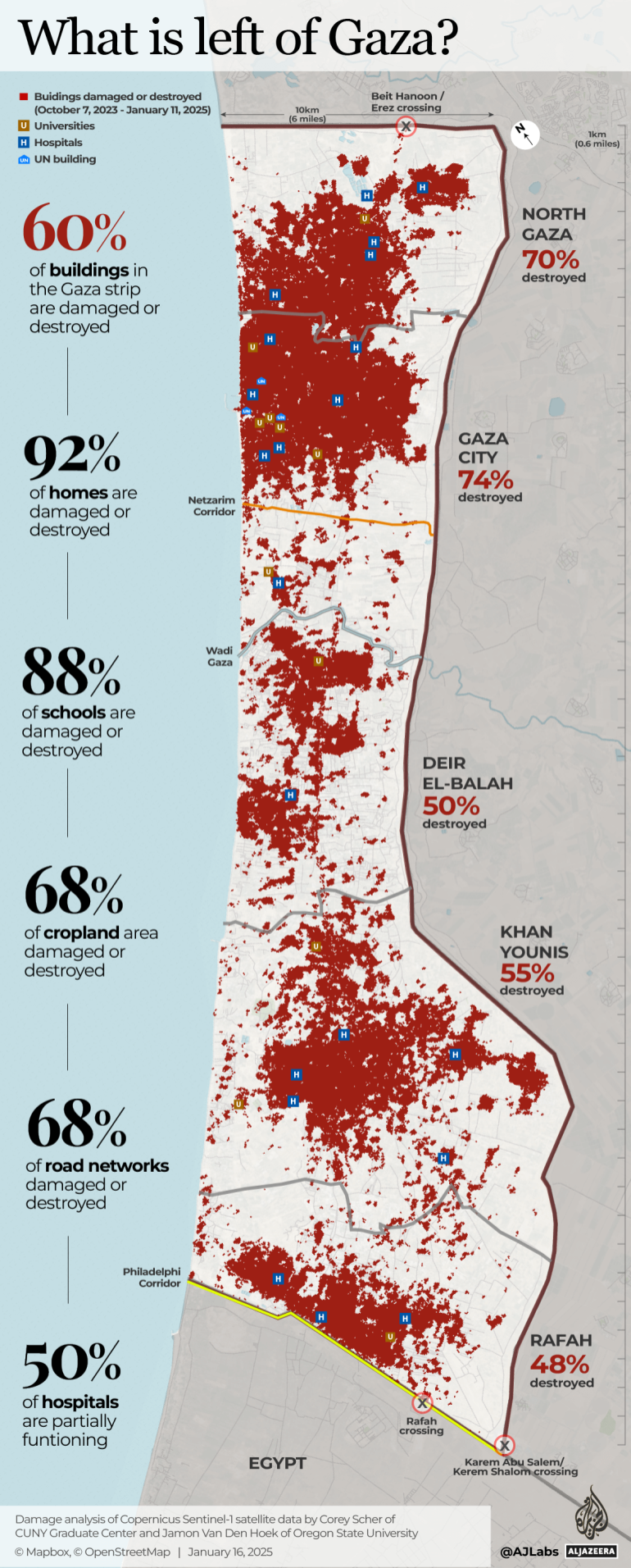
 The graphic at the right, also from Al Jazeera, shows
the massive scale of the destruction of Gaza, as of the truce on January 11, 2025. Since then, much
more of Gaza has been obliterated.
The graphic at the right, also from Al Jazeera, shows
the massive scale of the destruction of Gaza, as of the truce on January 11, 2025. Since then, much
more of Gaza has been obliterated.
“It took us a few minutes to accept that this pile of rubble was our home.”
—Islam Dahliz, a Palestinian on returning to where his home in Gaza once stood, after a
cease-fire halted fighting in January 2025. His family had been ordered by the Israeli military
to leave that Rafah region of Gaza the previous May. New York Times Quote of the Day,
January 23, 2025.
GAZA — Israeli-Enforced Starvation In
There are many ways in which the Israeli Zionists have been carrying out more and more intense
genocide against Palestinians, especially in Gaza. Simple mass murder by shooting them or dropping
endless numbers of U.S.-supplied bombs on them, of course. But also by blocking food supplies from
entering Gaza. The number of people, especially children, in Gaza who are dying from starvation, is
rapidly expanding at the present time. [August 2025]
See also:
ISRAEL—Genocide By
“A ship carrying baby formula and food intended for Palestinians in Gaza facing
rising starvation was at least the third of its kind to be turned away by the Israeli navy this
year.” —New York Times, “Israel Intercepts Ship Carrying Gaza Aid”, July 28, 2025.
GDP
See: GROSS DOMESTIC PRODUCT
Dictionary Home Page and Letter Index
MASSLINE.ORG Home Page
 The nom de guerre of Muppala Lakshmana Rao, the General Secretary of the Communist Party of
India (Maoist) from its founding in 2004 until November 2018. He resigned in that year in order to
make way for younger, more energetic revolutionary leadership of the party.
The nom de guerre of Muppala Lakshmana Rao, the General Secretary of the Communist Party of
India (Maoist) from its founding in 2004 until November 2018. He resigned in that year in order to
make way for younger, more energetic revolutionary leadership of the party.