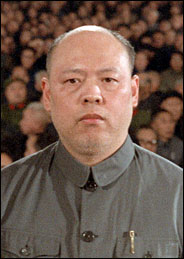
 One of Mao’s close followers and supporters in the Great Proletarian Cultural Revolution, and
one of the so-called “Gang of Four”. [More to be added.]
One of Mao’s close followers and supporters in the Great Proletarian Cultural Revolution, and
one of the so-called “Gang of Four”. [More to be added.]YAN’AN PERIOD (Old style: YENAN PERIOD)
The period in the Chinese Revolution from 1937 to 1947 when Yan’an, a city in Shaanxi province,
was the center of the Communist movement and headquarters of the Party and the people’s
government it led in large parts of rural China.
In addition, there was a distinctive style of
leadership of the masses (based on the mass line), and a more
modest and down-to-earth way of living by the CCP leadership who were closer to the life of the
people during this period. This was later called by Mao the “Yan’an Way”, and he and his closest
revolutionary followers always looked back on this period with fondness and seriously attempted
to recreate the Yan’an Way in all of China during the Great Proletarian
Cultural Revolution, unfortunately with only partial and short-term success.
YANG Chu (c. 395-335 BCE)
Early Chinese naive materialist philosopher, who severely
criticized religious views and the belief in immortality in particular. He urged people to enjoy
their lives and not worry about what will happen after death. He took a rather fatalistic view
about nature and society. In ethics he emphasized that people should work toward the greatest
satisfaction of their needs and wishes, but focused more on individual satisfaction than the
satisfaction of collective interests. However, his individualism was in reaction to the
reactionary Confucianism of his time which led to the differing
social gradation of people.
YANG Xianzhen (1896-1992)
Revisionist philosopher and politician in the People’s Republic of China. Provoked the
One-Divides-into-Two Struggle in 1964 by erroneously
arguing for the opposite, that the basic viewpoint of dialectics is supposedly that “Two Unite
into One” (or “Two Combine into One”). This philosophical notion promoted the playing down of
class struggle and the adoption of capitalist policies and methods in order to “build socialism”.
YAO Wenyuan [Old style: Yao Wen-yuan] (1931-2005)
One of Mao’s close followers and supporters in the Great Proletarian Cultural Revolution, and
one of the so-called “Gang of Four”. [More to be added.]
YELLOW RIVER [Huang He or Huang Ho (Old Style)]
A major river in China and the third longest river in Asia. Often called “China’s Sorrow” in
pre-Liberation times (before 1949) because of the frequent terribly flooding which killed
millions of people. During major floods it has often changed its course significantly, and the
present course began with the 1897 flood. The 1887 flood is estimated to have killed between
900,000 and 2 million people and according to the Wikipedia was the second-worst natural disaster
in history (excluding famines and epidemics). The 1931 flood killed between one and four million
people, and is the very worst natural disaster ever recorded (excluding famines and epidemics).
In 1938 Chiang Kai-shek ordered his troops to
destroy the dikes along the banks of the Yellow River in a vain attempt to stop the Japanese
imperialist invasion then in progress. It only slowed the Japanese down briefly and ended up
leading to the deaths of around 800,000 people either directly or through starvation. This was
one of the worst criminal acts of the 20th century.
See also:
CHIANG KAI-SHEK—As a Military Leader [2nd
quote by Richard Bernstein]
YEMEN — U.S. Imperialist Drone Warfare In
See also: DRONES
“The U.S.’s Deadly Drone War
“The U.S. has launched more than 100
drone strikes in Yemen since 2002, killing close to 900 militants, including Anwar
al-Awlaki, whom U.S. counterterrorism officials called ‘the most dangerous man in the
world.’ But dozens of civilians have also died. While most Yemenis want to see al Qaida
driven from their territory, the strikes have stoked strong anti-American feeling. President
Obama said missiles are fired only when there is ‘near certainty that no civilians will be
killed or injured,’ but from the air it can be difficult, if not impossible, to discern
every person’s identity. Many Yemenis believe that the Saleh and then Hadi governments often
gave the U.S. names of their political enemies and identified them as terrorists. ‘Every
time they kill an innocent person,’ said drone victims’ advocate Mohamed al-Qawli, ‘they
motivate the families to join al Qaida.’” —From “Yemen’s Descent into Chaos”, The
Week (a bourgeois U.S. magazine), March 6, 2015, p. 11.
[Not only is U.S. imperialism itself
by far the biggest direct source of terrorism in the world today, that same U.S. terrorism
definitely leads to even much of the other terrorism in the world that the U.S. itself
doesn’t directly commit! —S.H.]
YISHUV
A term referring to the body of Jewish residents in Palestine prior to the establishment of the State of
Israel in 1948. The term came into use in the 1880s, when there were about 25,000 Jews living in that
region, and continued to be used until 1948, by which time there were some 630,000 Jews there. The term
is still in use to denote the pre-1948 Jewish residents in Palestine. [From Wikipedia entry, as
of March 5, 2024.]
See also:
ZIONISM and related entries.
YISHUVISM
Although derived from the word “Yishuv” (see above), Yishuvism refers to a considerably more
elaborated nationalist radical political viewpoint: Namely, the theory which was popular among many
radical Jews in Palestine in the early 20th century that Zionism and
communism could and should be reconciled and held simultaneously. This was a seriously erroneous trend
within the Communist Party of Palestine throughout its existence (1919-1948), and was especially strong
in the 1920s. Even later it may well have played a part in convincing Stalin and the Soviet Union to
support the creation of the Zionist state of Israel in 1948. (See in particular: “Communism Versus Zionism:
The Comintern, Yishuvism, and the Palestine Communist Party”, by Johan Franzén, available on the
Palestine page on BannedThought.net.)
YOUNG HEGELIANS (or LEFT HEGELIANS)
“An idealist trend in German philosophy current in the thirties and forties of the nineteenth century; the Young Hegelians tried to deduce radical arguments from Hegel’s philosophy to prove the necessity for bourgeois reform of Germany. The leaders of the school were Strauss, the Bauer brothers, [Max] Stirner and some others; for a time they were joined by Feuerbach and also by Marx and Engels in their youth; Marx and Engels broke with the Young Hegelians and criticized the idealist, petty-bourgeois essence of the trend in The Holy Family (1844) and German Ideology (1845-46).” —Note 2 in Lenin, Selected Works (Moscow: 1967).
YOUTH
See also:
COMMUNISM—Attitude of Americans Towards,
GENERATIONAL CHANGE—U.S.
“...Is it not natural that youth should predominate in our Party, the revolutionary
party? We are the party of the future, and the future belongs to the youth. We are a party of
innovators, and it is always the youth that most eagerly follows the innovators. We are a party that
is waging a self-sacrificing struggle against the old rottenness, and youth is always the first to
undertake a self-sacrificing struggle....
“We shall always be a party of the youth of
the advanced class!” —Lenin, “The Crisis of Menshevism”, LCW 11:354-5.
YUGOSLAVIA
“If our country does not build up a socialist economy, what is it going to be? It will be like Yugoslavia, a capitalist country in fact. The proletarian dictatorship, worse still, a reactionary and fascist dictatorship. This problem deserves our fullest attention and [I] hope our comrades will give it their thought.” —Mao, Aug. 17, 1967; SW 9:417.
Dictionary Home Page and Letter Index