Dictionary of Revolutionary Marxism
— O —
OBAMA, Barack (1961- )
 President of the United States from January 2009 to January 2017. Since he was the candidate
of the Democratic Party (which many people in the U.S. still naïvely imagine is
qualitatively superior to the other major capitalist party, the Republicans), and because
he was the first Black (African-American) President, many liberals, minorities, and other
people had huge hopes for his presidency—which were slowly dashed against the rocks of
bourgeois reality.
President of the United States from January 2009 to January 2017. Since he was the candidate
of the Democratic Party (which many people in the U.S. still naïvely imagine is
qualitatively superior to the other major capitalist party, the Republicans), and because
he was the first Black (African-American) President, many liberals, minorities, and other
people had huge hopes for his presidency—which were slowly dashed against the rocks of
bourgeois reality.
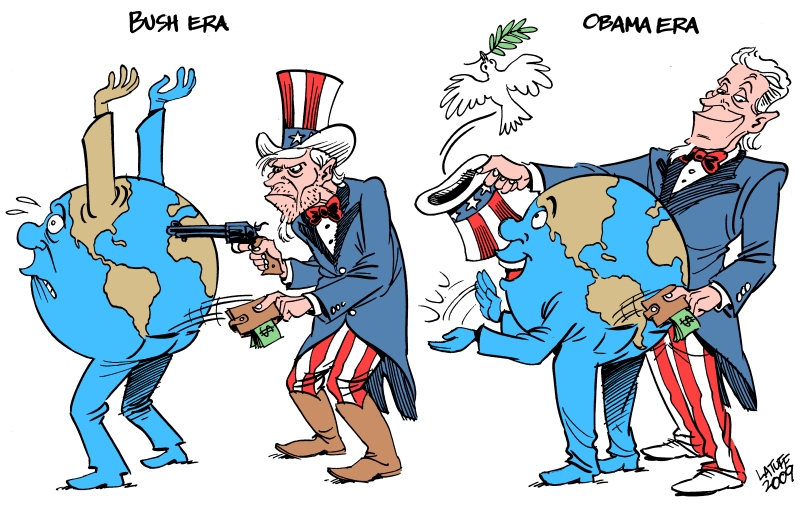
In foreign policy—and despite what the
cartoon at the right hoped for and implied—Obama continued, and to some extent expanded, the
U.S. imperialist wars in Afghanistan and Iraq, and extended them further to other countries
such as Syria, Libya and Yemen. He especially promoted the trend toward remote-controlled
mass murder, using armed drones, cruise missiles and bombs dropped
from airplanes in preference to ground troops in these wars. The U.S. war in Afghanistan
which began in 2001, and which Obama promised to end if elected, continued through his
entire 8-year presidency, and still continued after he was out of office. (As of July 2021
this imperialist war has lasted for 20 years, though it is now coming to an official
end—with only much lower levels of U.S. warfare likely to continue in Afghanistan for
now.)
When Obama took office the U.S. and world
were in the beginnings of a severe worsening of the long-developing capitalist financial and
economic crisis, in the form of the Great Recession. As
far as the job situation and welfare of the people is concerned, this intensified economic
crisis still continues. However, following the lead of his predecessor, George Bush, Obama
paid careful attention to bailing out the big banks and other major financial corporations
with many billions of taxpayer dollars. Although a pretense was made by Obama and Congress
in passing legislation (the Dodd-Frank Act) to “prevent” a similar financial crisis from
happening in the future, that was pure window dressing which cannot possibly address the
inherent contradictions within the capitalist mode of production which leads to such
crises.
In trade policy Obama also supported the
interests of capitalist corporations over the U.S. working class. Although he had promised
during the election campaign to reform or abandon the NAFTA agreement, he did nothing of the
kind. (See: NAFTA [McChesney/Nichols quote] )
Instead he arranged for additional international trade deals which eliminated more jobs in
the U.S., and even promoted the worst such proposed trade deal yet, the
“Trans-Pacific Partnership” (which however fell apart once Obama
left office).
The “signature accomplishment” of the Obama
Administration was the grossly inadequate (and quite insufficiently financed)
Affordable Care Act (also known as “ObamaCare”). As
poor as that pathetic excuse for a national health program is, the big debate in American
bourgeois politics since then has been whether ObamaCare should be eliminated (as Republicans
demand) or retained (as Democrats want).
Overall the Obama presidency was a dismal
failure, certainly with regard to advancing the material interests of the working class and
masses, and actually even with respect to significantly advancing the long-term interests of
the ruling bourgeoisie itself! Did the people learn from this negative experience with Obama
to stop supporting ruling class candidates in elections? Unfortunately, no. Many millions of
them still supported either Hillary Clinton or the billionaire demagogue Donald Trump in the
2016 election.
See also:
WHISTLE-BLOWER
[Speaking to a group of leading bankers during the most dangerous period of the Great Recession, when millions of workers were unemployed, losing their homes, etc.] “My administration is the only thing standing between you and the pitchforks.” —President Barack Obama, quoted by Robert Kuttner, “Free Markets, Besieged Citizens”, The New York Review of Books, July 21, 2022, p. 14. [An interesting self-exposure, indeed, about the real role of liberal Democrat politicians in America at the present time: namely, keeping the masses fooled and under control, for the benefit of the rich. —Ed.]
“OBAMA CARE”
See: AFFORDABLE CARE ACT
OBEDIENCE
Obedience “implies compliance with the demands or requests of someone in authority”. [Cf.
Merriam-Webster’s Collegiate Dictionary, 10th ed., 1991)] However, within a genuine
communist party we speak not of “obedience to demands”, but rather of organizational
discipline. Whereas obedience is something that often implies that force or threats
of force are used, organizational discipline within the proletarian party is something
which is voluntarily agreed upon by each new member of the party; it is part of the
rules of democratic centralism which each member of the party agrees to adhere to when they
join.
See also:
DISCIPLINE—Of the Proletarian Party,
DEMOCRATIC CENTRALISM,
JESUITS [Amir Alexander quote]
OBESITY
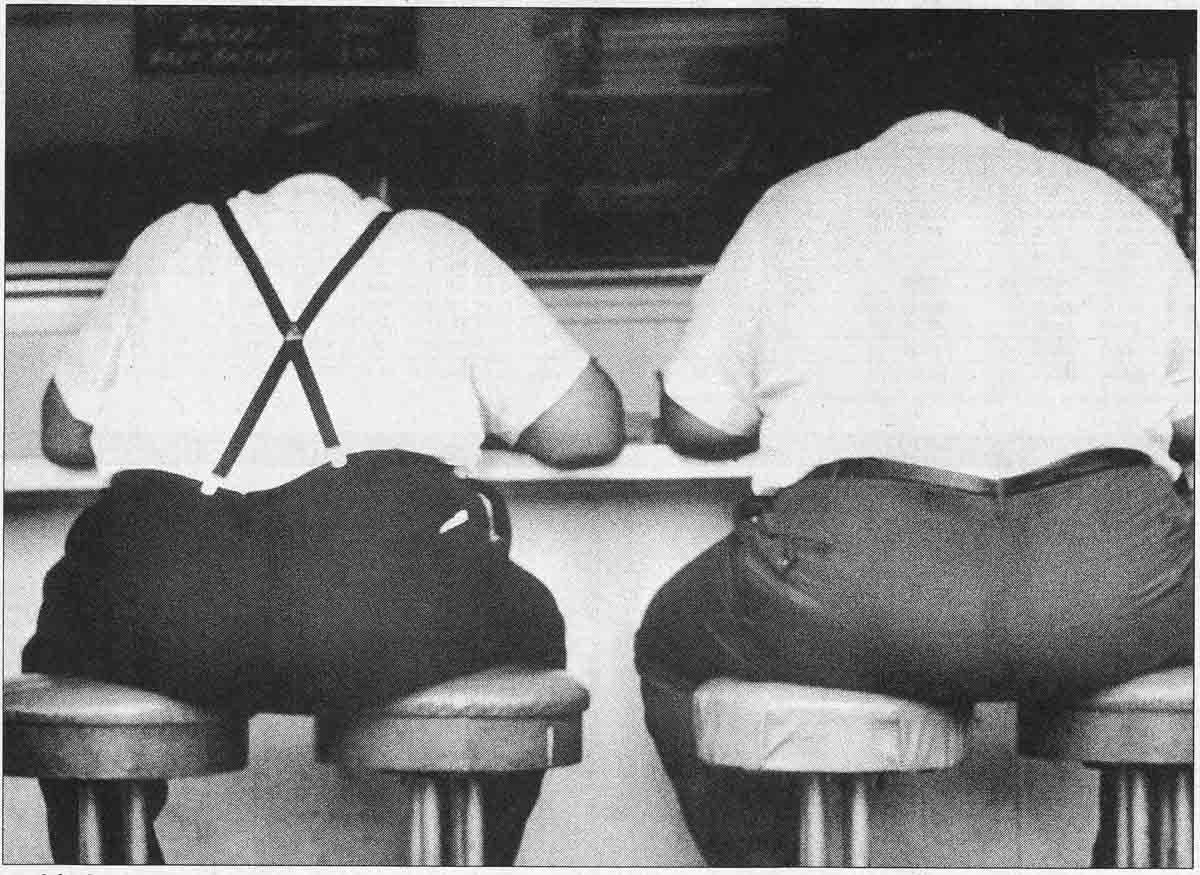 Being really excessively fat. Obesity is more and more common in advanced capitalist countries, where
there is an ongoing general decline in people’s health and physical condition. According to the
Centers for Disease Control, adult men (age 20 and older) in the United States weigh an average of
200 pounds. For women, the average is 171 pounds. Fully 73.6 percent of American adults are classified
as “overweight” and 42.5 percent are “obese.” [These are pre-pandemic figures; the situation is probably
even worse now. See:
https://www.cdc.gov/nchs/fastats/body-measurements.htm for some more details.] That means
that over 80 million people in the U.S. are now obese. However, obesity is fairly common in
“Third World” countries too, often because of the very poor quality
diets available to people.
Being really excessively fat. Obesity is more and more common in advanced capitalist countries, where
there is an ongoing general decline in people’s health and physical condition. According to the
Centers for Disease Control, adult men (age 20 and older) in the United States weigh an average of
200 pounds. For women, the average is 171 pounds. Fully 73.6 percent of American adults are classified
as “overweight” and 42.5 percent are “obese.” [These are pre-pandemic figures; the situation is probably
even worse now. See:
https://www.cdc.gov/nchs/fastats/body-measurements.htm for some more details.] That means
that over 80 million people in the U.S. are now obese. However, obesity is fairly common in
“Third World” countries too, often because of the very poor quality
diets available to people.
In an ultra-individualist, and bourgeois country like
the United States, it is considered terribly improper to suggest to fat or obese people that it might
be a good idea for them to lose some weight. And any hint of criticism of someone for being obese is
condemned as “fat-shaming”.
“Some 24 million Americans have what is characterized as severe obesity, a body mass index of at least 40. To reach a healthy weight, they need to lose 80 to 100 pounds.” —New York Times, “Facts of Interest”, May 23, 2026.
OBJECTIVE REALITY
The real world as it actually is, as opposed to various ideas—often quite fanciful—about the
world. Also called the external world, especially in older
philosophical writings.
See also:
REFLECTION THEORY
“The laws of war, like the laws governing all other things, are reflections in our minds of objective realities; everything outside the mind is objective reality.” —Mao, “Problems of Strategy in China’s Revolutionary War” (Dec. 1936), SW 1:190.
OBJECTIVE SITUATION
1. [Narrow definition:] The actual political
and/or military situation with regard to all the relevant factors for victory other than
the subjective understanding and attitudes of the Party members, soldiers, and the
advanced forces and the proletariat more generally. In a military situation this would include
the number and quality of the armaments on each side, as well as the fitness of the troops,
the availability of food and supplies, etc.
2. [Broad definition:] The actual political
and/or military situation with regard to all the relevant factors including the subjective
understanding, morale and attitudes of the Party, troops, advanced forces, proletariat as
a whole, etc.
The idea here is that sometimes we want to
contrast, or consider separately, the material and ideological factors in a struggle, while
at other times we just want to think about all the relevant factors for victory—both
“objective” and “subjective”—for both sides in a struggle. Although there is obviously
grounds for confusion between these two opposed definitions, the context soon clarifies which
sense is meant.
See also:
INVESTIGATION—Before Launching Political
Action,
LOOKING AND SEEING
“OBJECTIVISM”
The name the vulgar bourgeois writer Ayn Rand gave to her
shallow philosophical system glorifying selfishness and capitalism.
OBLIGATION
[Ethics:] A moral requirement to act in a certain way. Kant held
the extreme position that (what he took to be) moral obligations are absolute, that is,
they are morally necessary regardless of the consequences.
See also:
CONSEQUENTIALISM,
DUTY
OBLIVIOUSNESS
See: LOOKING AND SEEING
OBSHCHINA
Russian term for semi-feudal peasant village communes, which however, also had certain
collectivist aspects to them. For more about them see:
VILLAGE COMMUNE (Russia)
OCCAM’S RAZOR
A principle enunciated in cryptic form by the medieval philosopher William of Occam (or
Ockham) which states that you should always choose the simplest explanation for any
phenomenon, the one requiring the fewest assumptions and supporting entities.
See also:
Philosophical doggerel on
Occam and his “razor”.
OCCASIONALISM
A religious idealist doctrine which arose in the 17th century as an attempt to explain
the mysterious interaction of “soul” and body, as required by
Descartes’s dualistic theory
of the world. The Occasionalists held that the reciprocal action between mind and body
is due to the intervention of God. Malebranche carried this idea to the further extreme
of postulating divine intervention in every single causal action.
Of course from the dialectical materialist
point of view there are no “souls”, and mental phenomena are merely high-level ways of
looking at the functioning of certain very complex material systems (e.g. brains). Thus
the supposed mystery of how “two totally independent things”, mind and brain, can interact
and influence each other does not arise.
See also:
PSYCHOPHYSICAL PARALLELISM
OCCUPY MOVEMENT
 The “Occupy Movement” was an international youth-based leftwing populist political movement that,
though it arose from earlier protests around the world against the rich, their corporations, and
in favor of genuine democracy and social justice, became an international sensation with the
advent of the massive Occupy Wall Street demonstrations in Zuccotti Park, Lower Manhattan,
beginning on September 17, 2011. The movement then spread like wildfire, and by October 9th Occupy
protests had occurred and were often actively continuing and growing in more than 600 locations
in the United States, and in more than 951 places in 82 countries. [Much of the specific
information here comes from the Wikipedia.]
The “Occupy Movement” was an international youth-based leftwing populist political movement that,
though it arose from earlier protests around the world against the rich, their corporations, and
in favor of genuine democracy and social justice, became an international sensation with the
advent of the massive Occupy Wall Street demonstrations in Zuccotti Park, Lower Manhattan,
beginning on September 17, 2011. The movement then spread like wildfire, and by October 9th Occupy
protests had occurred and were often actively continuing and growing in more than 600 locations
in the United States, and in more than 951 places in 82 countries. [Much of the specific
information here comes from the Wikipedia.]
Of course the rise of such huge democratic
movements by the masses, no matter how peaceful they were in actual fact, hugely alarmed the
capitalist ruling classes in the U.S. and elsewhere, and after a month or so, when it became
apparent to the rulers that the Occupy Movement was not going away on its own, the authorities
clamped down and began forcibly removing the “Occupations”, and arresting anyone who resisted
or protested. One of the first police attacks on peaceful encampments was against the Occupy
Oakland site on October 25, 2011. By the end of that year almost all Occupy camps had been raided
and broken up, with the last of the high-profile sites, in Washington, D.C., and in London,
evicted by February 2012, according to the Wikipedia.
The Occupy Movement tried to take mass democracy
seriously, though some of the more anarchist-type ideologues involved in it had naïve
conceptions about how “direct democracy” might actually be
achieved without any form of representation being involved. The slogan “We are the 99%”
and the corresponding identification of the enemy of the movement as “the One Percent”, was,
however, positively brilliant! In effect it gave a new, alternative name to the bourgeoisie,
the capitalist ruling class, which everyone could immediately and instinctively see was entirely
appropriate! And, because of the Occupy Movement, the enemy of the masses has thus been more
clearly identified to the people.
See also:
HORIZONTALIDAD,
HORIZONTALISM,
PUBLIC RELATIONS
“In 2011, Occupy Movement protesters at Zuccotti Park, in Lower Manhattan, were not allowed to use bullhorns, so they repeated, telephone-style, phrase by phrase, a speech given at one end of the park so people could hear it at the other.” —New York Times, “What Made 42nd Street Soar”, September 28, 2020.
OCEANS
See also below, and
POLLUTION — Of the Oceans,
SEA LEVEL — Rising
OCEANS — Oxygen Levels
“Oxygen Loss — Oxygen levels are declining throughout the world’s
oceans, lakes, rivers and coastal waters, threatening aquatic life and the natural processes
that help stabilize Earth’s climate.
“Researchers say warming water holds
less oxygen, while fertilizer runoff, sewage pollution and disrupted ocean circulation further
expand low-oxygen areas.
“The world’s oceans have lost about 2%
of their oxygen since the 1960s, while the volume of completely oxygen-free ocean water has
quadrupled over roughly the same period.”
—Steve Newman, EarthWeek, for
the week ending July 24, 2026; San Francisco Chronicle, July 26, 2026.
OCEAN FLOOR MINING
The scraping off of various minerals, such as manganese nodules, from the floor of the ocean. This
activity has recently started to become more and more economically feasible and important; and also
more and more environmentally harmful.
“A total of 170 nations are members of the International Seabed Authority, a global authority that’s been struggling for a decade to set rules about mining the deep ocean.” —New York Times, “Sea Mining Turning the World’s Waters into a Wild West”, March 2, 2026.
OCEAN RESOURCES
See also above, and:
SOVIET UNION—Ocean Fishing Industry
OCEAN SHIPPING
“90% of world trade moves on water.
“In 2019, 11.1 billion tons of goods were
moved across the world’s oceans. And according to the World Shipping Council, the liner industry
moves more than $4 trillion in goods annually.” —Brad Howard, CNBC.com, July 2, 2021.
[This video program went on to discuss why
there was in the summer of 2021 a serious container ship traffic jam causing shipping delays
around the world. These problems include the continuing after-effects of the massive container
ship “Ever Given” which blocked the Suez Canal in March 2021, port disruptions because of the
Covid-19 Pandemic, and the tendencies for disruptions in one port to then affect other ports in
a sort of chain reaction. And since to increase profits the capitalist world economy has largely
moved to the paradigm of “just-in-time production”, these shipping delays in the global trade
network have become a major factor leading to more production interruptions and shortages of key
commodities. There really is some truth to the idea that capitalist production is anarchic and
thus subject to problems and interruptions of its own making. —Ed.]
OCTOBER LEAGUE
A short-lived organization in the U.S. “New Communist Movement” of the early 1970s which
developed out of one part of the RYM II faction of
Students for a Democratic Society (SDS) and later transformed itself
into the so-called Communist Party (Marxist-Leninist). OL was
characterized by the combination of arrogance and ideological instability that was quite
common within the general primitiveness of the reborn revolutionary movement of that era. The
top leader of both OL and the CP(ML) was Michael Klonsky,
who later abandoned “Marxism” entirely—even in its totally revisionist perverted form.
OCTOBER REVOLUTION
Also known as the Bolshevik Revolution. It
occurred November 8, 1917, which was October 25 on the calendar then in use in
Russia. [More to be added...]
OCTOBER ROAD
The term “October Road” is shorthand for the revolutionary
strategy, tactics and policies followed by Lenin and the Bolsheviks in the Russian Revolution;
sometimes just for the strategy used in the October Revolution insurrectionary seizure of power
itself, but often for the whole Bolshevik revolutionary strategy over a period of more than two
decades starting from around 1900. Thus the question “To what degree should American revolutionaries
follow the October Road?” means “To what degree should we employ the revolutionary strategy and
tactics that Lenin and the Bolsheviks used in making revolution?” This of course is still an open
question, though obviously revolutionaries in advanced capitalist countries have much to learn from
and emulate in the Bolshevik Revolution.
See also:
INSURRECTION
[Lenin speaking of the revolutionary strategy and tactics of the Bolsheviks at the time of the First World War (and note that he just uses the word ‘tactics’ where we would today usually say ‘strategy’):] “The Bolsheviks’ tactics were correct; they were the only internationalist tactics, because they were based, not on the cowardly fear of a world revolution, not on a philistine ‘lack of faith’ in it, not on the narrow nationalist desire to protect one’s ‘own’ fatherland (the fatherland of one’s own bourgeoisie), while not ‘giving a damn’ about all the rest, but on a correct (and, before the war and before the apostasy of the social-chauvinists and social-pacifists, a universally accepted) estimation of the revolutionary situation in Europe. These tactics were the only internationalist tactics, because they did the utmost possible in one country for the development, support and awakening of the revolution in all countries. These tactics have been justified by their enormous success, for Bolshevism (not by any means because of the merits of of the Russian Bolsheviks, but because of the most profound sympathy of the people everywhere for tactics that are revolutionary in practice) has become world Bolshevism, has produced an idea, a theory, a programme and tactics which differ concretely and in practice from those of social-chauvinism and social-pacifism.” —Lenin, “Proletarian Revolution and the Renegade Kautsky” (Oct.-Nov. 1918), LCW 28:292.
“... the mass of workers in all countries are realizing more and more clearly every day that Bolshevism has indicated the right road of escape from the horrors of war and imperialism, that Bolshevism can serve as a model of tactics for all.” —Lenin, ibid., LCW 28:293. (As always in this Dictionary, italics and other emphasis are as they appear in the original.)
OCTOPUS
Short for Organization for Counter-Terrorism and Operations. This is yet another
government paramilitary force attempting to destroy the Naxalites
(Maoist revolutionaries) in India. This particular force seems to have been set up by the
Andhra Pradesh state government.
OECD
See: ORGANIZATION FOR ECONOMIC COOPERATION AND DEVELOPMENT
OFFICE OF POLICY COORDINATION (Of the U.S. State Department)
Despite its purposely bland name, this was a secret United States “black ops” (covert
operations) spy agency hidden within the State Department bureaucracy in the period after the
World War II era Office of Strategic Services (OSS) was disbanded. When the
Central Intelligence Agency was first established in 1947, it mostly
functioned—as its name suggests—as merely a centralizing agency for all the extensive spying
done by the many U.S. spy agencies. Alan Dulles, though not a government employee at the time,
played a key role in establishing the OPC as a covert operations agency. And when he later
became head of the CIA the sort of “dirty tricks” and criminal activities characteristic of
the OPC were transferred to the CIA.
See also:
OPERATION SPLINTER FACTOR
OFFICE OF STRATEGIC SERVICES
The U.S. government spy agency which existed during World War II; the primary forerunner of
the CIA which was established in 1947.
OFFICE SPACE
A measure of the average cost of renting commercial office space in a city or section of it
(i.e., the “downtown area”), usually given in terms of some unit area (such as per square
foot). The change of the price of office space is an economic indicator of whether
the capitalist economy is expanding or declining, and whether or not there is a
property bubble developing in the price of business
buildings.
“Office space now costs more in Beijing than it does in New York. Rents have soared in Beijing over the past two years, making it the fifth most expensive city in the world for commercial space, surpassing New York. Hong Kong remains the most expensive, followed by London, Tokyo, and Moscow.” —From a Financial Times report quoted in The Week, Feb. 17, 2012, p. 38. [This is another indication that the property bubble in China has expanded to quite dangerous levels. And as long as the office space price remains high the commercial property bubble will keep expanding. —S.H.]
OFFSHORING
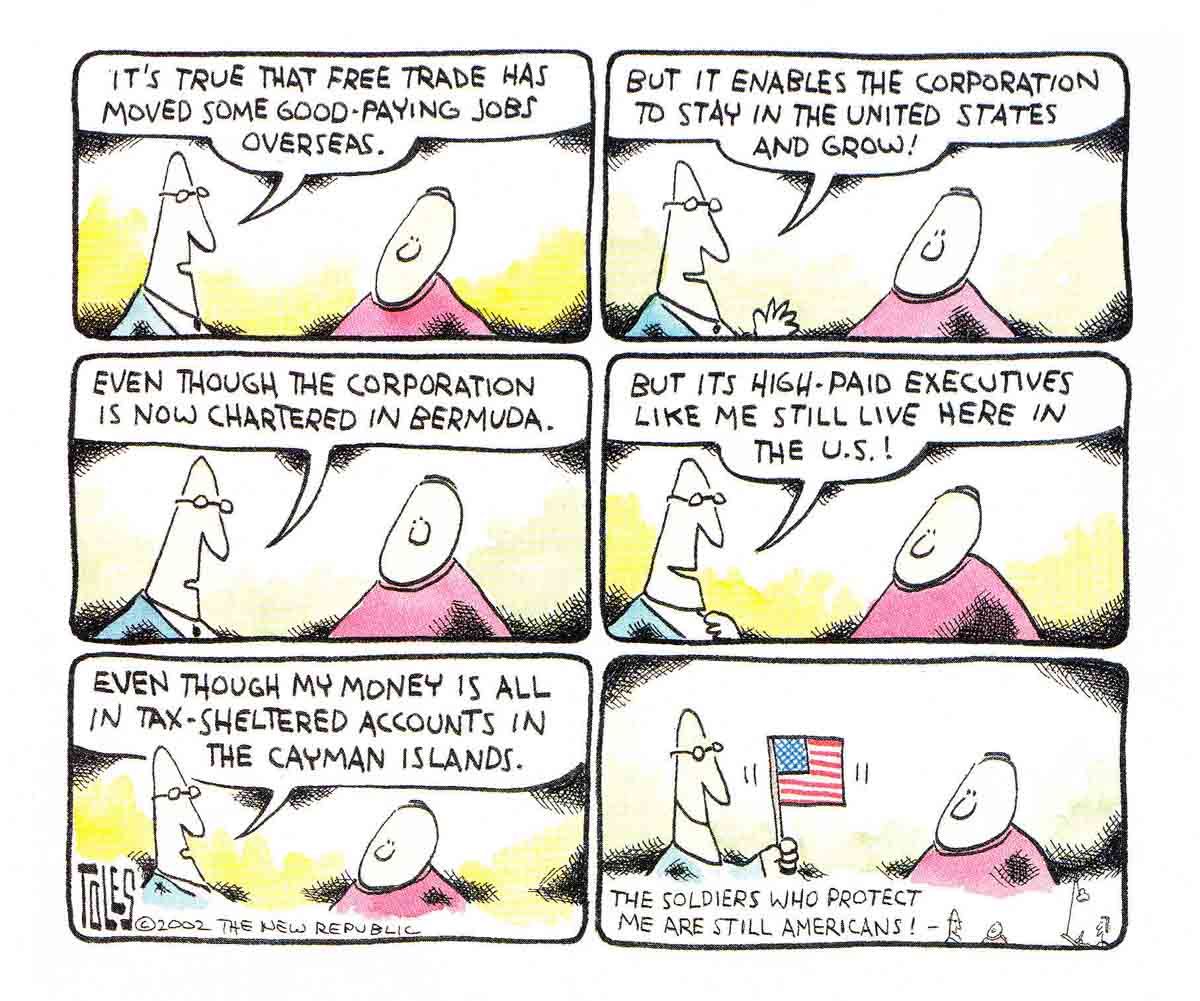
The transfer of jobs by a multinational corporation from its home country to other, lower-wage
countries. This term is popular in the bourgeois press in the United States where the transfer
of jobs to other countries usually means overseas countries, though many jobs have also
been shifted to Mexico. In the cartoon at the right, this offshoring is referred to under the more
general term, “free trade”, which often includes a lot of offshoring as a prelude to increased
trade between countries. (As production is shifted to other countries, a good part of the goods
produced then need to be imported back into the United States. However, if tariffs are too high,
and destroy “free trade”, it is then no longer profitable to shift production to other countries.
Thus offshoring and free trade are related and interdependent processes.)
A job is considered to be offshorable
if it would be both easy to transfer it to another country and profitable for the employer to
do so. According to an August 2009 study by two bourgeois economists, Alan Blinder and Alan
Krueger, despite all the jobs which have already been shifted out of the country, roughly
one out of four remaining U.S. jobs are offshorable. “Perhaps most surprisingly, routine work
is no more offshorable than other work.” Moreover, the jobs of well educated workers are
somewhat more likely to be offshorable than those of poorly educated workers.
See also:
RESHORING
OGALLALA AQUIFER
 See:
AQUIFER
See:
AQUIFER
OIL AND GAS FIELDS AND PIPELINES (U.S.)
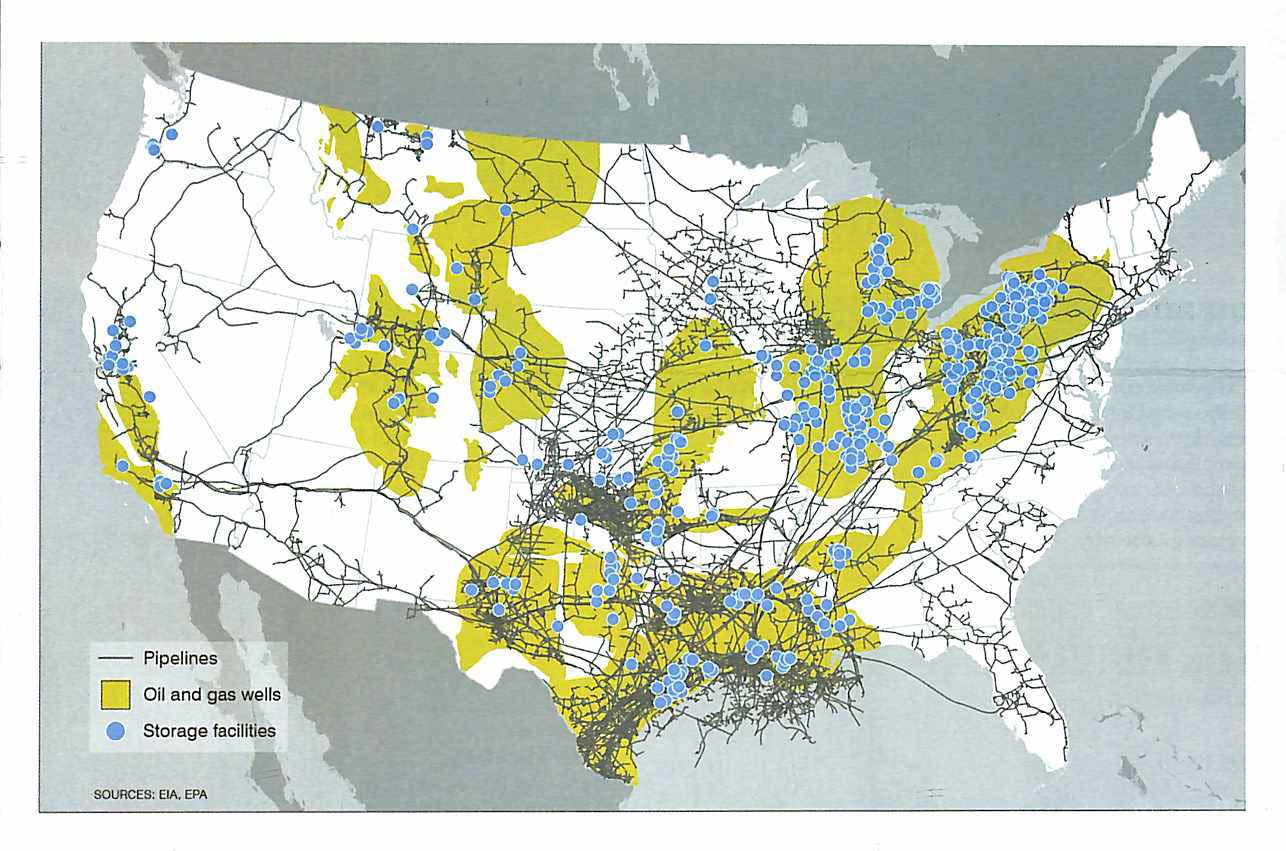
The map at the right (prepared by the liberal Environmental Defense Fund, c. 2016) shows the locations
in the United States of oil and gas fields, storage facilities, and pipelines. These very extensive
areas are of course extremely vulnerable to serious pollution due not only to major spills and other
accidents, but also through the very leaky and messy normal daily operations by the capitalist
corporations owning them, who care far more about their profits than they do about any harm to the
people or the planet. The EDF notes that “there are 1.3 million active oil and gas wells in the U.S.
and 305,000 miles of natural gas pipeline, and that 9.3 million metric tons of methane escape each
year. That is the same 20-year climate impact as more than 200 coal-fired power plants.”
OIL & GAS INDUSTRY — Productivity In
“The companies that extract, transport and process oil and gas employ roughly 25 percent fewer workers than they did a decade earlier when they were churning out less fuel, according to a Times analysis.” —New York Times, “For Oil Companies, More Production and Fewer Jobs”, January 28, 2025. [In other words, pretty much the same as in most other industries! —Ed.]
OIL PRICES
“As a rule of thumb, a $10 rise in the cost of a barrel of oil translates to a 24-cent rise in the cost of a gallon of gasoline.” —New York Times, National Edition, “After Fears of Recession, New Crises”, Oct. 4, 2024.
OIL WELLS
“As many as 3.9 million abandoned and aging oil wells dot the United States, according to the Environmental Protection Agency.” —New York Times, National Edition, May 28, 2024, p. 3.
“Scientists have found that abandoned oil wells, often called ‘orphaned’ wells, release methane, a powerful greenhouse gas that contributes to climate change, as well as benzene, a chemical linked to leukemia and other blood cancers.” —New York Times, “Facts of Interest”, November 1, 2025.
OKHRANA
The agency of the secret political police in Tsarist Russia,
which was formed in order to try to suppress and destroy the revolutionary movement. It hounded,
arrested, exiled, imprisoned or killed many thousands of revolutionaries. Although there were a
few well publicized assassinations of Tsars and Tsarist agents, overall the Okhrana was quite
effective until revolutionaries themselves began to use more sophisticated methods to secretly
organize themselves, and organize the working class to fight back, and until the conditions of
the masses became so extremely bad that even constant vicious police oppression could not keep
them from rebelling.
See also:
MALINOVSKY, Roman
OKISHIO THEOREM
A mathematics-based theorem in theoretical political economy, first formulated by the Japanese
Marxist/Neo-Ricardian economist Nobuo Okishio in 1961,
which does seem to show that, given some reasonable assumptions, the idea that there is a long-term
tendency for the rate of profit to fall [or TRPF] under capitalism, because of technological
change, is simply not correct. In his paper Okishio argued that “if the newly introduced technique
satisfies the cost criterion [i.e. if it reduces unit costs, given current prices] and the rate of
real wage remains constant”, then the rate of profit must increase, not only for that one
company, but for the industry and economy averages as a whole!
The Okishio Theorem itself has been proven
mathematically. But, as is often the case in science, the actual social implications,
economic and otherwise, that should be viewed as having been totally established by this proof are
still subject to dispute. If, as seems to be fairly plausible, this theorem demonstrates what it
claims to demonstrate, it either proves, or at least very strongly implies, that one of the
three theories that Marx advanced as being the basic cause of the recurring capitalist economic
crises, namely the “Falling Rate of Profit Theory”,
also cannot be correct. (Although there are plenty of other reasons to question the Falling Rate of
Profit Theory, even if the Okishio Theorem is eventually shown to be irrelevant.) However, the
Okishio Theorem has caused tremendous consternation among those who favor this explanation for
capitalist economic crises. The theorem may also have some consequences for the precise formulation
of the labor theory of value as well.
We should immediately note that, however valid the
Okishio Theorem actually is, Marx’s more basic explanation of capitalist economic crises in terms of
overproduction in comparison with market demand remains
completely valid. And similarly, the most essential aspects of the labor theory of value, arising
from the obvious fact that all wealth derives from human labor acting on the natural products of the
world around us, remain completely and absolutely true.
A more thorough discussion of the Okishio Theorem,
including its mathematics, Neo-Ricardian framework, and conditional assumptions, can be found on the
Wikipedia at:
https://en.wikipedia.org/wiki/Okishio%27s_theorem Excerpts from that article, focusing
on various Marxist (or pseudo-Marxist) reactions to the theorem, are given below.
“Okishio’s theorem ... has had a major impact on debates about Marx’s theory
of value. Intuitively, it can be understood as saying that if one capitalist raises his profits
by introducing a new technique that cuts his costs, the collective or general rate of profit in
society goes up for all capitalists. In 1961, Okishio established this theorem under the
assumption that the real wage remains constant. Thus, the theorem isolates the effect of pure
innovation from any consequent changes in the wage.
“For this reason the theorem, first proposed
in 1961, excited great interest and controversy because, according to Okishio, it contradicts Marx’s
law of the tendency of the rate of profit to fall. Marx had claimed that the new general rate of
profit, after a new technique has spread throughout the branch where it has been introduced, would
be lower than before. In modern words, the capitalists would be caught in a rationality trap or
prisoner’s dilemma: that which is rational from the point of view of a single capitalist, turns out
to be irrational for the system as a whole, for the collective of all capitalists. This result was
widely understood, including by Marx himself, as establishing that capitalism contained inherent
limits to its own success. Okishio’s theorem was therefore received in the West as establishing
that Marx’s proof of this fundamental result was inconsistent.
[BannedThought.net editorial insertion: While
if the ‘falling rate of profit’ notion is not correct, this does remove one reason for
thinking that capitalism is doomed, there are still many other reasons to strongly believe so,
including the fact that in the capitalist-imperialist era this socioeconomic system can no longer
resolve and end major depressions except through ever-more destructive world wars! This is a
consequence of Marx’s basic overproduction theory, rather than the falling rate of profit theory
for crises. —Ed.]
“More precisely, the theorem says that the
general rate of profit in the economy as a whole will be higher if a new technique of production is
introduced in which, at the prices prevailing at the time that the change is introduced, the unit
cost of output in one industry is less than the pre-change unit cost. The theorem, as Okishio points
out, does not apply to non-basic branches of industry.
“The proof of the theorem may be most easily
understood as an application of the Perron–Frobenius theorem. This latter theorem comes from a
branch of linear algebra known as the theory of nonnegative matrices. A good source text for the
basic theory is Seneta (1973). The statement of Okishio’s theorem, and the controversies surrounding
it, may however be understood intuitively without reference to, or in-depth knowledge of, the
Perron–Frobenius theorem or the general theory of nonnegative matrices....
“Some Marxists simply dropped the law of the
tendency of the rate of profit to fall, claiming that there are enough other reasons to criticize
capitalism, that the tendency for crises can be established without the law, so that it is not an
essential feature of Marx’s economic theory. Others would say that the law helps to explain the
recurrent cycle of crises, but cannot be used as a tool to explain the long term developments of
the capitalist economy....”
—Wikipedia (accessed on March 27, 2023).
“OKUN’S LAW”
An empirically derived rule of thumb in bourgeois economics that GDP growth must be at least
3% per year in order to reduce the prevailing rate of unemployment.
Another of the various formulations of the
“law”, known as the “gap version”, is that for every 1% increase in the unemployment rate a
country’s GDP will settle at roughly another 2% lower than its
“potential output”. This “law” was proposed by Arthur
M. Okun in 1962, and since then its reliability has often been disputed.
OLBERS’ PARADOX
The supposed “paradox” named after the German astronomer Heinrich Wilhelm Olbers in which the universe
was assumed to have an infinite number of stars, and therefore in which every single line of sight from
the Earth should eventually come to a star—and yet, because the sky is mostly dark at night, this
doesn’t seem to be the case.
For further discussion, see:
DARKNESS AT NIGHT
OLD AGE CARE WORK
“As jobs have shifted into areas like health care and retail, employers have
taken advantage of the permissive landscape. The part of the economy that is now expanding most
quickly is the work of caring for aging baby boomers. Half of the ten occupations projected to
add the most jobs in the United States by 2026 are different ways of saying ‘nurse.’ Those jobs
tend to be physically demanding and emotionally draining; they also tend to be poorly paid,
with meager benefits and little job security. The line of work projected to add the most jobs
over the next decade, ‘personal care aides,’ offered an average annual salary of $23,100 in
2016.
“If the iconic workplace of the midcentury
was an automobile factory that lifted its workers into the middle class, the microcosm of the
modern economy is a hospital staffed by a handful of highly paid physicians and a vast army of
poorly paid support staff.”
—Binyamin Appelbaum, The Economists’
Hour: False Prophets, Free Markets, and the Fracture of Society (2019), pp. 326-7.
OLD PEOPLE
Or, more euphemistically, “seniors”. Over the centuries, as medical science and social conditions have
at least in general improved, what counts as being “old” has gradually increased. Whereas someone aged
50 might centuries ago been considered old, they might now be viewed as merely “middle aged”.
See also:
AGING,
LIFE EXPECTANCY
“The proportion of people over age 65 living in poverty jumped to 14.1 percent last year from 10.7 percent in 2021 and 9.5 percent in 2020.” —New York Times, National Edition, Oct. 3, 2023, p. 3.
OLD REVOLUTIONARIES
“When you get old you want to teach.” —Maxim Gorky, quoted in Moissaye
Olgin, “Maxim Gorky: Writer and Revolutionist” (1933), p. 62.
[It is true that old revolutionaries do
often have a certain amount of hard-won wisdom to impart to younger people. But, more generally,
what old revolutionaries can and should do is the same as what they did when younger, though in
smaller and somewhat less frequent contributions as befits their reduced capabilities. —Ed.]
OLIGARCHY
Rule by the few, usually for their own corrupt and selfish purposes. Thus often, in
effect, rule by the few who are rich. Bourgeois society, whether in the form of
bourgeois democracy or
fascism, should be considered a type of oligarchy since
the ruling bourgeoisie is a tiny class relative to the
whole population.
OLIGOPOLY
Semi-monopoly, or a “looser form” of monopoly. In other words,
a situation where a small number of producers control the capitalist market for some
commodity, and limit their competition either in all respects (definitely including prices),
or—more commonly today because of the nominal anti-trust
laws—to areas of styling and advertising.
Lenin, when he talked about monopoly,
was really using the term in a way which would today better be called oligopoly.
(The word ‘oligopoly’ did not enter the English language until 1895 and even then at first
only in technical publications, and the Russian equivalent probably also did not exist
when Lenin was writing.)
ONE-CHILD POLICY (in China)
The Chinese government policy restricting most urban families to just one child. This policy
was introduced in 1978-79, after the Mao era, and by 2016 is finally being gradually phased
out. The government said that as of 2015 35.9% of the population was subject to this
one-child limit per family (with most of the rest being subject to a two-child limit). It
estimated that without this policy there would have been 250 million more babies born by the
year 2000.
At the time of the establishment of the
People’s Republic of China in 1949, Mao and the other revolutionary leaders initially viewed
having a large and rapidly growing population as an asset. But this opinion soon changed and
in August 1956 the Ministry of Public Health began vigorously supporting mass birth control
efforts. However, the fertility rate remained high, and after a few years a new campaign to
encourage later marriage and a lower birth rate was implemented. During the period of 1963-66
this cut the birth rate to half its previous level.
For a few years, with the advent of the
Great Proletarian Cultural Revolution, the more urgent matter of
which class would control society became preeminent. But in 1972-73 the People’s government
began a new nationwide birth control campaign. In the countryside the
“barefoot doctors” distributed birth control information
and contraceptives to the members of the people’s communes. In the mid-1970s the government
recommended that the maximum family size should be 2 children in urban areas and 3 or 4 in
the countryside. Mao himself was personally identified with the family planning movement at
this time. Still, the means used while Mao was alive was generally the
mass line method of democratic persuasion, and not one of
enforcement of small family size through fines or other penalties.
Once the revisionists seized control and
began to move the country back into capitalism, the whole point of family planning changed.
It was no longer a matter of how best to improve the welfare of all the people, but
rather of promoting the expansion of capitalist production as fast as possible and promoting
the growth of the economic and political power of the new bourgeoisie. What desire remained
to promote improved living standards for the masses was mostly for the purpose of keeping
them from challenging the new capitalist ruling class. And the methods used to promote
family planning became much more bureaucratic, legalistic and even authoritarian.
While education and social pressure are still
also used to promote the one-child policy, there are now considerable economic penalties
for violators, and sometimes strong coercion, including even forced abortions and
sterilizations. Moreover, the manner in which the policy has been implemented has led to many
cases of female infanticide. The traditional backward desire of Chinese families (especially
in rural areas) for a male heir, which has led to these problems, has not been sufficiently
combatted by educational campaigns, and this is now resulting in a growing disproportionate
shortage of women in Chinese society.
While the goal of promoting a low birth
rate in China, just as elsewhere in the world, is laudable, the manner in which the one-child
policy has been implemented cannot be supported. Somewhat surprisingly, a fairly large
majority of people in China do support the policy (one poll around 2008 claimed that 76% do),
though there also seem to be growing numbers of those ignoring it. Most interestingly of all,
there are now suggestions by bourgeois economists in both China and overseas, that this
one-child policy is no longer in the interests of Chinese capitalism. The idea is that it
“unduly” limits the growth of the cheap labor supply and the size of the domestic market, and
also leads to an aging population which on average consumes less. This appears to be a major
factor in why the policy is now being phased out.
In the fall of 2013 the one-child policy was
slightly weakened. Previously married couples, both of whom were a single child, were allowed
to have two children. Now, if just one of them was a single child, they are allowed to have
two children. In 2015 the “one-child policy” was weakened much more and will probably be
completely replaced by a universal “two-child” policy soon.
[Some of the information in this entry comes
from the Wikipedia.]
“China’s birth rate on the rise
“China’s birth rate rose last year
to its highest point since 2000, following the relaxation of the country’s one-child
policy in 2015. There were 17.86 million births in China last year, a 7.9% increase
from 2015.” —Time magazine, Feb. 6, 2017, p. 12.
ONE-DIVIDES-INTO-TWO STRUGGLE (In Maoist China)
The “One Divides into Two” controversy (一分为二) was a philosophical struggle in China beginning in
1964 over opposing ideas about how dialectical
contradictions develop and resolve themselves. The proper way to understand this specific point is
that of Lenin and Mao (see the separate One-Into-Two entry below). However,
the nominally (but phony) Marxist philosopher Yang Xianzhen in China came up with the erroneous notion that
the primary law of dialectics is that “Two Unite into One” (or “Two Combine into One”). Or, in other words,
that development supposedly proceeds through the peaceful unification of the dialectical opposites. This
is directly opposed to the Leninist and Maoist conception of “one dividing into two” and with one aspect of
a contradiction overpowering the opposing aspect. Yang’s notion was clearly anti-dialectical. Worse yet,
it can be, and was, used to support a number of reactionary and pro-capitalist ideas, such as that class
struggle should be minimized or abandoned in contemporary socialist society, and that capitalist economic
measures can be used to “build socialism”. The “Two Unite into One” idea, therefore, was very popular with
the capitalist roaders.
The fine Maoist philosopher Ai
Siqi launched a powerful attack on Yang Xianzhen’s reactionary conception, and was soon followed by Mao
himself. Numerous other critics of Yang then came forward, and his theory was completely rejected by the
Communist Party of China while Mao was alive.
Yang Xianzhen was rehabilitated by the capitalist roaders
after their coup d’état following Mao’s death, and his “two unite into one” perversion of “Marxist
dialectics” was wholeheartedly embraced.
For a large number of contemporary articles (in both English
and Chinese) about this struggle in Maoist China, and its aftermath, see:
http://marxistphilosophy.org/ChinTrans1221.htm
“Richard Baum has put the [one-divides-into-two] controversy in terms of modern game
theory as a debate between zero sum and non-zero sum competition. Alain Badiou during his Maoist phase
would use the principle of One Divides into Two to criticize the philosophy of Gilles Deleuze.”
—Wikipedia article on “One_Divides_into_Two” (as of June 29, 2020).
[Baum is a bourgeois Sinologist, and his absurd
“interpretation” of the One Divides into Two struggle is a typical example of their distortions. The
off-the-wall use of Maoist phrases by Badiou to attack other French idealist philosophical phonies is
even more bizarre! —Ed.]
ONE-INTO-TWO
A core viewpoint in dialectics, which sums up two main
principles: 1) Everything in the world is in reality a unity of opposites, or (dialectical)
contradiction of opposing forces; and
2) Development consists of the dialectical resolution of such
contradictions, or in other words, in the splitting of this unity, and the triumph of one
opposing aspect over the other, thus transforming the basic nature of the original entity.
See also:
ONE-DIVIDES-INTO-TWO STRUGGLE above.
“The splitting of a single whole and the cognition of its contradictory
parts ... is the essence (one of the ‘essentials,’ one of the principal, if not
the principal, characteristics or features) of dialectics. That is precisely how Hegel,
too, puts the matter...
“The correctness of this aspect of
the content of dialectics must be tested by the history of science. This aspect of
dialectics (e.g., in Plekhanov) usually receives inadequate attention: the identity of
opposites is taken as the sum-total of examples ... and not as a law of
cognition (and as a law of the objective world)....
“The identity of opposites (it
would be more correct, perhaps, to say their ‘unity,’—although the difference between
the terms identity and unity is not particularly important here. In a certain sense both
are correct) is the recognition (discovery) of the contradictory, mutually exclusive,
opposite tendencies in all phenomena and processes of nature (including mind
and society). The condition for the knowledge of all processes of the world in their
‘self-movement,’ in their spontaneous development, in their real life, is the
knowledge of them as a unity of opposites. Development is the ‘struggle’ of opposites....
“The unity (coincidence, identity,
equal action) of opposites is conditional, temporary, transitory, relative. The struggle
of mutually exclusive opposites is absolute, just as development and motion are absolute.”
—Lenin, “On the Question of Dialectics” (1915), LCW 38:359-360.
“ONE PERCENT” or “THE ONE PERCENT”
A term introduced by the recent Occupy Movement in the U.S. to
refer to the class of very rich people who run the country. It is, in short, a euphemism for
the bourgeoisie. However, in the U.S. the level of class consciousness is so abysmally low that
Marxist terminology (such as the bourgeoisie or even the capitalist class) is
either not understood by most people, or else often sounds to their ears like “obsolete” or
“politically suspicious” jargon! In this situation, the introduction of a new term for the
bourgeoisie was in fact quite useful! Of course, it is up to us Marxists to further explicate
rather vague terms such as “the one percent” and to get people to understand and get used to the
terminology that has been developed in our revolutionary science of Marxism-Leninism-Maoism.
See also:
MILLIONAIRES
ONE-SIDEDNESS
See:
POSITIVE AND NEGATIVE
ONE STEP FORWARD, TWO STEPS BACK [Lenin]
Important 1904 political pamphlet by Lenin focusing on the appropriate organization and line
of a revolutionary communist political party.
“This book is of key importance in establishing the principles of
organization of the Communist Party. It was written in 1904 following the 2nd Congress
of the Russian Social Democratic Labor Party—the Congress at which the split between
the Bolsheviks and Mensheviks first showed itself.
“In order to understand this book
and its background, the reader should consult the History of the Communist Party of
the Soviet Union, Chapter II, Sections 3 and 4. At the 2nd Congress in 1903, two
opposed groups became apparent in the Russian Social Democratic Labor Party, revolutionary
and opportunist. After the adoption of the Party Programme there took place a dispute
over the Party Rules. Lenin and his followers held that there should be three conditions
for party membership:
(1) Acceptance
of the programme.
(2) Payment of
dues.
(3) Belonging
to a party organization.
His opponents held that condition (3) was not necessary.
“At the end of this Congress the
followers of Lenin gained a majority on the Central Committee and on the Editorial Board
of the party newspaper Iskra. They therefore became known as the Bolsheviks—from
the Russian word meaning ‘Majority’—while the others were known as Mensheviks—from the
Russian word for ‘Minority.’ But afterwards the Mensheviks managed to capture Iskra
and began an attack on the party organization, which they declared was too ‘rigid.’ They
wanted ‘liberty’ for individuals not to obey party decisions. The opportunists thus began
their operations by an attack on the principles of party organization.
“Lenin recognized that this attempt
to weaken the party organization was a prelude to imposing opportunist policies on the
party concerning the major political issues. In One Step Forward, Two Steps Back,
after analyzing the proceedings and the votes at the 2nd Congress, and demonstrating the
existence of two wings—a revolutionary and an opportunist wing—Lenin shows the need for
a disciplined centralized party of the working class.”
—Readers’ Guide to the Marxist
Classics, prepared and edited by Maurice Cornforth, (London: 1953), p. 48.
“ONTOGENY RECAPITULATES PHYLOGENY”
[‘Ontogeny’ means “the development of an individual organism”; ‘phylogeny’ means “the
evolutionary history of a certain kind of organism”.]
This idea, which the 19th century
semi-materialist naturalist Ernst Haeckel called his “biogenetic law”, is basically that the
embryological development of an individual creature is a recapitulation of the stages of
the historical evolution of that species. Thus early embryos of humans and other mammals have
gills and a fish-like tail recalling their ancient fish ancestry. Modern biological science,
however, considers the idea that ontogeny recapitulates phylogeny to be sort of a very crude
and very limited partial truth.
“There is in fact a peculiar correspondence between the gradual development of organic germs into mature organisms and the succession of plants and animals following each other in the history of the earth.” —Engels, Anti-Dühring (1878), MECW 25:69.
“The same phenomenon is illustrated by the gill arches that still dominate the ontogeny of land-living vertebrates. It is obvious in all these cases that development is controlled by such a large number of interacting genes that the selection pressure to eliminate vestigial structures is less effective than the selection to maintain the efficiency of well established developmental pathways.” —Ernst Mayr, Toward a New Philosophy of Biology: Observations of an Evolutionist (1988), p. 435.
ONTOLOGICAL ARGUMENT [For the Existence of God]
The (fallacious) argument that God must exist as a consequence of the very definition
of the word ‘God’. Spelled out more completely:
God is, by definition, a totally perfect
entity. An entity would be less than perfect if it did not exist. Therefore, God exists.
This silly argument was originated by “Saint”
Anselm (1033-1109), Bishop of Canterbury and medieval Scholastic
philosopher. Even most other theologians (including Thomas
Aquinas) have recognized that this argument cannot be accepted as sound.
In Anselm’s own day it was pointed out that
just because we can form the concept of a “perfect island” it does not follow that a perfect
island really exists. No definition of anything can prove that that thing actually
exists in the real world. You can define a “round-square” as a Euclidean two-dimensional
geometrical figure which is both round (a circle) and at the same time a square,
but no such thing can really exist. Moreover, the notion that any real thing can be “perfect”
in every way is totally incoherent. Even if it makes any sense to say that something is
“perfectly smooth” or “perfectly rough”, it cannot possibly be both at the same time. In other
words, some forms of “perfection” preclude other forms. And there are many other conceptual
and logical problems with each of the numerous versions of the ontological argument.
ONTOLOGY
1. The branch of metaphysics
(in the non-Marxist sense) which discusses the nature of existence or reality in the abstract, what sort
of entities actually may be said to exist, and so forth.
2. [More narrowly, but still usually within the milieu
of bourgeois philosophy:] The set of entities or substances which are said to exist. The
dualist’s “ontology”, for example, includes not only matter
but also—independent of matter—mind and possibly “spiritual substances” (such as “souls”
or “gods”). The materialist’s “ontology” includes only matter and energy (or “matter in motion”); and mental
phenomena are viewed as functional characterizations of certain highly complex material entities (e.g., brains)
as they change and internally reorganize.
Thus, in both of these senses, the term ontology is
an absurdly esoteric and pretentious way of talking about the central question of philosophy, namely, what
sort of things actually exist, and which is fundamental—mind or matter.
[From an obituary for the Jamaican-raised American philosopher, Charles W. Mills (1951-2021):] “Rigorous, and persuasive, his work was also free of the jargon and obscurantism that bedevils so much of modern philosophy. He could also be disarmingly funny, often poking fun at himself or his profession. ‘If you are a member of the American Philosophical Association and you don’t use the word ontology in a talk, there’s someone from the A.P.A. sitting in the back of the room and your membership card will be yanked,’ he quipped.” —Clay Risen, “Charles W. Mills, 70, Philosopher of Race and Liberalism, Is Dead”, New York Times, National Edition, Sept. 29, 2021.
“OPEN AND ABOVE-BOARD”
See also:
DOUBLE-DEALING
“The case of Kao Kang and Jao Shu-shih serves as an important lesson for our Party, and all the members should take warning and make sure that similar cases will not recur in the Party. Kao Kang and Jao Shu-shih schemed and conspired, operated clandestinely in the Party and surreptitiously sowed dissention among comrades, but in public they put up a front to camouflage their activities. These were precisely the kind of vile activities the landlord class and the bourgeoisie usually resorted to in the past. In the Manifesto of the Communist Party Marx and Engels say, ‘The Communists disdain to conceal their views and aims.’ As Communists, let alone as senior Party cadres, we must all be open and above-board politically, always ready to express our political views openly and take a stand, for or against, on each and every important political issue. We must never follow the example of Kao Kang and Jao Shu-shih and resort to scheming.” —Mao, “Speeches at the National Conference of the Communist Party of China: Opening Speech” (March 21, 1955), SW 5:156.
OPEN DOOR POLICY
1. A policy (or goal) of early United States
imperialism toward China, which sought to keep U.S. trade and general economic access to China
and other areas open on an equal basis with other imperialist countries. In the late 19th
century the major imperialist powers started grabbing more and more parts of the undeveloped
world—especially in Africa—to be their own private colonies which they alone were allowed to
exploit (or at least in which they had many special privileges). The United States, as a
later-developing imperialist country, was very concerned that it was being frozen out of more
and more regions. In 1899 the U.S. Secretary of State John Hay sent a diplomatic note, referred
to as the “Open Door Note”, to the European powers proposing that China be kept open to trade
with all other countries on an equal basis. In other words, all of them (including the U.S.)
would be allowed to exploit China on equal terms. Thus no imperialist power should have any new
special areas of influence or control in China which the other imperialist powers did not share,
nor any unilateral agreements with or favors forced out of the Chinese government for that
power’s exclusive benefit. The stated areas of concern were the development special tariff
arrangements, the elimination or reduction of harbor dues and railroad charges for one power
alone, and similar things. But the overall scope of the Open Door Policy went far beyond
this.
As it turned out, U.S. imperialism at that time
was largely unable to achieve their “Open Door” goal. There were numerous secret deals being
forced on China by separate imperialist powers; existing forced arrangements, let alone existing
territorial seizures (such as by Britain in Hong Kong and by Portugal in Macao) were not ended;
and worst of all Japan totally flouted the “Open Door” principle beginning with its seizure of
Manchuria in 1931, and its later massive invasion of China from 1937 until the end of World
War II.
In history classes in the U.S. the “Open Door”
policy is portrayed as being “opposed” to imperialism—because it was opposed to individual
imperialist powers carving up China into colonies, and the like. Actually, this policy was more
like an early indication of a new form of imperialism that the United States would later
lead in establishing in the world following World War II. What the U.S. was already pushing,
even in the 1890s was a new neocolonialist
World Imperialist System.
2. Similar policies or goals by the U.S. or
other imperialist powers at various times and places, when they thought they were being blocked
by their imperialist competitors in exploiting some country or region of the world.
3. Occasionally the term “open door” is also used
to refer to the policy adopted by the Chinese capitalist-roaders led by Deng
Xiaoping in the 1980s to “open up” China to foreign investment.
OPEN-SOURCE SOFTWARE
Computer software which is written mostly by unpaid volunteer labor
and which is made freely available for anyone to use, often with only the condition that any
improvements made to it must then also be made available free for others to use. Writing and using
open-source software appeals to many people, whether or not they understand from a political
perspective that this more or less arises from natural human creative and communist impulses. (Many
workers, and not just software writers—and even though they must of course have some means of surviving
economically—are often really more interested in collectively producing useful things for people than
they are in getting rich in the process.)
Open-source software has been impressively successful
even in the present capitalist world. However, capitalist corporations have found a way to make
profits even from free software by selling support services for it, and the like.
“To the average capitalist ‘open source’ software may seem like a pretty odd
idea. Like most products, conventional computer software—from video games to operating systems—is
developed in secret, away from the prying eyes of competitors, and then sold to customers as a
finished product. Open-source software, which has roots in the collaborative atmosphere of
computing’s earliest days, takes the opposite approach. Code is public, and anyone is free to
take it, modify it, share it, suggest improvements or add new features.
“It has been a striking success. Open-source
software runs more than half the world’s websites and, in the form of Android, more than 80% of
its smartphones. Some governments, including Germany’s and Brazil’s, prefer their officials to
use open-source software, in part because it reduces their dependence on foreign companies. The
security-conscious appreciate the ability to inspect, in detail, the goods they are using. It is
perfectly compatible with making money. In July IBM spent $34 billion to buy Red Hat, an American
maker of a free open-source operating system [Linux], which earns its crust by charging for
ancillary services like customer support and training.”
—“Open Season: The rise of open-source
computing is good for competition—and may offer a way to ease the tech war”, leader (editorial)
in The Economist, Oct. 5, 2019, p.13.
OPERATION GREEN HUNT
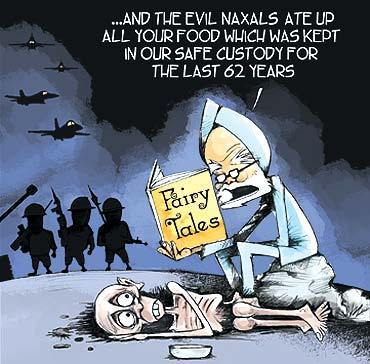 A large-scale anti-Maoist military campaign launched in the fall of 2009 by the Indian central
government together with the paramilitary forces of several states in India, and expected to
last for at least several years. The initial military operations began around Nov. 1, 2009, and
much larger operations are expected in the first months of 2010. A major focus of OGH is in
the Adivasi (tribal) areas in east-central India, where the
Communist Party of India (Maoist) has made much progress in organizing and leading the people
in mass struggles in resistance to the theft and despoilation of their land by giant mining
companies and other Indian and transnational corporations. In effect, OGH is aimed as much at the
Adivasi masses as it is at their Maoist leadership; it is in reality a war by the Indian government
against its own people.
A large-scale anti-Maoist military campaign launched in the fall of 2009 by the Indian central
government together with the paramilitary forces of several states in India, and expected to
last for at least several years. The initial military operations began around Nov. 1, 2009, and
much larger operations are expected in the first months of 2010. A major focus of OGH is in
the Adivasi (tribal) areas in east-central India, where the
Communist Party of India (Maoist) has made much progress in organizing and leading the people
in mass struggles in resistance to the theft and despoilation of their land by giant mining
companies and other Indian and transnational corporations. In effect, OGH is aimed as much at the
Adivasi masses as it is at their Maoist leadership; it is in reality a war by the Indian government
against its own people.
Many news articles about OGH, background
articles, and statements of opposition to the campaign, can be found at the following websites:
https://www.bannedthought.net/India/MilitaryCampaigns/
— BannedThought.net page on Military Assaults on Revolutionaries and People’s Movements in
India
OPERATION PAPERCLIP
The secret U.S. government program after World War II which brought German Nazi scientists to the
the U.S. to work on military projects for U.S. imperialism in its Cold War against the Soviet Union.
The role of these German scientists during the WWII, mostly quite fervently in support of Nazism,
and which amounted to outright mass murder, was conveniently “overlooked” and forgotten. The most
well-known example of these Nazi scientists was the rocket expert Wernher von Braun, who despite his
Nazi Party membership and his personal involvement in the literal enslavement of workers and the
deaths of at least thousands of them (not to mention the greater number of thousands that his
rockets killed), was transformed into an “American hero” by the U.S. ruling class as part of their
Space Program.
See also:
FREEDOM OF INFORMATION ACT [Jacobsen quote]
“[I]n the aftermath of the German surrender more than sixteen hundred of
Hitler’s technologists would become America’s own....
“Under Operation Paperclip, which began
in May of 1945, the scientists who helped the Third Reich wage war continued their
weapons-related work for the U.S. government, developing rockets, chemical and biological
weapons, aviation and space medicine (for enhancing military pilot and astronaut performance),
and many other armaments at a feverish and paranoid pace that came to define the Cold War.”
—Annie Jacobsen, Operation Paperclip: The Secret Intelligence Program that Brought Nazi
Scientists to America (2014), p. ix.
OPERATION SPLINTER FACTOR
A Cold War era intelligence operation of the Office of
Policy Coordination of the U.S. State Department designed to sow unfounded suspicion, disunity
and disruption, within the International Communist Movement and the Soviet Bloc, in particular. It
had some considerable success in this effort, partly because of the excessive suspiciousness of
people by Joseph Stalin.
The OPC, despite its bland name, was a secret
“black ops” agency engaged in nefarious activities of the sort which later characterized the CIA.
Starting around 1949, under the instigation of Allen Dulles, Frank Wisner and their associates,
the OPC secretly led Soviet agents and other Communists in Europe to believe that some Communists
or friends of the Soviet Union, were actually American spies. (Some of them had in fact met Allen
Dulles, though they were by no means working for him.) Among the individuals who were
“snitch-jacketed” in this way was Noel Field, a pacifist
Quaker who was an antifascist and sympathetic to the Soviet Union. Field was then lured to Prague
in Soviet-controlled Czechoslovakia with the offer of a teaching job. He was then secretly
arrested by the authorities there and taken to a prison in Hungary and tortured. Meanwhile Noel
Field’s disappearance alarmed his wife Herta and his brother Hermann, who went to Czechoslovakia
to search for him. They too were arrested and tortured. Finally, a young German friend of the
Field family, Erica Wallach, who had been rescued by them during World War II and sort of adopted
into their family, also went to search for the Fields, and after asking for information from the
political authorities in East Berlin she too was arrested, harshly interrogated, and sent off for
five years to first Berlin’s Schumannstrasse Prison and then to the Vorkuta prison labor complex
in the Soviet Arctic wastelands. It was only after Stalin’s death that these people were freed,
and apologies given to them. Many other people were victimized in similar ways, and the disruption
to the world revolutionary movement was quite serious.
“Operation Splinter Factor succeeded beyond the OPC’s wildest dreams. Stalin became convinced that the Fields were at the center of a wide-ranging operation to infiltrate anti-Soviet elements into leadership positions throughout the Eastern bloc. The Dulles-Wisner plot aggravated the Soviet premier’s already rampant paranoia, resulting in an epic reign of terror that, before it finally ran its course, would destroy the lives of untold numbers of people. Hundreds of thousands throughout Eastern Europe were arrested; many were tortured and executed. In Czechoslovakia, where nearly 170,000 Communist Party members were seized as suspects in the make-believe Field plot, the political crisis grew so severe that the economy nearly collapsed.” —David Talbot, Devil’s Chessboard: Allen Dulles, the CIA, and the Rise of America’s Secret Government (2015), p. 155. [Talbot is an anti-communist liberal, and it is possible that he is exaggerating things here, at least with regard to the role of the Field family specifically in all this. Nevertheless the story he tells in chapter 7 of this book is hair-raising indeed. —S.H.]
OPINION
“1. A view, judgment, or appraisal formed in the mind of someone about a particular matter; or 2. A
belief stronger than an impression and less strong than positive knowledge.” [Merriam Webster’s
Collegiate Dictionary, 10th Ed. (1993)]
While everyone has a large number of opinions about
lots of different things, there is a strong tendency for people in present-day bourgeois society to
disapprove of anyone having non-standard opinions particularly in certain special areas, such as with
regard to religion or politics. Thus Christians are often offended by the opinion of atheists (or
adherents of other religions) that their Christian views are anti-scientific nonsense. Despite the
often expressed remark that others “have a right to their own opinion”, many people in this society
do not really believe this. Similarly, some individuals who are deeply indoctrinated with bourgeois
points of view, think that revolutionaries have no real right to their opinion that the people should
rise up and overthrow the capitalist system, let alone the right to publicly express that
opinion!
But what about us Marxists? (We are speaking of real
Marxist-Leninist-Maoists, of course, not revisionist phonies!) Do we really believe that those who
disagree with us have a right to their own opinion? Well, certainly for those among the working
class and masses, yes we do! And we also uphold the right of members of the proletariat and of the
masses to publicly express their opinions, even when they disagree with us! Indeed, we really want
to hear those negative opinions and criticisms (along with their progressive and revolutionary opinions),
and to really get to know them. It is a major task of the members of the revolutionary party to gather
the actual ideas and opinions of the masses, and to transmit them to the party leadership. All
their widespread ideas, both progressive and backward.
Party members and supporters themselves will naturally
put forward revolutionary ideas and opinions to the masses and struggle against what we see as backward
or incorrect views that we sometimes hear from them. But we are determined to support the democratic
rights of the working class and masses to have and express their opinions, whatever they might be.
As for the enemy in socialist society, the remaining
capitalists and proven enemies of socialism, they too will have a right to their own opinions, and we
would like to know what they are too! But under the dictatorship of the proletariat, those reactionary
elements will not have the right to broadly spread their reactionary ideas among the masses, as they
always do in present-day capitalist society. —S.H. [June 27, 2025]
“One should not be drawn to new opinions, that is, those that one has discovered. [Instead] one must adhere to the old and generally accepted opinions ... and follow the true and sound doctrine.” —Benito Pereira, theologian of the Collegio Romano, 1564. Quoted in Amir Alexander, Infinitesimal, (NY: Scientific American, 2014), p. 55. [Not only do religious reactionaries want to suppress revolutionary ideas and opinions, they even want to suppress any other new or different opinions even from within their own ranks! —S.H.]
OPINION POLLS
See:
AMERICAN INSTITUTIONS — Public Support For,
CONGRESS (U.S.)
OPIOID ADDICTION CRISIS [U.S.]
See also:
FENTANYL
“America is battling a massive epidemic of heroin and its pharmacological substitutes. By 2008 drug overdoses, mostly from opioids, overtook car crashes as the leading cause of accidental death. In a related development, the number of annual users of heroin jumped from 370,000 in 2007 to 780,000 in 2013.” —“America’s Opioid Problem: Poppy Love”, The Economist, Aug. 1, 2015, p. 72.
“In the last two decades, more than 500,000 Americans have died from overdoses of prescription and illegal opioids.” —New York Times, “15 States Sign On to the Deal for the $4.5 Billion Settlement With Major Opioid Maker”, July 9, 2021.
“Between 1991 and 2012, at the height of the prescription phase of the opioid crisis in the United States, doctors were prescribing enough opioids for every American adult to get their own bottle of pills.” —New York Times, “Opioid v. Opioid”, The Magazine, p. 30, February 16, 2025.
OPIUM — and Religion
See also: OPIUM WARS
entry below. For Marx’s comment about religion being “the opium of the people”, see the entry
RELIGION—As a Palliative
“Jardine Matheson and Co. had become the biggest opium house in Canton, but they did not let matters rest there. Instead they sent ships up the China coast looking for new markets. The clippers, with a broadside of four or five guns port and starboard and a heavy gun amidship, were more formidable than any naval force the Emperor might put against them. They sailed up the Kwangtung and Fukien coasts to Amoy and Foochow, where they would be able to sell opium, often accompanied by Protestant missionaries who acted as interpreters for the captain and crew. The missionaries, obsessed with the printed word of God, would dispense versions of the Bible awkwardly translated into Chinese from one side of the ship while opium was sold from the other side. Christ, however, did not prove to be as irresistible as opium.” —Possibly taken or derived from John Fairbank, Trade and Diplomacy on the Coast: The Opening of the Treaty Ports, 1842-1854 (1969).
OPIUM WARS
Two imperialist wars of British imperialism against China during the 19th century which (among
other crimes) forced China to allow British traders to import opium into China and sell it there.
The first Opium War was in 1839-1842 and the second in 1856-1858. British Foreign Secretary
Lord Palmerston sent British troops to compel China to accept the import of opium against its
strenuous objections, and 20,000 Chinese soldiers were killed by the British in the war that
followed. These Opium Wars led to the introduction of the term “gunboat diplomacy” to describe
the forced compliance of “Third World” countries to the demands
of the imperialist powers.
A good short introduction to this sordid
imperialist history is the article “The Opium War”, by C. Clark Kissinger, in the Revolutionary
Worker, #734, (Dec. 5, 1993), page 11, available online at:
https://www.bannedthought.net/USA/RCP/RW/1993/RW734-English.pdf, and an excellent more
extensive history is the book The Opium War, History of China Series, (Peking: FLP, 1976),
149 pages, online at:
https://www.bannedthought.net/China/MaoEra/History/TheOpiumWar-FLP-1976.pdf [PDF format:
6,768 KB]
“The collective white man had acted like a devil in virtually every contact he had with the world’s collective non-white man. The blood forebearers of this same white man raped China at a time when China was trusting and helpless. Those original white ‘Christian traders’ sent into China millions of pounds of opium. By 1839 so many of the Chinese were addicts that China’s desperate government destroyed 20,000 chests of opium. The first Opium War was promptly declared by the white man. Imagine! Declare war upon someone who objects to being narcotized!” —Malcolm X, quoted in C. Clark Kissinger, “The Opium War”, op. cit. [This comment by Malcolm X brings out the racist aspect of this outrageous imperialist crime. —Ed.]
OPPORTUNISM [Marxist-Leninist senses]
1. The political line and activity of an individual,
group of people, or a political party who, though claiming that they are revolutionaries
working to overthrow capitalism, in reality only work for some of the short-term interests
of the proletariat in achieving reforms. In other words, in its most common usage, opportunism
pretty much means the same thing as reformism.
2. A type of revisionism
within MLM parties, whose essence is well summed up by Lenin in the following quotations:
“The idea of class collaboration is opportunism’s main feature....
“Opportunism means sacrificing the
fundamental interests of the masses to the temporary interests of an insignificant minority of
the workers or, in other words, an alliance between a section of the workers and the bourgeoisie,
directed against the mass of the proletariat.” —V. I. Lenin, “The Collapse of the Second
International”, section VII, (May-June 1915), LCW 15.
“The opportunist does not betray his party, he does not act as a traitor, he does not desert it. He continues to serve it sincerely and zealously. But his typical and characteristic trait is that he yields to the mood of the moment, he is unable to resist what is fashionable, he is politically short-sighted and spineless. Opportunism means sacrificing the permanent and essential interests of the party to the momentary, transient and minor interests.” —V. I. Lenin, “The Russian Radical is Wise After the Event” (Oct. 18, 1906), LCW 11:239.
“Once again [Alexander] Parvus’ apt observation that it is difficult to catch an opportunist with a formula [or mutually agreed-upon political statement] has been proved correct. An opportunist will readily put his name to any formula and as readily abandon it, because opportunism means precisely a lack of definite and firm principles.” —V. I. Lenin, What Is To Be Done? (Feb. 1902), Appendix, LCW 5:525.
“Opportunism does not extend recognition of the class struggle to the cardinal point, to the period of transition from capitalism to communism, of the overthrow and the complete abolition of the bourgeoisie.” —V. I. Lenin, “The State and Revolution” (Aug.-Sept. 1917), chapter II, section 3; LCW 25:412.
“Opportunism is our principal enemy. Opportunism in the upper ranks of the working-class movement is not proletarian socialism, but bourgeois socialism. Practice has shown that persons active in the working-class movement who adhere to the opportunist trend are better defenders of the bourgeoisie than the bourgeois themselves.” —V. I. Lenin, “Report on the International Situation and the Fundamental Tasks of the Communist International”, delivered at the Second Congress of the Communist International, July 19, 1920.
See also: LENIN—On Opportunism and its Roots in the Labor Movement
OPPOSITES — Unity Of
See: UNITY OF OPPOSITES
OPTION (Capitalist Finance)
A security (or transferable contract) allowing (but not obligating) the holder to buy or sell
something (such as uniform bulk commodities, currencies, or other securities, most commonly
shares of stock) at a future time and at a pre-agreed price. In the U.S. options can be
exercised at any time up until a specified date, whereas the European type of options can
only be exercised on the specified date itself. A “put”, or “put option”, gives the holder
the right to sell the share (or other thing) at the pre-agreed price, while a “call”,
or “call option”, gives the holder the right to buy at the pre-agreed price.
Bourgeois economists try to justify the
existence of options and options trading by pointing out that they allow the possibility of
a type of insurance for companies that must hold real assets
at the present time (and want to insure against their loss of value over time), or for
companies which must buy assets later (e.g., a manufacturing company that must buy steel six
months from now and does not want to be surprised by a huge increase in the price of steel
at that time). It is true that the judicious use of options can have this result. However,
the great preponderance of the buying and selling of options is not done for insurance
purposes, but simply as a form of speculation. Options exist primarily to facilitate
speculation and gambling. And this serves to further destabilize the already inherently
unstable capitalist financial system.
Options are just one of the many types of
derivatives, or ways of gambling about future stock prices,
commodity prices, currency exchange rates, etc., that financial capitalists have created,
and that go to make up today’s “casino economy”.
See also:
WARRANT
ORGAN TRANSPLANTS
The implantation of a bodily organ from a deceased individual into a live person who needs
a replacement for a damaged or malfunctioning organ. The need for replacement organs is
considerably higher than their availability. (In part this is because many individuals in
bourgeois society are not brought up with much concern for others and have not signed cards
indicating that their organs are available for transplants if they should die.) As of the
fall of 2015, more than 122,000 Americans are on lists waiting for the availability of a
replacement organ, including more than 100,000 who need kidneys. But during the first half
of 2015 only 18,000 organ transplants occurred in the U.S.
A pretense is often made in capitalist
society that scarce and life-preserving organ transplants are allotted on the basis of need,
and according to who has been waiting the longest on the lists of needy individuals. In
reality, the system has been set up so that the rich can jump ahead of others and unfairly
receive a transplant while others who were ahead of them on the lists die. To the ruling
bourgeoisie in class society it seems only “right” that those with money should live, while
those without it should die. Money, for them, is the primary measure of a person’s worth.
“You can’t buy hearts, kidneys or other organs but money can still
help you get one. Wealthy people are more likely to get on multiple waiting lists and
score a transplant, and less likely to die while waiting for one, a new study finds.
“The work confirms what many have
long suspected—the rich have advantages even in a system [supposedly!] designed to
steer organs to the sickest patients and those who have waited longest. Wealthier
people can better afford the tests and travel to get on more than one transplant
center’s waiting list, and the new study shows how much this pays off.
“‘Multiple-listed patients were
more likely to get transplanted and less likely to die,’ said Dr. Raymond Givens at
Columbia University Medical Center in New York.... He led the study and gave results
Monday at an American Heart Association conference in Orlando....
“Patients on multiple lists often
must pay for a new set of tests, which can range from $23,000 for a kidney to $51,000
for a heart, one study estimated, plus be able to get local housing or travel on short
notice if an organ becomes available....
“Steve Jobs was the classic
example [of someone using their wealth to jump ahead of others to get a transplant].
The former Apple chief was on a transplant list in Tennessee and received a new liver
at a hospital there in 2009 even though he lived in California.”
—Associated Press news report,
“Study finds the rich are more likely to get organ transplants”, San Francisco
Chronicle, Nov. 10, 2015, p. A-12.
ORGANIC COMPOSITION OF CAPITAL
The ratio between constant capital and
variable capital, or C/V, which is employed in the
capitalist production process. Constant capital is the sum total of the value of the
means of production (i.e., the factories, machines,
raw materials, fuel, electrical power and other necessary products used up in the production
process, and so forth). Variable capital is the value of the human
labor-power purchased (by hiring workers) and employed by
the capitalists in the production process.
There are therefore many different factors
which can affect the ratio C/V. If more machinery is purchased, and some of the workers are
laid off, the organic composition of capital will increase. If the workers’ wages rise, or
if their work day is shortened and additional workers must then be hired, the organic
composition of capital will decrease.
On this standard Marxist definition of the
organic composition of capital, over time and as more complex and expensive machinery is
introduced and fewer workers are needed to produce a given amount of goods, the general trend
is for C/V to rise. In Vol. III of Capital Marx makes the argument that this increasing
organic composition of capital will lead to a tendency for capitalist profits to fall
over time, and this is presented as one of three different theories in Capital to
explain how capitalist overproduction crises develop. This particular crisis theory, however,
is now disputed by many Marxists (including me! —S.H.).
There is, however, another conceptual
problem with the concept of the organic composition of capital as Marx put it forward. If,
as a few of us Marxists maintain (but not Marx himself!), the use of machinery in
effect allows the re-use of past human labor-power (which went into the production
of the machinery), then there should also be some contribution to variable capital
from the use of those machines as well as some contribution to constant capital (to account
for the maintenance and gradual wearing out of the machine). Moreover, the total
variable capital employed in the production process would then include not only the
additional contribution via the machinery but also the current contribution (from the
labor-power of the current workers). Thus the calculation of both C and V become more
complex, and at the same time V increases (perhaps considerably). Under this revised
conception of the organic composition of capital, it is no longer obvious that the ratio
C/V really does increase over time! It may well be that it decreases over time! The
crisis theory that depends on the long-term increase of the organic composition of capital
is therefore also even more called into question. [More discussion of this whole topic will
be presented under the general heading of the Labor Theory of Value.]
See also:
CAPITAL-LABOR RATIO
ORGANIZATION
See also: REVOLUTIONARY
ORGANIZATION
“In its struggle for power the proletariat has no other weapon but organization. Disunited by the rule of anarchic competition in the bourgeois world, ground down by forced labor for capital, constantly thrust back to the ‘lower depths’ of utter destitution, savagery, and degeneration, the proletariat can, and inevitably will, become an invincible force only through its ideological unification on the principles of Marxism being reinforced by the material unity of organization, which welds millions of toilers into an army of the working class.” —Lenin, “One Step Forward, Two Steps Back” (May 1904), LCW 7:415.
ORGANIZATION FOR ECONOMIC COOPERATION AND DEVELOPMENT (OECD)
An international organization of about 34 industrialized capitalist countries that coordinate
policy to maximize the economic growth of its members. The OECD is especially known for its
work in gathering and publishing statistics related to economic and social issues. Its web
site is at: http://www.oecd.org
ORGANIZATIONS — Political
“The character of any organization is naturally and inevitably determined by the content of its activity.” —Lenin, “What Is To Be Done?” (1902), LCW 5:440.
“Revolutionary organizational forms should serve the needs of revolutionary struggle. When an organizational form no longer conforms to the needs of the struggle, it should be abolished.” —Mao, quoted in “Build Revolutionary Great Alliance on the Basis of Fields of Work in Accordance with Chairman Mao’s Instructions”, Renmin Ribao editorial, Oct. 19, 1967. In English: Peking Review, vol. 10, #44, Oct. 27, 1967, p. 8.
“ORGANIZED CAPITALISM”
A revisionist theory about capitalist economics which
claims that in the modern monopoly era capitalism either already has become, or else will
soon become, so “organized” that economic crises will no longer develop. An early version
of this theory was put forward around 1900 by the revisionist pioneer
Eduard Bernstein, who argued that a long series of
reforms by the capitalist state, together with the regulation of production by private
associations of capitalist companies, would lead to a decline in the severity of crises
and their eventual complete elimination. Bernstein, of course, also opposed any form of
the “breakdown theory” (that crises might eventually
become so bad that the capitalist system would collapse).
In an article in 1915,
Rudolf Hilferding put forward a more elaborate version
of the “organized capitalism” thesis, but one just as erroneous. He had already hinted
at this notion in his famous book Finance
Capital. Basing himself on his research into the development of trusts, cartels
and finance capitalism, Hilferding claimed that the capitalists could now both regulate
production and also regulate profits. Since he believed that crises came about because
of the falling rate of
profit—voilà!—there would no longer be any capitalist economic crises!
This is a great example of how an
incorrect theory of crises can really totally mislead you. Bernstein’s theory of
“organized capitalism” was also based on an incorrect crisis theory, but in his case
it was the “anarchy theory” (i.e., that
crises are due to the anarchy of “many capitals”). Since monopoly capitalism, and the
advent of trusts and cartels, was presumed to end most of this anarchy, there should no
longer be any economic crises.
What neither Bernstein nor Hilferding
understood is that capitalist economic crises actually derive simply from the very
extraction of surplus value from the workers in the
first place, and are thus inherent in capitalism. In short, the workers are not
paid enough to buy back all they produce. Things can be kept going for a while by using
the surplus to build more factories (even if unneeded); by loaning the workers money to
buy the things they otherwise cannot afford; and by having the government run deficits
to purchase the “excess production”. But ultimately all that must of necessity collapse,
which brings on an inevitable economic crisis. Thus a correct understanding of capitalist
crisis theory shows that there cannot possibly be any such thing as crisis-free
“organized capitalism”.
We should also mention that Kautsky’s
theory of “ultra-imperialism” (under which the
entire world market is under unified capitalist control, which supposedly precludes
inter-imperialist wars), is sort of a extension to this “organized capitalism” nonsense
and a related revisionist fantasy.
ORGANIZING THEORY
See: CENTRAL ORGANIZING
THEORY
ORIGIN OF THE FAMILY, PRIVATE PROPERTY AND THE STATE, The [Book by Engels]
[Intro to be added...]
“I hope that in studying this question of the state you will acquaint yourselves with Engels’s book The Origin of the Family, Private Property and the State. This is one of the fundamental works of modern socialism, every sentence of which can be accepted with confidence, in the assurance that it has not been said at random but is based on immense historical and political material. Undoubtedly, not all the parts of this work have been expounded in an equally popular and comprehensible way; some of them presume a reader who already possesses a certain knowledge of history and economics. But I again repeat that you should not be perturbed if on reading this work you do not understand it at once. Very few people do. But returning to it later, when your interest has been aroused, you will succeed in understanding the greater part, if not the whole of it. I refer to this book because it gives the correct approach to the question in the sense mentioned. It begins with a historical sketch of the origin of the state.” —Lenin, “The State: A Lecture Delivered at the Sverdlov University” (July 11, 1919), LCW 29:473, online at: https://www.marxists.org/archive/lenin/works/1919/jul/11.htm
ORIGINATE-TO-DISTRIBUTE vs. ORIGINATE-TO-HOLD [Capitalist Finance]
An originate-to-distribute loan is one that a bank or other financial institution makes
with the intention to sell that loan (i.e., the right to receive interest on it and the
eventual return of the principal) to a third party. An originate-to-hold loan is one
that the bank or originating institution plans to hold onto itself (and thus itself receive
interest on it and the eventual repayment of the principal).
Allowing banks to originate-to-distribute
loans is a sure-fire way of guaranteeing that the issuing bank will not even really care
if the loan is ever repaid or not, since that will then be “someone else’s problem”. This leads
to wild recklessness in the granting of loans to people with little ability to repay them. This
practice was one of the factors that served to greatly amplify and worsen the financial crisis
that developed in 2008-2009. And it has not been ended even afterwards!
ORIYA
The main official language of the western Indian coastal state of Odisha. Several dialects of
Oriya are also spoken in other regions of India.
“The OTHER REPUBLICANS”
See: DEMOCRATIC PARTY (U.S.)
OTTOMAN EMPIRE
[To be added...]
See also:
SYKES-PICOT CARVE-UP
OTZOVISM
A “left” sectarian faction among the Bolsheviks that developed after the defeat of the 1905
Revolution. Its founder was Alexander Bogdanov and it
also included Pokrovsky, Lunacharsky, Bubnov and others.
“Otzovism (from the Russian word otozvat—to recall)—an
opportunist trend represented by a small section of the Bolsheviks which arose after the
defeat of the 1905-07 Revolution.
“The otzovists demanded the recall
of the Social-Democratic deputies from the State Duma, and the rejection of work in the
trade unions and other mass legal and semi-legal organizations. Under cover of
‘revolutionary’ phrases, the otzovists would actually have deprived the Party of the
possibility of employing legal methods of struggle, isolated it from the workers and
placed it in danger of attacks by the reactionary forces. Lenin sharply criticized the
otzovists and called them ‘liquidators of a new type’
and ‘Mensheviks turned inside-out’.” —Footnote 7, LCW 17.
“... In 1908 the otzovists formed a special group and opposed Lenin. They
refused flatly to participate in the Duma, and in trade unions, co-operatives and other
mass legal and semi-legal organizations; they tried to confine themselves exclusively to
the underground organization, cut the Party off from the masses of non-party people and
leave the Party face to face with reaction....
“A variety of otzovism was
ultimatumism; its champions differed from the otzovists in form alone. They
proposed first submitting an ultimatum to the Social-Democratic Duma group and to recall
it in the event of the ultimatum not being fulfilled.
“The ultimatumists were actually
covert otzovists, or, as Lenin called them, ‘shamefaced otzovists’.
“In the spring of 1909 the otzovists,
ultimatumists and god-builders set up an initiative group
to organize an anti-Party school on the island of Capri (Bogdanov, Alexinsky, Lunacharsky
and others). This group was, in fact, the center of the anti-Party faction consisting of
the above-named groups.
“The meeting of the enlarged
editorial board of Proletary was held in June 1909; it passed a decision to the
effect that ‘Bolshevism, as a definite trend in the R.S.D.L.P., has nothing in common with
otzovism and ultimatumism’ and called upon Bolsheviks to struggle against these deviations
from revolutionary Marxism. Bogdanov (Maximov), the founder of otzovism, was expelled from
the Bolshevik Party.” —Footnote 269, Lenin SW I (1967).
OUGHT
The word ‘ought’ is a “verbal auxiliary”, which is used to add the element of obligation
to the meaning of the verbal phrase (and hence the utterance as a whole). In the context of
morality, it is the additional meaning of moral obligation which is added. Thus, in
morals, ‘ought’ means “was (were) or am (is, are) under moral obligation (to do, be, have ...
something).”
See also:
DUTY
OUGHT FROM IS
The “ought-from-is” question, originated by David Hume, is a
major issue in bourgeois academic discussions of ethics, where it is very often claimed by
these foolish professors that you “cannot” deduce statements about what you ought to do
from factual statements about what is the case. However, to anybody with any common
sense, the statement that “a car is coming” is quite sufficient for you to deduce that “you
ought not to step off the curb in front of it”. The reason is simply that the discussion
of what you ought or ought not to do always tacitly assumes that somebody’s
interests or welfare is at issue. Bourgeois professors, with their great erudition, seem unable
to understand this very basic fact!
But there is a deep reason behind all such
bourgeois attempts to obfuscate morality; namely, when a tiny ruling class has to try to use
moral arguments (along with violent force) to keep the working class from rebelling, the very
last thing they want to have happen is for the masses to connect up what is right and
wrong with what is in their common, collective interests!
See also:
“NATURALISTIC FALLACY”
“In every system of morality, which I have hitherto met with, I have
always remark’d, that the author proceeds for some time in the ordinary way of reasoning,
and establishes the being of a God, or makes observations concerning human affairs; when
of a sudden I am surpriz’d to find, that instead of the usual copulations of propositions,
is, and is not, I meet with no proposition that is not connected with an
ought, or an ought not. This change is imperceptible; but is, however, of
the last consequence. For as this ought, or ought not, expresses some new
relation or affirmation, ’tis necessary that it should be observ’d and explain’d; and
at the same time that a reason shou’d be given, for what seems altogether inconceivable,
how this new relation can be a deduction from others, which are entirely different from
it.” —David Hume, A Treatise of Human Nature, ed. by David Fate Norton &
Mary J. Norton, (Oxford University Press, 2000), 3.1.1.27.
[The simple answer to Hume’s
puzzlement—which has been absolutized by many of his bourgeois successors into the claim
that you cannot deduce “ought from is”—is that the subject of morality is actually
concerned with what is in the interests of groups of
people, and therefore there is always this tacit assumed premise in every
discussion of morality: You ought to do that which is in the interests of the people
(or, in class society, you ought to do that which is in the interests of the people of
the same social class as the speaker). Given that there is this tacit additional
premise, there should be no surprise whatsoever that ought statements are deduced
from is statements in the discussion of moral issues. Thus, for example, “This
government represents the interests of the rich capitalists and therefore ought
to be overthrown,” makes perfect logical sense to a revolutionary proletarian, while the
same fact leading to the opposite conclusion, “that therefore this government ought
to be supported” makes perfect logical sense to the bourgeoisie! The explanation is that
each of them has a somewhat different tacit assumption, as to whose class interests
are to be favored. —S.H.]
“OUT OF BODY EXPERIENCES”
People sometimes report that they have had what they term an “out of body experience”, in which
they supposedly see their own body from a location several feet away from themselves. Are these
people lying or making this up? Or do they actually have such an inner experience? And if they
really do have such an experience, how can such a thing be explained? What is going on here?!
Interestingly enough, neuroscience has now determined what is actually happening in these
cases, and provides us with a materialist explanation:
“[T]he Swiss neurologist Olaf Blanke [did a] beautiful series of
experiments on out-of-body experiences. Surgery patients occasionally report leaving
their bodies during anesthesia. They describe an irrepressible feeling of hovering at
the ceiling and even looking down at their inert body from up there. Should we take
them seriously? Does out-of-body flight ‘really’ happen?
“In order to verify the patients’
reports, some pseudoscientists hid drawings of objects atop closets, where only a flying
patient could see them. This approach is ridiculous, of course. The correct stance is
to ask how this subjective experience could arise from a brain dysfunction. What kind
of brain representation, Blanke asked, underlies our adoption of a specific point of
view on the external world? How does the brain assess the body’s location? After
investigating many neurological and surgery patients, Blanke discovered that a cortical
region on the right temporoparietal junction, when impaired or electrically perturbed,
repeatedly caused a sensation of out-of-body transportation. This region is situated
in a high-level zone where multiple signals converge: those arising from vision; from
the somatosensory and kinesthetic systems (our brain’s map of bodily touch, muscular,
and action signals); and from the vestibular system (the biological inertial platform,
located in our inner ear, which monitors our head movements). By piecing together these
various clues, the brain generates an integrated representation of the body’s location
relative to the environment. However, this process can go awry if the signals disagree
or become ambiguous as a result of brain damage. Out-of-body flight ‘really’ happens,
then—it is a real physical event, but only in the patient’s brain and, as a result,
in his subjective experience. The out-of-body state is, by and large, an exacerbated
form of the dizziness that we all experience when our vision disagrees with our
vestibular system, as on a rocking boat.
“Blanke went on to show that
any human can leave her body: he created just the right amount of stimulation,
via synchronized but delocalized visual and touch signals, to elicit an out-of-body
experience in the normal brain. Using a clever robot, he even managed to re-create
the illusion in a magnetic resonance imager. And while the scanned person experienced
the illusion, her brain lit up in the temporoparietal junction—very close to where
the patient’s lesions were located.
“We still do not know exactly
how this region works to generate a feeling of self-location. Still, the amazing story
of how the out-of-body state moved from parapsychological curiosity to mainstream
neuroscience gives a message of hope. Even outlandish subjective phenomena can be
traced back to their neural origins.”
—Stanislas Dehaene,
Consciousness and the Brain (2014), pp. 44-45. [The original experiments are
reported in the paper by O. Blanke, T. Landis, L. Spinelli and M. Seeck, “Out-of-Body
Experience and Autoscopy of Neurological Origin”, Brain 127 (Pt. 2), 2004,
pp. 243-58.]
The more general conclusion which we materialists draw from cases such as this is that it is by no means correct to deny that people are having some sort of inner experience when they report “out-of-body” flights, or “Nirvana” or “the experience of God”. Yes, of course people are experiencing something internally; they are just misinterpreting and mis-reporting what is going on within their brains and minds. Their “soul” is not “really” floating outside their body and looking down at it, and they are not “really” in contact with “God” or “at one with the Universe”. These are merely the ideological expressions and ridiculous idealized interpretations of their own internal subjective experiences.
“OUTPUT GAP” [Bourgeois economics]
The difference between the actual output of an economy during a certain period (i.e., its
GDP) and its “potential output”,
or what supposedly “could have been”! Bourgeois economists believe that normally and “properly”,
all existing capital and technology should always be fully utilized, and when this occurs the
economy is producing up to its full “potential”. They also try to make reality fit their theory
in this regard by estimating this full-use of capital potential output vastly lower than it
really would be. Even so, they are often forced by circumstances to recognize that, despite
what their own economic theory says, actual output is not reaching this “potential”. And this
worrisome difference they call the “output gap”.
See also:
CAPACITY UTILIZATION
OUTSOURCING
The practice by corporations of sub-contracting work (manufacturing work, service work, etc.)
to other companies and especially foreign or non-union companies which pay lower wages and
offer fewer benefits to their workers. It is one of many very common ways today in which the
capitalists are intensifying the degree of exploitation of the international working
class.
[Here is one of the rare cases of outsourcing which is actually both
absurd and humorous!]
“The New York Times reported
in June [2004] that overworked Catholic clergy in the U.S., Canada, and Europe are
outsourcing certain ritual prayer requests from their parishioners over to Catholic
clergy in India. Priests said such a practice is not new, but that a priest shortage
might have caused a bump in numbers. Indian priests said the requests are typically
accompanied by US $5 to $10, which is much more than they are offered for domestic
prayers.”
OVERACCUMULATION
The aspect of the more general economic category of overproduction
in which the excess production is not in consumer goods but rather in producer goods (the
means of production, i.e. factories and machinery,
etc.). Overaccumulation is sometimes called “over-investment”, especially by bourgeois
commentators (though they falsely assume that such a thing must generally be unusual).
Many writers on Marxist political economy
(but not Marx himself!) have tried to belittle the notion of overproduction as the
central cause of capitalist economic crises and some of them have put forward the term
overaccumulation instead. This does have the virtue of emphasizing the most important
way in which overproduction occurs, and the way in which it is hidden during the boom period
of the business cycle (through the building of excessive numbers of factories as far as the
reliable and long-term market demand for consumer goods is concerned). However, as Marx pointed
out, producer goods are also commodities; factories and machinery are generally built by one
capitalist company and sold to another, and can be re-sold later. So the name which Marx chose
for the overall process, and the basic cause of capitalist economic crises, namely
overproduction, makes perfectly good sense.
Still, the term overaccumulation is
a very useful one in further explicating the nature of capitalist crises.
[Speaking of bourgeois economists such as Ricardo and those following him:] “The over-production of commodities is denied but the over-production of capital is admitted. Capital itself however consists of commodities or, in so far as it consists of money, it must be reconverted into commodities of one kind or another, in order to be able to function as capital. What then does over-production of capital mean? Over-production of value destined to produce surplus-value or, if one considers the material content, over-production of commodities destined for reproduction—that is, reproduction on too large a scale, which is the same as over-production pure and simple.” —Marx, TSV 2:533.
“It is thus in the nature of capitalist production, to produce without regard to the limits of the market.” —Marx, TSV 2:522.
“The market expands more slowly than production; or in the cycle through which capital passes during its reproduction—a cycle in which it is not simply reproduced but reproduced on an extended scale, in which it describes not a circle but a spiral—there comes a moment at which the market manifests itself as too narrow for production. This occurs at the end of the cycle. But it merely means: the market is glutted. Over-production is manifest. If the expansion of the market had kept pace with the expansion of production there would be no glut of the market, no over-production.” —Marx, TSV 2:524.
OVERCONFIDENCE
See also:
DUNNING-KRUGER EFFECT
OVERDETERMINISM
1. A term in Freud’s pseudo-scientific
psychoanalytic theory which he used to describe
what he took to be the multiple different determinations of specific dreams, and therefore
(for him) the appropriateness of multiple different interpretations of dreams.
2. A term used by the French academic
“Marxist”, Louis Althusser, to characterize the
supposed multiple independent causes of specific historical events, which he contraposed to
the Hegelian conception that each historical development is due to the working out of one or
another fundamental dialectical contradiction. (Of course contradictions generally resolve
themselves through subsidiary and secondary contradictions, but the dialectical conception
is still that there is one fundamental or primary contradiction that is the basic explanation
for that development.) Althusser’s conception of “overdeterminism” is therefore consciously
opposed to dialectical materialism.
3. The more general philosophical notion
that things, events, developments or circumstances typically do not have a single central
cause but rather are the result of various diverse combinations of multiple different
(and more or less unrelated) causes. This is a way of arguing against the view that things
and events have definite specific causes, and is thus a deeply anti-determinist and
anti-materialist point of view. Notions such as this are often put forward by those who
themselves do not understand the actual cause of some development, and therefore jump to the
conclusion that there is no such definite cause! Overdeterminist theories are
especially apt to be found in those who have been influenced by Freud and/or Althusser, such
as in the case of the American syndicalist economist Richard
Wolff and his claim that economic developments (such as crises) are “overdetermined”.
OVER-INVESTMENT
See: OVERACCUMULATION
OVERHANG [Political Economy]
1. A short-hand reference to accumulated
debt or other economic backlog which creates problems for the current economy.
2. A term sometimes used in Marxist political
economy to refer to the overaccumulation of
productive capital.
OVERLAPPING ECONOMIC CRISES
See:
ECONOMIC CRISES—Simultaneous Multiple Crises,
POLYCRISIS
OVERPRODUCTION
Production which exceeds effective market demand. That is, the production of commodities
(goods produced for sale) which cannot be sold because there is no market for them.
Overproduction is also called a “glut”.
However, it is important to recognize that
the greatest part of the overproduction of commodities in a capitalist system of production
inevitably consists of the overproduction of the means
of production, that is, of the factories and machinery which produce the commodities
intended to be sold to ordinary consumers. This aspect of overproduction is also called
overaccumulation. (Factories and machinery are themselves
commodities which can be sold, but conceptually there is often an important difference
between producer commodities and consumer commodities.)
During the boom phase of the modern
business cycle consumer credit is relatively easy to obtain and the market for consumer
goods is healthy. This leads the capitalist companies to expand production, build new
factories, buy more machinery and hire more workers. As time goes on it becomes apparent
that excessive credit has been granted to the workers and other consumers, and credit
availability starts to tighten. Government debt, which has also been used to purchase
many commodities from the capitalist corporations also grows excessive. Inevitably a
financial crisis eventually breaks out, credit suddenly really dries up, markets collapse,
workers are laid off, and a more general economic crisis develops. At this point the
overproduction of consumer commodities (relative to the market demand) is obvious. But if
the crisis is severe enough, factories also begin to close, some to be sold at huge losses,
or even to be dismantled entirely. In this situation the sudden glut of consumer goods is
the least of the problems for the capitalists. A previously hidden and much bigger and far
more serious problem is finally exposed: the overproduction of the means of production,
or in other words the overaccumulation of productive
capital itself!
See also the sub-topics below.
“He [Ricardo] cannot therefore admit that the bourgeois mode of production contains within itself a barrier to the free development of the productive forces, a barrier which comes to the surface in crises and, in particular, in over-production—the basic phenomenon in crises.” —Marx, TSV 2:528.
[Ricardo, from his On the Principles of Political Economy, and
Taxation (1817):] “...the very meaning of an increased demand by them [the
laborers] is a disposition to take less themselves, and leave a larger share for
their employers; and if it be said that this, by diminishing consumption, increases
glut, I can only answer, that glut ... is synonymous with high profits...”
[Marx, after quoting the above
passage, says:] “This is indeed the secret basis of glut.” [TSV 3:121.]
OVERPRODUCTION — As Relative Only To Effective Demand
As long as human beings need products and services which are not available to them there
is obviously not any overproduction in relation to what people need. However, in the
political economy of capitalism what we are talking about with the term
overproduction is the overproduction of commodities for sale when there is nobody
left who wants and needs them and who also has the money to buy them. This is
what is known as effective demand.
“The word over-production in itself leads to error. So long as the most urgent needs of a large part of society are not satisfied, or only the most immediate needs are satisfied, there can of course be absolutely no talk of an over-production of products—in the sense that the amount of products is excessive in relation to the need for them. On the contrary, it must be said that on the basis of capitalist production, there is constant under-production in this sense. The limits to production are set by the profit of the capitalist and in no way by the needs of the producers. But over-production of products and over-production of commodities are two entirely different things.” —Marx, TSV 2:527.
OVERPRODUCTION CRISES
Recurring crises within the capitalist mode of production caused by both the overproduction
of consumer commodities, as well as—far more importantly—by the overproduction of
productive capital itself (i.e., the producer
commodities, or means of production) used to produce
the excess consumer commodities. Overproduction is inherent in capitalist production and
consequently so are overproduction crises. Overproduction is inherent in capitalism because
the capitalists do not, and cannot, pay their workers enough to buy back all the
commodities that they produce. (For an elaboration of this see the entry
Overproduction Crises — Causes Of below.)
As capitalism develops, and as its
productive power becomes ever greater, the potential is created for overproduction crises
to get more and more serious. To some degree this has been mitigated by the ever more
determined intervention into the workings of the economy by the capitalist state. (This
amounts to the partial merger of the state with the private economy.) The economic managers
of the capitalist state have found the means to prevent most
recessions from continuing to develop and become full scale
depressions, primarily through: 1) lowering interest rates
(which makes borrowing easier); 2) tax cuts (which put more money into the hands of the
capitalists and the petty-bourgeoisie, and even sometimes some limited amounts into the
hands of workers!); 3) promoting increased consumer credit (such as by guaranteeing
consumer mortgage payments to the banks); and 4) massively expanding
Keynesian deficit financing. All of these
methods amount to ways of expanding either consumer or government debt, and therefore all
have limits which they eventually come up against. Although the recent quite serious
Great Recession, did not develop into a full-fledged
new depression, it came very close to doing so. The ability of the government to
“short-circuit” the development of overproduction crises in this way diminishes over time,
and in one of the next few recessions (perhaps even the very next one) they will no longer
be able to prevent things from developing into a more-or-less intractable depression, worse
even than that of the 1930s (because the means of moderating the depression will have already
mostly been used up in further postponing it). (See: split-cycle
theory.)
Will a new intractable depression which
eventually develops out of the current long-developing extremely serious overproduction crisis
lead to the final collapse of capitalism? This is indeed a real possibility, though it will
also require a mass revolutionary movement to develop and mature. (See:
breakdown theory)
See also the essay “An Introductory Explanation
of Capitalist Economic Crises” (2008), by Scott Harrison, at
https://www.massline.org/PolitEcon/crises/index.htm
, the sub-topics below, and:
CRISIS THEORIES,
ECONOMIC CYCLES
OVERPRODUCTION CRISES — As “Self-Correcting”
Throughout its history capitalism has suffered many overproduction crises, but—so far!—these
crises have also been followed by recoveries and new booms, only to give way eventually to
new crises. In the Communist Manifesto Marx and Engels state that such crises are
resolved “On the one hand by enforced destruction of a mass of productive forces; on the
other by the conquest of new markets, and by the more thorough exploitation of the old ones.”
This means that only if these methods can continue to be used will each new crisis be
capable of resolution. Some people have assumed that these resolution methods are automatic
and that they will always continue to work. Thus Trotsky, for example, said that:
“Capitalism does live by crises and booms, just as a human being lives by inhaling and exhaling. First there is a boom in industry, then a stoppage, next a crisis, followed by a stoppage in the crisis, then an improvement, another boom, another stoppage, and so on.... So long as capitalism is not overthrown by proletarian revolution, it will continue to live in cycles, swinging up and down.” —Leon Trotsky, “The world economic crisis and the new tasks of the Communist International,” from The First Five Years of the Communist International, Volume I (London: New Park, 1973), p. 252.
And, similarly, Bukharin wrote:
“The crisis never goes beyond the limits of unsettling the system. Having concluded our examination we see the system, moving, fluctuating; but through all the movements and disturbances the balance is again and again restored.” —Nikolai Bukharin, “The Period of Transition”, [Russian ed., p. 109]. English translation in Eugen Varga, The Decline of Capitalism, (London: 1928), p. 10. [This point of view is related to Bukharin’s notorious theory of “Equilibrium”. —Ed.]
These sorts of statements seem to imply that the capitalist economic recovery and regeneration
is somehow as automatic and guaranteed as is the advent of another crisis. However, look again at
just how Marx and Engels said that overproduction crises are resolved: The expansion of
capitalism to new markets is something that obviously cannot continue indefinitely since the world
is finite. And indeed there are very few (and only very tiny) places left in the world where
capitalism has not already penetrated and come to dominate the economy. Thus the only method left
to resolve overproduction crises these days is through the destruction of productive capital.
However, here too there are getting to be greater and greater difficulties.
In the imperialist era the overproduction of
capital between major crises has reached far beyond the levels of the 19th century.
The Great Depression of the 1930s lasted more than a
decade in most capitalist countries, and it took a world war to carry out the destruction of
excess capital to the degree necessary to clear the ground for a new capitalist boom. The
expansion of excess capital since World War II has been even more colossal, and the difficulties
for world capitalism in destroying that enormous excess (as far as its system of production is
concerned) are all the greater. Once again it seems that only a new world war, even more
unprecedentedly destructive, will be capable of accomplishing the job!
Thus it now appears that the crisis phase of
a major overproduction crisis in the capitalist-imperialist era is no longer self-correcting.
Moreover, if a new world war happened today it would almost certainly involve nuclear weapons on
a huge scale and would most likely wipe out humanity along with capitalism and its long series
of economic crises. The coming new depression will last indefinitely (though with secondary ups
and downs), will not automatically resolve itself, and will only end when one of two
things happens: either humanity gets rid of capitalism, or capitalism gets rid of humanity.
See also:
DEPRESSION—Chronic and Intractable
“Permanent crises do not exist.” —Marx, in a footnote focusing on an
error made by Adam Smith with regard to a supposedly permanent effect in the fall of the
rate of profit due to the over-abundance of capital, TSV 2:497.
[There are two things to say about this
general statement that “permanent crises do not exist”. First, the size and power of capitalist
overproduction crises has changed enormously since Marx was writing in the 19th century, and
in particular they have become much more serious and prolonged in those cases where they
cannot be prevented from developing into major depressions. Marx and Engels themselves noted
in the Communist Manifesto that the means then available to resolve these crises only
paved the way “for more extensive and more destructive crises” and diminished “the means
whereby crises are prevented”. In fact, things have now essentially reached the point where
such a depression becomes intractable; that is, the colossal overproduction of capital has
become so vast that the means available in the 19th century to destroy this “excess” capital
are no longer capable of clearing the ground for a fresh start to capital accumulation. Thus
there is no way out within the constraints of the continuing existence of the capitalist
system. But, on the other hand, this still does not really amount to an absolutely “permanent”
crisis, though it might well be extremely prolonged; eventually something still has to give,
even if it is the capitalist mode of production itself. —S.H.]
OVERPRODUCTION CRISES — Causes Of
In talking about the causes of overproduction crises we have to consider several levels
of contradictions, from the deepest and most basic level to some which are secondary or tertiary,
i.e., at more surface levels. The reason for this is that there are some methods which can postpone
or temporarily prevent full scale overproduction crises from breaking out, and reasons (causes)
also for the eventual failure of these temporary props in an economic system inherently prone to
overproduction. While it is indeed important to understand why these props fail in the end, it
is even more important to understand why such props are necessary in the first place! This is
why the emphasis in talking about the causes of crises must be placed on the deepest and more
basic reason for them.
The deepest, most basic, most central, cause of
overproduction crises is the Fundamental
Contradiction of Capitalism between the social character of production and private
appropriation. However, that statement is quite abstract; what does it actually mean? It
means that while workers come together in factories to create products, those products then do
not belong to the workers who make them but rather to the capitalists who own the factory and the
machinery. But why should this cause overproduction crises? This occurs because the capitalists,
in order to realize their profits, must sell those products (which now have become
commodities) to other people. But to whom? The capitalists
extract much more value (surplus value) in the form of
saleable commodities from the workers than they pay them in wages, so the workers cannot possibly
buy back all that they produce from the capitalists. Even less possible is it for the
unemployed and non-working poor to be a position to buy the remaining commodities produced. As
Marx put it, all the production of the capitalist enterprises cannot be sold “because of the
poverty and forced restrictions on the consuming power of the masses.” [Capital, III, Ch.
XXX, International ed. (1967), p. 484.] This is a direct consequence of the Fundamental
Contradiction, and is only a more concrete way of expressing that contradiction.
Of course the capitalists also take many of the
commodities produced for themselves, often in the form of wildly extravagant luxuries. And some
production is done for the purpose of selling to other capitalists for their personal use. But
capitalist production in the modern world is so powerful that the capitalists still have an
ever-larger accumulation of surplus value way beyond what they can personally consume even in the
way of expensive mansions and yachts. What can they do with it all? There is only one thing:
Build more factories, buy more machines and hire more workers to expand their production. This
is what they are already powerfully inclined to do anyway, since doing so is the source of their
wealth, and capitalists always want to further expand their wealth for reasons of power and
prestige if not because they need any more personal luxuries.
But if the existing level of production already
produces commodities way beyond the level of the unaided consumer market to buy, how will further
expanding production by building more factories help? It won’t, of course; it will only make
matters worse in the long run, with an even greater accumulation of surplus value. But in the
meanwhile it will give the capitalists something to do with the largest part of the wealth
created by their workers which the capitalists have ripped off.
We come now to the next major level of the
contradictions of capitalist overproduction, namely the absolute need for the capitalists to
find some artificial ways to expand the market for their ever-increasing overproduction. There
is really only one such general way to do this: by creating and continually expanding credit and
debt so that the workers and other consumers will be able to purchase the excessive production
of commodities which they otherwise cannot afford to buy.
Some consumer credit is issued by individual
manufacturing corporations. But the more usual method is for banks, or financial divisions of
some giant corporations which function like banks, to issue the credit. These “financial
institutions” issue home mortgages, car loans, student loans, and other kinds of loans, to
workers and other consumers so that they can buy houses, cars, send their kids to college, and
so forth—even though the borrowers really don’t have enough money to do these things. Is this
smart? Both workers and bankers convince themselves that “future earnings” by the borrowers will
allow them to pay off their loans. This may be possible in many individual cases, but overall
it is simply impossible. Most credit is not really issued “against future earnings”, but only
because both today and in the future as well, the workers and masses do not and
will not, have the money to buy back all that they produce for the capitalists. Thus the
continual expansion of consumer credit is absolutely necessary to keep the capitalist economy
functioning.
But consumer credit cannot be allowed to
expand without limit. If you can always get more credit and never have to pay it back, then
this is not really “credit” or a “loan”, but rather a gift. The capitalists shudder at the
possibility that their loans will not be repaid, and despite their initial great promotion of
credit they eventually must curtail it and eliminate it entirely for those they deem now “not
credit-worthy”.
The credit
bubble which has been built up during the boom period of the economic cycle must inevitably
pop in the end. For this reason it appears to many that what we Marxists call overproduction
crises are really only problems in the financial system, or “credit crises”. But to think
of the problem in this way is to ignore that deeper and inherent problem in the capitalist mode
of production that inevitably leads to financial crises. The better way to think about it is
that financial crises (or “panics”) merely expose a deeper problem, the overproduction
of productive capital.
In the contemporary world this is not the end
to the story. In the capitalist-imperialist era (since the
late 19th century) the capitalist state has of necessity come to play an indispensable role in
promoting the expansion of consumer debt. This adds yet another layer of contradictions. The
capitalists fear losing their previously acquired wealth so they are afraid to loan out any
part of it unless they are reasonably certain they will be repaid. But since the capitalist
class also controls the government, they have arranged for the government to provide some
widespread guarantees for them. In the U.S., for example, one way the government has done
this has been to set up several important “government sponsored
enterprises” (GSE’s), which are really government insurance agencies, but which pretend
they are private companies, to guarantee house mortgages especially, but also student loans,
etc. Without these government guarantees the vitally important housing market in the U.S.
would undoubtedly collapse.
The capitalist government promotes the
expansion of consumer and business debt in other ways as well. Especially when a slowdown in
the rate of expansion of the economy (GDP) begins to appear, the
national central bank (the Federal Reserve System in the
U.S.) will take steps to lower interest rates, making it easier and less expensive to borrow
money. Taxes may also be cut. (Most of these cuts are for the rich and their corporations,
but occasionally, in times of desperation for the ruling class, there are more modest cuts
for the “middle class” and sometimes even for a portion of
the lower working class.)
In addition to promoting the endless growth
of consumer debt, the capitalist government in the modern imperialist era also purchases an
ever larger amount of commodities itself. (Especially weapons and other military expenses.)
If it pays for these commodities with tax money, then there is no net gain in the market
(since those taxed have equivalently less money to buy things). But if the government uses
Keynesian deficit financing to buy commodities there is
indeed an expanded market for the capitalists. But this form of government debt also has
limits, and when those limits are reached there is yet another reason for a financial crisis
to break out, which once again exposes the overproduction problem at the bottom of the
mess.
In summary, overproduction crises are caused
first of all by the inherent problem in the capitalist mode of production which involves the
theft of surplus value produced by the workers—which means that the workers cannot possibly
buy back all that they produce. And secondly, overproduction crises are triggered by the
eventual collapse of the credit and debt bubbles which the capitalists and their government
are absolutely forced to build up in order for the system to function at all. The market
expands more slowly than production, and the economy can only keep functioning for a time by
artificially expanding the market through credit and debt—which eventually leads to a
disastrous financial crisis. That’s the basic explanation.
There may also be some additional
factors which play a contributing, but relatively minor, role in the development of crises.
These include the anarchy of production under capitalism (i.e., the fact that there is
no overall rational production plan due to the existence of many private corporations); other
disproportionalities that may arise; and, it is claimed by Marx and others, because of a
supposed tendency for the rate of profit to fall over time due to the increased
“organic composition of capital”. The
correctness, significance or importance of these sorts of additional factors is disputed
by some Marxists, however, including me. At the very least, they are not the basic cause or
explanation for overproduction crises. —S.H.
See also:
EXPANDED REPRODUCTION
“The ultimate reason for all real crises always remains the poverty and restricted consumption of the masses as opposed to the drive of capitalist production to develop the productive forces as though only the absolute consuming power of society constituted their limit.” —Marx, Capital, vol. III, ch. 30. (International ed., p. 484; Pelican ed., p. 615.)
“The real barrier of capitalist production is capital itself. ... The means—unconditional development of the productive forces of society—comes continually into conflict with the limited purpose, the self-expansion of the existing capital.” —Marx, Capital, vol. III, ch. 15, sect. 2. (International ed., p. 250; Pelican ed., p. 358-9.)
“The form of production is simply the form of distribution seen from a different point of view. The specific features—and therefore also the specific limitation—which set bounds to bourgeois distribution, enter into bourgeois production itself, as a determining factor, which overlaps and dominates production. The fact that bourgeois production is compelled by its own immanent laws, on the one hand, to develop the productive forces as if production did not take place on a narrow restricted social foundation, while, on the other hand, it can develop these forces only within these narrow limits, is the deepest and most hidden cause of crises, of the crying contradictions within which bourgeois production is carried on and which, even at a cursory glance, reveal it as only a transitional, historical form.” —Marx, TSV, 3:84.
“The apologetic phrases used to deny crises are important in so far as
they always prove the opposite of what they are meant to prove. In order to deny crises,
they assert unity where there is conflict and contradiction. They are therefore important
in so far as one can say they prove that there would be no crises if the contradictions
which they have erased in their imagination, did not exist in fact. But in reality crises
exist because these contradictions exist. Every reason which they put forward against
crisis is an exorcized contradiction, and, therefore, a real contradiction, which can
cause crises. The desire to convince oneself of the non-existence of contradictions, is
at the same time the expression of a pious wish that the contradictions, which are really
present, should not exist.
“What the workers in fact produce,
is surplus-value. So long as they produce it, they are able to consume. As soon as they
cease [to produce it], their consumption ceases, because their production ceases. But
that they are able to consume is by no means due to their having produced an equivalent
for their consumption....
“By reducing these relations to
those of consumer and producer, one leaves out of account that the wage-laborer who
produces and the capitalist who produces are two producers of a completely different
kind, quite apart from the fact that some consumers do not produce at all. Once again,
a contradiction is denied, by abstracting from a contradiction which really
exists in production. The mere relationship of wage-laborer and capitalist implies:
“1. that the majority of
producers (the workers) are non-consumers (non-buyers) of a very large part of their
product, namely, of the means of production and the raw material;
“2. that the majority of
the producers, the workers, can consume an equivalent for their product only so long as
they produce more than this equivalent, that is, so long as they produce surplus-value
or surplus-product. They must always be over-producers, produce over and above
their needs, in order to be able to be consumers or buyers within the limits of their
needs.” —Marx, TSV 2:519-20.
[Thus, since the workers under
capitalism must inevitably produce more than they can buy, the rest of what they produce
must be purchased by the capitalists themselves, if it is to be sold at all. If a large
part of what they produce goes to expand productive capital, then who will buy the goods
produced by that expanded production?! In fact, the only way the capitalist system can
function at all is for some artificial means to be put in place--for as long as is
possible--to allow both consumers (mostly workers) and the capitalists themselves to
buy more commodities (including more machines and factories). That is to say, the only
way capitalism can avoid overproduction crises even for a time is by expanding
consumer and government debt. Marx gets into these credit issues elsewhere in his work.
—S.H.]
“Overproduction, the credit system, etc., are means by which capitalist production seeks to break through its own barriers and to produce over and above its own limits. Capitalist production, on the one hand, has this driving force; on the other hand, it only tolerates production commensurate with the profitable employment of existing capital. Hence crises arise, which simultaneously drive it onward and beyond [its own limits] and force it to put on seven-league boots, in order to reach a development of the productive forces which could only be achieved very slowly within its own limits.” —Marx, TSV, 3:122.
OVERPRODUCTION CRISES — Marx On
As can be readily seen from looking at the many quotations accompanying the other subtopics
on overproduction crises on this page, the richest source by far for Marx’s comments on the
topic is his 3-volume work Theories of Surplus-Value (also
collectively known as volume IV of Capital), especially Marx’s extended critique of
Ricardo’s theory of capitalist accumulation in volume two of TSV. It is a curious fact that
many people imagine that they have mastered Marx’s theory of capitalist economic crises when
they have not yet even read his most important and extensive writings on the subject!
Specifically, it must be firmly stated that Volume III of Capital is not the
best source for Marx’s overall crisis theory, despite what many people have claimed.
Volume III of Capital was prepared by
Engels from Marx’s very rough and unfinished manuscript, but Engels notes in his preface that
not only did he struggle for quite a long time to pull all this diverse material together, he
purposely did not include most of the extensive material in Theories of
Surplus-Value in that volume. This he intended to publish separately as volume IV of
capital, but did not live long enough to do so. (Engels states that volume III “concludes the
theoretical part” of Marx’s Capital, but in actual fact there are a great many
theoretical comments specifically about crises in Theories of Surplus-Value which
Engels did not incorporate into volume III.)
Of course there is a considerable amount of
important material about capitalist overproduction crises in volume III of Capital.
But the volume does not present a well-organized and fully coherent crisis theory. Worse yet,
the excessive one-sided attention given by many readers to chapters 13-15 on the
tendency of the rate of profit to fall,
which is clearly a supplemental aspect of Marx’s overall crisis theory (and may not even be
correct!), has led to a very widespread distorted understanding of Marx’s basic crisis theory.
Many readers of Capital simply have not been able to grasp that the central reason for
capitalist overproduction crises is that the capitalists extract surplus value from the workers,
i.e., that the workers must necessarily produce more value than they
are paid for, and consequently they cannot possibly buy back all that they produce. The
capitalists then use all that surplus value (beyond that portion which they keep as their own
luxuries) to build more factories, buy more machinery, and in general to
overaccumulate productive
capital (the means of production) way beyond the level necessary to produce the commodities
for which there is a sure and continuing market. This continues for quite a while because of
the great expansion of consumer credit and government debt, but then collapses in a financial
crisis which leads to a general exposure of the more basic overproduction crisis. If
there is really a tendency for the rate of profit to fall over time, this is only a quite
secondary aspect to the basic problem and an additional part of the reason for the advent of
the financial crises.
OVERPRODUCTION CRISES — Possible Only Under Capitalism
Only under capitalism are overproduction crises possible. Before class society, there were
not really any “markets” for the sale of items at all (though from time to time small numbers
of goods were traded between different bands or tribes). In slave society some primitive
markets arose among the slave owners and the rich, but slaves were not paid for their labor,
nor did the overall economy depend on the “purchases” by slaves and the lower class of free
men. Similarly, in feudal society most production was not of commodities for sale in markets;
the bulk of the production by serfs was simply taken from them by the landlords.
Only with capitalism are commodity markets
central to the economy, with the value of the workers’ wages being systematically less than
the value that they produce (which is how the capitalists make their profits)—which means
that the workers cannot possibly buy back all that they produce. Therefore, as production
expands under capitalism it soon becomes clear that if all the goods produced are to be sold
a growing proportion of them will either have to be sold to the other capitalists themselves,
or else sold to the workers and masses on ever-expanding credit. When the rich are sated with
their many luxuries and the masses no longer can obtain credit the overproduction crisis
breaks out.
There can be no overproduction crises under
socialism or communism, because society is quite able to use the vast preponderance of all the
goods that it planned to produce, and actually does produce. Of course in every society there
will be at least a small amount of wastage in production, but under communism there is no
systematic glut due to the failure of market demand—since there are no capitalist
markets at all!
“Although, therefore, there was no over-production among the the ancients, there was over-consumption by the rich, which in the final periods of Rome and Greece turned into mad extravagance.... It is the unconditional development of the productive forces and therefore mass production on the basis of a mass of producers who are confined within the bounds of the necessary means of subsistence on the one hand and, on the other, the barrier set up by the capitalists’ profit, which [forms] the basis of modern over-production.” —Marx, TSV, 2:528.
“On this assumption—if capitalist production were entirely socialist production—a contradiction in terms—no over-production could, in fact, occur.” —Marx, TSV, 3:118.
OVERPRODUCTION CRISES — Resolution Of
Since capitalist overproduction crises are in their central essence due to the overproduction
of productive capital, their true resolution can only
come from the destruction of at least a large proportion of that “excess” capital.
(“Excess”, of course, only in relation to the capital that is required to meet actual
sustainable market demand, not in relation to the productive power necessary to meet the
people’s full needs.)
It is true, however, that such crises can
sometimes be temporarily interrupted or temporarily mitigated through the
intensification of the same means by which they are long postponed during boom periods; namely,
through the artificial methods of extending yet more credit to consumers and through having the
government buy yet more commodities paid for by Keynesian
deficit financing. There are, however, definite limits as to how far either of these two
methods of expanding debt may be taken without bringing about intractable financial crises or
even the outright collapse of the government currency.
Consequently the only real way to actually
resolve major overproduction crises today—as long as we remain within the constraints of
the capitalist system—is through the massive destruction of enormous amounts of productive
capital (i.e., of the means of production themselves, the factories and machines, etc.) which
have been amassed during the previous years and decades.
The difficulties, however, are that the amount
of excess productive capital has become colossal; that capitalist productive capabilities
continue to grow by leaps and bounds; that markets are beginning to diminish in size
(rather than expand) because automation and artificial intelligence
are putting more and more people either out of work entirely, or else forcing them into very
low-paying or part-time jobs; and that, therefore, it becomes ever more difficult to
destroy enough real capital to clear the ground and make way for any new boom. Many
giant contemporary multinational corporations have huge retained profits, massive lines of
credit, and have many other resources (including close friends in government) that allow them
to withstand quite adverse economic conditions for extended periods of time. Indeed, in the
capitalist-imperialist era there has in effect been a partial merger of the capitalist state
with the supposedly private corporate business world. The state closely works on their
collective behalf. All this means that when a financial/economic crisis breaks out—even a
very severe one—corporations have the means to prevent or postpone the destruction of
productive capital for quite long periods. This, in part, is why the descent into outright
and completely intractable depression is such a drawn out process in the world today, and is
characterized by prolonged periods of stagnation. The
capitalist system and capitalist political institutions were once quick and deadly in dealing
with over-investment, over-accumulation and overproduction—though this did mean crashes and
“panics”. But no more; capitalism can simply no longer resolve this inherent problem.
In the late period of capitalist-imperialism
the capitalist mode of production, and its allied political institutions, are no longer
capable of effectively destroying productive capital in a way quick and thorough enough to
keep the capitalist system alive. The only way this monstrous system now has to destroy
capital in massive enough way to really resolve overproduction crises is through the
incredible physical destruction of world war. World War I was not destructive enough to
really do the trick. World War II however was, and led to the quarter-century long
post-World War II capitalist boom. But world
war today, with nuclear weapons and other weapons of mass destruction, would likely wipe
out humanity completely. We could put it this way: World War II provided the capitalists
with a desperately needed resolution to the last Great Depression and gave the capitalist
system a renewal on life for about three-quarters of a century. But now the time is just
about up. Not even a world war can save the capitalists now, though it might end up killing
us all.
See also:
OVERPRODUCTION CRISES—As “Self-Correcting”
“In these crises there breaks out an epidemic that, in all earlier epochs,
would have seemed an absurdity—the epidemic of over-production. Society suddenly finds itself
put back into a state of momentary barbarism; it appears as if a famine, a universal war of
devastation had cut off the supply of every means of subsistence; industry and commerce seem
to be destroyed; and why? Because there is too much civilization, too much means of
subsistence, too much industry, too much commerce. The productive forces at the disposal of
society no longer tend to further the development of the conditions of bourgeois property;
on the contrary, they have become too powerful for these conditions, by which they are fettered,
and so soon as they overcome these fetters, they bring disorder into the whole of bourgeois
society, endanger the existence of bourgeois property. The conditions of bourgeois society are
too narrow to comprise the wealth created by them. And how does the bourgeoisie get over these
crises? On the one hand by enforced destruction of a mass of productive forces; on the other,
by the conquest of new markets, and by the more thorough exploitation of the old ones. That is
to say, by paving the way for more extensive and more destructive crises, and by diminishing
the means whereby crises are prevented.” —Marx & Engels, Manifesto of the Communist
Party (1848), section I. This passage is quoted from pp. 60-61 of the Norton Critical
Edition of the Manifesto, edited by Frederic Bender (NY: 1988).
[It should be noted that in the
mid-19th century, when this was written, feudalism (and even earlier forms of society) still
existed in major parts of the world. Today virtually the entire world is dominated by the
capitalist mode of production. Moreover, we are now in the late stages of the
capitalist-imperialist era, where the world is now dominated
by an international capitalist market. There are still ways for individual countries to
expand their markets at the expense of other countries, but for the world capitalist system
as a whole there are now almost no possibilities for resolving any major world overproduction
crisis through the “conquest of new markets”. Consequently, whereas Marx and Engels identified
two means by which overproduction crises could be resolved in their era, today there
is really only one central way: the destruction of excess productive capital. —S.H.]
“When speaking of the destruction of capital through crises, one
must distinguish between two factors.
“In so far as the reproduction process
is checked and the labor-process is restricted or in some instances is completely stopped,
real capital is destroyed. Machinery which is not used is not capital. Labor which
is not exploited is equivalent to lost production. Raw material which lies unused is no
capital. Buildings (also newly built machinery) which are either unused or remain unfinished,
commodities which rot in warehouses—all this is destruction of capital. All this means that
the process of reproduction is checked and that the existing means of production are
not really used as means of production, are not put into operation. Thus their use-value and
their exchange-value go to the devil.
“Secondly, however, the destruction
of capital through crises means the depreciation of values which prevents them
from later renewing their reproduction process as capital on the same scale. This is the
ruinous effect of the fall in the prices of commodities. It does not cause the destruction
of any use-values. What one loses, the other gains. Values used as capital are prevented
from acting again as capital in the hands of the same person. The old capitalists go
bankrupt.” —Marx, TSV 2:495-6.
[In the above passage Marx brilliantly
sums up the situation with regard to the forced destruction of capital in overproduction
crises in the era of pre-monopoly capitalism. But things have gotten much worse since
then! The crises contradictions in the capitalist mode of production have now become so
powerful that in addition to the two forms of the destruction of capital that Marx mentions
here—namely, the temporary destruction of real capital because it can no longer be utilized
in the current production process, and the depreciation in the value of capital (as when
it is forced to be sold at a loss by a bankrupt company)—there is now also an even more
extreme form of the destruction of productive capital which commonly occurs in overproduction
crises: namely, the forced physical destruction of capital! This now routinely occurs
on a limited scale even in many recessions and takes place
on an enormous scale during the less frequent but far more disastrous major
depressions.
[And, even worse than all that, in the
capitalist-imperialist era the overproduction of productive capital has become so massive
and so persistent that the very widespread voluntary, purposeful physical destruction of
productive capital is itself no longer adequate to clear the ground for a new capitalist
boom. The reason for this is that giant oligopolistic corporations
now have such huge resources and reserves, and such virtually guaranteed support from the
capitalist state, that they can leave huge amounts of their once productive capital idle for
very long periods. They may well physically dismantle many plants but they can now merely
“mothball” many other plants for months or even years (i.e., close them down without
dismantling them). This partial merger of the capitalist state with its corporations
prevents even major depressions from finally destroying enough productive capital to really
clear the ground for a major recovery and a new boom. Only one thing is now strong enough
to physically destroy enough productive capital to re-boot capitalism in the depths of an
otherwise intractable depression: a major world war between imperialist countries. It took
World War II to truly end the Great Depression of the 1930s. It will take an even more
unimaginably destructive world war to do the same thing this coming time around. So
destructive, in fact, that humanity probably won’t survive it.
[Of course there is one other way,
a so much better way, to end an extreme overproduction crisis which has led to an
intractable major economic depression—namely, socialist revolution which overthrows
capitalism completely. It remains to be seen if humanity will have the wisdom to choose
this one single viable path. —S.H.]
OVERQUALIFIED
In modern capitalism, and as technical progress and automation advance, jobs are becoming harder
and harder to find. The capitalist ruling class usually claims, however, that there are actually
plenty of jobs available but that people are not adequately educated and trained for them—and
so millions of jobs are going unfilled due to the lack of qualified applicants. The reality is
close to the exact opposite of this: millions of people are overqualified for the jobs
that they can actually get. Even large numbers of people with advanced degrees and long years
of training are unable to find jobs in the fields they trained for.
“Because of continuing weakness in the job market, nearly half of working Americans with college degrees are overqualified for their jobs. About 15 percent of taxi drivers and 25 percent of retail sales clerks have bachelor’s degrees.” —USA Today report, quoted in This Week magazine, Feb. 8, 2013, p. 32.
OVERWORK
See:
DEATH FROM OVERWORK,
KAROSHI
OWEN, Robert (1771-1858)
A Welsh industrialist and early utopian socialist. In the early 19th century, he
attempted to operate the factory town of New Lanark, Scotland, for the benefit of the workers
at the textile mills. With the help of outside philanthropists, the paternalistic experiment was
successful for a number of years until Owens’ business partners demanded an end to it. Afterwards
Owen and one of his followers founded two utopian socialist communities, one near Glasgow and the
more famous being the New Harmony community established in 1825 in Indiana. Owen, however, did
not take much of an active role in these utopian communities and spent little time there. There
was also little care taken in the selection of the original members, which included a number of
vagrants, opportunists, adventurers and very contentious enthusiasts each with their own strong
ideas about how to do things. Despite the fairly substantial initial funding, both communities
soon failed.
Dictionary Home Page and Letter Index