“BE WITH THE REVOLUTIONARY MASSES”
“What if in a certain country those who are Communists by their convictions
and their readiness to carry on revolutionary work, sincere partisans of Soviet power (the
‘Soviet system’, as non-Russians sometimes call it), cannot unite owing to disagreement over
participation in Parliament?
I should consider such disagreement
immaterial at present, since the struggle for Soviet power is the political struggle of the
proletariat in its highest, most class-conscious, most revolutionary form. It is better to
be with the revolutionary workers when they are mistaken over some partial or secondary
question than with the ‘official’ socialists or Social-Democrats, if the latter are not
sincere, firm revolutionaries, and are unwilling or unable to conduct revolutionary work
among the working masses, but pursue correct tactics in regard to that partial question. And
the question of parliamentarism is now a partial, secondary question.”
—Lenin, “Letter to Sylvia Pankhurst”
(August 28, 1919), LCW 29:562. [Yes; one should always try to remain organizationally with
the revolutionary masses even when they are making secondary mistakes. Of course Communists
should at the same time carefully but gently struggle with those masses over their mistaken
secondary views. —Ed.]
BEAUTY
The qualities or collection of qualities in a person or thing which gives great pleasure to the
senses and thus stirs one’s emotions. In the 19th century beauty was considered
to be the exclusive, or else by far the main, concern in the philosophy of art. But over the past
century aesthetics has expanded to include a great many other
concerns, such as questions about what sort of thing a work of art is, why art is so important to
human beings and why it has such a great impact on us, what the relation is between art and society,
and so forth. Even the answer to the question “What makes a work of art a good work?”, which was
formerly assumed to be simply beauty has now been greatly expanded to include things such
as the effect of the work upon society, the degree to which the work influences other artists, etc.
In short, beauty, while still quite important in aesthetics, is no longer all-important.
BEBEL, August (1840-1913)
One of the founders of the German Social-Democratic Party, and a prominent leader of it and the
Second International. He was of working class origins and
was President of the Union of German Workers’ Associations from 1867 on, a member of the
First International and an elected Deputy to the North German
and Imperial Reichstags. He opposed the Lassalleans, and during the Franco-Prussian War took a proletarian
internationalist stand. In 1872, along with Wilhelm Liebknecht, he was sentenced to two years’ imprisonment
for treason because of his opposition to that war. Bebel was a friend and associate of Marx and Engels
and for the most part he actively opposed revisionism and reformism.
BEIJING (PEKING) OPERA
A traditional form of Chinese opera which originally developed during the period 1790 to 1828
during the Qing Dynasty, and has been widely viewed as one of
most refined expressions of Chinese culture. Besides stage setting, music, singing, dance and
drama it also frequently includes elements of ballet and even acrobatics. Works in this genre
are often historical and cover the entire history of China. But for revolutionaries the most
important era was that of Revolutionary Peking Opera during the Chinese Revolution and the Mao
years of the People’s Republic, and especially the period of the Great
Proletarian Cultural Revolution. Mao’s wife, Jiang Qing took
a special interest in promoting the revolutionizing of this art form. Among the classic
Revolutionary Peking Operas created and staged during this period are: “Shachipang”, “Taking
Tiger Mountain by Strategy”, “The Red Lantern”, “The White-haired Girl”, and “On the Docks”.
Probably the most famous of all (though it may be considered more of a ballet than an opera)
was “The Red Detachment of Women”, the film version of which not only promotes revolutionary
politics but features absolutely superb dancing.
When the capitalist-roaders seized power in a
coup d’état after Mao’s death one of the first moves they made with regard to Beijing
Opera was to try to deny the important role Jiang Qing had played. But as they moved to the
right they soon rejected the works of Revolutionary Peking Opera almost entirely. Starting in
1978 they tried to reintroduce the older (especially pre-revolutionary) works of Beijing Opera
again, including via television performances, but the interest and support of this art form
based on those old or non-revolutionary themes rapidly diminished and has by now almost
disappeared.
See also the pamphlet by Jiang Qing and
others, “On the Revolution in Peking Opera” (1968), online at:
https://www.bannedthought.net/China/MaoEra/G4/JiangQing/OnTheRevolutionOfPekingOpera-ChiangChing-1968.pdf
BELL, Daniel (1919-2011)
American bourgeois sociologist best known for his theories of so-called “post-industrialism”
(a term which he coined). His early career was spent as a journalist on various establishment
magazines, including 10 years working for the corporate business magazine Fortune.
A favorite theme in bourgeois sociology is
that capitalist ideology has triumphed for all time and that all other ideologies, and
especially Marxism, are now “dead”. The ruling class therefore welcomed with open arms his
influential book The End of Ideology (1960) which proclaimed the “exhaustion” of
non-bourgeois ideas. His obituary in the Economist (Feb. 5, 2011) wryly noted, however,
that “His timing could hardly have been worse: the 1960s was one of the most ideologically
charged decades in American history.” And, indeed, we are now once again entering another period
of rising anti-capitalist ideology, as is inevitable when capitalism sinks into crisis.
In his book The Coming of Post-Industrial
Society (1973), Bell noted the ongoing relative expansion of service industries (as compared
with manufacturing), the growth of technology industries (as compared with old-line industries),
the rise of what are now often called “knowledge workers” (as opposed to blue-collar and
clerical workers), and the waning of the class struggle in the United States. The first and
second of these trends were indeed occurring, but in characterizing this as the rise of
“post-industrial society” Bell failed to appreciate the absolutely essential nature of the
continuing manufacturing base in any economy. The long-term gradual destruction of the
manufacturing base in the United States, which has been going on for decades now, has become
one major aspect of its extremely serious structural crisis.
Bell’s third idea, about the rise of “knowledge
workers” was also true for a time. But we are now in a period when even “knowledge work” is in
very serious decline in the U.S. One reason is the offshoring
of more and more of this work overseas. The other, deeper, reason is that computers are now
leading to the automation of not just manufacturing and clerical jobs, but also ever-growing
numbers of “high-tech” jobs. Bell’s fourth idea, about the decline of the class struggle in
the U.S. also reflected a temporary phenomenon, which was only possible because of the expansion
of American imperialism and the intensified exploitation of other countries. In recent decades,
and especially since the collapse of the “New Economy” bubble around 2001, the ruling class
has been forced to spread around ever fewer crumbs from the imperialist banquet table to the
U.S. working class. In general Bell recognized some contemporary socioeconomic trends circa
1970, but did not begin to understand the limits of those trends.
Bell’s book The Cultural Contradictions of
Capitalism (1976) worries that capitalist culture promotes insatiable desires for endless
self-gratification by people, which might destroy the work ethic which he, like Max Weber,
claims was a major factor in the development of capitalism. In fact, this type of unrestrained
consumerism has helped promote huge debt bubbles which have allowed capitalism to avoid sinking
into a new depression for as long as it has. Capitalism needs debt bubbles to function
at all, and a culture which promotes such bubbles is therefore also necessary to it—despite
the obvious fact that all such bubbles must burst in the end.
Daniel Bell considered himself to be a social
democrat at least through the 1970s, and as late as 1978 wrote that “I am a socialist in
economics, a liberal in politics, and a conservative in culture.” However, this was always the
absurdly phony “socialism” of those who think that socialism is compatible with capitalism. Bell
served on a couple Presidential advisory commissions in the 1960s and 1970s, and was a life-long
ideologist of the bourgeoisie. He was always totally opposed to genuine socialism and social
revolution.
BELL’S THEOREM
A logical demonstration, derived by physicist John S. Bell, from the axioms and postulates of
quantum mechanics, that one or the other of the following
two options must be true:
1) We must deny that particles (and other, larger
quantum mechanical entities) have any definite properties until they are measured; or
2) We must allow that the separate and
isolated particles in the universe are somehow connected with others distantly located in a way
which allows instantaneous communication between them. (This option seems to violate
Special Relativity.)
Bell’s Theorem has been used to argue for the
absurd Copenhagen Interpretation of quantum
mechanics and against any possible validity for the
Hidden-Variables Interpretation. Obviously
neither option is very palatable to materialists, though perhaps the second is slightly less
repulsive than the first.)
However, though deductively
valid, Bell’s Theorem is only a sound argument provided that the initial assumptions
(axioms and postulates of quantum mechanics) are actually correct (true). Several lines of opposition
to the conclusions of Bell’s Theorem are therefore possible, since the conclusions seem to only hold
within the theoretical framework of quantum mechanics. If there is some way to investigate
particles (or other aspects of the physical world) in a non-quantum-mechanical way, then Bell’s
Theorem may not even apply. Moreover, we know that in the macro world we have all sorts of ways of
investigating reality in non-quantum-mechanical ways. The issue would then be whether or not there
are similar methods to investigate the micro world.
Another possible line of opposition to Bell’s
Theorem may lie in simply rejecting or reformulating one or more of the axioms and postulates
that Bell used to prove his theorem.
Yet another line of attack on this apparently
idealist theorem, and an attack that is quite devastating, is to demand some coherent explanation
of what “measurement” is supposed to amount
to in quantum mechanics. (This has never yet been reasonably stated or clarified.) We should by
no means just assume that Bell’s Theorem is actually sound and applicable to all of reality.
Personally, I’m quite sure that one of these forms of criticism of the Theorem will completely
shoot it down in the end. —S.H.
BELL TRADE ACT
A law passed by the U.S. Congress in 1946 which re-established U.S. imperialist economic domination
of the Philippines after World War II, and in effect restored U.S. economic control of the
Philippines. The act had five major provisions: 1) It established reciprocal free trade (which favors
the dominant country) until 1954, after which gradually increasing duties could be imposed on both
sides until 1973 when full trade tariffs could be imposed; 2) The Philippines was prohibited from
imposing taxes on exports to the U.S.; 3) Absolute quotas (limits) were imposed on 7 important
Philippine exports to the U.S. (including sugar, coconut oil, hemp and tobacco); 4) It established a
pegged rate of exchange between the Philippine peso and the dollar, so that the Philippines could
not alter the exchange rate or impose restrictions on the transfer of money to the U.S. [In other
words the U.S. had control over the Philippine currency.]; and 5) Granted the U.S. President the
authority to suspend any part of the act if he should decide that the Philippines was discriminating
in any way against U.S. citizens or business interests.
At the same time the U.S. Congress passed the
Philippine Rehabilitation Act which provided $620 million in war damage payments to the Philippines,
but only on the condition that the Philippines agreed to the Bell Trade Act. (This was the carrot
that the U.S. dangled along with their big stick.) Part of this act also required “parity rights”
for U.S. citizens in the Philippines equal to the economic rights of Filipinos in their own country.
The Bell Trade Act enraged many Filipinos, but the compliant Philippine government voted to accept
it. In 1955 the Bell Trade Act was modified by the somewhat less onerous Laurel-Langley agreement.
BENTHAM, Jeremy (1748-1832)
English moral philosopher and judicial reformer, and one of the main founders of
utilitarianism. Bentham, more than anyone, was responsible
for giving utilitarianism its bourgeois, hedonist twist.
Marx appropriately calls Bentham “an
arch-Philistine” and an “insipid, pedantic, leather-tongued oracle of the ordinary bourgeois
intelligence of the 19th century”. In a footnote he adds: “With the driest naivete
he [Bentham] takes the modern shopkeeper, especially the English shopkeeper, as the normal man.
Whatever is useful to this queer normal man, and to his world, is absolutely useful. This
yard-measure, then, he applies to past, present, and future.... [Bentham is] a genius in the
way of bourgeois stupidity.” —Marx, Capital, vol. I, ch. XXIV, sect. 5: (International,
pp. 609-610; Penguin, pp. 758-9.)
See also:
Philosophical doggerel
about Bentham.
BERNANKE, Ben (1953- )
A prominent American bourgeois economist who was appointed by President George W. Bush to
succeed Alan Greenspan as Chairman of the Board of Governors of the
Federal Reserve System on February 1, 2006.
Four years later President Obama reappointed Bernanke for a second 4-year term. Bernanke oversaw
the Federal Reserve's greatest increase in power since its initial creation in 1913. But he was
incapable of preventing the great financial crisis that developed so ferociously in the fall of
2008, as part of the what came to be known as the Great
Recession.
Bernanke is supposed to be one of the greatest
“authorities” on the financial and economic aspects of the Great
Depression of the 1930s, but as the quotation below shows, he doesn’t even understand the
basic cause of that Depression. In a speech in honor of the ultra-reactionary bourgeois
economist, Milton Friedman, Bernanke said:
“Let me end my talk by abusing slightly my status as an official
representative of the Federal Reserve. I would like to say to Milton and Anna [Schwartz,
Friedman’s coauthor]: Regarding the Great Depression. You’re right, we did it. We’re
very sorry. But thanks to you, we won’t do it again.” —FRB Speech: Remarks by Governor
Ben S. Bernanke, At the Conference to Honor Milton Friedman, University of Chicago,
Chicago, Illinois, November 8, 2002.
Thus Bernanke does not even recognize that depressions are inherent in the
capitalist mode of production! Instead, like most bourgeois economists, he thinks the (last)
Great Depression was entirely due to “mistakes” on the part of government officials. Meanwhile,
he was in charge of the U.S. economy as it stumbled in the direction of the next Great
Depression, and came damned close to tipping into it on his watch (in the form of the very
serious Great Recession)! While the massive Keynesianism of both the Bush and Obama
administrations, which Bernanke supported, did indeed mitigate that financial crisis and worst
recession since World War II, it foreshadows a much worse scenario which is bound to arrive
before long. And when it does, Bernanke and his fellow bourgeois economists will be left
scratching their heads and wondering, “What the hell happened?!”
“We do not expect significant spillovers from the subprime market to the
rest of the economy or to the financial system.” —Ben Bernanke, May 17, 2007, just three
months before those “spillovers” were a huge factor in causing a major financial crisis
and the Great Recession. [Quoted in Business Week, Dec. 31, 2007, p. 24.]
BERNSTEINISM
A revisionist trend in international Social-Democracy which arose in Germany at the end
of the 19th century and which is named after one of its most prominent
advocates, Eduard Bernstein. Bernstein strove to revise the revolutionary heart out of
Marxism in the spirit of bourgeois liberalism. In Russia Bernsteinism took form as
“Legal Marxism”, “Economism”,
Bundism and Menshevism. Similar
trends have developed in other countries.
“The essence of the ‘new’ trend, which adopts a ‘critical’ attitude
towards ‘obsolete dogmatic’ Marxism, has been clearly enough presented by
Bernstein and demonstrated by Millerand [who gave
up revolution and joined the capitalist government].
“[According to them] Social-Democracy
must change from a party of social revolution into a democratic party of social reforms.
Bernstein has surrounded this political demand with a whole battery of well-attuned ‘new’
arguments and reasonings. Denied was the possibility of putting socialism on a scientific
basis and of demonstrating its necessity and inevitability from the point of view of the
materialist conception of history. Denied was the fact of growing impoverishment, the
process of proletarisation, and the intensification of capitalist contradictions; the
very concept, ‘ultimate aim’, was declared to be unsound, and the idea of the
dictatorship of the proletariat was completely rejected. Denied was the antithesis in
principle between liberalism and socialism. Denied was the theory of the class
struggle, on the alleged grounds that it could not be applied to a strictly democratic
society governed according to the will of the majority, etc.
“Thus, the demand for a decisive
turn from revolutionary Social-Democracy to bourgeois social-reformism was accompanied by
a no less decisive turn towards bourgeois criticism of all the fundamental ideas of
Marxism.” —Lenin, What Is To Be Done? (February 1902), LCW 5:352-3; (NY:
International, 1969), p. 9.
BETHUNE, Norman (1890-1939)
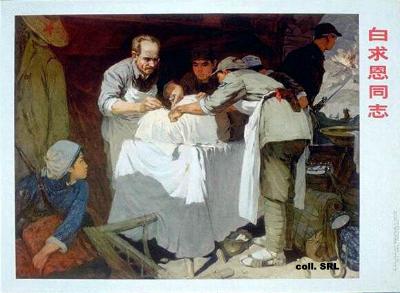 Norman Bethune was a Canadian surgeon and Communist who worked in Spain in support of the
Republic during the Spanish Civil War, and who later went to China to work in the medical
core of what became the People’s Liberation Army. He died in China in 1939 of blood poisoning
after nicking himself with a scalpel during a long day of operations on wounded soldiers.
Norman Bethune was a Canadian surgeon and Communist who worked in Spain in support of the
Republic during the Spanish Civil War, and who later went to China to work in the medical
core of what became the People’s Liberation Army. He died in China in 1939 of blood poisoning
after nicking himself with a scalpel during a long day of operations on wounded soldiers.
In his early medical career in Canada he
recognized that many of the greatest health problems arose because poor people did not have
adequate access to the health care system; from the failure of the health system to focus on
preventive medicine; and from other consequences of the capitalist social system in general.
During the Great Depression of the 1930s Bethune
frequently sought out the poor and provided them with free medical care. He was also one of
the earliest advocates of a national health care system for everyone (“socialized medicine”).
While in Spain he developed the world’s first
mobile medical unit which administered blood-transfusions and operated on soldiers near the
front lines, thus saving many lives. In China he further developed this idea into more complete
mobile surgical hospitals which saved the lives of a great many revolutionary soldiers. (Other
armies later copied this idea, including the United States Army which developed its “Mobile
Army Surgical Hospital” (M.A.S.H.) units late in World War II and more extensively in Korea
and other imperialist wars.)
After his death, Mao Zedong immortalized
Bethune’s internationalist revolutionary spirit in a very famous essay, “In Memory of Norman
Bethune” [available online at:
http://www.marxists.org/reference/archive/mao/selected-works/volume-2/mswv2_25.htm ].
Ever since then Norman Bethune has been an inspiration to both the Chinese people, and to all
Communists around the world.
“[Comrade Norman Bethune] arrived in Yenan in the spring of last year,
went to work in the Wutai Mountains, and to our great sorrow died a martyr at his post.
What kind of spirit is this that makes a foreigner selflessly adopt the cause of the
Chinese people’s liberation as his own? It is the spirit of internationalism, the spirit
of communism, from which every Chinese Communist must learn....
“Comrade Bethune and I met only
once. Afterwards he wrote me many letters. But I was busy, and I wrote him only one
letter and do not even know if he ever received it. I am deeply grieved over his death.
Now we are all commemorating him, which shows how profoundly his spirit inspires everyone.
We must all learn the spirit of absolute selflessness from him. With this spirit everyone
can be very useful to the people. A man’s ability may be great or small, but if he has
this spirit, he is already noble-minded and pure, a man of moral integrity and above
vulgar interests, a man who is of value to the people.” —Mao, “In Memory of Norman
Bethune” (Dec. 21, 1939), SW2:337-8.
BHOODAN ANDOLAN [“Land Gift Movement”]
A voluntary land reform movement in India started by Archarya Vinoba Bhave in 1951. It was
launched in the same naïve spirit of the philosophy of Mohandas K. Gandhi, and begged
the landlords to simply give some of their excess land to the landless poor. A few did so,
out of guilt or to appear beneficent or else from fear that they might otherwise lose all of
their land through mass violence. However, compared to the great need for land by the poor,
only a pittance was donated. Moreover, much of the donated land was of poor quality, and
actually unsuitable for agriculture. Even worse, much of the supposedly “donated” land was
actually given in name only, with the rich landlords retaining possession and control in
reality.
For a recent Times of India report
(Dec. 10, 2009) describing how farmers who have supposedly been the “beneficiaries” of this
“Land Gift Movement” are now completely disillusioned and turning to revolution, see:
“Bhoodan Farmers Ready to Emulate Maoists”
Dictionary Home Page and Letter Index
MASSLINE.ORG Home Page