PHARMACEUTICAL INDUSTRY
All capitalist corporations gouge the public to the maximum extent that they can. But the
pharmaceutical industry is one of the very worst, in part because obtaining medicine is often
a matter a life or death for sick people, and therefore pharmaceutical companies can get away
with the most extreme forms of capitalist extortion.
“A study carried out by Express Scripts, a ‘pharmacy-benefit manager’
that negotiates prices between drug companies and health insurers, found that the number
of Americans with annual prescription costs above $50,000 had risen by 63% in
2014, to 576,000. The number whose costs were over $100,000 trebled, to 139,000. Patients
are being prescribed ever more complex combinations of drugs to treat multiple conditions,
but medications for hepatitis C and cancer explain a good deal of the surge in costs.”
—“A bitter pill to swallow”, The Economist, May 16, 2015, p. 7. [It should also be
noted that the most incredibly expensive drugs are those which are only available from
one monopoly company because of the excessively generous patents which the bourgeois state
grants them. And the profits of pharmaceutical corporations are sky high, even compared
to those of other industries. —Ed.]
“PHASE THEORY” [In India]
A failed theory of how to go about making a revolution that has been very popular in India over
the past 40 years or more. Under this theory, people’s war in India could not be launched until
after many years of building up the people’s revolutionary movement through more peaceful struggle
and/or electoral efforts. But instead of expanding their revolutionary influence, those parties
which tried these approaches lost most of their influence, and have made no progress at all toward
ever leading a revolution.
“But let me also tell you that there are other ML parties [in India] which
do not [?] believe in taking up armed struggle but they want it to start much later in the
course of struggle. This can be understood as Phase Theory which many revolutionary
parties in India conform to. According to this theory, in the first phase one has to prepare
the masses through open and legal mass resistance struggles. In the second phase, underground
organisation of the movement is carried out, while in the third phase the armed struggle is
started. Though these parties had [a] large mass base initially, due to their faulty
understanding, they became smaller and smaller. This Phase Theory did not work. But the first
of the three revolutionary parties I have mentioned [CPI(ML) (People’s War)] started armed
struggle straight away, as they did not believe in phases of revolution. They analysed that
a revolutionary situation already exists in Indian society and the people can be organized
for an armed movement. Even they believed and understood that armed forms of struggles
predate their own existence. Hence they need to lead them with the MLM ideology at the
centre. They succeeded while the rest of the groups became weaker and alienated from the
oppressed masses. The revolutionary classes and individuals in the society came together in
the larger revolutionary groups and these groups expanded over time. On the other hand, those
groups which believed that they should spread the revolutionary ideas by going to the
parliament or believed that they should start the armed struggle much later, could not carry
forward the revolutionary movement. They remained for forty years in the same preparatory
stage and are now smaller forces – almost non-existent – even foregoing their character as
revolutionary forces. But those who believed from the very beginning that the phase theory
is wrong, that the Indian parliament has no relevance in India and that the peoples struggles’
can and should start with armed struggle became major revolutionary forces. They joined hands
and merged in 2004 to become Communist Party of India (Maoist) – the largest and the most
formidable revolutionary force in India. About ten smaller ML parties still exist, but they
have no relevance, leading no major struggle, thereby existing only on paper mainly. One such
organization is called CPI(ML) Liberation which contests parliamentary elections in some
pockets of the country. People consider it to be a revisionist group like the CPI and CPI(M)
which has no radical or revolutionary content and relevance. On the other hand, CPI(Maoist)
has emerged as the single largest Marxist-Leninist-Maoist Party of the country after the
coming together of all revolutionary forces in India. The movement it leads is still called
the Naxalite movement because its origins lie in the Naxalbari village.” —G. N. Saibaba, of
the Revolutionary Democratic Front, in an interview, April 15, 2012, online at:
https://www.bannedthought.net/India/RDF/2012/120415-SaibabaInterviewSweden.pdf
PHENOMENALISM
One of a number of related theories of knowledge based
on the notion that the immediate objects of knowledge are sensations.
These theories often argue that all statements about physical objects are equivalent in meaning
to statements about various subjective sensations that people have. All these theories are
empiricist and idealist to one
degree or another.
A typical expression of phenomenalism is
that, in the words of John Stuart Mill, “objects are
the permanent possibilities of sensations”. This takes sensations as all that we really know,
and seems to imply that there may be no objective reality beyond sensation. It seems
to “define away” the objective reality that gives rise to our sensations. Similar views have
been held by Bertrand Russell and most other empiricists.
Russell held that all talk about physical objects, including their properties and locations,
should be translated into talk about human subjective experiences. From our opposed
materialist perspective we argue that our sensations and impressions of the world actually
arise from, and are based on (to one degree or another), objective reality rather than the
other way around, as the phenomenalists would have it.
Strangely, the views of Mill and Russell
might be considered among the “moderate” forms of phenomenalism. Locke
and Herbert Spencer also held similar views, recognizing
at least that objective reality did exist, though insisting that all we are actually directly
aware of is our own sensations. Kantian agnosticism
formalized this point of view that human knowledge cannot know anything directly about the
real objects that give rise to our sensations, each of which is supposedly an unknowable
“thing-in-itself” (ding-an-sich).
The more extreme forms of phenomenalism merge
into outright subjective idealism. Examples of this
are in the philosophies of Bishop Berkeley,
Ernst Mach, and the loose school of idealist thought known as
Empirio-Criticism.
From the point of view of dialectical
materialism all forms of phenomenalism are false since they divorce human knowledge from
objective reality and from human practice in relating to objective reality.
See also:
POSITIVISM,
SENSATIONALISM,
SENSUALISM
PHENOMENOLOGY [Idealist Philosophy]
Literally, the description or study of appearances; but in practice a rejection of a scientific
materialist understanding of perception, consciousness, and mental phenomena generally.
1. One of a variety of wildly confused
idealistic theories about perception and mentalistic terms which
typically try to discuss their subjective “content” separately from their references or real-world
causes. The most prominent proponent of this strange doctrine of phenomenology in the 20th century
was Edmund Husserl. He argued that philosophy is not and cannot be
objective or scientific, but rather that its central focus should be to explore the “life-world”
[Lebenswelt] or the subjective inner life [Erlebnisse] of consciousness (whatever all
that is supposed to mean). This actually sounds more like religious meditation than it does
philosophy.
Phenomenologists believe that “truth” is discovered
through intuitions and the “direct awareness” of phenomena
(whatever that is exactly). Husserl said we should “bracket off” (ignore) any scientific explanations
for phenomena in order to see things as they directly and fundamentally appear to our consciousness.
Thus to these idealists, the way to view reality is to forget about or deny the existence of the
external world (the world outside of the mind).
Other idealist philosophers of the 20th century who
share many or some of these foolish ideas were Franz Brentano,
Martin Heidegger, Maurice Merleau-Ponty, and the falsely termed
“Marxist”, Jean-Paul Sartre. Many
existentialists besides Sartre also were strongly influenced by
these idealist doctrines.
2. In the 18th and 19th centuries the term
phenomenology—though still strongly associated with idealist philosophy—had various different
meanings for Kant and others. For Hegel, phenomenology meant the study
of the evolution of consciousness (or “spirit”, as he preferred to say)—but not as a modern
neuropsychologist might attempt to do this, but rather as a quintessential idealist philosopher
would.
“PHENOMENOLOGY is a theory about phenomena, that is, about the
nature of philosophical concepts associated with the sensually perceived experience but not
limited to perception alone.
“1) Phenomenology, in one of its meanings,
is a philosophical discipline treated differently in the history of philosophy: as a science
criticizing sense knowledge (German philosophers of the 18th century, particularly Johann
Heinrich Lambert who was the first to use the term ‘phenomenology’; Immanuel Kant); as a
teaching about the formation of philosophy and historical forms of consciousness (Georg Hegel,
Phänomenologie des Geistes, 1807); as a part of psychology describing psychological
phenomena (German philosopher Franz Brentano, 1838-1917; Austrian philosopher Alexius Meinong,
1853-1920).
“2) An idealistic philosophical trend and
method of cognition whose principles were elaborated by the German idealist philosopher Edmund
Husserl (1859-1938) in the early 20th century. Phenomenology appears as an opposition to, on
the one hand, psychologism in the theory of knowledge which regards cognition [as] identical
with sense-experience, and, on the other hand, ‘historicism’ treating philosophy as a
description of historical types of world outlooks. The purpose of phenomenology is to reveal
the primordial experience of consciousness through the reductive procedure
(epoche—abstention from any statement), which implies an intentional suspension of
belief in reality in order to get a clear understanding of its nature and achieve a sort of
final indivisible unity of consciousness in its intentionality. Husserl’s early theories are
marked by a turn from objective reality to intentionality of consciousness (he regarded
intentionality as a pure structure of consciousness free from individual—psychological,
social and other—characteristics. Phenomenology was one of the sources of existentialism and
other trends in modern Western philosophy.” —From “Our Glossary”, Social Sciences,
(USSR Academy of Sciences), 1980, number 3, p. 311-2.
PHILANTHROPY
Typically this is the gift by the rich of a small portion of what they have stolen from the
working class. “Philanthropist: Someone who gives away what he should give back.” —Anon.
“The rich will do anything for the poor, except get off their backs.”
—Often attributed to Karl Marx, but attributed to Leo Tolstoy by Holbrook Jackson in his
book Romance and Reality (1912). This is certainly a sentiment that Marx would have
agreed with.
“If you’re in trouble or hurt or need—go to poor people. They’re the only
ones that’ll help—the only ones.” —John Steinbeck, The Grapes of Wrath
(1939).
PHILISTINE
[Often not capitalized.]
1. [In aesthetics:] A person who is guided by
the pursuit of material possessions (“materialism”, in the vulgar sense), and is oblivious
to or disdains aesthetic and cultural values. This is an attitude characteristic of bourgeois
art collectors, who view the purchase of a work of art as primarily an investment.
2. [More broadly:] A person who is uninformed
about a special area of knowledge (such as Marxist theory) but who nevertheless assumes they
are well versed in the subject and therefore spouts off about it.
“Do you remember the German definition of a philistine?
Was ist der Philister?
Ein hohler Darm,
Voll Furcht und Hoffnung,
Dass Gott erbarm.
[What is a philistine?
A hollow gut,
full of fear and of hope
in God’s mercy.]
This definition does not quite
apply to our affairs. God ... God takes a back seat with us. But the authorities ...
that’s a different matter. And if in this definition we substitute the word ‘authorities’
for the word ‘God’ we shall get an exact description of the ideological stock-in-trade,
the moral level and the civic courage of the Russian humane and liberal ‘friends of the
people.’ [Narodniks]” —Lenin, “What the ‘Friends of the People’ Are” (1894), LCW 1:262.
[The quoted verse is by Goethe.]
PHILLIPS CURVE
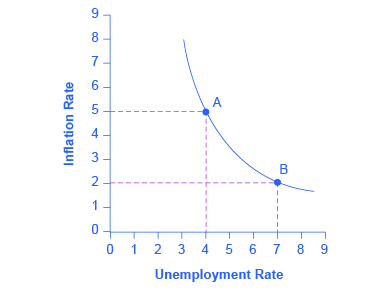 The claim by many bourgeois economists that there is a “trade-off” between fighting inflation
(as measured by changes in wages) and reducing unemployment. That is, supposedly if wages are
raised, there will be more unemployment; or if unemployment levels are lowered it can only be
done by lowering wages. This false doctrine is quite appealing to the bourgeoisie. It provides
them with yet another excuse to try to keep wages low.
The claim by many bourgeois economists that there is a “trade-off” between fighting inflation
(as measured by changes in wages) and reducing unemployment. That is, supposedly if wages are
raised, there will be more unemployment; or if unemployment levels are lowered it can only be
done by lowering wages. This false doctrine is quite appealing to the bourgeoisie. It provides
them with yet another excuse to try to keep wages low.
In 1958 the economist A. W. Phillips published
his study showing that in Britain for the entire period 1861-1957 this inverse relationship
seemed to hold. However, as needs to be constantly reminded to people, correlation is not the
same as cause and effect, and past correlations may not continue in new situations. In
particular, the period of stagflation in the U.S. in the late
1970s and 1980s showed that both high unemployment and high inflation were indeed possible at
the same time. In other situations both low inflation and low unemployment are possible, for
a time. (And even if this favorable situation is rare under capitalism, zero inflation
and zero unemployment soon become the norm under genuine socialism.)
“By the end of the decade [the 1950s], Keynesian economics had entered
the high summer of its self-regard. Leading economists insisted governments could adjust
economic conditions like the settings on a thermostat. The economist A. W. Phillips plotted
the relationship between unemployment and wages in the United Kingdom over the previous
century, and found wages tended to rise when unemployment was low. Enthusiastically
conflating correlations and causation, economists concluded governments could glide up and
down a ‘Phillips curve,’ trading off unemployment and inflation. In an influential paper
published in 1960, [Paul] Samuelson and Robert Solow, two of the most important economists
in the postwar era, said the American government could choose from a ‘menu’ of unemployment
and inflation rates. The available options included 5 to 6 percent unemployment with no
inflation or, if one preferred, 3 percent unemployment with 4 to 5 percent inflation.”
—Binyamin Appelbaum, The Economists’ Hour: False Prophets, Free Markets, and the
Fracture of Society (2019), p. 49.
“PHILOSOPHERS’ SHIPS”
A reference to the exiling, on Lenin’s instructions, of a small number of reactionary intellectuals
(including a few idealist philosophers) who were hostile to the October Revolution and
revolutionary Russia. In the fall of 1922 two German boats carried 160 expelled reactionaries
to Germany. In 1923 a smaller number of additional bourgeois intellectuals were expelled by
train to Riga, Latvia, or by ship from Odessa to Constantinople. Among those expelled on these
several occasions were: Nikolai Berdyaev, Nikolai Lossky,
Sergei Bulgakov, and Ivan Ilyin.
PHILOSOPHICAL NOTEBOOKS by Lenin
The collected notes made by Lenin on philosophy and philosophical themes which make up volume 38 of
Lenin: Collected Works, 4th edition (in English) (Moscow: Progress Publishers, first printing
1961). This volume is available online in a number of places, including:
https://www.bannedthought.net/USSR/Lenin/CW/Progress-4ed-English/LeninCW-V38-M2M.pdf
“Lenin’s Philosophical Notebooks contain conspectuses of and extracts
from various books and articles, notes on books and articles dealing with philosophy, and also
remarks and notes written in the margin or the text of books on philosophy from Lenin’s personal
library. The bulk of the material dates back to 1914-15. In these Notebooks Lenin is
concerned mainly with questions of materialist dialectics, its laws and categories, from which
it may be presumed that Lenin intended to write a special book on dialectics but did not actually
do so. Lenin had no intention of publishing this material and his notes, especially those in the
margin, are often abbreviated and written in the language of the book studied.” —Lenin
On Language, (Moscow: Raduga Publishers, 1983), end note #5 (page 268).
PHILOSOPHY: BOURGEOIS — Irrationality Of
“The lack of logic in contemporary bourgeois philosophy is a direct expression of
the historic fact that the existence of capitalism has become a brake on the historic development
of human society, that capitalism has outlived itself.” —Bolshevik [Russian language
theoretical journal of the Communist Party of the Soviet Union]: “Marasm [i.e., decline or wasting
away] of Contemporary Bourgeois Philosophy”, 1947, No. 16, p. 62; as translated into English in
Soviet World Outlook: A Handbook of Communist Statements, a collection published by the
U.S. State Department (!), 1950, p. 2. (This quote appeared simultaneously with the criticism of
G. F. Alexandrov’s book, History of Western Philosophy, as one of the more detailed
rebuttals of Western philosophy to appear in the period shortly after World War II.)
PHILOSOPHY — Difficulty Of
See also: PHILOSOPHY—For the Masses
below.
“The widespread prejudice that philosophy is something which is very difficult
because it is the intellectual activity of a specific category of specialist scholars or of
professional and systematic philosophers must be destroyed. To do this we must first show that
all men are ‘philosophers’, defining the limitations of this ‘spontaneous philosophy’ possessed
by ‘everyone’...” —Antonio Gramsci, “The Study of Philosophy and of Historical Materialism”,
in The Modern Prince & Other Writings, (NY: International Publishers, 1987 [1957]), p.
58.
[And, indeed, an important part of
educating the masses in philosophy is to help them first discover that everyone has “somehow”
already picked up a lot of tacit philosophical views from the society all around them, which
they are almost unconscious of! Some of this “spontaneous” philosophy may be correct, but some
will almost certainly be false. Thus acquiring a fully correct scientific philosophy is as
much a matter of “unlearning”, or removing, some erroneous semi-conscious philosophical biases,
as it is a matter of learning new principles. However, none of this is really any more difficult
than acquiring any other useful and important area of essential knowledge. —S.H.]
PHILOSOPHY — For the Masses
“Philosophical expositions which cannot be grasped by every educated
person do not, in our opinion, deserve the printer’s ink expended on them. What has been
clearly thought out can also be said clearly and without circumlocution. The philosophical
evils which disfigure the writings of the erudite seem to aim more at concealing thoughts
than revealing them.” —Engels, Dialectics of Nature, quoted in Monthly
Review, July-August 1980, p. 42. [We have not yet located this passage in the
Marx-Engels Collected Works. —Ed.]
“Liberate philosophy from the confines of the philosophers’ lecture rooms
and textbooks, and turn it into a sharp weapon in the hands of the masses.” —Mao, (1964?),
quoted in “Peasants Can Certainly Study and Apply Philosophy Well”, Peking Review,
#37, Sept. 11, 1970, p. 13. [The original source of this quotation is probably Mao’s “Talk
on Sakata’s Article” (Aug. 24, 1964), paragraph 3, online in a looser translation at:
http://www.marxists.org/reference/archive/mao/selected-works/volume-9/mswv9_28.htm]
“I have always figured that if I can’t explain something I’m doing to
a group of bright undergraduates, I don’t really understand it myself, and that challenge
has shaped everything I have written. Some philosophy professors yearn to teach advanced
seminars only to graduate students. Not me. Graduate students are often too eager to prove
to each other and to themselves that they are savvy operators, wielding the jargon of
their trade with deft assurance, baffling outsiders (that’s how they assure themselves
that what they are doing requires expertise), and showing off their ability to pick their
way through the most tortuous (and torturous) technical arguments without getting lost.
Philosophy written for one’s advanced graduate students and fellow experts is typically
all but unreadable—and hence largely unread.” —Daniel Dennett, Intuition Pumps and
Other Tools for Thinking (2013), p. 12. [Dennett is a bourgeois philosopher, but what
he says here is quite laudable. —Ed.]
PHILOSOPHY — Marxist — Study Of
“We must propagate dialectical materialism among the five million
intellectuals inside and outside the Party and among cadres at all levels so that they
will grasp it and combat idealism, and we shall then be able to organize a powerful
corps of theoretical workers, which we urgently need. That again will be a very good
thing.
“We must draw up a plan for the
formation of such a corps with several million people taking up the study of dialectical
materialism and historical materialism, the theoretical basis of Marxism, and combating
all shades of idealism and mechanical materialism. At present there are many cadres
doing theoretical work, but there is still no corps of theoretical workers, much less a
powerful one. Without such a corps, the cause of the entire Party, the socialist
industrialization and socialist transformation of our country, the modernization of our
national defense and our research in atomic energy cannot move along or succeed. I
therefore recommend that you comrades read philosophy. Quite a few people are not
interested in philosophy and have not cultivated the habit of reading it. They can
begin by reading pamphlets or short articles and, after their interest is thus aroused,
tackle books running to a length of seventy thousand or eighty thousand and then even
several hundred thousand words. Marxism consists of several branches of learning:
Marxist philosophy, Marxist economics and Marxist socialism, that is, the theory of the
class struggle, but the foundation is Marxist philosophy. If this is not grasped, we
will not have a common language or any common method, and we may keep on arguing back
and forth without making things any clearer. Once dialectical materialism is grasped, a
lot of trouble will be saved and many mistakes avoided.” —Mao, “Speeches at the National
Conference of the Communist Party of China: Concluding Speech” (March 31, 1955), SW
5:157-8.
PHILOSOPHY — Scientific
[Intro to be added... ]
See also:
DIALECTICAL MATERIALISM,
SCIENCE—and Philosophy
“Modern materialism embraces the more recent discoveries of natural
science, according to which nature also has its history in time, the celestial bodies,
like the organic species that, under favorable conditions, people them, being born
and perishing. And even if nature, as a whole, must still be said to move in recurrent
cycles, these cycles assume infinitely larger dimensions. In both cases modern
materialism is essentially dialectic, and no longer needs any philosophy standing
above the other sciences. As soon as each special science is bound to make clear its
position in the great totality of things and of our knowledge of things, a special
science dealing with this totality is superfluous. That which still survives,
independently, of all earlier philosophy is the science of thought and its laws—formal
logic and dialectics. Everything else is subsumed in the positive science of nature
and history.” —Engels, Anti-Dühring, MECW 25:26.
PHISHING [Pronounced: fishing]
A recent term for trying to trick, deceive, exploit or cheat people. This term probably
originally developed and has became most common with respect to the Internet, where criminals,
vandals, government spies and other con men have been using very sneaky methods to get
people to disclose their passwords to access computers, or their credit card information, or
online bank account information, etc. For example, such a criminal might send out an email to
the customer of a bank pretending to be from the bank itself, and claiming that the customer
must log on to his account to confirm the accuracy of some recent transaction. A link is then
provided, but the link is not actually to the bank’s computers, but to the criminal’s own
website. Then when the victim enters their password on what they think is the bank’s website
the criminal has it.
Such scams and cons have existed long before
the Internet was invented, and are in fact a permanent and major feature of capitalist society.
The term phishing is now being extended to those more traditional forms of trickery,
deceit and theft as well.
“‘Competitive markets by their very nature spawn deception and trickery.’
This is not the hyperbole of a diehard Marxist, but the contention of two Nobel prize
winners in economics in a new book, Phishing for Phools. Economic models tend to
assume that people are informed about the decisions they make; in the jargon consumers
have ‘perfect information’. This supposedly enables consumers to make markets work to
their advantage. But Robert Shiller of Yale University and George Akerlof of Georgetown
University argue instead that this assumption is false. There are plenty of market
equilibria, the authors find, where one party is being deceived, or ‘phished’. You may
think you are doing well out of markets; you may behave quite rationally; but in fact
you are being taken for a ‘phool’.” —“The Economics of Deception”, the Economist,
Sept. 19, 2015, p. 82. [For one example of how this works see the entry for
CREDIT CARDS. —Ed.]
PHLOGISTON THEORY
An obsolete and long abandoned scientific theory put forward to explain combustion, which was
demonstrated to be incorrect by Antoine-Laurent Lavoisier in the late 18th century. This is
now considered to be a classic example of how science has learned to discard theories once
they have been proven to be erroneous.
The phlogiston theory, which was first put
forward in 1667, held that things which can burn contain a fire-like element, phlogiston,
which is released when the material burns. Substances which burn in air were said to be
rich in phlogiston. When it was demonstrated that the same material burned in a small closed
space soon extinguished itself, the theory was patched up by saying that the small amount of
air surrounding the burning material was soon satiated with phlogiston and could hold no more
of it. The phlogiston theory required a series of such ad hoc patches, including the
suggestion at one point that phlogiston must have a “negative mass”. (When major or multiple
ad hoc excuses of this sort need to be proposed to keep a theory alive, it is usually
a good idea to raise some very serious doubts about the whole theory. For example, the
fantastic ad hoc patch to the Big Bang Theory in
cosmology, which requires us to believe in a totally inexplicable period of “hyper-inflation
of space-time” to keep the theory alive, should raise a serious question as to the validity
of that entire Big Bang Theory.)
The phlogiston theory was replaced by the
caloric theory of heat (which itself was later replaced
by the theory of thermodynamics) and the recognition that most combustion consists of the
rapid combination of oxygen with other elements. (In unusual cases, however, there may be
combustion that does not involve oxygen, such as with hydrogen in a fluorine atmosphere or
vice-versa.)
PHOENIX PROGRAM
A program of mass torture and murder by the United States CIA and the
American military during the U.S. War Against Vietnam. It operated from 1965 to 1972, though
similar programs existed before and after that. It was intended to identify and “neutralize”
(usually murder) the human infrastructure of the National Liberation Front in southern Vietnam
(which was known as the Viet Cong to American forces). Besides many NLF members themselves,
this program tortured and “neutralized” a huge number of NLF informers and supporters, as
well as thousands of people with no connection to the NLF. And despite its vast extent, it was
largely ineffective from a strategic point of view, and failed to destroy the NLF.
“During the war in Vietnam, the CIA’s Phoenix Program deployed systematic
torture and often brutal methods to dismantle communist networks in the countryside,
producing 46,776 extrajudicial executions but little actionable intelligence.” —Alfred
W. McCoy, In the Shadows of the American Century: The Rise and Decline of US Global
Power (2017), p. 138. [As a liberal, the American historian McCoy prefers euphemisms
such as “brutal methods” and “extrajudicial executions” for torture and murder, though he
cannot entirely avoid those terms. —Ed.]
PHOTON
A particle of light or other electromagnetic radiation. Photons are bosons
which carry the electromagnetic force.
“Although not in the least controversial today, Einstein’s bold suggestion
in 1905 that light must consist of particles [instead of simply waves] was harshly and
unanimously dismissed by his colleagues. Later in life, he declared this hypothesis, based
on but the shakiest of analogies, to be the most daring idea of his entire career; indeed,
it was so daring that it unleashed, among his colleagues, a barrage of scorn and hostility
whose magnitude, duration, and ferocity he surely could not have anticipated....
“The turning point when light quanta
at last emerged from the shadows came only in 1923, when the American physicist Arthur
Holley Compton astonished the world of physics with his experimental discovery that when an
electromagnetic wave approaches an electrically charged particle (an electron in an atom,
for instance), it transfers to the particle some of its kinetic energy and momentum, but
does not do so as Maxwell’s equations predicted. In fact, Compton found that the
wave-particle ‘collision’ that takes place in such a situation obeyed the long-known
mathematical rules of collisions between two particles, with the energies of the
incoming and outgoing waves matching exactly what Einstein had predicted in his 1905
paper about light quanta. And thus, at long last, light became particulate!
“It still took three more years for
the catchier word ‘photon’ to be coined by the American chemist Gilbert Lewis, but in any
case, today the notion of a photon—that is, a ‘wave packet’ of light—is a completely
familiar denizen of the physics world, and no physicist would dream of denying its
reality.
“It thus took almost twenty years
before the idea of light quanta, the fruit of an analogy conceived in 1905, was taken
seriously by physicists—and even after the Compton effect, it still took a bitter battle
before the idea was universally accepted. Today, oddly enough, this story is hardly
remembered...” —Douglas Hofstadter & Emmanuel Sander, Surfaces and Essences: Analogy as
the Fuel and Fire of Thinking (2013), p. 460, 462.
PHYSICS
“So you see, this physics of ours is a lot of fakery—we start out with the
phenomena of lodestone and amber, and we end up not understanding either of them very well.
But we have learned a tremendous amount of very exciting and very practical information
in the process!” —Richard Feynman, The Feynman Lectures on Physics, Vol. II, 1965, as
quoted in V. Gott, This Amazing, Amazing, Amazing but Knowable Universe (Progress, 1977),
p. 18. [This passage does not seem to appear in the Addison-Wesley 1964 edition of Feynman’s
Lectures.]
PHYSICS AND COSMOLOGY — Idealist Philosophy In
Beginning with Galileo, or perhaps a bit before, the development of physics and cosmology was
for centuries moving in the direction of more materialism and away from religion and philosophical
idealism. In the 20th century, however, very strong idealist
philosophical trends began to reappear in both of these sciences. In physics this was mostly due
to the difficulties in understanding the meaning of quantum
mechanics. With the development of the “Big Bang Theory”
cosmology also took a major turn toward religion and idealist philosophical conceptions again.
Worse yet, in both subjects, theories are now proposed and championed for which there seems to be
no possible way of testing them through experiment. In effect recent physics and cosmology seem
to be strongly moving back into the sphere of intellectualized religion and away from anything
which can be appropriately called science.
“[The theory of] quantum gravitation seems inaccessible to any experiment
we can devise. In fact, physics in general is moving into an era where the fundamental
questions can no longer be illuminated by conceivable experiments. It’s a very disquieting
position to be in.” —Stephen Weinberg, Nobel Prize winner in physics, speaking at a
Royal Society meeting; quoted in Clifford A. Pickover, Archimedes to Hawking (2008),
p. 33.
“As I am fond of saying, modern theoretical physics as a whole seems much
more like a branch of theology than it does science....
“One of the major problems with
theoretical physics today is just that it is so divorced from the real world, from practice,
from experiment. [In his book, Michio] Kaku himself says a couple of times that in the final
analysis it is experiment which must show whether superstring theory is correct or not. But
there is virtually no reference to experimental data in the book. Instead, we are over and
over referred to science fiction themes; we even get an ‘explanation’ of how warp drive
works on Star Trek!
“Kaku’s big excuse is that there
is no way to test superstring theory today, and probably won’t be for thousands of
years! The energy levels necessary, he says, are far beyond anything we can aspire to with
present technology. But he also says that the thing the theory really needs is...more
theory! He says that if the theory were better developed it should be able to
predict the mass of the proton (for example) from prior principles [p. 169]. This would
then be some sort of corroboration, at least. (However, it is all too easy to cook up
theories that produce ‘predictions’ that you already know the answers to, and then pretend
the theory is thus a great success! Cosmologists are always doing this (e.g., with the Big
Bang theory); indeed it seems to be their basic modus operandi.)
“What we really should say here though
is this: If a theory is so undeveloped that it is unable to make testable predictions,
then it is at best half-baked. (At worst, it perhaps should not be considered a
scientific theory at all yet.)
“On the one hand we are told that the
[superstring] theory is mathematically elegant; on the other hand we are told that no one
knows how to deal with the mathematics well enough to make a testable prediction. (How
elegant is that?!)
“On the one hand we are told that this
is a break-through theory for understanding all the forces of the physical world; on the
other hand it is admitted that ‘the underlying physical principle behind string theory is
unknown’. [p. 329]
“At this point I start to wonder again
just what the virtues of this string theory are supposed to be anyway! Apparently it’s
undeveloped; mathematically intractable; incomprehensible; outlandish; and untestable! Just
what the world of science really needs...
—Scott Harrison, “Review of Michio
Kaku, Hyperspace: A Scientific Odyssey Through Parallel Universes, Time Warps, and the
Tenth Dimension”, Sept. 11, 1995; full review online at:
https://www.massline.org/Philosophy/ScottH/hyperspace.htm
PHYSIOCRATS
“The physiocratic school, Physiocrats—a trend in bourgeois
classical political economy that emerged in France in the 1750s. The Physiocrats held
Nature to be the only source of wealth, and agriculture the only sphere of the economy
where value was created. Although they underestimated the role of industry and commerce,
the Physiocrats rendered an important service by shifting the search for the origins of
surplus value from the sphere of circulation to that of production, thereby laying the
basis for the analysis of capitalist production. Advocates of large-scale capitalist
farming, they showed the moribund nature of the feudal economy and thus contributed to
the ideological preparation of the bourgeois revolution in France.” —Note 430, MECW 26.
Dictionary Home Page and Letter Index
MASSLINE.ORG Home Page