EMANCIPATION OF LABOR GROUP
“The Emancipation of Labor group was the first Russian Marxist
group. It was founded in Geneva by G.V. Plekhanov in 1883; the group included P.B.
Axelrod, L.G. Deutsch, V.I. Zasulich, and V.N. Ignatov.
“The group did much to spread
Marxism in Russia. It translated such Marxist works as the Manifesto of the Communist
Party by Marx and Engels; Wage-Labor and Capital by Marx; Socialism:
Utopian and Scientific by Engels; it published them abroad and organized their
distribution in Russia. Plekhanov and his group dealt a serious blow at Narodism. In
1883 Plekhanov drafted a programme for the Russian Social-Democrats and in 1885 drew up
another. The two drafts were published by the Emancipation of Labor group and marked
an important step towards the establishment of a Social-Democratic Party in Russia.
Plekhanov’s Socialism and the Political Strugle (1883), Our Differences
(1885), and The Development of the Monist View of History (1895) played an
important role in disseminating Marxist views. The group, however, made some serious
mistakes; it clung to remnants of Narodnik views, overestimated the role of the liberal
bourgeoisie, while underestimating the revolutionary capacity of the peasantry. These
errors were the first projections of the future Menshevik views held by Plekhanov and
other members of the group. The group had no practical ties with the working-class
movement. Lenin pointed out that the Emancipation of Labor group ‘only laid the
theoretical foundations for the Social-Democratic movement and took the first step
towards the working-class movement’. [LCW 20:278] At the Second Congress of the
R.S.D.L.P., in August 1903, the Emancipation of Labor group announced its
dissolution.” —Note 102, LCW 5:552-553. [The internal Lenin quote has been
corrected to the form it appears as in LCW vol. 20.]
EMBOURGEOISMENT
Acquiring the characteristics of the bourgeoisie, and especially large parts of their
ideology. Sometimes those classes, strata or individuals which are embourgeoised, or
made more bourgeois, also acquire some objective characteristics of the bourgeoisie, such as
partial bourgeois relationships towards the means of production. (For example, a relatively
well-paid worker might buy some shares of stock or make other investments, even though he or
she must still continue to hold down a job.)
A fundamental principle of
historical materialism is that the prevailing
ideas of any age are ordinarily those of the ruling class. And thus, in bourgeois society,
most of the members of other classes are also indoctrinated to one degree or another with
aspects of the ideology of the bourgeoisie. In other words, in bourgeois society most of the
petty-bourgeoisie and even most of the proletarians are embourgeoised to some degree.
However, the term embourgeoisment usually refers to situations beyond this mere superficial
indoctrination, and where the members of other classes more deeply internalize bourgeois
ideology and habits.
Embourgeoisment of the working class is more
common in imperialist countries like the U.S. wherein a labor
aristocracy arises which to some limited degree shares in the spoils the imperialists rip
off from other countries. The ruling class has sometimes allowed this to happen in order to
keep the workers quiet at home while they exploit the rest of the world. Interestingly enough,
however, as economic problems and eventually a major economic crisis develops, the ruling
class is forced to drive these relatively well off workers down again. The capitalist
necessity becomes that of reproletarianizing the partially embourgeoised working class. This
has been happening in the U.S. in recent decades, and as of 2009 is now tremendously speeding
up as the intensifying crisis develops in the direction of a new great depression.
“EMBRACES BUT CANNOT REPLACE”
A phrase and concept used by Mao in his Talks at the Yenan Forum which describes
the relationship between Marxism and other spheres such as art or natural science. This concept
was later borrowed by Bob Avakian, and has apparently become one of
the main points in Avakian’s claimed “New Synthesis” of
communist theory. Here is what Mao wrote:
“To study Marxism means to apply the dialectical materialist and historical
materialist viewpoint in our observation of the world, of society and of literature and
art; it does not mean writing philosophical lectures into our works of literature and art.
Marxism embraces but cannot replace realism in literary and artistic creation, just as it
embraces but cannot replace the atomic and electronic theories in physics.” —Mao, “Talks
at the Yenan Forum on Literature and Art” (May 1941), SW 3:94.
Mao seems to mean here that there are many things of value in the world in addition to Marxism,
things such as aesthetic values in art and scientific theories of nature, which Marxism by no
means rejects or replaces. But ‘embraces’ means not just “accepts” or “welcomes”, but also “to
take in or include as a part ... or element of a more inclusive whole” [Merriam Webster’s
Collegiate Dictionary, 10th ed.]. Thus while Marxism does indeed accept or welcome
aesthetic values and scientific theories of nature, it also seeks to unite them with Marxist
principles into an overall coherent world outlook and expression. In art and literature,
for example, we by no means identify aesthetic merit with the exposition of or agreement
with Marxist ideas and principles; but we do judge works of art based not only on
their aesthetic merit, but also on the basis of whether or not they serve revolutionary
proletarian interests, both morally and politically.
Similarly, in natural science, we do use Marxist
principles to help arrive at and evaluate scientific theories. Our philosophy,
dialectical materialism, is simply the most abstract
conceptions which we have derived from all the sciences, and therefore it is not surprising
that it is of considerable value in determining and evaluatating new scientific theories even in
other spheres besides social science. Even in the natural sciences there are sometimes put
forward theories which purport to be scientific, but which can be almost immediately ruled
out based on the principles of dialectical materialism. (Two recent examples are “creationism”
and “intelligent design”, which have been promoted by Christian fundamentalists within biology
and the educational system.) In other cases, certain aspects of a natural science theory must be
revised in light of Marxist philosophy or principles. (For instance, we reject
“Social Darwinism” even though this was a very secondary
aspect of Darwin’s theory of evolution (and was promoted even more by bourgeois reactionaries
after Darwin). Similarly, in evaluating the “Big Bang” theory in cosmology, by no means must we
accept the religious dogma usually included in it that the universe and “time itself” were
“created” in the Big Bang.) Of course, some dogmatists (e.g., Stalin and
Lysenko) have gone too far with this evaluation of theories in natural
science and rejected some valid and correct theories (such as basic genetics). We must of course
carefully guard against that sort of thing happening again!
In addition to using Marxism to help derive
or evaluate theories in natural science, we also insist on using the principles of Marxism
(and most fundamentally, the basic interests of the people) as our primary guide in how the
discoveries and theories in science are actually made use of in society. For example, the
decision of whether or not to build a nuclear power reactor must be made not only on technical
grounds, but also in light of the possible severe danger it may have for the people should an
accident occur. “While we say that Marxism cannot replace natural science, we do not mean to
weaken the guiding role played by Marxism.”
[“Repulsing the Right
Deviationist Wind in the Scientific and Technological Circles”, Peking Review, v. 19,
#18, April 30, 1976, p. 7.]
There are in fact multiple aspects to what it
means when we say Marxism embraces but cannot replace the theories of natural science.
And while Mao first put it in these precise terms, this entire general approach to the arts and
sciences has been a core part of Marxism from the very beginning. It is thus sheer nonsense to
imagine that Avakian has added anything new to Marxism by including this principle of “embracing
but not replacing” as a central element in his supposed “New Synthesis”!
EMERGENCE
The development of a new property, based on newly arisen dialectical contradictions, of a new
entity, thing or process, which was formerly known only by the component parts which went in to
constructing it. A few of the enormous number of examples which could be mentioned are:
• The phenomenon of air
pressure which is an emergent property of the vast numbers of individual molecules in air
considered together, as they move around and collide with each other and with other objects.
• The phenomenon of ocean waves.
The individual molecules of water (and other substances) in the ocean only go to make up waves
when enormous numbers of them move together in certain ways.
• The blue color of the sky.
Individual air molecules are invisible, but visible light of the wave length we see as blue
is scattered more effectively by masses of air molecules which is why we see the sky as blue.
• Human intelligence is
an emergent property of the functioning of the brain. No individual neuron is “intelligent”,
but intelligence (like all mentalistic terms and states) is a high level way of describing
aspects of the functioning of the billions of components of the brain, or at least the
possible functioning of such a brain, since “stupidity” is also an emergent property
sometimes!
[More to be added... ]
“Simplicity in physics is an emergent phenomenon.” —Robert B. Laughlin,
a Nobel Prize winning physicist, A Different Universe: Reinventing Physics from the
Bottom Down (2005), p. 130. [This is a profound comment. At some levels of
investigation and description of the world there appears to be enormous complexity.
But, at least in some respects things are much simpler at a higher level of description.
There are trillions and trillions of air molecules in the room buzzing around me right
now and describing the precise situation seems totally impossible. But we can also
describe the air in the room as simply being at 70 degrees Fahrenheit, where the
temperature is an emergent characteristic of all those countless molecules of air
considered as a whole. —Ed.]
EMERGENCY ROOMS [In Hospitals]
Millions of poor people in America have no health insurance whatsoever and about their only access
to any health care at all is in hospital emergency rooms. However, the waits in such emergency
rooms are often excruciatingly long, and people sometimes die while waiting for treatment. Moreover,
the treatment is often perfunctory when it is finally given, and the financial charges to the
patients are generally outrageously huge. Nothing shows the ruling class’s total disregard for the
health and welfare of the poor and lower working class in clearer fashion than the state of U.S.
emergency rooms.
“An Atlanta woman who walked out of a hospital emergency room after seven
hours without treatment has received a bill for $700. Taylor Davis, who had a head injury,
says that no one even ‘called my name’ during the wait. In an email to Davis, Emory
Healthcare confirmed the charges, explaining ‘You get charged before you are seen. Not
for being seen.’” —“Only in America”, The Week, Nov. 12, 2021, p. 6.
“Waiting Over 5 Hours in ER Is Linked to Higher Death Rates, New Data Show
“As emergency rooms worldwide are flooded
with a wave of new COVID-19 patients, a large study in the United Kingdom has laid out the
deadly consequences of delayed critical care.
“Nearly 27 million individuals attended a
major emergency room in England from 2016 to 2018, waiting on average just under five hours for
a course of action. This is despite a four-hour operational standard adopted by the National
Health Service (NHS) back in 2004. Tragically, nearly 434,000 of those attendees would pass away
within a month, a statistic that became more likely after five hours of waiting.
“If a patient had to wait between six to eight
hours, they were, on average, 8 percent more likely to die of any cause in the next 30 days. That’s
one extra death for every 82 patients who weren’t treated within six hours. If a patient had to wait
more than eight hours, their likelihood of dying over the following month increased to 10 percent.
“‘Let nobody be in doubt any longer, the [NHS]
four-hour operational target is, as many of us have always known, of key importance to patient safety,’
writes physician Derek Prentice from the Royal College of Emergency Medicine in a linked editorial.
“The same operational targets are also in place
in other nations, like Australia and the United States, but that doesn’t mean ERs consistently enforce
the standards.... [The study was published in Emergency Medicine Journal.]
—Carly Cassella, Science Alert [Internet
media source], Jan. 24, 2022.
“EMERGING ECONOMIES”
“Emerging economies”, “developing economies”—these are the sorts of euphemistic terms used by
the bourgeoisie to refer to the poor countries of the world, most of which are neither
“developing” nor “emerging”, since they are bled dry under the thumbs of the imperialism
countries. Even the bourgeoisie itself sometimes admits these terms are totally phony:
“It makes even less sense to speak of the ‘south’ as shorthand for the
planet’s poor countries (what about Australia or Singapore?) or of the ‘West’ as synonymous
with industrialization and political freedom—what’s ‘western’ about Japan? ‘Third World’
dates from the Cold War, when the planet had capitalist ‘First’ and communist ‘Second’
compartments. Its most recent replacement, ‘emerging economies’, already seems out of date,
as some erstwhile star performers, such as Argentina, submerge. And the term unhelpfully
lumps together hardworking manufacturers (Vietnam, say) and service-based economies (Dubai)
with those blessed—or perhaps cursed—by natural resources (Nigeria, Saudi Arabia,
Russia).” —“A menagerie of monikers”, leader (editorial) in The Economist, Jan. 9,
2010, p. 16.
EMPATHY
Vicariously understanding and/or sharing the feelings or emotions of another person even
though you are not in the same objective situation as the other person, at least at the
moment. Thus you might emphasize with a person whose mother has just died, even though your
own mother is still alive and well. Empathy of this sort is possible because we can all at
least imagine how we might feel in the other person’s situation. Every normal human being
has this capability to one degree or another, and experiments have shown that babies are
either born with the capacity for empathy, or else develop it at an extremely early age.
(Babies tend to be upset when other babies around them are crying, for example.)
“We see someone scratch her elbow; we relate, because we, too, have
scratched our elbow (and our knee, and our neck...), thousands of times. We see
someone yawn; we relate because we, too, have yawned tens of thousands of times.
These kinds of analogies are certainly not deeply insightful, but they are nonetheless
deep, because they lie at the roots of our understanding of other beings—it would be
no exaggeration to describe them as the cornerstones of compassion and empathy—and
because they determine our style of relating to the world.” —Douglas Hofstadter &
Emmanuel Sander, Surfaces and Essences: Analogy as the Fuel and Fire of Thinking
(2013), p. 156. [I.e., we “relate to”, we are empathetic with, other human beings,
because we see in endless sorts of ways that they are like us and we are like them.
—Ed.]
EMPIRICISM
Empiricism is the view that all knowledge comes from experience, which clearly has a lot of truth
to it. However, one basic problem here is that within philosophy this is such a general and vague
statement that it can be given all sorts of wildly diverse interpretations, including stanchly
materialist interpretations and also grotesquely subjective
idealist interpretations of the sort championed by Bishop George
Berkeley! The most important issues come down to: 1) How one understands what experience
itself actually is; and 2) Whether or not raw experience alone is all that constitutes knowledge.
The materialist interpretations of empiricism
emphasize that it is human experience with the real physical world (including human society), the
world “external to our minds”, and thus our activity or practice in the world, which forms
the basis for our knowledge. The underlying assumption here is simply that there is an
“external world”, or physical reality which exists outside our
minds. And it is this real physical world which we are interacting with and experiencing. Of course
for us materialists this is elementary common sense. Among the prominent materialist (or mostly
materialist) proponents of empiricism, are Francis Bacon,
Thomas Hobbes, John Locke, and
the French materialist thinkers of the Enlightenment.
However, the philosophical idealist interpretations
of empiricism tend to focus on what is going on in our minds. According to most of these conceptions,
our knowledge is derived from the “sense data” which is all we can
derive from the world, and furthermore this sense data consists only of mental impressions. As
to what really underlies and causes that “sense data” and mental impressions, we supposedly have no
idea at all. Among the proponents of idealist empiricism are Bishop Berkeley,
David Hume, Ernst Mach,
Richard Avenarius, and the Logical
Positivists.
Since the philosophical idealist conceptions of
empiricism have been much more dominant in the philosophy of the capitalist era, the very term
empiricism itself has often come to take on idealist or even religious connotations for many
people. And the term radical empiricism, in particular, refers to the extreme views of those
like Berkeley who go so far as to deny that any real physical world exists at all.
After the materialist/idealist differences, the
next big question is what role, if any, reason or theorizing should play in human knowledge. In
bourgeois philosophy there are two main polarized schools of thought here: empiricism and
rationalism. Empiricism, in this sense, argues that all knowledge comes directly from experience
and not from reasoning, while rationalism argues the opposite,
that all knowledge (or at least all the most basic and most important knowledge) comes only from
reasoning, and not from experience or from our senses (which supposedly can never be trusted).
Empiricism enshrines experience as the sole source of knowledge, while rationalism enshrines human
reason as the sole source of knowledge (or at least of the deepest knowledge).
The Marxist view is that both of these stances are
one-sided and therefore quite mistaken. We view knowledge as based on experience, yes, but also
requiring rationalization, or scientific theorizing and summation, of that raw experience. In sum,
the MLM view of empiricism is that it is quite erroneous whenever it assumes an anti-materialist
(or idealist) perspective, as it frequently does, and that it is also quite erroneous insofar as it
assumes that raw experience alone, without any theoretical rationalization, constitutes human
knowledge. Nevertheless, we do recognize that experience of the world and society does form the
starting point for human knowledge, though that immediate experience must then also be summarized,
rationalized and related to broader theoretical categories, before we have knowledge in the complete
sense.
See also below, and:
LOGICAL POSITIVISM,
PERSONAL EXPERIENCE (esp. Mao quote),
RATIONALISM
“If one accepts the premise that all knowledge comes to us through our senses,
Hume says, then one must logically conclude that both ‘Nature’ and ‘Nature’s laws’ are creations
of our own imagination.” —Robert Pirsig, Zen and the Art of Motorcycle Maintenance (1974),
chapter 11.
[This is the sort of classic non sequitur
which idealistic empiricists are prone to. One might by the same “logic” conclude that since our
awareness and knowledge of the moon comes to us through our senses, that the moon is only a
“creation of our own imagination”. And that goes for the nose on your face, too. It is utterly
amazing how totally idiotic idealist empiricists can be! —S.H.]
EMPIRICISM — As One Kind of Revisionism
Those revolutionaries who incline toward empiricism neglect (or refuse) to scientifically summarize
the political experience of the proletariat, both within their own region, their own country, and
throughout history over the entire world. And, since their focus is on immediate social experience,
they tend to ignore Marxist-Leninist-Maoist revolutionary theory which is the scientific summation
of relevant past revolutionary experience around the world. They are mere
pragmatists, stumbling along based on their momentary impulses
and crude, undeveloped ideas about what to do. But pragmatism, though it exists in all countries,
was once mostly a term used and championed in the United States. So this explains why this
anti-theoretical political trend was often called “empiricism” in China and other countries. And,
indeed, it is easy to see that pragmatism is itself just one variety of empiricism.
“Empiricist ideology, which was the collaborator and assistant of
dogmatism [within the Communist Party of China] in the period of its domination, is
likewise a manifestation of subjectivism and formalism. Empiricism differs from
dogmatism in that it starts not from books but from narrow experience. It should be
emphasized that all the useful experience gained by vast numbers of comrades in
practical work is a most precious asset. It is definitely not empiricism, but
Marxism-Leninism, to sum up such experience scientifically as the guide to future
action, just as it is definitely not dogmatism, but Marxism-Leninism, to take the
theories and principles of Marxism-Leninism as the guide to revolutionary action and
not as dogma. But if there are some comrades among all those versed in practical
work who remain satisfied with their own limited experience and with that alone, who
take it for dogma that can be applied everywhere, who do not understand and moreover
do not want to acknowledge the truth that ‘without revolutionary theory there can be
no revolutionary movement’ [Lenin, “What Is To Be Done?”, LCW 5:369] and that ‘in
order to lead, one must foresee’ [Stalin, Works, 11:39], and who consequently
belittle the study of Marxism-Leninism which is the summation of world revolutionary
experience, and are infatuated with a narrow practicalism which is devoid of principle
and with a brainless routinism that leads nowhere; and if they nevertheless sit and
give orders from on high ... then indeed these comrades have become empiricists.”
—Mao, “Appendix: Resolution on Certain Questions in the History of Our Party”,
adopted April 20, 1941, SW 3:211-212.
[In the following passage, Mao sums up the difference between
empiricism and rationalism in philosophy, and relates it to revolutionary
practice:] “The second point is that knowledge needs to be deepened, that the perceptual
stage of knowledge needs to be developed to the rational stage—this is the dialectics of
the theory of knowledge. To think that knowledge can stop at the lower, perceptual stage
and that perceptual knowledge alone is reliable while rational knowledge is not, would
be to repeat the historical error of ‘empiricism’. This theory errs in failing to
understand that, although the data of perception reflect certain realities in the
objective world (I am not speaking here of idealist empiricism which confines experience
to so-called introspection), they are merely one-sided and superficial, reflecting things
incompletely and not reflecting their essence. Fully to reflect a thing in its totality,
to reflect its essence, to reflect its inherent laws, it is necessary through the
exercise of thought to reconstruct the rich data of sense perception, discarding the
dross and selecting the essential, eliminating the false and retaining the true,
proceeding from the one to the other and from the outside to the inside, in order to
form a system of concepts and theories—it is necessary to make a leap from perceptual to
rational knowledge. Such reconstructed knowledge is not more empty or more unreliable;
on the contrary, whatever has been scientifically reconstructed in the process of
cognition, on the basis of practice, reflects objective reality, as Lenin said, more
deeply, more truly, more fully. As against this, vulgar ‘practical men’ respect experience
but despise theory, and therefore cannot have a comprehensive view of an entire process,
lack clear direction and long-range perspective, and are complacent over occasional
successes and glimpses of the truth. If such persons direct a revolution, they will lead
it up a blind alley.
“Rational knowledge depends upon
perceptual knowledge and perceptual knowledge remains to be developed into rational
knowledge—this is the dialectical-materialist theory of knowledge. In philosophy, neither
‘rationalism’ nor ‘empiricism’ understands the historical or the dialectical nature of
knowledge, and although each of these schools contains one aspect of the truth (here I am
referring to materialist, not to idealist, rationalism and empiricism), both are wrong on
the theory of knowledge as a whole.” —Mao, “On Practice” (July 1937), SW 1:303-304.
[These philosophical errors of
“empiricism” and “rationalism” are often related to political errors. In particular, the
tendency toward “empiricism” can show itself in a failure to raise revolutionary practice
to the level of theory, and as a pragmatic, “let’s just keep doing whatever seems to be
working at the moment” approach. Similarly, “rationalism” can show itself politically in
the form of dogmatism along with the failure to scientifically sum up new
revolutionary practice. —S.H.]
EMPIRICISM — In Economic Forecasting
The tendency of most of those economists and economy-watchers in present-day capitalist society,
who are attempting to forecast both the short-term and long-term future of the economy, to focus on
prominent temporary, superficial and/or surface features, rather than on the underlying and deeper
developments. And the accompanying tendency, among capitalist apologists in particular, to be
ignorant of, or to ignore or dismiss the underlying economic laws of capitalism and
capitalist-imperialism which Marx and his followers have discovered and elaborated. This
sort of economic empiricism is therefore a deeply ignorant and anti-theoretical way of attempting
to predict both the near and more distant economic future.
See also:
ECONOMIC FORECASTING,
ECONOMIC PREDICTIONS,
RECESSIONS—Predicting,
THEORY DRIVEN
“The typical capitalist, and bourgeois economist, sees that which is before
his nose. He is excited by the particular features currently rising or falling most rapidly.
Recording these features of the recent past, he automatically projects them into the future,
although the real science of economic analysis must identify those features not yet prominent
which will become decisive in the future.
“He tends to overlook the cyclical
character of capitalist development, and to rationalize the indefinite continuation of whatever
trend is then underway. Theories of permanent prosperity crop up during every boom, while
theories of stagnation come to the fore in every depression. Because bourgeois economists are
supporters of capitalism, their empirical method is often biased. They are more unanimous in
expecting an uptrend to continue than a downtrend. Some will predict the rapid ending of a
downturn, feeling it their duty to the capitalists not to ‘rock the boat’ with gloomy
predictions.”
—Victor Perlo, a Marxist (or semi-Marxist)
political economist associated with the Communist Party USA, in his article “‘Monthly Review’ on
Booms and Busts”, Political Affairs, October 1959, p. 14.
[Perlo’s reference here to the cyclical
aspects to capitalist booms and busts has to be somewhat qualified now that it has become more
apparent that these major busts (i.e., depressions, not the usually milder and less
important recessions), while having become less frequent, have also become vastly more serious
and dangerous to capitalism. There is not only cyclicality here, but also development within
this changing cycle of ever greater seriousness and danger to capitalism itself as a viable
socioeconomic system. And for this reason, even cyclicality is sort of diminishing in its
importance. —S.H.]
EMPLOYEE MENTALITY
Viewing one’s work within the revolutionary movement, or for a revolutionary party, in
the same way an employee of a capitalist corporation might view their work. Naturally, since
the corporation exists not to benefit its employees or the public, but only to make profits
for its rich owners, few employees will go out of their way to do the very best job that
they can. They will most often do only what they are told to do by their supervisor, and
often only to the minimum acceptable level. However, when it comes to our revolutionary work,
each of us involved in it shares the greatest responsibility for making it as successful as
we can. Each of us must continually think about how we can do a better job in our revolutionary
work, and about what further tasks we can perform that really need to be accomplished. We must
not think like exploited employees, but rather like people who are really dedicating their
lives to serving the people.
“3. The ‘employee’ mentality. Some comrades do not understand that the
Party and the Red Army, of which they are members, are both instruments for carrying out
the tasks of the revolution. They do not realize that they themselves are makers of the
revolution, but think that their responsibility is merely to their individual superiors
and not to the revolution. This passive mentality of an ‘employee’ of the revolution is
also a manifestation of individualism. It explains why there are not very many activists
who work unconditionally for the revolution. Unless it is eliminated, the number of
activists will not grow and the heavy burden of the revolution will remain on the
shoulders of a small number of people, much to the detriment of the struggle.” —Mao, “On
Correcting Mistaken Ideas in the Party” (Dec. 1929), SW 1:113.
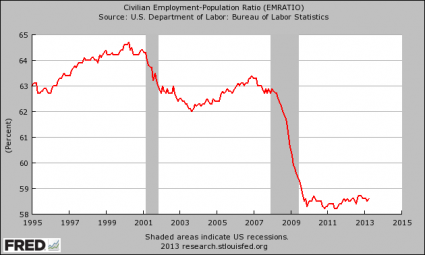 The percentage of the population that has jobs. In the U.S. this percentage increased for a
number of decades following World War II as growing numbers of women had to find jobs
outside the home to help maintain family income levels (as real wages of men began to fall).
However, in recent years, more and more people (men and women both) have been laid off and
have been unable to find new jobs, as the economic crisis continues to develop. And many
young adults who look for jobs once they are out of school cannot find them at all. The
drop in this employment/population ratio was especially sharp in the
“Great Recession” of 2008-9. Note that despite phony
claims by the government that the unemployment rate has been falling since then, the
employment/population ratio has remained low and essentially unchanged. A new recession
will cause it to drop even further.
The percentage of the population that has jobs. In the U.S. this percentage increased for a
number of decades following World War II as growing numbers of women had to find jobs
outside the home to help maintain family income levels (as real wages of men began to fall).
However, in recent years, more and more people (men and women both) have been laid off and
have been unable to find new jobs, as the economic crisis continues to develop. And many
young adults who look for jobs once they are out of school cannot find them at all. The
drop in this employment/population ratio was especially sharp in the
“Great Recession” of 2008-9. Note that despite phony
claims by the government that the unemployment rate has been falling since then, the
employment/population ratio has remained low and essentially unchanged. A new recession
will cause it to drop even further.