LUDWIG FEUERBACH AND THE END OF CLASSICAL GERMAN PHILOSOPHY [Book]
An important philosophical work by Engels, first published in 1886. This work is available
online in several places, including:
http://www.marxists.org/archive/marx/works/1886/ludwig-feuerbach/index.htm
“In Ludwig Feuerbach (the full title is Ludwig Feuerbach and
the Outcome of Classical German Philosophy) Engels shows how the advance was made from
Hegelian idealist dialectics to materialist dialectics, and from mechanical to dialectical
materialism.
“Feuerbach
was a German philosopher of the mid-19th Century who turned from Hegelian idealism to
materialism, and whose work had a big influence on Marx and Engels. This book by Engels,
published in 1888, was originally written as a review article on a book on Feuerbach by
C. N. Starke.
“The following are its principal contents.
“1. Engels explains the basic difference
between materialism and idealism. It arises from the question—which is prior, spirit or
nature? Idealism says that spirit is prior to nature. Materialism says that nature is
prior to spirit. Material being is prior to mind and ideas.
“Modern idealism has been specially
concerned with the question whether we can gain reliable knowledge of material things, of
the external world, and concludes that such knowledge is impossible. Engels refutes this
view, and shows that practice demonstrates that our ideas can and do constitute a true
reflection of external material reality.
“2. He shows that the materialism of the
past was mechanical materialism. Its great limitations were
(a) that it conceived of
the motion of matter as exclusively mechanical motion, and could not grasp other forms of
motion of matter, such as chemical or living processes;
(b) that it could give
no account of development and evolution, either in nature or, still less, in history and
human society.
“3. He explains the essence of Hegel’s
philosophy and of the advance from Hegel to dialectical materialism. Hegel considered
every process of change and development as being a mere reflection of the self-development
of the ‘Absolute Idea,’ which ‘does not only exist, where unknown, from eternity, but is
also the actual living soul of the whole existing world.’ Marxism threw over such
‘idealist fancies’ and ‘resolved to comprehend the real world, nature and history, just
as it presents itself to everyone who approaches it free from preconceived idealist
fancies.’
“Engels shows that dialectical materialism
regards the world as a complex of processes, not as a collection of ‘ready-made things.’
Dialectics is ‘the science of the general laws of motion both of the external world and
of human thought.’
“4. He discusses the essential ideas of
historical materialism, as the application of dialectical materialism to the sphere of
human society. He shows that the driving force of history is the class struggle, and that
classes and class struggles are rooted in economic conditions. He goes on to discuss the
economic foundations of the development of the state and of law, and then of political
and social ideology, of religion, philosophy, etc.
“In criticizing Feuerbach’s ‘philosophy
of religion and ethics,’ Engels attacks the approach which deals with abstractions such
as ‘humanity,’ instead of with ‘real living men as participants of history.’
“As appendix are added Marx’s eleven
Theses on Feuerbach, notes by Marx in 1845
in which he summarized his own ideas as opposed to mechanical materialism.” —Maurice
Cornforth, ed., Readers’ Guide to the Marxist Classics (1952), pp. 25-26.
LUMPENPROLETARIAT
The lowest social class consisting primarily of those pushed down and out from other social
classes, including especially from the working class (proletariat) but also from the
petty bourgeoisie, from the peasantry (in countries
where that class still exists), and even from the bourgeoisie itself in some cases. Thus, the
declassed individuals from other classes, who have fallen upon severely hard times,
and who try to survive as best they can by hand-to-mouth methods, as beggars, vagrants, living
on the streets, or as prostitutes and pimps, through petty thievery or other small-scale crime,
as drug addicts or as street level drug dealers, by sponging off of relatives or others, and
through help from individual or small-scale charities and soup kitchens, and from the very
inadequate government welfare programs where such programs actually exist.
The word ‘lumpenproletariat’ was coined by
Marx and Engels in their early work, The German Ideology
(1845-46). ‘Lumpen’, in German, originally meant “rags”, and later evolved to refer to those
dressed in rags, beggars and scoundrels. The modern lumpenproletariat, whether dressed in rags
or not, often amounts to those who are the dregs of society and in many cases the most extreme
victims of capitalist society. Are they therefore potentially revolutionary? In some cases,
certainly. But their conditions of life (which Marx & Engels refer to in the first quotation
below), which leads them into an isolated, individual struggle for existence and thus often into
a bitter and extreme individualist perspective (“I have no choice but to look out for myself,
so to hell with everyone else”), generally prevents them from seriously engaging in real
revolutionary struggle—unless they come under strong, organized and disciplined revolutionary
proletarian leadership. The lumpenproletariat is overall characterized by a lack of class
consciousness and solidarity.
There have been a few attempts to build a
revolutionary movement with the lumpenproletariat as a major part of its core, but these have
not been at all successful. One such abortive attempt was made in the U.S. during the early
1970s by a split-off from the Revolutionary Union led by the Stanford
University professor Bruce Franklin. That effort, which hoped to base itself on the revolutionary
student movement in combination with lumpen elements which it considered were leading the Black,
Chicano and other national liberation movements in the U.S., fell apart before it could hardly
even get seriously underway. (See Venceremos
Organization.) Before that futile attempt, though, Franklin did write an interesting
article, “The Lumpenproletariat and the Revolutionary Youth Movement” (1969), which appeared
in the RU’s Red Papers 2 and is also available separately online at:
https://www.marxists.org/history/erol/ncm-1/red-papers-2/franklin.htm In that
1960s-1970s era the Black Panther Party also had a
strong pro-lumpenproletariat focus (see Huey Newton quote below), which—along with vicious
attacks on the Panthers by U.S. government agencies—were an important reason for its collapse.
At the present time, though, it is mostly just a few isolated anarchists who still favor a
revolutionary strategy centered on the lumpenproletariat.
It is true, however, that as the current social
and economic crisis of the U.S. and world capitalist system continues to worsen, and as more
and more jobs disappear because of automation and the rapid
development of artificial intelligence, the size
and importance of the lumpenproletariat in modern society is bound to increase, perhaps very
rapidly at some points. For this reason, any rational strategy of social revolution will have
to take this into consideration and find ways to involve the best sections of the
lumpenproletariat in mass struggle under the leadership of the revolutionary proletariat. (See
LUMPENPROLETARIANIZATION entry
below.)
“The ‘dangerous class’, [lumpenproletariat] the social scum, that passively
rotting mass thrown off by the lowest layers of the old society, may, here and there, be
swept into the movement by a proletarian revolution; its conditions of life, however,
prepare it far more for the part of a bribed tool of reactionary intrigue.” —Marx & Engels,
Communist Manifesto (1848), ch. 1.
“On the pretext of founding a benevolent society, the lumpen proletariat of
Paris had been organized into secret sections, each section led by Bonapartist agents, with
a Bonapartist general at the head of the whole. Alongside decayed roués with dubious means
of subsistence and of dubious origin, alongside ruined and adventurous offshoots of the
bourgeoisie, were vagabonds, discharged soldiers, discharged jailbirds, escaped galley
slaves, swindlers, mountebanks, lazzaroni [street people in Naples], pickpockets, tricksters,
gamblers, maquereaux [pimps], brothel keepers, porters, literati, organ grinders,
ragpickers, knife grinders, tinkers, beggars — in short, the whole indefinite, disintegrated
mass, thrown hither and thither, which the French call la bohème; from this kindred
element Bonaparte formed the core of the Society of December 10. A ‘benevolent society’ —
insofar as, like Bonaparte, all its members felt the need of benefiting themselves at the
expense of the laboring nation. This Bonaparte, who constitutes himself chief of the
lumpenproletariat, who here alone rediscovers in mass form the interests which he
personally pursues, who recognizes in this scum, offal, refuse of all classes the only class
upon which he can base himself unconditionally, is the real Bonaparte, the Bonaparte sans
phrase.” —Marx, The Eighteenth Brumaire of Louis Bonaparte (1852), ch. 5.
“Why the future upswing should be ‘characterized’ by a sharp conflict of
pauperized petty bourgeois is not evident at all. Nor does there appear to be any reason why
the pauperized town petty bourgeoisie should be brought in just at this moment.
Lumpen-proletarians are sometimes distinguished for their sharp conflicts, and sometimes for
their amazing instability and inability to fight.” —Lenin, “A Caricature of Bolshevism”
(April 4 (17), 1909), LCW 15:383.
“Apart from all these [other classes], there is the fairly large
lumpen-proletariat, made up of peasants who have lost their land and handicraftsmen
who cannot get work. They lead the most precarious existence of all. ... One of China’s
difficult problems is how to handle these people. Brave fighters but apt to be destructive,
they can become a revolutionary force if given proper guidance.” —Mao, “Analysis of the
Classes in Chinese Society” (March 1926), SW1:19.
“China’s status as a colony and semi-colony has given rise to a multitude of
rural and urban unemployed. Denied proper means of making a living, many of them are forced to
resort to illegitimate ones, hence the robbers, gangsters, beggars and prostitutes and the
numerous people who live on superstitious practices. This social stratum is unstable; while
some are apt to be bought over by the reactionary forces, others may join the revolution. These
people lack constructive qualities and are given to destruction rather than construction; after
joining the revolution, they become a source of roving-rebel and anarchist ideology in the
revolutionary ranks. Therefore, we should know how to remold them and guard against their
destructiveness.” —Mao, “The Chinese Revolution and the Chinese Communist Party” (December
1939), SW2:325-6.
“As the ruling circle continue to build their technocracy, more and more of
the proletariat will become unemployable, become lumpen, until they have become the popular
class, the revolutionary class.” –Huey Newton, “Supreme Commander” of the Black Panther Party,
quoted in: Garrett Epps, “Huey Newton Speaks at Boston College, Presents Theory of
‘Intercommunalism’”, The Harvard Crimson, November 19, 1970, online at:
http://www.thecrimson.com/article/1970/11/19/huey-newton-speaks-at-boston-college/
[Epps also reported: “The Panthers seek
to organize the ‘unemployable’ elements of society, or ‘lumpenproletariat,’ Newton said,
because they form the only revolutionary class in technological society.” The
Black Panther Party was internally torn between
proletarian tendencies and lumpen tendencies. Leaders such as
Fred Hampton represented the best of the proletarian
revolutionary tendencies, while–unfortunately–Party co-founder and top leader Huey Newton,
represented some of the destructive lumpen tendencies which were a major part of the reason
for the eventual disintegration of the BPP. –Ed.]
LUXEMBURG, Rosa (1871-1919)
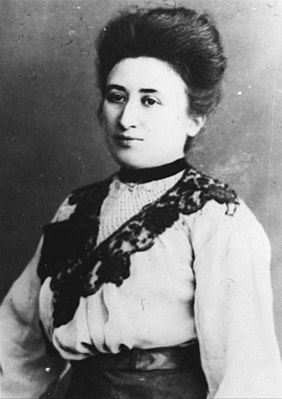 Outstanding revolutionary Marxist who participated in the Polish, German and international proletarian
movements. She was a prominent Left-wing leader of the Second International, and one of the founders
of the Communist Party of Germany. Luxemburg was what every communist should be: an independent thinker,
even while being guided by a deep study of the Marxist classics and a determined participation in mass
struggles. However, sometimes this independence of mind did mean that she was wrong about some particular
issues. Often, however, she was right when others were wrong, especially with regard to upholding a
strong class perspective, and a solid revolutionary firmness and dedication.
Outstanding revolutionary Marxist who participated in the Polish, German and international proletarian
movements. She was a prominent Left-wing leader of the Second International, and one of the founders
of the Communist Party of Germany. Luxemburg was what every communist should be: an independent thinker,
even while being guided by a deep study of the Marxist classics and a determined participation in mass
struggles. However, sometimes this independence of mind did mean that she was wrong about some particular
issues. Often, however, she was right when others were wrong, especially with regard to upholding a
strong class perspective, and a solid revolutionary firmness and dedication.
Rosa Luxemburg was born into a Jewish family in Tsarist
Russian-controlled Poland. Although multi-lingual, at home the family spoke Polish and viewed themselves
as Polish nationals. At the age of five Luxemburg was bed-bound with a hip problem which left her with a
permanent limp. She once described herself physically as “a heap of rags”. But as a human being she was
a giant. She began taking part in revolutionary activities very early in life. In 1886 she joined the
Polish left-wing Proletariat Party (which was founded in
1882), and interestingly enough, soon took part in organizing a general
strike. But the authorities cracked down hard, executed four of the Party leaders, and officially
disbanded the Party. (However, some of the remaining members, including Luxemburg, kept meeting in secret,
according to the Wikipedia, where some of the information here comes from.)
In 1889, at about the age of 18, Rosa Luxemburg fled to
Switzerland to both escape political detention and to continue her education. There, financially supported
by her businessman father, she attended the University of Zurich and studied history, economics, philosophy,
and mathematics, while specializing in political science, and economic and financial crises. Her
dissertation, “Die Industrielle Entwicklung Polens” [“The Industrial Development of Poland”] was presented
in 1897 and published the next year, and she was awarded a Doctor of Law degree. As the Wikipedia notes, it
was exceedingly rare for a woman to obtain a doctoral degree in Zurich (or anywhere else!) at that time.
Luxemburg then immediately immersed herself in international
revolutionary politics, often following the line and path of George
Plekhanov and Pavel Axelrod. In 1893, together with Leo Jogiches and Julian Marchlewski (alias Julius
Karski), she founded the Polish-language newspaper Sprawa Robotnicza [The Workers’ Cause] that
disagreed with the line of the Polish Socialist Party (which focused most centrally on Polish national
liberation). Luxemburg thought that goal was virtually impossible to achieve until the surrounding
imperialist countries of Germany, Austria-Hungary, and Russia were all toppled by socialist revolutions.
Moreover, even after such revolutions might become successful, she strongly favored the unity of the
proletariat in a single new socialist state. She even denied that oppressed nations, such as Poland, should
have a national right of self-determination! This led to a strong criticism by Lenin, who, however, did
certainly agree that the continued unity of the different nations and nationalities within a single
socialist state would be the very best outcome.
In 1899 Luxemburg, along with
Felix Dzerzhinsky and Leo Jogiches, led in merging what were then
called the social-democratic (i.e., Marxist) organizations in Poland and Lithuania, and then in founding
the new revolutionary party, the Social Democracy of the Kingdom of Poland and Lithuania (SDKPiL). Although
all three of these revolutionaries favored a united revolutionary movement and single revolutionary party,
ultimately throughout the entire Russian Empire and beyond, the situation at that time was unfavorable for
this in Poland and some other areas. Dzerzhinsky, though, and after a series of prison terms, did end up as
an important leader of the Bolsheviks. However, Luxemburg, because of her exile in the West, ended up as an
important revolutionary leader in Germany, as well as (from exile) in Poland. She was in fact the leading
theoretician for the SDKPiL. But she always kept her internationalist perspective.
Luxemburg entered a “marriage of convenience” which
allowed her to become a German citizen and live in Germany, and moved to Berlin in May 1898. She immediately
took up the struggle against Eduard Bernstein’s revisionist corruption
of Marxism, which had become so rampant. Her pamphlet “Social Reform or Revolution?” came out that autumn,
and was a major statement of the developing Left-wing opposition to Bernsteinism and revisionism in general.
She and the Left were unable to force Bernstein and his followers out of the Social-Democratic Party of
Germany (SPD), though at least for the time being they were not in total control of it.
Luxemburg wrote many articles for the socialist press,
and was in particular quite prescient in her strong and sustained opposition to the growing war pressures
which eventually led to World War I. She was especially alarmed by the intensifying militarism of Germany,
in part because that was where she was located and thus had a particular obligation to struggle against
such developments there, and in part because Germany—as a rising capitalist-imperialist power—was
destabilizing the existing international situation and leading it towards a major inter-imperialist war.
Luxemburg strongly pushed for a general strike of workers in Germany to force the government to end its war
preparations. It is highly doubtful that this would have actually prevented the looming war, even if it had
been tried, though it might have at least increased proletarian political class consciousness and helped
prepare the working class for some more substantial opposition to the war once it did begin. In any case,
Karl Kautsky and the other top SPD leaders, who themselves were moving
in a revisionist and more bourgeois nationalist direction, opposed the general strike idea and kept it
from happening. Luxemburg broke with Kautsky politically in 1910.
However, even before that, in the 1904 to 1906 period,
she was imprisoned because of her political and anti-war activities on three different occasions. In 1907,
after her third release, Luxemburg traveled to London to attend the Russian Social Democrats’ Fifth Party
Day conference, where she met Lenin. Later that year, at the socialist Second International Congress in
Stuttgart, she and Lenin participated in further improving Bebel’s draft resolution on ‘Militarism and
International Conflicts’ by adding the amendment that it was the duty of socialists to use the crisis
created by a war to revolutionize the masses and to overthrow capitalism. This very important amendment
was then approved by the 1907 Congress, and reaffirmed by the Second International conferences in 1910
and 1912.
In 1912, Luxemburg represented the SPD at the congresses
of European socialists. Together with the French socialist Jean Jaurès,
she once-again argued that European workers’ parties should organize a general strike if and when war broke
out. (Jaurès was not actually a revolutionary, but he was strongly opposed to militarism.) In 1913, she told
a large meeting: “If they think we are going to lift the weapons of murder against our French and other
brethren, then we shall shout: ‘We will not do it!’” However, when the assassination in the Balkins of
Archduke Ferdinand of Austria-Hungary triggered a series of events leading to the beginning of World War I
in 1914, the opportunists like Kautsky who controlled the socialist parties of the Second International,
failed to act as they had promised to try to stop the War, and even came out in open support of it! There
was no serious attempt at a general strike in Germany, France or elsewhere, or any other major mass actions.
Instead the Reichstag (German parliament) unanimously agreed to finance the war, including even the SPD
delegates. Instead of opposing the war in any way, the SPD agreed to the Burgfrieden
truce with the capitalist ruling class, which “suspended” the class struggle for the duration of the war,
and promised not to even engage in any economic strikes.
This terrible result deeply depressed Luxemburg, and it is
said that she even briefly contemplated suicide. But she soon rallied her resolve to keep struggling against
the opportunist and revisionist traitors to the working class and against the capitalist enemy. She led in
organizing anti-war demonstrations in Frankfurt, and called for conscientious objection to military
conscription and for the refusal by drafted soldiers to obey orders. Of course the ruling class was outraged
by this, and sentenced her to prison again for “inciting to disobedience against the authorities’ law and
order”.
In August 1914, the best of the prominent revolutionary
leftists from the SPD, led by Luxemburg, Karl Liebknecht, Clara Zetkin and Franz Mehring, founded Die
Gruppe Internationale (“The International Group”). They wrote and distributed a number of illegal
anti-war pamphlets signed with the name “Spartacus”, after the great slave revolt leader in Roman times.
For this reason they soon became known as the “Spartacists” and in January 1916 changed their name to the
“Spartakusbund” [Spartacus League]. At this time Luxemburg had her own nom de guerre, “Junius”, after
the founder of the Roman Republic, Lucius Junius Brutus. Under this name she wrote the powerful “Junius
Pamphlet” against the war.
Luxemburg spent most of World War I in prison, where she
did a lot of study and a lot of writing, including on political economy. (See the separate entries below
about her views on economics and capitalist imperialism.) But finally, in November 1918, the German war
effort collapsed and the first stage of a social revolution broke out in Germany. The Emperor, Kaiser
Wilhelm II, was overthrown and exiled, and a German republic was declared. All the political prisoners were
released from prison, including Rosa Luxemburg. The Social-Democratic Party of Germany [SPD] had split in
1917, with the anti-war faction now forming a new party, the Independent Social-Democratic Party of Germany
[USPD]. However, this party too, was still basically reformist and not revolutionary. The Spartacus League,
led primarily by Luxemburg and Karl Liebknecht, now operated as a revolutionary faction within the USPD.
The German government was now in the hands of the opportunist,
slightly reformist bourgeois nationalists of the SPD and the USPD, and was headed by Friedrich Ebert (who was,
ironically, a former student of Luxemburg’s). This government had taken the credit for ending the war after
four bloody years, and for having gotten rid of the Kaiser and establishing a republic, had signed the
Armistice, and promised more reforms and a much better life for the German people. (All bourgeois parties
make such promises, of course.) For these reasons Ebert initially had widespread support, not only from the
rather discredited military and ruling-class establishment which was looking for a government that could calm
things down, but also from a great many German workers, including it is said, a majority of those in
the new workers’ and soldiers’ councils which were being set up all around the country (and which of
course were inspired by the soviets in revolutionary Russia). The Ebert government
also initially had the support of most ordinary USPD members, with the exception of the small Spartacus League
within it.
Given this widespread initial support for the reformist
SPD/USPD government at that time, in retrospect the obvious strategy of the revolutionary forces should have
been to bide their time, engage in exposures about the inactions and failures of the government, find out from
the people their most urgent unmet needs and try to lead them in struggle around those issues, and wait briefly
for the workers and masses to see for themselves that the SPD/USPD government needed to be overthrown and replaced
by a government of the new workers’ councils. This is what Lenin correctly insisted that the Bolsheviks do in
Russia during the summer of 1917. The other argument at the time, however, may have been that in some areas
(especially Berlin) the revolutionary-minded workers were already on the move, and simply had to be joined
up with and led to victory. “Strike while the iron is hot!”, as the saying goes. Anyway, from the historical
perspective it does appear that the German revolutionary movement of the time, and its small core of leaders,
were not in sufficient control of the situation, and/or may have moved too precipitously, in what came close
to being merely a putsch attempt.
Luxemburg and the Spartacists called for a wider and deeper
revolution, called for the immediate nationalization of industry, the arming of the workers, the removal of
all the old government civil servants and military leaders, and for strong support for Soviet Russia. On
New Years Eve, 1918, they formally split away from the USPD and established the Communist Party of Germany
(KPD). The top two leaders of the KPD were, of course, once again Rosa Luxemburg and Karl Liebknecht. So far,
perhaps, so good! However, less than one week later armed fighting broke out in Berlin, which it seems
definitely was premature from the revolutionary perspective. The Spartacist/KPD newspaper, Die Rote Fahne
[“The Red Flag”] called on the rebels to occupy the offices of the bourgeois newspapers, and then all the
positions of political power. On January 8, 1919, Die Rote Fahne printed a public statement by Luxemburg
calling for revolutionary violence and no negotiations with the revolution’s “mortal enemies”, the Friedrich
Ebert-Philipp Scheidemann government. Supporting the government were the divisions of soldiers loyal to it,
known as the Freikorps [“Free Corps”]. The revolutionary side consisted of the KPD, demonstrators
supporting various other left organizations (including anarchists and some supporters of the USPD), and the
revolutionary shop stewards in the region. Alas, the pro-government troops were greater numbers, were better
armed and organized, and after several days of heavy fighting they were able to crush the uprising. The
government and the press called this the “Spartacist Uprising” though perhaps it was more of a semi-spontaneous
event. Even so, it appears that the Spartacists/KPD forces should have tried to avoid this premature uprising,
and should in fact have told the masses to wait a bit for a better time when conditions would be more certain
of success.
On January 15, 1919, both Rosa Luxemburg and Karl Liebknecht
were arrested and interrogated by the government. And then they were brutally murdered. Luxemburg’s
body was dumped in a canal, and was only recovered six months later. The anniversary of her murder remains
a revolutionary holiday to this day, with annual mass demonstrations to mark it.
The loss of the KPD’s top two leaders, was a huge blow to
the new Communist movement in Germany. And it was accompanied by a much broader vicious crackdown which
included the cold-blooded extrajudicial murder of many other Communists and revolutionary workers. One can
only wonder how different the world might be today if circumstances had been just a little different at the
time. If, for example, the Communist movement had been just a little more developed and prepared. Possibly a
second revolution, a genuinely socialist revolution, might have actually occurred in Germany following World
War I. Quite possibly most of Europe might then have had a socialist revolution. And, for such reasons, the
world might have been spared from the rise of Hitler and the Nazis.
Should we blame Rosa Luxemburg, Karl Liebknecht and their
comrades for not making this better result happen back then? No, we really cannot, despite some errors they
made. They did their very best under extremely difficult and dangerous conditions. They were real heroes who
we should always remember as such. The real blame for the failed German and European revolutions in the
aftermath of the First World War, should land on the heads of the traitorous revisionists like Karl Kautsky
and his fellow phony “socialists”. And, of course, on the murderous enemy bourgeoisie as a whole.
See also the entries below.
“In response to the uprising [in early January 1919], German Chancellor and SPD leader
Friedrich Ebert ordered the Freikorps to destroy the left-wing revolution, which was crushed by 11 January
1919. Luxemburg’s Red Flag falsely claimed that the rebellion was spreading across Germany. On 10
January, Luxemburg called for the murder of Scheidemann’s supporters and said they had earned their fate.
The uprising was small-scale, had limited support and consisted of the occupation of a few newspaper
buildings and the construction of street barricades. Luxemburg and Liebknecht were captured in Berlin on
15 January 1919 by the Rifle Division of the Cavalry Guards of the Freikorps (Garde-Kavallerie-Schützendivision).
Its commander Captain Waldemar Pabst, with Lieutenant Horst von Pflugk-Harttung, questioned them under
torture and then gave the order to summarily execute them. Luxemburg was knocked down with a rifle butt by
the soldier Otto Runge, then shot in the head, either by Lieutenant Kurt Vogel or by Lieutenant Hermann
Souchon. Her body was flung into Berlin’s Landwehr Canal. In the Tiergarten [zoo], Liebknecht was shot and
his body, without a name, brought to a morgue.” —From the Wikipedia article on Rosa Luxemburg, downloaded
February, 2022.
LUXEMBURG, Rosa — Disputes with Lenin
Over a period of more than two decades Rosa Luxemburg and V. I. Lenin were international Marxist
comrades, and were involved in common struggles against German and international revisionism, against
imperialist war, and for proletarian revolution everywhere. But they also had quite a few secondary
differences between them, which arose at different times, including during some periods when Luxemburg
was in prison and was somewhat cut off from extensive knowledge of outside and foreign events. These
disputes may have also been aggravated in part because of the fact that both of them wrote extensively
in the revolutionary press, which led to their differences usually being very public. In most cases it
now seems to us, in light of the further development of MLM theory and in light of historical
developments, that Lenin was generally correct in these disputes, especially with regard to political
issues. However, with regard to certain more theoretical questions in the political economy of
capitalism Luxemburg was sometimes right while Lenin was at least partly wrong.
In particular, Marxist-Leninist-Maoists now usually
conclude that Luxemburg was basically wrong in her promotion of the revolutionary strategy in advanced
capitalist countries centered on the general strike, as opposed to
organized mass insurrection at the appropriate time after a long period of mass agitation and
organizational work, and in the context of some major crisis for the ruling class such as a depression
or mass opposition to some horrible war. It now seems to revolutionary Marxists that her views on this
important issue leaned in the direction of relying too much on trade unionism and mass
spontaneity. And, partially in connection with this, we now think that
Luxemburg was unjustly critical of the supposed “un-democratic” nature of the Bolsheviks and the October
Revolution. (However, as Lenin notes in the quotation below, she did in fact change her position on
many of these political issues once she was released from prison and got a better grasp of the situations
in both Germany and Russia.)
With regard to the disputes between Lenin and Luxemburg
over political economy, the situation was more mixed. He was certainly right to criticize what many
have—perhaps falsely—considered to be the central theme of her book The Accumulation of Capital
(1913), that capitalism can only exist while there are external markets in non-capitalist countries
for the excess production under capitalism. (This same argument had been used by the Russian Narodniks to
argue that capitalism could not possibly fully develop in Russia, which led Lenin to write a whole book
explaining how and why capitalism had actually been developing, and was in fact still further developing,
in Tsarist Russia.)
On the other hand, there were also some serious
weaknesses in Lenin’s own understanding of Marx’s theory, especially with regard to the nature of
capitalist economic crises. Partly because Lenin did not have access to Marx’s massive work Theories
of Surplus Value [TSV], he actually accepted the validity of Say’s
“Law” in some of his early essays, and never corrected himself on that point. Say’s so-called “Law”
is the thesis that capitalist production invariably and automatically produces its own entire
market for the commodities produced, and thus that there can be no capitalist overproduction (or “gluts”)
resulting from the normal everyday operation of the capitalist system of production. This is completely
mistaken. In TSV Marx ridicules “Say’s Law”, and all the bourgeois defenders of it (including Ricardo).
But Lenin, in his 1897 article “A Characterization of Economic Romanticism”, wrote that the classical
bourgeois economists “advanced the perfectly correct idea that production creates a market for itself
and itself determines consumption.” [LCW 2:148] This is a clear (and quite erroneous) affirmation by
Lenin of what is now called Say’s “Law”. In the next paragraph, Lenin adds: “Further, the failure to
understand that production creates a market for itself leads to the doctrine that surplus-value cannot
be realized.” Again, this is a rather clear affirmation of what we now call “Say’s Law”. What this
meant was that Lenin’s understanding of the basic cause of capitalist economic crises was wrong. He
attributed such crises to the anarchy of production under capitalism, and not to the
overproduction of commodities and of the means of production themselves. (Unfortunately, many who have
learned political economy more from Lenin than from Marx himself have made this same error. Thus the
Revolutionary Communist Party, USA, also upholds the “anarchy” theory of crises, rather than the far
more fundamental overproduction/overaccumulation theory. See for
example their 1984 book, America in Decline.)
So Lenin failed to fully appreciate the centrality of
the overproduction of capital itself in capitalist society, a point on which Luxemburg was clear
and insistent. In his pamphlet and writings on imperialism, Lenin did come to appreciate the need for
the capitalists in the imperialist countries to both increase foreign sales of commodities, and even
more so, the need to export capital. But it seems he never drew the explicit conclusion that
these increased needs were the direct result of overproduction of both commodities and of productive
capital within the home country. If he had, he might have been forced to reconsider his earlier
rejection of the overaccumulation theory championed by Rosa Luxemburg.
In addition to this central dispute in political
economy between Lenin and Luxemburg, there were a number of more minor issues where she was right and
he was wrong, such as Lenin’s total dismissal of the contributions of Sismondi
in the development of political economy. (See Luxemburg’s comments on that on pages 188-189 of
The Accumulation of Capital [MR edition], and in light of Marx’s relative praise of Sismondi in
comparison with Ricardo in TSV.)
Any two thinking Marxist revolutionaries will of course
have some differences between them, despite their general unity and extensive shared understanding. We
see this in the case of Rosa Luxemburg and V. I. Lenin, and it should in no way bother us that this is
the case! It is from the dialectical struggle among excellent individual thinkers, and especially those
with good connections to the masses, that the full truth arises.
“[Speaking of the renegade, Menshevik-like, German ‘Communist’ Paul Levi:] Paul
Levi now wants to get into the good graces of the bourgeoisie—and, consequently, of its
agents, the Second and the Two-and-a-Half Internationals—by republishing precisely those writings
of Rosa Luxemburg in which she was wrong. We shall reply to this by quoting two lines from a good
old Russian fable, ‘Eagles may at times fly lower than hens, but hens can never rise to the height
of eagles.’ Rosa Luxemburg was mistaken on the question of the independence of Poland; she was
mistaken in 1903 in her appraisal of Menshevism; she was mistaken on the theory of the accumulation
of capital; she was mistaken in July 1914, when, together with Plekhanov, Vandervelde, Kautsky and
others, she advocated unity between the Bolsheviks and Mensheviks; she was mistaken in what she
wrote in prison in 1918 [about the Bolsheviks and the Russian Revolution] (she corrected most of
these mistakes at the end of 1918 and the beginning of 1919 after she was released). But in spite
of her mistakes she was—and remains for us—an eagle. And not only will Communists all over the
world cherish her memory, but her biography and her complete works (the publication of
which the German Communists are inordinately delaying, which can only be partly excused by the
tremendous losses they are suffering in their severe struggle) will serve as useful manuals for
training many generations of Communists all over the world. ‘Since August 4, 1914, German
social-democracy has been a stinking corpse’—this statement will make Rosa Luxemburg’s name
famous in the history of the international working-class movement. And, of course, in the backyard
of the working-class movement, among the dung heaps, hens like Paul Levi, Scheidemann, Kautsky
and all that fraternity will cackle over the mistakes committed by the great Communist.” —Lenin,
“Notes of a Publicist” (February 1922), LCW 33:210-211. [The date “August 4, 1914” Luxemburg
mentioned above refers to the date the Social-Democratic faction in the Reichstag (German
parliament) voted with the bourgeois representatives to provide 5 billion marks for World War I,
thereby supporting Wilhelm II’s imperialist war.]
[In the last years of Lenin’s life, when his focus was naturally on the political
struggles occurring within the great Russian Revolution, he in effect turned over theoretical
disputes on political economy to other comrades, especially Nikolai Bukharin. And thus it was
Bukharin, in 1924 and shortly after Lenin’s death, who published the major Bolshevik critique of
Luxemburg’s 1913 book The Accumulation of Capital. Bukharin’s short book was entitled
Imperialism and the Accumulation of Capital. But it has to be said that Bukharin was not at
all a very good Marxist theoretician, in political economy, philosophy, or any other area. His book
focuses on technical issues, relating mostly to the question of whether Luxemburg was right or
wrong in the details of the dispute over Marx’s examples of expanded reproduction from Volume 2 of
Capital (which Marx himself never even finished). But far more important than any of that
is, once again, the issue of how one understands the basic cause and nature of major capitalist
economic crises. And in this regard, Bukharin follows Lenin in arguing that these crises are due to
the anarchy of production under both classical and monopoly capitalism. Thus Bukharin actually
makes the argument in his book that a hypothetical state capitalism (where the anarchy of
production is removed) will no longer suffer major economic crises! The severe and ever-growing
economic problems of the state-capitalist Soviet Union from at least the 1960s until the collapse
of the USSR in 1991 sure proved that idea wrong!
[See Chapter 3, section 4, of Bukharin’s
book, especially p. 226 in the 1972 MR joint edition with Luxemburg’s “Anti-Critique”.
[It may in fact be quite possible for the
revolutionary proletariat to use state capitalism without major crises in a brief transition
period from capitalism to socialism (as was done in both the Soviet Union in its first decade and
in the People’s Republic of China in its first few years). But state capitalism, like all other
forms of capitalism, will simply not work without very serious and growing crises over the long
run. —S.H.]
LUXEMBURG, Rosa — Political Economy Of
Rosa Luxemburg seriously studied not only Marxist political theory and revolutionary strategy, but also
the political economy of capitalism, and particularly crisis theory and capitalist imperialism. She also
taught political economy classes to SPD members in Berlin. Even earlier, while a student herself at the
University of Zurich, she was especially concerned with capitalist economic and financial crises, which
are discussed in her doctoral thesis on The Industrial Development of Poland [in German, 1898]. In
later years, as a well-known Marxist political writer, she published a widely read (and also widely
criticized!) book, The Accumulation of Capital (1913). Other than her doctoral thesis, this was her
only economics book published in her lifetime. But she also wrote additional works on political economy,
including her short book, The Accumulation of Capital—An Anti-critique, which was a reply to the
critics of her earlier volume, as well as providing a good summary of that earlier work. This reply was
written in 1915 while she was in prison because of her strenuous anti-war efforts. And she wrote yet
another book, Introduction to Economics, while she was still in prison in 1916, which was only
partially published (in German) in 1925, and even then mostly only in rough draft form.
In her 1913 book, The Accumulation of Capital,
Luxemburg argued that modern capitalism requires imperialism in order to continue to exist, because
capitalist production produces more than it can possibly sell in its home market. There is some very
considerable truth to this general thesis! However, there were some serious errors in precisely how and why
she thought this must be the case. In particular, her view that only the acquisition of markets in
non-capitalist economies (such as pre-capitalist feudal economies in imperialist colonies) would
provide an outlet for the overproduction inherent in capitalism, was
incorrect. The basic problem in her analysis was that she didn’t see that continuing overproduction is in
fact possible within capitalist countries, and indeed that it might even proceed for fairly long
periods of time, not only between crises but even continuing through many of them. (The implicit
view of many Marxists that each recession, or depression, wipes out absolutely all of the
overproduction in the earlier period is not true; this only occurs, or nearly occurs, in the very
worst overproduction crises. Thus the level of overproduction in the U.S. economy has overall been
increasing—by fits and starts—ever since World War II, though there have been temporary partial
declines during recessions.)
Luxemburg did not sufficiently appreciate that modern
capitalism was in the process of developing and extending other very powerful ways to artificially
and temporarily expand its markets, both in its home countries and abroad. These ways primarily involve the
great expansion of credit and debt. There are places in Marx where he talks about various aspects of
this, as in Chapter XXVII in volume III of Capital, on “The Role of Credit in Capitalist Production”,
where he even states that “the credit system appears as the main lever of over-production...” and that “the
credit system accelerates the material development of the productive forces and the establishment of the
world market”. [International ed. (1972), Vol. III, p. 441.] And this is why Luxemburg was wrong to think
that Marx had made a mistake in his system which implied that capitalism really could not work at all. In
reality it “works” for a long time, though in a very dialectically contradictory fashion.
However, even Marx did not foresee how immensely more
important the expansion of credit and debt would become for the continuation of capitalism in what we
now refer to as its imperialist (or monopoly capitalist) stage, and most especially in its current late
period. So perhaps we can pardon Rosa Luxemburg (along with virtually everyone else at the time,
including Lenin) for also not sufficiently recognizing the possibility that the future vast expansion of
credit and debt, along with the new imperialist form of capitalism, which among other things involves the
partial merger of the state with capitalist corporations, might enable capitalism to last about one
additional century beyond what we might otherwise view as its “natural life span”! All this is now becoming
much clearer, as the colossal debt expansion over the past 80 years approaches its final extreme limits.
Luxemburg really was correct in claiming that Marx’s theory
implies that capitalism just can’t work in the very long run, and specifically because of the fact
that the growth of capitalist markets cannot keep up with the expansion of production (as Marx put it, and
as Engels also stated in Anti-Dühring). But what she didn’t understand is that there is this
artificial way of making it seem to be working for quite a long while—namely, the ever-greater, ever-faster
expansion of credit and debt, for as long as that continues to be possible.
Other Marxists, especially Hilferding
in 1910, and following him, Lenin, emphasized that a new essential feature of capitalist-imperialism was the
increasing need to export capital to other countries as well as to further increase manufactured
exports. But while Luxemburg saw that trend too, she focused more on the logical flaw in the theory if we
are really going to be talking about overproduction. Obviously, if all capitalist countries are
overproducing, then they can’t really ease the problem by exporting excess capital to each other’s countries
and thereby further increasing production there as well! However, neither Hilferding nor Lenin wanted to
talk very much about overproduction, despite the fact that that was Marx’s name for capitalist crises. Instead,
Hilferding subscribed to the falling rate of profit theory
of capitalist crises, and even claimed that with the growing “organization
of capital” capitalist crises would soon be a thing of the past! Lenin, instead, argued that capitalist
economic crises were due to the anarchy of production, which also implies (though Lenin never explicitly
said so) that capitalism should be able to eliminate crises if it could only get rid of its anarchy of “many
capitals”. [However, Bukharin did make this argument explicitly; see the quotation following the entry above:
LUXEMBURG, Rosa—Disputes with Lenin.] Marx himself put forward all three theories, overproduction (or
overaccumulation), the anarchy of capitalist production, and the falling
rate of profit theory. (In short, Marx left the theory of capitalist economic crises in something of a
disorganized mess, and failed to at least make it totally clear that the overproduction/overaccumulation
theory was the most essential thing.) Luxemburg followed Marx in discussing and emphasizing overproduction,
and thus in this respect, at least, was closer to Marx’s central theory than either Hilferding or Lenin.
However, the many Left critics of Luxemburg’s political
economy, most of whom are themselves opposed to Marx’s central overproduction/overaccumulation theory, prefer
to focus on Luxemburg’s secondary error, of claiming that capitalism can only function if it finds substantial
markets in non-capitalist areas. So we need to discuss that some more, and talk about the source of
that erroneous view—namely, none other than Karl Kautsky.
It must be remembered that in the period after Engels’s death
in 1895, and pretty much up until World War I, the most prominent and influential Marxist in the world was
Karl Kautsky. He was the leading Marxist theoretician of that period; though, in retrospect, of course, and
looking back at what he wrote and had to say then, and with especial thanks to Lenin’s many criticisms, we
now see all sorts of serious problems and errors even in that early period. It should also be stated that
Kautsky was very flaky and inconsistent in his writings, frequently changing the thrust of his ideas in
subsequent works. This makes it difficult to concisely sum up his ever-shifting views. One academic history
of Marxist economic thought says:
“As early as 1884 Kautsky argued that colonies were a prerequisite for capitalist
expansion, and that Germany’s lack of them was one of the main reasons why she had failed to
industrialize at the same time as Britain. In the seventeenth and eighteenth centuries colonial
possessions had been essential both for the primitive accumulation of capital and as a source of
markets. The latter function (realization) was now much the more important, Kautsky maintained.
Workers received in wages less than the value of their product, and capitalist consumption was
insufficient to fill the gap. Hence capitalists must find ‘a market outside the sphere of their own
production’ which could offer the prospect of continuous growth. Their first target was the domestic
peasantry, but its purchasing power was restricted by its steady impoverishment. Accordingly, ‘as a
sales market the colonies have become a condition of existence for capitalism’.” [M. C. Howard &
J. E. King, A History of Marxian Economics: Vol. I, 1883-1929, (1989), p. 92.]
On the next page Howard & King note that “There are echoes of this essentially Luxemburgist analysis of
imperialism” in Kautsky’s book The Class Struggle (1892). But they go on to show how many of Kautsky’s
views changed in various directions later on (and then returned to this original theme once again in 1901).
In their chapter on Luxemburg, Howard & King state:
“Luxemburg’s central theme reasserts the position taken by Kautsky in 1884 and
1901: capitalist growth is possible only if customers are available outside the system to realize
the increasing quantity of surplus value produced within it. The compulsive quest for non-capitalist
markets transforms the economies of the backward areas, overwhelming traditional pre-capitalist modes
of subsistence and thereby destroying the very outlets which the advanced nations so desperately
need. Thus capitalism is both fundamentally contradictory and increasingly aggressive, because of the
growing intensity of the struggle for economic territory. Cobdenism is dead and buried. Socialism or
the barbarism of modern warfare: this is the choice which capitalism offers to humanity.” [Ibid.,
p. 107. “Cobdenism” refers to the promotion of international free trade and opposition to wars and
interference in foreign countries. —Ed.]
Perhaps we should blame Luxemburg for not breaking away from this erroneous view of Kautsky’s in political
economy, just as she had already started to do with respect to many of Kautsky’s erroneous political views
which were obstructing the goal of making proletarian revolution. But it is difficult to recognize and break
away from the errors our teachers instill within us. And we do have to remember that Marxist political
economy (like MLM in general) is a science which needs to develop over time, in part by correcting earlier
misconceptions and mistakes, even sometimes those by the greatest developers and representatives of that
science.
Rosa Luxemburg was an important Marxist theoretician in not
only the political sphere, but also in political economy. A completely balanced appraisal of her work in
political economy will probably not be widely agreed upon until MLM theory has finally settled on a more
coherent, unified and finalized capitalist crisis theory, which itself is probably not likely until the
long-developing current overproduction crisis has reached its terminal stage—and, therefore, theory can
completely catch up with reality. In my own opinion the “Marxist Left” has been excessively critical of Rosa
Luxemburg’s writings on capitalist economics. Yes, there are some errors in these works, but also plenty of
things of value and essential correctness that are often improperly denied or ignored. The inappropriate
criticism of our great predecessors should itself be criticized. And that goes for the case of Rosa Luxemburg,
too. —S.H. (05/30/22)
LUXURY GOODS
Products produced primarily for the rich and their families, such as mansions, yachts, expensive private
automobiles (such as Porsche, Ferrari, Rolls Royce, Bentley, and Bugatti), accommodations at upscale hotels
and resorts, super-expensive Haute couture clothing, very expensive jewelry and watches like Rolex, fine
wines, caviar, and restaurant meals at high-end establishments, and even such trivia as women’s designer
handbags costing thousands of dollars each.
In bourgeois economics and marketing theory, a luxury good,
also called an upmarket good or superior good, is characterized by its income elasticity of demand, which
measures how responsive the demand for a product is to changes in income. For a luxury good, demand increases
more than proportionally as income significantly rises. In simpler terms, wealthier people tend to spend a
larger proportion of their income on these items. This is in contrast to necessity goods (like food or basic
clothing), where demand increases proportionally less than income.
Luxury goods generally have these traits:
• Superior Quality: They are often made with high-quality materials and craftsmanship, lasting
longer than standard products in the same category.
• Exclusivity & Scarcity: Luxury brands often limit product availability, making them harder to
obtain and creating a sense of rarity and desirability.
• High Price Point: Their high cost reflects the quality, craftsmanship, exclusivity, and the
brand’s prestige.
• Brand & Prestige: Luxury items are often symbols of status and social position, desired for
the prestige and recognition they confer upon the upper class owner.
Although the total market for luxury goods in the U.S. is
huge, it is still only a small part of the vast American economy. It is completely impossible for the
capitalists to spend all the enormous surplus value they extract from the
working class on mere personal luxuries. For this reason, even the wildest expansion in the purchase of luxury
goods by the ruling class cannot prevent the outbreak of overproduction
crises.
[This entry was prepared with the assistance of the Wikipedia
and the Google AI program. (Aug. 15, 2025)] See also:
CONSPICUOUS CONSUMPTION
“Although the technical term luxury good is independent of the goods’ quality, they
are generally considered to be goods at the highest end of the market in terms of quality and price.
Many markets have a luxury segment including, for example, luxury versions of automobiles, yachts, wine,
bottled water, coffee, tea, foods, watches, clothes, jewelry, cosmetics and high fidelity sound equipment.
Luxuries may be services. Hiring full-time or live-in domestic servants is a luxury reflecting income
disparities. Some financial services, especially in some brokerage houses, can be considered luxury
services by default because persons in lower-income brackets generally do not use them.” —Wikipedia
entry on Luxury Goods [accessed Aug. 15, 2025].
“Last year, over $400 billion was spent globally on personal luxury goods. The use of
this market to launder funds is well documented, though just how much has not been quantified.”
—New York Times, “Louis Vuitton’s Dutch Subsidiary Is Investigated In a Money Laundering Case”,
July 24, 2025.
LYING
To make a false statement with the intent to deceive, or to purposely mislead someone
into believing a falsehood. Most of the time, and in most circumstances, this is not a
good thing, of course. And we revolutionaries should specifically make it a general
principle not to lie to either our comrades or to the masses. However, there are times
when lying is both necessary and completely moral, as when lying to the enemies of the
people prevents the occurrence of some serious harm. Amazingly enough, there have been some
idealist philosophers (especially Kant) who have not been able to
understand this elementary truth!
See also:
CATEGORICAL IMPERATIVE
“I would not break my word even to save humanity.” —Johann Gottlieb
Fichte, quoted in Raymond Smullyan, The Tao is Silent (1977), p. 126. [Fichte
was a disciple of Kant, and this quote is a great example of how fantastically stupid
Kantians and others who think in terms of absolute moral
maxims can be! —S.H.]
“One ought always to lie when one can do good by it.” —Mark Twain,
“On the Decay of the Art of Lying” (1882). [Expressing a much more sensible point of
view! —S.H.]
“The [bourgeois] philosopher Stuart Hampshire served in British military
intelligence during the Second World War. When we were colleagues at Princeton he told
me about the following incident, which must have taken place shortly after the Normandy
landings. The French Resistance had captured an important collaborator, who was thought
to have information that would be useful to the Allies. Hampshire was sent to interrogate
him. When he arrived, the head of the Resistance unit told Hampshire he could question the
man, but that when he was through they were going to shoot him: that’s what they always
did with these people. He then left Hampshire alone with the prisoner. The man said
immediately that he would tell Hampshire nothing unless Hampshire guaranteed he would be
turned over to the British. Hampshire replied that he could not give such a guarantee. So
the man told him nothing before he was shot by the French.
“Another philosopher, when I told him this
story, commented drily that what it showed was that Hampshire was a very poor choice for
the assignment.” —Thomas Nagel (another bourgeois philosopher), “Types of Intuition”,
London Review of Books, Vol. 43, #11, June 3, 2021, p. 3.
[Assuming that it was correct to work for
the defeat of Nazi Germany at that time (a very reasonable assumption!), this story does
show that Hampshire was an idiot. By just lying to the French collaborator he could
probably have gotten some potentially important information to aid the Allied war effort.
But apparently this bourgeois philosopher (or philosopher-to-be) was already indoctrinated
with something like the Kantian moral perspective into believing that all moral maxims
are total absolutes, never to be violated, including “Thou shalt not lie.” Even to the
enemy! People who are obsessed with subordinate principles like “don’t lie” forget the
greater principles, including the most basic moral principle of all, that what is
good and right is that which is in the real overall interests of the people. (Such as for
example, winning a world war against fascism.) These greater principles help us to
determine whether subordinate principles should be honored in that situation. —S.H.]
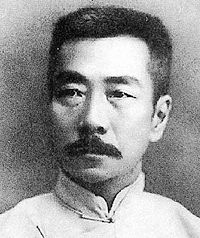 A great Chinese writer, probably the greatest of the Twentieth Century, and also a firm and
very influential revolutionary. He is widely viewed as the most prominent individual in modern
Chinese literature.
A great Chinese writer, probably the greatest of the Twentieth Century, and also a firm and
very influential revolutionary. He is widely viewed as the most prominent individual in modern
Chinese literature.