GUARANTEED BASIC INCOME
A proposed method of trying to keep capitalism from self-destructing by granting every adult
a state-funded guaranteed minimum income even if there are no jobs for them.
There are today constant technical advances and
a continuous growth of labor productivity. And with the elimination of more and more jobs—not
only in manufacturing, but with the development of more sophisticated
computers and
artificial intelligence—also clerical jobs and
even “knowledge work” too, it is now possible to produce all the goods and services for which
there is a profitable market with fewer and fewer workers. Thus the further continuation of
capitalism is in growing conflict with the welfare and livelihood of more and more people. The
scheme of implementing a guaranteed basic income is put forward as a means of pacifying the
expanding numbers of the unemployed masses and, in accordance with liberal sensibilities, at
least keeping them from starving to death.
There are lots of difficulties for the
capitalist ruling class in actually attempting to implement any program of guaranteed minimum
incomes, however. If one country implements such a plan and others do not, then the economy
of the “liberal” country will be at a serious economic disadvantage compared with the more
dog-eat-dog capitalist state. (This is the same sort of competition for profits that keeps
any individual corporation from paying its workers significantly above the going wage rates.
Capitalism is always a “race to the bottom” as far as the pay, benefits and welfare of the
working class is concerned.) Moreover, it is to the economic advantage of the capitalists to
have a mass of desperate unemployed workers around. As one 19th century capitalist (Samuel
Insull) put it, “My experience is that the greatest aid to the efficiency of labor is a long
line of men waiting at the gate.”
There are now, however, a few beginning
experiments with a guaranteed basic income, including a small-scale trial (of just 5,000
people) in Finland. There is also growing discussion of the idea all around the world,
including in relatively poor countries like India. It is perhaps true that a growing
number of countries will be forced to try such schemes as the world capitalist economic
crisis further worsens. But it is virtually certain that these programs—even if they are
actually implemented on a wide scale—will be more hype than reality, and will be
pathetically inadequate. Moreover, it is very wrong for Marxists to promote such schemes,
as the first quotation below brings out. A social program focused on promoting a guaranteed
basic income in effect acquiesces in the
lumpenproletarianization of the working
class.
[In response to growing fears about automation and the elimination of
jobs during the 1960s, and the popular liberal document of those times in reaction to
this, known as “The Triple Revolution”:]
“It is against this background that
one must evaluate the central proposal of ‘The Triple Revolution,’ that society should
guarantee to all an adequate income regardless of whether they work or not. The authors
see this guaranteed income as taking the place of what they call the patchwork of welfare
measures designed to ensure that no one shall actually starve, and they believe that its
enactment will inaugurate an era of social and moral regeneration. If the proposal is
addressed to the oligarchy which now controls the surplus out of which these guaranteed
incomes would have to be paid, its acceptance, we fear, would have a different meaning
and different consequences. It would be a streamlining of the present patchwork of
welfare measures, not a replacement of them. And far from inaugurating an era of
regeneration, it would merely tend to dull the sense of anger and outrage which is the
natural human reaction to a society as corrupt and shameful as ours, and which we can at
least hope is the harbinger of a genuinely revolutionary movement to come.
“Our conclusion can only be that the
idea of unconditionally guaranteed incomes is not the great revolutionary principle which
the authors of ‘The Triple Revolution’ evidently believe it to be. If applied under our
present system, it would be, like religion, an opiate of the people tending to strengthen
the status quo. And under a socialist system, as we argued above, it would be quite
unnecessary and might do more harm than good.”
—The Editors [Paul Sweezy & Leo
Huberman], “The Triple Revolution”, Monthly Review, November 1964, p. 422.
“The idea of the basic income was first posited by those on the left
in the 1960s as a response to an initial automation scare, and this led to a lively
debate. It was regarded skeptically by those who saw it as no solution at all, but
merely a way for the wealthy to bribe the bulk of the population so they could keep
their system and their privileges. At the heart of many basic-income proposals is a
calculus that says that once people get their annual check sent to them by a government,
that is the end of any services they get from that government. If they want healthcare
or transit, or quality education, they have to go buy it in the marketplace, like they
would a hamburger or a pair of shoes. In this scenario, all public services would be
privatized. The grand irony of ‘basic income’ thinking along these lines is that it
leads to the precise opposite of where John Stuart Mill and John Maynard Keynes wanted
to end up. Instead of reducing commercialism and the market in a post-scarcity world,
it elevates commercialism and the market so that everything is for sale. Hardly a
recipe for human happiness. And economist Tyler Cowen makes the astute point that even
if this looks like a terrific deal for society’s millionaires, it is almost certain
they will resist paying taxes to sustain those they regard as deadbeats and freeloaders.
Then there develops a massive popular struggle to win and maintain the basic income. If
people are going to organize a gigantic battle, they ought to fight for more than this.
They ought to fight for a world where their concerns are central, and not struggle to
be extras in a world of, by, and for the rich.” —Robert W. McChesney and John Nichols,
People Get Ready: The Fight Against a Jobless Economy and a Citizenless Democracy
(2016), p. 250. [We are impressed that even the more sophisticated
social-democrats such as these authors see how
deeply mistaken (and bourgeois!) it would be to build a political program for the “left”
based on the demand for a guaranteed minimum income! —Ed.]
GUARDIAN NEWSPAPER (U.S.: 1948-1992)
The Guardian was a weekly tabloid newspaper published in New York City which played an
important role in the New Left and “New Communist” movements of the 1960s and 1970s. The
newspaper was founded under the name The National Guardian in 1948 by three “left”
reformist journalists, James Aronson, Cedric Belfrage, and John McManus. It was identified
with the Progressive Party of Henry Wallace and was also initially sympathetic toward the
revisionist Communist Party USA. However, it had an independent editorial stance and during
the 1950s and 1960s it carried articles by such well-known leftist journalists as Anna Louise
Strong, Agnes Smedley and Wilfred Burchett.
In 1966 its more radical New Left staffers
staged a coup shifting the newspaper in a more revolutionary direction. Its two surviving
founders (Aronson and Belfrage) then resigned, and the newspaper essentially became the voice
of the Students for a Democratic Society (SDS) although SDS also had
its own monthly and more theoretical publication, New Left Notes. This was by far the
most important period in the history of the Guardian, and it played a key role in
transforming many SDS radicals into revolutionaries and communists. At the same time as more
young revolutionaries began to read the newspaper, many of the more revisionist older readers
dropped away. When the Guardian came out in support of the Palestinian struggle and the
Palestinian Liberation Organization, the newspaper lost 3,000 old-line subscribers in a single
week. During this period the publication also served as somewhat “neutral ground” for disputes
and discussions within SDS and the New Communist movement.
But later on, under the primary editorship of
Irwin Silber, the paper became more ideosyncratic and dogmatic, and also moved to the right,
such as by talking more about the supposed “actually
existing socialism” in the Soviet Union, which by then was really a
state-capitalist and
social-imperialist country. Around this time there was
a new rebellion with an anarchist flavor by some of its staffers, who then started a competing
newspaper called the Liberated Guardian, which however did not last very long. By the
mid-1980s the Guardian had more or less returned to the journalistic style and politics
of its early reformist years. But its influence continued to decline. The paper which once had
more than 80,000 subscribers dropped to less than a tenth of that. In 1992 it closed down
completely.
GUEVARA, Ernesto “Che” (1928-67)
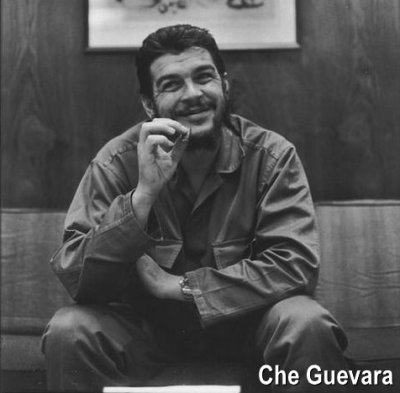 Famous Argentinian Marxist revolutionary who played an important role in the Cuban
Revolution, and through a firm internationalist perspective attempted to help promote
revolutions throughout the world. While in many respects a great and appropriately honored
revolutionary, some of his political views and theories were seriously wrong, and even led to
disaster both for others and himself. (See: FOCO
THEORY.)
Famous Argentinian Marxist revolutionary who played an important role in the Cuban
Revolution, and through a firm internationalist perspective attempted to help promote
revolutions throughout the world. While in many respects a great and appropriately honored
revolutionary, some of his political views and theories were seriously wrong, and even led to
disaster both for others and himself. (See: FOCO
THEORY.)
In 1951 Che took a year off from his
medical studies and travelled around South America on a motorcycle. He later wrote up
his experiences in his Motorcycle Diaries, eventually made into a well-known and
excellent film. Che was transformed by the horrible poverty and conditions of the people
that he saw on this trip, and soon came to understand that the great inequalities of
wealth in Latin America were due to the domination of capitalism, neocolonialism and
imperialism. He graduated with a medical degree from the University of Buenos Aires in
1953.
Che participated in the social reform
program of the government of Jacobo Arbenz Guzmán in Guatemala, and the 1954 CIA-organized
overthrow of that democratically elected government further radicalized him.
Che met Fidel Castro in Mexico and joined
his 26th of July Movement. He was with Castro in December 1956 when they “invaded” Cuba and
then set up guerrilla operations in the Sierra Maestra mountains. Che played an important
leading role in the two years of low-level guerrilla warfare in Cuba. This guerrilla
warfare was one of the factors that led to the collapse of the Batista dictatorship around
January 1, 1959.
Che also played an important role in the
first years of the Cuban revolutionary government. He served at various times as Minister
of Industry, president of the national bank, and a high-level Cuban diplomat. He played
an important role in agreeing to bring Soviet nuclear-armed missiles to Cuba, about which
President John F. Kennedy and U.S. imperialism came very close to starting a nuclear world
war.
While Castro tended to lean toward Soviet
revisionist ideology (as well as toward the Soviet Union for economic support and military
protection), Che was more ambivalent and on a few questions took a position closer to
that of Maoism. Che always firmly upheld the need for revolutionary armed struggle, though
it seems he did not fully appreciate the importance of the peasantry in Third World
countries. However, for him moral incentives under socialism were much more important than
material incentives. He argued that it was necessary to work toward forging a new political
consciousness, or toward creating a “new man”, as a means of promoting socialist production,
whereas revisionists typically argue that production must be hugely expanded first before
any progress toward creating a “new man” can be achieved (or even be seriously attempted).
Perhaps partly because of the intensifying
Sino-Soviet split and Castro’s siding with the revisionists, Che gradually became more
and more dissatisfied with his role in the Cuban government. Finally, in 1965 he resigned
from all roles in that government and first headed off to the Congo (Kinshasa) in Africa
to participate in revolutionary guerrilla warfare there. After that failed, he headed to
South America, and made another attempt at his foco
strategy in Bolivia. This failed even more disastrously. In 1967 Che was captured by
the Bolivian Army (with the help of the CIA), and was then secretly tortured and
executed. It was the sad end to the life of a sincere and dedicated revolutionary.
But even in death, Che Guevara still
serves the world revolution as an honored and respected martyr. He is perhaps as famous
and influential today as he has been at any time since the late 1960s.
See also the important 1985 essay,
“Guevara, Debray, and Armed Revisionism”, by Lenny Wolff, at
https://www.bannedthought.net/Cuba-Che/Guevara/Guevara-Debray-Wolff.pdf for a
strongly critical appraisal of Che, Régis Debray, and focoism.
GUILD SOCIALISM [Britain]
“Guild socialists—a reformist trend in the British trade
unions, which arose before the First World War. They denied the class character of
the state and sowed illusions among the workers that it was possible to get rid of
exploitation without the class struggle, by establishing, on the basis of the
existing trade unions, special associations of producers, so-called guilds whose
federation was to take over industrial management. In this way the guild socialists
hoped to build socialism.
“After the October Socialist
Revolution the guild socialists stepped up their propaganda, contraposing the
‘theory’ of guild socialism to the ideas of the class struggle and the dictatorship
of the proletariat. In the 1920s guild socialism lost all its influence on the
British workers.” —Note 79, LCW 31.
GULF STREAM
A major current flow in the North Atlantic Ocean which moves warm water from the Caribbean
Sea up along the eastern seaboard of the United States, then eastward and down along the
western coast of Europe. This flow of warm water moderates the climate in these areas and
especially in Europe. The Gulf Stream was discovered, in part, by Benjamin Franklin. It is
part of the larger North Atlantic Current. Climate models have raised the alarm that branches
of the North Atlantic Current are weakening because of global warming, and might even collapse
completely. This could prove to be a serious disaster for northern Europe.
“A new study has found evidence that the ocean circulation in the
North Atlantic has become the weakest of the past 1,500 years, mainly as a result of
a warming climate. Many climate models predict a weakening, or even a collapse, of
this branch of the ocean circulation under global warming. Researchers from the
University of Hong Kong write in the journal Geophysical Research Letters that
the Atlantic Meridional Overturning Circulation has far-reaching impacts on the climate
from North America to Europe, and can influence the monsoon rainfall in South Asia and
Africa.” —Steve Newman, “Earthweek: a diary of the planet”, San Francisco
Chronicle, Dec. 2, 2018, p. B-12.
GUOMINDANG (GMD) [Old Style: KUOMINTANG (KMT)]
The Nationalist Party in China. It was organized in 1912 by Sun Yat-sen and became a major
bourgeois nationalist political force in China. After Sun Yat-sen died, Chiang Kai-shek
became its dominant leader in 1928, and after that the Party took on more and more of a
comprador and big bureaucrat capitalist character. The GMD, in control of the government
of China, waged war against the Communist Party of China for decades and was defeated and
expelled from the mainland in 1949. For decades after that it still retained power in
Taiwan.
See also:
ENTRYISM
“The Kuomintang of China was originally a democratic political
party of the bourgeoisie founded by Dr. Sun Yat-sen.
“Dr. Sun organized the Tung Meng
Hui (the Chinese Revolutionary League) in 1905 and became its president. Under the
leadership of the Tung Meng Hui, the Revolution of 1911 succeeded in overthrowing the
government of the Ching Dynasty and the monarchy in China and setting up the
Provisional Government of the Republic of China in Nanking with Dr. Sun Yat-sen as
the Provisional President.
“Shortly afterwards, a split
took place within the Tung Meng Hui and the bourgeoisie made a compromise with the
feudal forces. As a result, state power fell into the hands of the northern warlord
Yuan Shih-kai and the revolution failed. In 1912, the Tung Meng Hui and other smaller
parties reorganized themselves into the Kuomintang which actually became a clique
made up mainly of bureaucrats and politicians.
“Dr. Sun Yat-sen, however,
continued to press ahead with the bourgeois-democratic revolution and started an
anti-Yuan campaign in 1913, but without success. The following year when he was in
Japan, he assembled part of the Kuomintang members to form the Chinese Revolutionary
Party which was reorganized into the Kuomintang of China after the May 4th Movement
in 1919.
“The Kuomintang issued a
manifesto on its reorganization in November 1923 and held its First National Congress
in January 1924. It accepted the Chinese Communist Party’s political stand for
opposing imperialism and feudalism and put into practice the Three Great Policies of
alliance with Russia, co-operation with the Communist Party and assistance to the
peasants and workers. Thus the old Three People’s Principles developed into the new
Three People’s Principles and the first co-operation between the Communist Party and
the Kuomintang was effected. At that time, the Kuomintang was revolutionary.
“After the death of Dr. Sun
Yat-sen on March 12, 1925, the Northern Expedition took place between 1926 and 1927.
From April through July 1927, Chiang Kai-shek and Wang Ching-wei successively staged
counter-revolutionary coups d'état in opposition to communism and the people and in
betrayal of Dr. Sun Yat-sen’s revolutionary stand. From that time on, the Kuomintang
collaborated with imperialism and feudalism in opposing the masses of the people and
became a reactionary clique of the landlords and big bourgeoisie. In the ten-year
period between 1927 and 1937, Chiang Kai-shek’s Kuomintang fought an anti-communist
and anti-popular civil war, and there were endless wars among the various groups of
Kuomintang warlords. All this encouraged the Japanese imperialists to invade China.
“Following the outbreak of the
War of Resistance Against Japan in 1937, the Communist Party and the Kuomintang
co-operated for a second time, thanks to the former’s policy of forming the
Anti-Japanese National United Front and pressure from the people of the whole
country. However, after the fall of the important city of Wuhan in central China in
October 1938, Chiang Kai-shek’s Kuomintang switched over to a policy of passive
resistance to Japan and active opposition to the Communists.
“Immediately after the victory
in the War of Resistance Against Japan in 1945, Chiang Kai-shek’s Kuomintang, backed
by U.S. imperialism, launched a full-scale anti-popular civil war which continued
until its total defeat by the Chinese people in 1949. Thus the Kuomintang reactionary
rule on the Chinese mainland was toppled and its remnant forces fled to Taiwan
Province.
“The patriotic democrats who
broke away from the Kuomintang were against Chiang Kai-shek’s policy of national
betrayal and dictatorial rule; they supported the Chinese Communist Party’s political
stand against imperialism, feudalism and bureaucrat-capitalism. So they organized the
Revolutionary Committee of the Kuomintang in 1948 which has since become one of the
democratic parties in China.” —Note in
Peking Review, #1, Jan. 6, 1978, p. 21.