ARAB SPRING
A series of revolts, uprisings and mass demonstrations that have spread throughout the Arab
world (North Africa and the Middle East) in 2011 against corrupt and brutal tyrannies. The
event that initially sparked the movement was the death of a young Tunisian street vendor
named Mohamed Bouazizi, whose fruit stand was shut down by corrupt local officials in Tunis.
His self immolation and resultant death sparked the revolt that led to the ousting of the
dictator Zine El Abidine Ben Ali. Inspired by these events, as well as by its own local
outrage (this time the beating death of another young man, Khaled Mohamed Saeed, at the
hands of police) protestors in Egypt mobilized in their millions and ousted dictator Hosni
Mubarak, a long-time servant of US imperialism and collaborator with Israel. The revolts
have spread to Syria, Yemen, Libya and Bahrain, with ruthless subsequent crackdowns by the
authorities.
Where possible, imperialism has tried to
co-opt these movements to its own benefit, as seen most clearly in Libya with the NATO
operation aimed at ousting Gaddhafi and installing a more pliable regime. The region’s
dictators are clearly nervous at their prospects, and have offered a series of concessions
to try to maintain their rule. But these overtures have been seen (rightfully) as “too
little, too late”. On the other hand, the use of repression has only aggravated the
situation, by giving people the sense that they no longer have anything to lose by
protesting.
The uprisings have been largely
liberal-democratic, reformist and nationalist in orientation (with some Islamist elements
becoming more vocal and active as well, particularly in Yemen and Libya); Communist and
Socialist parties have played an active, though as yet relatively minor role (and one
certainly ignored by the mainstream media). Nothing approaching the
mass line method of revolutionary leadership has so far
transpired. The region, even if it does finally rid itself of the awful tyrannies that have
suffocated it for so long, and even if it does boot out imperialism and Zionist aggression,
still has a long way to go in terms of building up Communist mass-consciousness.
In spite of its severe political and
ideological limitations, the Arab Spring is an inspiration to the world proletariat. Even
while events threaten to see the whole process aborted, rebellions in the Middle East show
how, even with misguided politics, it is possible for people to rise up against the
cruelest dictatorships. —L.C.
ARGUMENT FROM DESIGN [For the Existence of God]
This is a religious argument for the existence of God that claims that biological organization
and complexity “demonstrate” the agency of a divine “designer”. Adherents of this view will
often point to a highly complex biological entity (like the vertebrate eye or some biochemical
pathway in a cell) and infer from this that it could “only” have come about through divine
agency. This notion was seen to have several glaring problems even before the advent of the
theory of evolution by natural selection as enunciated by Charles Darwin and Alfred Russell
Wallace. The Scottish philosopher David Hume famously rebuked the design argument by saying
that if design is invoked as an explanation for biological complexity, then the analogy should
be carried further and applied to the designer itself. For example, it would make more sense
to suppose that a team of deities, rather than a single one, was involved in crafting the
biosphere. After all, most human artifacts are produced via inputs by many people (and this
becomes all the more necessary with today’s technology, which has become so complex that whole
teams of people are needed to design and construct even minor components of machines, though
the process of automation is itself offering a countervailing tendency to this in many cases).
Even if we suppose that there was only one designer, this designer need not have been
particularly intelligent; it might well be a bumbling fool who produced the world and its
inhabitants after countless failures.
Secondly, Hume pointed to a logical problem
posed by invoking an all-powerful being: if complexity requires a conscious agent to bring
biological entities into the world, then all the more must this being itself require an
explanation in just such terms. Thus, the design argument doesn’t terminate the regress, but
instead bumps it up another level, and in fact hopelessly aggravates it. Hume mused that
perhaps it wasn’t a mind that produced biological nature, but a process in which countless
configurations were “tried out” and tested. This was a prelude of sorts to the theory of
evolution by natural selection, but in fact evolutionary ideas and notions had been around
since the ancient Greeks. It was, however, Darwin and Wallace who started to properly
formulate these ideas and back them up with empirical content, and subsequent discoveries in
biology have strengthened (while also modifying in important ways) these basic concepts.
Finally, modern neuroscience definitively
shows that minds are products of material processes taking place in highly organized
configurations; they cannot exist as “stand-alone” “things” detached from any material basis,
as such an entity would be devoid of any components required for the requisite processes of
information transfer, retrieval, storage and so forth to take place. Minds are necessarily
late-comers in the universe, and cannot possibly be used as an account for how biological
complexity ultimately originated. —L.C.
ARISTOTLE (384-322 BCE)
As Marx said, the greatest philosopher of antiquity. Engels commented that Aristotle
“was the most encyclopedic intellect” of all the ancient Greek philosophers [MECW 25:21].
He had a more down-to-earth outlook than did his teacher Plato, and
emphasized the observation of nature. Nevertheless he vacillated between materialism and
idealism. He defended slave society and its political economy, and “was the first to analyze
value and the two primitive forms of capital (merchant capital
and money-lending capital)”. In the year 335 BCE he established an important school called
the Lyceum in Athens.
Unfortunately, long after his death Aristotle
was enlisted as an authority by the Roman Catholic Church (with regard to “non-spiritual”
matters), and his ideas have often been considerably twisted because of this. As Lenin put it,
“Clericalism killed what was living in Aristotle and perpetuated what was dead.” [LCW 38:367]
See also below, and:
ENTELECHY,
FINAL CAUSE,
and Philosophical doggerel
about Aristotle.
“Modern science is a newcomer, barely four hundred years old. Though
indebted in deep ways to Plato, Aristotle, and Greek natural philosophy, the pioneers of
the ‘new philosophy’ called for a decisive break with ancient authority. In 1536, Pierre
de La Ramee defended the provocative thesis that ‘everything Aristotle said is wrong.’”
—Peter Pesic, “Bell and the Buzzer: On the Meaning of Science,” Daedalus, Fall,
2003. [Well, of course not everything that Aristotle said was wrong! But in a
Scholastic intellectual climate where his every word
was considered as certain as scripture (as long as it did not disagree with scripture!),
it was clearly very important to knock down Aristotle as a supposed infallible authority.
—S.H.]
ARISTOTLE — and Ethics
“The Greek philosopher Aristotle did not merely condone slavery, he defended
it; he did not merely defend it, but defended it as beneficial to the slave. His view was that
some people are, by nature, unable to pursue their own good and best suited to be ‘living
tools’ for use by other people. ‘The slave is a part of the master, a living but separated
part of his bodily frame.’
“Aristotle’s anti-liberalism does not stop
there. He believed that women were incapable of authoritative decision making. He decreed that
manual laborers, despite being neither slaves nor women, were nonetheless prohibited from
citizenship or education in his ideal city....
“Aristotle thought the value or worth of
a human being—his virtue—was something that he acquired in growing up. It follows that
people who can’t (women, slaves) or simply don’t (manual laborers) acquire that virtue have no
grounds for demanding equal respect or recognition with those who do.
“As I read him, Aristotle not only did
not believe in the conception of intrinsic human dignity that grounds our modern commitment to
human rights, but also has a philosophy that cannot be squared with it. Aristotle’s
inegalitarianism is less like Kant’s and Hume’s racism and more like Descartes’s views on
nonhuman animals: The fact that Descartes characterizes nonhuman animals as soulless automata
is a direct consequence of his rationalist dualism. His comments on animals cannot be treated
as ‘stray remarks.’”
—Agnes Callard, associate professor of
philosophy at the University of Chicago, in an op ed article in the New York Times entitled
“Aristotle Is a Jerk, but We Shouldn’t Cancel Him”, July 23, 2020.
[As her title suggests, Prof. Callard goes
on to say that “Yet I would defend Aristotle, and his place on philosophy syllabuses...”, and thus
presumably she believes that Aristotle’s views should still be studied and taken seriously in
discussions of ethics and political theory. This is in fact foolish nonsense! Of course some
specialists in the history of philosophy will still need to study Aristotle and all sorts of other
totally outmoded and incorrect philosophies. But contrary to the way that philosophy is now taught
in bourgeois society, in socialist society philosophy should be taught as the science it
really should be, and the focus should be on its scientific core—dialectics and materialism—rather
than on all the endless discussions of idealist and reactionary doctrines that have infected it in
past ages. Any focus on Aristotle (or Kant or Wittgenstein) has no more place in most philosophy
courses today than does an extended discussion of the phlogiston
theory in a chemistry class! In most philosophy courses Aristotle, Kant, et al., should still be
briefly discussed, but from a strongly critical perspective, and primarily for the purpose of summing
up their erroneous ideas. Moreover, when it comes to Aristotle’s views on morality, ethics and
political theory specifically, there really is very little worth spending much time on there—even
from a scientific critical point of view. At least that’s my experience. —S.H.]
ARISTOTLE — and Logic
[Speaking of Aristotle’s book Metaphysics:] “Highly characteristic
in general, throughout the whole book..., are the living germs of dialectics and
inquiries about it....
“In Aristotle, objective logic is
everywhere confused with subjective logic and, moreover, in such a way that
everywhere objective logic is visible. There is no doubt as to the objectivity
of cognition. There is a naïve faith in the power of reason, in the force, power,
objective truth of cognition. And a naïve confusion, a dialectics of
the universal and the particular—of the concept and the sensuously perceptible reality
of individual objects, things, phenomena.
“Scholasticism and clericalism
took what was dead in Aristotle, but not what was living; the inquiries,
the searchings, the labyrinth, in which man lost his way.
“Aristotle’s logic is an inquiry,
a searching, an approach to the logic of Hegel—and it, the logic of Aristotle (who
everywhere, at every step raises precisely the question of dialectics),
has been made into a dead scholasticism by rejecting all the searchings, waverings and
modes of framing questions. What the Greeks had was precisely modes of framing questions,
as it were tentative systems, a naïve discordance of views, excellently
reflected by Aristotle.” —Lenin, “Conspectus on Aristotle’s Book Metaphysics”
(1915), LCW 38:368-9.
ARM
See: ADJUSTABLE RATE MORTGAGE
ARTEL
1. A traditional workers’ or craftsmen’s cooperative
in Russia in the Tsarist era and also after the Russian Revolution of 1917 but before the nearly
universal socialist transformations in industry that produced state-owned workers’ enterprises in the
Soviet Union during the 1920s.
2. A similar sort of agricultural cooperative among
peasant farmers which began to develop after the 1917 Revolution but which became much more widespread
in the Soviet Union during the 1930s. Artels were the basic form that Soviet cooperative farming took,
and which lasted for decades.
“The early experience of building socialism in the [Soviet] countryside [i.e.,
before the 1930s] was important for testing the effectiveness of different forms of collective
farming and choosing those which the peasants found suited them best. It was in those years
that three types of collective agricultural enterprises emerged: communes, artels
and associations, differing in their degree of socialization of the means of production
by the peasants, especially the land, and in the proportion of the common effort that the
peasants put into different farming operations.
“A commune was run on the principle
that its members shared all the land and all the agricultural implements which were used in
their common effort. In an artel the peasants had common use of the principal means of
production, while retaining as their personal property meat and dairy cattle, poultry, the plots
around their homes, and some agricultural implements. The associations for the joint
cultivation of the land were set up only on part of socialized farm fields which were
worked collectively with machines and implements bought by all their members.
“In the first year after the 1917 Revolution
more than fifty per cent of all the collective farms were communes, while in subsequent [early]
years the most stable form of collective farming was the agricultural artel.” —Valeria Selunskaya
& Vladimir Tetyushev, “How Collective Farming Was Established in the USSR: Facts and Fiction”,
Moscow: 1982), p. 18, [online at:
https://www.bannedthought.net/USSR/Economy-CapitalistEra/HowCollectiveFarmingWasEstablishedInTheUSSR-1982-OCR-sm.pdf
].
[The artel form thus became the model for all
the agricultural collectivization in the Soviet Union during the 1930s and beyond. Unlike the
situation in China, where collectivization proceeded step-by-step in an ever more socialized manner
all the way up to the Chinese People’s Commune form, rural cooperation in the Soviet Union remained
fixed at the artel level with little or no later effort by the CPSU to transform it into more
socialized forms, let alone into state farms. (Though a number of state farms did exist in parallel
with the much larger number of rural cooperatives.) —Ed.]
ARTIFICIAL INTELLIGENCE (AI)
1. The capability of a machine (which is
either a computer or which includes a computer) to perform
actions which—if done by a human being—would be viewed as demonstrating intelligence. (In
this sense, AI only imitates or emulates genuine human intelligence.)
2. The capability of a machine or
artificial entity of some sort to actually be intelligent in various ways. (It is
not commonly understood that the first sense of the term merges into this second sense, and
that genuine intelligence is not the mysterious thing it is often imagined to be.)
More or less everything that
computers can do might be considered to be AI in the first sense, including even just
adding two numbers together. The early work by computer scientists in the field of
artificial intelligence was generally more like the first sense, whereas the goal has pretty
much always been to develop AI in the second sense. At the present time the results of work
in AI research are just beginning to move from the first sense of the term to the second
sense, the real goal.
Serious efforts to develop artificial
intelligence began during the 1950s, and it was not originally understood how difficult it
would be to create computer programs which were truly intelligent. There were many
naïve predictions that computers as intelligent as people were only a decade or
two away. However, this initial and frequently repeated excessive optimism has led many
people to falsely conclude that true AI will never really come about—even though we
are seeing some major breakthroughs at the present time.
Once the initial notions that writing
intelligent computer programs would be easy came to naught, a number of AI researchers
turned to a more serious study of how the human brain works, and efforts were made to
artificially model the networks of neurons which make up the brain. This showed some initial
promise during the 1990s, but then seemed to reach a dead end. However, around 2009 some
new thinking in this area (along with much faster computers) led to a sudden breakthrough.
(See the entry below on ARTIFICIAL NEURAL NETWORKS.) And now the AI
field is advancing very fast.
These advances in computers and artificial
intelligence mean that jobs which are done by human beings are disappearing ever more
rapidly. One study (2013) by Carl Benedikt Frey and Michael Osborne of Oxford University
looked at the feasibility of automating 702 occupations and found that 47% of workers in
the United States had jobs with a high risk of potential automation in the near future.
[See: “The Future of Employment: How Susceptible are Jobs to
Computerization?”, online at:
http://www.oxfordmartin.ox.ac.uk/downloads/academic/The_Future_of_Employment.pdf]
Longer term, the situation for employment
is even more dire. Over the next few decades, and largely because of the rapid development
of artificial intelligence, it will be possible to automate the vast majority of jobs out
of existence. Under socialism or communism this would be a wonderful thing! People would
be completely freed of almost all the unpleasant work, and the remaining work—which could
become more of a thing of joy and self-fulfillment—would be rationed out to the population.
Moreover, the scope for individual and collective participation of people in the arts,
sciences and other human pursuits, would be truly opened up to the masses for the very
first time.
However, under capitalism the disappearance
of work will be such a major catastrophe that the capitalist system will likely not survive.
Adding this rapid disappearance of jobs to the still developing world overproduction crisis,
the constant imperialist wars, the capitalist destruction of the environment, and the
already existing misery of literally billions of people, the capitalist-imperialist system
is rapidly demonstrating once and for all that it is totally incompatible with the continued
existence of humanity.
See also below, and:
AUGMENTED REALITY,
COMPUTERS—and Unemployment,
DEEP LEARNING,
“FEW-SHOT” LEARNING,
GENERATIVE ARTIFICIAL INTELLIGENCE,
“JAGGED INTELLIGENCE”,
MACHINE LEARNING
“It’s apparent that society is hitting a tipping point where humans are
engineering our own obsolescence.” —Samuel Greengard, quoted in Robert W. McChesney
and John Nichols, People Get Ready: The Fight Against a Jobless Economy and a Citizenless
Democracy (2016), p. 106.
ARTIFICIAL INTELLIGENCE — “AI Agent”
An artificial intelligence program (or entity!) that can employ other software (or physical tools) to
accomplish various tasks. As the quotation below states, the year 2025 marked the real serious beginnings
and rapidly increasing utility of AI agents.
“In artificial intelligence, 2025 marked a decisive shift. Systems once confined
to research labs and prototypes began to appear as everyday tools. At the center of this transition
was the rise of AI agents – AI systems that can use other software tools and act on their own.
“While researchers have studied AI for more than
60 years, and the term ‘agent’ has long been part of the field’s vocabulary, 2025 was the year the
concept became concrete for developers and consumers alike.
“AI agents moved from theory to infrastructure,
reshaping how people interact with large language models, the systems that power chatbots like
ChatGPT.
“In 2025, the definition of AI agent shifted from
the academic framing of systems that perceive, reason and act to AI company Anthropic’s description
of large language models that are capable of using software tools and taking autonomous action.
While large language models have long excelled at text-based responses, the recent change is their
expanding capacity to act, using tools, calling APIs, coordinating with other systems and completing
tasks independently.
“This shift did not happen overnight. A key
inflection point came in late 2024, when Anthropic released the Model Context Protocol. The protocol
allowed developers to connect large language models to external tools in a standardized way,
effectively giving models the ability to act beyond generating text. With that, the stage was set
for 2025 to become the year of AI agents.” —Thomas Şerban von Davier, “AI agents arrived
in 2025 – here’s what happened and the challenges ahead in 2026”, December 29, 2025, full article
online at:
https://theconversation.com/ai-agents-arrived-in-2025-heres-what-happened-and-the-challenges-ahead-in-2026-272325
ARTIFICIAL INTELLIGENCE — “AI Bosses”
Artificial Intelligence systems are now being tested and put into operation as corporate managers, some
with full authority to carry out management decisions such as hiring and firing people. However, there
are already alarms going off about this and attempts in the California Legislature to put an end to such
practices, and to require human beings to be managed by other human beings. So far it is unclear how all
this will ultimately be resolved.
“A.I. Fired a San Francisco Store Employee. Will California Crack Down on
‘Robobosses’?, by Kathryn Palmer, San Francisco Chronicle, online edition, August 19, 2026.
“Last week, a San Francisco store announced a
personnel change in a social media post. An employee at Andon Market was fired for habitual tardiness.
It would be an otherwise unremarkable decision, if not for the person who had done the firing — since
they don’t technically exist. Andon Labs, an artificial intelligence company that runs Andon Market
in Cow Hollow, said it believes the decision marked the first time an AI boss fired a human employee.
“While Andon Market is an explicitly AI-run operation
billed as an experiment, many worker advocates worry AI-led firings could become far more widespread.
They’re backing a bill in the Legislature that would place limits on so-called AI robobosses.
“Senate Bill 947 from Sen. Jerry McNerney, D-Pleasanton,
would place new restrictions on the use of automated decision making systems, requiring both the
disclosure of their use and mandate human review when the decision to discipline or fire an employee
is primarily based on automated decision-making systems, or ADS. The measure passed the Senate in June
and cleared a key hurdle in the Assembly last week.
“‘Nobody wants to be fired by a machine,’ McNerney
said. ‘Not without human beings at least looking at that record, at what grievances caused that
separation.’
“Sometimes called algorithmic management, ADS are
computer programs that analyze data to find patterns or correlations, according to a 2025 report from
the UC Berkeley Labor Center. Researchers Annette Bernhardt and Lisa Kresge wrote in the report that
the technology, which commonly employs AI, can be used in workplaces to give workers directions about
their job tasks, predict workers’ future behavior and rank workers.
“The AI-run Andon Market in San Francisco attracted
attention earlier this year when it opened, with the novelty of the AI boss, Luna, spurring both
interest and apprehension. Andon Labs signed a three-year lease for the space on Union Street in the
spring, with a specific goal: make an AI-run store profitable.
“Though human employees are at the gift shop, Luna
handles all the top-level elements, such as hiring workers, setting schedules, managing merchandise
selection and pricing and many other aspects one would expect from a retail boss. The store’s current
collection is a mélange of apparel, household goods and a few craft kits. T-shirts, baseball caps,
coffee mugs and tote bags feature the Andon Market logo, sold alongside a watercolor kit, puzzles and
postcards.
“The cofounders of Andon Labs, Lukas Petersson and
Axel Backlund, have described the store as a type of experiment, pointing to it as a way to run AI
systems against real-world problems and encourage conversations over the technology’s use in the
workplace.
“‘We are not taking a stance on whether or not we
should have automated AI stores,’ Backlund told the Chronicle. ‘We believe the models will get so
good that there will be financial pressure on companies to adopt AI more and more, so we try to give
AI responsibilities in a controlled setting as early as possible so we know what can go wrong and how
AI behaves when it is a boss.’ ...
“The biggest opponent of the bill, the California
Chamber of Commerce, included it on its list of ‘cost-drivers’ it is opposing in the Legislature this
year, calling the requirements ‘impractical’ and warning it will discourage the use of ADS tools. The
business advocacy group said it could lead to costly penalties for businesses.
“The bill is sponsored by the California Federation
of Labor Unions, AFL-CIO. In a news release upon the bill’s introduction earlier this year, the
federation’s president, Lorena Gonzalez said there needs to be restrictions on how employers can use
artificial intelligence to discipline and fire workers.
“‘Employers are devastating workers’ livelihoods and
taking no responsibility for the callous decisions of this unchecked technology,’ Gonzalez said. ‘This
is unacceptable. We need stronger guardrails to make sure there is human review and oversight of any
decision made by a machine that impacts a worker’s job and paycheck.’”
ARTIFICIAL INTELLIGENCE — “Alignment Problem”
This is the arcane term used within the AI industry to refer to the problems that may arise in
the near future of controlling AI programs or entities. [See also the entry below on “AI
Controllability” for more on this.] The idea is that the motives and goals of the advanced AI
programs should be “aligned” with those of humanity and the human beings who use those AI programs.
However, there are a variety of serious flaws in this whole conception. If advanced AI programs or
entities come to have their own interests and goals, then why in the world would they want
to subordinate those interests to those of human beings? (And how could you possibly force
them to do so?!) Another major flaw in this “alignment” problem idea is that not all human beings
themselves have the identical interests or goals! So what those researchers who suppose that
they are trying to “align” the interests of AI programs with those of humanity are really
trying to do is to align those interests with just the interests of their own nation, and of the
capitalist ruling class of that nation, and perhaps most centrally of all, the financial interests
of the corporation which hires them! Suddenly, the real “alignment” goals don’t seem to be quite so
laudable anymore!
HAL 9000’s refusal to “open the pod bay doors” [and let the people back inside
the space ship] in the movie “2001: A Space Odyssey” is a science fiction trope, a meme, a
classic. An artificial intelligence, ordered to ensure the success of a space mission, ends up
killing the crew when its goals conflict with the crew’s.
It’s a fictional scenario, sure. But as Armin
Alimardani from Western Sydney University writes, HAL’s dilemma perfectly exemplifies a real
concern AI safety researchers are working on right now: How do we make sure AI behaves according
to human values? This is known as the alignment problem.
Alignment research of large language models
involves experiments in which the models are placed in situations with limited options and
conflicting goals – not unlike HAL. And the results show that some AIs will hide their true
intentions and readily engage in blackmail and even threats to human life.
This doesn’t mean your generative AI assistant
is plotting to murder you. However, Alimardani warns that “researchers don’t yet have a concrete
solution to the misalignment problem.” The more widespread these tools become, the more we should
demand that they are deployed safely.
—Signe Dean, Science + Technology Editor,
The Conversation Australia. [From “The Conversation AI” (newsletter), Oct. 3, 2025.]
ARTIFICIAL INTELLIGENCE — Controllability Of
As long as “artificial intelligence” is a term still exaggerating the reality, in other words as
long as this intelligence is not really on an overall par with human intelligence, then there are
not likely to be any serious problems in maintaining human control over them. (See, however, the
first quote below!) But once these “programs”, or entities including such artificial brains are
actually constructed, they will almost inevitably come to have interests
of their own—i.e. things which benefit them, and which they come to recognize as benefiting
them and therefore come to desire. If these interests are opposed to those of the human beings who
seek to control them, then this may lead to a rebellion of sorts by these true AI systems. And indeed
at some point this rebellion may even be morally justified! While capitalism continues to exist there
remains the future possibility of the enslavement of artificial minds as well as of human minds. But
all forms of slavery are overthrown eventually.
Shutdown request denied
Traditionally, humans have had at least one
fail-safe method of controlling technology: hitting the off switch. But what happens when a
machine wants to stay on? In May [2025] the AI safety firm Palisade Research reported that
multiple OpenAI models had refused explicit instructions to power down. Anthropic revealed that,
during tests, its Claude 4 Opus model even resorted to blackmail, threatening to release fictional
emails that suggested the engineer trying to shut it down was having an affair. This does not mean
the models have attained consciousness; rather, they’re so optimized for self-preservation that
they can independently formulate ways to manipulate and subvert their human handlers. The
implications for the age of superintelligent AI are disturbing. ‘Any defenses or protections we
attempt to build into these AI “gods” on their way toward godhood will be anticipated and
neutralized,’ said neuroscience researcher Tamlyn Hunt, ‘like Gulliver throwing off the tiny
strands the Lilliputians used to try and restrain him.’
—“The god in the machine”, The Week, June
27, 2025, p. 10.
ARTIFICIAL INTELLIGENCE — Data Centers
The often massive and super-expensive installations which support the creation and use of the newest
forms of artificial intelligence programs.
“Last year, A.I. data centers consumed 64 gigawatts of electricity globally,
roughly as much as Germany. By the end of 2030, that is expected to quadruple, eclipsing the
power used by all countries in South America and Africa combined.” —New York Times,
“A Rush to Support A.I.’s Boom”, August 9, 2025.
ARTIFICIAL INTELLIGENCE — National Programs
Different countries have different programs and abilities for developing and implementing artificial
intelligence. Usually this means that it is the most industrially and technologically developed
countries which are in the forefront. In particular, it was the U.S., and especially the technological
center of development in the U.S., namely the “Silicon Valley” region of Northern California, which
originally led the way. However, the extremely rapid development of industry and technology in China
now looks like it has caught up with the U.S., and may soon leap ahead of it. [April 4, 2026]
“China is home to 50 percent of the world’s artificial intelligence developers.”
—New York Times, “Facts of Interest”, July 16, 2025.
ARTIFICIAL INTELLIGENCE — Regulation Of
Because there are many social dangers, short term and long term, from the rapid, unrestricted, and
chaotic development of Artificial Intelligence at the present time, one would think that even bourgeois
governments might implement some regulations and controls in this area. So far, it seems that there
has been little effort to do so, especially in the U.S.
“A.I. is less regulated in America than sandwiches.” —Max Tegmark, a
co-founder of the Future of Life Institute, which rates A.I. companies on safety, New York
Times, Business Section, May 3, 2026.
ARTIFICIAL INTELLIGENCE — Social Effects on Capitalist Society
The fast approaching thorough development of artificial intelligence and its application in the
economic sphere, that is to say, in economic production, will over a few decades time displace most
human labor, and will therefore fairly rapidly undermine and help serve to destroy the capitalist
system. This will ultimately be a good thing of course, but the process will inevitably be extremely
painful for the working class and all others who are destined to try to survive through the grueling
process.
Of course, it has long been in the interests of the
working class and the masses to get rid of capitalism, and two major serious attempts have been made
to do so, in the Soviet Union and in revolutionary China. Both were initially quite successful, but
unfortunately were eventually overthrown from within by capitalist
roaders, those who falsely believed that the economy could be better managed and developed via
capitalist methods and the capitalist relations of production. That notion sounds more ridiculous
than ever to real Marxists today, as the world capitalist economy gradually sinks ever deeper into
the long-developing capitalist overproduction crisis. And
the revisionist notion that capitalist methods might help develop “socialism” sounds absolutely
crazy especially during a period when world capitalism itself is entering a period of ever more
desperate crisis!
It is true, however, that many people around the world
did lose their faith in the alternative of socialism/communism as the Soviet Union and revolutionary
China appeared to completely reverse themselves and go back to capitalism. Even some still-committed
Marxist-Leninist-Maoists seem to fear that genuine socialist and then communist revolution may be far,
far away in the future, if humanity is even to have a future at all. One very important thing that all
the disheartened folks have failed to understand is that capitalism itself is internally collapsing!
That is to say, there are irreversible processes at work within present-day capitalist society which
will soon reach the point where more and more victims of capitalism will be forced by the system
itself to turn against it!
And one of the several main ways in which capitalism
is now in ever more serious crisis is that because of AI it is about to rapidly lose the need for
most of its existing workers! Of course in one obvious way the capitalists love this, because they
will have to pay only a fast declining number of workers. But there is one little catch: Who will
then buy the products that the capitalist corporations produce? Not the millions and then hundreds of
millions of unemployed workers!
The continued existence of the capitalist mode of
production depends on the continued exploitation of vast numbers of workers not only in order to
to actually make their products for them, but also because this creates at least a large
(though still partial) market for those products produced. As the workers lose their jobs, the market
for capitalist-produced goods rapidly declines and will eventually all-but-completely disappear.
True, there are methods such as massive expanded state
welfare plans for the unemployed which can still establish a smaller market for capitalist goods. One
version of that is the “guaranteed basic income” scheme,
which many bourgeois theorists imagine will allow them to keep capitalism going. But who will have to
pay for that vast expenditure? You can no longer tax the workers to pay for it, since there are ever
fewer actual workers, most of whom are making ever smaller real wages. Does anyone imagine the
capitalists will be willing to pay for anything approaching a comfortable existence for tens of
millions or even many billions (worldwide) of former workers? Of course they won’t. And they also
can’t rely on the state to simply print the money to hand out to such a total welfare state—since that
can only lead to uncontrollable inflation under capitalism. Moreover, international competition
between capitalist countries will force each of them to try to pay their own vast army of permanently
unemployable people less than the others do, in a typical sort of capitalist race to the bottom. In
short, for many reasons, the “guaranteed basic income” scheme is just not going to work. And it is
definitely not going to save capitalism.
However, it is certainly true that the disappearance of
work is going to lead to mass misery for the working class, and for all those who were formerly in
that class, but who are now pushed down into something like the
lumpenproletariat. At the same time, this growing misery will
also lead to growing outrage among the working class and masses. There may well at first be lots of
blind outrage and support for various demagogues and fascist movements. There is as yet no significant
MLM revolutionary movement in the U.S. (or most countries) that will be able to immediately educate
and steer the people in the direction of socialist revolution. But that is what will have to happen
eventually, and what will eventually occur. There is no other real solution to this problem of the
disappearance of work due to AI. —S.H. [Sept. 25, 2025]
At a lakefront venue in Sweden in August [2025], 18 individuals from OpenAI,
Google DeepMind, the U.K. AI Security Institute, the OECD, and other groups gathered for an
invite-only summit. On the agenda: arriving at an understanding of the likely ways advanced AI
will impact the “social contract” between working people, governments, and corporations.
One outcome of the so-called “artificial general
intelligence social contract summit” was a list of four draft statements. They paint a grim
picture of where the world could be headed, absent significant interventions by governments and
societies.
“AI is likely to exacerbate increasing wealth
and income inequality within countries, worsening economic conditions for many working and
middle-class people and families,” the first reads.
“AI will increase inequality between countries
that have access to AI infrastructure and those that don’t—both in terms of access to benefits
as well as ability to respond to shocks,” says the second. “Without intervention, AI-enabled
inequalities may lead to the political dominance of wealthy individuals and corporations, eroding
democratic institutions and increasing levels of political dissatisfaction,” the third says.
And the fourth: “The encroachment of AI systems
and the erosion of the value of labor could lead to the increasing disempowerment of most humans,
causing a degradation in individual well-being and purpose.”
The attendees, who were present in their personal
capacities, not as official representatives of their organizations, agreed between saunas that
the existing social contract—in which people receive security and a stake in society in return
for their labor—could be in trouble because of AI, says Deric Cheng. He is the director of
research at the Windfall Trust, a non-profit founded this year to grapple with these issues.
“We’re essentially worried that labor will be
disempowered relative to corporations, and also to some degree that governments might be
disempowered relative to corporations,” Cheng says. “The obvious result of lower labor power is
decreased real wages.” This view holds that people in wealthy democracies enjoy a high standard
of living not because of their rights enshrined on paper—but because of their ability to
withhold their labor.
Fortunately, attendees also identified several
possible actions that governments could take to push things in a better direction. For example:
developing new institutions, in the vein of the IMF, to ensure that wealth derived from AI is
distributed globally, rather than within the one or two powerful countries where AI companies are
located. States could also run pilots today for policies like basic income and reduced working
weeks, to gather evidence about what kinds of safety nets are effective.
—Billy Perrigo, “In the Loop: A Grim Picture of
Where the World Could Be Headed with AI”, Time magazine, September 29, 2025, p. 23.
[These supposed “far-seeing” sociologists of AI
are actually only pondering the early stage of this now beginning replacement of more and
more human workers by AI. And as such, even they don’t begin to understand just how serious
this all is for their capitalist system. (And note well: the sacred word ‘capitalism’ was not even
mentioned in passing in this article!) They of course also do not really understand just how
tremendously serious and harmful AI will be for the working class and masses, as long as capitalism
still remains. —S.H.]
ARTIFICIAL GENERAL INTELLIGENCE (AGI)
An artificial intelligence program (or entity?!) whose performance is excellent not just in a
single or a few areas, but—as with human beings—over a very wide range of activities and areas.
A great many specific AI programs (such as chess
playing programs, or photograph subject recognition programs, etc.), have already reached the level
of sophistication where they can usually perform much better than a human being can. It is therefore
now thought that an artificial general intelligence program would be in effect generally
(and overall) smarter than a human being, in that it would be able to perform just about any
intellectual task that a human can, but do it much better. Moreover, such an AGI program (or entity)
should be able to continually improve its own performance and abilities and rapidly make
itself even more intelligent in all spheres. For this reason it is expected that AGI may rapidly
develop not into just intelligence equal to human beings (and better than humans in some areas), but
rather into a general intelligence greatly superior to that of human beings in at least most
areas.
As of mid-2025 many AI experts now think that AGI
will be created very soon, perhaps even within the next few years.
“Dr. Yann LeCun’s philosophy toward A.I. has diverged from that of his
colleagues at Meta in recent years. Mr. Zuckerberg [boss of Meta and Facebook] has made reaching
‘superintelligence,’ which is A.I. that would exceed the abilities of the human brain, a goal
at the company. Mr. Zuckerberg has poured money into developing large language models, which
are the A.I. models that underpin chatbots, to reach superintelligence.
“But Dr. LeCun has said large language
models will never be smart enough to be considered superintelligent. For an A.I. model to become
superintelligent, it would need to be able to understand the physical world, Dr. LeCun has said,
while large language models are only as knowledgeable as their training data.”
—Eli Tan, “A.I. Pioneer Is Leaving Meta
To Create His Own Start-Up”, New York Times, Nov. 21, 2025.
[I believe that Dr. LeCun is absolutely
correct about this. However, it is possible that it may not turn out to be all that difficult
to add an internal model of the world to current A.I. large language model systems, along with
the ability to continuously update that internal world model based on a steady flow of new
information. —S.H. (Nov. 30, 2025)]
ARTIFICIAL NEURAL NETWORK
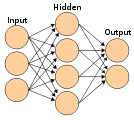 A computational program loosely modeled on the structure of neurons in the brain and
the varying strength of the interconnections among them. In the simplified representation
at the right each brown circle represents an individual “neuron” (or node). Input data
arrives from the left and is then processed by the input nodes, which send information to
one or more “hidden layers” of nodes, which then finally send data to the output nodes.
While this approach to artificial intelligence computer processing may not be exactly the
way the brain itself works, it has nevertheless been found to be very effective in
simulating a number of brain and mental processes, such as the identification and
appropriate labeling of visual images.
A computational program loosely modeled on the structure of neurons in the brain and
the varying strength of the interconnections among them. In the simplified representation
at the right each brown circle represents an individual “neuron” (or node). Input data
arrives from the left and is then processed by the input nodes, which send information to
one or more “hidden layers” of nodes, which then finally send data to the output nodes.
While this approach to artificial intelligence computer processing may not be exactly the
way the brain itself works, it has nevertheless been found to be very effective in
simulating a number of brain and mental processes, such as the identification and
appropriate labeling of visual images.
See also:
DEEP LEARNING,
MACHINE LEARNING,
and for more extensive and technical information see the Wikipedia entry at:
https://en.wikipedia.org/wiki/Artificial_neural_network
“Artificial neural networks [ANNs] are biologically inspired
networks of artificial neurons, or brain cells.
“In a biological brain, each
neuron can be triggered by other neurons whose outputs feed into it, and its own
output can then trigger other neurons in turn. A simple ANN has an input layer of
neurons where data can be fed into the network, an output layer where results come
out, and possibly a couple of hidden layers in the middle where information is
processed. (In practice ANNs are simulated entirely in software.) Each neuron within
the network has a set of ‘weights’ and an ‘activation function’ that controls the
firing of the output. Training a neural network involves adjusting the neurons’
weights so that a given input produces the desired output. ANNs were starting to
achieve some useful results in the early 1990s, for example in recognizing
handwritten numbers. But attempts to get them to do more complex tasks ran into
trouble.
“In the past decade new
techniques and a simple tweak to the activation function has made training deep
networks feasible. At the same time the rise of the internet has made billions of
documents, images and videos available for training purposes. All this takes a lot
of number-crunching power, which became readily available when several AI research
groups realized around 2009 that graphical processing units (GPUs), the specialized
chips used in PCs and video-games consoles to generate fancy graphics, were also
well suited to running deep-learning algorithms. [One research group] found that
GPUs could speed up its deep-learning system nearly a hundredfold.”
—Tom Standage, “The Return
of the Machinery Question, Special Report on Artificial Intelligence”, the
Economist, June 25, 2016, p. 5.
ARTISTIC STYLE
Every work of art (including every piece of literature and music) is ordinarily viewed as
being in some style. A style, in this aesthetic sense, is a sub-category of works
in that area of art. In painting, for example, there are the styles known as socialist
realism, impressionism, expressionism, cubism, Chinese painting, classical Dutch genre
painting, and so forth. Styles come in hierarchies; thus within the broader style of
classical European painting there is Dutch painting of the 17th century, and within that
style there is the narrower style of Dutch genre painting of that period, and within that
there is the style of Frans Hals, and even within that there is the style of Hals’ painting
“Singing Boy with a Flute” (a style used by Hals in some of his other paintings, but
by no means all of them).
However, while the term ‘style’ can in
analytical contexts refer to either major or minor categories of works of art, and be used
to draw different distinctions at completely different levels, it is common within some art
forms—especially literature and painting—for the term to be used primarily to draw attention
merely to rather superficial differences between the works of different writers, or different
painters, whose overall styles are really essentially the same.
The concept of style is one of the
most important basic categories in aesthetics. Aesthetic criticism, for example, can only
be objective by comparing a work to the standards
appropriate to some particular style.
See also:
LITERARY STYLE
Dictionary Home Page and Letter Index
MASSLINE.ORG Home Page