SCHRÖDINGER’S CAT
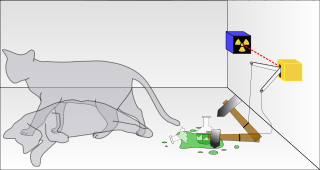 A thought experiment in the philosophy of
quantum mechanics proposed by the physicist Erwin
Schrödinger in 1935, and designed to show that the idealist
Copenhagen Interpretation of quantum
mechanics had to be nonsense. Suppose, said Schrödinger, that you have a cat in a
sealed box where a quantum event (such as the detection or non-detection of the decay of a
radioactive atom) will determine if the cat will live or die (by either releasing a vial of
poison or else not doing so). The Copenhagen Interpretation of the situation is that the cat
is either both dead and alive until the box is opened to see the result, or else that
the cat is neither dead nor alive until the box is opened. Obviously either way is a
complete absurdity. (The defenders of the Copenhagen Interpretation have of course tried to
wiggle out of this predicament, but have not succeeded in coherently doing so!)
A thought experiment in the philosophy of
quantum mechanics proposed by the physicist Erwin
Schrödinger in 1935, and designed to show that the idealist
Copenhagen Interpretation of quantum
mechanics had to be nonsense. Suppose, said Schrödinger, that you have a cat in a
sealed box where a quantum event (such as the detection or non-detection of the decay of a
radioactive atom) will determine if the cat will live or die (by either releasing a vial of
poison or else not doing so). The Copenhagen Interpretation of the situation is that the cat
is either both dead and alive until the box is opened to see the result, or else that
the cat is neither dead nor alive until the box is opened. Obviously either way is a
complete absurdity. (The defenders of the Copenhagen Interpretation have of course tried to
wiggle out of this predicament, but have not succeeded in coherently doing so!)
See also:
MEASUREMENT—Concept of in Quantum Mechanics,
WAVE FUNCTION
“What is the situation today? The remarkable answer: virtually all
physicists accept the Born-Heisenberg point of view. [The Copenhagen Interpretation
of quantum mechanics.] Yet the absurdity of Schrödinger’s cat has never been
satisfactorily answered. How do today’s physicists respond to the reductio ad
absurdum, the ridiculous example, of Schrödinger’s cat? They don’t.
Schrödinger’s cat still bothers them today, when they think about it, but then
they choose to ignore the problem and move on.” —Richard A. Muller, a prominent
bourgeois physicist, in his book Now: The Physics of Time (2016), pp. 196-7.
“Scientists have ideological positions just like everyone else,
especially in conflicted situations, and sometimes the consequences are bizarre. The
Schrödinger cat has grown over time to become a symbol of transcendence, a meaning
exactly opposite to the one Schrödinger himself intended. It has acquired
quasi-religious overtones, so that twisting one’s mind around to understand this cat is
often viewed by students as a step on the path to enlightenment. Unfortunately, it is
not. In science one becomes enlightened not by discovering ways to believe things that
make no sense but by identifying things that one does not understand and doing
experiments to clarify them.” —Robert B. Laughlin, Nobel Prize winning physicist,
A Different Universe: Reinventing Physics from the Bottom Down (2005), p. 50.
SCIENCE — As Having “Come to an End”
It is safe to say that if science ever really does “come to an end”, in which all important
discoveries have already been made, this will certainly be far into the distant future.
Might we even say that it can never happen, and that there will always be
more fundamental scientific laws or principles to be discovered? Marxists, including Lenin
and Mao, have often argued that from the perspective of dialectics this must in fact be the
case. A somewhat more cautious opinion is that it may well be the case, but this is
not absolutely certain. We need to remember Engels’ remark that dialectical laws themselves
have only been generalized from nature and society, and they are by no means some sort of
absolute Kantian imperatives that must from the very principles of reason always and
everywhere be true. Yes, when we look around us with an increasingly careful eye, so far
we always do seem to discover more dialectical contradictions (oppositions) within
everything. And hence there are more scientific laws to be discovered. But will this go
on forever? Dialectics may lead us to expect that it will. But it doesn’t
prove this absolutely.
It is also true, however, that the
occasional claims, even by quite eminent scientists, that “everything” has already been
discovered—at least in physics—have turned out to be laughably wrong. (See first quotation
below for one example.)
“The most important fundamental laws and facts of physical science
have all been discovered, and these are now so firmly established that the
possibility of their ever being supplemented in consequence of new discoveries is
exceedingly remote.”
—Albert Michelson, 1894
dedication address, Ryerson Physical Laboratory, University of Chicago. [He said
this just as physics was on the verge of a major revolution, with the discovery of
radioactivity, the beginning investigations into the structure of the atom, and the
advent of quantum mechanics and relativity theory. Ironically, it was the famous
Michelson-Morley experiment of 1888 which was one of the key pieces of evidence
which showed his view here to be totally wrong! —Ed.]
“There may be further laws to discover, to do with the unification
of gravity with quantum theory and with the other forces of nature. But in a certain
sense, we have for the first time in history a set of laws sufficient to explain
the result of every experiment that has ever been done.” —Lee Smolin, “Never Say
Always”, New Scientist, September 23, 2006."
[The identical thing could
have well been said in the late 1800s. What Smolin forgets is that there are still
many new experiments to be conceived of and done in light of new ideas
which arise and with the further investigation of existing and newly discovered
anomalies. We might also point out that Smolin is very narrowly focused on the
physics of particles and forces here, and there is a whole lot more to science than
just that! —S.H.]
“I believe that scientific knowledge has fractal properties; that
no mater how much we learn, whatever is left, however small it may seem, is just
as infinity complex as the whole was to start with. That, I think, is the secret
of the Universe.”
—Isaac Asimov, I. Asimov:
A Memoir (1995). [Though phrased in a different terminology, this is quite
similar to the view of many Marxist dialecticians. But again, how do we know
for sure that this fractal nature of knowledge continues indefinitely? Might
not that only be a conjecture? —S.H.]
SCIENCE DENIALISM
The rejection or refusal to believe some (or even a great many) of the very well-established findings
of one or more sciences, which are rejected for non-scientific reasons, such as because of
religious or political biases. Historically, this has been most common because of very strongly held
religious beliefs and dogmas which scientific investigations have shown to be false, such as that the
Earth is the center of the universe and that the Sun supposedly goes around the Earth. Those holding
the erroneous views in these cases have often simply refused to accept any evidence which shows that
their dogmatic beliefs are false, no matter how good and solid that evidence is. Thus science
denialism is simply the rejection of science, or the ignorant opposition to science.
The Catholic Church, in particular, was guilty
of extreme science denialism with regard to astronomy for hundreds of years. The philosopher and
scientist Giordano Bruno was burned at the stake in the year 1600
for supporting and extending the Copernican theory that the Earth goes around the Sun. The same nearly
happened to Galileo a few years later. Christian churches have also
strongly pushed science denialism with regard to many other sciences, and especially with regard to
biology, including the scientifically proven fundamentals of evolutionary science. Some Christian
churches do now finally admit that human beings have evolved from lower animals, though many still
reject the now scientifically certain evidence in this regard. And positively all religions
oppose at least some areas of science, and promote science denialism to some degree. The religious
concept of “God”, for example, which is absolutely central to their doctrines, absurdly supposes that
there can be a disembodied (non-physical) being which nevertheless has a mind. This incoherent notion
is in direct opposition to the modern science of cognitive psychology which is based on the recognition
that minds are simply the set of high level aspects, characteristics and states of a physical
brain as it functions and changes.
Sometimes science denialism in the present period is
based as much or more on anti-science political dogmas and biases as it is on the traditional
religious dogmas and biases. Thus it is in the interests of capitalist manufacturers and investors to
believe that global warming and other dangerous forms of climate change are not happening, or at least
they are not happening because of their own profligate emissions of carbon dioxide from their factories,
and other totally irresponsible activities. These science-denial views are then propagated through the
political parties, social organizations, and capitalist-owned media. In the U.S., this especially means
the Republican Party (and its supporting media), which is the more extreme anti-science apparatus of the
two dominant ruling class parties. Furthermore, because of the absurdly poor educational system in the
U.S., knowledge of and respect for science is generally at a very low level for the adherents of the
other main ruling class party, the so-called “Democrats”, as well. Republicans and their supporters still
mostly oppose doing much of anything to prevent the worsening of the current climate change disaster.
Whereas, Democrats and their supporters admit there is a serious and growing problem here, but still only
propose grossly inadequate and very tardy responses. (What good is abstractly admitting that dangerous
climate change is real if you are then still unwilling to do anything truly effective about it?) Neither
of these two bourgeois parties is really willing to effectively deal with the problem, or implement the
major program solutions that climate scientists put forward. In reality, both parties are science
deniers. The bourgeoisie which runs the U.S. (and the world) are overall not willing to even fully
recognize the climate disaster they have created, let alone effectively deal with it. The two main parties
each have their own tribal “belief system”, and the supporters of each party are indoctrinated with the
doctrines of their particular party. But neither of those “belief systems” is truly based on science,
either with regard to the climate emergency, the growing dangers of quite-possible inter-imperialist war
between the desperate United States and China, or on any other major question.
One of the many other areas of rampant science denialism in
current bourgeois society in the U.S. is the widespread rejection of, and hostility towards, well-established
epidemiological methods of preventing or dealing with infectious
diseases, including the absurd “anti-vax” movement. This area of science denialism in the U.S. led to the
needless deaths of 1.1 million people in the Covid-19 pandemic.
—S.H. [Nov. 30, 2023]
See also:
“HOUDINI RULE”,
SITUATIONAL SCIENCE
“Science denial is basically anti-intellectualism. It’s a thread that has run
through American society for decades, possibly even centuries. Back in 1950, Isaac Asimov said
that it’s ‘nurtured by the false notion that democracy means that “my ignorance is just as good as
your knowledge.”’ Today we’re dealing with its most recent manifestation, at its peak.
“Climate change is a special case of science
denial, which of course goes back to Galileo. The Catholic Church didn’t push back on Galileo until
he stuck his head out of the ivory tower and published in Italian rather than in Latin, so that he
could tell the common people something that was in direct opposition to the church’s official program.
Same with Darwin. The church didn’t have a problem with his theory of evolution until he published a
popular book that everyone could read.
“Similarly, we’ve known about the relationship
between carbon dioxide and global warming since the 1890s. It’s been about 50 years since scientists
warned President Lyndon B. Johnson about the dangers of a changing climate. But scientists back then
didn’t get the deluge of hate mail that I get now. So what shifted? It started possibly with [Columbia
University climate scientist] James Hansen’s testimony before Congress in 1988. He announced that a
resource we all rely on—and makes many of the world’s biggest companies rich—is harming not just
the environment but all of humanity. I think it’s no accident that Hansen is the most vilified and
attacked climate scientist in the U.S. because he was the first person to emerge from [the] Ivory
Tower and start talking about global warming in a sphere where its implications became apparent for
policy and politics.
“So you can see that the problem people have
with science is never the actual science. People have a problem with the implications of
science for their worldview and, even more important, for their ideology. When anti-intellectualism
rises to the surface, it’s because there are new, urgent results coming out of the scientific community
that challenge the perspective and status quo of people with power. Renewable energy is now posing a
very significant threat to them. The more viable the technologies, the greater the pushback. It’s a
last-ditch effort to resist change, which is why denial is at a fever pitch.
“Today, although many of the objections to
climate science are couched in science-y terms—it’s just a natural cycle, scientists aren’t sure,
global cooling, could it be volcanoes—or even religious-y terms—God is in control—99 percent
of the time, that language is just a smokescreen. If you refuse to engage these arguments and push
through for even five minutes, the conversation will naturally lead to profound objections to climate
change solutions.”
—Katharine Hayhoe, a climate scientist, in her
interview article, “The Roots of Science Denial”, Scientific American, October 2017, pp. 66-68.
[Professor Hayhoe’s article goes on to talk about a number of other important things in connection with
science denialism, including the whole matter of tribalism and tribal-based
beliefs in American society. —Ed.]
SCIENCE — Limits Of Scientific Knowledge
In an 1872 speech the German physiologist Emil du Bois-Reymond put forward the thesis:
“Ignoramus et ignorabimus.” [“We do not know and will not know.”] Or, in other words
that there are some important things that science will never be able to know. His speech itself
was entitled “Über die Grenzen des Naturerkennens” [“The Limits of Science.”].
But are there really any facts about the
world which science can never know? Well of course there are many trivial factoids
that are almost certainly permanently beyond our knowledge, such as the precise high and
low temperatures of the air in what is now the center of downtown San Francisco on what we
might now call the first day of January in 100,001 BCE (or B.C.). However, what we are
really concerned about are not trivialities like that, but significant and important facts
about the world, especially those of the sort which get enshrined in scientific theories. And
I maintain that there is no reason whatsoever to believe that science is permanently limited
in this respect. All the postulated examples of “things we can’t know” which have been put
forward have either already been discovered despite their proclaimed “impossibility”; or quite
reasonably may yet someday be found out; or are mathematical conundrums within a formal
(axiomatic) logico-mathematical deductive system (rather than facts and theories about the
physical world); or else are silly idealist philosophical conundrums rather than genuine
scientific mysteries.
A striking example of “impossible knowledge”
that was actually soon discovered is the chemical composition of the stars, which the
positivist philosopher Auguste Comte proclaimed forever
unknowable “by any means” in 1835 and which the invention of the spectroscope easily revealed
shortly after Comte’s death. Many other things which at first seemed impossible to know have
nevertheless been discovered by science, such as the average temperature of certain oceans
several million years ago (by noting the presence of fossils of marine animals which can only
exist within a narrow temperature range).
In reaction to du Bois-Reymond’s dogmatic
skepticism about the supposed narrow limits to scientific knowledge, the great German
mathematician David Hilbert pointed out around 1900 that if we believe a certain type of
knowledge to be impossible we thereby impede efforts to actually discover that knowledge. In
addition to this correct comment, however, he also argued that “in mathematics there is no
ignorabimus”, which is more subject to dispute. In 1930 he stated: “For us there is no
ignorabimus, and in my opinion none whatever in natural science. In opposition to the
foolish ignorabimus our slogan shall be Wir müssen wissen—wir werden wissen”
[“We must know—we will know.”] The problem with extending this quite reasonable position in
natural science to formal mathematical deductive systems (such as that formulated by Whitehead
and Russell in their influential work Principia Mathematica (1910-13), is that it was
proven by Kurt Gödel in 1931 that all such systems are “incomplete”; that is, there are
always theorems which can be framed within such a system which cannot be proven (or disproven)
within it. At the beginning of the 20th century Hilbert presented a list of 23 important
mathematical problems that he challenged mathematicians to solve in the coming century. As of
2020 some of these have been solved, some have not, and a few have been shown to be impossible
to answer because of the limitations of the formal mathematical systems they are framed within.
But, again, what is possible within such formal logical systems is not at all the same as
answering scientific questions about the physical world!
Finally, here are several of the supposed
scientific problems (or “world riddles”), which were claimed to never be capable of solution,
which Emil du Bois-Reymond himself put forward in 1872 and 1880, together with my brief
commentaries. It is not at all clear that many of these even truly are scientific questions,
rather than apparently quite silly philosophical puzzles propounded from an idealist
perspective:
1) “The ultimate nature of matter and
energy.” The history of physics since at least the time of Galileo and Newton has been an
ever deeper explanation of the nature of “matter and energy”. But that seems to be not good
enough for du Bois-Reymond: He wants the ultimate explanation! Whether there even is such
a thing is highly problematic; many dialectical materialists such as Lenin have argued that the
world is “inexhaustible”, or that there is always more to discover (but that more always can
be discovered!). He even said this is true of individual aspects of the world, such as the
nature of the atom or of the electron. And so far, at least, he has been proven
right. Asking for “ultimate explanations” in nature may in fact often be anti-scientific in
itself, and something closer to religion.
2) “The origin of motion.” This too
is really just a fanciful puzzle in idealist philosophy. Since the world consists of matter in
motion, this is hardly any different than demanding an explanation for why the world
exists, or the silly question “why is there something rather than nothing?” There seem to be
only idealist or religious reasons for even pondering questions like this!
3) “The origin of simple sensations.”
When the physiologist du Bois-Reymond posed this question psychology was indeed barely getting
started as a science and neuropsychology and neurophysiology did not even yet exist at all. No
wonder the topic of what sensations are, and how they arise in the body and the brain, seemed
hopelessly mysterious to him. However, today there has been a vast amount of knowledge accumulated
about how human and animal sensory systems work, and how brains make use of this input data. On a
larger scale, the once mysterious problem of what a “mind” really is, is
now understood at least in its essence, as being a functional description of the activities and
states of brains. In effect this “world riddle” that so puzzled du Bois-Reymond has been solved.
4) “The enigma of consciousness”
Ah, consciousness, which even today many people—especially idealist philosophers—call the
mystery of mysteries. However, while there is always more to learn about the brain and therefore
about consciousness, the basics have now been obvious for many decades. (See the entry on
CONSCIOUSNESS in this dictionary for an introductory
explanation.)
In sum, the claims of those in past ages about
any supposed drastic limitation on the ability of science to discover the nature of the world
around us look pretty foolish now, motivated as they were by very scientifically obsolete idealist
philosophical ignorance. —S.H.
Some of the information above is from the Wikipedia.
See also my essay “Can We Really Understand the World?” (March 1989), online at:
https://www.massline.org/Philosophy/ScottH/understand.htm
SCIENCE — Trustworthiness Of
How trustworthy is science? There is a whole lot to say in response to this question, though we
will try to keep the discussion here limited to some of the most basic points.
First, science, and especially
natural science, is generally quite trustworthy because
of the tested methods it employs, and because it is self-correcting. Indeed, that is pretty much
the whole point of science: To employ ever-more well-tested methods in the investigation of nature,
society and of us human beings ourselves, which are self-correcting because of later, deeper and
more careful investigations of the same sort, and which thus gradually result in better theories
and ever-more certain and well-establish facts. And to the extent that science proves more and more
useful to us in controlling the world for our collective purposes we thereby have the proof that
science and scientific methods are essentially valid and correct.
Of course, the very fact that self-correcting
procedures are needed in science also shows that there have been, and—we must obviously
assume—still continue to be, many limitations and errors in at least a great many existing
scientific theories and scattered among what are presently assumed to be the enormous number of
scientific facts which have now been arrived at. And especially at the newest margins of existing
science there is bound to be more uncertainty and even outright error which remains to be detected
and corrected.
Second, there are great differences in the levels of
reliability and trustworthiness of the proclaimed facts and theories in different sciences,
and also often in different theories and topics within particular sciences. And in particular, we
have to be much more skeptical of sciences, and specific theories within sciences, where ideological
biases are rampant. Thus, for example, we need to either be extremely skeptical of—or, actually to
outright reject—notions in cosmology which really reflect religious hopes and biases, such as that the
universe (i.e., everything that exists) was created at some particular time, supposedly by a God.
It is true, of course, that we have to also be somewhat
cautious about totally rejecting certain scientific theories which may seem to go against our own
dialectical-materialist views (or “biases”) too! Thus, while the whole Big
Bang Theory does indeed seem quite far fetched, and while we can in fact completely rule out the
openly religious aspect of it which claims that “everything that exists” was created out of nothing
some 13.7 billion years ago, still, it is conceivable at least that there was some great “explosion”
back then, possibly even of space-time itself (whatever that might entail). What we should be skeptical
about, and what we should totally dismiss out of hand, are two different sorts of things. The same is
true about the physics principles of quantum mechanics versus the idealist philosophical understandings
of it such as the Copenhagen Interpretation. It is
mostly only the nutty religious/idealist philosophical interpretations of physics that we totally
outright reject without taking such notions seriously.
There are some so-called sciences in contemporary society
that are so infused with bourgeois ideology and outright lying that they almost need to be rejected in
toto. In particular, the value and correctness of a very large part of what is called social science
in capitalist society simply cannot be given much credence or respect. Why not? Because this so-called social
“science” has been consciously, or at least semi-consciously, constructed primarily to support the continued
existence of the capitalist system, capitalist exploitation, and capitalist-imperialism. What is usually
called “sociology” in present capitalist society was actually originally
consciously created as an alternative to, and in direct opposition to, Marxism (and especially the
fundamental principles of historical materialism). Even many
bourgeois commentators themselves often laugh at the pretentiousness and uselessness of establishment
“social science”, including not only sociology, and so-called “political science”, but also even economics
in its present dominant bourgeois form. However, in this
dictionary entry we would like to focus more on the real sciences, not the various corruptions of
science by bourgeois ideologists.
Third, there is the problem that scientists often
disagree among themselves about specific points, ideas, about what the actual facts are, and even sometimes
about the validity of major theories. So if we are going to try to understand and apply science in dealing
with problems, how should we handle this situation?! In this “age of the Internet” and social media, it
might seem to some people that this problem cannot be dealt with at all; that in science, too, anything goes.
Or that no idea or opinion is better than any other, as the “post-modernists”
absurdly claim.
However, determining who to believe is not normally very
much of a problem if we approach it in the most sensible way. And that means in practice, and in each area
of science, we have to rely on the various established authorities to tell us what science
has determined so far. Each science, and each specialized area within each science has created numerous
authorities. They are the ones who write the textbooks being used at universities, those who contribute
most of the research to journals in their field, and the editors of those journals, and so forth.
Some folks may have read about the struggles that brilliant
young scientists like Galileo, Einstein, Darwin (and Marx!) had with the “authorities” in their day, and
have possibly come to the conclusion that “the existing authorities are the enemy of science”. That is
indeed occasionally true, especially with respect to pathbreaking new ideas at the margins of existing
sciences. But as far as learning about the great mass of existing knowledge in the sciences goes, it is not
true at all. In learning the basic accumulated knowledge in any science (including MLM science) there is
no other reasonable course of action except to try to learn from the best authorities, which often means
those who have most contributed to the creation of that science in the first place, or at least summaries
of their contributions. In learning science, like learning anything else, the best course of action is to
seek out the best authorities and try to learn from them directly. True, if you yourself are a brilliant
young scientist with important new ideas that go against existing theories in some ways, then the existing
authorities may in fact be a major obstacle, or even your enemy. But if you are instead just a student of
some existing science, seeking to learn and apply it in practice, then the existing authorities are who you
must seek out and learn from. They are (or should be) your primary teachers.
Fourth, we must stress the importance of caution and modesty
on the part of us non-scientists who are seeking to understand and use a science and scientific procedures,
or to make political decisions based on our level of understanding of those sciences. A serious problem in
American society today is that a great part of the population imagines that they know far more about the
sciences, and the best social practices in light of those sciences, than they really do. Very few of us have
actually seriously studied climate science, for example, or epidemiology. And yet a great many people reject
the dominant advice of the bodies of authorities in those fields. Furthermore, many people who actually are
not trained in a science think they themselves are somehow qualified to pick and choose from among
all the scientists in that field to determine who most to trust. In reality, only the best people within any
field of study are qualified to say who the other best people are. Those of us on the outside must instead
rely on the consensus views to guide us.
In the case of global warming and other forms of climate
change (such as the consequent trend toward more severe storms), some of the earliest warnings about the
potential seriousness of these problems first appeared way back in the 1960s and 1970s. But even within that
branch of science itself there was at that time no consensus. However, by the late decades of the 20th century
the situation was much clearer, and by far the most dominant view among climate specialists was that global
warming was becoming a very serious problem, and major efforts had to be made to at least start to ameliorate
the causes of that problem and its consequences. However, the ruling class, and especially the right-wing of
it—the more “know-nothing”, more anti-science wing—continued to pooh-pooh the problem (because trying to deal
with it would be expensive, harm corporate profits, and force increases in taxes). It is a principle of
historical materialism that people tend to believe that which is in their own perceived interests. And
at that time there were still a few climate scientists around, often in the direct pay of the rich, who
continued to deny that there was anything to worry about. So this was a situation in which each side in the
political dispute over climate change could “choose its own authorities”—i.e., pay attention only to those
scientists who supported what they already believed. But those who chose to believe the great majority of
climate scientists that global warming was a major and increasing problem that had to be dealt with, were
correct. They were not correct in their reasoning if they chose to believe the majority of scientists
only because those opinions agreed with their own; but they were correct if their reasoning itself was
to believe the great majority opinion or the consensus opinion within that science. While it is
true that the vote of a majority of scientists in some area of science does not determine what is true,
the great majority or consensus does normally actually favor the views of the leading and most trustworthy
authorities in that field. And this is what those of us who try to learn and use science have to go
by.
The case of the dismal and grossly unscientific response to the
Covid-19 pandemic in the U.S. and around the world is different in an important way. In the case of climate
change there is little that ordinary people can do about it; there has to be major changes made by the government
and corporations (neither of which has done very much so far, as things continue to seriously worsen). However,
according to the fundamental principles of epidemiology, the basic way to try
to defeat an epidemic or pandemic is to educate and seek the cooperation of virtually all the people in the
affected area in a society. Defeating an epidemic largely depends on the actions of the people themselves, once
they know what to do and are willing to do it. But in the U.S., for sure, a great many didn’t know, and a great
many of them didn’t do it. And that is why more than a million Americans have already needlessly died, and as
of 2023 hundreds more still continue to die every day.
The things that individuals need to do to stop a Covid-19 type
of epidemic can be simply stated: 1) Avoid people with the disease, and avoid regions where it is rampant; 2) Get
yourself tested if there is reason to believe you might have caught the disease; 3) Seek immediate treatment if
you have, and strictly socially isolate yourself while you may still be contagious; 4) Be sure to inform the
medical authorities about everyone you’ve been in contact with since you became infected [See
Contact Tracing]; 5) Get vaccinated and boosted if and when that becomes
possible; and, 6) Wear effective masks, whenever mixing socially with other
people who just might be infected. In short: AVOID, TEST, TREAT, ISOLATE, VACCINATE, and MASK. Although this is
basic epidemiology, and the strong advice of the consensus of medical authorities, the U.S. government
did not effectively educate people and strongly and consistently promote and implement this program. In
considerable part this was because of their own insufficient preparations and numerous other serious errors and
their lack of concern for the welfare of the masses (as compared with keeping production going and corporate
profits high). (For some of the details see: COVID-19
PANDEMIC)
It may be that in the modern world only a true socialist country,
which uses the mass line to educate and lead the masses in their own collective
interests would now be capable of really successfully dealing with major epidemic threats. Certainly the U.S. is
no longer capable of doing so, if it ever was. Science education is so extremely poor in the U.S. that a great many
ordinary people couldn’t tell you the most elementary basics of how a pandemic should be dealt with, even if their
own life depended on it (which it very well might!). And when there is an outrageous and wildly conflicting jumble
of conflicting opinions about what to do on social media and elsewhere, most ordinary people have no idea how to
rationally determine which voices represent the dominant ideas in actual science or who to put their primary trust
in. This is the bourgeois world we are stuck in for now. —S.H. [March 11, 2023]
See also:
EPISTEMIC TRUST,
“HOUDINI RULE”,
INTELLECTUAL HUMILITY
SCIENCES — Development of the Separate Sciences
“There has been achieved what Engels called ‘the successive development
of the separate branches of natural science’—the evolution of the different sciences
one from another, and their differentiation one from another as distinct ‘disciplines’.
“Apart from mathematics, astronomy,
and mechanics, which were already in existence’, writes Engels, ‘physics becomes
definitely separated from chemistry (Torricelli, Galileo ...). Boyle put chemistry on a
stable basis as a science. Harvey did the same for physiology.... Zoology and botany
remain at first collecting sciences, until paleontology appeared on the scene—Cuvier—and
shortly afterwards came the discovery of the cell and the development of organic
chemistry. Therewith comparative morphology and physiology became possible.... Geology
was founded at the end of the eighteenth century.’
“In this process, which, as Engels
says, must be ‘studied further in detail’, the successes scored in one field of science
create the possibility for the establishment of the scientific investigation of new
fields. The whole process exhibits its own internal logic of development, which unfolds
on the basis of the development of the productive forces of capitalist society, which
at one and the same time present new problems for science to tackle and provide the
technical means for tackling them.
“This successive development and
differentiation of the sciences, which proceeds right to our own day, and will continue,
has, however, its negative side. This is shown in the tendency to the separation of the
sciences and to over-specialization, which continues to operate despite the
establishment of intermediate sciences, such as physical-chemistry, bio-chemistry, etc.,
and which today results in ‘the unity of science’ being posed as a major unsolved
problem by bourgeois philosophy of science.” —Maurice Cornforth, “Dialectical
Materialism and Science”, (London: Lawrence & Wishart, 1949), pp.6-7. Cornforth here
summarizes the views of Engels in his Dialectics of Nature, on pp. 214-215 of
the edition he used.
SCIENTIFIC INVESTIGATION
[Intro to be added...]
See also:
FOOLING YOURSELF,
“HOUDINI RULE”,
SCIENTIFIC METHOD
“You see, the problem of obtaining facts from experience—it sounds
very, very simple. You just try it and see. But man is a weak character and it turns
out to be much more difficult than you think to just try it and see. For instance,
you take education. Some guy comes along and he sees the way people teach
mathematics. And he says, ‘I have a better idea. I’ll make a toy computer and teach
them with it.’ So he tries it with a group of children, he hasn’t got a lot of
children, maybe somebody gives him a class to try it with. He loves what he’s doing.
He’s excited. He understands completely what his thing is. The kids know that it’s
something new, so they’re all excited. They learn very, very well and they learn
the regular arithmetic better than the other kids did. So you make a test—they
learn arithmetic. Then this is registered as a fact—that the teaching of
arithmetic can be improved by this method. But it’s not a fact, because one of the
conditions of the experiment was that the particular man who invented it was doing
the teaching. What you really want to know is, if you just had this method described
in a book to an average teacher (and you have to have average teachers; there are
teachers all over the world and there must be many who are average), who then gets
this book then tries to teach it with the method described, will it be better or not?
In other words, what happens is that you get all kinds of statements of fact about
education, about sociology, even psychology—all kinds of things which are, I’d say,
pseudoscience. They’ve done statistics which they say they’ve done very carefully.
They’ve done experiments which are not really controlled experiments. [The results]
aren’t really repeatable in controlled experiments.”
—Richard Feynman, “Richard
Feynman Builds a Universe”, in his book The Pleasure of Finding Things Out
(1999), pp. 241-242. [From a truly scientific standpoint a lot of what is considered
to be scientific fact—especially in what are termed the “social sciences” in
bourgeois society—is in reality just pragmatic guess
work. In MLM revolutionary work we must also take great care not to fall into such
pseudo-scientific methodology. This is one of the many reasons why we must strongly
encourage both internal and external perusal and criticism of our policies and
methods. —Ed.]
SCIENTIFIC LAWS — As Mere Tendencies
On rare occasions, mere tendencies or unquantifiable probabilities have sometimes been
spoken of as laws, as with Marx’s discussion of what he calls “the law of the tendency of the
rate of profit to fall” (in Part 3 of Volume III of Capital). A few modern Marxists,
often under the influence of bourgeois post-modernist
ideology, have gone so far as to claim that most or even all laws in social science are
“only tendencies”! [For one example of this by the Revolutionary Communist Party, USA, and a
strong criticism of this stance, see my essay “Notes on Notes on Political Economy”
(Feb. 25, 2000), especially the section “Tendencies and Tendential Laws”, online at:
https://www.massline.org/PolitEcon/ScottH/NotesNPE.htm —S.H.]
However, the modern convention in science in
general is to describe such partial or limited regularities not as “laws” at all, but
simply as “tendencies”. In the way the term ‘scientific law’ is almost universally used in
science today there are never any exceptions to scientific laws. If exceptions to what was
previously thought to be a law are found, then either the scope of the application of
that law is narrowed to exclude such situations, or else (if that cannot be done) it is no
longer considered to be a law at all.
“Social laws are therefore no more than tendencies, the
development of which is constantly interfered with, changed and modified by the
action of counter-tendencies. In fact, there is no difference between a law and a
tendency: the dominant tendency becomes a law.” —Eugen Varga, Politico-Economic
Problems of Capitalism (Moscow: Progress, 1968), p. 19.
[Varga
was the leading representative of the Comintern in the 1930s with regard to political
economy. Some of his views on economics were correct, but some were not! The same goes
for his views on politics and philosophy. (The book from which the above comment was
taken promotes many revisionist ideas.) Personally, I think his views on this specific
point are grossly incorrect, even if there is a sentence or two in Marx which can be
used in support of his position. See the quote below for some of my reasons. —S.H.]
“The new RCP doctrine that all social laws are only ‘tendencies’ is
the sort of notion that has quite a bit of plausibility if you only think about it
briefly and superficially. But if you check it against the sorts of things that we
have been calling laws, or at least well-established law-like principles, it
immediately loses its persuasiveness.
“Let me give a little example of
this. After Engels’ death Lenin wrote a tribute to him which included these words—which
I will intersperse with questions about ‘tendencies’:
“Marx and Engels were the first
to show that the working class and its demands are a necessary outcome of the present
economic system, which together with the bourgeoisie inevitably creates and organizes the
proletariat. [Is the creation of the working class only a ‘tendency’ instead of an
inevitable result of capitalism?] They showed that it is not the well-meaning
efforts of noble-minded individuals, but the class struggle of the organized proletariat
that will deliver humanity from the evils which now oppress it. [Is the class
struggle of the proletariat the definite method by which humanity will free itself, or is
it only a ‘tendency’ in that direction?] In their scientific works, Marx and
Engels were the first to explain that socialism is not the invention of dreamers, but the
final aim and necessary result of the development of the productive forces in modern
society. [Is socialism merely a ‘tendency’ of the productive forces in modern
society, instead of a ‘necessary result’ as Lenin says?] All recorded history
hitherto has been a history of class struggle, of the succession of the rule and victory
of certain social classes over others. And this will continue until the foundations of
class struggle and of class domination—private property and anarchic social
production—disappear. [Was Lenin wrong here too? Is the continuation of this class
struggle only a ‘tendency’ and not an inevitable characteristic of any society based on
private property?] The interests of the proletariat demand the destruction of
these foundations, and therefore the conscious class struggle of the organized workers
must be directed against them. [Or do the interests of the proletariat only have
a ‘tendency’ to demand the destruction of these foundations?]
“I could go on and on in this vein,
but I think you probably see the pattern here. And of course it is possible to quibble a
bit on some of these questions if you are determined to do so. Thus you could say that
socialism (communism) is not the necessary result of the development of the
productive forces in modern society, since capitalism (or some natural disaster, like an
asteroid hitting earth) might wipe out humanity entirely instead. But this sort of
response is disingenuous, since an implicit premise of the argument is that humanity
continues to exist. (Or if you like, you could say that the more precise law is this:
Unless some unlikely natural disaster, or perhaps the hideous workings of capitalism
itself, wipes out humanity entirely, communism will be the necessary result of the
present capitalist social system. And that law is indeed definitely true, and certainly
no mere ‘tendency’.)
“The general point is just that
the new RCP principle that demands that all the laws and law-like principles of social
science be viewed as mere tendencies looks down-right foolish when it is compared
against the vast majority of those laws and law-like principles. How is it that the RCP
didn’t notice this? Apparently the authors of this new doctrine never thought to compare
it to the actual laws of society that have been discovered by Marx, Engels, Lenin, Mao
and others. Incredible as it seems, they apparently didn’t think to see if their new
principle was valid in any cases other than the one which led them to it in the first
place.” —S.H., “Notes on Notes on Political Economy” (Feb. 25, 2000), online at:
https://www.massline.org/PolitEcon/ScottH/NotesNPE.htm
SCIENTIFIC LAWS — Hierarchical Structure Of
Something that is all too seldom appreciated is that the laws of science (or laws of nature)
are pitched at different levels of abstraction appropriate to the specific science
and specific phenomena in question, and that therefore there is a hierarchical structure
to scientific laws. At the level of quantum chromodynamics there are laws which have been
discovered about the interactions of quarks via the
strong nuclear force. At the level of atoms and
molecules, and their interactions—that is, at the level of quantum
electrodynamics—there is another set of natural laws. And although QED forms the
theoretical basis for chemistry, in practice there needs to be a whole large additional set
of laws of chemistry such as the knowledge of the nature of acids and bases, which solvents
are useful in specific cases, and so forth. At a slightly higher level there are specific
chemical principles useful in the manufacture of batteries. The laws now start to sometimes
be called engineering principles, but that is just an acknowledgement that the laws
or principles at these levels are of a more practical nature. And finally we get to the laws
or principles used to build complex machines, including such things as sewing machines and
automobiles. And, yes, in a sense, even automobiles and sewing machines function according
to the laws of quantum mechanics, but these machines (and how to build and maintain them)
cannot possibly be understood in practice by Schrödinger equations or Feynman diagrams!
There simply must be new laws and principles to describe how autos and sewing
machines work at a much higher level than that, couched in terms such as drive shafts and
transmissions, or needles and bobbins.
Other sciences have very different sorts of
scientific laws and principles appropriate to the phenomena which they study. In linguistics
there are laws about the structure of words in terms of morphemes, and at a deeper level,
in terms of phonemes. In geophysics there are laws about tectonic plates and “hot spots”,
and how mountains are created, and which explain volcanoes and earthquakes. In the political
economy of capitalism there are laws which explain why capitalism inherently leads to
overproduction crises and the immiseration of
millions. In historical materialism there are
laws and principles couched in terms of social classes, such as explanations of the essence
of the state and of social revolution.
Because each science needs to formulate its
own laws to describe the developments and interactions of the phenomena it studies, any
program of complete reductionism is totally foolish, even
if certain limited types of reductionist explanations can be helpful at times.
From a Marxist philosophical standpoint the
hierarchy of scientific laws is a result of the hierachy of dialectical contradictions and
of the particularity of contradiction.
“The tendency of nature to form a hierarchical society of physical
laws is … why the world is knowable. It renders the most fundamental laws, whatever
they are, irrelevant and protects us from being tyrannized by them. It is the reason
we can live without understanding the ultimate secrets of the universe.” —Robert B.
Laughlin, Nobel Prize winning physicist, A Different Universe: Reinventing Physics
from the Bottom Down (2005), p. 8.
“SCIENTIFIC MANAGEMENT” [Of Capitalist Production]
[To be added...]
See also:
TAYLORISM
SCIENTIFIC METHOD
The idealized general method used to advance scientific knowledge which itself has been
developed and refined along with the major sciences themselves, especially the physical
sciences (physics, chemistry, biology, etc.). Its most essential points are:
• The careful and systematic
investigation of the phenomena being studied, including careful measurements of attributes
where possible;
• The analysis of complex
entities by looking at their component parts and aspects, and studying the interactions
and interrelationships between these various parts;
• The formulation of hypotheses
which explain or which seem to have led to the existence of the phenomena in question;
• Where possible, drawing out
the implications of the hypothesis and making predictions of new results that we
would expect to be true if the hypothesis in question is correct;
• Criticism and testing of
these hypotheses and predictions, especially through careful experiments where this is
possible, or through further observations where formal experiments are not possible;
• Correcting, revising or
replacing the previous hypotheses in light of this criticism, testing and experiment,
and formulating them into what become generally accepted scientific theories.
• Continuing this procedure in
a reiterative fashion, and especially as long as there are puzzling aspects of the existing
theories which have not yet been adequately explained.
In short, scientific method is the procedure
which the sciences have developed over the centuries to investigate nature, human beings and
society, to acquire new knowledge, to correct or replace views which are found to be wrong,
and to organize the resulting knowledge according to general principles or what we call
theories. These scientific theories are then made use of to guide our scientific,
engineering and social practice.
Although scientific method generally refers
to this overall methodology which is applicable to all the sciences, there are differences
among the sciences which require some modifications or extensions of scientific method in
particular sciences. In some sciences, for example, experiments can be difficult to perform,
or may even be completely out of the question in some cases for ethical reasons. To take an
extreme example to prove the point, there is a quite well established theory that a major
nuclear war between imperialist countries might lead to a “nuclear winter”, a period of
several years in which nearly all sunshine is blocked from reaching the ground, and in which
therefore most life on earth would be killed. While it is technically possible to run a full
experiment—to actually purposely start a major nuclear war!—to see if this is actually the
case, no one in their right mind would consider doing so. Fortunately, many scientific
conclusions such as this can be reasonably demonstrated to be true via lesser experiments
and without drastic “full experiments” of that sort.
In some sciences, such as psychology and
medical science where human subjects are experimented on, scientific method needs to be
extended in ways which eliminate as much bias and wishful thinking on the part of both the
subject and the experimenter as possible. In testing a new drug, for instance, it has been
found that it is an important part of the scientific method to do this in a double-blind
fashion, with neither the patient nor the doctor knowing whether the patient is actually
receiving the new drug or just a placebo, until after the experiment is finished. In
experiments of this sort careful and appropriate statistical procedures are also required.
See also:
FOOLING YOURSELF,
“HOUDINI RULE”,
RESIDUAL PROBLEM,
RETRODICTION,
TESTABILITY,
ANALYSIS (Scientific)
SCIENTIFIC THEORY
Scientific theories are the summation of scientific knowledge; theories form knowledge into
a logical and coherent structure and make a whole body of investigations comprehensible. Thus
the formulation of scientific theories is at the core of science and is its highest goal.
(Of course the goal in the application of science is to change the physical or social
world in one way or another.)
On the other hand there have often been
idealist tendencies in science, particularly in cosmology, “theoretical physics”, and the
social sciences, to divorce the construction of theories from the actual results of careful
investigations of nature and society, and to engage in wild flights of fancy with little or
no evidential foundation. Obviously what is needed instead is a dialectical combination of
practice and theory, and of careful investigation and the formulation and testing of theories
based on what has been learned in those actual investigations.
Scientific education should consist primarily
of two things:
1. Learning the scientific
method for science in general, and the specific scientific methods which are useful within
particular sciences; and
2. Coming to understand and appreciate the most
important scientific theories. That is, science education should be “theory-structured”.
Focusing on the explication of the most
important theories in a science actually makes that science both more comprehensible and
easier to learn. Speaking of his own science, Linus Pauling said in the preface to his 1947
book, General Chemistry, “The progress made ... in the development of theoretical
concepts has been so great ... that the presentation of general chemistry ... can be made in
a more simple, straightforward, and logical way than formerly.”
Revolutionary Marxism, or Marxism-Leninism-Maoism,
is also a science, and mastering it requires the same approach. One must focus on its central
theories and come to understand and appreciate them. And this requires some considerable study
along with participation in the ongoing revolutionary movement.
See also:
AD HOC PATCHES TO SCIENTIFIC THEORIES,
CENTRAL ORGANIZING THEORY,
REVOLUTIONARY THEORY
SCIENTIFIC THINKING
See:
EVOLUTIONARY THINKING
SCIENTISTS — And Science
Although science has been created by scientists, individual scientists are sometimes quite wrong
about new scientific claims and even about the big and small scientific theories that they publish
or defend. It is very often up to other scientists to show later on that these errant
claims or theories are in fact either fully or partially incorrect. What this means is that science,
like most other major human pursuits, is a social activity. As great as some individual
scientists are, their ideas also have to be carefully checked—and sometimes corrected or rejected—by
many later scientists and researchers. While it is a human tendency to focus excessively on individual
heroes, science is much more centrally the result of the continuing social and collective activity
of the whole scientific community.
“Scientists have an uncanny ability to find what they’re looking for—whether
it’s there or not.” —The Amazing Randi [magician James Randi], quoted by AP reporter
Scott Williams, “Amazing Randi Debunks the Magic”, San Francisco Examiner, October 19,
1993, p. B-9. [This is one reason why other scientists, along with professional skeptics like
the Amazing Randi, have to check up on them! See also: “Houdini
Rule”]
SCIENTISTS — Motivation Of
Human beings are complicated creatures and there can be many different sorts of motivations for the
things we do. This certainly applies to scientists as well as to others. But are there some small
number of typical motivations that characterize many scientists? Certainly. And, as one might expect,
these do in fact include curiosity, the deep and genuine desire to understand how nature works.
In the case of medical scientists, especially, there is often also a deep desire to help humanity,
by seeking to cure diseases or in other ways. Of course there are also plenty of rather less admirable
goals that may also often motivate a particular scientist as well, such as strong desires for fame
and fortune.
However, regardless of what the actual motivations
of some specific scientist are, as social revolutionaries our primary overall judgment of them
has to be based not so much on their scientific brilliance as it is on whether or not their work has
in an overall way served the people.
“My impression of photosynthesis researchers is that they are happy to think
that their work is, in some way, of planetary significance. [Such as with regard to helping
deal with the problem of global warming. —Ed.] But most are remarkably uninterested in actually
cashing that significance in. They feel about helping the planet rather as researchers in other
parts of basic biology feel about healing the sick; they’re in favor of it in principle, and
in that they think their work is relevant to that noble end, they feel good about themselves.
It provides an inspiring and self-affirming context in which to do what they wanted to do
anyway. But it’s not why they do what they do; that agenda is set by their own curiosity, and
by the judgment of their peers. And while their work’s relevance is pleasing, and may even help
when selling projects to funding bodies, turning that relevance into practical achievement tends
to be seen as someone else’s business.
“This is not, or not wholly, an abnegation
of responsibility. It is a statement of fact. Most scientists really do see themselves as out to
understand the world, rather than to change it. They often understand the ways in which the
world might be changed far better than their forebears in the Lunar Society did—but the way
their profession has developed has robbed them of that magnificent eighteenth-century sense of
themselves as actors in the world at question. Instead, they follow their own curiosity, often
driven as much by a need for escape from the world as a need for engagement with it. Institutions
provide contexts and channels for this enthusiasm, and will not support it arbitrarily. But to
a surprising extent scientists get to define their own questions.”
—Oliver Morton, Eating the Sun: How
Plants Power the Planet (2008), pp. 405-6. [This unfortunate change in the social consciousness
of scientists from that of the eighteenth century is very probably due to the intensifying sinister
effects of bourgeois society. We will certainly work to return that motivation of working for the
people (along with scientific curiosity) to scientists in socialist and communist society. When
society is run by and for the people, science can once again focus on both understanding
and also changing the world for the benefit of the people. —S.H.]
SCIENTISTS — Obligations of to the People
“‘Science must not be a selfish pleasure. Those who are so lucky as to be able to
devote themselves to scientific pursuits should be the first to put their knowledge at the service
of mankind.’ One of his favorite sayings was, ‘Work for the world.’” —Paul Lafargue, quoting Marx,
in his book Reminiscences of Marx, re-quoted in Political Affairs, the CPUSA journal,
February 1949, p. 96.
SCOPES “MONKEY” TRIAL (1925)
A famous trial held in Dayton, Tennessee in 1925 in which a public school teacher, John T. Scopes,
was tried for illegally teaching the Darwinian theory of evolution in a science class. It was given
the name “Monkey Trial” by H. L. Mencken, as part of his ridicule of the entire proceedings. The
prosecution was led by the famous populist politician William
Jennings Bryan and Scopes was represented by a team led by the great defense lawyer, Clarence
Darrow, who was an agnostic. Although Scopes was found guilty and
fined $100 (a significant amount at the time), the verdict was set aside on a technicality. However,
the broader and quite positive result of the trial was that the ignorance and anti-scientific views
of fundamentalist Christians were appropriately denounced and ridiculed both during the trial and
ever since.
On day seven of the trial, Darrow called the counsel
for the prosecution, William Jennings Bryan, to the stand as a self-proclaimed expert on the Bible.
Darrow then asked Bryan a series of embarrassing questions, such as whether he really believed that
Eve was created from Adam’s rib; where their son Cain got his wife (since according to Genesis Adam,
Eve and their sons were the only humans who yet existed); and so forth. Bryan could only answer
the question about where Cain’s wife came from by saying that he would “leave the agnostics to hunt
for her.” After Bryan’s absurd (if sometimes humorous) responses, Darrow said to him: “You insult
every man of science and learning in the world because he does not believe in your fool religion.”
Bryan, recognizing the considerable effect that Darrow was having, said that the purpose of Darrow’s
questions was “to cast ridicule on everybody who believes in the Bible”. Darrow responded, “We
have the purpose of preventing bigots and ignoramuses from controlling the education of the United
States.”
A famous play and then movie based very loosely on
the Scopes Trial is Inherit the Wind. The 1960 movie featured Spencer Tracy in the role based
on Clarence Darrow and Fredric March in the role based on William Jennings Bryan. A more accurate
account of the trial is available in the book by Ray Ginger, Six Days or Forever?: Tennessee v.
John Thomas Scopes (1958).
SCORCHED-EARTH POLICY
See also:
“NERO DECREE”
Dictionary Home Page and Letter Index
MASSLINE.ORG Home Page