FOCO THEORY (or FOCOISM, FOCALISM, FOQUISMO, etc.)
A strategy for revolution associated with Ernesto “Che” Guevara,
and formalized by Che and the radical French writer Régis Debray. According to this
theory it is not necessary to wait until conditions are right to launch either an
insurrection or else a people’s
war (depending on the nature of the country). Instead, at least in oppressed Third
World countries, a dedicated band of revolutionaries can launch very small-scale, roving
semi-guerrilla warfare at any time, which will supposedly serve as a focus (Spanish:
foco) and inspiration for the rapid growth of more general guerrilla warfare and/or
at some relatively early time a general uprising capable of seizing political power. The
theory is that these paramilitary roving bands can themselves create the necessary
conditions for revolution through their vanguard actions
and moral example.
Unlike genuine people’s war, the foco
theory is based on the assumption that a band of heroes can create a revolution, and that
the mere existence of the foco makes it a vanguard
without any necessity to merge deeply with the masses, forge close ties with them,
participate seriously in their own struggles, and actually lead the masses in their
own struggles. Foco theory, or focoism, is therefore a strongly elitist theory of
revolution.
The origin of the foco theory lies in
an idealist generalization of the experiences of Che and Fidel Castro in the Cuban
Revolution. However, given the strategy followed by Castro, the success of that revolution
was pretty much a lucky accident. This was at the time when there was already mass
disgruntlement on the verge of boiling over against the Batista dictatorship. In other
words, while the foco theory says it is not necessary for conditions to be
particularly ripe for revolution, in Cuba itself they actually were. This circumstance
also led to tremendous demoralization and ineffectiveness in Batista’s army, which almost
totally fell apart after Castro’s small guerrilla force of a few hundred men took over a
similarly small Cuban Army garrison of 250 men near the city of Santa Clara in December
1958 (the Battle of Yaguajay).
Attempts to apply the foco strategy in
other countries have always failed dismally. In Africa Laurent-Désiré Kabila, with the
direct help of Che, attempted it with very dismal results in the Congo. The most famous
example is that led by Che himself in Bolivia, where his approach failed to connect up
with the Bolivian peasants and led to his swift capture by the Bolivian Army with the help
of the U.S. CIA. (The actual cold-blooded murder of Che after his capture is said to have
been done personally by the notorious CIA agent Felix Rodriguez.) This humiliating failure
led Cuba to back off on supporting similar focoist adventures for a number of years, and
revolutionary groups around the world which had been inspired by the Cuban revolution
began splitting into factions, and shifting more toward alternative strategies. In the
mid-1970s, however, Cuba resumed its support for international revolution in a big way.
In Africa it deployed its own troops and also supported the MPLA guerrillas in Angola. In
the Caribbean area it resumed substantial support for groups following the foco strategy.
In Argentina, the People’s Revolutionary Army (ERP), led by Roberto Santucho, tried the
foco method in Tucumán Province, near Bolivia, but apparently without Cuban military or
financial support. It was also rather easily defeated by around 3,000 Argentine soldiers,
partly by using vicious state terror tactics against the small number of ERP supporters
in nearby towns.
While the original foco strategy was
designed for revolutionary efforts in rural areas in oppressed Third World countries, in
the late 1960s the foco idea was also adapted for urban areas in some Third World
countries and even in the United States! Needless to say, the results of this
urban guerrilla warfare were even more
ignominious defeats. (See: Venceremos Organization,
Weather Underground organization and
Carlos Marighella.)
See also the article
“Guevara, Debray, and Armed Revisionism”, by Lenny Wolff (1985), at:
https://www.bannedthought.net/Cuba-Che/Guevara/Guevara-Debray-Wolff.pdf
FOOD ADULTERATION
To make food impure by the addition of foreign or inferior substances, inert or otherwise.
In other words, the mixing of improper, sometimes inedible, and occasionally even quite
dangerous, materials into the food products sold by capitalist corporations to the
unsuspecting public. Although there are laws governing the adulteration of food in almost
all countries today and which usually require the labeling of all contents, these laws are
weak, and—worse yet—often not enforced. This means that a lot of food sold by capitalist
companies to the people are actually adulterated in one or more ways. This is done, of
course, in order to lower the costs of producing these foods and therefore in order to
increase profits. The obvious moral here once again is: The capitalist profit motive
is incompatible with the genuine welfare of the people.
With the growth of giant agribusiness into
its modern national and international form, and with ever more concentration on the “bottom
line” (profits), food adulteration has been taking more and more serious forms with the
spread of serious illnesses through food contaminated with dangerous bacteria such as
E. coli, Listeria and Salmonella. Many thousands of people have become
sick or even died in this way. This sort of adulteration is not done of purpose, of
course, though it is an inevitable outcome when safety procedures cost money (and therefore
harm profits).
As bad as things are in the U.S., the
situation in some other countries—such as China and India—is even worse. A few years ago
there was a notorious case in China where milk and infant formula was being purposely
tainted with the industrial chemical melamine in order to make it appear in routine tests
that these products were richer in protein. In tests done in the Indian state of Tamil Nadu
in 2013-14 it was found that nearly 40% of all food items were adulterated in one way or
another. Capitalism marches on.
“When agents from the U.S. Food and Drug Administration paid a
surprise visit to a Pennsylvania cheese factory in November 2012, they found evidence
that Castle Cheese was doctoring its so-called 100 percent Parmesan with cut-rate
substitutes and fillers such as wood pulp. ...[A]dulterated grated Parmesan and
Romano cheeses remain a very real problem.” —Lydia Mulvany, “Let Them Eat Wood”,
Bloomberg BusinessWeek Feb. 22-28, 2016, p. 25.
[You might think that this
one raid by the FDA at least resolved this particular problem, but you would be wrong.
When, more recently, a lab hired by Bloomberg tested the Parmesan cheeses of other
companies it found that wood pulp cellulose was 3.8% of Kraft’s “100% grated Parmesan”;
7.8% of Walmart’s “Great Value 100% grated Parmesan”; and 8.8% of “Jewel-Osco Essential
Everyday 100% grated Parmesan”. Thus even for a food product which is already
well-known to the Food and Drug Administration to be commonly adulterated, the
adulteration continues almost unimpeded. —Ed.]
“When an industry doesn’t want a law enacted but fears a public
backlash if it openly opposes the proposed law, it quietly makes sure that there aren’t
enough funds to enforce it. This was the case when the food industry went along with
the Food Safety Modernization Act, which became law in 2011, after thousands of people
were sickened by tainted food. Subsequently, the industry successfully lobbied Congress
to appropriate so little to enforce it that it has been barely implemented.” —Robert
B. Reich, Saving Capitalism (2015), p. 71. [Reich, a former Secretary of Labor
in the Bill Clinton administration, provides endless examples of how capitalism goes
against the interests of the people, and controls the government. And yet he still
thinks it can somehow be “reformed”. His own book shows how foolish that notion really
is! —Ed.]
FOOD BANK
An agency, usually run by a philanthropic organization or a church, which distributes donated
food to people in our capitalist society who are too poor to buy enough to eat. In the United
States often much of this food is given to these food banks by the federal government, which
acquires it through crop price support programs as de facto subsidies to agribusiness. Food
banks have largely replaced the soup kitchens in the Great Depression of the 1930s, though they
only provide the food and do not prepare it for immediate consumption.
“America’s food banks distributed roughly 50 percent more food in 2020
compared with 2019, much of it to first-time visitors.” —New York Times,
April 3, 2021, p. 3.
FOOD INSECURITY
Frequently not having enough food available. Usually said of an individual or a family. This is
not quite the same thing as outright starvation, though being forced to skip meals or eat only
a small portion of what you want and need is certainly very unpleasant even on an intermittent
basis.
“According to Census Bureau Pulse Survey data released this week, 10.5
percent of American adults are experiencing some level of food insecurity.” —New York
Times, from the article “Food Stamps: Are You Eligible? It’s Complex”, July 18, 2020,
p. 3.
FOOD — Pathogens In
Foodborne bacteria, viruses and other pathogens, are becoming more and more common because of
careless practices by modern agribusiness, and their almost exclusive focus on maximizing profits.
Recently the frequency and seriousness of disease outbreaks caused by pathogens in food has become
qualitatively worse and of increased concern to the American public.
“At least 10,500 cases of foodborne illness related to pathogens have been
recorded so far in 2026, seven times higher than the annual average. The FDA investigated an
average of 25 foodborne illness outbreaks a year from 2021 to 2025; seven months into 2026,
it has confirmed 20 outbreaks and is investigating 18 more.” —CNN.com news report,
as summarized in The Week, August 28, 2026, p. 16.
FOOD WASTAGE
In present world bourgeois society, where vast millions of people go hungry every day, there is
at the same time an enormous wastage of food—especially in the rich countries.
“On average, Americans waste nearly a pound of food per person every day.
Fresh fruits and vegetables make up more than a third of what goes uneaten.” —New
York Times, “Facts of Interest”, February 25, 2026.
FOOLED PEOPLE — Convincing Them They’ve Been Fooled
“It’s easier to fool people than it is to convince them that they’ve been fooled.”
—Attributed (probably incorrectly) to Mark Twain (Samuel Clemens).
[Although that precise quote has not been found
in Twain’s writings, he did dictate the following remark, which expresses the same idea, while writing
his autobiography in December 1906: “How easy it is to make people believe a lie, and how hard it is
to undo that work again!”
[It is worth thinking about just why it is
easier to fool people than to talk them out of their foolishness. It is probably basically because
most of the ways in which they are easily fooled are about things they are already prone to accept,
things they already want to believe, because these things seem to accord with their existing
ideas and opinions. However, they are then highly reluctant to abandon those same ideas or
presumed “facts” for the very same reason, they still want to believe them!
[Skilled demagogues recognize this and pitch their
lies in terms that the backward sections of the masses are most prone to accept. For example, that all
their problems should be blamed on others, such as immigrants, Black people, communists, the other
political party, or whatever.
[People who seriously want to be scientific in
their approach to the world, who really want to try to keep themselves from being fooled about anything,
thus have an important thing to learn here: Namely, if anything, they must be even more careful about
accepting as true something they would like to be true rather than something they hope is not
really true. (They are already a bit suspicious about claims they hope are false.) Perhaps also
questioning and investigating what we would like to be true is only a stance that the most determinedly
scientific people can learn to do. Even we Marxists have trouble with this sometimes. —Ed.]
FOOLING THE MASSES
Can the masses of people be fooled? Well, of course they can. If they couldn’t be fooled, the capitalist
ruling class could not possibly hold on to its political power, no matter how vicious and murderous it is.
The continuation of the capitalist system, in any of its different bourgeois
democratic or fascist variations, absolutely also depends upon the
continued and often intensifying fooling of the masses by their oppressors and exploiters.
No Marxist doubts this for a second!
But what about revolutionaries and communists? Is it ever
correct for them to try to fool the masses? Don’t think that there are not plenty of such people who try
to do this, and who even think it is justified to do this, at least to some degree! This is a greater
negative possibility where the revolutionary party has come to power and largely controls the information
which reaches the people. But even where a proletarian revolutionary party is new, and small, and struggling
to gain the ear of even an initially small section of the masses, and to win over more of them to its banner,
there are strong tendencies for such a party to greatly exaggerate its early successes, to hide or greatly
downplay its setbacks and mistakes, and to grossly exaggerate its early prospects for major advances. But
isn’t this also a way of attempting to fool the masses? Or even a way of lying to them?
On the other hand it is certainly correct to try to
encourage the masses to struggle for their own interests, both their immediate reformist interests
and, much more so, their long-term revolutionary interests. But our encouragement of the masses has to be on
the basis of real and reasonable possibilities for advances in the people’s struggles. Leadership by trying
to fool people always backfires in the end.
Being optimistic about possibilities is not a way of
fooling the masses, though being unrealistically or absurdly optimistic might well be. We need
to keep the big difference here in mind.
In Chapter 23, on “Mass
Combativity”, of my book The Mass Line and the American Revolutionary Movement, there is a section
on the “May Day, 1981” demonstration and march led by the Revolutionary Communist Party, USA, in
the Mission District of San Francisco, which is described in detail. As I note there, this was a small
demonstration with only between 110 and 120 people at the peak (according to my own repeated head counts).
It had very little participation by anyone other than RCP people, or those already close to the group.
And the illegal march in the street was viciously attacked by the police with many individuals beaten
and/or arrested.
But how did the Revolutionary Worker, the
RCP newspaper, describe this event? They basically lied to the masses about it; or tried to fool them.
The main headline on the front page of the
May 8, 1981, issue
of the RW said “May 1st 1981: The Shape of Things to Come”, and the subhead for the San Francisco
report was “San Francisco Proletarians Liberate Some Territory”. A tiny illegal march which was totally
broken up by police after a block or two cannot possibly be considered to have been “liberated territory”,
even for the 15 or 20 minutes it lasted! The article lied in claiming that the march consisted of
“250 to 300 people” plus another hundred participating on the sidewalks, when in fact it was less than a
third of that size. It lied about the support from the community, and about the support of the people who
witnessed the march and the police attack on it. They lied about the effect the event had on the masses
in the Mission District. In short, the article was basically a big lie; an attempt to fool people who read
the report about what had actually happened.
But maybe the worst thing of all about that false
report is that it amounted to the RCP fooling itself about what had actually occurred on May Day
1981 in San Francisco. When communists try to fool the masses they also end up fooling themselves.
—Scott Harrison
FORCED MARRIAGE
“Every day around the world, some 39,000 girls under the age of 18
are forced into marriage, with their families often selling them off for dowries—often,
to much older men.” —Associated Press report, quoted in The Week magazine,
March 22, 2013, p. 18.
FORCED TRANSPARENCY
The revelation of secrets against the will of a person, institution or government which is
trying to keep them hidden.
Because of their growing internal
contradictions and difficulties, economic and otherwise, even governments and societies
which are nominally bourgeois democracies are
becoming less and less democratic in actuality and continually less open about what they are
doing, both at home and internationally. This means that they have more and more secrets to
hide even from their own citizens. The growing problem for them, however, is that in this
modern digital age it is becoming much more difficult to prevent at least a considerable
number of their expanding mass of secrets from being revealed against their wishes. The
strong desire of the people everywhere for openness and public honesty has even led to the
creation of major projects, such as WikiLeaks, to facilitate
making the nefarious secrets of the exploiting and vicious ruling classes of the world
transparently open to everyone.
“Try to expose every single crime of the bastards!” —“Wick’s
Maxim”
FORD, Henry (1863-1947)
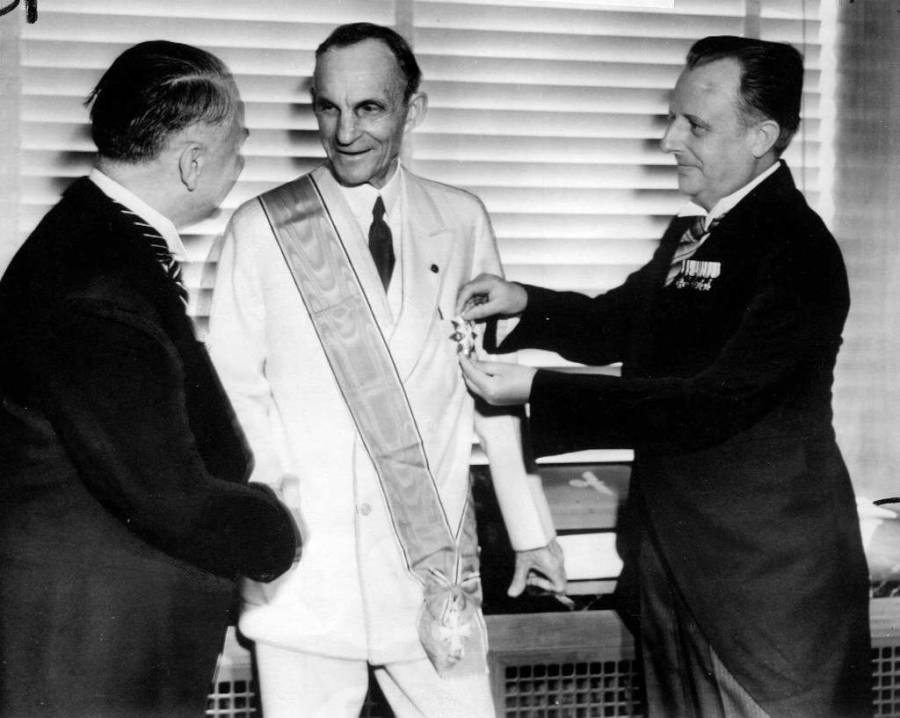 American industrial capitalist and the founder of Ford Motor Company. Although he did not
invent the automobile, he was a pioneer in the use of assembly line techniques of mass
production, and because of that, along with the vicious exploitation of workers, he was
able to produce large numbers of automobiles at relatively low prices for a wider market
than ever before. This allowed large numbers of “middle class” Americans to buy automobiles
for the first time.
American industrial capitalist and the founder of Ford Motor Company. Although he did not
invent the automobile, he was a pioneer in the use of assembly line techniques of mass
production, and because of that, along with the vicious exploitation of workers, he was
able to produce large numbers of automobiles at relatively low prices for a wider market
than ever before. This allowed large numbers of “middle class” Americans to buy automobiles
for the first time.
Ford himself became extremely rich off
the labor of “his” workers, and more and more tyrannical. A phony story of “Fordism” has
been constructed about him which falsely claims that he produced inexpensive cars for
the working class while simultaneously paying high wages to his workers so they could
buy those cars. In reality he did no such thing, and was one of history’s most vicious
capitalists and a ferocious and murderous opponent of labor unions.
Henry Ford was also a notorious anti-Semite
who wrote large numbers of anti-Semitic and racist articles, and a sympathizer of Nazism
in Germany. In the photo at the right from 1938, Ford is awarded the Grand Cross of the
German Eagle, Nazi Germany’s highest decoration for foreigners.
“In Germany, Ford’s anti-Semitic articles from The Dearborn
Independent were issued in four volumes, cumulatively titled The International
Jew, the World’s Foremost Problem published by Theodor Fritsch, founder of several
anti-Semitic parties and a member of the Reichstag. In a letter written in 1924,
Heinrich Himmler described Ford as ‘one of our most valuable, important, and witty
fighters.’ Ford is the only American mentioned in Mein Kampf.” —From the
Wikipedia entry on Henry Ford (accessed on March 5, 2013).
“The history of capitalism is replete with cases of successful
captains of industry who, suddenly concerned with their place in history, decide to
write a book celebrating their achievements, while articulating a new philosophy of
philanthropic capitalism—usually with the help of a ghostwriter or ‘collaborator’ of
some sort.
“The most successful instance of
this is Henry Ford, who famously introduced the five-dollar day for a majority of the
production workers in his auto-assembly plants to counter the enormously high turnover
in those plants—the result of horrendous working conditions. Journalist Samuel Crowther
collaborated on three books (beginning with My Life and Work in 1922) with Ford,
in which the latter, ostensibly in his own words, was portrayed as a far-sighted
entrepreneur who understood that high wages were needed in the age of high-production,
high-consumption capitalism. The term ‘Fordism’ was widely adopted in the Europe of
Ford’s day to refer to the supposedly benign capitalism of Crowther’s Ford. However,
in the United States, where the reality of Henry Ford was better known, the notion of
Fordism in this sense failed to take hold until the 1980s, some forty years after Ford’s
death (finally entering into works like Michael Harrington’s The Next Left).
U.S. labor could not easily forget the extreme exploitation in Ford’s plants, Ford’s
virulent anti-Semitism, or the severity of his opposition to the New Deal. In 1932
Ford’s notorious Service Department under Harry Bennett—along with the police (the
police chief was a former Ford detective)—opened fire with pistols and machine guns at
point-blank range on the Ford Hunger March in Dearborn, Michigan, wounding around fifty
and killing four marchers outright (a fifth died later of his wounds). A New York
Times photographer got a bullet in the head. Bennett himself, Ford’s right-hand man,
emptied his pistol on the marchers (see John Bellamy Foster, ‘The Fetish of Fordism,’
Monthly Review, March 1988; Maurice Sugar, The Ford Hunger March).
“Today, however, Crowther’s
doctored version of Ford prevails. The mythology of a progressive ‘Fordism’ is now
avidly promoted by right and left alike—as in the PBS documentary on Ford’s life that
aired in January 2013 in celebration of the 150th anniversary of his birth. The
documentary managed to avoid all mention of the Ford Hunger March, or ‘Ford Massacre’
as it was also called—though it did allude to Bennett and his brutal tactics on behalf
of Ford in less murderous contexts.” —Notes From the Editors, Monthly Review,
Vol. 64, #10, March 2013.
FOREIGN DIRECT INVESTMENT (FDI)
The acquisition by corporations of one country of real assets in another country,
such as factories, mines, or businesses. These assets may be acquired by building new
factories, etc., or by simply purchasing existing factories and companies. FDI does not
include the purchase of foreign securities (e.g., stocks and bonds), unless this amounts
to buying a major or controlling influence in the foreign company that issues these
securities. (A common guideline is that ownership of more than 10% of a foreign company
is considered to be FDI.)
Foreign investment by imperialist
transnational (or multinational) corporations is one of the main mechanisms by which
neo-colonialism occurs in the Third World today. The foreign imperialist owners of these
local factories, mines and plantations, exert enormous influence on both the local
government and on their own imperialist government—which in turn often indirectly
controls the foreign government when it comes to matters which it considers to be
important.
FOREIGN EXCHANGE RESERVES
Foreign currencies, gold, liquid investments in foreign countries (and thus easily
transformed into foreign currencies via their sale), or balances held by the country with
international institutions such as the IMF,
any or all of which are held by the central bank of a country. Such reserves are needed
in order to be sure that the country will be able to buy the goods it needs from foreign
countries, even if its sale of its own goods to other countries is inadequate during some
period to directly finance those purchases. Moreover, countries operating under the
current world capitalist system may wish to buy or sell foreign currencies in order to
adjust the relative worth of their own currency on international markets. For example,
buying foreign currency with the country’s own currency is a way of keeping the value of
its own currency low, thus promoting the sale of goods to foreigners and supporting its
own manufacturers at the expense of foreign manufacturers.
FOREIGN EXPERIENCE
“The experience of the Chinese revolution, that is, building rural
base areas, encircling the cities from the countryside and finally seizing the cities,
may not be wholly applicable to many of your countries, though it can serve for your
reference. I beg to advise you not to transplant Chinese experience mechanically. The
experience of any foreign country can serve only for reference and must not be
regarded as dogma. The universal truth of Marxism-Leninism and the concrete conditions
of your own countries—the two must be integrated.” —Mao, “Some Experiences in our
Party’s History” (Sept. 23, 1956), SW 5:320. [This was part of a talk with
representatives of some Latin-American Communist parties.]
“FOREVER CHEMICALS”
A group of organic chemicals containing fluorine which are quite stable and tend not to break
down when released into the environment. For more information see the entry
PFAS.
“Last month, the E.P.A. [Environmental Protection Agency] approved the use
of two pesticides that meet the internationally recognized definition of ‘forever chemicals’,
which are linked to serious health risks.” —New York Times, “Facts of Interest”,
December 6, 2025.
FORMALISM
1. [In general and in discussions of
dialectics:] A kind of thinking that emphasizes form in a one-sided way, regardless of
real content, or emphasizes the appearance of something without analyzing its essential nature.
Formalism in this sense refers to one type of what Marxists call undialectical or
“metaphysical” thinking.
2. [In ethics:] The approach to ethics, or
the assumption, that some formal logical aspects of morality hold and dictate the essential nature
of ethics, as opposed to any analysis of the content and social nature of morality. For example
claims that some abstract formal principle (such as the Golden
Rule or Kant’s categorical imperative) determines
what is right or wrong, rather than any consideration of what is in the beneficial
interests of individuals or groups of people.
Kant’s ethical theory is also properly considered
to be an example of formalism because he focuses on the will (or psychological attitude) of
individuals rather than on the content or consequences of their actions. [See:
CONSEQUENTIALISM]
3. [In art:] The method of focusing exclusively
on form, or absolutizing aesthetic form as opposed to the subject and content of the work of art
or its social impact or function. Thus art which is, among other things, opposed to realism.
Formalistic schools (or styles) in art developed
around the end of the 19th century and have characterized bourgeois art ever since. These include
futurism, cubism, surrealism, expressionism, and abstract art. While there are considerable
differences among such schools, they all tend to divorce art from reality, separate artistic form
from content and from social ideas, and make abstract form into the supposed essence of art. The
underlying outlook of formalism is that art is outside the control of reason, is independent of
human or social interests and concerns, and has nothing whatever to do with society and social
ideas. This strong trend toward formalism in art in modern bourgeois culture reflects its
decadence and dead-end nature.
4. [In bourgeois literary criticism:] An
approach to the analysis and criticism of literary texts, inspired by Roman Jakobson, which
supposedly rejects subjective opinions and instead focuses on various structural characteristics
and techniques in the writing. This approach assumes that it is not the content of the work,
nor the writer’s intentions, nor the social impact of the work, which make it good or bad, but
rather primarily (or only!) its objective structural features.
5. [In mathematics:] The trend which
attempts to resolve problems concerning the foundations of mathematics by means of the
construction of formal logical axiomatic systems. Gottlob Frege, David Hilbert, Bertrand
Russell, Alfred North Whitehead and many others have employed this approach, but its
limitations were exposed by various paradoxes which arose in some of these formal systems,
and then in a more general way in 1931 by Kurt Gödel who proved the incompleteness
of all such formal systems. (That is, these axiomatic systems which were put forward as the
foundation for all of mathematics necessarily contain propositions which can neither be
proved nor disproved within their logical framework.)
FOSTER, John Bellamy (1953- )
The current editor of the socialist magazine Monthly
Review, and a professor of sociology at the University of Oregon at Eugene. He has
adopted and further elaborated the blend of Marxism and Keynesianism characteristic of the
Monthly Review School of political economy,
which was originally developed by Paul Sweezy,
Paul Baran, and Harry
Magdoff. He has also given considerable attention to ecology and the environment.
Among Foster’s numerous books are: The
Theory of Monopoly Capitalism: An Elaboration of Marxian Political Economy (1986),
which is a good exposition and overview of the Monthly Review School’s conceptions,
The Ecological Revolution: Making Peace with the Planet (2009), and The Great
Financial Crisis: Causes and Consequences (with Fred Magdoff, 2009).
FOUCAULT, Michel [Pronounced: mish-shell foo-ko] (1926-1984)
French bourgeois philosopher and sociologist who taught at universities in both France and
the United States. He was variously closely associated with
structuralism, post-structuralism and
postmodernism, though he ultimately rejected all those
labels. (Bourgeois philosophers, especially adherents to the schools of
Continental Philosophy, very much dislike being
pinned down on matters big or small. Besides not wanting to have to defend any definite
philosophical positions, they often think they are so great and so unique that any existing
label could only demean them!) In later years, however, Foucault did describe his thought
as a critical history of “modernity” rooted in Kant. Besides Kant, he was also greatly
influenced by Nietzsche, and in one interview he openly stated that “I am a Nietzschean.”
But despite this variety of deeply bourgeois
connections and associations, including some of the most reactionary like Nietzsche,
Foucault is often considered a “leftist radical” in academia, and someone worth seriously
studying, discussing and following! Indeed, the Wikipedia (from which a lot of the
information in this entry is taken) says that in 2007 Foucault was listed by the [London]
Times Higher Education Guide as the “most cited intellectual in the humanities”.
Foucault is said to be “best known for his critical studies of social institutions, most
notably psychiatry, medicine, the human sciences, and the prison system, as well as for his
work on the history of human sexuality”. So if you are interested in discussions of those
topics from the perspective of Kant, Nietzsche and postmodernism, then I guess Foucault is
your man. But if you want a revolutionary Marxist perspective, then look elsewhere.
Foucault was an inactive member of the
revisionist Communist Party of France for a few years, but never anything like a real
revolutionary Marxist, either in theory or practice. In the late 1970s, in the midst of a
turn in French society away from radicalism, a number of young philosophers who had
previously considered themselves to be “Maoists” completely abandoned that perspective and
shifted strongly to the right. These so-called “New Philosophers” often cited Foucault as
their major influence. While Foucault himself is said to have had “mixed feelings” about
this, any genuine revolutionary would have been completely disgusted and totally embarrassed
by it! But this shows the sort of influence which Foucault has actually had.
“FOUR OLDS”
Shorthand for the set of ideological targets of the Great Proletarian
Cultural Revolution in China: old ideas, old culture, old customs and old habits. These
were four aspects of the feudal, bourgeois, imperialist-dominated and reactionary past,
which Maoist revolutionaries sought to replace with new ideas, culture, customs, and
habits appropriate to the new socialist society. [Reference: Peking Review, 1966, #36,
p. 19.]
Old Ideas: These were the traditional,
often Confucian, outlooks and philosophies that promoted a class-based exploitative society
and blind obedience to authority. Opposing this was a rejection of traditional feudal or
bourgeois intellectualism in favor of revolutionary thought.
Old Culture: This included all anti-
or non-proletarian art, literature, and educational systems. Instead a new socialist art and
literature, and educational system, were championed and promoted. However, the young Red Guards
did sometimes carry this to an extreme by not just criticizing and condemning this old culture
and traditional art forms, but even by sometimes destroying ancient artifacts, burning
classical texts, and vandalizing historical sites.
Old Customs: This encompassed social
traditions and rituals, such as religious practices, superstitions, and traditional ceremonies.
The Red Guards strongly opposed these backward practices. They also made name changes to places
and things; sometimes they damaged religious sites; and frequently they attacked those seen as
promoting the old ways.
Old Habits: These were the behaviors
and lifestyles of the exploiting classes that were appropriately deemed to be feudal, bourgeois
or excessively individualistic. This included everything from traditional dress and hairstyles
to the private property and personal adornments of well-off or prominent people.
The Maoist revolutionaries maintained that
eliminating the Four Olds was necessary in order to create a new socialist culture based on
proletarian values and to prevent a new bourgeoisie from re-emerging to seize power again. This
Cultural Revolution campaign was part of a larger, more long-term, effort to ensure a permanent
(or continuing) revolution throughout the entire socialist era by constantly purging society of
any newly arising counter-revolutionary influences. Some destructive aspects were indeed
properly promoted as a revolutionary and creative act and as part of building and reinforcing
the “Four News” (new ideas, new culture, new customs, and new habits). However, Maoists today
do recognize that there were some excesses in carrying this out on the part of the young Red
Guards. Unfortunately, for a relatively short period of time in the late 1960s they were the
only force available among the masses who were willing and able to carry out this most
essential basic task at all!