CHANGE — Dialectics Of
“New things come from old things which change and develop. But how
do things in general change? People familiar with Marxist dialectics of course know that
change takes place through qualitative leaps. In other
words the dialectical view is not that something develops gradually and evenly from one
thing into another, but that at some point there is a sudden transition, a leap, a
revolution. This is true not only in human thought and society, but in nature as well,
such as in the change of water to steam as it is heated. But the point I want to emphasize
here is that this is not the whole story about change.
“(Generally it is necessary to give
special emphasis to the importance of dialectical leaps when talking to people about
change and development. That is because most people in present society are not used to
looking at things this way. But with my present intended audience I assume this first
essential characteristic of change is already well understood and completely obvious. That
is why I am putting the emphasis here on the other important characteristic of change.)
“While qualitative leaps are the
essence of change, there is also the aspect of gradual development leading up to
those qualitative leaps. Water, for example, does not make the sudden transition to steam
unless it has first been gradually heated up from room temperature to the boiling point.
Now it is true that if you look at the preliminary gradual process in a detailed enough
way, you will find that it also is composed of many small leaps. In the case of the
gradually heated water what is going on at a very fine level is the sudden qualitative
leap in the acquisition of energy by individual water molecules as they come in contact
with the energetic (heated) surface of the tea kettle (or with other, hotter, water
molecules). Thus ultimately all change does seem to take the form of dialectical
leaps. But nevertheless, from the point of view of the overall process, a large series of
very small subsidiary qualitative leaps takes on the appearance of gradual development. It
is almost as bad to fail to recognize this as it is to fail to see that this gradual
development must lead to a qualitative change if there is to be any fundamental change in
the overall situation.
“Change is a matter of gradual
development leading up to, and preparing the ground for, sudden transition. Thus any
intelligent effort to bring about change must not only recognize that a sudden transition
or revolution is necessary at some point (though that is the first element of wisdom), but
that also the ground must be prepared for that revolution through a period of
gradual development. To rationally work to bring about a change is therefore primarily
to concern yourself with fostering the gradual development that must inevitably occur
before the necessary sudden leap is possible.
“Politically, there is the phenomenon
of individuals who long for social revolution with all their heart and soul, but who are
too impatient to do the actual work necessary to prepare the ground for revolution. Because
they are so impatient, they abandon the dialectical outlook on change, focus entirely on
the need for a sudden transition, and down-play the effort needed to lay the necessary
ground work.
“Such extreme impatience even leads
people to revise their revolutionary theory to fit their subjective desires. ‘Winning the
masses takes time, therefore maybe it is not necessary to win the masses, or maybe it is
only necessary to win a small number of the masses...’ In such a way are the impatient
pushed away from the masses, away from mass revolution, away from Marxism and toward ‘left’
adventurism or even putschism.
“‘Organizing the masses takes time,
therefore maybe it is not necessary to organize the masses, maybe we can just suppose that
when push comes to shove the masses will spontaneously organize themselves for revolution...’
In such a way are the impatient pushed toward a form of anarchism and aloofness from the
masses (even if they still recognize the importance of a vanguard party).
“‘Participating with the masses in
their day-to-day struggle in order to raise their revolutionary consciousness is too big a
job, therefore maybe it is not necessary, maybe it is really only a kind of reformism
dressed up as revolutionary preparations; maybe the masses do not really need to learn
through their own experiences, and maybe we do not need to be there with them to help them
with this summation...’ In such a way does Marxism get turned into a sort of ‘leftist’
preaching, or a form of evangelism.
“‘Preparing for revolution takes time
and effort, therefore maybe it is not necessary to make extensive preparations, maybe the
masses are almost ready to go right now, maybe the revolution could break out any day...’
In such a way do the impatient lose the ability to appraise the objective situation, and
start to lose contact with reality. This leads to constant predictions of revolution ‘within
this decade’, or ‘within a couple years’, or even ‘within a few months’—which in turn leads
to demoralization when the subjective predictions do not materialize.
“Extreme impatience can thus lead to
ultra-‘leftism’ in various guises, and to a distortion of Marxism.
“Impatience can be a good thing or a
bad thing. If impatience with the present despicable bourgeois world turns us into
revolutionaries, and gets us working toward bringing about revolution, it is of course a
very good thing. But if that impatience gets out of hand and leads us into the renunciation
of Marxism and the only real path to revolution, it is a very bad thing. We should be
impatient, but we should not let it make us crazy.” —Scott Harrison, The Mass Line and
the American Revolutionary Movement, Chapter 31 (excerpt), online at:
http://www.massline.info/mlms/mlch31.htm
CHANGING MINDS
The claim that you “cannot change people’s minds” is actually most commonly an excuse for
not even trying to do so; or, in other words, an excuse for liberalism
in the Maoist sense.
True, it is in fact difficult to
change people’s minds and there are very good reasons for that. People have an overall
worldview and most of their important ideas are deeply
integrated into that general worldview. Attempting to change a person’s mind even about
one specific issue often at least indirectly or implicitly challenges many other of their
ideas, and often even their entire worldview which they cannot give up without a prolonged
struggle, both with others and within their own head. But through extensive struggle,
through experience, and through time, people can and do change their minds, not only about
specific issues, but indeed with regard to their overall worldview itself. So don’t be
discouraged by initial failure! Keep plugging away, including with a variety of new
arguments and new evidence, and from a variety of new angles!
See also:
COGNITIVE DISSONANCE
“When people say you can’t change minds, they’re usually talking about
one conversation that didn’t go well. But change doesn’t happen all at once—it’s often
glacial.” —W. Kamau Bell, a liberal African-American comedian who focuses on
sociopolitical issues, “Talk About Racism? Yes, Now... And Often: It’s Time to Get
Comfortable Having Uncomfortable Conversations”, Stand magazine, published by
the American Civil Liberties Union, Winter 2018, p. 36.
[Although Kamau Bell is only an
ACLU-type liberal, this is quite a profound comment which all of us who are concerned
to change the opinions of others should keep firmly in mind. And, if you think back,
I’ll bet you’ll recall some political arguments you’ve had with people where it
appeared you were totally unable to convince the person—but where later, somewhat to
your surprise, you heard that very same person promote the better point of view that
you were defending! (And others may have had the same experience with you!) Sometimes
good arguments take a while to sink in and become part of a person’s own thinking.
—S.H.]
CHASI MULIA ADIVASI SANGHA (CMAS)
A militant but peaceful organization of Adivasis, or tribal
people, in the southwestern part of Orissa state in India. In particular the CMAS has
struggled for the redistribution of land to the Adivasis, and against illegal mining on
their land by giant mining corporations. The CMAS has been accused by the police and media
of being a front organization of the Communist Party of India (Maoist), and this was the
“excuse” given by the police for murdering 3 Adivasis (including a CMAS leader) at a
demonstration led by CMAS in Narayanpatna, in southern Orissa, on November 20, 2009.
However, the leadership of the CMAS is actually made up of some of the middle range of
revolutionary forces in India, who have been trying to wage a peaceful struggle for the
people. In an interview, one of these top CMAS leaders, Gananath Patra, explained their
political ideology and strategy this way:
Satyabrata: The state has militarized itself. What will its effect
be on the movement?
Gananath Patra: We know very
well that behind the military intervention of the State is its intention to militarize
our movement in order to find a plea to brutally subjugate it. We know their intentions
and we are careful about any move we shall be taking. The movement must continue.
Satyabrata: The CMAS is being
projected as the frontal organization of the Maoists. Is that true?
Gananath Patra: You mean the
CPI(Maoist). No. we have considerable differences with the CPI(Maoist) line, though
they are our sympathizers and critics. I believe in Marxism-Leninism-Mao Tse-tung Thought,
which has considerable differences with the Maoism of the CPI(Maoist). Our method of
occupying and cultivating land is mass line task and has nothing in common with the
CPI(Maoist).
Satyabrata: Why are you being
projected as Maoists then?
Gananath Patra: We pose a danger
to the status quo the ruling class wants to maintain and hence it wants us to be branded
as Maoists. Then the matter becomes simple; pick up anyone who is against this status
quo, brand him a Maoist and rob him of his movemental potentiality by either putting
him behind bars or by gunning him down. History has been spectator to this strategy of
several States at several conjunctures in the past. The state has banned the CPI(Maoist)
to facilitate this purpose. [From: “Narayanpatna: An Interview with Gananath Patra”,
online at: http://sanhati.com/articles/1917/]
However, it seems that Gananath Patra has inadvertently put his finger on the fatal problem
with the CMAS political strategy: The state will simply not allow them to proceed with
their programme no matter how peaceful they are. They will simply be attacked and destroyed
by the armed forces of the Central and state governments of India. Peaceful strategies will
not work against governments willing to shoot you dead anyway.
In early December 2009 hundreds of Adivasi
people associated with CMAS surrendered to the police in what was falsely billed by the media
as a large surrender of “Maoists”. Those are the alternatives facing the people there: abject
surrender to the government and their perpetual victimization, or else a very different form
of struggle involving the force of arms.
However, as of January 2010, it appeared that
either the CMAS organization, or part of it, or at least a large number of those who have been
members of it, were moving rapidly towards the Maoists and the Maoist approach to revolution.
See the news article
“India Drives Tribals into Maoist Arms” for more information.
CHEN BODA [Wade–Giles: Ch’en Po-ta] Simplified Chinese: 陈伯达 (1904-1989)
[Name at birth: Chen Jianxiang (Simplified Chinese: 陈建相; traditional Chinese: 陳建相; pinyin: Chén Jiànxiāng]
A leading ideologist within the Communist Party of China during most of the Mao period, who
served as Mao’s research assistant and political secretary during the Yan’an (Yenan) period,
and who was the leading interpreter of Maoism in China during the first two decades of the
People’s Republic. He also played a prominent role in the Great
Proletarian Cultural Revolution. He eventually became associated with what were deemed
ultra-left forces, and finally was accused of politically conniving with Lin Biao. (Much of
the personal history for Chen in this entry comes from the Wikipedia entry on Chen and from
other bourgeois, but generally fairly reliable, reference sources.)
Chen Boda was born in Huian County, Fujian
(Fukien in Wade-Giles) province, to poor peasant parents. However, when he was young his family
moved to what is now Amoy, probably in order for him to attend the Jimei Normal School to
become a teacher. After graduating he taught at elementary schools until 1927, but also
enrolled in 1925 in the Shanghai Labor University studying literature. He joined the Communist
Party of China in 1927.
In Fujian, he was hired as the personal
secretary of General Zhang Zhen, and helped to prepare for the 1926-27 Northern Expedition
to try to unify China, working from the CCP side of the First United Front. When that
cooperation was destroyed by the perfidy of Chiang Kai-shek and the Guomindang (Kuomintang),
Chen fled but was arrested in Nanjing. However, he was released after a month, on General
Zhang’s recommendation.
Shortly after this, Chen was sent by the
Party to the Soviet Union to study at the Sun Yat-sen University in Moscow. He remained there
for four years studying politics and Marxist philosophy. One source says that he had a heavy
Fujian accent and also was afflicted with a stammer. He was short and is said to have had an
introverted bookish personality. Perhaps for some of these reasons he was associated with a
minority group of Chinese students studying in the U.S.S.R., rather than with the main group
which was more completely connected to and loyal toward the Soviet leaders. He was excluded
from local politics at the University, but in comparison with the others it seems he learned
a lot more Marxist-Leninist theory.
Chen returned to China in 1931, where he
married another former Moscow student, Zhu Yuren (Chu Yu-jen) of Sichuan. He then became a
professor of politics and ancient Chinese history at China College in Beijing, and began
writing articles under the names Chen Zhimei and Chen Boda. He also did underground party
work in Tianjin. Much of his writing during this period focused on the dispute between
revolutionary writers associated with Lu Xun (Lu Hsun) who stressed class struggle, and
others who insisted that literature should serve current national needs (what was called
“national defense literature”).
When Japan’s imperialist war in China
expanded in 1937, Chen went to Yan’an, where he became a leader in the Rectification
movement. He began lecturing on politics and Marxist philosophy at the Central Party School
and heading its China Problems Research Office. Chen’s calligraphy was said to be “very
beautiful” and this enhanced his prestige.
Chen soon became the personal research
assistant and chief political aide to Mao Zedong. Among other things, he helped Mao draft
speeches and find apt quotations in the Marxist-Leninist literature to support the political
points Mao was making. Chen published the first collection of Mao’s writings in 1937, and
an official history of the Party in 1945. He became an associate member of the Central
Committee in 1945 and a full member in 1946.
“Chen claimed that dialectical materialism
was the world’s greatest cultural achievement, but it came in Chinese as well as Western
forms. He insisted that modern plain speech (pai-hua), containing some Western loan
words, could be made accessible to the Chinese masses and become common speech
(pu-tung-hua). Similarly, even Marxism could be localized. Chen relied not just on
texts by Marx and Engels, but also on dialectical elements in ancient Chou philosophy. He
liked Mo Tzu, whose notions about ‘appearance and reality’ and ‘knowledge and action’
(ming shih, chih hsing) seemed useful for contemporary problems. Chen was an
academic, whereas Mao was a leader who often attacked Chinese traditions more broadly than
did his secretary. But Chen phrased Maoism dialectically, as a Chinese national form of
Marxism-Leninism, and this nicely suited Mao’s political needs.” [Paragraph
from the academic work edited by Edwin Pak-wah Leung, Historical Dictionary of
Revolutionary China, 1839-1976, pp. 49-50.]
After the seizure of proletarian power in
China in 1949, Chen played a leading role in overseeing mass media and ideology in the
newly liberated country. Mao and the CCP leadership entrusted him with many important
tasks, such as:
• Deputy Director of the CCP Propaganda Department, overseeing the Renmin
Ribao (“People’s Daily”) newspaper and the Xinhua News Agency.
• Director of the Institute of Political Research.
• Joined the Party’s Rural Work Department in 1955.
• Became an alternate member of the Politburo in 1956.
• Editor-in-chief of the CCP theoretical organ Hongqi (“Red Flag”),
when it was established in 1958.
• Vice President of the Chinese Academy of Sciences, overseeing Social and
Political Sciences. (These departments later branched out to form the Chinese Academy of
Social Sciences).
In 1951, Chen wrote an important article
with the title “Mao Zedong’s theory of the Chinese Revolution is the combination of
Marxism-Leninism with the Chinese Revolution” and a book entitled “Mao Zedong on the
Chinese Revolution”. These works made him one of the most important interpreters of Mao
Zedong Thought. Even more importantly, Chen worked with Lin Biao to produce the world
famous Little Red Book: Quotations from Chairman Mao Tse-tung [First Chinese
edition in May 1964; 1st English ed. 1966]. And it was Chen who suggested to Mao the
slogan, “Let one hundred schools of thought contend.” This suggests that Chen, like Mao,
had real democratic feelings.
Chen also played an important role in
establishing the CCP policy towards the Soviet Union. He was the only high leader of
the CCP to accompany Mao on his trips to Moscow in 1949-1950 and 1957. He often served
as Mao’s agent within the new Chinese government, as when after Mao complained that
“the economic sector is blocking me and Comrade Liu,” Chen was appointed in 1962 to
serve as a vice director of the State Planning Commission. [See
Wikipedia entry for Mao quotation source.]
In the spring of 1966 Mao launched what
came to be called the Great Proletarian Cultural Revolution
(GPCR), whose primary goal was to seize back political control of the nation from the
capitalist roaders who had become dominant
within both the Party and the government. Since the Party itself was the center of the
problem, a new directing center for the GPCR had to be set up, the Central Cultural
Revolution Small Group (CCRSG). Mao, upon the recommendation of Zhou Enlai, named Chen
as the chairman of this very important body which was entrusted with the task of
directing this critical new revolutionary process. Chen tried to decline the leadership
of the CCRSG on the grounds that he was only a scholar, but Zhou told him to submit to
Party discipline. [R. MacFarquhar & M. Schoenhals, Mao’s Last
Revolution (2006), p. 45.] Soon, and for a time, the CCRSG became the most
important political body in China, more important even than the CCP Politburo. Along
with Jiang Qing, Chen also replaced Lu Dingyi, the revisionist head of the government’s
ideological education apparatus, and became a member of the Standing Committee of the
Politburo.
For several years the Cultural
Revolution developed successfully in an overall positive direction, despite a
considerable amount of largely unavoidable error, internal infighting and chaos due
to the youth and inexperience of the Red Guards who had to be largely relied on for
quite awhile.
But there was also a certain amount
of secondary ultra-leftism that developed within the primary struggle of the GPCR
against the revisionists and capitalist roaders. Mao’s method in political struggle
was always to try to unite the 90% against the most reactionary 10%. But quite a few
young enthusiasts in the GPCR tended to forget this principle and tried to push the
revolution forward faster than most of the masses were ready for and willing to
support. In particular in the summer of 1967, one tiny ultra-leftist Red Guard group
called the “Capital Red Guard May 16 Regiment” arose in Beijing which called for the
overthrow of Zhou Enlai. (The role of Zhou Enlai in the GPCR was mostly positive,
but especially toward the end became far more questionable. For more on this see:
ZHOU Enlai—Role in the
Cultural Revolution) The CCRSG labelled that May 16 Regiment group an
illegal organization and Chen personally called it a conspiratorial organization that
“is in reality targeting the center. It has to be struck down.”
[MacFarquhar & Schoenhals, op. cit., p. 221.]
More generally there were a variety
of more serious ultra-left errors which developed during the GPCR, such as quite
widespread physical mistreatment of those who were (usually) appropriately criticized,
and also including some wild leftism within the foreign affairs branch of the
government, even as it operated overseas. It seems that Chen Boda got the blame for
some of this, but it is unclear to us just how much blame he really deserves. (And in
general it is a poor policy to come down too hard on those who make leftist errors,
since it tends to promote more rightism and revisionism in response!) It is true,
however, that Chen had himself occasionally put forward some ultra-left positions,
such as in 1958, during the Great Leap Forward era, when he proposed abolishing
currency (money)—something that will be necessary to do as we enter actual communist
society, but which was wildly inappropriate in 1958 China! [Edwin
Pak-wah Leung, Historical Dictionary of Revolutionary China, 1839-1976, p. 50.]
Still, during the era of an often only nominally “communist” world movement
which is so often dominated by revisionists, you do have to sort of admire Chen for
even thinking about that idea! For real Maoists, the transition from socialist society
to communist society is something we actually work toward and intend to carry out!
However, more to the point at issue here, it seems that Chen was viewed as
“ultra-left” because he opposed Zhou Enlai’s attempt to gradually close down the
GPCR and prematurely consolidate the Party organization even though it would
then still be composed of unremolded capitalist roaders for the most part!
Chen was also accused after the
downfall of Lin Biao (after Lin tried to kill Mao and seize power for himself!) of
having been unduly part of Lin’s milieu. As far as I know there is no evidence
whatsoever that Chen was in any way part of that plot. Yes, he did work with and
apparently support the work of Lin; but after all, Mao chose Lin as his successor,
and Lin was so designated in the Chinese Constitution. It is hard to see how any high
leader in China at that time would not be connected in some considerable way with Lin.
However, it is true that there were some things to criticize in Chen and Lin’s
association and joint work. Even as far back as 1960, Chen worked with Lin in
producing the “Little Red Book” (Quotations of Chairman Mao Tse-tung) and in
my own opinion that work, great as it is, does have some faults. For example,
because of its selection and position of quotations, it did distort Mao’s ideas at
least with regard to the basic meaning of the “mass line”. But everyone makes some
errors, and if only a few things like this are all we can actually point to
concretely as errors made by Chen Boda in association with Lin Biao, then the
charge against Chen that he was an ally with Lin against Mao seems to be completely
unsubstantiated.
Some serious disagreements developed
between Chen and the so-called “Gang of Four” (Jiang Qing, Zhang Chunqiao, Yao
Wenyuan and Wang Hongwen). Here is the way one source describes things:
“As the Cultural Revolution unfolded ... personal and political
conflicts began to develop in the CCRSG, especially between Chen and Jiang Qing,
deputy head of the CCRSG, and her close associates Zhang Chunqiao and Yao
Wenyuan. The conflicts intensified when Chen began to work on the party’s
political report in preparation for the Ninth National Congress of the CCP and
to discuss the content of the report with Lin Biao. Mao criticized Chen’s first
draft for its ‘productionist’ tendencies and entrusted Zhang Chunqiao and Yao
Wenyuan instead with the task of redrafting and revision, which virtually ended
Chen’s cooperation with his colleagues in the CCRSG and pushed him further
toward an alliance with the Lin Biao group. Later, Chen made an ironic comment
on the Zhang-Yao version of the political report: ‘all movement and no goal.’
“In August 1970, at the
Second Plenum of the CCP Ninth Central Committee, Chen joined Lin Biao and the
majority of CCP leaders in proposing that the PRC state presidency be restored.
He was also involved in a strategic move, with the full support of the veteran
leaders attending the plenum, against Zhang Chunqiao. Opposing both moves, Mao
wrote a short piece entitle ‘Some Views of Mine’ in which he singled out Chen
Boda as the leader creating chaos. Chen was dismissed from office and was
imprisoned. After Lin Biao’s downfall, the CCP leadership denounced Chen Boda
as a leader in the ‘Lin-Chen Anti Party Clique.’ The CCP’s investigation report
dated 2 July 1972, named Chen a ‘Kuomintang anti-Communist, Trotskyite, renegade,
spy, and revisionist,’ most of which turned out to be baseless charges.”
—Guo Jian, Yonggyi Song, & Yuan Zhou, Historical Dictionary
of the Chinese Cultural Revolution (2006), p. 34.
[This suggests to me
that there may have been error on both sides of this basically internal
squabble among Maoists, who were unable to unify themselves against the still
extremely serious dangers from the right. —S.H.]
The Wikipedia entry on Chen comments: “As the leadership became more moderate in
its outlook and the initial aims of the cultural revolution were sidelined, Chen’s
radicalism caused concern, and he was denounced at the 10th Party Congress in 1973 as
a ‘revisionist secret agent’ for his associations with Lin Biao.” Frankly, to me, and
given the information actually available to us, this treatment of Chen Boda seems quite
unjust, even if he did deserve some criticism on some specific issues.
After the capitalist roaders took
back complete power in a coup d’état following the death of Mao in September
1976, Chen was tried and imprisoned by the new revisionist regime. He was sentenced to
18 years in prison, but was released on parole shortly after his sentencing because
of his ill health. His parole ended in 1988, and he died on 20 September 1989 at
the age of 85. —S.H. [March 30, 2026]
CHEN YONGGUI [Old style: CHEN YUNG-KUEI] (1915-1986)
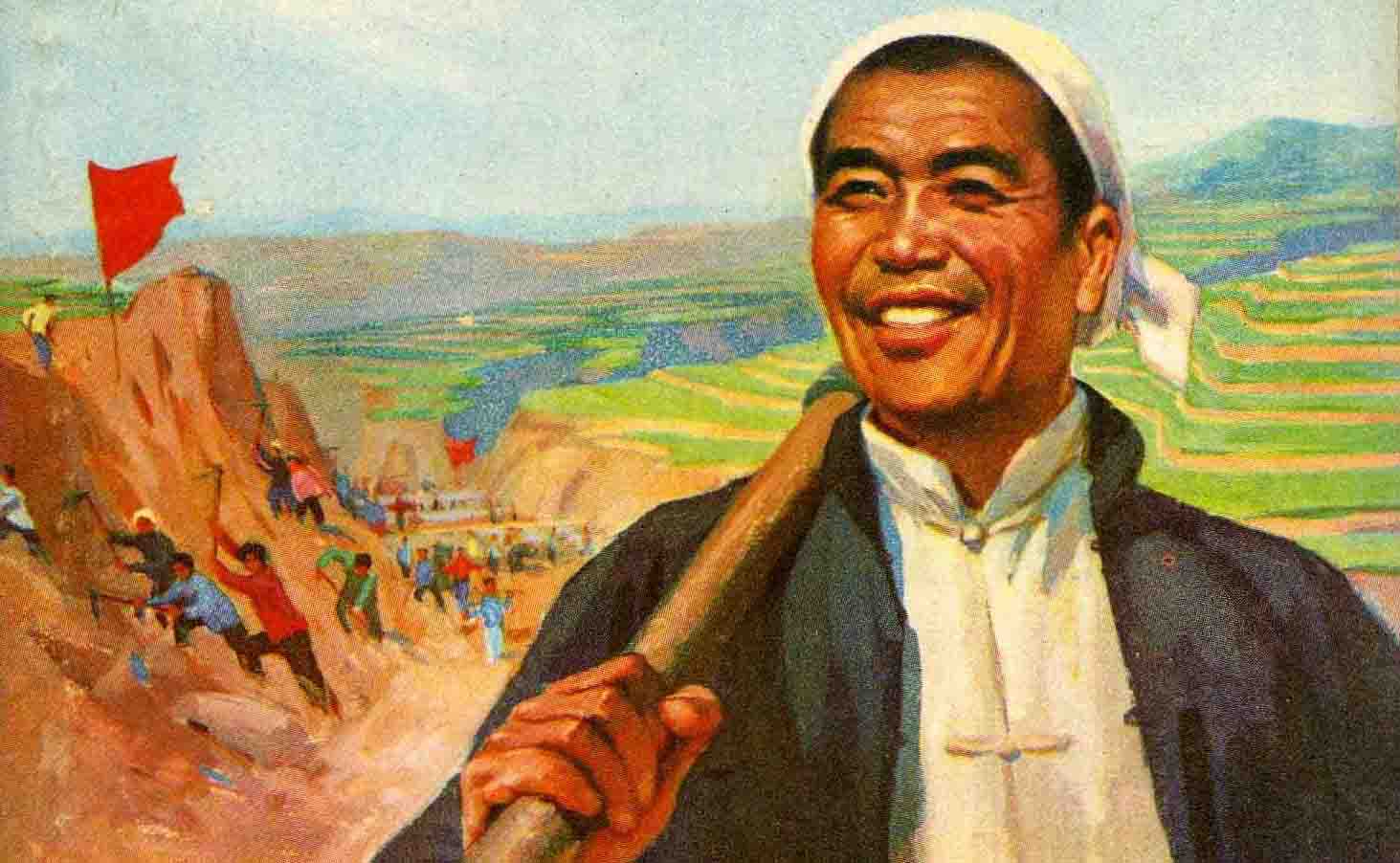 A famous peasant leader from Dazhai village, Xiyang County in Shanxi Province, China. Chen was
an enthusiastic participant in the land reform movement against the landlords and joined the
Communist Party of China in 1948. He was a hardworking farmer and became the party secretary for
the village, and later for the Dazhai production brigade. He was very successful in mobilizing
the peasants in this village and regions beyond it to transform their initially extremely poor
circumstances into a highly productive and successful farming community. Grain output per acre
tripled from 1952 to 1962. In 1963 there were a series of locally severe natural disasters which
destroyed 180 acres of hard-won arable land, and also some buildings. But under Chen’s leadership
the brigade declined any help from the state and managed to completely reconstruct and recover
within one year’s time.
A famous peasant leader from Dazhai village, Xiyang County in Shanxi Province, China. Chen was
an enthusiastic participant in the land reform movement against the landlords and joined the
Communist Party of China in 1948. He was a hardworking farmer and became the party secretary for
the village, and later for the Dazhai production brigade. He was very successful in mobilizing
the peasants in this village and regions beyond it to transform their initially extremely poor
circumstances into a highly productive and successful farming community. Grain output per acre
tripled from 1952 to 1962. In 1963 there were a series of locally severe natural disasters which
destroyed 180 acres of hard-won arable land, and also some buildings. But under Chen’s leadership
the brigade declined any help from the state and managed to completely reconstruct and recover
within one year’s time.
This example of hard work, collective organization,
rapid progress and self-reliance came to the attention of the top leadership of the CCP, and in
December 1964 Mao issued the directive “In agriculture, learn from Dazhai.” This made Dazhai
famous not only throughout China, but also among friends of the Chinese revolution around the
world.
“When the Cultural Revolution began, Dazhai’s model was emphasized even
more. During a meeting with Zhou Enlai, Chen Yonggui was encouraged to create Dazhai’s own
Red Guard organization, which was later established under the name ‘Jinzhong Field Army’.
He was appointed vice-chairman of the Shanxi Revolutionary Committee in 1967; in the same
year, the Cultural Revolution Group approved his ‘five recommendations’ for conducting the
Cultural Revolution in rural areas, published in the CPC Central Committee Document No.
339. In 1969 he was elected member of the CPC Central Committee, and a secretary of the
CPC Shanxi Committee in 1971. He once again gained Mao Zedong’s approval in 1972 by firmly
opposing CPC Shanxi First Secretary Xie Zhenhua’s request to downgrade the Dazhai
production brigade to production team.” [From the Wikipedia entry on CHEN YONGGUI (accessed
6/19/15).]
In 1973 Chen Yonggui was elected as a member of the CCP Politburo and transferred to Beijing.
In January 1975 he was also appointed a Vice-Premier of the State Council, and a couple months
later he led a Chinese delegation to Mexico. In September 1975 he gave the keynote speech at the
First National Conference for Learning From Dazhai in Agriculture, which was chaired by
Hua Guofeng. With Mao’s approval Chen spent 1/3 of his time on
work in Beijing where he was more or less in charge of agricultural policy, 1/3 on inspection
tours, and 1/3 as an ordinary farm laborer in Dazhai. He never let high office go to his
head.
However, Chen Yonggui, for all his great
strengths, was not an educated man. And as he himself readily admitted (see quotation below) his
knowledge of Marxism was very limited. After Mao’s death he was easily fooled at first by the
initial steps by the capitalist-roaders to suppress the revolutionary followers of Mao (the
so-called “Gang of Four” and many others), and joined in their
condemnation. Only when Deng Xiaoping came back to power in 1978-1979 did Chen soon come to
understand that China was now firmly on the path back to capitalism. Chen’s refusal to approve
private agricultural plots and his resistance to Deng’s “Seeking Truth from Facts” campaign
(which “reversed the verdicts” and condemned the Cultural Revolution),
brought him into direct conflict with Deng and the other capitalist-roaders. Chen was
removed from his party leadership posts in Jinzhong and Xiyang in 1979; was dismissed from his
Vice-Premier position in the State Council in 1980 (at the same time Hua Guofeng was pushed out
of the premiership by Deng); and was not re-elected to the party Central Committee in 1982.
Chen Yonggui spent the remainder of his life
working as a farm advisor near Beijing and died of lung cancer at the age of 71. The ultimately
tragic outcome of his life is brought out in his own words:
“I can read very few [ideographic] characters, and I’ve never studied
Marxism-Leninism.... I don’t really know what Capital and The State and
Revolution are all about.... Some comrades quoted from the classics—history, Marx,
the works of Mao Zedong—but I didn’t catch many things.... If you ask me about the proper
time to plant seeds, apply fertilizers, and weed, I can be at least 80 percent right, from
my obsrvations of the weather and my experience.... Seven or eight years ago, Chairman
Mao wanted me to work in the Central Committee. I told him that I wouldn’t feel at home
in such a big office.... After the Lin Biao affair, the Gang of Four tried to enlist me on
their side. The Chairman said to me, ‘Old Devil, don’t turn the Gang of Four into the Gang
of Five.’ After I heard this, I dared not even answer the phone calls from Jiang Qing, and
I went back to Dazhai several times, feigning sickness.... I don’t care to be a
vice-premier or a Politburo member.... It means nothing to me.... Rolling up the bottom of
my trousers to till the soil has always been my lot.... I already pointed out that since
the 3rd Plenum of the CCP Central Committee [July, 1977], the Party Central has been facing
the danger of a capitalist restoration, has sent away Chairman Mao’s holy tablet, and
driven away workers, peasants, and soldiers. The phenomenon of campuses managed by
bourgeois intellectuals has reemerged. At the same time, I also said more than once that
the 3rd Plenum cut the Dazhai banner, abandoned self-reliance, forsook the Party’s
tradition, regressed into the past, stopped talking about the line and class struggle,
wanted no more of the proletarian dictatorship, depended no longer on poor and lower-middle
peasants, and practiced revisionism instead of Socialism. As I spoke these words, some
people wanted me to disclose the identity of the behind-the-scenes instigator.... ‘Comrade
Chen Yonggui, these words are probably not from your heart. You were taken in and made a
scapegoat by others. For the solidarity of the Party and the acceleration of the four
modernizations, you must take a firm stand and divulge the identity of whoever wanted you
to say these things. Then there will be no problem.’ When I heard this, I felt strange.
This is my viewpoint. Why should I implicate anyone either on the stage or behind the
scenes? ... I can either go back to Dazhai or go somewhere else. I am unfit to be a leader
of the Party, but I can be an ordinary Party member; I am unfit to be a cadre, but I can
be a peasant....” —Chen Yonggui, English translation in Issues and Studies, May,
1980. [Quoted in: Edoarda Masi, China Winter (1982), pp. 23-24.]
[Clearly these are the words of a
broken and defeated man, who after Mao’s death was not at all up to facing the adverse
rightist political challenges he encountered. Mao and the revolutionary forces following him
were unable to politically educate and prepare people like Chen Yonggui to fully recognize
and stop the capitalist-roaders in time. —S.H.]
CHIANG KAI-SHEK — As a Military Leader
Chiang Kai-shek’s primary policy during most of the period of the Japanese imperialist invasion of
China (1937-1946) was to avoid military resistance to the Japanese, and instead either attack the
Communists or else to at least keep most of his troops in reserve until the day came for a show-down
with the Communists once Japan was defeated by the U.S. and other countries. However, at times Chiang
was forced to more seriously resist the Japanese; and when he did so his total incompetence as a
general and military leader became all too apparent. It also became clear that he had no concern
whatsoever for the welfare of even his own troops, let alone that of the masses.
“To resist the Japanese attack on Shanghai [in 1937], Chiang ordered whole
divisions to stand and fight, even though it meant that they would be wiped out, rather than
withdraw them so they could survive to fight again. The resulting losses were ruinous and
unrecoverable. The estimates of Chinese military casualties ranged from a low of 187,000 to a
high of 300,000, with the main losses suffered by Chiang’s best German-trained and equipped
divisions—a catastrophe that would directly affect China’s military effectiveness for the rest
of the war. To western eyes, this sacrifice was senseless from the military point of view...”
—Richard Bernstein, China 1945
(2014), p. 72. Bernstein is a bourgeois historian who actually bends over backward to be
sympathetic to Chiang Kai-shek, but even he has to condemn Chiang at times. He also quotes an
American journalist who suggests that this particular horrible military disaster may have
worked in Chiang’s international political favor to some degree. Not only was it a
ghastly demonstration of the degree of suffering by the Nationalist Chinese forces when they
did resist the Japanese, it may have also somewhat eased the later strong American pressure on
Chiang to further commit his forces to fight Japan. —Ed.]
“In 1938, in a desperate effort to stop the Japanese advance in North China,
Chiang ordered that the dikes of the Yellow River, not for nothing known as China’s Sorrow, be
broken. This only delayed the Japanese advance while it created an inundation of the vast
North China plain, with two or three feet of water sweeping over whole counties in several
provinces. The flooding caused widespread crop failure such that at the worst of it ten
thousand starving people each day were gathering in major cities seeking relief. In the end,
800,000 people died either directly of flooding or of starvation. In 1945, five million
refugees were still in the places they had fled to.” —Richard Bernstein, China 1945
(2014), p. 69.
“For Americans [in China during World War II], the singular goal was the
defeat of Japan, and since that was also the Chinese goal, Americans couldn’t understand why
Chiang seemed so hesitant about measures that would help to achieve it, such as a reform of
the Chinese armed forces, the firing of incompetent commanders, the consolidation of
ramshackle, underequipped, and badly led divisions into a smaller number of disciplined and
effective troops. For Americans like [General Joseph] Stilwell this military reform was simple
good sense. It would help defeat Japan and, along the way, equip Chiang with the kind of army
he’d need in the future confrontation with the Communists.
“... But what was simple for the
Americans was infinitely complex for Chiang. Chiang’s power rested on a network of personal
relations among China’s military chieftains that went back to his days as commander of the
Whampoa Military Academy and, in some key instances, to his days in Japan when he was a young
military academy cadet. The armed forces were not simply an army; they were a network of
power bases, some loyal to Chiang and others (often the more effective of them) independent
of him, potentially even rivals to him. Chiang needed to keep commanders loyal to him in
charge of their armies, even if it meant tolerating the way they padded their rolls with
nonexistent soldiers so as to receive their salaries from the central government, even if
they lined their pockets by trading strategic materials with the Japanese, even if they were
ineffectual commanders. Chiang refused to fire the commanders who owed allegiance to him.
Moreover, during the war, he refused to supply able commanders in combat who did not owe
allegiance to him, because in China’s quiltwork of personal military relations, they were not
part of his personal network.” —Richard Bernstein, China 1945 (2014), pp. 157-8.
CHILD LABOR
It has taken a huge class struggle in country after country to win even such a simple and obviously
necessary reform under capitalism as to protect children by outlawing child labor in industry. And
in many countries, including India and Pakistan and many parts of Africa, child labor is still
extremely common, law or no law. (I.e., the laws are infrequently enforced.) At least to some extent
the exploitation of child labor exists in every capitalist country, even today.
In many cases capitalist companies have argued that
the pressures of competition force them to also employ child labor. In England in 1863
Josiah Wedgwood & Sons, and 22 other pottery manufacturers proclaimed that they could not
voluntarily limit the hours worked by children because “competition with other capitalists ... did
not allow them” to do so. [See Marx, Capital, vol. I, (Pelican ed., 1990
[1976]), p. 381 fn.]
This argument is used over and over by capitalists
with regard to every proposal to improve working conditions for both children and adults, men and
women, or proposals to shorten the length of the work day, reduce the level of intensification of
labor (speed-up), improve safety conditions, increase wages and other compensation, and with regard
to virtually every other proposed improvement for the working class. And in the modern era of
international capitalist competition, even legislation to improve working conditions and compensation
for all workers within the country (thus eliminating the excuse of “competition by other companies”
within that country) is opposed because of the threat of competition from capitalists in other
countries. Thus capitalism has become an international “race to the bottom” as far as the
exploitation and treatment of the working class (including children) is concerned. Of course most
capitalists do not really give a damn about the welfare of the working class, or even the welfare of
working class children. And the common excuse that “they are unable to stop doing what they are
doing” because of the pressures of capitalist competition sure does come in handy for them, time
after time. By far the best response to that pathetic capitalist “excuse” is: “OK, then, if
that’s the sort of thing that capitalism continually leads to, the working class must unite to
overthrow this goddamned capitalist system!”
“... Marx refers to capitalists and workers as personifications of economic
categories. It is not that they have no agency at all, but rather that in the theory of
capital’s deep structure their agency is sharply constrained by the motion of economic
categories operating through a commodity form. A particular English capitalist in 1830 may not
particularly like exploiting the labor of children, but because their labor is cheap and docile,
he may be unable to afford not to if it means losing out to competitors. In short, in order to
be a capitalist at all, he must make profits, and if exploiting children is a necessary part
of this, then his choice is to exploit children or go out of business. Indeed, as Marx points
out in Capital, it is precisely such reification that made it so difficult to end the
exploitation of children in England. And it is such reification that always leads to the ‘hard
choices’ that always place profits ahead of other human values. ‘Sorry we had to shut down the
only company in the company town thus destroying the town, but it was no longer profitable.’
‘Sorry we had to pollute the environment, but not to have done so would have increased costs
too much.’ A great deal of the history of capitalism is people mobilizing to deal with such
fallout...” —Robert Albritton, Economics Transformed: Discovering the Brilliance of
Marx (2007), pp. 52-53.
CHILE — Military Coup of 1973
[Intro material to be added...]
Since Pinochet’s military dictatorship was
overthrown, the government of Chile has gradually announced that more and more people were killed,
tortured, or became political prisoners during that period. As of August 2011, the official
victim list totals 40,018, though this probably still considerably understates the scope of
these crimes. [S.F. Chronicle, 8/19/11, p. A2.]
“The classic example [of what happens when a democratic country elects a
government explicitly committed to replacing capitalism with socialism] is the elected
socialist government in Chile under Salvador Allende in the early 1970s. For committed
democrats, this was the ideal outcome: a free democratic society had determined to change
its economy over time following its constitution and the rule of law. It was at all times a
a democracy and would ever remain so. If the people disapproved of the socialist direction,
they had the power to elect a government that would change course. For those who hated
communist dictatorship but desired a more equalitarian democracy, this was a development to
be embraced.
“To those who regard capitalism as
sacrosanct, however, Allende’s elected government had crossed the line. The United States
government surreptitiously organized and bankrolled all sorts of protests meant to disrupt
the economy and make life difficult, hence discrediting the government. When those efforts
failed, it helped organize a bloody military coup in 1973—with the strong support of the
wealthy and upper-middle class in Chile—that installed one of the most barbaric
dictatorships of the twentieth century under General Augusto Pinochet. [Milton] Friedman
and some of his fellow economists at the University of Chicago actively supported and
advised the Pinochet regime, because it was installing ‘free market’ economics. It was
therefore a ‘free’ country. Democracy did not have a right to alter capitalism, and Chile
was only allowed to return to democracy when the property system was safe.
“In contrast, Friedman and
conservatives worldwide applauded the new democracies of Eastern Europe in the 1990s when
they rejected Soviet-style communism [so-called! —Ed.] and embraced markets and a
profit-driven economy. That was democracy at its best, and they were its loudest champions.
But once those democracies made that decision, they forever lost their right to revisit
the matter again. Capitalism was inviolate. You can opt in, but you can never opt out.”
—Robert W. McChesney and John Nichols, People Get Ready (2016), pp. 296-7, note
46.
[These are the words of two
social democrats who—despite this acknowledgement
that the rulers of society will simply not allow a transition to socialism via the
ballot box—nevertheless themselves put forward that very path in the United States! (Of
course they are also wrong in some of particulars even here; what they call “democracy”
is only “bourgeois democracy”, and “Soviet-style
communism” in Eastern Europe was in the period under discussion neither communism nor
socialism, but simply state capitalism.) —Ed.]
CHINA — Air Pollution In
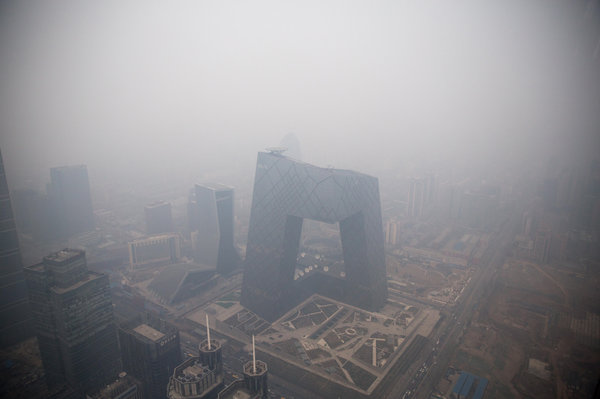 Contemporary capitalist China has by far the worst air pollution
problem of any country in the world (although India is fast “catching up”). It has become an extremely
serious health hazard, with large numbers of people actually dying because of it, and many others
developing serious sicknesses. Beijing itself is one of the worst-hit cities. As the
New York Times reported (March 21, 2013), “A haze akin to volcanic fumes cloaked the
capital, causing convulsive coughing and obscuring the portrait of Mao Zedong on the gate to the
Forbidden City.”
Contemporary capitalist China has by far the worst air pollution
problem of any country in the world (although India is fast “catching up”). It has become an extremely
serious health hazard, with large numbers of people actually dying because of it, and many others
developing serious sicknesses. Beijing itself is one of the worst-hit cities. As the
New York Times reported (March 21, 2013), “A haze akin to volcanic fumes cloaked the
capital, causing convulsive coughing and obscuring the portrait of Mao Zedong on the gate to the
Forbidden City.”
This horrible smog in China comes primarily from
the usual sources, air pollution by industry (especially coal-fired electrical plants) and from
motor vehicles. Why doesn’t the Chinese ruling class deal with this problem more seriously? The
answer, even more so than in other capitalist countries, is that this would harm the profits of
the capitalist corporations (including the large state-owned enterprises—SOEs), and slow down
China’s economic expansion. China is the most wide-open and wild capitalist country in the world
today, and government regulations are weak (where they exist at all), and are often ignored with
impunity even by the SOEs. However, this air pollution has become so bad that the bourgeois
government itself is now being forced to make at least some efforts to ease this notorious
problem. While capitalism can never completely resolve such
“externalities”, as improvements with regard to air pollution
in Western countries show, even under capitalism this problem does not have to be as terrible as
it presently is in China. And, after all, it harms not only the masses but also the ruling
class itself.
“China’s capital and other northern cities have banned half of all
vehicles from city streets and ordered factories, schools and construction sites closed
in response to a five-day smog red alert. The emergency steps enacted Friday night
significantly reduced traffic in Beijing on Saturday, although it wasn’t clear what effect
it was having on air pollution. By midday, the capital was enveloped in a smothering layer
of smog, with concentrations of microscopic PM2.5—small, inhalable particles that can
penetrate deep into the lungs and are considered a reliable gauge of air quality—rising
to more than 10 times the level considered safe by the World Health Organization.
Researchers at Germany’s Max Planck institute have estimated that smog has led to 1.4
million premature deaths per year in China, while the nonprofit group Berkeley Earth in
California has had a higher figure, 1.6 million.” —“World News of the Day”, San
Francisco Chronicle, Dec. 18, 2016, p. A4.
CHINA — Foreign Investment In
When the capitalist-roaders led by Deng Xiaoping took over
in China following Mao’s death, there were two main thrusts to their program: 1) What they
called “reform” (i.e., the implementation of capitalist relations of production within the
Chinese economy), and 2) the “opening up” of the country to investment by foreign imperialist
corporations. This foreign investment soon became massive in the last two decades of the 20th
century, and has continued to further expand in the new century.
Some observers thought that this meant that
a comprador bourgeoisie had come to power in China
and that they were turning over control of the country, or at least control of its economy,
to foreign imperialists. This was, however, mistaken; actually a new national bureaucratic
bourgeoisie was running China and was opening up its economy to foreign investment as part of
its program of national capitalist development under its own continuing overall control. (For
more about this see N. B. Turner, et al., Is China an Imperialist Country? (2014),
especially chapters 4 through 8, online at:
https://www.bannedthought.net/International/Red-Path/01/RP-8.5x11-IsChinaAnImperialistCountry-140320.pdf
.)
And, indeed, China’s locally owned capitalist
economy is now expanding even faster than new foreign investment in China, although that
foreign investment is still expanding rapidly as well. The massive size of this foreign
investment can be seen by the number of Chinese workers employed by foreign-based corporations
(though many of these “foreign” corporations are actually Chinese companies based in Hong Kong,
Macao and Taiwan). (See the quotation below.)
See also:
“CHINA PLUS ONE” STRATEGY
“[P]olitical tensions obscure the region’s intense economic links,
particularly the fact that an astonishing number of Chinese are employed on the mainland
by East Asian firms.
“At the latest count 88,000 firms
from Taiwan employ 15.6 million Chinese workers. About 11 million are employed at 23,000
Japanese firms or their suppliers. Throw in 2 million more workers for South Korean
enterprises, and companies from around the troubled East China Sea have approaching 30
million Chinese on their payrolls.
“... The working conditions at some
firms have come in for criticism. Foxconn from Taiwan, which makes things for Apple and
other high-tech firms, is the best-known example, and also the largest foreign employer,
with a staggering 1 million Chinese workers. Chinese authorities, never friendly to
independent organized labor, have at times tolerated strikes and other labor disputes at
foreign-owned factories, including Japanese carmakers. At times, it makes being in
business in China look a touch risky. When anti-Japanese tension flares in China,
intricate regional supply chains suddenly look fragile.”
—“East Asian firms in China: A
bridge over troubled waters”, Economist, Nov. 8, 2014, p. 44.
CHINA — Hyperinflation In (1937-1949)
The corrupt and reactionary Chiang Kai-shek regime in China
horribly mismanaged the nation’s economy, as well as the country in general. In order to pay
for its enormously expensive war to try to put down the Revolution, it simply printed up ever
more money. By late 1946 what had cost one yuan (the unit of Chinese money) in 1937 now cost
1 million yuan. By December 1947, it cost 16 million, and by the end of 1948, 21 billion yuan.
In May of 1949, just before the final collapse of that government, the same purchase would have
required 8.5 trillion yuan, one of the most extreme examples of hyperinflation in world
history!
The new revolutionary government led by Mao
Zedong soon brought the situation under complete control, however. For some information on how
this was done, see the pamphlet “Why China Has No Inflation” (Peking: 1976), by Peng Kuang-hsi,
posted at:
https://www.massline.org/PolitEcon/China/Inflation-pamphlet.htm
“Already by late 1945 the wheelbarrow had become the common mode of
conveyance for money, because so much of it was needed. In November in Shanghai, a
rickshaw race was held for public amusement. Chinese, White Russian, and American women
sat in the rickshaws, which were decorated with crepe paper and banners and pulled by
Chinese coolies. The winning coolie got seven million Chinese dollars, which was
equivalent to twenty-two American dollars, and when he put it in his rickshaw to take
away, it took up the same space as the passenger he’d just discharged.” —Richard
Bernstein, a reactionary American historian, China 1945 (2014), p. 274. [This
also says something about the nature of upper class “amusements” at the time! —Ed.]
CHINA INTERNATIONAL PUBLISHING GROUP (CIPG)
The Chinese agency/corporation which has published foreign language publications since the
foundation of the People’s Republic of China. CIPG was founded in January 1949, and opened
what became the China International Bookstore in December 1949. It launched the Foreign
Language Press in Beijing in July 1952. Here is a list of some of the more important magazines
it publishes:
• People’s China — English
bi-weekly magazine launched in January 1950. It later had editions in Russian, Japanese,
Chinese, French and Indonesian. [We think only the Japanese edition continues to be
published. The English language magazine continued through 1957, but its function
was then evidently replaced by Peking Review and China Reconstructs.] Some
issues of People’s China are available online at:
https://www.massline.org/PeoplesChina/index.htm
• El Popola Cinio
[People’s China] — In Esperanto; launched in May 1950.
• China Pictorial —
Launched in July 1950. This monthly English magazine eventually came to also have Russian,
Indonesian, Korean, Japanese, French, Spanish, Vietnamese, German, Hindu, Indonesian, Arabic,
Burmese, Swedish, Swahili, Italian, Urdu, Romanian, Thai, Mongolian, Tibetan, Uygur and
Kazakhstan editions. Many issues are available (most in English, some in Chinese) at:
https://www.bannedthought.net/China/Magazines/ChinaPictorial/index.htm
• Chinese Literature —
The English edition began as a quarterly in October 1951, and by 1961 had become a monthly
magazine. A quarterly French edition, Litterature Chinoise, began later. Many English
language issues are available at:
https://www.bannedthought.net/China/Magazines/ChineseLiterature/index.htm
• China Reconstructs —
Launched in English in January 1952; monthly magazine. (Renamed as China Today in 1990.)
Other editions include simplified Chinese, traditional Chinese, Spanish, French, Arabic,
Russian, German and Portuguese. Many English language issues are available at:
https://www.bannedthought.net/China/Magazines/ChinaReconstructs/index.htm
• Peking Review — Weekly
English edition launched in March 1958, and renamed Beijing Review in January 1979.
Editions in French, Spanish, Japanese and German began in March 1963. In the late 1970s an
Arabic edition began, and later still editions in Indonesian and Portuguese were added. This
is the most important political magazine published in China. Over 1,600 entire issues of the
English language edition, along with hundreds of individual articles, are available at:
https://www.massline.org/PekingReview/index.htm
CHINA — Socialist Economy in Mao Era — Growth Rate Of
See also:
MAOIST ECONOMIC DEVELOPMENT
“China’s socialist economy expanded at a very rapid pace during the Great
Proletarian Cultural Revolution (often dated from 1966 through 1976), averaging more than
10% per year! [See: Mobo Gao, ‘Debating the Cultural Revolution: Do We Only Know What We
Believe?’, Critical Asian Studies, vol. 34 (2002), pp. 424-425; and Maurice Meisner,
The Deng Xiaoping Era: 1978-1994, p. 189.] Even the capitalist-roaders themselves
had to admit that, except for brief declines during the Great Leap Forward and the first
3 years of the GPCR, the growth of both industrial and agricultural production during the
rest of the Maoist socialist period (1969-1976) was very fast. See the charts on the
second page of the article ‘China’s Industry on the Upswing’, Beijing Review, Vol.
27, #35 (Aug. 27, 1984), p. 18 ff., online at:
https://www.massline.org/PekingReview/PR1984/PR1984-35.pdf The later claim of the capitalist-roaders
that the Cultural Revolution was a ‘disaster’ for the economy was an outright lie. Even the
brief production declines of the first three years of the GPCR were very rapidly made up
for beginning in 1969, and the overall trend line from before the decline and after it was
as if the short decline had not even occurred.” —N. B. Turner, et al., Is China an
Imperialist Country? Considerations and Evidence (2014), footnote on page 18, online at:
https://www.bannedthought.net/International/Red-Path/01/RP-8.5x11-IsChinaAnImperialistCountry-140320.pdf
“Even in the area most closely identified with the achievements of the
post-Maoist regime—improving the material well-being of the Chinese people—Mao’s record,
as I have noted, was good. From 1953 until 1977, Chinese industry grew at an average rate
of 13.134 percent (even including the disastrous Great Leap Forward years) while from 1978
to 1995 Chinese industry grew at a rate of only 12.4 percent. If the period is extended to
include the steep rise in Chinee industrial production that occurred from 1949 to 1953,
years that were certainly under Mao’s watch, the comparative rate of increase of Chinese
industry realized under Mao becomes truly spectacular. Industrial growth is the area in
which Mao’s comparative economic record shines the most, but in most other areas the
overall economic growth under Mao was also impressive.” —Lee Feigon, Mao: A
Reinterpretation (2002), pp. 180-181.
[Note that this comment by Lee Feigon
is referring to the industrial growth rate specifically, whereas the previous quote
is talking about the overall economic growth rate including agriculture—which though smaller
was still very impressive. A footnote mentions that Feigon’s statistics are from the
Historical National Accounts of the People’s Republic of China, 1952-1995, which is
a quite respectable academic source. It should be admitted that during the years following
1995 the GDP growth rate in China under the new capitalist regime remained high. It was
only during and after the world financial crisis of 2007-2009 that Chinese GDP growth
consistently fell below 10% and is now down to around 6% to 7% annually and still falling.
Although there can be at times economic booms
under capitalism, they always come to an end eventually. Socialism, however, has no such
internal contradictions which lead to the inevitability of overproduction, and it is quite
possible for impressive economic growth to continue indefinitely, even overcoming any
temporary political missteps that might occur, such as the Great Leap Forward, and major
political struggles that might be necessary, such as the Cultural Revolution. —Ed.]
CHINA — “Workshop of the World”
Over the past few decades China has become the new “workshop of the world”, the country
where more and more of the world’s manufacturing is done. Even the gradual rise of wages in
China has not slowed this down very much.
See also:
RISE AND FALL OF KEY MODERN ECONOMIES,
“CHINA PLUS ONE” STRATEGY
“In the mid-1800s Britain was known as the ‘workshop of the world’. But
that changed. By the early 1900s the main workshop of the world was the United States,
and Germany had also surpassed Britain. Now manufacturing is in serious decline in the
U.S. and everyone appropriately views China as the main workshop of the world. As the
world changes it is necessary for our ideas to change along with it.” —N. B. Turner,
et al., Is China an Imperialist Country? Considerations and Evidence (2014),
section 10. This book is online at:
https://www.bannedthought.net/International/Red-Path/01/RP-8.5x11-IsChinaAnImperialistCountry-140320.pdf
and elsewhere.
“A few low-tech industries, like garment manufacturing, are moving from
China to places that still have very low wages, like Bangladesh. But many industries,
particularly electronics, are still moving factories to China. That is because so many
of the parts suppliers are now in China that it is often more costly to do assembly
elsewhere. So although building robots to replace workers is seldom cheap, a growing
number of companies are finding it less costly than either paying ever-higher wages in
China or moving to another country.” —Keith Bradsher, “Cheaper Robots, Fewer
Workers”, New York Times, April 24, 2015.
“China makes nearly one of every three physical products in the world—more
than the United States, Germany, Japan, South Korea and Britain combined.” —“Made in
China Labels Abound in U.S. Homes”, New York Times, May 4, 2025.
CHOKEHOLD
[Sometimes written as a single word, sometimes as two words.]
1. A chokehold, or “strangle hold”, is a physical
technique frequently used by police, that employs a tight arm grip from behind around the neck of
someone to restrict their breathing and/or blood flow. It is used to restrain or incapacitate a
person. It is a very dangerous procedure which can lead to the death or severe injury to the person
so restrained. Police officers in bourgeois society love to brutalize people by using chokeholds on
them, even when there is no possible justification for doing so. Some police departments have
“rules” which supposedly restrict the use of chokeholds, but even where such rules exist they are
often ignored.
2. [Figuratively:] The total control or obstruction
of something; or an economic monopoly and its effects.
“On Oct. 6, 1976, Los Angeles police pulled over 24-year-old Adolph Lyons
for a burnt-out taillight. Four white officers, guns drawn, ordered him out of the car. Lyons,
unarmed, did not resist. Nevertheless, an officer put him in a choke hold so tight that Lyons
lost consciousness. He woke up on the ground, his underwear soiled, spitting blood and dirt.
The police wrote him a traffic ticket and let him go....
“After the 1976 encounter, Lyons who
was Black and a military veteran, found a lawyer and investigated what happened. He soon
realized how lucky he was to be alive. The Los Angeles Police Department used choke holds
often, causing frequent injuries and sometimes worse. In an eight-year period during which
they brutalized Lyons, Los Angels police killed 16 people using choke holds, 12 of them Black,
according to court filings.” —Joe Mathews, “SCOTUS ruling shields police who commit
abuses”, San Francisco Chronicle, January 11, 2026. [The Supreme Court ruling was that
even a person like Lyons, who had almost been choked to death, had no legal basis for suing
the L.A.P.D. to stop the practice “since no one can show that he will be personally choked in
the future”, as the Court absurdly argued! —Ed.]
CHOLLIMA MOVEMENT
One of the earliest and best known political mass campaigns in the Democratic People’s Republic of
Korea (North Korea), which took place during the late 1950s and early 1960s, and was intended to
promote a much more rapid expansion of production (on the one hand), and the completion of the
establishment of socialist society as well as the initial steps toward communist society (on the
other hand). The first goal was initially quite successful, but then collapsed. And a major part of
the reason it did collapse was that the second goal was largely abandoned around the end of 1960.
At that time the earlier attempt to massively transform the Korean working class via communist
ideology was mostly abandoned. The ideological incentives for workers to work harder, which
had been initially so prominent in the movement were systematically replaced with material
incentives and awards (such as bonuses and vacation prizes), and a much more bourgeois approach to
proletarian motivation began. In addition, collectivized tools, animals, and small plots of land
were returned to the peasants, all in opposition to the professed goal of collectivization and
socialism in the countryside.
The term ‘Chollima’ refers to a powerful and ultra-fast
winged horse in Chinese mythology. This is an especially appropriate name, since the Chollima Movement
in the DPRK was itself essentially a conscious emulation of the Great
Leap Forward (GLF) mass movement in China. The Chollima horse was frequently referred to in both
China and Korea well before the advent of the GLF and Chollima Movement, and this was later used by
the Kim Il-sung regime in the DPRK to hide the fact that the Chollima Movement was inspired by
the Chinese Great Leap Forward which began in late 1958. More broadly, both the GLF and the
Chollima Movement can be viewed as being more indirectly inspired by the much earlier
Stakhanovite movement in the Soviet Union in the 1930s.
From the point of view of rapidly expanding economic
production, the Chollima Movement is generally considered to have been much more successful than the
Great Leap Forward. Industrial production really did expand at a very rapid pace, though agricultural
production seriously lagged (as it did in China). In rural areas too, in both countries, industry
expanded. In China the weakness in agriculture was greatly aggravated by bad weather and crop failures
(along with the misrepresentations of harvest sizes and other sabotage by many government officials),
which even led to famine in some areas during the GLF, though apparently not so in North Korea at the
time.
Thus, in the first few years, and unlike the situation
in China, the Chollima Movement was considered a great success in the DPRK. Just as a goal of the GLF
was to surpass Britain in industrial production, a goal of the Chollima Movement was to surpass Japan.
This of course did not happen. However, by the early 1960s North Korea was actually the second most
industrialized country in Asia (on a per capita basis), behind only Japan. And Newsweek magazine
reported at the time that North Korea had achieved one of the highest living standards in Asia—despite
the virtual total destruction of the country by the U.S. imperialists during the Korean War!
[On these points see: B.C. Koh, “North Korea and Its Quest for Autonomy”, Pacific
Affairs, #38, (1965), p. 300.]
However, the economic success of North Korea during
this period was also greatly fostered by the huge amount of aid from both the Soviet Union and China.
As the ideological struggle between the Maoists in China and the Soviet revisionists developed, the
DPRK tried to remain “neutral”. This actually meant that it received even greater aid through attempts
by both sides in the international struggle to win it over. But when the Soviet Union abruptly ended
aid to China, and with the crop failures and more general failure of the GLF, China was no longer in a
position to give as much aid to North Korea. This led to the DPRK becoming resentful and hostile toward
China and moving closer to the state-capitalist Soviet Union, a direction in which it had already been
moving internally in its own ideology. It is claimed that Mao told his comrades that Kim Il-sung had
become “a traitor to the revolution”. Whether Mao said this or not, this was reported to Kim during a
visit to Moscow, and at least from that time forward the DPRK has had a consolidated revisionist line,
both domestically and internationally.
Perhaps not really so strangely, the apparent early
success of the Chollima Movement did not last long. By the mid-1960s the economic crisis in the DPRK
had become so serious that it stopped publishing economic statistics (and has never resumed doing so).
From a country more developed than South Korea, and growing much faster, the DPRK has gradually become
an economy only about one-twentieth the size of South Korea, and in perpetual stagnation, crisis, and
even in a series of long famines. Commentators have given various reasons for this, such as that the
North Korean working class was totally exhausted by its forced economic march after the Korean War;
that it is a land with few natural resources and poor agricultural prospects; that mistakes were made
in promoting short-term gains in the quantity of things produced, at the cost of their
quality; that management of the economy was mishandled by providing excessive resources to some
sectors and woefully inadequate resources to other sectors (especially agriculture); and that the North
Korean population was just too small to keep up with South Korea. There is at least some considerable
truth to many of these points. But the basic problem is that capitalism really does not work very well
at all, at least in the long run. Capitalist economic crises are inevitable, even under state
capitalism.
While it seemed at the time that the Chollima Movement
was (initially anyway) a great success and the Great Leap Forward a serious failure, in the aftermath
of these two mass movements China went on to huge successes in socialist economic expansion—even during
the Great Proletarian Cultural Revolution, while the DPRK sunk into perpetual
economic crisis. Obviously, Mao and his followers learned the correct lessons from the GLF, while the
Kim family regime in the DPRK has never been able to figure out just what went wrong.
CHOMSKY, Noam (1928- )
 Famous American linguist and political radical, who is known very widely for both things. He is
perhaps today the most prominent American intellectual who regularly speaks out against United
States imperialism. Politically he is variously described as an
anarchist, an anarcho-syndicalist,
or a libertarian socialist. He is surprisingly weak when
it comes to political theory and political economy, but quite often effective in criticizing
American foreign policy.
Famous American linguist and political radical, who is known very widely for both things. He is
perhaps today the most prominent American intellectual who regularly speaks out against United
States imperialism. Politically he is variously described as an
anarchist, an anarcho-syndicalist,
or a libertarian socialist. He is surprisingly weak when
it comes to political theory and political economy, but quite often effective in criticizing
American foreign policy.
Chomsky is one of the most famous linguists in
history, and his contributions starting in the 1950s are now known as the “Chomskyian Revolution”
in that branch of science.
In the 1950s, Chomsky began developing his theory of generative grammar,
which has undergone numerous revisions and has had a profound influence on linguistics. His
approach to the study of language emphasizes “an innate set of linguistic principles shared
by all humans” known as universal grammar, “the initial state of the language learner,” and
discovering an “account for linguistic variation via the most general possible mechanisms.”
He also established the Chomsky hierarchy, a classification of formal languages in terms of
their generative power. In 1959, Chomsky published a widely influential review of B. F.
Skinner’s theoretical book Verbal Behavior, which was the first attempt by a
behaviorist to provide a functional, operant analysis of language. In this review and other
writings, Chomsky broadly and aggressively challenged the behaviorist approaches to studies
of behavior dominant at the time, and contributed to the cognitive revolution in psychology.
His naturalistic approach to the study of language has influenced the philosophy of language
and mind. [From the “Chomsky” entry at Wikipedia.com]
Chomsky first became known as a critic of American foreign policy during the Vietnam War.
He has published a large number of books which expose the day-to-day activities and outrages of
American imperialism in detail. Indeed, sometimes these books are a bit dull because of all their
many details and extensive source notes! But his writings are a good source for particulars about
the actual role of the United States in the world today. Chomsky has also given many extensive
interviews (a number of which have been published in book form), and gives frequent public
lectures on political matters (many of which are available as videos on the Internet).
Chomsky describes himself as a libertarian
socialist, which he says is “the proper and natural extension of classical liberalism into the
era of advanced industrial society.” [“Government in the Future” (1970)] The surprising thing,
however, is how very non-radical his political ideas are when you look at them carefully! He
seems to think that American politics is “democratic”, or has mostly been so far (even if there are
now growing “limitations” to that “democracy”). He has no deep theoretical criticism of
bourgeois democracy, of the sort that Lenin did. When it
comes to economics his ideas are even more startling. He actually said in a recent video that
contemporary American corporations can be “democratized” and thus be transformed to serve the
people, presumably within the existing market economy. He has little or no understanding of Marxist
political economy, and doesn’t even understand something as basic as the nature of
surplus value. Thus, like many liberals, he thinks the cause
of the 2008-9 economic crisis was the foolishness of the banks in creating and promoting sub-prime
mortgages and securities based on them, and doesn’t even begin to understand that capitalist
economic crises are inherent in capitalism, and ultimately arise from the very extraction of surplus
value.
Chomsky’s contributions to linguistics are important
(though not always completely correct), as are his constant criticisms of American foreign policy.
But his theoretical writings and lectures on politics and economics are of little value. He is
called an “anarchist”, and even wrote a book promoting his idea of what anarchism is. But actually
he is proof of how pedestrian and non-revolutionary anarchism can sometimes be. He is really
only proposing that we make some rather limited and superficial modifications to the American
capitalist socioeconomic system that in fact deserves to be completely destroyed and reconstructed
from the ground up.
See also:
CREDENTIALS [Chomsky quote],
MILITARY KEYNESIANISM [Chomsky quote],
“QUICK FIXES” [Chomsky quote and commentary]
CHRISTIAN ZIONISM
Advocacy and/or support on the part of Christians for the Jewish conquest and settlement of
Palestine and the expulsion of the Palestinian Arabs from their homeland. In the late 1800s and
early 1900s one of the major motivations for Christians to urge or support Zionism was anti-Semitism;
and more specifically, the desire of many European Christians to rid their countries of Jews. But
there were also reasons of dogmatic religious doctrine (and the supposed fulfillment of Biblical
prophecies) which led many Christians to encourage Zionism. This sort of religious doctrinal nonsense
is now much more dominant, although today there is also an additional reason why many Christians in
the United States in particular support Zionism; namely, because this promotes the U.S. imperialist
agenda in the Middle East, including the weakening of Arab and other Muslim regimes, which in turn
allows the easier American exploitation of Middle Eastern oil.
“Christian Zionism in Britain and the United States long preceded Jewish
Zionism, and has been a significant elite phenomenon with clear policy implications (including
the Balfour Declaration, which drew from it). When General Edmund Allenby conquered Jerusalem
during World War I, he was hailed in the American press as Richard the Lion-Hearted, who had at
last won the Crusades and driven the pagans out of the Holy Land.
“The next step was for the Chosen People
to return to the land promised to them by the Lord. Articulating a common elite view, President
Franklin Roosevelt’s secretary of the interior, Harold Ickes, described Jewish colonization of
Palestine as an achievement ‘without comparison in the history of the human race.’ Such
attitudes find their place easily within the Providentialist doctrines that have been a strong
element in popular and elite culture since the country’s origins, the belief that God has a
plan for the world and the United States is carrying it forward under divine guidance, as
articulated by a long list of leading figures.
“Moreover, evangelical Christianity is a
major popular force in the United States. Further toward the extreme, End Times evangelical
Christianity also has enormous popular outreach, invigorated by the establishment of Israel in
1948 and revitalized even more by the conquest of the rest of Palestine in 1967—all signs, in
this view, that End Times and the Second Coming are approaching.
“These forces have become particularly
significant since the Reagan years, as the Republicans have abandoned the pretense of being a
political party in the traditional sense while devoting themselves in virtual lockstep
uniformity to servicing a tiny percentage of the superrich and the corporate sector. However,
the small constituency that is primarily served by the reconstructed party cannot provide votes,
so they have to turn elsewhere. The only choice is to mobilize social tendencies that have
always been present, though rarely as an organized political force: primarily nativists
trembling in fear and hatred and religious elements that are extremist by international
standards but not in the United States. One outcome is reverence for alleged Biblical prophecies;
hence not only support for Israel and its conquests and expansion but a passionate love for
Israel—another core part of the catechism that must be intoned by Republican candidates (with
Democrats, again, not too far behind).
“These factors aside, it should not be
forgotten that the ‘Anglosphere’—Britain and its offshoots—consists of settler-colonial
societies, which rose on the ashes of indigenous populations suppressed or virtually
exterminated. Past practices must have been basically correct—in the case of the United
States, even ordained by divine providence. Accordingly, there is often an intuitive sympathy
for the children of Israel when they follow a similar course. But primarily, geostrategic and
economic interests prevail, and policy is not graven in stone.”
—Noam Chomsky, Who Rules the World?
(2016), pp. 80-81.
CHURCHILL, Winston (1874-1965)
Famous British politician and imperialist leader. He had a very long history of leadership of the
capitalist-imperialist state against the interests of both the British peoples and—even more
outrageously—against the people in the British colonies and elsewhere in the world. However, he is
viewed as a national hero by the ruling class in Britain (especially for his leadership role in World
War II), and as a “great world leader” by both the bourgeoisie and numerous misled people in other
countries. There is much work still to do to more fully expose him as a vicious enemy of the people
of the world.
See also below, and:
COMMUNISM—As Part of a Supposed “World Jewish Conspiracy”,
FAMINES—Imperialist Caused
“We [the British] are not a young people with an innocent record and a scanty
inheritance... We have engrossed to ourselves an altogether disproportionate share of the wealth
and traffic of the world. We have got all we want in territory, and our claim to be left in the
unmolested enjoyment of vast and splendid possessions, mainly acquired by violence, largely
maintained by force, often seems less reasonable to others than to us.” —Winston Churchill,
a comment to his British Cabinet colleagues in January 1914; quoted in John Darwin, The
Empire Project (Cambridge, 2010), p. 268.
“Obama said he keeps [a] Churchill bust where he can see it every day. ‘It’s
there voluntarily... I love Winston Churchill. I love the guy.’
“What is there to love about Winston
Churchill? His hands were shamelessly drenched in the blood of literally millions of people in
Africa and Asia, and he defended these deaths by arguing that the world’s dark-skinned natives
benefited from the rule of the superior white man. Yet people are so brainwashed that UK polls
hail Winston Churchill as a great statesman, perhaps the greatest ever.
“As a young man he set off for Africa to
take part in ‘a lot of jolly little wars against barbarous peoples’. When he found the local
population fought back against British troops and settlers occupying their land, he branded
their resistance as ‘a strong aboriginal propensity to kill’ and demanded they be crushed. He
defended the British concentration camps in South Africa where 28,000 Boers (Dutch immigrants)
died, and separate camps where 150,000 Black Africans were herded and 14,000 died. As Colonial
Secretary in the 1920s, he unleashed Black and Tan thugs (the Special Forces of the day) on
Irish rising up against British rule. When Kurds rebelled against British domination in the
1940s, he declared himself ‘strongly in favour of using poisoned gas against uncivilised
tribes’.
“Churchill believed the fertile highlands of
Kenya should belong to white settlers and indigenous populations should be cleared out. When the
Kikuyu people fought against this in what became known as the Mau Mau rebellion, some 150,000 were
forced into detention camps. In her book Imperial Reckoning: The Untold Story of Britain’s
Gulag, based on five years of investigation, Pulitzer prize-winning historian Professor
Caroline Elkins describes the electric shocks, whipping, horrendous mutilation and murder,
including burning people alive, used against Africans suspected of supporting the uprising.
“He offered the ‘Promised Land’ to Jews and
dismissed the Palestinians already living in the country as ‘barbaric hoards who ate little but
camel dung’. He created Jordan and Iraq, using arbitrary borders to divide and rule ethnic groups,
bombing whole villages into submission and setting the stage for today’s crisis. The terror bombing
of civilians in 1920 was a preview of US and British tactics during the invasion and occupation of
contemporary Iraq.
“In sheer numbers, Churchill’s imperial
policies were most brutally demonstrated in colonial India. In the 1943 famine, at least 3 million
people starved to death in Bengal. In full awareness, Churchill refused to send food supplies to
the region, saying it was the fault of Indians themselves for ‘breeding like rabbits’.
“Madhusree Mukerjee’s book Churchill’s
Secret War vividly describes the famine’s effect, drawing on interviews with survivors. ‘Many
suicides, mercy killings and cases of child abandonment took place among families who could no
longer bear to see the wild-eyed, starving faces of their children. Mass prostitution by village
mothers, wives or daughters with anyone who had grain often saved whole families. Brothels for
[British and Australian] soldiers were serviced by the starving young girls from the countryside.
Many were lured by promises of a real job and then forced into servitude, in much the same way as
today women are forced into prostitution around the world.’”
—“Barack Obama and Winston Churchill”, A
World to Win News Service, April 25, 2016.
CHURCHILL — And the United States
Although Winston Churchill nearly always spoke well of the United States in public, and of
course led Britain to become a partner of the United States (and also the Soviet Union!) during World
War II against Nazi Germany and imperial Japan, as a quintessential English imperialist he was actually
strongly resentful of the U.S., and even fearful of it at times. In fact, at one point during the 1920s
he even considered it possible that England might need to go to war against America! (See first quotation
below.) Each imperialist power, and each imperialist leader, really has no guaranteed permanent foreign
allies. Their own imperial interests always come first and foremost.
From the other side of the Atlantic, and for many decades,
the portrait of Churchill put forward by the American bourgeoisie has almost always been adulatory in
the extreme. However, as the second quotation shows, this too seems to now be changing.
“In the 1920s, Churchill was highly critical of the United States’ determination
to build a fleet equal in power and tonnage to the Royal Navy’s. ‘There can really be no parity
between a power whose navy is its life and a power whose navy is only for prestige,’ he wrote in
a secret cabinet memorandum in June 1927, while he was chancellor of the exchequer. ‘It always
seems to be assumed that it is our duty to humour the United States and minister to their vanity.
They do nothing for us in return but exact their last pound of flesh.’ The next month he went
much further, writing that although it was ‘quite right in the interests of peace’ to say that
war with the United States was ‘unthinkable,’ in fact ‘everyone knows this is not true.’ For,
however ‘foolish and disastrous such a war would be, we do not wish to put ourselves in the power
of the United States.... Evidently on the basis of American naval superiority, speciously
disguised as parity, immense dangers overhang the future of the world.’ The next year, speaking
after dinner to the Conservative politician James Scrymgeour-Wedderburn at Churchill’s country
house, Chartwell Manor in Kent, he said that the U.S. was ‘arrogant, fundamentally hostile to us,
and that they wish to dominate world politics.’” —Andrew Roberts, “Churchill Disses America”,
Smithsonian magazine, Nov. 2018, p. 14.
“Unlike more sentimental accounts of the relationship between Roosevelt and Churchill,
... [British-born historian Nigel] Hamilton’s trilogy presents the American as more exasperated than
enamored when it came to his London partner [during World War II], leery of the prime minister’s
latest schemes and intrigues and constantly maneuvering to keep the war heading in the right
direction.
“In War and Peace [2019], as in the first
two books, Hamilton condemns ‘Winston’s erratic course,’ his ‘sheer amateurishness,’ his ‘new madness,’
his ‘autocratic and often wild behavior’ and his ‘homicidal meddling’ in military matters. ‘Time and
again,’ he writes, ‘Churchill had been infamously wrong on strategy.’ The wrong-headed Churchill
obsessively continued pressing for military action in the Mediterranean and Balkans while resisting
the cross-channel D-Day invasion that even the Nazis foresaw would decide the fate of the war.
‘Whitewashed by generations of subsequent historians, this was the great tragedy of the war in late
1943,’ Hamilton writes....
“The centerpiece of Roosevelt’s strategy, of
course, was Operation Overlord, the Normandy invasion, which Roosevelt advocated relentlessly despite
doubts, arguments and even sabotage by Churchill. The prime minister, aware that the sun was setting
on the empire on which the sun never set, suggested almost every other option. He pressed for more
Allied focus on Italy, as well as landings in Greece and the Aegean. He was consumed inexplicably
with the island of Rhodes. He fixated on the bloody battle of Anzio. Roosevelt batted away one
Churchill effort to derail the D-Day invasion after another, single-mindedly determined to seize the
beaches of Normandy.” —Peter Baker, a New York Times reporter, in a review of Nigel Hamilton’s
book, “A Blundering Churchill, A Farsighted Roosevelt”, The New York Times Book Review, June
23, 2019.
[Baker does approve of this new realism in the
evaluation of Churchill, even in bourgeois circles. But at a time when the American presidency is in
ever-greater ill-repute even among liberals (what with Trump in office), both the reviewer and the
bourgeois historian Nigel Hamilton seem determined to rescue the office by talking about how great
FDR supposedly was. And if Churchill was a fool, then how smart was FDR for often going along with
what Churchill wanted, including prolonged delays in scheduling D-Day? And of course, not a
word here about the primary reason Churchill wanted to continue to post-pone D-Day: namely, to
give more time to the Nazis to try to destroy the socialist Soviet Union. When both Churchill and FDR
did finally agree to launch the Normandy invasion it was only because it was already becoming clear
that the Soviet Red Army stood a good chance of defeating the Nazis pretty much all on their own, and
to then end up in control of most of Europe. —Ed.]
 An early mass semi-revolutionary movement of British workers which arose because of the
bad economic conditions they suffered and their political disenfranchisement. Chartism
was one of the earliest working class movements in the world. The Chartist movement began
with (and takes its name from) the People’s Charter of 1838 which focused on voting
rights. Only about 700,000 of Britain’s 25 million population at that time had the right
to vote. The movement reached its peak in 1839, a year in which Britain came closer to
social revolution than any time since the English Civil War, or any time since. There was
mass rioting, a failed general strike, and actual insurrections in south Wales and northern
England.
An early mass semi-revolutionary movement of British workers which arose because of the
bad economic conditions they suffered and their political disenfranchisement. Chartism
was one of the earliest working class movements in the world. The Chartist movement began
with (and takes its name from) the People’s Charter of 1838 which focused on voting
rights. Only about 700,000 of Britain’s 25 million population at that time had the right
to vote. The movement reached its peak in 1839, a year in which Britain came closer to
social revolution than any time since the English Civil War, or any time since. There was
mass rioting, a failed general strike, and actual insurrections in south Wales and northern
England.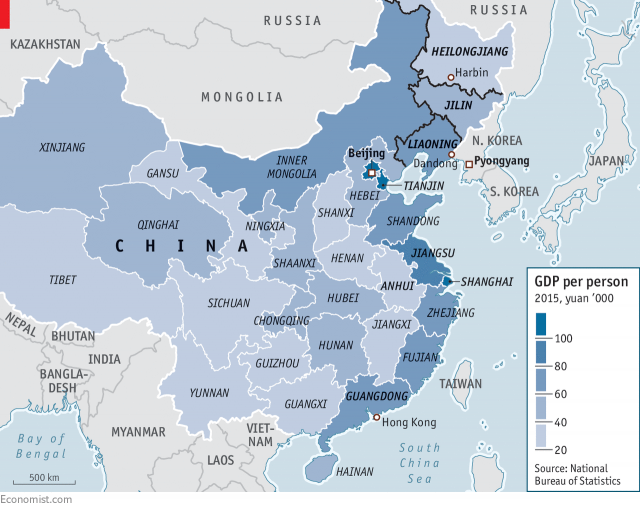 The map at the right shows the substantial differences in GDP/person, and hence overall
economic development, in the various provinces of China (as of 2015). Note that in the
new capitalist era far less attention than before has been given to developing the interior
of the country and the rural areas. (Inner Mongolia shows as a fairly high GDP/person only
because it is so extremely sparsely populated over most of that region.)
The map at the right shows the substantial differences in GDP/person, and hence overall
economic development, in the various provinces of China (as of 2015). Note that in the
new capitalist era far less attention than before has been given to developing the interior
of the country and the rural areas. (Inner Mongolia shows as a fairly high GDP/person only
because it is so extremely sparsely populated over most of that region.)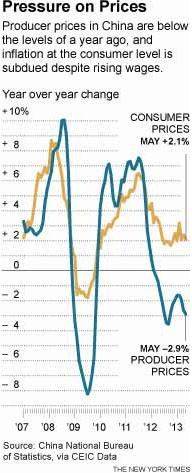 During the socialist period there was no inflation in China (see
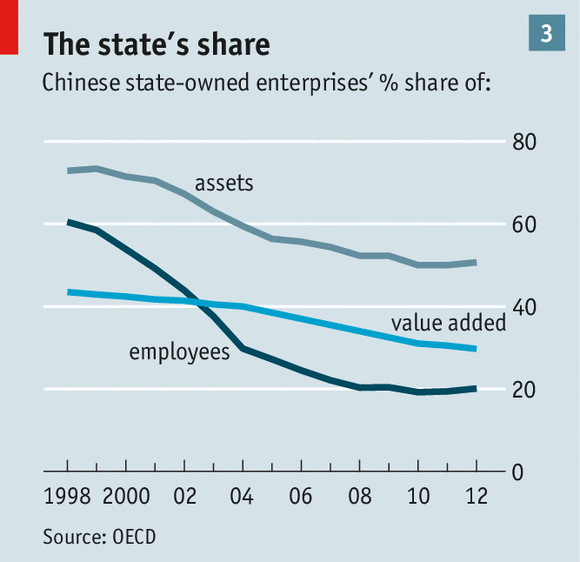 Even though China has been a capitalist country for decades now, as of 2012 state-owned
enterprises (SOEs) still form a large part of the overall economy: approximately half of the
economy in terms of assets owned, and about one-third in terms of value-added production. About
20% of Chinese employees work at these SOEs, down from 60% as recently as 1998.
Even though China has been a capitalist country for decades now, as of 2012 state-owned
enterprises (SOEs) still form a large part of the overall economy: approximately half of the
economy in terms of assets owned, and about one-third in terms of value-added production. About
20% of Chinese employees work at these SOEs, down from 60% as recently as 1998.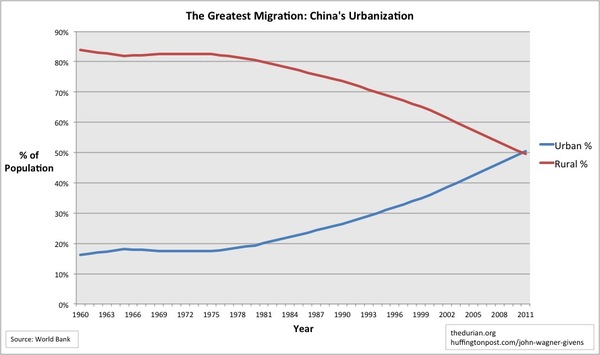 In China in recent decades there has been a historically unprecedented migration of hundreds of
millions of people from rural areas to urban areas, as well as the transformation of many formerly
rural districts themselves into urban areas. By 2012 more than half of the population in China
lived in cities, and by 2016 the urban population reached 55%. One recent NBER research paper says
that China’s urbanization level has grown “from about 20% in the early 1980s to 60% in 2018”.
[Li Gan, Qing He, Ruichao Si & Daichun Yi, “Relocating or Redefined: A New
Perspective on Urbanization in China”, NBER Working Paper No. 26585, Dec. 2019.] This
paper notes that 33.4% of the increase in urbanization between 2010 and 2015 was due to the
reclassification of rural districts to urban districts. So the rate of urbanization in China
from a combination of internal migration and the transformation of formerly rural areas is now
very fast indeed.
In China in recent decades there has been a historically unprecedented migration of hundreds of
millions of people from rural areas to urban areas, as well as the transformation of many formerly
rural districts themselves into urban areas. By 2012 more than half of the population in China
lived in cities, and by 2016 the urban population reached 55%. One recent NBER research paper says
that China’s urbanization level has grown “from about 20% in the early 1980s to 60% in 2018”.
[Li Gan, Qing He, Ruichao Si & Daichun Yi, “Relocating or Redefined: A New
Perspective on Urbanization in China”, NBER Working Paper No. 26585, Dec. 2019.] This
paper notes that 33.4% of the increase in urbanization between 2010 and 2015 was due to the
reclassification of rural districts to urban districts. So the rate of urbanization in China
from a combination of internal migration and the transformation of formerly rural areas is now
very fast indeed.