KANT’S NEBULAR HYPOTHESIS
Although Kant was a philosopher, and basically an idealist one
at that, and not really a scientist, he did make one very important contribution to astronomical
science: namely, his theory (from 1755) was of the nebular origin of the sun and the planets of
the solar system. (This was later extended to stars in general and to other solar systems.) He
proposed that the sun and planets had formed out of an originally quite amorphous swirling cloud
of matter. He even provided some good reasons to think that this theory might be correct, such
as that all the planets are in more or less the same plane, and all of them rotate in the same
direction as the sun spins. This did constitute a major advance in astronomy. Not only that,
but ironically it also served to help promote materialist and developmental ideas in the
sciences in general.
“The Kantian theory of the origin of all existing celestial bodies from
rotating nebular masses was the greatest advance made by astronomy since Copernicus. For
the first time the conception that nature had no history in time began to be shaken. Until
then the celestial bodies were believed to have been always, from the very beginning, in
the same states and always to have followed the same courses; and even though individual
organisms on the various celestial bodies died out, nevertheless genera and species were
held to be immutable. It is true that nature was obviously in constant motion, but this
motion appeared as an incessant repetition of the same processes. Kant made the first
breach in this conception, which corresponded exactly to the metaphysical mode of thought,
and he did it in such a scientific way that most of the proofs furnished by him still hold
good today. At the same time, the Kantian theory is still, strictly considered, only a
hypothesis. But the Copernican world system, too, is still no more than this.” —Engels,
Anti-Dühring (1878), Chapter VI, MECW 25:53. [In a later work, however, Engels
pointed out that Copernican theory was no longer just a hypothesis, and that it had been
proven correct when it was used to predict and then locate the planet Neptune. See MECW
25:650-1, note 38. Similarly, the essential core at least of Kant’s nebular hypothesis
has by now long since been proven to be true. —Ed.]
KANTIAN ETHICS
There are several strands to Kant’s theory of ethics. He started from the
idealist position that there is some inherent “voice of
conscience” which establishes the truth about what is right or wrong, where reason cannot.
(This is factually completely wrong; we know very well that the
consciences of different people can give them very different
and opposed views about what is right or wrong, that the conscience is originally programmed
for you by the attitudes of your parents and others around you when you are very young, and
that the conscience can even be reprogrammed later.) Kant also believed in religious fashion
that the world must ultimately be one of freedom and justice, and—seeing that there is much
injustice around us—believed that this must mean that there is another life after this in
which God can “redress the balance”.
Thus Kant absurdly believed, from religious
impulses, that moral principles are a priori knowledge,
which are not learned, but which a person knows by instinct. (However, he did allow that a
person may learn through experience how to apply these moral principles and how to
actually do what is right.)
While perceiving that morality could not be
based on individual self-interest, Kant became fixated on the notion of absolute moral laws
which must take a universal form. He viewed moral principles as a question of absolute duty
which every person must be guided by no matter what the consequences. Ludicrous as it is, he
actually believed that moral principles (or moral maxims)
must have no exceptions whatsoever. Thus he maintained that lying
is always wrong even if someone will be injured or murdered if you tell the truth in some
situation. Kant’s famous (notorious?) doctrine of the categorical
imperative forms the heart of his theory.
Kant opposed any form of
naturalistic ethics which bases morality on human concepts,
on our social existence, and on our collective needs and interests. As such, Kantian ethics
is profoundly opposed to the Marxist-Leninist Class
Interest Theory of Ethics.
See also:
DEONTOLOGY
KANTIAN IDEALISM
See also:
A PRIORI,
DING-AN-SICH
“The principal feature of Kant’s philosophy is the reconciliation of
materialism with idealism, a compromise between the two, the combination within one system
of heterogeneous and contrary philosophical trends. When Kant assumes that something
outside us, a thing-in-itself, corresponds to our ideas, he is a materialist. When he
declares this thing-in-itself to be unknowable, transcendental, other-sided, he is an
idealist. Recognizing experience, sensations, as the only source of our knowledge, Kant
is directing his philosophy towards sensationalism, and via sensationalism, under certain
conditions, towards materialism. Recognizing the apriority of space, time, causality,
etc., Kant is directing his philosophy towards idealism. Both consistent materialists and
consistent idealists (as well as the ‘pure’ agnostics, the Humeans) have mercilessly
criticized Kant for this inconsistency. The materialists blamed Kant for his idealism,
rejected the idealist features of his system, demonstrated the knowability, the
this-sidedness of the thing-in-itself, the absence of a fundamental difference between
the thing-in-itself and the phenomenon, the need of deducing causality, etc., not from
a priori laws of thought, but from objective reality. The agnostics and idealists
blamed Kant for his assumption of the thing-in-itself as a concession to materialism,
‘realism’ or ‘naive realism’.” —Lenin, Materialism and Empirio-Criticism
(1908), LCW 14:198.
[While Lenin is correct here in
saying that some few aspects of Kant’s philosophical system lean toward materialism while
other aspects lean toward idealism, it is nevertheless true that any philosophical system
which is as encumbered by idealism as Kant’s is, must clearly be viewed as promoting
philosophical idealism. And it is quite wrong to believe (as individuals such as Mach and
the Empirio-Criticists of Lenin’s day did) that Marxist dialectical materialism owes
anything to Kant’s philosophy. —S.H.]
“In my opinion, the essence of the argument is: (1) In Kant, cognition
demarcates (divides) nature and man; actually it unites them; (2) In Kant, ‘the empty
abstraction’ of the Thing-in-itself instead of living progress, motion, deeper and
deeper, of our knowledge about things.” —Lenin, “Conspectus of Hegel’s Book The Science
of Logic” (1914), LCW 38:91.
KAPITALISTATE
An irregularly published journal whose subtitle was “Working Papers on the Capitalist State”.
The articles were written by academic Marxists and, as that subtitle indicates, they focused
on the nature of the state in capitalist society. There were 9 issues in all (two of which
were “double” issues). They are available on the Marxist Internet Archive at:
https://www.marxists.org/history/usa/pubs/kapitalistate/index.htm
“The journal Kapitalistate was published between 1973 and 1983. It
was edited by editorial collectives in a number of cities, which varied over time. The
collective in the San Francisco Bay Area was the most consistent over time, lead [sic] by James
O’Connor, but there were also collectives with varying degrees of activity and longevity
in: Madison, Wisconsin; Boulder, Colorado; Germany; Italy; the UK; and Canada.” —Introductory
note on the Marxist Internet Archive.
KAROJISATSU (Japanese)
Suicide caused by extreme overwork. (See also KAROSHI entry below.)
“Foxconn [the Taiwan-based corporation which manufactures electronic
products for multinational corporations, including Apple iPhones and iPads] has been
involved in several controversies relating to how it manages employees in China. There has
been a history of suicides at its factories blamed on working conditions. In January 2012,
about 150 Foxconn employees threatened to commit mass-suicide in protest at their working
conditions.” —Wikipedia entry on Foxconn, accessed on June 1, 2016. The news source for
the mass suicide threat is: “‘Mass Suicide’ Protest at Apple Manufacturer Foxconn Factory”,
The Daily Telegraph, Jan. 11, 2012.
KAROSHI (Japanese)
Death from extreme overwork, which has been fairly common in Japan for decades. It is also
fairly common in many other capitalist countries, especially where the working class is more
viciously exploited and oppressed than usual, such as China and India. There have been many
deaths of terribly overworked workers, including numerous suicides, at Foxconn plants in China
for example.
See also:
DEATH FROM OVERWORK
“The Japanese are working themselves to death, said Scott North and Rika
Morioka. Labor activists have been trying to draw attention to the problem of karoshi,
or death from overwork, for decades. The related problem of karojisatsu, or suicide
because of overwork, is similarly hard to confirm without a suicide note specifically
blaming the job. Unfortunately, the [proposed new] law’s draft isn’t very ambitious. It
says nothing about limiting working hours, mandating days off, or punishing employers who
flout labor laws. Instead it ‘relies on moral suasion’ by ‘calling upon the government to
make karoshi prevention a duty.’ The vagueness means the law will be ‘less a solution
to a social problem than official recognition that the problem exists.’” —“Japan: Can death
from overwork be prevented?”, in “The Week Presents Confidential Intelligence
Briefing”, 2015, p. 5.
“The health effects of overwork
“Researchers have found ‘the clearest
proof yet that your job is killing you,’ said Jeff Guo in The Washington Post. For
years, the link between job stress and poor health ‘has mostly been correlational.’ But
economists at Purdue University and the University of Copenhagen examined ‘what happens
when people suddenly get a lot busier at work’ by analyzing the health of Danish workers at
manufacturing companies where sales spiked unexpectedly. ‘This kind of study could only be
done in a place like Denmark, where the single-payer health-care system keeps track of
everyone’s doctor’s visits and drug purchases.’ After sales booms, women were more likely
to suffer from severe depression, or be prescribed medication for heart attack or stroke.
For men and women, the rate of serious injury increased. Sick days went up dramatically.
The results seem clear: ‘Working too hard has health consequences.’” —The Week
magazine, July 29, 2016, p. 32.
KASAMA PROJECT
A small U.S. revolutionary group, now defunct, which was centered around the Kasama website
(which no longer exists). Mike Ely and friends started the Kasama website in December 2007, and
soon developed a regular readership. An initial posting on Kasama, which remained its central
and most important document, was Mike Ely’s
“9 Letters to Our
Comrades”, a fairly extensive critique of the Revolutionary Communist
Party. Many of the core people originally associated with the Kasama site were folks
who were earlier in or around the RCP. Some critics referred to Kasama as “the RCP without the
Avakian cult” or the “RCP-Lite”. However, later on the ideas of the initial group seemed to
be changing in various directions, and external political currents such as French academic
“Marxist” philosophy were beginning to make inroads. In addition, people from other “left”
traditions (including Trotskyists) started gravitated toward Kasama and it seemed to be becoming
more politically diverse and ideologically unstable.
In April 2008 the core group formed a communist
organization called the Kasama Project. However, for some years the main presence of
the group was still the Kasama website, a blog which—though heavily moderated—still was unable
to present a fully coherent and unified political line. It remained more of a “left” discussion
forum than the voice of any definite political organization.
Several years later the attempt was made to
transform the Kasama Project into a cadre organization (more truly along the lines of the RCP
organizationally) and at first this seemed to be working. However serious internal differences
arose, including around questions of sexism on the part of some leaders, which led to the
effective collapse of the organization by the end of 2015.
What were the central reasons for its collapse?
We would hope that Mike Ely and those involved in the Kasama leadership might eventually give
us some more history and their own views on this. In the meanwhile we can only surmise that: 1)
Former longtime members of a political cult like the RCP seem very
unlikely to ever start a good and viable political organization; 2) A considerable amount of
additional ideological “baggage” from the RCP continued within the Kasama Project, including
some of the tendency toward a conspiratorial conception of how to make revolution; 3) A
continuing failure to really understand and use the mass line method of “from the masses, to
the masses”, even though Kasama itself criticized the RCP on this score; and 4) The larger
problem of the petty-bourgeois (or ex-student) background and individualist perspective of
many young American revolutionaries which makes forming any good revolutionary proletarian
organization so extremely difficult in this most bourgeois of all countries. Our understanding
is that instead of trying to combat this last tendency towards a petty-bourgeois membership,
Kasama may have actually promoted it—as in the case of one member who described himself as
akin to a “sports recruiter” searching for “potential talent” for the organization.
See also:
MARTIN, Bill
KAUTSKY, Karl (1854-1938)
German skin-deep socialist theoretician and leader, who after 1909 became a complete
renegade from revolutionary Marxism. Kautsky started off much better, and became the leading
theoretician of the Social-Democratic Party of Germany (SPD) and of the
Second International. But he was excessively
influenced in his political outlook by a sort of Darwinian gradualist evolutionary
thinking, which eventually led him to believe that revolutionary activity by the masses was
not really very necessary or appropriate and that if we just wait long enough capitalism will
be automatically transformed into socialism. Instead of working toward real socialist
revolution Kautsky promoted the strategy of gradual socialist ascendance through parliamentary
means and through the growth and class education of the German working class via trade unions
and through the socialist press.
Earlier, Kautsky became Engels’ secretary
in 1881 and was the literary executor of Marx and Engels’ papers after Engels’ death. He
performed very poorly in this role, and was very slow in getting more works by the founders
of scientific socialism published. Worse yet, the 3-volume edition of Marx’s very important
Theories of Surplus Value (also known as “volume IV of
Capital”) which Kautsky edited was corrupted and distorted. It was not until decades
later that a proper and reliable edition of TSV in German (and then also in English
translation) was published in the Soviet Union.
Kautsky’s full opportunistic nature was not
completely exposed until the years leading up to World War I, and until that war itself began.
Whereas the true Marxist wing of the SPD, led by great revolutionaries such as Clara Zetkin,
Rosa Luxemburg and Karl Liebknecht, totally opposed the build-up to the war and demanded that
socialist members of the Reichstag (parliament) vote against all war appropriations, the
right-wing of the SPD supported its own bourgeois ruling class and their war. Kautsky tried
to take a “centrist” position in between these two trends (in effect a “centrist” position
in between right and wrong!) which then served to give “centrism”
the bad name it has deserved ever since within the international revolutionary movement. For
example Kautsky favored voting for war credits when these could be presented as “only for the
purpose” of German “self-defense”.
But the deeper problem was the refusal of
Kautsky and the “centrists”, as well as the right-wing of the SPD, to try to make use of
the social crisis brought about by the Great War to lead the German proletariat in making
revolution and seizing political power. In this he betrayed the revolution, betrayed the
German and international working class, and betrayed Marxism.
Theoretically, Kautsky cooked up all sorts
of phony theories to try to justify his betrayal. While being forced to admit that
imperialism lay behind the war, he tried to claim that imperialism was only a “policy”
that the great powers had adopted, that such a policy need not continue permanently, and
that a much more peaceful sort of “ultra-imperialism”
was likely to come about in the future in which all the imperialist powers would share in
their exploitation of the rest of the world.
Lenin, as well as other revolutionary
Marxists such as Rosa Luxemburg, was horrified at Kautsky’s betrayal of Marxism, and
ferociously attacked him. This was done in numerous articles and pamphlets leading up to
and during World War I, including: Imperialism, the Highest Stage of Capitalism
(1916); The State and Revolution (1917); and The Proletarian Revolution and the
Renegade Kautsky (1918). And in light of Kautsky’s turn toward open social chauvinism
before and during that war Lenin looked back with a more critical eye at Kautsky’s earlier
work and now found more to criticize there as well. For example, even though Kautsky had
attacked the open revisionists such as Eduard Bernstein, it was now clearer that Kautsky
himself had systematically gravitated “towards opportunism precisely on the question of
the state.” [LCW 25:477] The roots of Kautsky’s betrayal of revolution in the World War I
years were now much more readily seen in his massive earlier writings.
“Kautsky was the archetype of a doctrinaire, dry and unimaginative
German Social Democrat, whose enormous theoretical output and central ideological
position influenced the whole socialist movement for decades.” —Entry on Kautsky in
Martin van Creveld, ed., The Encyclopedia of Revolutions and Revolutionaries
(1996), p. 235.
“I hate and despise Kautsky now more than anyone, with his vile,
dirty self-satisfied hypocrisy. Nothing has happened, so he says, principles have
not been abandoned, everyone was entitled to defend his fatherland. It is
internationalism, if you please, for the workers of all countries to shoot one
another ‘in order to defend their fatherland’.
“Rosa Luxemburg was right when
she wrote, long ago, that Kautsky has the ‘subservience of a theoretician’—servility,
in plainer language, servility to the majority of the Party [the SDP which was
mostly supporting the German ruling class in the war—Ed.], to opportunism. Just now
there is nothing in the world more harmful and dangerous for the
ideological independence of the proletariat than this rotten self-satisfaction
and disgusting hypocrisy of Kautsky...” —Lenin, Letter to A. G. Shlyapnikov, Oct. 27,
1914; LCW 35:167-8.
“In all his writings during the war Kautsky tried to extinguish
the revolutionary spirit instead of fostering and fanning it.” —Lenin, The
Proletarian Revolution and the Renegade Kautsky (1918), LCW 28:291.
KAUTSKYISM
A viewpoint based on the revisionist ideas and theories of Karl Kautsky (see above).
Some of the erroneous attitudes which are especially apt to be referenced by this term
are:
• Imagining that socialism will
evolve out of capitalism automatically and more or less peacefully, without the need for
any organized insurrection or revolutionary violence on the part of the working class;
• A failure to view the
capitalist state as the dictatorship of the bourgeoisie, and the necessity for any
revolutionary socialist state to be the dictatorship of the proletariat;
• A failure to view modern
imperialism as inherent to capitalism since the last decades of the 19th century, and as
the modern stage of capitalism;
• A tendency to believe that
capitalism is becoming much more organized, that many contradictions within it are
gradually disappearing, that inter-imperialist world war is no longer possible, and that
we may soon reach a new era of “ultra-imperialism”,
if we have not already done so.
See also:
NEO-KAUTSKYISM
“The growing world proletarian revolutionary movement in general,
and the Communist movement in particular, cannot dispense with an analysis and
exposure of the theoretical errors of ‘Kautskyism.’” —Lenin, Imperialism, the
Highest Stage of Capitalism, “Preface to the French and German Editions” (1920),
(Peking: FLP, 1975), p. 8.
KAYPAKKAYA, Ibrahim (1949-1973)
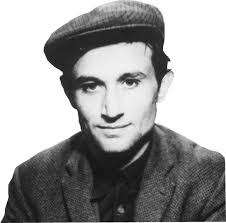 A very important leader of the revolutionary Communist movement in Turkey, and founder of
the anti-revisionist Communist Party of Turkey/Marxist-Leninist (TKP/ML) in 1972.
Kaypakkaya was captured by the government in January 1973 during a military crackdown on
the revolutionary movement. He was tortured for several months, and finally murdered on
May 18, 1973, by being shot in the head in the torture dungeons of the notorious
Diyarbakir prison. He was only 24 years old.
A very important leader of the revolutionary Communist movement in Turkey, and founder of
the anti-revisionist Communist Party of Turkey/Marxist-Leninist (TKP/ML) in 1972.
Kaypakkaya was captured by the government in January 1973 during a military crackdown on
the revolutionary movement. He was tortured for several months, and finally murdered on
May 18, 1973, by being shot in the head in the torture dungeons of the notorious
Diyarbakir prison. He was only 24 years old.
Despite being horrifically tortured,
Kaypakkaya did not reveal any information to his interrogators. He created the tradition
for Turkish revolutionaries that “You give your life but not a secret”, a tradition which
continues to the present time. Kaypakkaya is revered today as a martyr and symbol of
revolutionary resistance to a vicious fascist regime.
The National Intelligence Organization
of Turkey viewed Kaypakkaya as the most dangerous revolutionary in the country because
of his organizational abilities and his great success in bringing revolutionary ideas to
others. Though he was still very young he had already become an important and prominent
Marxist theorist in Turkey. He defended the revolutionary ideas of Marx, Lenin and Mao,
and applied them creatively to the situation in Turkey. He led in the struggle against
modern revisionism in the Soviet Union and against its supporters in Turkey. He took up
Maoism and strongly supported the Great Proletarian Cultural
Revolution in China. Kaypakkaya shocked many on the nominal “left” in Turkey by
exposing and condemning Kemalism as an oppressive bourgeois
ideology. And he made an especially important contribution to the correct understanding
of the national question in Turkey by strongly supporting the right of the Kurdish
people to determine their own future, including complete independence if they so chose.
All these positions were of critical importance in establishing a new revolutionary
movement in Turkey on a sound ideological basis.
Ibrahim Kaypakkaya is rightfully viewed
as a revolutionary hero in Turkey, and around the world.
“Kaypakkaya was communism’s torch and a beacon shining light and
exposing the true nature of Kemalism as fascism, challenging the taboos surrounding
the Kurdish national question, waging an unflinching ideological struggle against
liquidationism, against those who played ‘revolutionaries’ [with a] constitutional
line, and the die-hard so-called Marxists that wished to monopolize the scene....
“Even 40 years after his death,
comrade Kaypakkaya, with his time tested views, is still important and indispensable
for the TKP/ML. This importance has significant weight not only for our party but
also for a successful revolutionary march of the proletariat and the entire
revolutionary movement in Turkey.”
—From “His Name is Our Pride,
His Party is Our Honor, His Doctrine is Our Guide: On the 40th Anniversary of the
Murder of Ibrahim Kaypakkaya” (2013), by the TKP/ML, online at:
https://www.bannedthought.net/Turkey/TKP-ML/2013/I-Kaypakkaya-ENG.pdf
KEMALISM
The program of “reforms” proposed and partially implemented by
Mustafa Kemal “Atatürk” in Turkey, and the
continued support for this program after Mustafa Kemal’s death in 1938. Some aspects of
this program were actually reforms (such as shutting down religious schools and courts
of law and replacing them with secular institutions). But most aspects of this program
were very negative “reforms” indeed! The secular political and legal system, for example,
was initially modeled on Mussolini’s fascist Italy! And although Kemalism proposed to
institute “democracy” it has never actually done so. While Mustafa was alive only his
own bourgeois party was legal. After his death multi-party elections began, but no
revolutionary parties genuinely representing the interests of the masses are legal.
And there is no genuine freedom of speech and of the press in Turkey, even by European
bourgeois standards.
In effect, modern Kemalism is a program
for the continuation of a fascist bourgeois state, with all its attendant repression and
oppression.
“The official version of the history of the Turkish state at this
time bears very little resemblance to the actual events. Not surprisingly, the
authorized version does not interpret events as exploitation, persecution and
massacres. The history of the Turkish republic and the ideas and character of the
leader of the Turkish bourgeoisie, Mustafa Kemal, have been distorted from beginning
to end.
“Turkish people are
indoctrinated with Kemalist ideas from an early age. The intention is to mesmerize
people into thinking that if they love Mustafa Kemal they will go to heaven, and
if they don’t, they will go to hell. Kemalism is represented as being the only
valid path to follow. Everyone accuses each other of not being a true Kemalist and
in inter-party political struggles this is a reason often given in order to denounce
someone.
“If we examine Mustafa Kemal
and the deeds of his followers, it is easy to discern the true character of Kemalism.
Firstly, Kemalism is opposed to all progressive forces. During the country’s years
of occupation before 1923, the Kemalists established a good relationship with the
Soviet Union, receiving moral, financial and military support from them. This
resulted in the occupying imperialists being forced into concessions in the ‘war
of liberation.’ As soon as agreement was reached with the occupying forces, the
Kemalists took action against all progressives, democrats, revolutionaries and
communists.
“Secondly, Kemalism is fascist.
The Kemalists did not hesitate in massacring, imprisoning, exiling and hanging
these workers, peasants and people who tried to claim their basic rights, such as
the right to work, education, distribution of the land and personal freedom....
“Kemalism also embodies extreme
nationalism and racism; racism is particularly directed at the Kurdish nation, as
well as at other minorities. The Kemalists had promised independence and liberty to
the Kurdish people during the years of occupation in order to gain their support
during the ‘war of liberation.’ After the war when they asked for their promised
demands the answer they received was a most definite no, and there followed the
massacres in which tens of thousands of Kurdish people were killed.
“Kemalism played an active
role collaborating with the imperialist powers, who were involved in the suppression
of anti-fascist and anti-imperialist elements amongst the peoples of the Middle
East and elsewhere. Under Kemalist rule, Turkey continued to be exploited by
imperialist powers, especially by the USA.”
—From the “What is Kemalism?”
section of the article “Historical Background of Turkey” (online at:
https://www.bannedthought.net/Turkey/TKP-ML/2000s/HistoricalBackground-Turkey-2002-Eng.pdf),
in a collection of articles published by the Communist Party of Turkey/Marxist-Leninist
circa 2002.
“Even after the death of Mustafa Kemal and his colleagues, Kemalist
ideology continued to permeate the ideas of people of all political persuasions, and
indeed it was not until the 1970s that anybody was able to analyze its reactionary
and fascist character and to struggle against it. The pioneer of this thinking was
the Communist Party of Turkey / Marxist Leninist (TKP/ML) leader,
Ibrahim Kaypakkaya, who spoke out amidst cries of
derision and shock from the other left-wing parties. Here are the TKP/ML analyses
Kemalism and Kemalist ‘revolution’:
“1) The Kemalist ‘revolution’
was a revolution of the top stratum of the Turkish merchant bourgeoisie, landlords,
usurers and a few industrialists. Both the comprador Turkish bourgeoisie, and the
middle bourgeoisie of national character took part in the revolution.
“2) The leaders of the
‘revolution,’ starting during the years of the ‘war of liberation,’ set out to
collaborate with Allied imperialism in an underhand way. The imperialists took a
benevolent stand towards the Kemalists and looked favorably at the possibility of a
Kemalist power.
“3) This collaboration became
even stronger and continued after the Kemalists signed a peace treaty with the
imperialists. The Kemalist movement developed ‘against the peasants and workers,
and against the very possibility of an agrarian revolution.’
“4) As a result of the Kemalist
movement, the colonial, semi-colonial and semi-feudal structure of Turkey was
replaced by a semi-colonial and semi-feudal structure. In other words, the
semi-colonial and semi-feudal economic structure remained intact.
“5) In the social field, the
new Turkish bourgeoisie which developed from within the middle bourgeoisie of
national character and which set out to collaborate with imperialism, plus a
section of the old Turkish comprador big bourgeoisie and plus the new bureaucracy
took the place of the comprador big bourgeoisie of the national minorities, plus
the old bureaucracy and plus the Ottoman intelligentsia. The domination of some of
the old landlords, big landowners, usurers and speculating merchants continued,
while the rest of them were replaced by new ones. Kemalist power as a whole, does
not represent the interests of the middle bourgeoisie of national character but the
interests of the above classes and strata.”
—Ibid.
KENT STATE MASSACRE
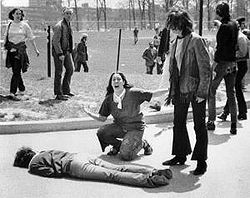 An attack on and murders of unarmed students at Kent State University in Ohio on May 4,
1970, who were protesting the U.S. war in Vietnam and the recent U.S. invasion of
Cambodia. The Ohio National Guard fired at the demonstration, killing four students and
wounding 9 others, one of whom was permanently paralyzed.
An attack on and murders of unarmed students at Kent State University in Ohio on May 4,
1970, who were protesting the U.S. war in Vietnam and the recent U.S. invasion of
Cambodia. The Ohio National Guard fired at the demonstration, killing four students and
wounding 9 others, one of whom was permanently paralyzed.
This massacre led to a nation-wide
student strike which closed down hundreds of universities, colleges and high schools,
involving over 4 million students. This is so far the only national student strike
in U.S. history. The massacre also further turned U.S. public opinion against the
imperialist U.S. war in Indo-China.
Eight of the National Guard soldiers
were later indicted by a grand jury, but the reactionary court system accepted the
absurd claim by the soldiers that they fired only because they “feared for their lives”,
and all the charges were dropped. The Guardsmen had been firing so indiscriminately that
even some people walking by the demonstration, or watching it from afar, were shot. But
there was no way the government was going to seriously discipline its own murderous
troops, whether in Ohio or southeast Asia.
KEY LINK
“As an old saying goes, ‘Once the headrope of a fishing net is
pulled up, all its meshes open.’ It is only by taking hold of the key link that
everything else will fall into its proper place. The key link means the main theme.
The contradiction between socialism and capitalism and the gradual resolution of
this contradiction—that is the main theme, the key link. Grasp this key link, and
all kinds of political and economic work to help the peasants will fall under it.”
—Mao, “Two Talks on Mutual Aid and Co-operation in Agriculture: The Talk of November
4” (Nov. 4, 1953), SW 5:136. [In later years many Chinese leaders, including Deng
Xiaoping, talked in terms of the “key link”, but for them it never meant class
struggle.]
KEYNES, John Maynard (1883-1946)
A famous British liberal bourgeois economist and diplomat. He represented the British Treasury in
international economic and political negotiations during and after both the First and Second World
Wars.
Keynes’s most famous work is his General Theory
of Employment, Interest and Money (1936), often called the General Theory for short.
Keynes, unlike most bourgeois economists, understood that “during some periods”
“Say’s Law” (that capitalist production generates its own full market
demand) is not actually valid. So, according to him, during those critical periods the government
needed to arrange to somehow get money into the hands of consumers in order to get them to spend and
“restart” the capitalist economy. This may indeed work in very exceptional cases, and during the
very short term. But the flaw in Keynes’s theory is that during serious capitalist
overproduction crises mere short-term and limited government
deficits will not resolve the problem and restore health to the economy. It will merely serve
to slightly ameliorate the situation temporarily while gradually building up government and consumer
debt to unsustainable and dangerous levels, leading eventually to an even more serious financial
crisis and economic collapse.
So Keynes, despite what he thought he had done, in
no way actually provided a solution to the inherent contradictions within capitalism that continually
lead it into serious economic crises.
See also below, and:
BASTARD KEYNESIANISM,
“LEISURE AGE”,
LIQUIDITY TRAP,
“MILITARY KEYNESIANISM”,
NEO-KEYNESIANISM,
NEW KEYNESIAN ECONOMICS,
POST-KEYNESIANISM,
“PRIMING THE PUMP”,
ULTRA-KEYNESIANISM
“Keynes, unlike many of his followers, was not a man of the left. ‘The Class
war will find me on the side of the educated bourgeoisie,’ he said in his 1925 essay, ‘Am I a
Liberal?’. He later described trade unionists as ‘tyrants, whose selfish and sectional
pretensions need to be bravely opposed.’” —“John Maynard Keynes: Was he a liberal?”,
The Economist, Aug. 18, 2018, p. 58.
“The decadent international but individualistic capitalism, in the hands of
which we found ourselves after the [First World] war, is not a success. It is not intelligent,
it is not beautiful, it is not just, it is not virtuous—and it doesn’t deliver the goods. In
short we dislike it, and we are beginning to despise it. But when we wonder what to put in its
place, we are extremely perplexed.” —John Maynard Keynes, “National Self-Sufficiency”,
Yale Review, #22, 1933, pp. 760-61. [This comment seems to show just how shaken Keynes
was by the Great Depression. —Ed.]
KEYNESIANISM
[To be added...]
See also:
BASTARD KEYNESIANISM,
PHILLIPS CURVE,
POST-KEYNESIANISM,
ULTRA-KEYNESIANISM
“Keynes’s basic conclusion can ... be put very directly. Previously it had been
held [by bourgeois economists —S.H.] that the economic system, any capitalist system, found its
equilibrium at full employment. Left to itself, it was thus that it came to rest. Keynes showed
that the modern economy could as well find its equilibrium with continuing, serious underemployment.
Its perfectly normal tendency was to what economists have since come to call an underemployment
equilibrium.” —John Kenneth Galbraith, The Age of Uncertainty (1977), p. 216.
KEYNESIAN DEFICIT FINANCING
Keynes partially rejected the standard bourgeois economic dogma, known as Say’s
Law which holds that capitalist production always creates its own full markets. (I.e., that it
automatically creates a market equal to the full value of all the commodities produced.) However,
he thought the failure of capitalism to do this was just a sometime thing, which could be
controlled and circumvented by the government overseers of the capitalist economy. (He did not at all
understand, let alone agree with, the Marxist theory of surplus value
and how its very generation ensures that capitalist production is never able to create markets
equal to the full value of the commodities produced under this system.)
When “gluts” or overproduction
did appear, along with a recession and rising unemployment, Keynes said that one major way to eliminate
these problems was to “prime the pump” (i.e., get things working
“properly” again) by having the government hire the unemployed and pay them wages from either money
borrowed from the rich, or else from money that the government just prints up instead of obtaining it
from taxes. He thought (quite erroneously) that once things were running smoothly again, the government
could start running surpluses instead of deficits, and—with proper management—over time the deficits and
surpluses would even out, and this procedure could be applied indefinitely.
In his General Theory magnum opus Keynes argued that the public
works projects were not themselves essential and were merely a side benefit. The real boost to the economy
was due to the government budget deficits themselves and the putting of money (in whatever way) into the
hands of those who would actually spend it. He even stated (correctly!) that it would work just as well
to hire workers to dig useless holes, and then fill them up again! The point was to somehow get
money into their hands which they would then spend.
Although “Keynesian deficits” are named after Keynes, he
was not the first to come up with the idea. Other bourgeois, and especially social democratic, economists
in Germany and Sweden not only came up with the same basic idea before Keynes, but even started using it
to good effect before Keynes wrote his General Theory. In Sweden, for example, Gunnar Myrdal talked
the government there into applying deficit financing which greatly mitigated the Depression, and a similar
thing happened in Germany.
Marxist economists understand that Keynesian deficits do
not really “prime the pump”, except in rare and highly atypical
cases. Instead, such deficits usually only postpone the deeper reckoning by constantly building up
government debt (also accompanied by mushrooming consumer and corporate debt) to totally unsustainable and
desperately dangerous levels. This is actually the situation that exists in the capitalist world at the
present time, both in the United States and everywhere else. And such massive and unsustainable debt bubbles
end up doing what they always do: they pop. This signals the beginning of a terrible financial crisis, which
then develops into a more general and horrendous economic crisis. (I.e. a serious and prolonged recession,
or even an outright intractable depression.) This came very close to happening with the
Great Recession of 2008-9. And this doomsday-like result for capitalism
now looms ever nearer.
See also:
“MILITARY KEYNESIANISM”,
“MODERN MONETARY THEORY”
“On the last day of 1933, the British economist John Maynard Keynes published
an open letter in the New York Times pleading with President Franklin Delano Roosevelt
to embark on a spending spree. He advised the President to build more railroads—though,
really, anything would do. The government, he said later, could even bury money in old mines
and sell digging rights....
“Keynes’s letter was an attack on [the
prevailing] faith in markets. In his view, no invisible hand ensured markets automatically
would deliver the best possible outcomes. Businesses uncertain about the future would refrain
from investing; people would remain unemployed. The government, he said, needed to borrow and
spend until ‘animal spirits’ were revived.
“Keynes wrote that if Roosevelt followed his
instructions, the President could spark a global recovery. ‘If you succeed, new and bolder
methods will be tried everywhere,’ he wrote, ‘and we may date the first chapter of a new economic
era from your accession to office.’”
—Binyamin Appelbaum, The Economists’ Hour:
False Prophets, Free Markets, and the Fracture of Society (NY: Little, Brown, 2019), pp.
46-47.
[Roosevelt was not smart enough to follow Keynes’s
advice, though after the Great Depression dragged on for a few more years he did finally give it
a very half-hearted try. But then as the Depression eased somewhat in America in 1937, Roosevelt
lifted his foot from the debt accelerator again, and the U.S. economy sank back into more serious
depression once more. Only the massive military deficits from 1940 on, as the U.S. prepared for
and entered World War II really interrupted the Great Depression; and only the massive
destruction of productive capital world-wide during the
war itself truly ended the Great Depression and prevented it from resuming after the end of
the War. —S.H.]
KHOZRASCHET
[Russian: “cost accounting”] A method of supposedly “socialist” economic management used in the
state-capitalist Soviet Union from the 1960s until the collapse of the USSR in 1991. The essence
of this method is that each enterprise should keep very careful track of all production costs to
make absolutely certain that every commodity it produces is appropriately priced so that it will
be sold for a profit.
Thus, under this system, cost accounting exists
either mostly, or perhaps entirely, to make sure the enterprise is profitable. How such a
“socialist” system could ever be transformed in the direction of communism is impossible to
imagine. Clearly the state-capitalist Soviet Union had no plans or desires to do so.
[Reference: E. Cherevik & Y. Shvyrkov, An ABC
of Planning, (Moscow: Progress, 1982), p. 243.]
“Khozraschet. A word which describes an economic unit which has its
own profit and loss account and is run in a business like way. Used by extension in phrases
such as ‘full khozrachet’ to describe the choice of inputs and outputs by enterprises or
associations themselves, flexible prices, and payment for the use of natural resources and
capital goods.” —Michael Ellman, Soviet Planning Today (1972), p. xi.
KHRUSHCHEV, Nikita Sergeyevich (1894-1971)
[Outside of the U.S. his name is often transliterated from Cyrillic as ‘Khrushchov’ rather
than ‘Khrushchev’.] Soviet revisionist ruler who led in the complete destruction of socialism
in the Soviet Union.
Born near Kursk, as a boy he was a shepherd
and later a locksmith. He was almost illiterate until the age of 25. In 1918 he joined the
Communist Party [Bolsheviks] and fought in the Civil War. He received most of his education
as a Party member and at the same time rose rapidly in the Party organization. In 1939 he
was made a full member of the Politburo. During World War II he organized guerrilla warfare
in Ukraine against the German invaders, and afterwards was in charge of the economic
reconstruction of the region. In 1949 he was in charge of a major reorganization of Soviet
agriculture.
When Stalin died in March 1953, Khrushchev
became First Secretary of the CPSU. At the 20th Party Congress in 1956 he gave a secret
speech (soon leaked) denouncing Stalin and his errors and crimes,
but from a bourgeois standpoint, not a Marxist-Leninist one. The next year he demoted his
main rivals, Molotov, Kaganovich and Malenkov, and consolidated
his personal power. From then on he more and more promoted the process of changing what
remained of socialism into state capitalism. He further
promoted the expansion of privileges for high-ranking Party members, economic “reforms” that
made production more dependent on profits, material bonuses to workers (rather than moral
education and rewards), etc.
Internationally Khrushchev’s policies wavered
between contention and co-operation with U.S. imperialism. On the one hand he made “peaceful
competition” with capitalism his basic program, and the insistence on reformist, electoral
policies for all other “Communist” parties not already in power. In line with these policies he
tried to cut various deals with U.S. imperialism. On the other hand, after the U.S. installed
nuclear missiles in Turkey which were aimed at the USSR, Khrushchev rather recklessly attempted
to do the same thing in Cuba. This led to the Cuban
Missile Crisis, a game of “nuclear chicken” between U.S. imperialism and Soviet
“social-imperialism” (socialism in name, imperialism in deeds) which almost led to World War
III. The “liberal” regime of President John Kennedy was quite willing to launch such a war if
Khrushchev did not back down, even if it did mean the horrible deaths of hundreds of millions
of people! Khrushchev, for all his crimes and faults, at least had sense enough to back down
and withdraw the missiles he had en route to Cuba. After that Khrushchev reverted once
more to a general policy of appeasement and co-operation with U.S. imperialism, to the detriment
of the world revolution.
By cozying up to U.S. imperialism, acting in
an imperialist manner himself, and by taking the capitalist road within the Soviet Union,
Khrushchev and his fellow revisionists also provoked a split with Mao’s China which was
determined to keep to the proletarian revolutionary road.
By 1964 Khrushchev’s fellow revisionists in
the leadership of the Soviet Union were becoming weary of him and his economic and political
failures, and forced him from power.
How is it possible that a man of
peasant/proletarian origins, who was educated and developed by the Communist party of Lenin
and Stalin, and who provided service to the socialist cause for decades became the leader in
the destruction of genuine socialism? The fundamental lesson here seems to be that no matter
what one’s class origins, no matter what one’s education, no matter what one’s prior
contributions, a person can change his class stand and ideology, especially if he is in a
society that is quite conducive to that. The Soviet socialist system as it developed under
Stalin was largely top-down and paternalistic, with the masses having little power to
directly control their own lives and little ability to supervise the leadership of the Party
and government. Though Stalin did not intend to create a new bourgeoisie within the
higher ranks of the Party, this is what happened, in part because Stalin himself promoted
the special privileges and rewards for what later came to be called the
nomenklatura. In effect, people like Khrushchev were
educated early on by the Party as communists, and then “re-educated” later on as
revisionists. Once people like that achieved full power themselves, socialism was soon
demolished.
See also:
FIVE REQUIREMENTS FOR SUCCESSORS TO THE REVOLUTIONARY
CAUSE OF THE PROLETARIAT
“To realize the professed goal of ‘advancing to communism,’ he
[Khrushchev] declared that certain ‘reforms’ are needed: ‘We must elevate the
importance of profit and profitability.’ He predicted that through maximizing profits
in the shortest time, the USSR by 1980 would be a fully communist, classless society.
To insure that the new regimen for broadening commodity-money relations got off to a
strong start, he abolished the central planning ministries. This threw enterprise
managers into the profitability vortex of getting desired raw materials at the lowest
price and selling finished products at the highest price. In order to increase
‘production,’ another ‘reform’ divided the Soviet party into industrial and agricultural
branches and tied the salaries of local party officials to the ‘economic success
indicators’ of the factories and farms they supervised. This thrust party officials
into the profitability race, as well as pitted workers and farmers against each other.”
—Ira Gollobin, Dialectical Materialism: Its Laws, Categories, and Practice (1986),
pp. 470-471.
KIENTHAL CONFERENCE
The second of two important international socialist conferences held in Switzerland in the early
years of World War I, and which attempted to address the question of what socialists should do
about the War.
See also:
ZIMMERWALD CONFERENCE
“The Second International Socialist Conference met at Kienthal
(April 24-30, 1916). The Left wing was more solidly united and stronger than at
Zimmerwald. Lenin secured the adoption of a resolution criticizing social-pacifism and the
opportunistic activities of the International Socialist Bureau. The Kienthal Manifesto
and resolutions represented a further step toward an international movement against the
war.
“Zimmerwald and Kienthal helped to
crystallize and unite the internationalist elements, but both Conferences failed to take
a consistent internationalist stand, and did not accept the basic principles of the
Bolshevik policy: conversion of the imperialist war into a civil war, defeat of one’s
own imperialist government in the war, and the organization of a Third International.”
—Note 333, Lenin, SW I (1967).
KISSINGER, Henry (1923-2023)
American diplomat and war criminal who is probably more responsible for the millions of
murders in U.S. imperialist wars and other actions, in Vietnam and elsewhere during the
late 1960s and 1970s, than anybody other than the U.S. presidents he served (Nixon and
Ford). Kissinger was appointed National Security Advisor by Nixon in 1969 and then
became U.S. Secretary of State in 1973. He was an advocate and practitioner of
Realpolitik, or in other words unrestrained imperialist
gun-boat or strong-arm diplomacy and war.
In a self-exposure of the reactionary and
pro-imperialist nature of the Nobel Peace Prize committee, Kissinger was absurdly awarded
the 1973 “Peace Prize” for supposedly “ending” the Vietnam War. Two members of that Nobel
committee resigned in protest against this outrageous award. When the war resumed after
that award (because of renewed U.S. imperialist war policies), Kissinger offered to
return that “Peace Prize”, but didn’t actually do so.
[Excerpt from a conversation between Mao Zedong and Kissinger in
Beijing on February 17, 1973.]
[Kissinger:] “Our interest in
trade with China is not commercial. It is to establish a relationship necessary for
the political relations we both have.”
[Mao, working to draw Kissinger
out some more:] “We do not understand your affairs. Your domestic affairs, we don’t
understand them. There are also many things about foreign policy that we don’t
understand either.”
[Kissinger:] “You have a more
direct, maybe a more heroic mode of action than we do. We sometimes have to use more
complicated methods because of our domestic situation. But on our fundamental
objectives we will act very decisively and without regard for public opinion. So if
a real danger develops or hegemonic intentions become active, we will certainly resist
them wherever they appear. And as the President said to the Chairman, in our own
interests, not as a kindness to anyone else.”
—“Pact: Most Favored Nation”,
Harper’s Magazine, May 2008, pp. 24-25. The open admission by Kissinger that
the U.S. ruling class just doesn’t care about U.S. public opinion when its important
interests are at issue is especially noteworthy. —Ed.
“Forget everyone’s nominee for master diplomat, Henry Kissinger,
who was as inept as he was ruthless—extending the Vietnam War by seven bloody years
to mask his diplomatic failure, turning East Timor over to Indonesia for decades of
slaughter until its inevitable independence, cratering US credibility in Latin
America by backing a murderous military dictatorship in Chile, and mismanaging
Moscow in ways that helped extend the Cold War by fifteen years. Kissinger’s career,
as international law specialist Richard Falk observed, has been marked by ‘his
extraordinary capacity to be repeatedly wrong about almost every major foreign
policy decision made by the U.S. Government over the course of the last
half-century.’” —Alfred W. McCoy, In the Shadows of the American Century:
The Rise and Decline of US Global Power (2017), p. 209. [This is the view of a
liberal bourgeois historian. The Marxist view of Kissinger is simpler: the man
deserved to be hanged for his long promotion of genocidal murder around the world
in the endless service of U.S. imperialism. —Ed.]
KNOWLEDGE — Certain
[To be added... ]
See also:
AGNOSTICISM, and
the essay “Do We Know For
Certain That the Earth Goes Around the Sun?”
“But are there any truths which are so securely based that any doubt
of them seems to us to be tantamount to insanity? That twice two makes four, that the
three angles of a triangle are equal to two right angles, that Paris is in France, that
a man who gets no food dies of hunger, and so forth? Are there then nevertheless
eternal truths, final and ultimate truths?
“Certainly there are.... If it
gives anyone any pleasure to use mighty words for very simple things, it can be asserted
that certain results obtained by these sciences [mathematics, astronomy, mechanics,
physics and chemistry] are eternal truths, final and ultimate truths; for which reason
these sciences are known as the exact sciences. But very far from all their
results have this validity.” —Engels, Anti-Dühring (1878), MECW 25:81. [Note
that of course Engels’ comment that the sum of the three angles of a triangle equal two
right angles is only valid in Euclidian geometry. —S.H.]
“Truth and error, like all thought-concepts which move in polar opposites,
have absolute validity only in an extremely limited field..., and as even Herr Dühring
would realize if he had any acquaintance with the first elements of dialectics, which deal
precisely with the inadequacy of all polar opposites.” —Engels, Anti-Dühring
(1878), MECW 25:84.
KONDRATIEV, Nikolai D. (Also spelled: Kondratieff) (1892-1938)
Russian semi-Marxist proponent of the existence of long-term economic waves, often called
Kondratiev Waves after him. (See below.) In the early 1920s he engaged in a theoretical
dispute with Leon Trotsky over this issue, in which both his and
Trotsky’s arguments left more than a little to be desired.
Kondratiev was a member of the peasant-based
Socialist-Revolutionary Party before the October Revolution, and briefly a member of the last
Kerensky government. After the Revolution he focused on academic research, and in 1920 founded
the Institute of Conjuncture. (Modern advocates of “conjuncture
theories” please note!) He was a proponent of the Soviet New Economic
Policy (NEP) and argued for the primacy of agriculture and consumer goods rather than heavy
industry in order to develop the Russian economy. By 1927 he no longer had any influence on
Soviet economic policy.
While it is no doubt true to say that
Kondratiev was not really much of a Marxist, his treatment by the Stalin regime was quite
outrageous. According to the Wikipedia, he was arrested in July 1930 and accused of being a
member of an illegal and probably non-existent “Peasants’ Labor Party”. In August 1930 Stalin
wrote a letter to Molotov asking for Kondratiev’s execution. However he was first imprisoned
for a term of 8 years. In 1938 he was re-tried and condemned to another 10 years in prison,
but was executed on the same day the edict was issued, as part of Stalin’s Great Purge.
KOREA — North and South
 [Intro to be added...]
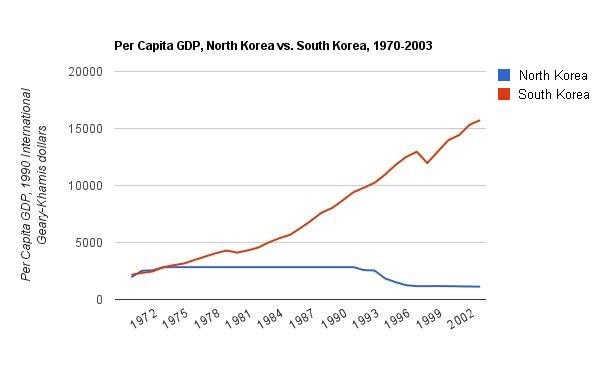
From an economic standpoint the regime in North
Korea has been a dismal total failure since at least 1975. When the two countries were established
at the end of World War II, the North had more industrial development than the South (which was
more agricultural). It is true, however, that most of industry in the North was totally obliterated
by the massive U.S. bombing during the Korean War. Still, even as late as the early 1970s the per
capita GDP of the two countries was virtually the same. Since then, however, the South, with the
aid of the U.S. and Japan, has zoomed upward, while the North has stagnated and even declined
despite aid from the Soviet Union and China. Per capita GDP in the North is now apparently less
than 5% of that in the South. (See the chart at the right which was posted on a Washington
Post blog on 12/19/11.
We can’t vouch for this chart’s total accuracy, but it certainly reflects at least the approximate
situation.) One commentator noted that “Each year the dollar value of South Korea’s GDP
expansion equals the entire North Korean economy.”
In agriculture the situation has been even worse
in the North, where major famines have led to the deaths of possibly more than one million
people and the serious malnutrition of many more millions. And that is despite food aid from
China and extensive U.N. emergency food aid.
In our view these differences between South
Korea and North Korea by no means reflect any supposed superiority of capitalism to socialism,
because the North has not really been a socialist country at all (let alone a “communist”
country as it is called in the West). It is not even what Marx derided as “barracks socialism”;
instead, it is the world’s worst example of state capitalism, in effect “one big corporation”
running (and totally mismanaging) the economy to the colossal detriment of the people, and for
the benefit of a tiny few at the top.
“‘Until the 1960s,’ a Library of Congress country study reported, ‘North
Korea’s economy grew much faster than South Korea’s. Although Pyongyang was behind in total
national output, it was ahead of Seoul in per capita national output, because of its smaller
population relative to South Korea. For example, in 1960 North Korea’s population was
slightly over 10 million persons, while South Korea’s population was almost 25 million
persons. Phenomenal annual economic growth rates of 30 percent and 21 percent during the
Three-Year Plan of 1954-56 and the Five-Year Plan of 1957-60, respectively, were reported.’
The reports were not fraudulent, the Library of Congress investigators explain; rather,
‘during the reconstruction period after the Korean War, there were opportunities for
extensive economic growth—attainable through the communist regime’s ability to marshal
idle resources and labor and to impose a low rate of consumption.’ By the mid-1970s,
however, the two Koreas were reversing positions economically, although their per capita
incomes remained about equal up to 1976. After that time the North fell progressively
further behind the rapidly industrializing South, particularly in fuel resources and
transportation infrastructure, with the North diverting a crushing share of its
income—above 30 percent—to defense.” —Richard Rhodes, The Twilight of the Bombs
(2010), pp. 177-8.
KORNILOV REVOLT [Russia: August 1917]
“The Kornilov revolt against the revolution was organized by the bourgeoisie
and landowners in August 1917. It was led by the tsarist general Kornilov, then Supreme
Commander-in-Chief of the Army [which was nominally under the authority of the Provisional
Government after the fall of the Tsar in the ‘February’ Revolution]. The conspirators aimed
at capturing Petrograd, smashing the Bolshevik Party, disbanding the Soviets, establishing a
military dictatorship, and paving the way for the restoration of the monarchy. A. F. Kerensky,
head of the Provisional Government, joined in the conspiracy. However, when the revolt began,
he disassociated himself from Kornilov, fearing that he might be swept away with Kornilov, and
declared Kornilov to be a rebel against the Provisional Government.
“The revolt began on August 23 (September
7). Kornilov marched the Third Cavalry Corps against Petrograd. In Petrograd itself, the
counter-revolutionary organizations of Kornilov’s backers were getting ready for action.
“The Bolshevik Party led the people
against Kornilov as it continued, in accordance with Lenin’s recommendation, to expose the
Provisional Government and its S.R. [Socialist-Revolutionary Party] and Menshevik hangers-on.
In response to the call of the Bolshevik Party’s Central Committee, the workers of Petrograd
and the revolutionary soldiers and sailors rose to fight the rebels. The Petrograd workers
promptly formed Red Guard units. Revolutionary committees were set up in several localities.
The advance of the Kornilov troops was checked and Bolshevik propaganda began to demoralize
them.
“The Kornilov revolt was put down by
the workers and peasants under the leadership of the Bolshevik Party. Under pressure from the
people, the Provisional Government had to order the arrest and trial of Kornilov and his
accomplices.” —Footnote 95 to LCW 25.
[Here is another account of this episode by a bourgeois historian:] “In
March 1917 A. I. Guchkov, minister of war in the Provisional Government, appointed Kornilov
Commander-in-Chief of the Petrograd Garrison. Disillusioned by the refusal of the Provisional
Government to authorize the use of force to restore order during the disturbance known as
the ‘April Days’ (20-22 April 1917), Kornilov asked to be sent back to the Front [against
Germany in World War I which still continued]. During the offensive in June he commanded the
VIII Army on the South-West Front with only limited success. It was his conduct during the
subsequent German counter-offensive that attracted public attention; he illegally shot 14
looters out of hand and displayed their bodies as a warning to others. Encouraged by
Commissar B. V. Savinkov, Kornilov successfully urged the restoration of the death penalty
and the suppression of [political] meetings [of soviets of soldiers] at the Front. On 18
July 1917, he was promoted Supreme Commander-in-Chief, making his acceptance conditional on
being given a free hand by the Provisional Government. On 3 and 10 August Kornilov visited
Petrograd to urge the Provisional Government to restore the death penalty in the rear, to
militarize the factories and railroads and to reconstitute the cabinet. Kerensky and his
closest colleagues fobbed Kornilov off with vague assurances, while publicly warning
against a coup d’état. Tension mounted as the political elite gathered in Moscow on 12
August for a State Conference. On this occasion the Allies vigorously discouraged Kornilov,
in the hope that Kerensky himself could be induced to adopt Kornilov’s program. Savinkov,
now deputy war minister, also encouraged Kornilov in these hopes. Kornilov anticipated that
the Bolsheviks, and perhaps other socialists, would resist his proposed measures. With
Kerensky’s approval, he drew up plans to post a Special Army in (or near) Petrograd [for
the suppression of any mass resistance or uprising]. He also concocted a secret conspiracy
to fake a ‘Bolshevik Rising’ in Petrograd as a pretext for vigorous action against the
soviets. Relations between government and Supreme Commander were further complicated by
the ham-fisted attempts at mediation undertaken by the conservative politician V. N. Lvov.
On 27 August Lvov presented himself to Kerensky with what appeared to be an ultimatum from
Kornilov instructing Kerensky and Savinkov to join Kornilov at GHQ in Mogilev in a directory.
At this point Kerensky decided to denounce Kornilov and demand his resignation. When
Kornilov refused to comply, he became a mutineer. His pathetic ‘Appeal to the Russian
People’ went unanswered, while the reaction of the masses was so hostile that Kornilov’s
forces were peacefully disarmed. Kerensky then appointed the Shablovsky Commission of
enquiry. When it began to leak details of Kerensky’s previous dealings with Kornilov,
Kerensky’s reputation was destroyed and the path made clear for Lenin [and the Bolsheviks].
Kornilov himself escaped from custody during the October Revolution to become one of the
commanders of the ‘White’ Volunteer Army in South Russia. On 13 April, 1918, he was killed
in action at the siege of Ekaterinodar.” —Richard Abraham, “Kornilov entry”, in
The Blackwell Encyclopedia of the Russian Revolution, ed. by Harold Shukman, (Oxford,
England: 1988).
KRISTALLNACHT
“Kristallnacht”, or the night of broken glass, was a pogrom or
coordinated wave of vicious attacks against Jews throughout Nazi Germany and parts of Austria
on the night of November 9/10, 1938. It was carried out by the Nazi SA paramilitary forces and
by anti-Semitic civilians. German police authorities looked on and made no effort to stop it.
The name comes from all the broken glass that littered the streets after Jewish-owned stores,
businesses and synagogues had their windows smashed. At least 91 Jews were killed in the
attacks (some sources say many more), and 30,000 were arrested and sent to concentration camps.
Jewish homes, hospitals and schools were ransacked, and many buildings were demolished with
sledgehammers. Over 1,000 synagogues were burned and over 7,000 Jewish businesses were damaged
or destroyed. The pretext for the attacks was the assassination in Paris of a German diplomat
by a German-born Polish Jew who was resident there. Kristallnacht marked a major escalation of
the racist Nazi policies toward the Jews, and the beginning of what they later called the
“Final Solution to the Jewish question”, the massive genocide against Jews which led to the
murder of around six million European Jews by the end of World War II. [Most of the information
here is from the Kristallnacht entry in the Wikipedia.]
KROPOTKIN, Peter [Pyotr Alexeyevich] (1842-1921)
Russian prince and anarchist. Though opposed to Marxism, his writings on ethics and related
topics have considerable interest, especially Mutual Aid as a Factor of Evolution
(1902) and Ethics (1922). Though weak in class perspective and revolutionary political
theory, he showed considerable insight into questions of the evolution of cooperation and the
social nature of ethics.
“For [Herbert] Spencer, Darwinian natural selection provided the
explanation for why laissez-faire liberalism required a brutal ‘struggle for existence’.
Darwin, despite regarding Spencer’s work as speculative, later adopted the term—and
even later regretted having done so. Had he instead adopted the Russian anarchist and
biologist Prince Peter Kropotkin’s ‘struggle for life’ in which mutual aid, not mere
existence, was a driving force in evolution, the naturalizing gloom of Darwinism might
have been averted. The proposition that it is not only competition but cooperation—both
within and between species—which has been a major driving force in evolution, has run
like a subterranean heresy through most of the evolutionary theorizing of the last
century. Only now ... has it re-emerged into the daylight of mainstream thinking.”
—Hilary & Steven Rose, Genes,
Cells and Brains: The Promethean Promises of the New Biology (2013), p. 61.
[Kropotkin is indeed to be
commended for the considerable stress he put on the role of cooperation in evolution
and nature, but others—including Engels—held this same view before him. See:
COOPERATION IN NATURE ]
KRUPSKAYA, Nadezhda (Nadezhda Konstantinovna “Nadya” Krupskaya) (1869-1939)
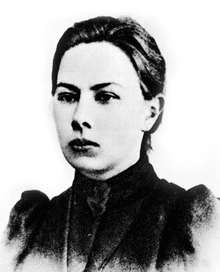 A Russian Marxist and Bolshevik revolutionary. She married Vladimir Lenin in 1898, and they
remained devoted to each other. Krupskaya focused her efforts especially on education, not
only on questions of literacy and libraries, but particularly on socialist education. She was
Deputy Minister of Education in the Soviet Union from 1929-1939. She is now best known for her
very interesting and useful biography, Reminiscences of Lenin, published in the USSR
in 1933, and first published in English in Britain in 1960.
A Russian Marxist and Bolshevik revolutionary. She married Vladimir Lenin in 1898, and they
remained devoted to each other. Krupskaya focused her efforts especially on education, not
only on questions of literacy and libraries, but particularly on socialist education. She was
Deputy Minister of Education in the Soviet Union from 1929-1939. She is now best known for her
very interesting and useful biography, Reminiscences of Lenin, published in the USSR
in 1933, and first published in English in Britain in 1960.
“In the summer of 1930, on the eve of the Sixteenth Party Congress, the
Moscow district Party conferences were held. Lenin’s widow, N. K. Krupskaya, spoke at the
Bauman district branch against the methods that Stalin was using in the collectivization
drive, declaring that this programme had nothing in common with Lenin’s co-operative
scheme. She accused the Party Central Committee of ignorance of the peasants’ mood and
of refusing to consult the people. ‘It is pointless to blame the local organizations for
all the mistakes made by the Central Committee itself,’ she declared.
“While Krupskaya was making her
speech, the district committee chiefs got word to [Lazar] Kaganovich, who came round to
the platform when Krupskaya had finished and subjected her speech to coarse and scathing
abuse. He repudiated her argument and added that as a member of the Central Committee she
had no right to utter her criticism from the platform of a district Party conference.
‘N. K. Krupskaya should not imagine’, he declared, ‘that she has the monopoly on Leninism
because she was Lenin’s wife.’” —Roy Medvedev, All Stalin’s Men (1984), pp. 118-9.
[Medvedev was a revisionist, but this report rings true. It demonstrates Krupskaya’s
commitment to using something more like the mass line, and the total rejection of that
method by Stalin and one of his top lieutenants Kaganovich. Krupskaya, like any Party
member, should indeed have had the right to speak out on the line of the Party, especially
in a period leading up to a Party Congress. And there is no reason to believe Kaganovich’s
ridiculous charge that Krupskaya viewed herself as having a “monopoly on Leninism”. —S.H.]
KU KLUX KLAN — and Immigration
“The 1920’s K.K.K. gained astonishing strength—four to six million members—and
operated a sophisticated lobbying and get-out-the-vote machine. The Klan-identified congressman
Albert Johnson, chairman of the House immigration committee, shepherded the anti-immigration
bill into enactment [the Johnson-Reed Act of 1924]. The law remained in effect until 1965, with
some dreadful consequences. To name just one: It justified the refusal to accept refugees from
Nazism, including 20,000 Jewish children.” —Linda Gordon, “The Original Wall: A History of the
1920s Nativist and Eugenicist Movements that Shut Down Immigration to America”, New York
Times, book review section, July 7, 2019.
[Ms. Gordon notes that while racist
anti-immigrant policies existed in the U.S. before the influence of the KKK, and in particular
against Chinese and other Asians, the Klan’s even more rabid ideology led the U.S. into the
explicit goal of preserving the white Protestant dominance in the country. —Ed.]
KUHN, Thomas S. [Surname pronounced: coon] (1922-1996)
American bourgeois philosopher and historian of science, best known for his very influential
(and deeply flawed) 1962 book, The Structure of Scientific Revolutions. Kuhn challenged
the notion—which almost nobody other than school kids really believes anyway—that scientific
progress is entirely cumulative, unidirectional and without any subjective errors or missteps.
Instead he put forth the theory of “paradigm shifts” to
portray how science really develops; that is by sudden leaps, often in unexpected directions.
This fits well with the Marxist dialectical idea of qualitative
leaps. However, Kuhn grossly exaggerates the extent to which older ideas in science must be
thrown out when a new paradigm replaces an old one. At times he even seems to suggest
that new paradigms are in general no better than old ones, and pushes an ultra-skeptical or
even epistemological agnostic view about the
supposed inability of humanity to ever discover any actual scientific truth.
“In the sciences there need not be progress of another sort. We may,
to be more precise, have to relinquish the notion, explicit or implicit, that changes of
paradigm carry scientists and those who learn from them closer and closer to the truth.”
—Thomas Kuhn, The Structure of Scientific Revolutions, Second Edition (1970), p.
170.
[It of course does occasionally
happen in science that what is first viewed as an advance (or better new “paradigm”)
is not actually closer to the truth than the previous “paradigm”; it might even be less
close! But in general science does advance and scientific theory does get closer
to the truth about how the world works. We know this because we can do things today that
we could not do previously, such as building bridges over wide rivers, manufacturing and
using automobiles, airplanes, radios, TVs, computers, etc. So yes, there “need not” be
progress in any particular change in scientific theory, but overall there definitely
is such progress! Suggesting otherwise is simply foolishness of the
“postmodern” variety! —Ed.]
KULAK
A Russian term which originally meant a “grasping”, well-off peasant, but which was later
defined to mean a peasant who employed labor, and who thus exploited poor and often
landless peasants. The Communist Party of the Soviet Union appropriately targeted the kulaks,
and sought to eliminate them as a social class. Unfortunately, this was to a large degree
not accomplished by the most appropriate means of turning the kulaks into first
ordinary peasants and then rural proletarians. Instead, during the collectivization campaign
of 1930-33, directed by Stalin, millions of peasants who were officially classified as kulaks
were either shipped off to forced labor camps or else died of starvation. Moreover, it seems
that many of these were actually middle peasants, and not “kulaks” at all.
“One problem keenly debated in party circles was the question what to
do with the kulak, or the peasant labelled as such by the authorities, the
peasant who commonly farmed the largest and best plots of land in the village, was best
equipped with animals and machines, produced and held the largest surpluses of grain,
and offered the strongest opposition to Soviet policies, including the policy of
collectivization. Opinions were sharply divided. If the kulak, together with his
land and inventory, were incorporated in the Kolkhoz, he would—so
some party members argued—make an important contribution to its production and efficiency.
But he would also—as others reasonably predicted—exercise a dominating influence over
it, and guide it in directions hostile to the purposes of the party and the state. If,
however, he were excluded from the Kolkhoz, what was to become of him? He could not be
allowed to retain his land and possessions, and constitute an independent unit of
production side by side with the Kolkhoz. He would have to be evicted and expelled from
the region; and this was a harsh measure which few at first were ready to contemplate.
No acceptable solution could be found.” —E.H. Carr, The Russian Revolution from Lenin
to Stalin: 1917-1929 (1979), ch. 16. [Carr was a bourgeois historian, somewhat
sympathetic to the Russian Revolution.]
KUTIEN CONFERENCE [of the CCP]
The Ninth Party Congress of the Fourth Army of the Chinese
Red Army held in the village of Kutien, Shanghang County, Fukien Province, in December
1929. This Conference was held under the leadership of Mao Zedong and adopted the resolution
On Correcting Mistaken Ideas in the Party, which was written by Mao. “This
resolution laid down for the Red Army the proletarian line of building the army politically
and based the building of the Red Army on Marxism-Leninism-Mao Tsetung Thought. With the
elimination of all the influences of the old armies, the Red Army became a genuine people’s
army.” [Note in Peking Review, #32, Aug. 6, 1969, p. 11.]
Dictionary Home Page and Letter Index
MASSLINE.ORG Home Page