CLASS ANALYSIS
1. The general purpose determination (or
attempted determination) of the actual social classes in a given society, in light of their
respective roles in the functioning of the economy (especially their differing relationships
to the means of production); and in light of many
other factors, including their sizes, their sub-sections (strata), the attitudes and
characteristic ideas of these individual classes as well as of their various strata both
at present and potentially, their relative power, potential and importance in the political
and/or revolutionary processes already existing or which might later come into existence,
their current and potential class consciousness and moods, their experience in struggle so
far, their maturity, and so forth.
2. A more direct and focused determination
and analysis of the social classes within the capitalist socio-economic system specifically,
for the scientific purpose of understanding and explicating the nature and operation
of the capitalist mode of economic production. For Marx this was a dialectical process:
Instead of first completely specifying the classes involved and then determining their
respective roles in capitalist production, Marx just as much determined the classes
involved (and their precise definitions) on the basis of his deep investigation of the
functioning of capitalist production. This led to his determination that there were two
primary classes in capitalist society, the bourgeoisie (or
capitalist class) which owns the means of production and exploits hired labor, and the
proletariat (or working class) which because it owns none
of the means of production must sell its labor power
(ability to work) to the capitalists in order to survive. All other classes that may exist
in capitalist society, such as the petty bourgeoisie,
the remnants of the feudal aristocracy and the peasantry (where they may still exist), and
the lumpenproletariat, are of much less interest and
relevance when it comes to understanding the functioning of the capitalist mode of
production. Similarly, the political activities, attitudes, ideas and moods of the various
classes, and even of the bourgeoisie and proletariat themselves (and their internal strata),
while extremely important for other purposes, are only of quite secondary interest when it
comes to focusing on the functional role of the two main classes in capitalist production.
3. A different, but also more direct and
focused determination and analysis of the social classes and their sub-sections (or strata)
within capitalist society, but now from the perspective of trying to create an appropriate
revolutionary strategy and to then build a revolutionary political movement to overthrow
capitalism. The central purpose here is not to study and describe the precise workings of
capitalist production, but to overthrow the beast. As such, the investigation of the specific
strata of the proletariat, and their differing attitudes and moods, in order to focus the
political work of education, agitation and organization on the most exploited and potentially
revolutionary-minded people, becomes of greatest importance. Moreover, as such a revolutionary
movement is built, political work among sections of some other classes, such as
certainly the peasantry in semi-feudal countries, and even among sections of the petty
bourgeoisie and lumpenproletariat may well become of considerable importance.
4. We should also briefly mention here the
superficial and absurd “class analyses” sometimes attempted by bourgeois ideologists, which
have been done more for the purpose of distorting and hiding actual capitalist reality than
for explicating and understanding it. And they certainly have not been done in order to
determine how to overthrow capitalism, but rather as part of their continuing attempt
to defend capitalism and preserve it! Their obsessive focus on the so-called
middle class is typical of this sort of purposeful
obfuscation.
A point to make note of here is that there can
be different purposes and perspectives which may be involved in carrying out a class analysis
of a given society. And different goals and purposes might actually lead to slightly different
class analyses and class specifications, even just within the Marxist milieu. We
suggested some of these potential differences above, such as that a class analysis done as
part of a scientific analysis of the capitalist mode production might lay almost exclusive
stress on the precise relationship of different classes to the means of production (as in
definition 2 above); whereas, a class analysis focused on creating a revolutionary strategy
and building a revolutionary movement to overthrow capitalism, might well place somewhat less
emphasis on the direct relationship of classes to the means of production and much more
emphasis on the current and potential ideologies of different classes and their various
strata (as in definition 3 above).
It is in fact possible to combine these two
different purposes together and to perform a single class analysis of a society with both
of these purposes in mind (as in definition 1 above). However, this inevitably leads to at
least some small amount of tension and the necessity for slight compromises in the precise
definitions arrived at for the different social classes. In particular, the second purpose
(building a revolutionary movement) frequently leads people to narrow their definition of the
proletariat somewhat to exclude at least some of the better off strata (especially skilled and
comparatively well-paid workers and the labor aristocracy
where that exists) on the grounds that these workers are generally hopelessly infected with
bourgeois or petty bourgeois ideas and have much less revolutionary potential than the lower
strata of the proletariat do. Instead of being part of the proletariat, these upper strata are
instead often consigned to an expanded petty bourgeoisie. Thus the tendency is to move the
precise definitions of the proletariat and the petty bourgeoisie away from what they would be
if the purpose was exclusively one of the scientific analysis of capitalist production. (See
the entry on petty bourgeoisie, and the essay “Comments
on the Term ‘Petty Bourgeoisie’” (April 2019), by Scott Harrison, online at:
https://www.massline.org/Politics/ScottH/PettyBourgeoisie-190428.pdf for more on
this tendency.) It would have been preferable, and quite possible, to keep to the scientific
definitions of classes in terms of their exclusive relationships to the means of production,
and still talk about the need to focus on particular strata of the proletariat in building a
revolutionary movement. But it might not be all that serious that this has been very hard for
people to do in actual practice.
A reasonably correct class analysis is an
absolutely necessary foundation for both a correct understanding of the given economic system
and also for any rational revolutionary strategy and movement in that society. Mao wrote his
classic paper, “Analysis of the Classes in Chinese Society” (March 1926), in his Selected
Works, vol. 1, which is also available online [though the Marxist Internet Archive version
includes some typos]. It is interesting to note, however, that Mao continued to refine that
class analysis of the Chinese peasantry in particular in later years. A really good class
analysis of a society is by no means easy to accomplish. And it is not clear that a fully
adequate class analysis of contemporary American capitalist society yet exists. —S.H.
See also:
RULING CLASS
CLASS CONSCIOUSNESS — Bourgeois
The class consciousness of the bourgeoisie arises from their class interests. But individuals
from other classes can come to share some or all of that bourgeois class consciousness when
their interests become connected with those of the bourgeoisie.
“It is difficult to get a man to understand something when his salary
depends upon his not understanding it.” —Upton Sinclair, quoted in The Week,
July 19, 2002, p. 15.
CLASS CONSCIOUSNESS — Proletarian
“Class political consciousness can be brought to the workers only
from without, that is, only from outside the economic struggle, from outside the
sphere of relations between workers and employers. The sphere from which alone it is
possible to obtain this knowledge is the sphere of relationships of all
classes and strata to the state and the government, the sphere of the interrelations
between all classes.” —Lenin, “What Is To Be Done?” (1902), LCW 5:422.
CLASS INTERESTS
The collective interests of the members of a particular social
class; the interests which they hold in common; the things which benefit them as a group.
These differ greatly from one class to another. Thus the capitalist class has an essential
interest in exploiting workers in order to generate surplus
value and therefore profits. The working class, on the other
hand, has a strong objective interest in ending this system of capitalist exploitation,
whether or not individual workers are aware of this class interest of theirs at a particular
time.
“[A]n essential condition for such an alliance [between socialists
(communists!) and bourgeois democrats in the struggle for democracy] must be the full
opportunity for the socialists to reveal to the working class that its interests are
diametrically opposed to the interests of the bourgeoisie.” —Lenin, “What Is To Be
Done?” (1902), LCW 5:362.
CLASS ORIGIN
The social class which a person was born into and raised as part of.
Class origin is an important consideration in the class struggle, though not the only
consideration. People can change their class outlook and allegiance, as indeed most of the
great founders of our revolutionary science have done—including Marx, Engels and Lenin.
Moreover, some notorious revisionists, such as Khrushchev, came from peasant/proletarian
backgrounds. Nevertheless, if a revolutionary party or its leadership is composed mostly of
people of non-proletarian class origins it is extremely doubtful if that party will be able
to continue along the path of revolution on a permanent basis. One of the serious problems
with the “new communist movement” which arose in the U.S. in the late 1960s was the fact that
it was mostly composed of, and led by, students from a relatively privileged upper strata of
the working class (the so-called “middle class”), or else
even from the petty bourgeoisie. This explains, to a considerable degree, its rampant
individualism and ultimate failure.
See also:
“BLOOD-LINE COUPLET”
“Close attention must be paid to class struggle. The four clean-ups in
the rural areas is a class struggle; the five anti’s in the cities is likewise a class
struggle.... Class identifications must also be drawn in the cities. As to how they
should be drawn, certain criteria should be formulated when we come to do this work in
the future. We should not take account of the class origin alone. Marx, Engels, Lenin,
and Stalin, none of them had their origin from the working class.” —Mao, “Interjection
at a Briefing by Four Vice-Premiers” (May 1964), SW 9:86.
CLASS STRUGGLE
The struggle between social classes with antagonistic (irreconcilable)
interests.
“The history of all hitherto existing society is the history of class
struggle.” —Marx & Engels, first sentence of chapter I of the Manifesto of the
Communist Party (1848), MECW 6:482. In a footnote added to the 1888 edition, Engels
notes that of course the sentence is only referring to written history, and that
by then it was well known that there were no social classes in pre-history (before the
advent of the Neolithic Age).
“Classes struggle, some classes triumph, others are eliminated. Such is
history, such is the history of civilization for thousands of years. To interpret history
from this viewpoint is historical materialism; standing in opposition to this viewpoint
is historical idealism.” —Mao, “Cast Away Illusions, Prepare for Struggle” (Aug. 14, 1949),
SW4:428; also in Quotations of Chairman Mao Tsetung, Chapter 2.
CLASS STRUGGLE — In Bourgeois Society
[Intro material to be added... ]
“The modern bourgeois society that has sprouted from the ruins of
feudal society has not done away with class antagonisms. It has but established new
classes, new conditions of oppression, new forms of struggle in place of the old
ones.
“Our epoch, the epoch of the
bourgeoisie, possesses, however, this distinctive feature: it has simplified the
class antagonisms. Society as a whole is more and more splitting up into two great
hostile camps, into two great classes, directly facing each other: Bourgeoisie and
Proletariat.” —Marx & Engels, Manifesto of the Communist Party (1848), MECW
6:485.
CLASS STRUGGLE — In Socialist Society
“The dictatorship of the proletariat does not signify a cessation
of the class struggle, but its continuation in a new form and with new weapons. This
dictatorship is essential as long as classes exist, as long as the bourgeoisie,
overthrown in one country, intensifies tenfold its attack on socialism on an
international scale. In the transition period, the small farmer class is bound to
experience certain vacillations. The difficulties of transition, and the influence of
the bourgeoisie, inevitably cause the mood of this mass to change from time to time.
Upon the proletariat, enfeebled and to a certain extent declassed by the destruction
of the large-scale machine industry, which is its vital foundation, devolves the
very difficult but paramount historic task of holding out in spite of these
vacillations, and of carrying to victory its cause of emancipating labor from the
yoke of capital.” —Lenin, “Theses for a Report on the Tactics of the Russian
Communist Party” (prepared for the Third Congress of the Communist International,
June 13, 1921), LCW 32:460.
CLASS VIEWPOINT
A viewpoint which reflects the interests, needs or desires of
some particular social class. It is the Marxist position that every
social theory or idea, and—indeed, even a great many ideas and opinions which may not be
obviously connected to society and social relationships—actually are the viewpoint of one
or another class.
“In class society everyone lives as a member of a particular class,
and every kind of thinking, without exception, is stamped with the brand of a class.”
—Mao, “On Practice” (July 1937), SW1:296; also in Quotations of Chairman Mao
Tsetung, Chapter 2.
CLEAN ENERGY
Energy produced by means which are “clean”, that is to say, by means which do not require or
result in a lot of pollution and despoilation of the environment.
“Among its clean energy technology initiatives, China is rolling out
fleets of autonomous delivery trucks, experimenting with flying cars and offering drones
that deliver lunch by lowering it from the sky on a cable.” —New York Times,
“Flying Taxis? China Has Them. Drone Lunch Deliveries, Too”, January 13, 2026.
[Perhaps embarrassed by how far
behind in clean energy and other technology the U.S. is compared to China, the U.S. media
has recently taken to ridiculing some of the more exotic products and methods in China.
But these are generally the minor and far less important initiatives. The really major and
important developments and initiatives in Chinese clean energy and clean delivery systems,
such as cheap and efficient solar panels and wind power systems, and a focus on electric
vehicles, are changing the world. Meanwhile the Trump administration in the U.S. is doubling
down even more on promoting coal and oil production. —S.H. ]
CLIMATE CHANGE
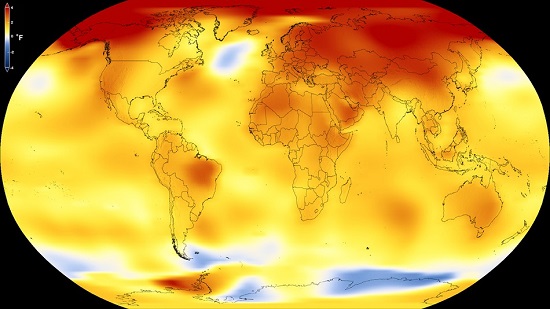 Global warming and other factors (such as pollution and
acidification of the oceans) are leading to very rapid climate change. The NASA graphic at
the right shows the changes in average temperatures during the period 2013-2017 as compared
to the baseline period of 1951-1980. Note that almost all parts of the globe have become
notably warmer during this period, and especially the arctic regions. “The 20 warmest years
on record have all come in the past 22 years.” [NY Times, March 16,
2019.]
Global warming and other factors (such as pollution and
acidification of the oceans) are leading to very rapid climate change. The NASA graphic at
the right shows the changes in average temperatures during the period 2013-2017 as compared
to the baseline period of 1951-1980. Note that almost all parts of the globe have become
notably warmer during this period, and especially the arctic regions. “The 20 warmest years
on record have all come in the past 22 years.” [NY Times, March 16,
2019.]
Climate change is one of the many severe
and ever worsening consequences of the indifference of the capitalist ruling classes to the
welfare of the people of the world and to the state of the world itself. Tremendous
disruptions to the production of food are occurring, whole regions are suffering as deserts
spread, and a worldwide major extinction
episode is occurring for large numbers of animals and plants. Even if humanity survives the
capitalist era (by no means a given, in light of the growing possibility of inter-imperialist
nuclear war), it may take a century or more to completely clean up the environmental mess
that capitalism has left behind.
We should also note that while the term
‘climate change’ is still widespread, in April 2021 Scientific American magazine announced
that henceforth it would instead be using the term ‘climate emergency’, thus joining a growing
trend.
See also below, and:
DROUGHT,
EXTREME WEATHER EVENT,
HEAT—Excessive,
SMOKE,
SUNLIGHT
CLIMATE CHANGE DENIAL
The anti-scientific claims that climate change, including global warming, either is not
occurring at all—despite a mountain of evidence that it is—or else that human activity (and
especially capitalism!) has nothing to do with whatever actual changes are occurring—thus
letting the capitalist corporations and their governments off the hook.
The bourgeoisie and its ideologists have a
very long history of denying facts which condemn their profit-seeking obsession regardless
of its consequences, and their mismanagement of society and nature. The tobacco industry
denied the bad affects of tobacco on people’s health for most of a century or so, while
growing millions died of cancer, heart disease and other ill effects. But the case of climate
change denial is even more serious and likely even deadlier to millions of people around the
globe. This is in part because the worst damage and disasters have not yet come about—though
it is virtually inevitable at this point that they will.
In the U.S., liberals and Democrats like to
pretend that it is only the Republicans who hold such anti-scientific views, and generally
try to at least ignore the central role of capitalism and capitalist ideology in this
determined denialism. This merely shows that they are also participating in this climate
change denialism, even if in a more subtle and hidden way. It is like condemning smoking
but avoiding all criticism of tobacco companies!
“The latest official report by America’s preeminent climate scientists
warns that unless there are ‘substantial and sustained’ efforts to reduce greenhouse gas
emissions, climate change could eventually cost the country ‘hundreds of billions’ of
dollars per year. That stark warning issued by the National Climate Assessment was
immediately dismissed by President Donald Trump. The report, issued every four years,
states that climate change is already affecting the natural environment, agriculture,
energy production and use, transportation and human health across the country. But with
an administration that supports the fossil-fuel industry and is openly hostile toward
efforts to curb greenhouse emissions, many scientists say they now feel any official
U.S. action to address climate change is likely to come far too late to avoid a climate
catastrophe.” —Steve Newman, “Earthweek: a diary of the planet”, for the week ending
Nov. 30, 2018; San Francisco Chronicle, Dec. 2, 2018, p. B12.
CLIMATE CHANGE — and Human Extinction
Climate change from greenhouse gas emissions leading to global warming, is a very serious
problem for humanity, but it is only one of a great many very serious problems resulting from
capitalism, and not even the worst of them. Contrary to the wild claims of some radical liberals,
there is no good reason for thinking that climate change by itself will lead to the extinction
of humanity! No scientific study of the problem has ever concluded such a thing. Yes, it will
likely eventually lead to the deaths of millions of people, and has already led to the deaths of
many. But so have many other effects of capitalism. Air pollution,
for example (the particle emission portions of which are not normally considered part of climate
change) already kills millions of people around the world each year. The same is true of mass
starvation, on-the-job fatal accidents, the absence of adequate health care, and so many other
problems of capitalism. So yes, climate change is a very serious problem, and a major crime by
the capitalists against humanity. But as bad as climate change is, there are even worse
crimes that the capitalists are already committing or are capable of—one of which might indeed
lead to the extinction of our species. This capitalist-imperialist system has already led to
two major world wars over the past century or so, and if a third such war should now come
about—almost certainly involving vast numbers of nuclear weapons and/or equally horrendous new
chemical and biological weapons—it is indeed now quite possible that human beings will not
survive it.
Some of those quite reasonably alarmed by global
warming and climate change, and especially the activists with
petty-bourgeois origins, still do not have any full
appreciation for the much larger problem that humanity faces at the present time. Instead of any
hysterical focus on one single problem arising from capitalism, we must develop a much deeper
understanding of how the whole capitalist-imperialist system is an extreme danger to us, and how
it simply must be overthrown if humanity is to have a future.
CLIMATE CHANGE HYPOCRISY
In recent years there have been a number of conferences, discussions, proclamations, and other
promises and pretenses of remedial action, on the part of bourgeois politicians and big shots
around the world, with regard to the climate change problem. So far nothing even remotely
effective has actually been done about the problem by capitalist governments.
“[In the fall of 2021, the billionaire] Jeff Bezos, Prince Albert of
Monaco, and an estimated 400 luminaries flew into the COP26 climate summit in Glasgow in
private jets, spewing out millions of pounds of carbon dioxide.” —The Week magazine,
Nov. 12, 2021, p. 6.
“CLOPENING”
“Workers at major corporations in America recently came up with a new verb:
clopening. That’s when an employee works late one night to close the store or
café and then returns a few hours later, before dawn, to open it. Having the same
employee closing and opening, or clopening, often makes logistical sense for a company. But
it leads to sleep-deprived workers and crazy schedules.
“Wildly irregular schedules are
becoming increasingly common, and they especially affect low-wage workers at companies like
Starbucks, McDonald’s, and Walmart. A lack of notice compounds the problem. Many employees
find out only a day or two in advance that they’ll have to work a Wednesday-night shift or
handle rush hour on Friday. It throws their lives into chaos and wreaks havoc on child care
plans. Meals are catch as catch can, as is sleep.” —Cathy O’Neil, Weapons of Math
Destruction (2017), pp. 123-4.
CLOTHES / CLOTHING
“Roughly a third of clothing purchases in the United States in the past year
were secondhand—an increase from previous years—in large part because consumers are looking
to save money, according to a recent report by Capital One [bank].” —New York
Times, “Learning How to Sew Has Become Cool Again”, Sept. 14, 2025. [Note that the NYT
says more and more people are buying used clothing “to save money”; we would more frankly say
that they are buying used clothing because they can no longer afford new clothes!
—Ed.]
“With most apparel manufacturing having been exported overseas, only 2
percent of the clothing Americans buy is manufactured domestically.” —New York
Times, “Game Changer: ‘Made in the U.S.’”, May 1, 2025.
CLOUD COMPUTING
Computing done, mostly by corporations ranging in size from very small to very large, on an
off-site network of computer systems which is accessed through the Internet. The advent of
cloud computing is leading more and more companies to drastically reduce or totally eliminate
their own data processing divisions, and instead to hire the computing services of cloud
computing providers. This form of business computing, which is especially focused on building,
maintaining and accessing huge data bases of information, started before 2009 but began a very
rapid expansion around 2014 which is still continuing. During this early period of cloud
computing the service cost for corporations has declined rapidly. One of the biggest companies
providing cloud computing, and a pioneer in the field, is Amazon Web Services (a division of
Amazon Corporation). Two other very large cloud hosting companies are Microsoft Azure and
Google’s Google Cloud Platform. An important result of the cloud computing boom—and the main
reason that corporations are shifting into cloud computing—is that it allows the rapid
disappearance of a great many data processing jobs at individual corporations.
“In 2010, an estimated 79 percent of data center computing was done in
traditional computer centers. By 2018, 89 percent of data center computing took place in
cloud data centers.” —New York Times, “The Internet Is Eating Up Less Energy
Than Expected”, June 26, 2021.
CLUSTER BOMB
A bomb designed to kill as many individuals as possible by scattering around indiscriminately
many submunitions which then explode, sending shrapnel in all directions. It frequently
happens that some of these submunitions do not explode immediately (often purposely so), and
go off when people come by later—usually civilians.
Because so many civilians have been killed by
these weapons, an international treaty known as the Convention on Cluster Munitions which bans
them has been signed by 119 countries (as of 2017), but not by the United States, which
is by far the biggest user of these vicious weapons. In 2008, however, the U.S. did pretend to
adopt a policy of not using cluster bombs anymore. But in 2009 44 civilians in Yemen were
killed by cluster bombs delivered by a U.S. cruise missile, and for a while the U.S. did stop
using them, apparently. However, in November 2017 the Pentagon reversed this policy again,
and announced it would resume the use of cluster bombs.
Approximately 270 million submunitions from
cluster bombs were dropped by the U.S. on Laos alone during the Vietnam War, and about 80
million remain unexploded. Peasant farmers there continue to be killed by them frequently. An
estimated 20,000 civilians have been killed or maimed by unexploded ordnance since the end of
the Vietnam War. And this is just one more of the great many ways in which U.S. imperialism
continues to be the terrible, murderous enemy of the people of the world. [The
information here is taken from a brief article by Gunar Olsen in the Nation magazine,
Jan. 1/8, 2018, p. 4.]
CM
An abbreviation used in India for “Chief Minister”, the prime minister heading a state in
India, who performs a function similar to that of the governor of an American state.
CMAS
See: CHASI MULIA ADIVASI SANGHA
CMEA
See: COUNCIL FOR MUTUAL ECONOMIC AID
Dictionary Home Page and Letter Index
MASSLINE.ORG Home Page