GLEICHSCHALTUNG [Pronounced: ˈɡlaɪçʃaltʊŋ, or (roughly) glike-shawl-toong]
1. A term which originated in Nazi Germany and referred
to the process of the complete Nazification of the economy, politics, media, education, culture and the
entire German society. Anything in any way opposed to Hitler and Nazism was systematically eliminated in
all spheres through a combination of new laws and violence. So the word means something along the lines of
the coordination, systematization, synchronization, or unification of everything to come into full
agreement with Nazi ideas and policies. This full control was achieved through a combination of new laws,
government police forces, and organized Nazi party violence, that dissolved opposing groups, removed
individuals from power, and enforced participation in Nazi-controlled organizations.
[Origin:] The word itself is a compound formed from
“gleich” (same) and “schaltung” (circuit). It apparently derives from an electrical engineering term where
all switches are connected to the same circuit, allowing them to be activated by a single master switch.
2. [In America starting in 2025:] The current attempted
application of this same sort of systematization, domination and total unification of all ideas and policies
to now come into alignment and total agreement with the new authoritarian ideas and policies of Donald Trump,
starting with the beginning of his second term as President in January 2025. Many opponents of Trump and
his fascist-like program have recognized that what he and his movement are up to now is very much along the
lines of the Gleichschaltung as it began in Germany under Hitler in 1933, and is focused on the
complete elimination of any expression or act of disagreement or opposition by anybody.
“[Regimes of the fascist genus], once they have gained control of the executive
branch of the state, whether by election or coup, do not rule simply through raw power, but cling
to some notion of legal order as the basis of their rule, claiming to conform to a constitutional
order. What would normally be considered extralegal coercion is justified in terms of various
‘states of exception’ such as the declaration of a ‘national emergency’ or martial law, along with
the introduction of a leadership principle enhancing executive authority, allowing the usual
constitutional barriers to be crossed. This process, however, requires the support or acquiescence
of the larger society. Hence, consolidation of such regimes is not the work of a day. Full dominance
can only be achieved through a lengthy process that in Nazi Germany was known as Gleichschaltung,
meaning synchronization or falling into line, whereby the entire state apparatus and the larger
cultural apparatus are brought step by step under the regimes control.
“In the destruction of the liberal democratic state,
a fascist or neofascist movement needs to gain control of the executive, legislative, and judicial
branches; the administrative state or civil service bureaucracy; the military and national security
system; and, below the national or federal level, regional and local governments. However,
Gleichschaltung does not stop with the conquest of the state apparatus but necessarily extends
to the entire cultural apparatus of society, including the media, the educational system as a whole
(both public and private), the wider legal sphere (lawyers and law schools), trade unions, the
sciences, and the arts—eliminating all areas of critical thought and potential opposition.
“In Nazi Germany, Gleichschaltung began with
the introduction of the Law for the Restoration of the Professional Civil Service in April 1933,
shortly after Adolf Hitler’s rise to power. This law allowed for the firing of all ‘non-Aryans’ or
Jews and all political opponents (principally Communists and socialists more generally from the civil
service, including judges, professors, art museum directors, teachers, musicians, and conductors—and
immediately extended to the practice of the professions in general, for example, lawyers and notaries.
The aim was to gain complete control over civil society—all the way to the creative arts. In the
words of Hitler in Mein Kampf, ‘The purification of our civilization must include almost every
field. Theatre, art, literature, cinema, press, posters, and displays must be cleansed of exhibitions
of a world in the process of putrefication, and be put in the service of a moral idea, a principle of
State and civilization’ (Adolf Hitler quoted in Jean-Michael Palmier, Weimar in Exile: Antifascist
Emigration in Europe and America [London: Verso, 2017], 23).
“Gleichschaltung in Germany was carried out
mainly in the first two years of the Nazi regime. An example in the universities can be seen in the
appointment of the philosopher Martin Heidegger, the official Nazi choice, as rector of the University
of Freiburg in April 1933—at the same time as the passage of the Law for the Restoration of the
Professional Civil Service. Heidegger introduced the Nazi salute at Freiberg, and denounced
intellectuals he disliked to the Gestapo as friends of the Jews, leading to their removal. In his
inaugural address as rector, he presented the Führerprinzip (Führer principle),
promoted by the Nazi jurist Carl Schmitt, according to which, in Heidegger’s words, ‘The Führer
himself and he alone is the German reality, present and future, and its law’ (Karl Dietrich Bracher,
‘Stages of Totalitarian “Integration” [Gleichschaltung]: The Consolidation of National
Socialist Rule in 1933 and 1934,’ in Republic to Reich ed. Hajo Holborn [New York: Vintage,
1972], [and other sources]...”
—“Notes from the Editors” [John Bellamy Foster],
Monthly Review, Vol. 77, No. 2, June 2025, inside covers. [Foster includes further material
here about how Gleichschaltung worked in early Nazi Germany.]
GLOBAL DEBT
Capitalism can only function through the continual expansion of debt: consumer debt, business debt,
and government debt. The most basic reason for this is that those who actually produce wealth (the
working class) are only paid in wages for a fraction of the wealth they produce, and therefore—as
consumers—can only buy back all that they produce by going ever deeper into debt. Growing business
and government debt, though not quite as logically necessary, also become indispensable in practice
to a great degree. (See: Keynesian Deficits). Consequently,
in the entire capitalist world, and in between the catastrophic financial collapses during major
capitalist overproduction crises, debt must continue to
grow, and to grow at a generally ever increasing pace.
In major countries this expansion of debt becomes
enormous. And on a world scale it eventually becomes truly colossal! According to the Institute of
International Finance, based in Washington, D.C., global debt reached $246.5 trillion in
the first half of 2019. This is 318 percent of the world’s annual GDP. This comes to $32,500 for
every man, woman and child on earth! Of this grand total, the collective debt of the advanced
capitalist countries is $177 trillion, and the debt of the “developing nations” is about $69
trillion. These amounts are very near to the limit that is possible even under the wild debt growth
typical of (and necessary to) capitalism. It strongly suggests that a new world financial crisis is
very near, and one leading to a new world capitalist depression.
[After citing the global debt figures mentioned above, the economist Alexander
Losev continues:]
“However, despite the unprecedented growth
of world debt in the past ten years after the 2008 crisis, investment activity in the real
economy is declining, growth in the world economy and international trade is slowing and the
risk of a global recession is on the rise. The accumulated aggregate debt is becoming a real
threat to the stability of the global financial system.
“Credit financing has become the main, if
not the only means of maintaining global consumer demand and a major impetus for the growth of
stock markets and economic advance in general. The post-industrial model with a high level of
automation and the transfer of production to countries with cheap labor and [the transfer of]
profit centers to tax havens has led to a sharp decline in the share of human labor in the end
product. Now owners of capital and means of production share much less with their workers and
states. [I.e., much less of the total value added by production now goes to wages and taxes.
—Ed.] Under the circumstances, governments must continuously increase their national debt to
finance budget deficits, while the population has to take out loans to maintain existing living
standards because of falling revenues.
“Another problem is that now global debt
is growing faster than the world economy, and each new percent of economic growth is matched
by an additional increase in the aggregate debt by 1.5 to 2 percent. Deceleration of credit
financing for various reasons, including a decline in economic activity due to trade wars, a
shortage of liquidity and/or interest rate increases could instantly lead to the stagnation
of the world economy. It is only the incredibly soft money-and-credit policy of the world’s
major central banks that is keeping the entire economic and financial system afloat at this
point.
“The International Monetary Fund (IMF)
noted that corporate debt-at-risk could rise to $19 trillion. In its half yearly report on
the condition of world financial markets, the IMF warned that it will be impossible to
service almost 40 percent of the corporate debt in the eight leading countries—the United
States, China, Japan, Germany, Great Britain, France, Italy and Spain. The IMF notes that
adaptive money-and-credit stimulation by central banks has helped companies accept financial
risk, which led to ‘alarming’ debt levels with low loan quality.
“It will be impossible to continue to
expand loan capacity....
“The unprecedented debt load of major
economies, like the United States, China and the EU is fraught with a disastrous threat for
the entire world. This could lead to a disaster that will by far exceed the Great Depression
if deleverage starts. In effect, this happens when a credit bubble bursts. A deleverage could
happen not because banks will run out of money for new loans but because borrowers may not
have an opportunity to refinance debt and redeem loans. As the 2007-2008 America mortgage
crisis showed, defaults totaling $1.3 trillion could trigger a domino effect with mass-scale
bankruptcies and blowout sales of collateral that’s rapidly losing its value.
“Since the global debt has reached $246.5
trillion, neither governments nor central banks will have enough resources to repurchase
liabilities and write off debt as they did during the 2008 crisis when they helped banks,
pension and investment funds, companies and individuals that were rapidly losing assets. In
addition, considering that the market for currency and loan derivatives exceeds $600 trillion
(about $545 trillion in the United States alone), it’s clear that there are several ticking
bombs.
“It is only a matter of time before a
disastrous crisis makes the Great Depression of the 1930s and the 2008 recession seem mild.”
—Alexander Losev, “Is There a Threat of
a New Global Economic Crisis?”, speaking at the Valdai Club (a Russian ruling class discussion
group), Nov. 14, 2019, online at:
http://www.valdaiclub.com/a/highlights/is-there-a-threat-of-a-new-global-economic-crisis/#
GLOBAL FINANCIAL MARKETS
“After the fall of Lehman Brothers 10 years ago, there was a public debate
about how the leading American banks had grown ‘too big to fail.’ But that debate overlooked
the larger story about how the global markets where stocks, bonds and other financial assets
are traded had grown worrisomely large.
“By the eve of the 2008 crisis, global
financial markets dwarfed the global economy. Those markets had tripled over the previous
three decades to 347 percent of the world’s gross economic output, driven up by easy money
pouring out of central banks. That is one major reason that the ripple effects of Lehman’s
fall were large enough to cause the worst downturn since the Great Depression.
“Today the markets are even larger,
having grown to 360 percent of global gross domestic product, a record high. And financial
authorities—trained to focus more on how markets respond to economic risk than on the risks
that markets pose to the economy—have been inadvertently fueling this new threat....
“To have any chance of anticipating
and preventing the next downturn, regulators must look for the threats that have emerged
since 2008. They need to recognize that the markets now play an outsized role in the
economy, and their attempts to micromanage this vast sea of money have only pushed the
risks away from big American banks and toward new lenders outside the banking system,
particularly in the United States and China.
“Markets have grown so large in part
because every time they stumbled, central bankers rescued them with easy money. When markets
rose sharply—as they have in recent years—the authorities stood by, saying they are not
in the business of popping bubbles. Now, the markets are so large it is hard to see how
policymakers can lower the risks they pose without precipitating a sharp decline that is
bound to damage the economy. It’s a familiar problem: Like the big banks in 2008, the global
markets have grown ‘too big to fail.’” —Ruchir Sharma, the Chief Global Strategist of Morgan
Stanley Investments Management (a giant Wall Street firm), “Sowing the Next Downturn”,
New York Times, Sept. 19, 2018, p. A-19.
GLOBAL POSITIONING SYTEM
A satellite-based system which allows anyone on the ground, anywhere in the world, to determine their
exact location within a few meters. The person (or equipment) on the ground receives signals from
multiple satellites and the software in their cell phone (or other device) can calculate their position
from that information and in accordance with the laws of physics (including the speed of light and
even relativistic effects).
“The ideas behind GPS took several decades and many billions of dollars to
develop. No surprise, then, that it was a project of the American military as a way to keep track
of their most important assets around the globe. Only an institution like that could realistically
have afforded or justified building it.
“The technology became available to civilians
in 1983 after a South Korean passenger jet inadvertently strayed into prohibited Soviet airspace
and was shot down, killing all 269 passengers on board. The American government realised that if
positioning technology had been available to the pilot of the airliner, the tragedy might have been
averted.
“Modern military satellites can do much more
than find your location. By bouncing radio waves off the surface of the Earth, some systems can
build up extremely detailed pictures of what is going on there—some are reportedly even capable of
detecting enemy submarines by measuring the tiny disturbances left by their wakes in the curvature
of the ocean surface. And you are probably by now familiar with the high-resolution pictures and
video that satellites record for reconnaissance or to guide missiles.
“Until now, most of these technologies have
remained within armed forces or wrapped up in secretive intelligence agencies. A big part of that
has been down to cost—building a satellite and launching it into space are eye-wateringly
expensive.
“That has been changing in recent years. A new
generation of small satellites that can be built and launched cheaply are bringing to civilians
capabilities that were once the preserve of governments alone.
—The Economist: Simply Science email
report, March 17, 2021.
GLOBAL WARMING
The rise in the average surface temperature of the Earth due to the emission of certain
gases into the atmosphere which cause it to more efficiently trap the radiant energy from
the sun, leading to a result similar to what occurs in a greenhouse. The most important such
gas is carbon dioxide, much of which is now being released into the atmosphere by humans
burning fossil fuels such as coal and petroleum. Carbon dioxide accounts for about two-thirds
of the increasing global warming. About one-third of that warming is caused by the release
of methane, most of which escapes from oil wells.
See also:
CLIMATE CHANGE,
FLOODS,
HEAT—Excessive,
“HOTHOUSE” EARTH,
POTATOES [Cooking in ground],
SUNLIGHT
“The climate system could jump abruptly from one state to another with
devastating effects.” —Wally Broecker, 1984. [Broecker, who died in 2019, was one of
America’s leading climate scientists and is sometimes referred to as “the grandfather of
climate science.” His early recognition here that there might well be qualitative leaps
in the situation, rather than merely slow gradual change, was especially prescient. —Ed.]
“The seven warmest years in the history of accurate worldwide record-keeping
have been the last seven years, and 19 of the 20 warmest years have occurred since 2000.”
—New York Times, “Canadians Wilt as Heat Breaks National Record, with No Letup for
Days”, June 29, 2021.
“A new U.N. report warns that global warming is now on track to exceed 3
degrees Celsius (5.4 F) by the end of the century and that only a ‘quantum leap in ambition’
to curb greenhouse gas emissions can avert a planetary climate catastrophe.
“Global emissions rose by 1.3% between
2022 and 2023, reaching a new high of 57.1 gigatons of carbon dioxide equivalent, the report
said. It adds that most nations are not taking steps needed to achieve their long-term
net-zero pledges, meaning the planet will continue to suffer unbridled warming.
“‘We’re teetering on a planetary tight
rope,’ U.N. Secretary-General António Guterres said in a speech on Oct. 24. ‘Either
leaders bridge the emissions gap, or we plunge headlong into climate disaster.’”
—Steve Newman, “EarthWeek”, San Francisco Chronicle, Nov. 3, 2024.
“Global warming has accelerated sharply over the past decade, with Earth
now heating at roughly 0.65 degree Fahrenheit per decade—about twice the rate observed
before 2014, according to a new analysis of temperature records.
“Researchers at Germany’s Potsdam
Institute found the acceleration after they filtered out natural influences such as El
Niño, volcanic eruptions and solar cycles, indicating that the trend is largely
driven by human-caused climate change.
“The findings suggest that
temperature increases once expected decades in the future may occur much sooner, leaving
communities less time to prepare and adapt.” —Steve Newman, “EarthWeek”, San
Francisco Chronicle, March 15, 2026.
GLOBALIZATION [Economics]
‘Globalization’ is a much ballyhooed term in recent decades, but with capitalist roots
that go back for centuries. There are a variety of meanings which the term can have or
include, such as:
• The fairly rapid expansion
of capitalism from its earliest centers of development in a few countries to almost all
other countries and to virtually every corner of the world;
• The tendency toward the
development of a single world market, where commodities from one country can be sold in
other countries and where a more or less uniform world market price develops for
commodities (allowing, however, for differing transportation costs, tariffs added,
etc.);
• Reflecting this, the
great expansion of world trade, and also the growing importance of the export of
capital;
• The international
integration of production of many of the more complicated products, wherein more and
more products include components from many other countries; and
• The formation of
international cartels, transnational corporations (TNCs) or
multinational corporations (MNCs), and a tendency toward
oligopoly even internationally (though much less thoroughly
so than within individual major capitalist countries).
[More to be added... ]
See also sub-topics below, and
LOGISTICS REVOLUTION,
ULTRA-IMPERIALISM
“The need of a constantly expanding market for its products chases
the bourgeoisie over the whole surface of the globe. It must nestle everywhere,
settle everywhere, establish connections everywhere.
“The bourgeoisie has through
its exploitation of the world market given a cosmopolitan character to production
and consumption in every country. To the great chagrin of Reactionists, it has
drawn from under the feet of industry the national ground on which it stood. All
old-established national industries have been destroyed or are daily being
destroyed. They are dislodged by new industries, whose introduction becomes a life
and death question for all civilized nations, by industries that no longer work up
indigenous raw material, but raw material drawn from the remotest zones; industries
whose products are consumed, not only at home, but in every quarter of the globe.
In place of the old wants, satisfied by the production of the country, we find new
wants, requiring for their satisfaction the products of distant lands and climes.
In place of the old local and national seclusion and self-sufficiency, we have
intercourse in every direction, universal inter-dependence of nations. And as in
material, so also in intellectual production. The intellectual creations of
individual nations become common property. National one-sidedness and
narrow-mindedness become more and more impossible, and from the numerous national
and local literatures, there arises a world literature.
“The bourgeoisie, by the
rapid improvement of all instruments of production, by the immensely facilitated
means of communication, draws all, even the most barbarian, nations into civilization.
The cheap prices of its commodities are the heavy artillery with which it batters
down all Chinese walls, with which it forces the barbarians’ intensely obstinate
hatred of foreigners to capitulate. It compels all nations, on pain of extinction,
to adopt the bourgeois mode of production; it compels them to introduce what it
calls civilization into their midst, i.e., to become bourgeois themselves. In one
word, it creates a world after its own image.” —Marx & Engels, Manifesto of the
Communist Party, Ch. I: MECW 6:487-8.
GLOBALIZATION — Exaggeration Of
Although the degree of the globalization of capital in the imperialist era is considerable,
and of considerable importance both economically and politically, there have been
tendencies at various times to overstate or exaggerate its extent and to
forget that the basic situation in modern capitalism is still separate imperialist states
ruled by competing bourgeoisies, and with economies which are still in important ways
largely independent of each other.
The first thing to note is that the
degree of globalization of capitalism varies from one period to another, and not always by
increasing. There have been two main periods of greatly expanding globalization in
the history of capitalist imperialism, and both have occurred towards the end of what were
overall long periods of development leading up to periods of crisis. The first period of
the major expansion of globalization was the couple decades leading up to World War I.
But not only did that war strongly interrupt and to a considerable degree reverse
that strong globalization trend, but perhaps just as much so did the
Great Depression of the 1930s that followed a
decade after World War I. During this period capitalist economies seriously weakened,
tariffs increased, and world trade and other aspects of globalization (such as the export
of capital) actually declined until the end of the Second World War.
After World War II a gradual expansion
of world trade began again, along with the new huge spurt in the export of capital from
the U.S. and later on also from the other major economies (including Britain, Japan and
Germany). But especially from the 1980s on the expansion of all the various aspects of
globalization picked up greater speed and strength. This was the second major period of
expanding globalization.
Although some theorists, especially those
representing the bourgeoisie, began to view this as a “permanent” new feature of world
capitalism, there is already important evidence that a new decline in many aspects of
globalization has been developing. The first serious jolt occurred with the world
financial crisis in 2008-9 and the first decline in world trade in decades. But there are
also other indications (as mentioned in the quotation below), and all this will become a
much more serious weakening of globalization as the world overproduction crisis continues
to develop toward a new intractable depression.
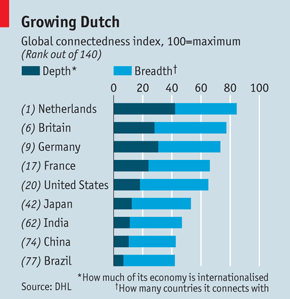
“Globalization Going Backwards: The world is less connected than
it was in 2007.
“How integrated countries are
with the rest of the world varies more than you might expect. And the world is less
integrated in 2012 than it was back in 2007. These are the conclusions of the latest
DHL Global Connectedness Index, which found that the Netherlands is the most
globalized of 140 countries (see chart)....
“The index measures both the
depth of a country’s connectedness (i.e., how much of its economy is internationalized)
and its breadth (how many countries it connects with). The economic crisis of 2008
made connections both shallower and narrower. The depth measure has rebounded since
2009, and is now 10% higher than it was in 2005—though it remains below what it was
in 2007. But the breadth of connectedness has continued to slip, and is now 4% lower
than in 2005.
“At first, as the economic
crisis took hold, both trade and capital flows became less globalized, but since
2009 trade has bounced back whereas capital flows have continued to become less
globalized, says DHL. This seems to reflect a fall in the number of places into
which companies from any given country are willing to put their foreign direct
investment.
“... Mr. [Pankaj] Ghemawat
[of the IESE Business School, who oversees the index] conducts surveys of popular
views of globalization. He finds that people consistently assume that the world is
much more interconnected than it really is.” —The Economist, Dec. 22, 2012,
p. 105.
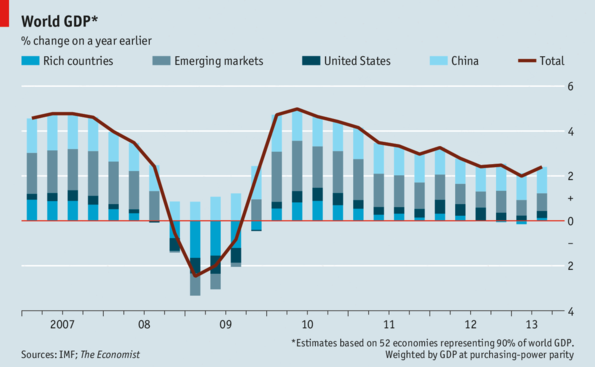 The total Gross Domestic Product (GDP) for all the countries of the world,
for a given year. The Global GDP for 2008 was $61.3 trillion. However, in 2009 the global
GDP dropped for the first time in decades, by 2.4% in real terms, to just $58.2 trillion. It
then expanded again in succeeding years.
The total Gross Domestic Product (GDP) for all the countries of the world,
for a given year. The Global GDP for 2008 was $61.3 trillion. However, in 2009 the global
GDP dropped for the first time in decades, by 2.4% in real terms, to just $58.2 trillion. It
then expanded again in succeeding years.