PUBLIC HEALTH — In China
See also:
BAREFOOT DOCTORS
“Tell the Ministry of Public Health that it only works for fifteen
per cent of the total population of the country and that this fifteen per cent is
mainly composed of gentlemen, while the broad masses of the peasants do not get any
medical treatment. First they don’t have any doctors; second they don’t have any
medicine. The Ministry of Public Health is not a Ministry of Public Health for the
people, so why not change its name to the Ministry of Urban Health, the Ministry of
Gentlemen’s Health, or even to Ministry of Urban Gentlemen’s Health?...
“They work divorced from the
masses, using a great deal of manpower and materials in the study of rare, profound
and difficult diseases at the so-called pinnacle of science, yet they either ignore
or make little effort to study how to prevent and improve the treatment of commonly
seen, frequently occurring and widespread diseases. I am not saying that we should
ignore the advanced problems, but only a small quantity of manpower and material
should be expended on them, while a great deal of manpower and material should be
spent on the problems to which the masses most need solutions....
“In medical and health work put
the emphasis on the countryside!”
—Mao, “Directive on Public
Health” (June 26, 1965), SW 9:216-217. [It was the widespread trends of this sort,
with the government forgetting who it existed to serve, that made it clear that a
cultural revolution was indeed urgently required in China! —Ed.]
PUBLIC HEALTH — In the U.S.
The administration and functioning of the public health system in the United States has always
been poor and very inadequate. The reason is obvious: the capitalist ruling class just doesn’t
care very much about the health of the working class and masses, as long as their diseases don’t
interfere with their rulers’ economic production and profits, or get out of hand and spread to
the ruling class itself!
Of course the bourgeoisie does care about their
own health, and that of their families, so using part of the enormous wealth they extract from
the workers (both at home and abroad) they built up a rather impressive medical science
development system in this richest of all capitalist countries. That system has in fact led the
world for decades since World War II in the development of new medicines and new treatments for
a wide range of diseases and conditions. However, these medical advances were only made available
to the masses at incredibly exorbitant prices, which include huge profits for pharmaceutical
companies and health insurance corporations.
But actual public health programs, especially
those focused on preventative measures to benefit the broad masses of the people, have languished
all along. Now, as capitalist America sinks more and more into economic and social crisis, the
public health system has been taking major turns for the worse, and even showing signs of heading
into complete disfunction.
This has been especially obvious with the advent
of the second Trump Administration and the appointment of the anti-vaccine, anti-scientific
ignoramus Robert F. Kennedy Jr., as Secretary of the department of Health and Human Services.
The already declining health of the masses in the United States is now in very serious danger of
major further collapse. —S.H. [September 20, 2025]
“In hindsight, handing the reins of American public health to a ‘wholly
unqualified anti-vaccine nutter’ may have been a mistake, said Rex Huppke in USA Today.
Taking a break from his campaigns to promote the recuperative powers of sunshine, raw milk,
and beef tallow, Health and Human Services Secretary Robert F. Kennedy Jr. announced last week
that he’s canceling 22 contracts, worth a combined $500 million, for research into mRNA
vaccines. First deployed during the [Covid-19] pandemic by Moderna and Pfizer-BioNTech, mRNA
shots instruct the body to produce a fragment of a virus, which then sparks an immune response
within the body. That technology saved millions of lives and could soon yield treatments for
diseases from malaria to type 1 diabetes and cancer. Explaining his decision, Kennedy said
mRNA vaccines are ineffective at preventing upper respiratory infections—never mind that the
Covid shots reduced hospitalizations and death by 70% among immunized adults—and have caused
‘epidemics’ of myocarditis, or inflammation of the heart, a
claim not backed by data. At best,
scrapping mRNA research is a ‘generational setback’ for American science, said Devi Sridhar
in The Guardian. But with avian flu ‘now just one mutation away’ from human-to-human
transmission, Kennedy may have robbed us all of a tool to fight the next pandemic....
“Kennedy has also fired independent
vaccine advisers at the Centers for Disease Control; ordered reviews of childhood vaccines,
which he claims—despite all scientific evidence to the contrary—cause autism; downplayed
the threat of measles; and demanded enhanced clinical trials for all shots. Faced with this
onslaught, vaccine makers are pulling back; Moderna in May nixed its application for a
[combination] Covid-flu shot, ‘citing regulatory difficulties.’
“‘Science itself, in the global sense,
will be fine,’ said Ross Andersen in The Atlantic. But with Kennedy at HHS and the
Trump administration slashing research funding across agencies, we’re likely watching the end
of America’s run as a ‘techno-scientific superpower.’ A recent Nature survey found that
75% of U.S. scientists are thinking of moving their labs overseas. Who can blame them? said
Celine Gounder in The New York Times. The same week RFK Jr. axed mRNA funding, a gunman
who thought the Covid vaccine had caused his health woes shot up CDC headquarters in Atlanta,
killing a police officer. Why would scientists stay in a country where they have ‘targets on
their backs’?”
—“Health: Will Medical Science Survive
RFK Jr.?”, The Week magazine, August 22, 2025, p. 6.
PUBLIC PROPERTY
1. [In capitalist society:] Property which
(supposedly) belongs to the public, rather than to some private individual. In reality, in
bourgeois society, public property is not really owned by the public! It is instead owned by
the ruling bourgeoisie, and managed by them in their own class interests. In some cases it
is to the advantage of the bourgeoisie if the use of the property is made freely available
to the public (as with most roads). In some cases the property is made available to the
public only for fees, which are often substantial, as with certain parks. And in other cases,
so-called “public property” is restricted entirely from public use (as with the vast tracks
of land reserved for military bases and other government operations, or for cheap lease to
private logging companies).
2. [In socialist or communist society:]
Property which truly does belong to the public, and which is managed in the actual people’s
interests either directly by the people themselves or else through their representative
government or agencies.
PUBLIC RELATIONS
 Public relations is the “art” of making bad seem good or wrong seem right. It
is mostly employed by the rich (who can afford to hire professional specialists to do this)
in order to try to hide their misdeeds and crimes against the people, or at least to put a
“positive spin” on them.
Public relations is the “art” of making bad seem good or wrong seem right. It
is mostly employed by the rich (who can afford to hire professional specialists to do this)
in order to try to hide their misdeeds and crimes against the people, or at least to put a
“positive spin” on them.
Since the bourgeoisie owns and controls the
media, most of the time they are at least partially successful in covering up their crimes.
Fortunately, at least once in a while, they are so inept in attempting this that their
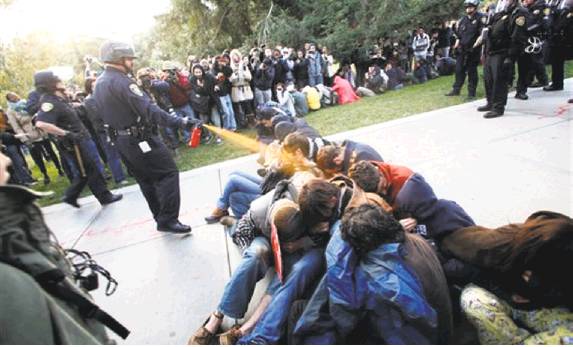
efforts to hide or justify their crimes actually backfire. An example of this is the attempt
by the University of California—Davis to cover up their outrageous police attacks on peaceful
Occupy demonstrations by students in November 2011. (See photo and then quote below.)
“Here’s Rule No. 1 in public relations: If you do something stupid,
don’t do something stupider to try to airbrush it. UC Davis is providing a case study
in what not to do for communications classes everywhere.
“The university spent at least
$175,000 for consultants to try to steer online searches away from the disgraceful
2011 incident in which campus police pepper-sprayed
student protesters, the Sacramento Bee disclosed this week. The intent was to
‘clean up the negative attention’ on the university and its chancellor, Linda Katehi,
according to the proposal from the Maryland firm that was given a $15,000-a-month
contract....
“A Google search offers a less
glowing account. On Thursday, the keywords ‘UC Davis’ popped up links to stories
about this ham-handed cover-up—with the chancellor’s picture. If UC Davis is thinking
about rehiring the reputation consultants to undo this [latest] debacle, we offer
this free advice: Don’t do it.” —Editorial in the San Francisco Chronicle,
April 15, 2016, p. A13.
[Note that this bourgeois
newspaper is not against public relations or “communications”, as it is euphemistically
called in business schools, but only desires that such efforts be less embarrassing to
the ruling class. —Ed.]
PUBLIC TRANSPORTATION
“Over the past 65 years, the United States has spent nearly $10 trillion
in public funds on highways and roads, and just a quarter of that on subways, buses and
passenger rail.” —New York Times, “America Adores the Open Road; Can it Love
Trains and Buses, Too?”, April 3, 2021. [The answer to that article title question is
“no”, even if there is some temporary improvement in expenditure on public transportation
due to efforts to overcome the intensifying weakness of the American economy. Individual
freedom of movement for the rich and comfortable is far more important to the U.S. ruling
class than is the ease of movement for the working class and poor. —Ed.]
PUNCTUATED EQUILIBRIUM
The scientific theory that biological evolution over geologic time does not occur at a constant
rate but rather each lineage is generally characterized by fairly long periods of relative
stasis alternating with shorter periods of much more rapid change including new speciation.
These periods of more rapid change are often caused by external factors such as climate and
environmental changes and by mass extinctions which
open up many new niches.
Sewall Wright, a primary founder of the field
of population genetics, was one early advocate of the idea that evolution is not uniformly
gradual as Darwin seems to have supposed, but rather occurs in periodic relatively sudden bursts.
[See: Judea Pearl & Dana Mackenzie, The Book of Why (2018), p. 73.]
However, Darwinian “gradualism” largely dominated evolutionary science until the theory of
punctuated equilibrium was prominently proposed by Stephen
Jay Gould and Niles Eldridge in 1977. Gould’s father was a Marxist and his son learned about
the Marxist philosophical principle of qualitative leaps
from him. (This is part of the reason that punctuated equilibrium has often been opposed by
reactionaries and anti-Marxists.) But punctuated equilibrium is also based on quite substantial
paleontological evidence and is now generally considered to be a valid and important principle
of evolutionary science.
“But since the early 1980s, methodical paleontological research,
together with much higher resolution isotopic age dating, has shown that the fossil
record is not always so fatally flawed. Many alleged missing links have been found (e.g.,
dinosaur to bird, land mammal to whale), and it has also become clear that evolutionary
rates are simply not constant. Comparatively rapid radiations—periods of
branching and experimentation—have occurred many times in the geologic past, particularly
after episodes of devastating environmental change and mass extinction (e.g., after the
Permian-Triassic debacle and the Cretaceous-Tertiary meteorite impact). So the idea of
punctuated equilibrium has been somewhat grudgingly accepted by the palaeobiological
community.” —Marcia Bjornerud, Reading the Rocks: The Autobiography of the Earth
(2005), p. 161.
PUPPET TROOPS
Nominally independent soldiers raised and controlled by an imperialist country from the
population within the oppressed country it is exploiting. All imperialist powers have
done this when they’ve been able to, so as to put only the foreign population at risk instead
of their own soldiers. During the 1930s and 1940s, for example, the Japanese imperialists
had the slogan of “using Chinese to subdue Chinese”, a policy which included the use of
puppet troops as well as other measures to divide the Chinese people.
During the colonial era, puppet troops were
more easily seen for what they are. But under neocolonialism
the situation is in essence the same. Local military forces under the control of the
comprador bourgeoisie or other agents of foreign imperialism are directed to suppress any
rebellions or revolutions, thus making it easier for the foreign imperialists to maintain
real control.
PURCHASING POWER PARITY
 The traditional way to calculate the income, standard of living, or gross domestic
product (GDP) in a foreign country is to take the values in the local currency and translate
them into dollars via the current official exchange rate. However, this does not take into
consideration the fact that prices may also be lower in that country than in the U.S. (I.e.,
a dollar exchanged for the local currency may buy more actual goods there than a dollar
buys in the U.S.) Thus a different translation of quantities expressed in local currencies
must be made in order to determine the actual equivalent standard of living, GDP, or other
quantity, relative to the situation in the U.S. This is called the translation into a
purchasing power parity value.
The traditional way to calculate the income, standard of living, or gross domestic
product (GDP) in a foreign country is to take the values in the local currency and translate
them into dollars via the current official exchange rate. However, this does not take into
consideration the fact that prices may also be lower in that country than in the U.S. (I.e.,
a dollar exchanged for the local currency may buy more actual goods there than a dollar
buys in the U.S.) Thus a different translation of quantities expressed in local currencies
must be made in order to determine the actual equivalent standard of living, GDP, or other
quantity, relative to the situation in the U.S. This is called the translation into a
purchasing power parity value.
The PPP conversion factor is the
number of units of a country’s currency necessary to buy the same amount of goods and
services in that country as a U.S. dollar would buy in the United States. As noted above,
this is in general not at all the same as the exchange value of that foreign
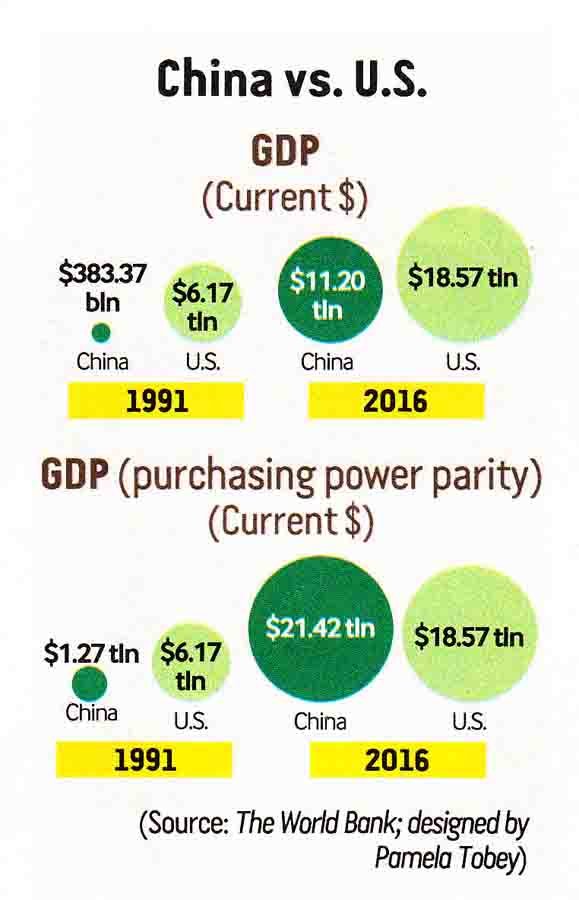
currency. The huge difference between exchange rate comparisons and the much more accurate
PPP comparisons is well illustrated in the graphic at the right, which shows that China’s
GDP in 2016, instead of being smaller than that of the U.S., was actually larger.
See also:
BIG MAC INDEX
PYTHAGORAS (c. 570-c. 495 BCE)
Founder of a mystical religious, philosophical idealist, and
political sect in the Greek city-state of Croton (in what is now Southern Italy). He had many
strange ideas, including the notion that it was wicked to eat beans. Pythagoras was also very
mystical about numbers. His numerological system identified the number four with justice, and
he thought that the number ten was the “most perfect number” (in part because the numbers 1
through 4 add up to 10). He is said to have proclaimed that “all is number”, after supposedly
being the first to discover that musical notes are related in a simple fashion to the relative
lengths of the vibrating strings that produce them. The Pythagorean Theorem in geometry is also
named after him, though it was known long before his time.
In ancient times Pythagoras was considered a
very wise man and eventually an important philosopher (by the followers of Plato, for example).
But modern scholarship has pretty much shown that this hugely exaggerates his real role in
intellectual history. His followers had the habit of attributing all wisdom, including their
own ideas and discoveries, to Pythagoras, in much the same way that Christians do with Jesus,
and that dogmatists within what should be the revolutionary science of Marxism
occasionally do with Marx, Lenin and Mao.
See also below, and:
Philosophical doggerel about
Pythagoras.
PYTHAGOREANS
Members of the sect founded by Pythagoras (see above), and also his later followers. This
peculiar sect required self-discipline, silence, and the honoring of numerous taboos—especially
the strict avoidance of eating meat and beans. Pythagoras and his followers expanded the concept
of the soul (which had originally only meant the physical breath
that leaves the body when a person dies) into a partially mentalistic concept. However, they
still also identified this “immortal” soul with gases, and seem to have believed that the
eating of beans, which led to farting, allowed part of the soul to prematurely escape the
body! (Religion is a very weird thing!) After a person’s death, however, they believed
the soul could be reincarnated into a new body, or into other animals or plants, or to “rejoin”
the universal “soul”. Politically, the Pythagoreans were a secretive, cultish faction of the
slave-owning aristocracy.
The idealization of mathematics was also an
important part of Pythagorean doctrine. When the followers of Pythagoras discovered that the
square root of 2 is an irrational number (i.e., one which cannot be expressed as a ratio of two
integers), they were so upset that they tried to hide this discovery from the world.
See also:
Philosophical doggerel about
Pythagoras and his followers.
“From the observation of nature, the ancient Babylonians and Egyptians
built up a body of mathematical knowledge which they used in making further observations.
Thales perhaps introduced deductive methods; certainly the mathematics of the early
Pythagoreans was deductive in character. The Pythagoreans and Plato [The Republic,
section VII] noted that the conclusions they reached deductively agreed to a remarkable
extent with the results of observation and inductive inference. Unable to account
otherwise for this agreement, they were led to regard mathematics as the study of the
ultimate, eternal reality, immanent in nature and the universe, rather than as a branch
of logic or a tool of science and technology. An understanding of mathematical principles,
they decided, must precede any valid interpretation of experience. This view is reflected
in the Pythagorean dictum that all is number, and in the assertion attributed to Plato
that God always plays the geometer.” —Carl B. Boyer, The History of the Calculus and
Its Conceptual Development (1949), p. 1.
[This erroneous idealization of
mathematics thus became one of the sources of the more general philosophical
idealism that still so negatively influences human
conceptions of the world. —Ed.]
“[T]he Pythagorean mathematical concepts, abstracted from sense
impressions of nature, were now in turn projected into nature and considered to be the
structural elements of the universe. Thus the Pythagoreans attempted to construct the
whole heaven out of numbers, the stars being units which were material points. Later they
identified the regular geometrical solids, with which they were familiar, with the
different sorts of substances in nature. Geometry was regarded by them as immanent in
nature, and the idealized concepts of geometry appeared to them to be realized in the
material world. This confusion of the abstract and the concrete, of rational conceptions
and empirical description, which was characteristic of the whole Pythagorean school and
of much later thought, will be found to bear significantly on the development of the
concepts of the calculus.” —Carl B. Boyer, ibid., pp. 17-18.
Dictionary Home Page and Letter Index
MASSLINE.ORG Home Page