BACON, Francis (1561-1626)
One of the most prominent early promoters and theorists of the experimental scientific method.
His works The Advancement of Learning (1605) and the Novum Organum (1620) were
highly influential in the development of science.
See also:
Philosophical doggerel about
Bacon.
“The brilliance of Bacon’s reputation has hardly diminished, even to
this day. Though not a creative scientist himself, he is nevertheless considered one of
the crucial figures in the scientific revolution, whose writings made possible the growth
and expansion of science. Bacon provided a brilliant defense of the experimental method,
which had been viewed as suspect during the centuries in which Scholastic dispute and
reliance on ancient authority were considered the proper path to true knowledge. He
provided a road map for the development of experimental science, advocating for the
systematic collection of data by a multitude of field-workers, and its concentration in
a centralized institution for systematic evaluation. More than anything, perhaps, he made
the experimental method respectable.” —Amir Alexander, Infinitesimal (2014),
p. 254.
BADIOU, Alain (1937- )
A very confused and grossly overrated French petty-bourgeois political radical and
idealist (non-materialist) philosopher of sorts, who once
considered himself to be a “Maoist”, and still likes to associate himself with what some of his
admirers call “post-Maoism”.
Badiou was strongly influenced by, and somewhat
further radicalized by, the great student uprising in France in the spring of 1968. In 1970 he
was the founder and leader of the Groupe pour la Fondation de l’Union des Communistes de
France Marxistes Léninistes, more commonly called the UCFML [Union of Communists of
France Marxist-Leninist], one of several nominally Maoist organizations in France in that period.
When the UCFML collapsed in 1985 he and his friends created L’Organisation Politique.
This small group supported immigrant rights and other reforms, but apparently did no actual
work toward social revolution. In any case, Badiou no longer believes that there needs to be,
or should be, a revolutionary political party in order to transform society!
“Up to the end of the 1970s, my friends and I defended the idea that an
emancipatory politics presumed some kind of political party. Today we are developing a
completely different idea, which we call ‘politics without party’.” —Alain Badiou,
Ethics: An Essay on the Understanding of Evil, trans. by Peter Hallward, (Verso,
2001), p. 95. (In the interview appendix.)
Even more absurdly, Badiou now explicitly renounces the class perspective in politics
and ideology, and refuses to even think in terms of the proletariat versus the bourgeoisie!
“The second thing that has changed over these last twenty years concerns
the status of class. For a long time we were faithful to the idea of a class politics, a
class state, and so on. Today we think that political initiatives which present themselves
as representations of a class have given everything they had to give.” —Alain Badiou,
ibid., p. 97.
Badiou’s philosophical views are strongly influenced by Kant,
Althusser’s corruption of Marxism and by Lacanian
psychoanalysis, along with mathematical set theory. (What a mish-mash!) Badiou is sometimes
called an adherent of the “anti-postmodern” strand of Continental Philosophy. However, for the
most part his philosophical ideas are nearly impossible to describe in any intelligible fashion,
since they are almost completely incoherent. But whatever his philosophical views are, exactly,
it is clear that he is not a materialist. One commentator (Johannes Thumfart) argues that
Badiou’s philosophy can be regarded as a contemporary reinterpretation of Platonism.
Badiou’s views on ethics are a blend of Kant,
classless nihilism, and his usual general incoherence. [See my commentary: “Alain Badiou: A
Pseudo-Maoist Obscurantist”, at:
https://www.massline.org/Philosophy/ScottH/BadiouAndEthics.pdf. —S.H.]
Oddly enough, for a person who is obviously not
a Marxist nor even a real revolutionary, Badiou and his views have recently become something of
a fad within radical movements led by intellectuals, not only in North America, but also in
desperately poor and exploited countries like India, the Democratic Republic of the Congo and
South Africa! Even some revolutionary Marxists have been attracted to him, though it only serves
to discredit their own good judgment. Just how much in politics and philosophy can we possibly
have to learn from someone who rejects the class perspective, rejects the need for a revolutionary
party (and apparently also for any actual revolution), and who derives his own ideas mostly from
either bourgeois ideologists directly, or else from revisionist distorters of Marxism?!
See also: “Badiou, St. Paul, and the Mass Line”
at:
https://www.massline.info/Misc/BadiouMassLine.pdf; and
LAZARUS, Sylvain
BAKUNIN, Mikhail (1814-76)
Russian anarchist and determined opponent of Marx. He was born near Moscow of aristocratic
descent. He took part in the German revolutionary movement of 1848-49 and was condemned to death.
In 1855 he was sent to Siberia, but escaped to Japan and then came to England in 1861. In
September 1870 he led an abortive uprising in Lyon.
Bakunin was the most prominent anarchist of his
day and the leader of the anarchist opposition to Marxism within the First
International. At the Hague Congress of the International in 1872 he was outvoted and
expelled. But he and his followers had done major damage to that organization, and it disbanded
a few years later.
“Bakunin joined the revolution at an early age, was imprisoned in Germany
in 1849 and extradited to the tsarist government in 1851. Shortly after, he wrote Tsar
Nicolas I a letter of ‘confession’ in which he expressed his repentance, thus betraying
the revolution. In 1857, he wrote several letters of repentance to Tsar Alexander II
pleading for mercy. In 1861, with official blessing, he effected a ‘miraculous escape’
to Western Europe. There, keeping his apostasy secret, he wormed his way into the workers’
movement and the First International to act as an informer and spy for the tsar. He
assiduously preached anarchism and opposed the theory of the dictatorship of the
proletariat.
“Marx and Engels pointed out that
Bakunin was a ‘traitor to the European proletariat’ and that he and his lieutenants
ought to receive ‘the benevolence of the governments whom they have served so well in
disorganizing the proletarian movement.’ The Great Soviet Encyclopedia which
was published by the Soviet Union in the early 1950s clearly condemns Bakunin as ‘an
ideologist of anarchism’ and ‘a deadly enemy of Marxism.’ It points out that he was guilty
of ‘betraying the fundamental interests of the revolutionary movement’ and ‘in fact
played a treacherous role with regard to the Russian revolutionaries—democrats.’
“Now, this wretch has suddenly
emerged covered with glory in the eyes of the Soviet revisionist renegades who have gone
so far as to openly challenge the judgment of Marx and Engels on him and lavish praise on
him. In Khrushchev's time, they already set about ‘rehabilitating’ Bakunin. They acted in
a more undisguised way after Brezhnev took over. The Great Soviet Encyclopedia
(third edition), published in 1970, actually hails this shameless renegade as a
‘revolutionary.’ Whitewashing his apostasy, it asserts that his betrayal of the revolution
and groveling before the tsar for mercy were ‘tactics designed to get himself free at
any price.’ ....
“Bakunin, a notorious expansionist in
his own right, sang the praise of the great-Russian chauvinism practiced by the old tsars.
During his exile in Siberia in the late 1850s and early 1860s, he showed himself a faithful
servant of the tsar by applauding his policy of aggression against China. In a letter to
A. I. Herzen in 1860, he brazenly acclaimed tsarist Russia’s aggression against China and
lauded to the skies Nikolai Muraviev, then Lieutenant-Governor of Easter Siberia. Under his
pen, this inveterate buccaneer of great-Russian chauvinism and expansionism who seized from
China large tracts of territory south of the Outer Khingan Mountains, became ‘a fine man’
and ‘redeemer of Russia.’ He even hailed tsarist Russia’s piratic act of occupying Chinese
territory as ‘a great patriotic cause.’
“While in exile in Western Europe, he
vociferously advocated pan-Slavism in the interests of the tsar’s expansionist policy in
Europe. In a paper submitted to the tsar, he even urged him to ‘lead’ the pan-Slave
crusade ‘firmly and boldly’ so as to ‘bring good and glory to Russia.’ For this Bakunin
was sharply denounced by Marx and Engels. In their work The Alliance of Socialist
Democracy and the International Workingmen’s Association (1873), Marx and Engels wrote:
‘That is the man [meaning Bakunin] who has styled himself as an internationalist
since 1868, and in 1862 preached a racial war in the interests of the Russian Government.
Pan-Slavism is an invention of the St. Petersburg cabinet and has no other aim than to
extend the European frontiers of Russia to the west and to the south.’ They pointed out
that ‘the pan-Slavism of Nicolas to the pan-Slavism of Bakunin... pursue the one and the
same goal and all of them are in essence perfectly at one with each other.’”
—Excerpts from “Why Do the Soviet
Revisionists Try to Reverse the Verdict on Bakunin?”, Peking Review, #43, Oct. 21,
1977.
BAKUNINISTS
“Followers of Mikhail Bakunin, an anarchist theoretician and implacable
enemy of Marxism and scientific socialism. The Bakuninists conducted a stubborn struggle
against Marxist theory and the Marxist tactics of the working-class movement. The basic
postulate of Bakuninism was the rejection of all forms of [the] state, including that of
the dictatorship of the proletariat. The Bakuninists did not understand the historic role
of the proletariat. Bakunin propounded the idea of class ‘levelling’, the alliance of
free associations’ from below. A secret revolutionary society consisting of ‘outstanding
people’ would lead popular revolts that were to begin immediately. In Russia, for example,
the Bakuninists assumed that the peasantry were ready to start an immediate revolt. Their
tactics of conspiracy, immediate revolts and terrorist acts was sheer gambling and was
contrary to the Marxist theory of insurrection. Bakuninism was one of the sources from
which the Narodniks drew their ideology.” —Note 9 in Lenin,
Selected Works, vol. I (Moscow: 1967).
For further information about Bakunin and his followers see: Marx & Engels, “The Alliance
of Socialist Democracy and the Working Men’s International Association” (1873); Engels, “The
Bakuninists at Work” (1873) [online at:
http://www.marxists.org/archive/marx/works/1873/bakunin/index.htm ]; Engels,
“Emigré Literature” (1875); and Lenin, “On the
Provisional Revolutionary Government” (LCW 8:461-81), [online at:
http://www.marxists.org/archive/lenin/works/1905/prg/article2.htm#v08fl62-474 ]
BALANCES — In Socialist Economic Planning
A socialist economic plan consists, in part, of a large input-output matrix (or table), which—for a
number of key commodities—lists all the planned sources of supply for that commodity (or commodity
category) in one column and all the planned amount of usage of that commodity in another column. Of
course the planned supply must equal the planned usage for that commodity. In other words, for each
basic commodity, the two columns must “balance”. Thus one such commodity might be steel, and the
production of steel in all the mills (plus whatever amount is imported) must equal the planned usage
of steel (plus whatever amount is to be exported).
But of course there are different alloys of steel
used for different purposes, and a vast array of different sorts of steel products, including sheets,
rods, pipes, wires, I-beams, engine blocks, nails, and on and on. So it is not enough to just have
a single commodity entry for “steel” in this table; there must also be commodity categories
for the major alloys of steel and at least the most important categories of steel products. On the
other hand, it is not feasible to have “balances” for every single possible variety and sub-variety
of steel products in a national economic plan. There is unlikely to be a separate entry in the plan
for flat-headed ¼" diameter steel screws with a length of 1", another entry for 1 ½"
long screws, and so on! But there will have to be enough steel produced overall, and of the
appropriate kind, so that even large numbers of small steel items of this sort can also be made.
The Soviet Union was the first country to develop
socialist economic planning, and later, after the new bourgeoisie arose and seized power, the first
to attempt to transform that socialist planning into state-capitalist
economic planning. And the trend in the USSR was to have ever larger numbers of commodities listed in
the national input-output matrix. According to Maurice Dobb, before World War II the number of major
commodity types in the table was between 400 and 500. By around 1965 that had reached about 1,500
commodity balance entries in the table. The more commodities (or commodity categories) listed in the
table, the more difficult it is to deal with changes in the plan. If, for example, it is decided that
more cars must be built, then more sheet steel, steel car frames, engine blocks, and many other
automobile parts of all kinds, will be needed. So changing one “commodity balance” in the input-output
matrix forces the change in many other “balances”. The re-calculations to “fix” the table can be
time-consuming and difficult. The advent and use of digital computers in this process tremendously
helps the situation, though it does not make such changes completely simple or fully automatic for a
variety of reasons (including the difficulties in keeping the computer programs and input data
completely up to date). And the Soviet Union and other revisionist countries from the late 1950s until
their final collapse around 1990 were very slow to make truly effective use of computers in their
economic planning.
What this all means is that the national economic
plan under socialism cannot be absolutely precise. It must be supplemented by more precise planning
in different industries and even within separate enterprises. In other words a considerable amount
of decentralization is required in socialist economic planning.
The revisionist, or de facto state-capitalist,
economic planners in the Soviet Union and Soviet bloc, from the late 1950s on, used the difficulties
with preparing an absolutely precise national economic plan as an argument to introduce more and more
capitalist market mechanisms into the so-called “socialist economic plans”. But that was just
an excuse for what they wanted to do anyway; namely, to transform the entire economy step-by-step
back into monopoly capitalism governed by capitalist market prices.
BALFOUR DECLARATION
A document of the British government issued in November 1917 that promised to support
Zionism with the establishment of a “national home for the Jewish
people” in the then Ottoman-ruled region of Arab Palestine, and to allow large numbers of Jewish
people in other countries to emigrate there. Britain expected to (and did) seize the region from
Turkey at the end of World War I. So, in effect, British imperialism vaguely promised to eventually
give away part of the land it was only then in the process of stealing for itself. At the time,
less than 10% of the population in Palestine were Jews.
So what possessed Britain to promote Zionism in
this way? Among the most important reasons were: 1) Because the British ruling class, like most or
all of the other ruling bourgeoisies in Europe, were themselves rather anti-Semitic and wanted the
Jews to go elsewhere. With regard to this first point, Foreign Minister Arthur Balfour himself “had
successfully driven the Aliens Act through Parliament with impassioned speeches regarding the need
to restrict the wave of immigration into Britain from Jews fleeing the Russian Empire”. [As noted
in the Wikipedia (accessed Feb. 9, 2019).] 2) Because the British were in this period trying
to promote greater American involvement in World War I on their side and believed that Jews in
America were influential enough to help bring this about (based on the widespread—then and
now—anti-Semitic notion that “Jewish bankers” were supposedly dominating much of the world). And
3) Because they believed that Britain could use a sympathetic and beholding population of European
Jews in the Middle East region to help it safeguard and hold onto the nearby Suez Canal. [This
point was noted decades ago in the Encyclopedia Britannica.] In other words British support
for Zionism was done both to promote their own perceived imperialist interests and because of at
least two kinds of anti-Semitic views of their own.
In later years Britain did oppose the creation of a
Jewish state in Palestine because Britain wanted Palestine to remain as its own colony and
under its own control. But with the Balfour Declaration and the long support for large-scale Zionist
emigration to Palestine they made the eventual creation of Israel, as a racist state run by and for
Jews exclusively, virtually inevitable. They ended up supporting the theft of Palestine from the
people born and living there, first for themselves and their own imperialist interests, and
eventually by the Zionists. Thus began the long tradition of mutual interdependence and support
between the major imperialist powers (of Britain and the U.S. especially) and Zionism.
BANDUNG CONFERENCE
The first conference of the “non-aligned” Afro-Asian countries which occurred in Bandung, Indonesia
from April 18-24, 1955. Five countries sponsored the conference (Indonesia, India, Pakistan, Burma
and Ceylon) and 29 countries attended, including the People’s Republic of China, whose delegation
was led by Zhou Enlai. These countries were “non-aligned” in the sense that they were not formally
in the camp of either superpower, the U.S. or the U.S.S.R. The countries at the Bandung Conference
did not want to be caught up in the constant contention between the two superpowers, and were on
one level or another opposed to the domination of either imperialist superpower. Moreover, they
were concerned about the possibility of superpower attacks on other countries, and especially the
danger of a U.S. attack on China, which was quite serious at that time.
However, most of these countries were not really
independent of imperialist domination and control, as the hugely murderous CIA-arranged military
coup d’état in Indonesia itself a decade later amply demonstrated. In 1977 the new
revisionist rulers in China, in the course of pushing their “Three
Worlds Theory”, called Bandung “the first international conference convened by the Asian and
African countries, which had become masters of their own destiny.” [Peking
Review, #46, Nov. 11, 1977, p. 27.] Since most of these countries were not
actually the “masters of their own destiny”, this was a complete misrepresentation of reality.
The “Bandung spirit” continued long after the 1955
conference, and even persists today. Of course it is not wrong for countries to band together
against imperialism and imperialist domination, but it is important for the people of the world to
recognize that de facto neo-colonies of the imperialist powers are by no means the leaders of the
international struggle against imperialism, nor even reliable allies in that great struggle.
BANK
A financial institution whose primary activity is the borrowing and lending of money. Banks borrow
from the general public, both individuals and businesses, who become depositors in the bank.
The banks normally pay only a rather low rate of interest to borrow this money. (Checking accounts
usually pay no interest at all.) They then loan out money to others at a higher rate of interest,
which is usually the main source of their profits. These loans are to businesses and also to
individual people (for mortgages, car loans, and other purposes). To the extent that the bank
interest income from loans comes from capitalist companies, the banks share in the
surplus value generated by the workers at those companies. The
banks centralize idle cash, not only from capitalist corporations but also a great many smaller
deposits from workers and other non-capitalists, and serve the necessary capitalist function of
accumulating and turning many isolated quantities of idle money into large chunks of money
capital available to companies to use in continuing and expanding production.
Commercial banks may be either general
purpose or focus their activity mostly on certain areas of banking, such as savings banks
(or “savings & loans” institutions) which specialize in gathering the savings of many small
depositors and in issuing mortgages. Merchant banks specialize in servicing financial needs
of businesses and promoting trade, including international trade. Investment banks specialize
in handling transactions of large corporations and the rich, including loaning them large sums of
money, handling their investments for them, helping arrange mergers and acquisitions of other
companies, arranging for IPOs and so forth.
Central banks are government banks whose
primary purposes are to supervise the commercial banks, regulate the money supply, and to try to
keep the overall economy running smoothly. They do not accept deposits from individuals. The U.S.
central bank is the Federal Reserve. Others include the Bank
of England and the Bank of Japan. The European Central Bank regulates the monetary policy of
those countries using the Euro currency.
Finally, there are a few international banks
(meaning not those commercial banks which operate internationally, but rather banks set up by
associations of many nations which try to regulate the world financial system). Most notably there
is the International Monetary Fund, which is a crude sort of world central
bank, and the World Bank, which is a world investment bank that in
theory, at least, tries to promote economic development in more economically backward (i.e., more
exploited!) nations. Both of these are tightly controlled by the imperialist powers, especially
the United States.
See also entries below and:
MONEY CREATION BY COMMERCIAL BANKS,
ZOMBIE BANK
BANKS — Big
“They don’t call them big banks for nothing. Assessed by international
accounting rules, the four biggest U.S. banks—JPMorgan, Bank of America, Citigroup, and
Wells Fargo—have combined assets totaling $14.7 trillion. That’s the equivalent of 93
percent of the U.S. gross domestic product in 2012.” —Bloomberg.com, as summarized
in The Week magazine, March 1, 2013, p. 30.
“By 2014, Wall Street’s five largest banks held about 45 percent of
America’s banking assets, up from about 25 percent in 2000. They held a virtual lock on
taking companies public, played key roles in the pricing of commodities, were involved in
all major U.S. mergers and acquisitions and many overseas, and were responsible for most
of the trading in derivatives and other complex financial instruments. Wall Street’s
biggest banks offered the largest financial rewards and fattest bonuses, attracted the
most talent, oversaw the biggest pools of money, and effectively controlled the
fastest-growing sector of the entire U.S. economy. Between 1980 and 2014, the financial
sector grew six times as fast as the economy overall.
“Here again, economic prowess and
political power feed on each other. As the big banks have gained dominance over the
financial sector, they’ve become more politically potent. They are major sources of
campaign funds for both Republican and Democratic candidates. In the 2008 presidential
campaign, the financial sector ranked fourth among all industry groups giving to
then-candidate Barack Obama and the Democratic National Committee, according to the
non-partisan Center for Responsive Politics. Obama reaped far more in contributions—roughly
$16.6 million—from Wall Street than did his Republican opponent, John McCain, at $9.3
million.” —Robert Reich, former U.S. Secretary of Labor, Saving Capitalism (2015),
pp. 40-41.
BANKERS
[Excerpts from a speech to bankers given by Will Rogers, probably to
the American Bankers Association in 1922 in New York City:] “Loan sharks and interest
hounds—I have addressed every form of organized graft in the United States, excepting
Congress, so it’s naturally a pleasure for me to appear before the biggest.
“You are without a doubt the most
disgustingly rich audience I ever talked to, with the possible exception of the
bootleggers’ union, Local No. 1, combined with the enforcement officers....
“I see by your speeches that you’re
very optimistic of the business conditions of the coming year. Boy, I don’t blame you.
If I had your dough, I’d be optimistic too....
“You have a wonderful organization.
I understand you have 10,000 here, and what you have in federal prisons brings your
membership up to around 30,000. So goodbye, paupers. You’re the finest bunch of shylocks
that ever foreclosed a mortgage on a widow’s home.”
—Will Rogers, reprinted in
Harper’s Magazine, Dec. 2008, p. 16.
BANKRUPTCY
A legal arrangement or status of a company (or individual) which is unable to pay their debts.
Bankruptcy proceedings may be started by either the insolvent debtor, or by one or more of the
creditors to which money is owed. Once the legal system (i.e., a judge) rules that the company
(or person) is bankrupt, a receiver is appointed by the judge to seize and then sell
some or all of the remaining assets and to use the funds to repay the creditors to the extent
possible.
With regard to companies, there are two main
types of bankruptcy in the United States: Chapter 7 bankruptcy and Chapter 11 bankruptcy. In the
former, the company is “liquidated” (closed down and all its assets are sold off for the benefit
of the creditors). In a Chapter 11 bankruptcy, an attempt is made to reorganize the company so
that it can continue in business and eventually pay its debts. For the time being the company
is protected against the claims for payment by its creditors. Both forms of bankruptcy are
often used to screw the workers at these companies: labor contracts are often voided, as are
the company’s obligations to pay pension benefits, etc.
“Bankruptcy was designed so people could start over. But these days, the
only ones starting over are big corporations, wealthy moguls and Wall Street.
“Corporations are even using
bankruptcy to break contracts with their employees. When American Airlines went into
bankruptcy three years ago, it voided its labor agreements and froze its employee pension
plan.
“After it emerged from bankruptcy
last year and merged with U.S. Airways, American’s creditors were fully repaid, its
shareholders came out richer than they went in and its CEO got a severance packaged valued
at $19.9 million.
“But American’s former employees got
shafted.”
—Robert Reich, former U.S. Secretary
of Labor, “Bankruptcy lets the rich make risky bets blithely”, San Francisco Chronicle,
“Insight” magazine supplement, September 28, 2014, p. E8.
BAREFOOT DOCTOR
[In China during the Mao era, and especially during the Great Proletarian
Cultural Revolution:] A para-medical worker with only limited formal training who provided
medical services, sometimes only part-time, primarily in rural areas where there were as yet
almost no doctors available to the people. They promoted hygiene, preventive health care, and
family planning, and treated common injuries and illnesses. They acted as the primary health-care
providers at the grass-roots level and brought the first wave of medical care to millions of
people who never before had access to any at all.
See also:
PUBLIC HEALTH—In China
“‘Barefoot doctors’ is the affectionate name Shanghai’s suburban poor and
lower-middle peasants have given to health workers who divide their time between farming
and medical work. [Note: Shanghai municipality itself included some large rural and
semi-rural areas at this time. —Ed.]
“In 1958 in response to Chairman Mao’s
great call, medical circles in Shanghai organized a 10,000 strong contingent to go to the
rural areas, where they trained, in short-term classes and through practice, large numbers
of health workers who did not divorce themselves from production. Giving medical treatment
and vigorously carrying out preventive measures and doing propaganda work, they achieved
outstanding successes in transforming public health and medical conditions in the rural
areas. In 1965, Chairman Mao issued his brilliant instruction: ‘In medical and health
work, put the stress on the rural areas.’ The counties on the outskirts of Shanghai
carried out a comprehensive job of reorganizing and training ‘barefoot doctors’ who both
farm and give medical service to bring the number up to more than 4,500. These ‘barefoot
doctors’ in turn trained more than 29,000 health workers for the production teams.”
—Introductory note to two articles about ‘barefoot doctors’ in the magazine Chinese
Literature, 1968, #12, online at:
https://www.bannedthought.net/China/Magazines/ChineseLiterature/1968/CL1968-12.pdf
“Many people say, yes, you’ve got all these para-medical workers, but
what kind of level have they got? What kind of doctors are they really? Do they really
look after the health of the people? This raises very big questions, including the
question of what attributes a doctor should have.
“Some people think that the most
important attributes are to have a lot of degrees, to have gone through a lot of specialist
courses, to have a good bed-side manner, and so on. I’m not belittling the importance of
professional skill, and mastery of modern techniques. But in my opinion, the most important
attribute that any doctor can possibly have is the determination to put the interests of
his patients before everything else, to devote his whole life to the service of his
patients, of his fellow men. If he has this drive, if he has this motivation, he’s a good
doctor. And if he doesn’t have it he falls short of being a good doctor no matter what his
technical or professional level is.
“Peasant doctors have this
determination to be of service to their fellow men. To whatever degree their technical or
professional knowledge falls short of the ideal, that can be put right in time. And will
be put right in time. Because to have a sense of responsibility towards your patients means
that you also have the determination to equip yourself with the knowledge and skills to
serve their needs. It’s part of the same thing.
“So I say to those good people who
say, ah well, what kind of doctors are they? they don’t really count—I say they do
count. I say this is the kind of doctor of the future—this is not an expedient, this is
not just a stop-gap measure. This is how doctors of the future will be trained, rooted
among the people. They will come from the people, they will be motivated by a desire to
serve the people, they will not be separated from the people, by their income, their dress,
their motor cars, where they live, or anything else. They’ll merge with the people and
serve them to the best of their ability.” —Dr. Joshua Horn, “The Mass Line”, a wonderful
1971 speech available in full at:
http://www.massline.info/China/JHorn-ML.htm
“BARRACKS SOCIALISM” / “BARRACKS COMMUNISM”
Sometimes the most horrendous situations or circumstances have been called
“socialist” or “communist” by
those who don’t know any better. During the 20th century it is extremely doubtful if a great
many of the regimes which have called themselves “socialist”, such as most of those in Eastern
Europe after 1945, were properly so called. The same could be said of many of the regimes in
Africa from the 1950s on, which were trying to escape imperialist control but often degenerated
into personal or military dictatorships of the local elites. However, it is likely that the
worst perversion of the name socialism has come with the regime in North Korea (the Democratic
People’s Republic of Korea) of which it should surely be said that this was not genuine socialism
by any stretch of the imagination, but rather an extremely perverted distortion of the idea, of
the sort that characterizes military barracks and prisons.
“Herr [Karl] Grün says: ‘Listen to Mirabeau!’ and quotes some of the passages
stressed by Cabet, in which Mirabeau advocates the equal division of bequeathed property
among brothers and sisters. Herr Grün exclaims: ‘Communism for the family!’. On this
principle, Herr Grün could go through the whole range of bourgeois institutions, finding
in all of them traces of communism, so that taken as a whole they could be said to
represent perfect communism. He could christen the Code Napoléon a Code de la communauté!
And he could discover communist colonies in the brothels, barracks and prisons.” —Marx &
Engels, The German Ideology (1845-6), Vol. II, Ch. 4, section IV, online at:
https://www.marxists.org/archive/marx/works/1845/german-ideology/ch04d.htm
“BARRACKS COMMUNISM, the concept used by Marx and Engels to denote the
most vulgarized and primitive notions about communism as a system characterized by asceticism
with regard to the satisfaction of human needs, by a despotic, thin stratum of ‘revolutionary
leaders,’ by bureaucratization of the entire system of social relations, and by a view of man
as a blind instrument for carrying out the will of higher authorities.
“The introduction of this concept was
occasioned by the publication of S. G. Nechaev’s article ‘The Basic Principles of the Future
Society’ (1870). In this ‘future,’ cut to Nechaev’s specifications, the ruling principle is to
‘produce as much as possible for society and to use as little as possible’, labor is obligatory
on pain of death, and the discipline of the rod prevails. ‘What a fine model of barracks
communism! Everything is here: common dining halls and sleeping quarters, price-fixers
[apparently this means prices set by the ruling committee—Ed.], and offices supervising
education, production, and consumption, in a word, all social activity, and at the head of
everything, as the supreme leader, stands, nameless and unknown, “our committee”’ (K. Marx and
F. Engels, Soch., [“Works” in Russian], 2nd ed., vol. 18, p. 414). The founders of
scientific communism described the methods proposed for achieving this ‘barracks paradise’ as
an apologia for treachery, lies, intimidation, and force—as bourgeois immorality carried to an
extreme.
“This ruthless criticism of ‘barracks communism’
and of Nechaev’s views reflects the profound humanistic essence of Marxism. From his earliest
works Marx opposed ‘crude and thoughtless communism,’ which for the sake of illusory rejection of
private property negates the personality of man. ‘The thought of every piece of private property
as such,’ wrote Marx, ‘is at least turned against wealthier private property in the form of envy
and the urge to reduce things to a common level.... Crude communism is simply the culmination of
this envy and of this leveling-down proceeding from the preconceived minimum. It has a definite,
limited yardstick. That such an annulment of private property by no means represents the real
assimilation of it is in fact proved by the abstract negation of the entire world of culture and
civilization, by the regression to the unnatural simplicity of the poor and crude man who
has few needs and who has not only failed to go beyond private property, but has not even reached
it’ (K. Marx and F. Engels, Iz rannikh proizvedenii 1956, pp. 586-87)....”
—Great Soviet Encyclopedia, translation
of the Third Edition, (NY: Macmillan, 1976), Volume 11, entry on “Barracks Communism”, p. 2.
[This article then goes on to absurdly claim that
this sort of “barracks communism” has been urged and promoted in China, when in fact those
commentaries in China during the Mao era were actually aimed at Soviet revisionism and rising
social imperialism. —Ed.]
BASE AND SUPERSTRUCTURE
Concepts of historical materialism: The base
(or “basis”, or “economic base”) is the totality of the underlying relations of production in
a given society, or in other words, the underlying economic structure; the superstructure
is the totality of all the social phenomena which ultimately arise from this base and depend
upon it, but nevertheless also tend to influence the base in its turn. The superstructure
therefore includes social consciousness (including
all forms of ideology), human social relationships other than
those which constitute the relations of production, and institutions and organizations that
make up society, such as the State, political parties, law courts,
churches, etc.
“The general guiding principle of my studies can be summarized as follows:
In the social production of their existence, men inevitably enter into definite relations,
which are independent of their will, namely relations of production appropriate to a given
stage in the development of their material forces of production. The totality of these
relations of production constitutes the economic structure of society, the real foundation,
on which arises a legal and political superstructure and to which correspond definite forms
of social consciousness. The mode of production of material life conditions the general
process of social, political and intellectual life. It is not the consciousness of men that
determines their existence, but their social existence that determines their consciousness.
At a certain stage of development, the material productive forces of society come into
conflict with the existing relations of production or—this merely expresses the same thing
in legal terms—with the property relations within the framework of which they have
operated hitherto. From forms of development of the productive forces these relations turn
into their fetters. Then begins an era of social revolution. The changes in the economic
foundation lead sooner or later to the transformation of the whole immense superstructure.”
—Marx, A Contribution to the Critique of Political Economy, Preface, (January 1859),
MECW 29:263.
BASTARD KEYNESIANISM
A term coined by Joan Robinson to refer to various other
bourgeois economists (especially Americans such as Paul Samuelson)
who adopted aspects of the Keynesian perspective but crudely distorted
it in the direction of standard neoclassical bourgeois
economics, especially by covertly restoring the supposed validity of “Say’s
Law”. The “bastards” distorted Keynes by arguing that, given a certain level of savings, the
government could ensure enough investment, which Robinson found little different than the
neoclassical claim that savings determines investment, and which ignored the effect of insufficient
market demand (underconsumption) upon investment. Robinson complained that Keynes’ concept of
“effective demand” had been abandoned and also that there was little concern for understanding
what capital actually was.
“Say’s Law implied that there could not be a deficiency of demand; the
bastard Keynesian doctrine takes the rate of saving as knowable and then through fiscal
and monetary policy arranges an equal amount of investment, thus restoring Say’s Law.
[Robinson says:] ‘Under its shelter all the old doctrines creep back again, even the
doctrine that any given stock of capital will provide employment for any amount of labor
at the appropriate equilibrium level.’” —Marjorie Shepherd Turner, Joan Robinson and
the Americans (M.E. Sharpe, 1989, p. 111.)
BATTLE OF BHIMA KOREGAON [1818]
A historic battle in India which today is mostly commemorated because of the victorious role of
the oppressed Mahar soldiers who were then termed “Untouchables”
(but who are now called Dalits).
The Battle of Bhima Koregaon was a significant
conflict that occurred on January 1, 1818, between the British East India Company and the Maratha
Empire during the Third Anglo-Maratha War. It took place near the village of Koregaon, on the banks
of the Bhima River, near the city of Pune, in Maharashtra state. The battle is notable for the
perceived victory of a smaller British-led force, primarily composed of Mahar soldiers (considered
“Untouchables” at the time), against a much larger Maratha army led by Peshwa Bajirao II.
One might suppose that most Indians today would not
celebrate a victory in which British imperialism prevailed, but now that Britain has long ago been
forced out of India, today the class and religious contradictions in India are much more important.
In the era of corporate capitalism and Hindu religious domination of India, an old victory by those
the Hindu caste system views as “Untouchables” now seems much more worthy of commemoration!
The battle was relatively small, with the British
East India Company’s forces numbering about 800, but with the Maratha army variously estimated to
be between 2,000 and 28,000 men. And it only lasted one day. But it was historically significant in
that it was an important event in the defeat of the Marathas and in the rise of British rule in
India. And even more so because the lower caste (and lower class) Mahars played such an
important role in the defeat of the upper-caste Maratha Peshwas. It is now more than ever viewed as
an major event in Indian history, given that it was a victory of the marginalized against their
oppressors. The site of the battle is now a place of pilgrimage for Dalits, particularly on the
anniversary of the battle on January 1st.
BAY OF PIGS INVASION
The invasion of Cuba at the Bay of Pigs location in April 1961 which was organized and directed
by the American CIA in an attempt to overthrow the Castro regime and put
in power a puppet government controlled by U.S. imperialism. The goal from the beginning was to
hide U.S. involvement in the invasion and maintain the pretense that the invasion was the work of
anti-Castro exiles from Cuba, and this ultimately led to its failure. The CIA organized, trained
and supplied the 1,400 member invasion force (which did however include a small number of U.S.
military personnel as well as many CIA officers). This imperialist invasion and overthrow effort
turned into a complete fiasco for the United States and was easily defeated by the Cuban military
in just three days.
Many people are not aware of the back scenes
struggle between the CIA and the Kennedy administration which led to this fiasco. The CIA, and
its director Allen Dulles, were well aware by the time they
assured President Kennedy that the plan would work that it could not actually work unless
the U.S. military also supported the invasion. Kennedy had made it clear that he was unwilling to
do this because he was pushing a new line for American imperialism and trying to make it appear
less threatening to the rest of the world. But the CIA figured that in the end Kennedy would have
no other choice and therefore tried to trick him into a course of action he was trying to avoid.
It didn’t work. Not because Kennedy was opposed to imperialism, but because he was trying to do
a better job of hiding the nature of U.S. imperialism from the world.
“Mr. [Adlai] Stevenson [the U.S. ambassador to the U.N.] declared that Cuban
Foreign Minister Raul Roa had not presented one shred of evidence that the invasion Monday had
been launched from Florida.” —N.Y. World-Telegram, April 19, 1961, page 1, column 7.
“Miami, April 19: ... there were more
planes than usual last night. No, not United States government planes. Big, privately owned
transports.... At least five took off from OpaLocka, an ‘abandoned’ Navy base north of town.
They departed after midnight, flying south ... toward the Caribbean. And they were loaded with
men and guns.” —N.Y. World-Telegram, April 19, 1961, page 1, column 4.
“Perhaps the most devastating revelation about the CIA operation emerged
years later, in 2005, when the agency was compelled to release the minutes of a meeting
held by its Cuba task force on November 15, 1960, one week after Kennedy’s election. The
group, which was deliberating on how to brief the president-elect on the pending invasion,
came to an eye-opening conclusion. In the face of strong security measures that Castro
had implemented, the CIA task force admitted, their invasion plan was ‘now seen to be
unachievable, except as a joint [CIA/Department of Defense] action.’ In other words, the
CIA realized that its Bay of Pigs expedition was doomed to fail unless its exile brigade
was reinforced by the power of the U.S. military. But the CIA never shared this sobering
assessment with the president.”
—David Talbot, Devil’s Chessboard:
Allen Dulles, the CIA, and the Rise of America’s Secret Government (2015), p. 398.
[Talbot, a liberal bourgeois writer and fan of President Kennedy, argues extensively in
this book that the CIA went ahead with this plan which—on the face of it—was doomed, because
they believed that when it began to fail it would force President Kennedy to turn to
a massive U.S. military invasion of Cuba with Marines and U.S. Air Force bombings, to bail
out the feeble and inept CIA-organized invasion of Cuban exiles and soldiers of fortune.
However, Kennedy was attempting to put a pretty face on American imperialism and hide
any direct involvement of the U.S. in schemes to overthrow other governments. For this
reason he refused to be manipulated by Allen Dulles and the CIA into using the U.S.
military in Cuba, and was even willing to let the whole Bay of Pigs invasion—which he
had authorized—collapse instead. However, following that embarrassing fiasco, a major
focus and even obsession of Kennedy and his administration was to try to arrange for the
assassination of Fidel Castro. —Ed.]
“Years after the Bay of Pigs, historians—including the CIA’s own Jack
Pfeiffer—painted a portrait of Dulles as a spymaster in decline, bumbling and disengaged
and maybe too advanced in years, at age sixty-eight, for the rigors of his job. Only a spy
chief with a shaky grasp on the tiller could have overlooked the deep flaws embedded in
the Bay of Pigs strategy, it was stated.
“But, as usual, there was method to
Dulles’s seeming carelessness. It is now clear that the CIA’s Bay of Pigs expedition was
not simply doomed to fail, it was meant to fail. And its failure was designed to
trigger the real action—an all-out, U.S. military invasion of the island. Dulles plunged
ahead with his hopeless, paramilitary mission—an expedition that he had staffed with
‘C-minus’ officers and expendable Cuban ‘puppets’—because he was serenely confident that,
in the heat of battle, Kennedy would be forced to send the Marines crashing ashore. Dulles
was banking on the young, untested commander in chief to cave in to pressure from the
Washington war machine, just as other presidents had bent to the spymaster’s will.”
—David Talbot, ibid., pp. 399-400.
[Liberals, like Talbot, want to blame wars and most other major crimes of the United States
on just the CIA and the Pentagon, and imagine that their heroes, such as John Kennedy and
Barack Obama are actually trying to stop such outrages. The reality is quite different. It
is just a matter of different imperialist strategies, and both Kennedy and Obama proved
only too well that they were also willing and able to use the U.S. war machine when they
saw the need to do so. Kennedy, for crying out loud, came close to ending human
civilization in his game of nuclear chicken with Khrushchev in the Cuban Missile Crisis
just 16 months later! But it is true that even intra-ruling class struggles over
imperialist strategy can be quite ferocious at times. —Ed.]
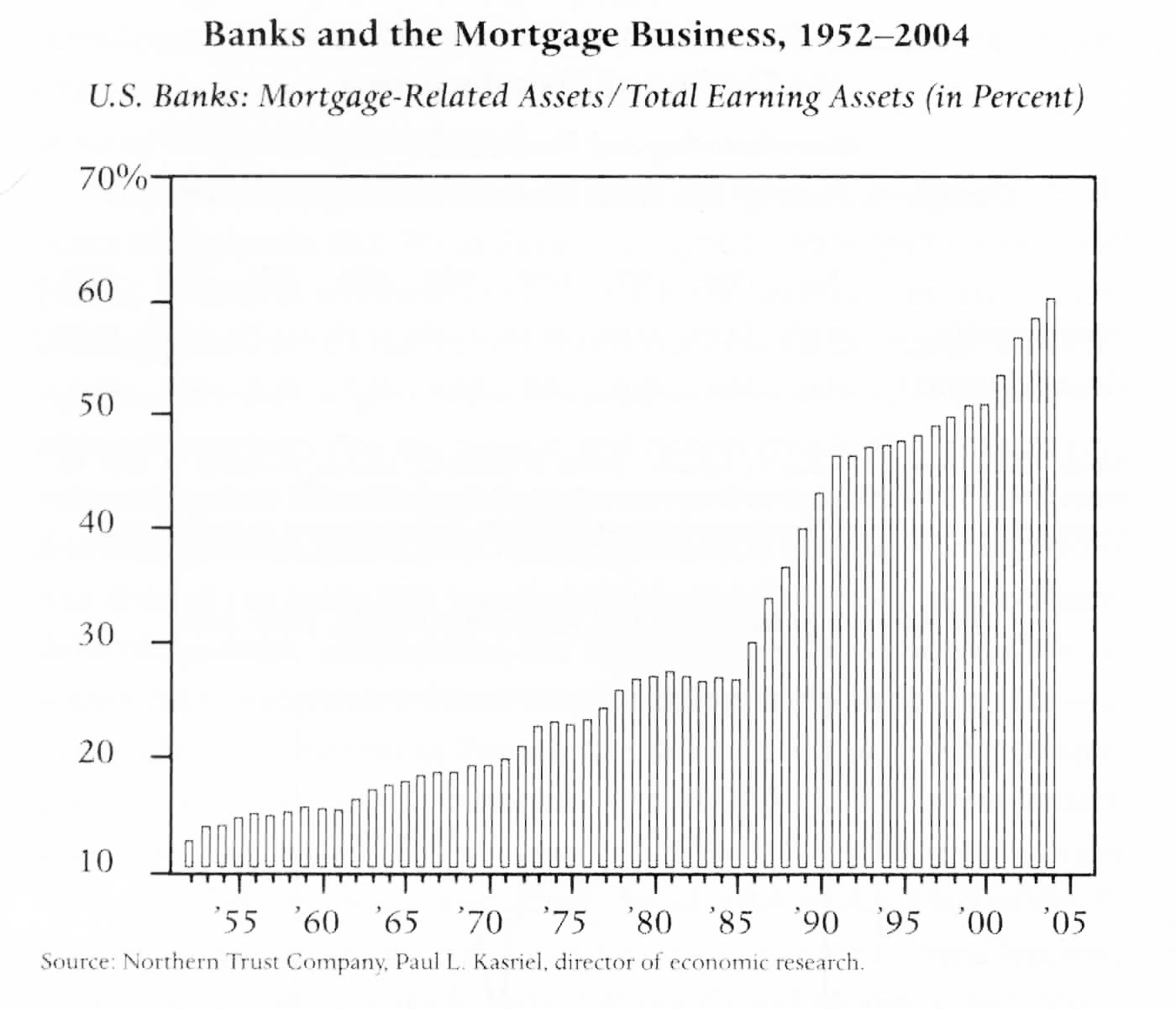 Over the past 60 years, and especially since the mid-1980s, mortgages and mortgage securities
have formed an ever-growing percentage of bank assets, and have contributed an ever-growing
percentage of bank profits. (See graph at right for the situation in the U.S. from 1952 to
2004.)
Over the past 60 years, and especially since the mid-1980s, mortgages and mortgage securities
have formed an ever-growing percentage of bank assets, and have contributed an ever-growing
percentage of bank profits. (See graph at right for the situation in the U.S. from 1952 to
2004.)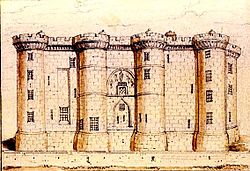 The National Day of France, July 14th, which celebrates the storming of the notorious feudal
Bastille fortress-prison in Paris by the masses on July 14, 1789. This was a key moment and
turning point in the
The National Day of France, July 14th, which celebrates the storming of the notorious feudal
Bastille fortress-prison in Paris by the masses on July 14, 1789. This was a key moment and
turning point in the