CUBA — Is It Really a Socialist Country?
“So what about Cuba? In my view this was originally an anti-imperialist, nationalist
revolution against a comprador puppet dictator. And, as such, it was certainly something to be supported.
After seizing power Castro did in fact move to what is commonly called ‘the left’, i.e. in the direction
of state ownership of the means of production and improving the condition of the people. To a considerable
degree they also implemented the principle of ‘... to each according to their work.’
“Castro and his associates have operated in a
very paternalistic manner. They truly do care about the welfare of the people, about improving mass
education and health, etc., and have in fact made great strides in those directions. But this definitely
does not mean that the working class itself is running Cuba.
“Within a few years of the revolution most of the
progressive social transformations in the relations of production also stopped in Cuba. Moreover, while
Cuba largely escaped the clutches of U.S. imperialism, it did so by voluntarily coming under the clutches
of Soviet social-imperialism—including ideologically (for the most part).
“The reasons these things happened is that Cuba was
not ruled by representatives of a revolutionary proletariat, but by a paternalistic national bourgeoisie
who happened to favor state capitalism (under the name of ‘socialism’).
“So Cuba is in many ways quite an anomaly, and
certainly not a model for revolutions elsewhere.
“In my view the primary reason why Cuba is not
socialist (and never was) is that it was never ruled by a revolutionary proletariat determined to transform
the economy from capitalism to communism. I.e., I’m stressing again the importance of that third aspect
(or principle) of what socialism really is, that ‘Maoist’ principle.
“Of course objective conditions meant that a complete
transformation to communism in Cuba alone was out of the question. (Generally we Marxists believe this
can only be completed on a worldwide basis.) But many more steps in that direction could certainly
have been taken. The opposition of Castro to the Great Proletarian Cultural Revolution in China and its
siding with and supporting Soviet state capitalism speaks volumes, I’d say.
“And all the changes in Cuban society are now back in
the direction of Western-style monopoly capitalism, never in the direction of communism. Of course we should
continue to oppose U.S. attacks on Cuba, the blockade, etc. It is even fine to admire many of the things
that Cuba has done for its people, especially in the areas of health and education. I admire those things
myself, which have been accomplished under very difficult circumstances.
“But it is very wrong to put Cuba forward as a model
for socialist revolution. That’s what I most object to. Real socialism is a step toward communism. Cuba is
no such step, and has actually been more of an ideological obstacle to promoting real socialist revolution
around the world.”
—Scott Harrison, excerpt from a letter to Bob Weil on
Dec. 20, 2013. The full letter is online at:
https://massline.org/Politics/ScottH/WhatIsSocialism.pdf
CUBA — Emigration From
“About 250,000 Cubans, or more than 2 percent of the country’s population,
have migrated to the U.S. over the past year alone, government data shows. The pandemic’s
evisceration of the tourism industry and the tightening of U.S. sanctions have deepened the
socialist nation’s poverty, and kicked off the largest exodus from Cuba since the 1959
revolution.” —New York Times report, summarized in The Week, Dec. 23,
2022, p. 16. [It should be noted that the obviously pro-capitalist NYT is far more likely
to consider Cuba a “socialist country” than are Marxist-Leninist-Maoists. —Ed.]
CUBA — Health System
Unfortunately the once shining aspect of Cuban society, its public health system, has entered a period
of desperate stress, along with the general economic near-collapse of Cuba resulting from a number of
negative factors, including the U.S. imperialist blockade of Cuba which is especially focused on blocking
imports of oil.
“The Cuban government says that the U.S. oil blockade has left intensive
care units without electricity as 100,000 patients await surgery, including 12,000 children.”
—New York Times, “Trump’s Economic Vise Leaves Cubans Desperate for Food and
Medicine”, September 21, 2026.
CUBA — Living Standards at Present
“In Cuba, the average monthly income is about 4,700 pesos, or $14. In 2023,
the Columbia Law Project estimated Cubans needed at least seven times as much as that amount
to cover basic expenses.” —New York Times, “Facts of Interest”, Sept. 18,
2025.
[So how then are the Cuban people
surviving at all?! If people need 7-times more money than they receive in order to survive,
then they will not survive! The study probably failed to take into full account that the
cost of living in a poor country like Cuba is far lower than it is in the U.S. Moreover,
they apparently failed to take into consideration that poor people with very low wage
incomes are forced to engage in many “side-hustles” (as they are called in the U.S.).
That means participating in the unofficial and perhaps illegal private capitalist economy.
But it is very true that life in Cuba is at present really difficult for the masses, most
of whom are now quite desperately poor. The fact is, Castro’s revisionist-style
state-capitalist revolution in Cuba has turned out to be an economic and social failure.
—S.H.]
CUBA — Collapse of Mass Support for the Regime
“Reliable polling is hard to find in Cuba. But a recent survey by a
Cuban news website, El Toque, found that about 56 percent of Cubans who reside in the
island, and nearly 70 percent of those abroad, would support a U.S. military intervention.”
—New York Times, “Facts of Interest”, May 22, 2026.
[Obviously such statistics appearing
in a leading American imperialist publication cannot be completely trusted. And it is
impossible for the world to be completely sure about how ordinary Cubans currently view their
ruling regime. But there does seem to be enough news coming out of Cuba now to suggest that
the Cuban ruling class has at least lost the support of a major part of the masses, and
perhaps even the great majority. It therefore appears that the U.S. imperialists will have
little trouble overthrowing the regime if they follow through with their current plans, and
even if a majority of Cubans still do not actually “support” a U.S. takeover. —S.H.
[May 23, 2026]
CUI BONO?
[Latin: “To whose benefit?”] A wise Roman adage that means that when investigating crimes, or
when trying to understand politics (which also often amounts to a long series of crimes), the
best place to start is usually by asking yourself, “Who stands to benefit from this?”. In
bourgeois society, for example, it will almost always be found that governmental decisions
are made which promote the economic and political interests of the ruling capitalist class.
CULT (Political)
Most people associate the term ‘cult’ with unorthodox or outrageous religious
sects characterized by fanatical devotion to the doctrine and
leadership of the sect and the refusal to even seriously entertain the possibility that
anything the top leader might say could be mistaken. But there are also similar political
cults. The key concept in political cults, too, is devotion, the devotion of the
adherents to every single aspect of the doctrine of the cult and an unquestioning acceptance
of whatever the top leader says.
Cult members are conditioned by powerful social
pressures within the cult toward:
1) The belief that their top leader is an
indispensable individual, and in effect, a savior not only for their group alone, but
for their whole country and even for all humanity;
2) Inability to question any significant aspect
of the doctrine of the group, unless and until the top leader makes a change in the
official doctrine;
3) Frequent direct quotation of their leader,
especially when asked by outsiders to explain the doctrines and ideas of their group;
4) Fear of publicly saying anything else; in
other words, the fear of getting approved doctrine slightly “wrong”;
5) A tremendous reluctance to raise any
disagreements or criticisms of the group (let alone of the top leader), because they will be
harshly pounced on, and possibly excommunicated, expelled and shunned, if they do;
6) A great reluctance to raise any new ideas
of any kind, even if they don’t seem to go against current doctrine (because these ideas might
be interpreted by the leadership that way);
7) A strong tendency to hide their own
personal shortcomings and failures to successfully carry out the instructions of the group and
its leader (because they similarly know they will be severely attacked if shortcomings and
errors come to light). This is doubly the case because of the often extreme demands which
are placed on the members;
8) A strong tendency toward
sectarianism, and the strong beliefs that only their own leader
and group can generate knowledge about the correct path forward; and even the subtle feeling
that anyone outside the group is really sort of the enemy (even if they have never directly
criticized the group);
9) A strong tendency toward monasticism,
of making the group and its leader the entire focus of their whole life, and of restricting or
cutting off even social relationships with other people and the masses (especially if they ever
express any strong opinions the group disapproves of, and certainly if they ever express any
major criticisms of the group or its leader whatsoever);
10) A tendency to nevertheless “burn out” and
drop away after a number of years when the false predictions and expectations of the group
continue to prove wrong time after time—especially if they are among the members of the
group who get blamed for these failures. (The leader of the group rarely admits to any
personal role in these failures of the group, except where it is absolutely unavoidable. Even
then various excuses will be offered up.);
11) The tendency to seize upon the defections
and departures of other members as an opportunity to blame them for the failures of the
group, and to view them as having been hidden enemies who the group is now well rid
of;
12) A tendency to still be infected with
much of the outlook of the group and its leader even if they themselves do drop out or
get forced out, and the tendency towards an inability to think how to organize and operate a
political group in any other fundamentally different way. (Indoctrination runs deep.) Of
course over time, and with the exposure to different ideas, more of the lingering
indoctrination can be expected to fade away.
All of this is a total travesty of Marxism, and
is in essence a religious approach to politics rather than a rational, democratic, and
scientific approach. It is hard to understand how anyone could ever think otherwise.
A clear current example of a political cult in
the United States is the Revolutionary Communist Party with its top
leader Bob Avakian being the undeniable object of devotion
by the members of the group, who are required to promote a “culture of appreciation,
promotion, and popularization around the leadership, the body of work and the
method and approach of Bob Avakian.” (See: AP&P
).
“CULTURAL APPROPRIATION”
A concept which derives from the extension of bourgeois identity
politics into cultural matters.
“Cultural appropriation is the inappropriate or unacknowledged adoption of an
element or elements of one culture or identity by members of another culture or identity. This
can be controversial when members of a dominant culture appropriate from minority cultures.”
—Google definition on the Internet, as of Dec. 17, 2021.
[In bourgeois nationalist society, culture
in most or all of its aspects (including artistic practices and styles) is treated as the
intellectual property of the individual who produces it, or else—more broadly—as sort of the
collective intellectual property of the ethnic group whose members have originally created it.
Even individual intellectual property is something which is bourgeois to the core, and in
socialist and then communist society, it will no longer exist. But the extension of this
bourgeois concept of intellectual property to national or ethnic groups is even more absurd. In
reality all human culture belongs to all the people of the world, and it is for all of
us to become better acquainted with it, and to more deeply appreciate it as we individually see
fit. It is not “a bad thing” for cultural practices to become more widely known and appreciated,
but a very good thing. And if this cultural knowledge is spread, of course many more people in
different parts of the world, may themselves want to participate in the expression of these new
forms of culture themselves. And this is a wonderful thing too, and certainly not something to
be opposed on the absurd basis of narrow “identity politics”.
[Sometimes purists object to the adoption
by and engagement in a culture by people originally outside of it, on the grounds that this
leads to a “distortion” of the original. But the original still exists too; and the so-called
“distortion” or blend of cultures may itself be of great value. An example of this is jazz music,
which originally was largely (though not entirely) the creation of African-Americans, and was
based on a blend of African and European musical styles, rhythms, melodies, harmonies and even a
new musical scale of notes itself, the “blues scale”. This wonderful new music, in a long series
of new and developing sub-forms, became one of the world’s great cultural treasures. And what
complete nonsense it would be to condemn this as some sort of “cultural appropriation” of either
existing European or African musical culture! —S.H.]
“[T]he very concept of ‘cultural appropriation’ is misbegotten. As I’ve
previously argued, it wrongly casts cultural practices as something like corporate intellectual
property, an issue of ownership. Where there’s real cause for offense, it usually involves not a
property crime but something else: disrespect for other peoples.” —Kwame Anthony Appiah, “The
Ethicist”, New York Times Magazine, Aug. 22, 2021, p. 12.
CULTURE
All the accumulated social consciousness (knowledge, opinions, abilities, etc.)
of a society, especially in regard to its manner of living, and the material results
of that social consciousness, which together characterize the historical stage attained in
the development of the society. Culture may therefore be divided into intellectual
culture, consisting of all social knowledge and consciousness, and material culture,
consisting of all the material wealth and means of producing this wealth. Culture in both
its intellectual and material forms undergoes constant development, and is transmitted from
one generation to the next.
See also:
SOCIAL CONSCIOUSNESS,
IDEOLOGY
CURRENCY WARS [International Capitalist Finance]
One of the many forms of international competition between the bourgeoisies of different
countries, wherein each country tries to lower the value of its own currency in relation to the
other major currencies in order to promote the sale of its own goods in foreign countries.
In the capitalist-imperialist era, with the
intensified systemic problems of overproduction, imperialist
countries need to sell more and more products in foreign countries (as well as to export capital
itself, i.e. to invest in other countries). While, because of the concentration of production
(into oligopoly or monopoly) there is less and less price
competition within each capitalist-imperialist country, there still remains substantial
international competition for commodities based on price (as well as on other factors, such as
quality and reliability). However, commodities are priced in terms of different currencies
(either national currencies like the dollar or the yen, or else regional currencies like the
euro). Therefore, the actual differences in prices also depends on the exchange rate between
currencies. It is thus to the advantage of the capitalist exporters from each country to have
their own currency continually devalued in relationship to the currencies of competing countries,
which will in turn lower their effective prices in foreign countries and make it easier for them
to sell their products.
The easiest way for a country to drive down the
exchange rate for its own currency is to simply print more and more of its own currency. Of
course, too much of this sort of thing can soon lead to harmful inflation or even disastrous
run-away inflation within that country. However, countries whose currencies are also used as
international reserve currencies can get away with inflating their currency to a much greater
degree. The U.S. dollar is still the most important reserve currency (though its centrality is
slowly diminishing). Other important reserve currencies include the euro, the yen, the British
pound and the Swiss franc. (The Chinese yuan [RMB] is just beginning to become an international
reserve currency, though it will almost certainly become more important in the future.) So it
is the U.S., Europe, Japan and Britain, and a few other stable countries such as Switzerland,
who are mostly contenders in these international currency wars at the present time.
The U.S. has been running huge Federal budget
deficits of a trillion dollars per year (or more!) since the current economic crisis took a
serious turn for the worse in 2008. This has led to a significant rise in the value of some
other currencies against the dollar, including the yen and the euro—even though Europe and
Japan have their own extremely serious financial problems. And Britain has been in even worse
financial and economic shape, which accounts for the recent decline of the pound against the
dollar. In response to all this, Japan has begun printing more and more yen for the international
market. Because all these more important currencies were being inflated at roughly the same rate
overall, international currency speculators began turning to the more stable Swiss franc. But
this then began to drive up the prices of Swiss goods overseas and was seriously harming Swiss
exports. Therefore, in 2012 Switzerland itself began to print more and more francs to inflate
its currency and save its export markets.
The basic problem, of course, is the world
overproduction crisis. Currency wars are merely a means of pushing some of the pain in one
country off onto other countries. In no way can they resolve the basic overproduction problem
of capitalism!
Note that from the point of view of exporting
capital, it is actually better to have a strong national currency! For example, this
would allow the purchase of foreign companies with fewer units of one’s own currency. The fact
that most major ruling classes prefer to have weaker currencies shows that they are more
concerned to expand foreign markets than they are to export capital. The export of capital in
the imperialist era is overall of ever-growing importance, but it is still in second place
compared to the importance of promoting foreign markets, at least in the eyes of most national
bourgeoisies today.
“CURSE OF KNOWLEDGE” [Psychology]
The “Curse of Knowledge” is a reference to the common distorted viewpoint of those who have
achieved some level of specialized knowledge with regard to some topic, but who are unable to
remember how ignorant they themselves once were on the matter, and the difficulties they
themselves may once have had in coming to properly understand the specific issues being discussed.
They therefore often tend to assume everyone already understands things nearly as well as they
now do. This is a fairly common failing among school teachers and college professors: The
inability to put themselves in the place of their students.
We Marxists, who are working to bring the social
knowledge of our MLM revolutionary science to others, need to keep in mind the difficulties and
misconceptions which we ourselves once had at the beginning or our own political education, and
do our best to start with our students current level of understanding, and try to develop their
comprehension step by step from where they are now at, and at their own pace.
CYBERTARIAT
A recent, sometimes semi-serious, term for the growing number of young workers who are vicariously
employed as freelance contract workers and who do such work mostly via the Internet.
Two books on the topic are:
Ursula Huws, The Making of a Cybertariat: Virtual Work in a Real World (NY: Monthly
Review Press, 2003); and Ursula Huws, Labor in the Digital Economy (NY: Monthly Review
Press, 2014). See also:
CONTINGENT WORKERS,
GIG WORK,
PRECARIAT
“By 2015 the precariat is evolving into a cybertariat, as digital technologies
become more central to organizing and even constituting labor. The Economist credits
the ubiquity of the smartphone for moving freelancing from the margins to the center of
capitalism. [Jan. 3, 2015, p. 18.] By 2025 experts anticipate that one of every three global
labor ‘transactions’ will be conducted online as part of the ‘on-demand’ or ‘crowd labor’
economy, with a few gigantic digital hiring hall corporations using their networks and apps to
get temp labor for employers. Informal work, or freelancing, already accounts for around
one-third of the US workforce, fully 53 million workers, according to an Edelman Berland report
prepared for the Freelancers Union. A Christian Science Monitor report stated that up
to 50 percent of the new jobs in the recovery [from the Great Recession of 2007-2009] were
freelance positions. Economic Modeling Specialists Intl., a labor market analytics firm,
calculated that by 2014 some 18 percent of all US jobs were performed by part-time freelancers
or part-time independent contractors. There was a 60 percent increase in the number of these
part-time gig jobs from 2001.” —Robert W. McChesney and John Nichols, People Get Ready:
The Fight Against a Jobless Economy and a Citizenless Democracy (2016), p. 71.
CYNICISM
The general or systematic distrust of human beings and human motives; or, more specifically, the belief
that human actions are motivated entirely by individual self-interest. But is it really sensible to think
that this is true of every single person in the world, including ourselves, just because it is so obviously
true of the capitalists who are running things in the world today?
The biggest problem with such a general cynical
outlook is that it is a classless perspective, and therefore a hidden bourgeois doctrine in
present society. We should indeed be quite “cynical” about the motives of the capitalists and their
agents, politicians, and other hirelings. Why? Because we understand their selfish goals! But we
should also recognize that there are a vast number of basically good people within the working class and
masses, who—even if we have of course all been somewhat negatively affected by the evil bourgeois society
around us—are essentially honest and moral, and who wish to see a better world. Instead of sitting around
and doing nothing except to complain about the present society in a totally cynical fashion, our efforts
are focused on organizing and leading the working class and masses to make revolution and construct a very
different, and very much better world. Sure it is difficult; but it is the path we have chosen, and has
been proven possible before! [Jan. 3, 2024]
“To be completely cynical about humanity and its prospects is to have gone over to
the side of the bourgeoisie yourself.” —Scott’s Painfully Obvious Conclusion, #2.
“I worry that no matter how cynical you become, it’s never enough to keep up.”
–Lily Tomlin, acting in Jane Wagner’s 1985
one-woman play titled The Search for Signs of Intelligent Life in the Universe.
[But is it even “cynical” to reject the false
claims and promises of the capitalists and their system? Or is it more like the rejection of the
claims and promises of the exploiting ruling class which we know very well does not have the people’s
interests at heart. However, a general cynicism is a matter of rejecting all ideas and all
suggestions from everybody, whether you have good reason to do so or not! And that’s pretty foolish.
—Ed.]
CZECHOSLOVAK CORPS (In Russia during the Bolshevik Revolution)
An army of Czech and Slovak soldiers which under the influence of the Entente alliance in World
War I revolted and, with the active participation by the Mensheviks
and Socialist-Revolutionaries, joined the attempt
by the imperialist countries to suppress the Russian revolution.
“The Czechoslovak corps was formed in Russia prior to the Great October
Socialist Revolution from Czech and Slovak prisoners of war, soldiers of the
Austro-Hungarian army, for waging war against Germany. After the establishment of Soviet
power, the Czechoslovak corps, by agreement with the Soviet Government, was to be sent
to France through Vladivostok. But the counter-revolutionary commanders of the corps,
perfidiously violating the agreement with the Government of the R.S.F.S.R. on the
surrender of weapons and deceiving the Czechoslovak soldiers, at the end of May 1918
began an armed insurrection at the bidding of the Entente. Acting in close co-ordination
with the whiteguards and kulaks, the Czechoslovak whiteguard corps seized Chelyabinsk,
Penza, Tomsk, Omsk, Samara and other towns. Nevertheless, a considerable section of the
Czechoslovak prisoners of war did not succumb to the anti-Soviet and nationalist
propaganda of the reactionary top stratum of the Corps; over 10,000 Czechs and Slovaks
fought in the ranks of the Red Army.
“In the autumn of 1918 the Volga
area was freed by the Red Army. The revolt of the Czechoslovak corps was finally
suppressed at the end of 1919 together with the rout of Kolchak.” —Note 2 in Lenin,
SW 3.
Dictionary Home Page and Letter Index
MASSLINE.ORG Home Page
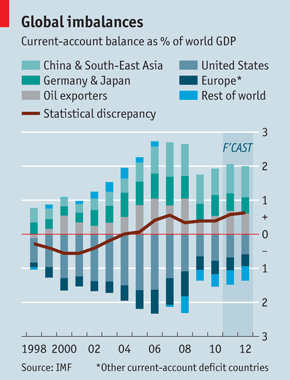 One of three components of the international balance of
payments between countries. The current account balance includes the value of imports and
exports as well as receipts from or spending abroad in other ways, such as through tourism or
workers in foreign countries sending money back home. It also includes receipts from foreign
property income.
One of three components of the international balance of
payments between countries. The current account balance includes the value of imports and
exports as well as receipts from or spending abroad in other ways, such as through tourism or
workers in foreign countries sending money back home. It also includes receipts from foreign
property income.