APOSTASY
1. [In religion:] Renunciation of religious faith.
2. [In intellectual or political matters:] The renunciation or
abandonment of a previous intellectual or political viewpoint, or defection to an opposing viewpoint.
A person who renounces their previous faith or viewpoint
is called an apostate.
“... every philosophy of the past without exception was accused by
the theologians of apostasy...” —Marx, leading article in the Kölnische
Zeitung, # 179, 1842. [Marx’s point being that religion opposed all philosophical
thought and progress.]
APPARATCHIK [Plural: apparatchiki]
1. [As originally used in Russian in the Soviet Union in the late
socialist period:] A member of the Communist Party of the Soviet Union “apparatus” or organization, or a government
official. More specifically, this term usually referred to a full-time functionary of the Party or government, or
what in China is called a cadre.
2. [As used by the more-and-more disgusted Soviet workers in the
USSR during the state-capitalist period (c. 1955-1991):] A CPSU or government functionary who worked as part of the
machinery which controlled and oppressed the people; i.e., a low or medium-level bureaucrat. The apparatchiki
in this era did not include the newly arisen highest officials of the CPSU or government who were a separate and
much more powerful and privileged group, the nomenklatura.
3. [In the U.S. today:] A similar term to sense 2, and with tacit
reference to the fallen Soviet regime, for an individual government or corporate bureaucrat, or member of some
political or other organization, who blindly follows established policies or the orders of higher officials.
While this sort of mindless bureaucratic behavior is of course
despicable, it should also be noted as counterpoint that an ultra-individualistic society such as the U.S. today
has no understanding or appreciation for democratic-centralism within a
revolutionary party or within a revolutionary society as a whole. I.e., there is more to this topic than the
undialectical bourgeois mind can comprehend. It is in fact correct and necessary for individuals in many situations
(within a revolutionary army, for example) to follow orders or policies which they may personally disagree with.
APPEARANCE AND ESSENCE
See also:
SUPERFICIAL
“All science would be superfluous if the form of appearance of things
directly coincided with their essence.” —Marx, Capital, Vol. III, Chapter
48: The Trinity Formula, Penguin Classics Ed. (1991), p. 956. (In the International Publishers
1967 Ed. [4th printing, 1972], the passage is on page 817, and reads: “But all science would
be superfluous if the outward appearance and the essence of things directly coincided.”)
“We should draw a lesson here: Don’t be misled by false appearances.
Some of our comrades are easily misled by them. There is contradiction between
appearance and essence in everything. It is by analyzing and studying the appearance
of a thing that people come to know its essence. Hence the need for science. Otherwise,
if one could get at the essence of a thing by intuition, what would be the use of
science? What would be the use of study? Study is called for precisely because there
is contradiction between appearance and essence. There is a difference, though,
between the appearance and the false appearance of a thing, because the latter is
false. Hence we draw the lesson: Try as far as possible not to be misled by false
appearances.” —Mao, “Speeches at the National Conference of the Communist Party
of China: Concluding Speech” (March 31, 1955), SW 5:165-6.
“The relation of appearance to reality is a very basic philosophy
problem for Marxism.” —Maurice Cornforth, Marxism and the Linguistic
Philosophy (1967), p. 11.
[I’m not sure how big of a general
“philosophical” problem this still remains! But it very often is quite an important issue
in many practical situations. Becoming an expert in some field, such as medicine, is often
a matter of learning what can be discovered about internal essences by studying surface
appearances. —S.H.
APPLE CORPORATION
See also:
CORPORATIONS—Extravagances Of,
KAROJISATSU
“Apple is worth roughly $4 trillion, makes more than $100 billion in
profit every year and has 2.5 billion of its phones, tablets, computers and other devices
in use around the world.” —New York Times, “Facts of Interest”, April 2,
2026.
“APRIL DAYS” [Russia, 1917]
After the overthrow of the Tsar in the “February Revolution” in 1917, the new Provisional
Government continued Russian participation in World War I. The masses were already long
weary of the war, and as the months went by there were more and more calls for peace. But
the Provisional Government consisting of bourgeois and phony “socialist” parties was
determined to pursue the war until the final and complete victory over the Central Powers
(Germany and its allies). On April 18, the “Milyukov note”, a document by the Foreign
Minister P. N. Milyukov, was published which brought out the Provisional Government’s
continuing commitment to the total destruction of Austria-Hungary and punative reparations
against Germany, rather than any early peace on less demanding terms. This triggered public
demonstrations known as the “April Days”. One military unit, the Kexholm Guards, demonstrated
against Milyukov in front of the Maryinsky Palace on April 20. They were dispersed, and a
counter-demonstration was led by the Cadets (Constitutional Democrats, Milyukov’s bourgeois
party). But this in turn resulted in a Bolshevik-led Red Guards mass mutiny. The Provisional
Government was, however, quickly able to regain control, though Milyukov himself was forced
out and the government was reshuffled.
“APRIL THESES” [Lenin]
The ideas and programme summed up historically as Lenin’s “April Theses” consisted of the
article “The Tasks of the Proletariat in Our Revolution” (April 10, 1917), online at:
https://www.marxists.org/archive/lenin/works/1917/apr/04.htm, along with several
related articles from the same period, including: “Letters on Tactics”, and “Political
Parties in Russia and the Tasks of the Proletariat”, all in Lenin: Collected Works,
4th English ed., vol. 24. Basically, in these articles Lenin reoriented the ongoing Russian
revolution from being merely an anti-feudal, anti-Tsarist, bourgeois democratic revolution
into becoming a socialist revolution. See the summary below for the major points included
in these theses.
“LENIN: The Tasks of the Proletariat in Our Revolution; The April
Theses; The April Conference
“On arrival in Russia on April 5,
1917, Lenin presented his famous April Theses, in which he summed up the tasks of the
revolution. The April Theses were ten in number and may be summarized as follows:
“1. It is impossible to end
the war by a just democratic peace without the overthrow of capitalism.
“2. There is taking place a
transition from the first stage of the revolution, which placed power in the hands of
the bourgeoisie, to the second stage, which must place power in the hands of the
proletariat and poor peasants.
“3. No support for the
Provisional Government.
“4. The Bolsheviks must
work for a majority in the soviets and to transfer state power to the soviets.
“5. Not a parliamentary,
but a soviet republic.
“6. Confiscation of landed
estates and nationalization of the land.
“7. A single national bank
controlled by the soviets.
“8. Control of all
production and distribution by the soviets.
“9. A party congress.
“10. A new International.
“In his pamphlet The Tasks of
Proletariat in our Revolution, published in April 1917, Lenin explained in a popular
form the fundamental ideas of the April Theses. The bourgeoisie, he says, has developed
in history two methods of rule, (a) by violence and (b) by deception. The Provisional
Government is at present using the second method, and the immediate task is to develop
a campaign of patient explanation of the real situation to the people.
“In discussing the future transfer
of power to the soviets and the soviet republic, Lenin declares that what is required
is a new type of state, ‘a state of the Paris Commune type,’ in which the masses directly
participate in the ‘democratic upbuilding of their own state life from top to bottom.’
“Lenin calls for an agrarian
programme in the interest of the peasants, the nationalization of the land and the
confiscation of estates. The peasants, he says, must be urged to confiscate the landlords’
lands on their own initiative. All the banks must be amalgamated into one national bank
under the control of the soviets, and the capitalist trusts and combines must be
nationalized.
“In his speeches at the April
Conference of the Bolsheviks, which took place at the end of April (or beginning of May
new style) and which are published in the volume The April Conference, Lenin again
works over the line of the April Theses.”
—Readers’ Guide to the Marxist
Classics, prepared and edited by Maurice Cornforth, (London: 1952), pp. 69-70.
“When ... Lenin set out to re-define the character of the revolution
in his famous ‘April theses’, his diagnosis was both perceptive and prescient. He
described what had happened as a revolution in transition from a first stage which had
given power to the bourgeoisie, to a second stage which would transfer power to the
workers and the poor peasants. The Provisional Government and the Soviets were not
allies but antagonists, representing different classes. The end in view was not a
parliamentary republic, but ‘a republic of Soviets of Workers’, Poor Peasants’ and
Peasants’ Deputies all over the country, growing up from below’. Socialism could not
indeed be introduced immediately. But as a first step the Soviets should take control
of ‘social production and distribution’. Throughout the vicissitudes of the summer of
1917 Lenin gradually secured the adherence of his party followers to this programme.”
—E. H. Carr, The Russian Revolution from Lenin to Stalin: 1917-1929,
(Palgrave/Macmillan, 2004 (1979)), p. 4.
APTHEKER, Herbert (1915-2003)
A historian specializing in African-American history, and a long-time leader of the
revisionist Communist Party, USA. His book American Negro Slave Revolts (1943) was
pathbreaking and important, but it seems he was never really a revolutionary Marxist.
Aptheker joined the CPUSA in 1939, and
remained loyal to it until 1991, when at around the time of the collapse of the revisionist
Soviet Union he left with the social-democratic breakaway group, the
Committees of Correspondence. He strongly
defended Soviet social-imperialism in 1956 when it invaded Hungary, and again in 1968 when
it invaded Czechoslovakia.
After the death of Aptheker and his wife,
his daughter Bettina wrote a book [Intimate Politics (2006)] in which she claimed
that her father had repeatedly sexually molested her from the age of 4 until the age of
13—but that she had not remembered this until writing that book! We may not know what to
believe about that accusation, but we can be very sure that Herbert Aptheker was definitely
a revisionist.
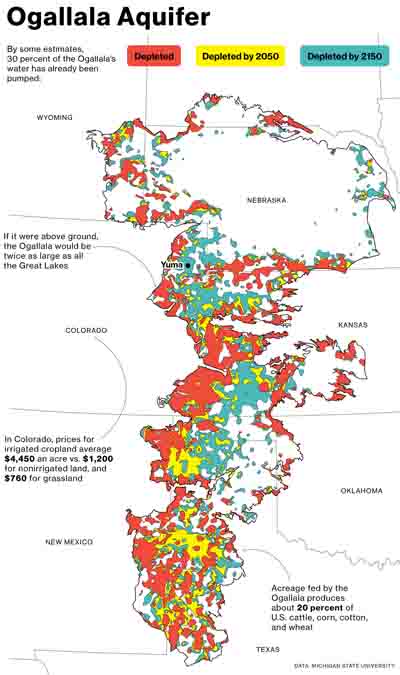 An underground supply of water in permeable rock, sand or gravel. One of the outrageous things
about capitalist society is that in the pursuit of short-term profits it is using up or
destroying many of the natural products and features of the world without regard to the future
needs of humanity. And this includes the rapid depletion and pollution of aquifers much faster
than natural forces can replace or purify them.
An underground supply of water in permeable rock, sand or gravel. One of the outrageous things
about capitalist society is that in the pursuit of short-term profits it is using up or
destroying many of the natural products and features of the world without regard to the future
needs of humanity. And this includes the rapid depletion and pollution of aquifers much faster
than natural forces can replace or purify them.