CRIME
Crime is the violation of a law. And what are laws? They are the rules established by a state
(government) controlled by some specific ruling class primarily for the benefit of that one
social class. Thus, if the capitalists who own an automobile factory or giant agribusiness
corporation steal half or more of the wealth produced by “their” workers (via the extraction
of surplus value in the production process), amounting to
millions or even billions of dollars every year, that is not of course a crime in capitalist
society. But if a poor, starving unemployed worker steals a loaf of bread, that is a very
serious crime and a worrisome break down in law and order.
The revolutionary proletariat views the worst
real crimes in society as those forms of exploitation (theft), oppression, mass killings
(mostly through endless imperialist wars), and so forth, which are technically not crimes in
bourgeois society at all (since there are no laws against them). It is also true, however, that
the bulk of the great many smaller crimes (according to the legal code itself), such as robberies
and burglaries, though mostly committed by “lumpen”
elements among the masses, are also directed primarily at workers and others among the masses.
The ruling class is mostly concerned about such “petty crimes” only because they are also the
occasional victims themselves.
“Mark the part of your city where crime flourishes. Now look at the map
of your city. You have marked the areas where there are slums, poor schools, high
unemployment, widespread poverty; where sickness and mental illness are common, housing
is decrepit and nearly every site is ugly—and you have marked the areas where crime
flourishes.... Poverty, illness, injustice, idleness, ignorance, human misery, and crime
go together. That is the truth. We have known it all along. We cultivate crime, breed it,
nourish it. Little wonder we have so much. What is to be said of the character of people
who, having the power to end all this, permit it to continue?” —Ramsey Clark, Attorney
General in the Lyndon Johnson Administration, quoted in Andrew Karmen, “Poverty, Crime,
and Criminal Justice,” in Wm. Heffernan & John Kleinig, eds., From Social Justice to
Criminal Justice: Poverty and the Administration of Criminal Law (2000), p. 28.
CRISIS THEORIES (For Capitalist Economic Crises)
There are a large number of different theories attempting to explain why economic crises periodically
develop in capitalist society. Most bourgeois economists, when pressed to explain such social disasters,
try to say that the causes are all “exogenous” (external) to the workings of capitalism itself. Usually
they claim that financial panics, recessions, depressions, etc., are instead entirely due to the foolish
errors and missteps on the part of the government authorities. In some cases, though, they’ve come up
with rather bizarre theories, such as William Stanley Jevons blaming
sunspot cycles! It seems quite fair to say that bourgeois economists, and bourgeois economics as a
whole, have no good explanation whatsoever for the existence and continual development of capitalist
economic crises, as important as those crises certainly are!
However, economists in the Marxist tradition have many
different theories, and/or sub-theories, to explain this phenomenon of recurring economic crises under
capitalism. Virtually all Marxists, from Marx on, say that these crises are inherent to capitalism, and
will continue to occur as long as the capitalist mode of production continues to exist. Marx gave the name
Overproduction Crises to them, and quite obviously, overproduction is definitely a central aspect
to them. However, the various theories that have been created and defended are focused on what the basic
cause of these crises is, which could conceivably be something else entirely. Here we list the
three three main categories of Marxist theories of capitalist economic crises. For further discussion of
each, go to the specific entries:
I. The
Overproduction Theory itself, as it is usually called, is the most central and important crisis theory.
In brief outline, it basically argues that since the capitalists pay their workers for only a fraction of
what they produce, the workers can therefore only buy back a fraction. Since the
surplus value (the value produced by the workers that the capitalists
don’t pay them for) is enormous and continually accumulating, it is up to the capitalists themselves to
buy all the remaining commodities produced. But even after spending great amounts on their own luxurious
lifestyles, there is still a mountain of loot left. For a long while they use that loot mostly to build
more factories, but that just makes the underlying problem worse. Even more goods are produced for
which there is no true market. So they grant credit to the workers and other consumers for a long while,
in order to artifically expand the market; and similarly the capitalists have their government go into ever
greater debt to buy the excess production (often in preparation for capitalist wars). And, really, it is
only this continual expansion of credit and debt that allows a capitalist economy to keep functioning at
all. But finally the debt bubble collapses in a financial crisis and there follows a recession or even a
depression, characterized by a true mass of commodities which cannot be sold even while people are in great
need of them; and also, the much greater problem for the capitalists is exposed, the vast array of
idle factories representing the overproduction of productive capital itself.
However, some superficial and naïve versions of this
overproduction theory, such as that of Rodbertus, focus only on the
overproduction of final consumer commodities as compared to the limited market demand for them, and ignore
the massive overproduction of productive capital itself and the necessary endless expansion of debt. Those
writers who favor a different theory of capitalist economic crises prefer to call this the
“underconsumption” theory, rather than the overproduction
theory, as a means of emphasizing the erroneous idea of a few, like Rodbertus, who thought that these crises
could then be prevented by simply raising workers’ wages somewhat. However, this criticism of the
overproduction/“underconsumption” theory is setting up a straw man and is essentially dishonest. Virtually
all modern proponents of the overproduction theory of crises totally reject such naïve versions of it as
that of Rodbertus!
Marx’s own overproduction theory focuses on the overproduction
of productive capital itself, and is for that reason often referred
to as overaccumulation, although Marx himself generally just used the
term ‘overproduction’, since productive capital, like final consumer goods, is also created via the production
of commodities under capitalism.
II. The
Anarchy of Production Theory. The basic idea here is that capitalist production is not done according to an
overall plan for what society needs, and therefore too much of some things and too little of other things get
produced. While that is certainly true, capitalism does not care about what people really need; only about
producing commodities that can be sold. And in terms of the effective demand
for goods, capitalist corporations generally seem reasonably efficient in switching production to meet any shifts
in that demand. (In fact, the U.S. capitalists frequently bragged about this ability as compared with the
sluggishness in the U.S.S.R. in its state-capitalist era.) The proponents of this crisis theory, however, say
that the market itself tends to lead to disproportionalities that result in crises. Mostly, it seems to us, that
they have not proven their point. And the most important disproportions that do in fact arise—such as the
continual construction of unnecessary new factories (given actual demand without excessive credit expansion)—can
be better explained by the overproduction theory (see above).
It is of course true that there can still be disruptions in
production which throw the economy seriously out of whack for a while, such as major crop failures, earthquakes,
hurricanes and other severe weather, wars, or pandemics like Covid-19
which led to sudden major but temporary shifts in market demand for many commodities, and therefore all kinds of
“supply chain” problems. However, it should be noted that these sorts of major truly exogenous problems can lead
to problems under every mode of production, including even socialism and communism. Most of those who
nevertheless still favor the theory that capitalist economic crises are basically due to its unplanned nature, or
to the independent production of commodities by “many capitals”, prefer to speak in terms of disproportionalities
rather than anarchic production. But it is not clear that merely changing the terminology makes this theory any
more plausible.
It should also be noted that this anarchy-of-production-theory
of capitalist economic crises has itself historically had some very negative consequences. For example, it has
reinforced the tendency for people to misunderstand socialism as simply the nationalization of industry. And in
addition it was very puzzling to many upholders of this crisis theory to see the Soviet Union in its final
state-capitalist decades fall into ever deeper economic crisis even though it was the least anarchic, and
most organized and monopolized economy on earth!
III. The
Falling Rate of Profit Theory. It has long been supposed, even in classical bourgeois economics such as by
Adam Smith, David Ricardo, and many others, that there is a long-term overall tendency in capitalism for the
average profit rate to fall. (Real profit rates are difficult to ascertain, especially for periods with poor
statistical records.) However, the empirical evidence we have from that period of classical bourgeois economy
does suggest that this may have been true back then, for reasons which might remain not fully explained, even by
Marx. However, for long periods since the beginning of the capitalist-imperialist era, this is certainly no longer
true. See: Falling Rate of Profit Theory—Empirical Investigations
This strongly suggests that falling profit rates—when they do occur—may be more the result of other negative
factors, than they are the supposed primary driving causal factor leading to crises.
Of course profit rates generally fall during a serious
economic crisis! But that is no more the explanation for the cause of the crisis than laying sick in bed is the
cause of your getting the flu. Moreover, even during the course of a really prolonged overproduction crisis,
such as the current one which actually began around 1973 and a half-century later is still continuing to develop
and worsen, there may well be numerous sub-periods when average profit rates rise as well as other sub-periods
when they decline.
There are various quite different reasons why the capitalists
may pull back on new investment and thus weaken or further weaken the economy, and not just because of falling
profit rates. How about the fact that their existing factories might already produce all they can sell, for
example, whether their current profit rates are high or not! (The overproduction explanation.) At the very most,
the falling rate of profit theory is only an adjunct or secondary component of a full and complete explanation
for overproduction crises.
Yes, Marx also believed (at least in his earlier decades) that
there was a long-term tendency for the rate of profit to fall. And in the mid-1860s he also believed and wrote
drafts about his theory at that time that this was a deeper cause of overproduction crises. But after about 1965
he stopped writing anything at all about this particular crisis theory—even though it was obviously in need of
a lot more work. And since he didn’t die for another couple decades (in 1883), it seems quite plausible to think
that he gave up on this theory completely. (For a thorough discussion of this matter, see Michael Heinrich,
“Capital after MEGA: Discontinuities, Interruptions, and New Beginnings”, online at:
https://www.bannedthought.net/MLM-Theory/PoliticalEconomyOfCapitalism/Crises/CapitalAfterMEGA-Discontinuities-Heinrich-2016-OCR.pdf
Engels incorporated those passages from the mid-1860s about
the falling rate of profit theory into Volume 3 of Capital which he edited, but it should not be assumed
from this fact that by the end of his life Marx himself would have done so.
All three of these main crisis theories are derived from
the writings of Marx himself, including directly from the various drafts of his great but unfinished work
Capital. Moreover, it is quite clear that all three theories have at least some relevance and partial
validity to them in that each may at least contribute to the overall explanation for capitalist economic crises
and how they develop. For example, the falling rate of profit is not the first or most basic cause of
overproduction crises, and simple overproduction is the basic cause (since as both Marx and Engels put
it in different places, the expansion of the capitalist market is unable to keep up with the expansion of
production). Nevertheless, that falling rate of profit which then develops early in the crisis, and because of
it, will certainly compound the situation, and for one thing, make capitalist companies even more reluctant to
start investing again in new factories, thus at least helping to prolong the crisis. Similarly, even if the
anarchy of “many capitals” is not actually the cause of overproduction crises, it will certainly contribute to
the problem as the crisis develops. For example, each corporation will try to keep as many of its own factories
operating, and try to force the other companies to permanently close down their plants. Since the
de facto destruction of excess productive capital is the only real way to resolve the crisis, the individual
interests, reserves and reluctance of each competing company will tend to strongly slow down the resolution
process and extend the crisis. (These are just two of many examples of how these other subsidiary crisis
theories also enter the overall picture.)
Nevertheless, it is incorrect to try to say that all three of
these crisis theories are equally correct, or equally important, or somehow equally “the basic cause” of
overproduction crises, as some Marxist or pseudo-Marxist writers have tried to claim. In reality the
overproduction of commodities, including most especially the overproduction of productive capital itself, is
the basic and primary cause of these crises—which is why they are indeed appropriately called overproduction
crises. But in the further development of these crises there are in fact elements of capitalist anarchy and
disproportions, and also falling rates of profits, which then compound, amplify, and extend the overall crises.
This, in part, and along with the necessity of getting into the financial aspects of crises, are what makes
fully understanding overproduction crises a somewhat challenging task. —S.H. [March 31, 2023]
See also:
ECONOMIC CRISES,
FINANCIAL CRISES
CRITICISM AND SELF-CRITICISM
Political criticism of oneself or of one’s comrades and others for the purpose of improving
the effectiveness of the revolutionary work of individuals, groups, parties and the
revolutionary movement as a whole. Making regular and appropriate use of criticism and
self-criticism within our ranks is a fundamental characteristic of any genuine
Marxist-Leninist-Maoist organization or party, and is essential to our development and
success.
Criticism involves pointing out shortcomings
of individuals which are interfering with their political efforts. This includes the
deficient character of the relationships which individuals may have with the masses, their
manner of interacting with comrades or the masses, or any other aspect of their activity (or
lack of it) which is deemed harmful to the political work. Criticism also involves pointing
out aspects of the general or collective work of the group which is holding things back.
This can extend at times even into criticism of part of the political line which the group
is putting forward to the masses, or how that is being done.
See also the sub-topics below, and the essay
“How Critical Should Revolutionaries Be of Each Other?” (2004), by Scott
Harrison, at:
https://www.massline.org/Politics/ScottH/HowCritical.htm and:
CONFABULATION,
CONFESSIONS—False or Insincere,
INNER-PARTY STRUGGLE,
SELF-CRITICISM
“We have the Marxist-Leninist weapon of criticism and self-criticism.
We can get rid of a bad style and keep the good.” —Mao, “Report to the Second Plenary
Session of the Seventh Central Committee of the Communist Party of China” (March 5,
1949), SW 4:174.
“I wondered also at the new level of tolerance and understanding
attained by the whole group [attending a Communist Party conference in rural China in
1948] through the method of self-and-mutual criticism. The method, I began to realize,
was something that had to be learned. It did not flow naturally out of the extremely
individualistic, face-conscious culture in which the majority of the team members had
been reared.
“To practice self-and-mutual
criticism well one had to cultivate objectivity in several ways. First, one had to be
willing to be objective about oneself. One had to be willing to seek out that kernel
of truth in any criticism regardless of the manner in which it was presented. Second,
one had to be objective about others; one had to evaluate others from a principled
point of view with the object of helping them to overcome their faults and work more
effectively. One had to raise others up, not knock them down. In practice these two
considerations meant that one had to pay great attention to one’s own motives and
methods when criticizing others, while disregarding in the main the motives and
methods used by others towards oneself.
“Above and beyond this, one had
to cultivate the courage to voice sincerely-held opinions regardless of the views held
by others, while at the same time showing a willingness to listen to others and to
change one’s own opinion when honestly convinced of error. To bow with wind, to go
along with the crowd was an irresponsible attitude that could never lead to anything
but trouble for oneself, for the revolutionary movement, and for China. The reverse
of this, to be arrogant and unbending was just as bad.” —William Hinton, Fanshen:
A Documentary of Revolution in a Chinese Village (1966), p. 395.
CRITICISM — By the Masses
“It seems that some of our comrades still do not understand the
democratic centralism which Marx and Lenin talked of. Some of these comrades are already
veteran revolutionaries, with a ‘three-eight
style’ or some other style—anyway they have been Party members for several decades,
yet they still do not understand this question. They are afraid of the masses, afraid
of the masses talking about them, afraid of the masses criticizing them. What sense does
it make for Marxist-Leninists to be afraid of the masses? When they have made mistakes
they don’t talk about them. The more frightened they are, the more haunted they become.
I think one should not be afraid. What is there to be afraid of? Our attitude is to
hold fast to the truth and be ready at any time to correct our mistakes. The question
of right or wrong, correct or incorrect in our work has to do with the contradictions
among the people. To resolve contradictions among the people we can’t use curses or
fists, still less guns or knives. We can only use the method of discussion, reasoning,
criticism and self-criticism. In short, we can only use democratic methods, the method
of letting the masses speak out.
“Both inside and outside the Party
there must be a full democratic life, which means conscientiously putting democratic
centralism into effect. We must consciously bring questions out into the open, and let
the masses speak out. Even at the risk of being cursed we should still let them speak
out. The result of their curses at the worst will be that we are thrown out and cannot
go on doing this kind of work—demoted or transferred. What is so impossible about that?
Why should a person only go up and never go down? Why should one only work in one place
and never be transferred to another?” —Mao, “Talk at an Enlarged Central Work Conference”,
Jan. 30, 1962, in Stuart Schram, ed., Chairman Mao Talks to the People: Talks and
Letters: 1956-1971 (1974), p. 160-1.
CRITICISM — In Socialist Society
“Thoroughgoing materialists are fearless; we hope that all our fellow
fighters will courageously shoulder their responsibilities and overcome all difficulties,
fearing no setbacks or gibes, nor hesitating to criticize us Communists and give us
their suggestions. ‘He who is not afraid of death by a thousand cuts dares to unhorse
the emperor’—this is the indomitable spirit needed in our struggle to build socialism
and communism.” —Mao, “Speech at the Chinese Communist Party’s National Conference on
Propaganda Work” (March 12, 1957); Quotations from Chairman Mao Tse-tung, 1st
ed. (1966), pp. 258-259.
“If we have shortcomings, we are not afraid to have them pointed out
and criticized, because we serve the people. Anyone, no matter who, may point out our
shortcomings. If he is right, we will correct them. If what he proposes will benefit
the people, we will act upon it.” —Mao, “Serve the People” (Sept. 8, 1944), SW 3:227.
CRITICISM — Sharp
“Criticism should be sharp. I don’t find the criticism made by some
comrades at this conference very sharp; they seem to be afraid of offending others. If
you are not sharp enough, if the sting doesn’t reach home, the person criticized will
not feel any pain and take any heed.... Fear of offending others is only fear of losing
votes and of an uneasy relationship at work. Will I lose my rice-bowl if you don’t vote
for me? Nothing of the kind. Actually, if you speak your mind and lay the issues on the
table sharply, you’ll find it easier to get along with others. Don’t draw in your horns.
Why does an ox have two horns? They are for fighting, for self-defense and attack. I
often ask comrades if they have ‘horns’ on their heads. Comrades, touch and feel if you
have any. I can see some comrades have horns, some have horns but not very sharp ones,
and others have no horns at all. In my opinion, it is better to have them, for that
goes well with Marxism. One of the tenets of Marxism is criticism and self-criticism.”
—Mao, “Speeches at the National Conference of the Communist Party of China: Concluding
Speech” (March 31, 1955), SW 5:170-1.
“[I]n opposing subjectivism, sectarianism and stereotyped Party writing
we must have in mind two purposes: first, ‘learn from past mistakes to avoid future
ones’, and second, ‘cure the sickness to save the patient’. The mistakes of the past
must be exposed without sparing anyone’s sensibilities; it is necessary to analyze and
criticize what was bad in the past with a scientific attitude so that work in the future
will be done more carefully and done better. This is what is meant by ‘learn from past
mistakes to avoid future ones’. But our aim in exposing errors and criticizing
shortcomings, like that of a doctor curing a sickness, is solely to save the patient and
not to doctor him to death. A person with appendicitis is saved when the surgeon removes
his appendix. So long as a person who has made mistakes does not hide his sickness for
fear of treatment or persist in his mistakes until he is beyond cure, so long as he
honestly and sincerely wishes to be cured and to mend his ways, we should welcome him
and cure his sickness so that he can become a good comrade. We can never succeed if we
just let ourselves go, and lash out at him. In treating an ideological or a political
malady, one must never be rough and rash but must adopt the approach of ‘curing the
sickness to save the patient’, which is the only correct and effective method.”
—Mao, “Rectify the Party’s Style of Work” (Feb. 1, 1942), SW 3:50.
CRITIQUE OF THE GOTHA PROGRAMME [By Marx]
A very important work criticizing the Gotha Programme, a
draft of which had been prepared for a conference of the united German Social Democratic Party
to be held in the city of Gotha in 1875.
This work by Marx is available in many
editions, including MECW 24:75-99, and also online at several places, including:
http://www.marxists.org/archive/marx/works/1875/gotha/index.htm
“Marx’s Critique of the Gotha Programme deals with fundamental
questions of the theory and programme of the working class party. It consists of a series
of comments on points contained in the draft programme prepared for a unity conference
of the German working class movement held at Gotha in 1875. Marx’s comments were
suppressed by the opportunist leadership of the German Social Democratic Party, and were
subsequently published by Engels in 1891, against the wishes of the leadership.
“The intention of the draft
programme—the ‘Gotha Programme’—was to provide a platform behind which the whole German
working class movement could unite. But for the sake of ‘unity’ it made a number of
concessions on points of principle to the followers of the splinter group led by Ferdinand
Lassalle.
“What are the principal points
clarified in Marx’s critique?
“1. He shows that the
capitalist mode of production has created the material conditions for advancing to
socialism, and deals with the way in which the social product will be distributed in
socialist society. Socialism is only the first phase of communism, and is guided by
the principle, ‘From each according to his ability, to each according to his labor.’ It
will lead to full communist society, the principle of which is, ‘From each according to
his ability, to each according to his need.’
“2. He attacks the reformist
slogan of ‘a fair distribution of the products of labor,’ and exposes the theoretical
confusion behind this slogan. For the distribution of the products of labor, must
always be a consequence of the mode of production. He likewise attacks the reformist
slogan of ‘state aid under democratic control,’ and shows that the aim of the working
class must be ‘to revolutionize the present conditions of production.’
“3. He attacks the conception
that, relatively to the working class, all other classes are only one reactionary
mass. It is necessary to examine concretely the actual position of each class at each
stage of history, and not lump them all together as ‘reactionary.’ Thus the workers may
fight together with sections of the capitalists against feudal survivals, together with
the lower middle class for certain democratic demands, and so on.
“4. He affirms the
international character of the working class struggle in opposition to the
narrowly national aims of the Gotha Programme.
“5. He refutes the conception
of an ‘iron law of wages,’ according to which the worker’s real wages can never be raised
above a minimum subsistence level.
“6. He attacks the reformist
slogan of a ‘free state,’ and shows that ‘between capitalist and communist society lies
the period of the revolutionary transformation of the one into the other. There
corresponds to this also a political transition period in which the state can be nothing
but the revolutionary dictatorship of the proletariat.’”
—Maurice Cornforth, Readers’
Guide to the Marxist Classics (London: 1952), pp. 9-10.
CROSS-BORDER INTERBANK PAYMENT SYSTEM (CIPS)
An international payment system between corporations or other businesses, which allows payments to
be made in various currencies including the Chinese yuan. This international agency has been set up
by China with the support of other countries as an alternative to the U.S.-dominated
SWIFT international payment system, which is focused on
payments in U.S. dollars, and which therefore gives the U.S. the ability to block payments that it
disapproves of. The U.S. imperialists frequently use this ability to put political pressure on other
countries or even to completely block part of their international trade. The CIPS system has
developed into a successful method to get around this U.S. political interference in the world
financial system.
“The war [by the U.S. and Israel against Iran in 2026] has also given a boost
to China’s Cross-Border Interbank Payment System (CIPS), an alternative to SWIFT, the
Belgium-based but effectively U.S.-controlled system that still settles the great bulk of
international transactions.
“...The dollar’s role as the dominant
currency for ordinary business is not under threat. A new article in Foreign Policy by
Agathe Demarais is titled ‘China’s de-dollarization drive has hit a wall.’ It points out that
overall use both of CIPS and of yuan remain quite modest compared with the SWIFT/dollar system.
Doing business in dollars remains easier and cheaper than using any other currency, and will
remain so unless U.S. policy becomes even more self-destructive.
“Yet something important has happened.
The Iran debacle has demonstrated that using dollars and retaining access to the U.S. banking
system, while convenient, aren’t necessary. Iran’s ability to withstand American pressure has
demonstrated that U.S. sanctions are a lot less effective than in the past given that rogue
actors can use the yuan and CIPS as a work-around. And as the Gulf States’ actions show, even
countries that are U.S. allies are now considering signing onto the Chinese payment system.
“As I wrote a few weeks ago, recent
events — not just the failed war on Iran but the limited effects of Trump’s tariffs and, in a
different way, Ukraine’s survival without U.S. aid — have shown that America is now an
inessential nation. Trump thought that throwing America’s weight around would show the world
how powerful he is. Instead, he made us weaker and the world knows it.”
—Paul Krugman (liberal bourgeois
economist), “The Humbling of the Once Almighty Dollar: Another consequence of Trump’s debacle
in Iran”, in his Substack column, June 29, 2026.
CRYPTOCURRENCY
A digital form of “money” (or, more accurately, something pretending to be money) which is based on
complex computer coding and widely distributed bookkeeping of its ownership (via “blockchains”) which
keeps individuals from easily producing endlessly more of it. Bitcoin is the best known example,
but there are now at least hundreds of others.
Money was originally some
rare special commodity itself, such as gold or silver, which
served as a relative measure for the value of other commodities, as a means of exchange, and as a store
of value. When powerful governments were established, the possibility of establishing
fiat money arose, that is, printed paper which only has value because
the government says it does (and because people are willing to believe the government and use that
currency because the government doesn’t excessively inflate prices of real commodities by printing too
much of the fiat currency). But governments cannot be trusted not to do this, especially in times of
economic or social crisis. For this and other reasons, skilled computer programmers, originally of an
anarchist inclination, have recently created many forms of cryptocurrency independently of governments,
in hopes that these will replace government-issued fiat money.
However, cryptocurrencies are also fiat money! That is,
they only have value because people believe they have value. A single bitcoin, for example, has no
inherent value in the way that an ounce of gold does. Some cryptocurrencies, such as bitcoin, allow for
the gradual expansion of the number of coins (for a limited period) through what is referred to as
“mining” (i.e., by using computers to solve difficult mathematical calculations and thus be rewarded
with newly issued bitcoins). Others have a permanently fixed number of digital “coins”. And all these
cryptocurrencies can be bought or sold for ordinary money issued by governments. Their price varies
constantly, commonly with huge speculative swings up and down.
In reality, it is usually extremely difficult or even
outright impossible to use any “cryptocurrency” as actual money to buy real commodities (such as food,
clothing, or to pay your rent), and few people even try to do so. Those who buy these cryptocurrencies
are doing so only because they think their price will go up, and they will be able to sell them at a
higher price later on. In other words, the current cryptocurrency boom is actually an old-style Ponzi
Game, in which the gamblers hope to cheat each other, or else are ignorant of the whole situation. This
can only end with most people involved losing most or all of their real money they “invested”.
[Apr. 20, 2022]
See also below, and:
NATIONAL DIGITAL CURRENCY,
PRICE OF A THING WHICH HAS NO VALUE
“Twenty percent of American adults—36 percent among millennials—own cryptocurrency,
according to a recent Morning Consult survey.” —“Crypto is Here to Stay”, Sunday Business
Page, New York Times, March 20, 2022.
“According to a 2024 Pew Research Center survey, 42 percent of men ages 18 to 29
have invested in cryptocurrency, versus 17 percent of women in that age group.” —“Young People
Discover Fountain of Compound Interest”, Sunday Business Page, New York Times, June 29, 2025.
[Note that this and the previous quotation show that the
infatuation with cryptocurrency is apparently still rapidly growing in the U.S., despite occasional
setbacks as described in the entry below. At present it appears that this cryptocurrency bubble will
still expand for a while (though probably in fits and starts). It may even be that it won’t totally
collapse until the next major general financial crisis hits, which may yet take several more years.
Those relatively high income younger people, especially, who have not yet learned the punishing lessens
of the financial casino that is the modern American economy, are desperate to find places to invest
their money, especially in places that offer high rates of return. So the cryptocurrency casino economy
has become extremely attractive to them. Most of them will end up paying dearly for their innocence!
—S.H.]
CRYPTOCURRENCY — Collapses Of
Just months after the above entry on cryptocurrency was added, a major collapse in this Ponzi-like boom
occurred in late 2022, with the “value” [i.e., current market price] of cryptocurrency investments crashing
by about 75%, from about $3 trillion to around $800 billion. In response to this collapse many victims have
been calling for government regulation of the “crypto industry”. This is foolishness of course. It is like
calling for government regulation of fraud and confidence games!
This particular collapse, however, was soon followed by a
new re-inflation of the cryptocurrency bubble. So desperate are many people with some money to invest to
find high rates of return that they not only jump into the stock market, but into the even more risky
cryptocurrency game! As mentioned in the commentary for the entry above, it now looks like only another
really major general financial crisis (like that of 2008-9) will be capable of causing the crypto bubble
to more or less completely collapse. And as long as capitalism continues to exist, there will always be new
attempts to create similar Ponzi-like schemes. —S.H. [June 30, 2025]
“Following a series of bankruptcies of crypto companies, and following the total
collapse of some stablecoins, and following the general collapse of crypto prices, and following
revelations of all kinds of imaginable and previously unimaginable shenanigans, scams, and frauds in
the entire crypto and DeFi space, the US banking regulators today issued a warning to banks about the
crypto and DeFi space, amid fears of contagion to the banking sector.”
—Wolf Richter, “Fed, FDIC, & OCC Warn Banks about
Contagion from Cryptos, with Laundry List of Sordid Stuff Inherent in the Crypto Scene”, on WolfStreet.com,
Jan. 3, 2023.
“This is another example of the regulators closing the barn door after the proverbial
horses have bolted. Yet so many people, including numerous commenters on this [WolfStreet.com] site,
still have faith in the regulatory process.
“Go look at the history of regulation. This is how
it always works. A mania or bubble followed by widespread fraud that is supposedly ‘shocking’ to the
politicians and public. This is followed by regulatory ‘reform’ to ‘prevent’ the crisis or fiasco that
just happened.
“No amount of regulation can prevent manias or
regulate moral hazard. It’s not possible to fix stupid either. In the case of crypto, the stupid is
believing that nothing is something. It’s also stupid to pretend that nothing (crypto) is something and
then regulate it, yet this is virtually guaranteed to happen.
“There is no need to pass some statute or write
endless pages of regulations for anything that is fraud or theft. That’s already covered by English
Common Law, the foundation of the US legal system.”
—Agustus Frost, posting on the WolfStreet.com
blog, Jan. 4, 2023.
CRYPTOCURRENCY — Trump’s Involvement
“The scale of the graft is decidedly off the charts, but the revelation that Donald
Trump raked in a personal fortune of $2.2bn during his first year in office should come as no surprise.
The president didn’t even try to hide his venality. Not only did he refuse to sell businesses and put
assets in a blind trust, as other presidents have done to limit opportunities for self-dealing; the
quid pro quos with foreign governments and assorted magnates were exposed for all to see.
“It is troubling that the president of the United
States would so nonchalantly deploy his official powers to profit from dealings with money launderers
and Middle Eastern princes. It is perhaps more so that the supposedly robust checks and balances
upholding American governance proved powerless to stop him. (Here’s waiting for the supreme court to
define Trump’s dealings as ‘official acts’ in order to exonerate him.)
“What’s most worrying, at the moment, though, is
the extent to which Trump put at risk the stability of the United States economy. His business dealings
are not little grifts that are harmless to America. Trump’s most lucrative maneuver – which netted him
$1.2bn – came from the cryptocurrency industry. The pro quo from Washington included getting regulators
off crypto’s case and plugging the currency into the formal financial system. That is likely to prove
immensely costly to us all.
“Seventeen years since bitcoin emerged on the
scene, crypto hasn’t yet found a purpose other than to pay for crime, allow countries like Russia and
Iran to avoid American sanctions and provide volatile assets for fools and gamblers to bet their savings
on – like Dutch tulips in the 17th century, though not as pretty.
“Trump once said crypto was a ‘scam’. That was
before the industry piled gobs of money into his presidential campaign and, notably, before he took a
personal stake in the business. He launched the crypto company ‘World Liberty Financial’ (of which he
sold 49% to an investment firm tied to the United Arab Emirates for $500m) and issued his memecoin
$Trump, which cost naive, Maga-friendly investors nearly $4bn but netted the president more than
$600m.
“Trump nixed the crypto-enforcement program at the
Securities and Exchange Commission – aborting crypto-related lawsuits and investigations – and gutted
the unit in charge of overseeing the industry. The Department of Justice announced it would pull back
investigations and prosecutions of money laundering and other shenanigans against crypto-related
platforms.
“Then, campaign coffers seeded with generous
contributions from the industry, 206 Republicans and 102 Democrats in Congress passed the Genius Act,
which Trump aggressively promoted, that entangled crypto in the regular banking system, where your and
my savings live.
“Banks and non-banks – even retailers like
Walmart – can now issue their own ‘stablecoin’, a type of cryptocurrency, pegged at a fixed value of $1,
that today is used almost exclusively to buy and sell riskier crypto assets like bitcoin.
“Unlike bank accounts, stablecoin holdings are not
insured by the FDIC. ...
“The financiers are piling in. As of early June,
there were 233 stablecoins available on the crypto market. Mastercard is buying up crypto businesses and
accepting settlements in stablecoin. Big banks like Citi and JPMorgan hope to defend their business from
crypto upstarts by setting up their own crypto deposit infrastructure and launching their own coins.
Brokers are allowing customers to invest with stablecoin.
“And Trump is pushing hard for swift passage of the
Clarity Act,which would offer regulation-light legal cover for the broader universe of crypto businesses
to issue and support trading in more speculative assets like bitcoin.
“As Yale’s Gary Gorton and Jeffery Zhang from the
University of Michigan wrote: ‘Some policymakers may view stablecoins as an up-and-coming financial
innovation that does not currently pose any systemic risk and therefore believe that the best strategy is
to wait to see how things play out. That would be a terrible mistake.’
“ ... The ‘efficiency’ case for inviting crypto in
from the cold ignores the enormous stress it is likely to impose on the financial system. It’s been almost
20 years since the last massive financial crisis. It looks like Trump and his crypto-funded cronies are
happy to engineer the next.
“As they become established in the financial ecosystem,
stablecoins will inevitably draw money from somewhere else, perhaps some foreigners who want dollar assets,
but also, inevitably, commercial banks...
“The payment system will be remade as hundreds of
different private stablecoins, each with its own risk profile, compete for business. Stablecoin issuers will
be tempted to stretch the rules, which require that they invest the proceeds in only the safest assets to
guarantee their $1 peg. Many will instead buy riskier, higher-yielding stuff. As the Rutgers economist
Michael Bordo pointed out: ‘There are always new entities that are going to figure out a way to be outside
the regulatory net.’ The ‘who owns what’ question will invite the stablecoin equivalent of bank runs.
“Even if most issuers invest largely in the safest
treasurys, the set-up – opaque, lacking a lender of last resort – invites chaos. As Barry Eichengreen from
the University of California, Berkeley noted: ‘If panicked customers force [issuers of stablecoin] to sell,
treasury prices could collapse, sharply increasing interest rates and destabilizing other financial markets
and our entire economy.’ ...”
—Eduardo Porter, “Trump has normalized crypto. Is
it the path to the next financial collapse? Cheerleading by the president, who made $1.2bn last year off
uninsured currency, does not bode well for US economy”, The Guardian, July 17, 2026.
Dictionary Home Page and Letter Index
MASSLINE.ORG Home Page
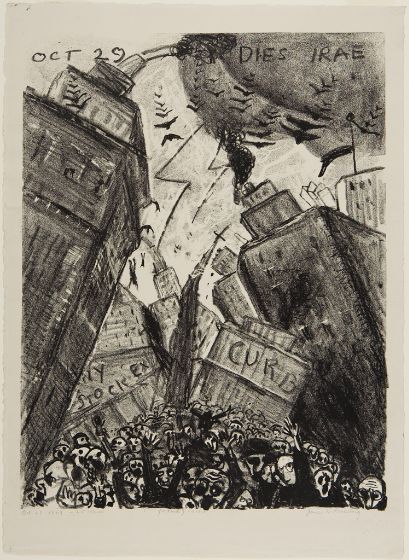 The major stock market crash and financial crisis that
broke out in the United States in the fall of 1929 and is generally viewed as the beginning of
the Great Depression of the 1930s.
The major stock market crash and financial crisis that
broke out in the United States in the fall of 1929 and is generally viewed as the beginning of
the Great Depression of the 1930s.