AGE DISCRIMINATION
Discrimination against people because they are older. This includes not hiring, or being
less likely to hire, people older than some arbitrary age; not promoting them, for the same
reasons; not treating them in the same way as younger adults; and so forth. These are very
widespread wrongful behaviors in bourgeois society in all countries.
“In China, age discrimination is so normalized that it has its own
name: the Curse of 35, a widely held belief that white-collar workers become liabilities
rather than assets once they cross that age threshold.” —New York Times,
“Laid Off in Midlife and Facing Downward Mobility in China”, March 25, 2026.
AGENT PROVOCATEUR
A term added to the vocabulary of English from French, which means “a provoking agent”. The
government, in its attempts to put down protests, will often secretly insert one or more of
its agents (such as plain-clothes cops) among the masses, who will then loudly call for some
extreme or self-defeating action (in that situation) against the government itself! If the
masses, or some of them, follow this foolish advice in that situation, this will then give
the government an excuse to physically attack the demonstrators, beat them, arrest
them, and possibly even kill some of them.
Sometimes, in poorly disciplined
demonstrations, or in ones in which there are a lot of young and inexperienced protesters
(often young anarchists) anxious to greatly raise the immediate level of struggle themselves,
some of these wild and foolish people will function just as if they were actually
agents provocateurs themselves (even though they are not). This is sort of
inadvertently doing the government’s nefarious work for them! The possibility of this sort
of thing is why many serious political demonstrations need to have their own onsite monitors
and leaders, and why they need to train the protesters over time to be disciplined and act
collectively.
Actual agents provocateurs can also function
internationally. For example, their secret violent actions can be used by an imperial power
as an excuse to launch an intervention or war against a “Third
World” nation.
AGING [Getting Older]
See also:
LIFE EXPECTANCY,
OLD PEOPLE,
OLD AGE CARE WORK
“A recent study by the National Council on Aging found that the
poorest Americans die, on average, nine years earlier than the wealthiest Americans.”
—New York Times, “Facts of Interest”, October 25, 2025.
AGITATION
1. [Wide sense:] Oral, printed and visual political works or activity whose purpose is
to influence people’s consciousness and mood, and to motivate them to take political
action.
2. [Narrow (Leninist) sense:] As above, but specifically with respect to a single
issue.
See also:
PROPAGANDA
“Those who make nation-wide political agitation the corner-stone of
their programme, their tactics, and their organizational work, as Iskra
does, stand the least risk of missing the revolution.” —Lenin, “What Is To Be
Done?” (1902), LCW 5:513.
AGNOSTICISM — About the Existence of God
Claiming not to know, or the view that one cannot know, whether or not
God exists. Agnosticism in this sense is most commonly a liberal
evasion of what in this modern scientific age should be considered common sense
materialism, that no such thing as a “disembodied mind”
(as gods and ghosts are supposed to be) can possibly exist. This is because mind and mental
attributes are merely high-level functional descriptions of a physical brain at work, as well
as the overall objective states that this physical brain is in at specific times.
“But this philosophical idealism, openly, ‘seriously’ leading to
God, is more honest than modern agnosticism with its hypocrisy and cowardice.” —Lenin,
referring to the neo-Platonists, in a note while reading Hegel’s book Lectures on
the History of Philosophy (1915), LCW 38:303.
AGNOSTICISM — Epistemological
Philosophical, or epistemological, agnosticism is the view that no one can really know
anything about the world, at least with any certainty.
See also:
RELATIVISM—Epistemological, and
Philosophical doggerel
about agnosticism.
“Agnosticism (from the Greek words ‘a’ no and ‘gnosis’
knowledge) is a vacillation between materialism and idealism, i.e., in
practice it is vacillation between materialist science and clericalism. Among the
agnostics are the followers of Kant (the Kantians), Hume (the positivists, realists
and others) and the present-day Machists.” —Lenin, “Twenty-Fifth Anniversary of
the Death of Joseph Dietzgen” (May 5, 1913), LCW 19:80.
“One expression of the profound crisis in present-day bourgeois
ideology, a reflection of the crisis in the capitalist social order, is the spread of
agnosticism and skepticism among intellectuals. Skepticisms and irrationalism have always
been characteristic of the ideology of classes that history has doomed to extinction, of
classes incapable of creating a new, life-affirming view of the world. As in the past,
when Lenin wrote Materialism and Empirio-Criticism and other works, so today
agnostics and other idealists deny not only the primacy of matter and put consciousness
in first place, they also hold the world around us to be unknowable.” —V. S. Gott,
Soviet philosopher of science, This Amazing, Amazing, Amazing but Knowable Universe,
(Moscow: Progress Publishers, 1977; original Russian edition 1974), p. 49.
AGNOSTICISM — and Science
The common, but quite false, claim that there is no certainty whatsoever in science, that
absolutely everything that we think we know is subject to future rejection because of
further scientific investigation, and that the method of science is to “doubt everything”. In
reality there are a great many things that we do now know with scientific certainty, although
it is true that the great mass of detailed scientific information which has been accumulated
over the past few centuries is indeed subject to further review, modification or, in many
specific cases, to rejection or replacement. Even many present-day scientific theories will
eventually be substantially modified, or in some rarer cases, will be abandoned entirely.
However, at the same time, a great many other scientific truths have already by now been
firmly and permanently established, at least in their most essential aspect.
For an extensive essay which criticizes this
agnostic conception of science, see: Scott Harrison, “Do We Know For Certain that the Earth
Goes Around the Sun?” (1998), online at:
https://www.massline.org/Philosophy/ScottH/certain.htm
“Ignoramus et ignorabimus.” [“We are ignorant and we will remain
so.”] —Emil du Bois-Reymond, a German physiologist, in his 1872 address “Über die
Grenzen des Naturerkennens” (“The Limits of Science.”) [He was arguing not simply that there
are still many things we don’t know (which of course is true), but rather that there are a
great many important things that we cannot possibly ever know—which is a highly
dubious, and agnostic, notion. —Ed.]
“All scientific knowledge is provisional. Everything that science ‘knows,’
even the most mundane facts and long-established theories, is subject to reexamination as
new information comes in. The latest ideas and data are the most provisional of all.”
—The Editors, Scientific American, “In Science We Trust”, December 2002, p. 14.
[This is an absurd exaggeration of the
real situation! And it is especially ridiculous to put scare-quotes around everything that
science ‘knows’, which falsely implies that science really doesn’t know anything!
Science is indeed self-correcting over time, which means previous findings and theories are
subject to re-examination, revision, and sometimes complete rejection. But this does not
mean that from a scientific point of view everything we know is subject to complete
rejection! We do now know many things with complete scientific certainty, such as that:
• The Earth orbits the Sun.
• The Moon orbits the Earth.
• The Earth is (more or less) a sphere. [Technically, a very slightly irregular oblate spheroid.]
• The Earth spins on its axis (relative to the Sun and stars).
• The earth was formed vastly longer ago than 4,004 BC. [Current estimate: 4.6 billion years ago.]
• Water is composed of two atoms of hydrogen and one of oxygen.
• Table salt is sodium chloride (plus impurities).
• Plant and animal species on earth have evolved from earlier, simpler organisms.
• Human beings require oxygen to live.
• (Ordinary) heat is at bottom the motion of molecules.
• Some atoms are radioactive.
• Light is a form of electromagnetic radiation.
• The human organ responsible for intelligence and other mental capabilities is the brain.
• Contemporary society consists of various social classes.
• and on and on!
[S.H. (August 15, 2026)]
AGRARIAN REFORM — China
The policy which developed in the course of the Chinese Revolution in which land taken from
rural landlords and the richest peasants was redistributed in a much fairer and more
equitable fashion among the peasantry. This began in liberated areas in the late 1920s,
became more widespread as the revolutionary wars continued, and was completed in almost all
of the rest of the country during the 1950-1952 period. This nationwide land reform movement
was carried out by the peasants themselves under the leadership of the Communist Party of
China. Note that this entire movement was completed before the collectivization of
agriculture occurred during the mid-1950s, which itself developed in stages and led
eventually to the People’s Communes.
See also:
AGRICULTURE—Discussion Of in the Marxist Classics
“Beginning from the winter of 1950, the new liberated areas, one after
another, unfolded a large-scale agrarian reform movement. By the winter of 1952
agrarian reform was basically completed, except in some minority nationality areas. In
the old and new liberated areas throughout the country, about 300 million landless or
land-deficient peasants received some 700 million mou
of land.” —Editorial note 3 to Mao’s article, “Fight for a Fundamental Turn for the
Better in the Nation’s Financial and Economic Situation” (June 6, 1950), SW 5:32.
AGRICULTURAL PRODUCTIVITY
The ratio of agricultural production to the number of workers who produce that production.
For a given crop, the production may be measured by volume or by weight, but for agricultural
production as a whole it must usually be measured by the money value of all the crops added
together. To compare agricultural productivity from one time to another or from one place
to another, the money value must be translated into a single currency which is also adjusted
for inflation. Even so, there will probably be problems in making such comparisons if the
prices of the various crops have significantly changed for non-inflationary reasons (such as
because of supply and demand fluctuations).
However, the overall improvement in
agricultural productivity can also be measured by simply dividing the number of farmers and
agricultural workers at different times by the total population of the country, as in the
following example:
“[Because of technological advances], between the sixteenth and
nineteenth centuries the British agricultural revolution achieved a substantially
greater production of food while simultaneously becoming less labor-intensive, and the
fact that a decreasing proportion of farmers and agricultural laborers was needed to
feed everyone else enabled greater urbanization. By 1850, Britain had the lowest
proportion of farmers of any country in the world, with only one person in five working
in the fields to feed the entire nation. By 1880 only one Briton in seven had to work
the land, and by 1910 that had fallen to one in eleven. And in developed nations today,
which exploit artificial fertilizers, pesticides, and herbicides, as well as enormously
labor-efficient technologies like combine harvesters, every agricultural worker grows
enough food to feed around fifty others.” —Lewis Dartnell, The Knowledge: How to
Rebuild Our World from Scratch (2014), p. 77 (footnote).
AGRICULTURE — Discussion Of in the Marxist Classics
Here are some general sources to investigate on this topic:
• The development of capitalism in agriculture:
— Marx,
Capital, Vol. I, Parts 4, 7, 8; Vol. III, Part 6.
— Lenin,
“Capitalism and Agriculture in the U.S.A.” (1915) [LCW 40:408-415];
The Development of Capitalism in Russia (1896-99) [LCW 3];
“The Agrarian Question and the Critics of Marx” (1907) [LCW 13:169-216];
“New Data on the Laws Governing the Development of Capitalism in Agriculture, Part One: Capitalism and
Agriculture in the U.S.A.” (1915) [LCW 22:13-102];
“The Agrarian Programme of Social-Democracy in the First Russian Revolution, 1905-7” (1907) [LCW 13:217-429]
• The socialist collectivization of agriculture:
— Engels,
“Peasant Question in France and Germany”
— Lenin,
“On Cooperation” (1923) [LCW 33:467-75]
— Stalin,
“The 15th Congress of the CPSU(B)” (1927), section II, part 3. [Works 10:310-321];
“On the Grain Front” (1928) [Problems of Leninism; Works 11:85-101];
“Concerning Questions of Agrarian Policy in the USSR” (1929) [PL; Works 12:147-78];
“Concerning the Policy of Eliminating the Kulaks as a Class” (1930) [PL; Works 12:184-89];
“Dizzy With Success” (1930) [PL; Works 12:197-205];
“Reply to Collective-Farm Comrades” (1930) [PL; Works 12:207-34];
“Work in the Countryside” (1933) [PL; Works 13:220-39];
“Speech Delivered at the First All-Union Congress of Collective-Farm Shock Brigaders” (1933)
[PL; Works 13:242-63]
— Mao,
“Report on an Investigation of the Peasant Movement in Hunan” (March 1927) [SW 1:23ff];
Report From Xunwu (May 1930), tr. by Roger Thompson, [Stanford Univ. Press, 1990);
“Preface and Postscrpt to Rural Surveys” (March-April 1941) [SW 3:11ff];
“Spread the Campaigns to Reduce Rent, Increase Production and ‘Support the Government and Cherish the
People’ in the Base Areas” (October 1943) [SW 3:131ff];
“The Land Problem”, in “On Coalition Government”, sect. IV. part 6 (April 1945) [SW 3:297-302];
“Rent Reduction and Production are Two Important Matters for the Defense of the Liberated Areas”
(Nov. 1945) [SW4:71-73];
“Tactical Problems of Rural Work in the New Liberated Areas” (May 1948) [SW4:251-2];
“The Work of Land Reform and of Party Consolidation in 1948” (May 1948) [SW4:253-9];
“Request for Opinions on the Tactics for Dealing with Rich Peasants” (March 1950) [SW5:24-25];
“Take Mutual Aid and Co-operation in Agriculture as a Major Task” (Dec. 1951) [SW5:71];
“Solve the Problem of the ‘Five Excesses’” (March 1953) [SW5:89-91];
“Two Talks on Mutual Aid and Co-operation in Agriculture” (Oct.-Nov. 1953) [SW5:131-140];
“On the Co-operative Transformation of Agriculture” (July 1955) [SW5:184-207];
“Rely on Party and League Members and Poor and Lower-Middle Peasants in the Co-operative Transformation of
Agriculture and the Current Class Struggle” (October 1955) [SW5:211-234];
“Prefaces to Socialist Upsurge in China’s Countryside” (Sept.-Dec. 1955) [SW5:235-41];
“Request for Opinions on the Seventeen Article Document Concerning Agriculture” (Dec. 1955) [SW5:281-83];
“The Relationship Between Heavy Industry on the One Hand and Light Industry and Agriculture on the Other”,
in “On the Ten Major Relationships” (April 1956) [SW5:285-86];
“On the Correct Handling of Contradictions Among the People”, section III: “The Question of the Co-operative
Transformation of Agriculture” (Feb. 1957) [SW5:399-401]
See also:
LENIN—On the Agrarian Question;
AGRARIAN REFORM—China
AI SIQI [Old style: Ai Ssu-ch’i]
[Pronounced (roughly): eye suh-chee] (1910-66)
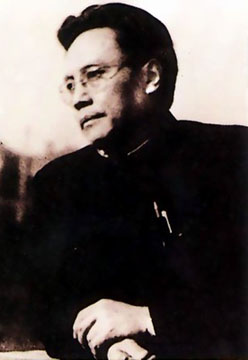 Well-known Marxist-Leninist philosopher in revolutionary China. Mao often sought him out for
philosophical conversations both during the Yan’an (Yenan) period
and in later years. Ai was well-known for his ability to explain and popularize abstract
ideas to the masses, using easy to understand examples and ordinary language, and even
employing Chinese proverbs and well-known literary allusions. His most famous book was
Philosophy for the Masses (c. 1934-36), which—like his other works—has not been
translated into English (unfortunately!).
Well-known Marxist-Leninist philosopher in revolutionary China. Mao often sought him out for
philosophical conversations both during the Yan’an (Yenan) period
and in later years. Ai was well-known for his ability to explain and popularize abstract
ideas to the masses, using easy to understand examples and ordinary language, and even
employing Chinese proverbs and well-known literary allusions. His most famous book was
Philosophy for the Masses (c. 1934-36), which—like his other works—has not been
translated into English (unfortunately!).
Ai Siqi was actually a pen name; his
original name was Li Shenxuan. As a young man he was educated in philosophy in Japan, and
returned to China in the early 1930s. He joined the Chinese Communist Party in 1935, and
went to Yan’an in 1937. There he taught both philosophy and Marxist-Leninist theory more
generally, in higher party schools. In 1937 he published his book Philosophy and Life,
which is said to address the unjustified criticism leveled at Marxism that it has no moral
or ethical principles. Besides his own writing, he also translated many foreign works of
Marxist philosophy into Chinese, including many Soviet books and articles.
In 1949 the CCP started an important
theoretical journal (Study) and Ai was a frequent contributor. He was an important
and influential person in philosophical circles in revolutionary China, and often led in
the criticism of bourgeois and reactionary philosophical ideas including those which
sometimes arose within the Party. Ai was one of the people in charge of establishing the
China Philosophical Society, and was a member of the philosophy and social sciences section
of the Chinese Academy of Sciences. But perhaps his most important contribution was that,
after Mao himself, for three decades Ai was the most important popularizer and polemicist
in philosophy in China.
See also:
“INFANTILE LEFTISM”,
ONE-DIVIDES-INTO-TWO CONTROVERSY
AIR POLLUTION
An extremely serious problem which is mostly downplayed by the capitalists and their
governments, even though it is one of the leading causes of health problems and deaths
for millions of people around the world today. According to the UN’s World Health Organization,
more than 90% of the world’s people breathe unhealthy air, and air pollution disproportionately
affects people in “developing countries”, the two worst cases being India and China. Air
pollution is the 4th largest risk factor to human health at the present time. It is responsible
for one in eight premature deaths in the world, totaling about 8,800,000 people annually.
See also:
CHINA—Air Pollution In,
FLYGSKAM,
PARTICULATE MATTER,
SMOG
“Air pollution is a vastly underestimated problem. Polluted air is linked
to one in eight deaths worldwide, and studies have shown that bad air quality can cause
cognitive impairment in young people and increase the risk of dementia and Alzheimer’s
disease in older people. But until recently, there was no good source of air quality data
that researchers and activists could rely on.
Christa Hasenkopf, an atmospheric
scientist, decided to fix that. She and a software developer started OpenAQ, an open
source platform that collects air quality data from governments and international
organizations in a single place and makes it free and accessable.” —Kevin Roose, “A Year
in Good Tech”, New York Times, Dec. 31, 2019. [The OpenAQ website is at:
http://www.openaq.org ]
“In Europe, nearly 400,000 people a year die prematurely because of
poor air quality, according to the European Union.” —“E.U. Says Carmakers Colluded to
Delay Clear Air Tech”, New York Times, April 6, 2019.