“JAGGED INTELLIGENCE”
“The way [contemporary] A.I. looks like a genius at one moment and dense
in another is called ‘jagged intelligence.’ Experts use the term to explain why A.I. is
racing ahead in some areas—like math—while struggling to make headway in others....
“The term, ‘jagged intelligence’ was
coined by Andrey Karpathy, a founding researcher at OpenAI... ‘Some things work extremely
well (by human standards) while some things fail catastrophically (again by human
standards),’ he wrote on social media in 2024, ‘and it’s not always obvious which is which.’
This, he wrote, is different from the human brain, ‘where a lot of knowledge and problem
solving capabilities are all highly correlated and improve linearly all together, from
birth to adulthood.’
“A.I. systems like Claude and OpenAI’s
ChatGPT learn their skills by pinpointing patterns in digital data, including Wikipedia
articles, news stories, computer programs and other text culled from across the internet.
But that gets them only so far. The Internet holds only a fraction of human knowledge. It
records what people do in the digital world, but contains comparatively little data about
what happens in the physical world. That means these systems can write emails, answer
questions, riff on almost any topic and generate computer code. But because A.I. systems
reproduce the patterns they find in digital data, they are not good at planning ahead,
generating new ideas or tackling tasks they have not seen before. ‘A.I. does not have
general intelligence,’ Mr. [François] Chollet said. ‘What it has is a lot of
different skills.’
“Now companies like Anthropic and OpenAI
are teaching these systems additional skills using a technique called reinforcement
learning. By working through thousands of math problems, for example, they can learn
which methods lead to the right answer and which do not. This works well in areas like
math and computer programming, where A.I. companies can clearly define good and bad
behavior. The answer to a math problem is either right or wrong. Computer code either
passes a performance test or it fails. But reinforcement learning does not work as well
in areas like creative writing or philosophy or even some of the sciences, where the
distinction between good and bad is harder to pin down....
“The wild card is that A.I. is quickly
improving. Many of the weaknesses that Dr. Karpathy and others pointed out in 2024 and
early 2025 are no longer there. Companies will find other shortcomings and fix them as
well. ‘The valleys in the technology are closing,’ Dr. Imas said.”
—New York Times, “Jagged
Intelligence Can Reframe the Debate Over A.I.”, April 17, 2026.
JANA ANDOLAN
A term in the Nepali language which means “People’s Movement”. In the recent history of
Nepal there have been three major events which have gone under this name:
Jana Andolan-I was the mass movement
in 1990 which ended the absolute monarchy and established a government which was nominally,
at least, a constitutional democracy. It was also supposed to eliminate the
Panchayat system of local and caste governance in
Nepal. However, the monarchy still existed, the King still controlled the army, and he
even dissolved parliament and re-established authoritarian control again. The failure of
Jana Andolan-I to really change the basic situation resulted in a 10-year People’s War led
by the Communist Party of Nepal (Maoist) beginning in 1996, and then to:
Jana Andolan-II in 2006 which
overthrew the King again and this time abolished the monarchy completely. This mass movement
also led to the “Seven-Party Alliance” which included the CPN (Maoist) [now renamed the
Unified Communist Party of Nepal (Maoist)], and an agreement to end the People’s War, merge
the revolutionary army into the regular army, create a new constitution, and so forth.
However the bourgeois parties [including
a revisionist party called the “Communist Party of Nepal (United Marxist-Leninist)”] have
failed to honor those agreements. In response, the UCPN(Maoist) led what it called the
Jana Andolan-III in early 2010 in an attempt to force the reactionary parties to
fully implement that earlier agreement and possibly to further develop the revolution in
Nepal. Although this involved huge mass demonstrations and a general strike
(bandh), mere protests of this sort were not sufficient
to force the reactionary parties to fulfill their promises.
There have been many threats by the
UCPN(Maoist) to launch yet another Jana Andolan, but growing numbers of the members
of the UCPN(Maoist) now seem to agree that it will take something much more powerful than
mere mass demonstrations to truly change and revolutionize Nepal.
JANGALMAHAL
[Bengali:] The Jangalmahal, or sometimes two words: Jangal Mahal, and which means
“forested belt”, is the region consisting of the largest parts of these three districts in the
Indian state of West Bengal: Paschim Medinipur (or West Midnapore), Bankura and Purulia. The
population of the Jangalmahal consists mostly of Adivasis or
“tribals” (tribal peoples), who are very poor and generally severely exploited and oppressed.
There are about 1.3 million Adivasis in the 74 “blocks” (sub-districts) of the Jangalmahal.
There has been considerable Maoist revolutionary activity in this region in support of Adivasi
struggles against the theft of their land, etc., especially in the area around Lalgarh village
in West Midnapore.
Occasionally the term Jangalmahal
is used in a looser and broader sense to cover a much larger region of the forested, tribal
belt in parts of five states of east-central India: West Bengal, Jharkhand, Madhya Pradesh,
Chhattisgarh and Bihar.
JANTELOVEN [Pronounced (very roughly): yahn-teh-low-ven]
 A set of social rules that are presumed to be characteristic of Scandinavian culture (Norway, Sweden,
Denmark). The word comes from a 1933 novel by the Dano-Norwegian author Aksel Sandemose about the
rural town Jante, where the following laws applied:
A set of social rules that are presumed to be characteristic of Scandinavian culture (Norway, Sweden,
Denmark). The word comes from a 1933 novel by the Dano-Norwegian author Aksel Sandemose about the
rural town Jante, where the following laws applied:
1. You shall not think that you are somebody.
2. You shall not think you’re quite as good as us.
3. You shall not think you are wiser than us.
4. You shall not fool yourself into thinking you are better than us.
5. You shall not think that you know more than us.
6. You shall not think that you are more than us.
7. You shall not think that you amount to anything.
8. You shall not laugh at us.
9. You shall not think that anyone cares about you.
10. You shall not think that you can teach us anything.
In social and cultural discussions, the word is used exclusively
in a negative sense.
The questions of whether the “Jantelov” exists, to
what extent, whether it’s exclusive to Scandinavia and why it exists in the first place, are up for
discussion. One’s answer will largely depend on class outlook. Bourgeois ideologues might refer to
“Janteloven” in order to equate socialist and egalitarian ideals with “small-town pettyness”. However,
other interpretations exist.
“Janteloven” might illustrate how class struggle in the
ideological field leads to different interpretations of concepts that are common to the whole culture.
—B.T. [Jan. 27, 2023]
See also:
IDEOLOGY
“JANUARY REVOLUTION” (Shanghai, January 1967)
The first major seizure of power away from the capitalist-roaders during the
Great Proletarian Cultural Revolution.
“Proletarian revolutionaries are uniting to seize power from the
handful of persons within the Party who are in authority and taking the capitalist
road. This is the strategic task for the new stage of the great proletarian
cultural revolution. It is the decisive battle between the proletariat and the
masses of working people on the one hand and the bourgeoisie and its agents in the
Party on the other.
“This mighty revolutionary
storm started in Shanghai. The revolutionary masses in Shanghai have called it the
great ‘January Revolution.’ Our great leader Chairman Mao immediately expressed
resolute support for it. He called on the workers, peasants, revolutionary
students, revolutionary intellectuals and revolutionary cadres to study the
experience of the revolutionary rebels of Shanghai and he called on the People’s
Liberation Army actively to support and assist the proletarian revolutionaries in
their struggle to seize power.”
—“On the
Proletarian Revolutionaries’ Struggle to Seize Power”, Hongqi [“Red Flag”]
editorial, #3, 1967; Peking Review, vol. 10, #6, Feb. 3, 1967, p. 10.
JAPAN — Immigration
The demographic trends in Japan are basically for the population to rapidly shrink and for
the remaining population to get ever-older on average. Both these trends are extremely
negative from the point of view of the capitalist economy. The population is shrinking
because of the very low fertility rate, which is itself due to the need for capitalists to
work both women and men for long hours and at wage levels that make supporting a family
difficult. In addition, for racist reasons Japan has been extremely reluctant to allow large
numbers of immigrants into the country. Economic requirements have forced the country to
allow a bit more immigration recently, however, as well as much larger numbers of
temporary guest workers. Despite this, however, the falling and aging population of
Japan continues to put the country at a gradually worsening economic disadvantage as compared
with other major capitalist-imperialist countries who allow more immigration.
“Vexed by labor shortages in their rapidly aging country, lawmakers
relaxed Japan’s longstanding insularity early Saturday by authorizing a sharp increase in
the number of foreign workers.... More than a quarter-million visas of five-year duration
will be granted to unskilled guest laborers for the first time, starting in 2019....
“In the absence of immigration,
Japan’s population is projected to shrink by about 16 million people—or nearly 13
percent—over the next 25 years, while the proportion of those over the age of 65 is
expected to rise from a quarter of the population to more than a third....
“Yet the new law, which came under
considerable criticism from opposition parties, does not represent an embrace of
immigration so much as a deeply ambivalent business calculation.... ‘This isn’t about
Japan becoming a multicultural society and it’s not about Japan opening its doors to
become more globally oriented,’ said Gabriele Vogt, a professor of Japanese politics and
society at the University of Hamburg who has studied migration. ‘This is just very plain
labor market politics.’
“As of October, there were nearly
1.3 million foreign workers in Japan, according to the government. Many employers use
the trainees as cheap labor, and they often are abused. Between 2015 and 2017, the
government reported that 63 foreign trainees had died from accidents or illness in Japan,
with another six committing suicide. Critics fear the new law could simply extend the
exploitation of foreign workers.” —Motoko Rich, “Out of Necessity, an Insular Japan
Changes Its Tune on Foreign Caregivers”, New York Times, Dec. 8, 2018.
JAPAN — IMPERIALISM Of
[To be added...]
See also entries above about Japan, and
specific discussion of aspects of Japanese imperialism in entries below.
“In the middle of the twentieth century Japan will meet Europe on the
plains of Asia and wrest from her the mastery of the world.” —Japanese Count Okuma
Shigenobu, Prime Minister of Japan, 1915. Quoted by Edgar Snow, The Battle for Asia
(NY: Random House, 1941), title page.
[Okuma (1838-1922) was part of the
Japanese aristocracy and for his services to imperial Japan was posthumously made a prince.
The Wikipedia entry on Okuma (accessed on 13 July 2018) notes that he was “an early
advocate of Western science and culture in Japan”, thus touting his supposedly progressive
views. It somehow fails to mention the imperialist and militaristic intentions of his own
and of the entire Japanese ruling class. —Ed.]
JAPAN — Imperialist War Against China (1937-1946)
[Intro to be added...]
“For most of the first four years of the Sino-Japanese War, the United
States continued to supply Japan with vital raw materials, the most important of which
was oil, so in a way Americans were collaborators in China’s humiliation and despoliation.
In 1931, after the Mukden Incident, the headline in the Hearst tabloids provided a
succinct summary of the American attitude, wherein its sentimental attachments to China
were trumped by China’s strategic unimportance. ‘WE SYMPATHIZE. BUT IT IS
NOT OUR CONCERN.’ The same headline could have been written after the Japanese
invasion of 1937, even if the sympathy was greater and the knowledge of Japanese atrocities
more immediate.” —Richard Bernstein, China 1945 (2014), pp. 54-55. [Bernstein is a
bourgeois American historian, so his acknowledgement of American complicity in the Japanese
imperialist war against China is all the more interesting. —Ed.]
JAPAN — Population
“Japan’s population fell by more than three million over the past five
years, according to official statistics, a drop that underscores the depths of the country’s
accelerating demographic crisis.
“The population stood at 123 million
last year, according to preliminary census results released last week, down from 126.1
million in 2020. It is the biggest decrease since the government began collecting census
data in 1920.
“Japan’s population peaked in 2008 at
128 million, and it is projected to fall to 87 million by 2070. The country is now roughly
the same size it was in 1989.
“For decades, the Japanese authorities
have tried to make up for the rapidly aging population by encouraging young people to have
more children. But the effort has fallen short, leaving the country with one of the world’s
lowest birth rates. For each new birth there are two deaths.
“Japan is a harbinger of the demographic
challenges that will soon buffet other developed countries. The shrinking population is
already constraining Japan’s economic growth, putting pressure on its health care system and
causing labor shortages.” —New York Times, “Japan Is Losing People, and It
Can’t Seem to Stop”, June 2, 2026.
[The fall in the population of a
country need not be an economic problem, except under capitalism! If the population
of a country were static or falling, then production could be appropriately adjusted in a
(genuine) socialist or communist country. Only capitalism demands perpetual expansion of
production at a pace that must eventually come into conflict with the environment in an ever
more serious way. And with the rapid expansion of automation
and A.I. at the present time, the supposed “labor shortages” of countries is becoming a mere
nonsensical story. Furthermore, there is something ridiculous about capitalist countries
demanding more and more people to pay for the health and welfare of their population! Any
rational (i.e., socialist) society could easily find the funds for the health and welfare of
everyone by simply giving up the billions and trillions of cash going to the very rich and for
imperialist wars! —S.H.] (June 28, 2026)
JAPANESE-AMERICAN INTERNMENT CAMPS — In the U.S. During World War II
The illegal, unconstitutional and totally unnecessary arrest and incarceration of more than
120,000 Japanese-American residents on the West Coast, including both citizens and non-citizens,
at the beginning of the U.S. participation in World War II. This outrageously racist and
jingoistic act was carried out after President Roosevelt issued Executive Order 9066 on February
19, 1942, even though no American of Japanese descent had been convicted of espionage or
sabotage.
[More to be added...]
“A Jap is a Jap. There is no way to determine their loyalty.” —Lt.
Gen. John DeWitt, at the time the Japanese-Americans were rounded up and put into
concentration camps. Quoted by Glenn C. Altschuler in a review of Richard Reeves, Infamy:
The Shocking Story of the Japanese-American Internment in World War II (2015), San
Francisco Chronicle, April 26, 2015, p. N-1.
“We can cover their legal situation ... in spite of the Constitution.
The Constitution is just a scrap of paper to me.” —Assistant Secretary of War John McCloy,
at the same time, quoted in the same article mentioned above. [Laws and the U.S. Constitution
are always just scraps of paper whenever the ruling class feels it needs to dispense with
them. —Ed.]
JAPANESE-AMERICAN INTERNMENT CAMPS — Effects on American Farming
Not only was the sending of Japanese-Americans to concentration camps during World War II a
political crime against a section of the people, it—ironically—also harmed American farm
production both during the war and for a long time afterwards.
“The expulsion of Japanese Americans from western states during World War II
upended nearly 120,000 lives, including those of nearly 22,000 agricultural workers, and set
back farming in affected regions for several decades. Citing security concerns in the wake of
the surprise attack on Pearl Harbor, the US government in spring 1942 declared that all
individuals of Japanese ancestry, regardless of citizenship status, were subject to mandatory
removal from all of California and parts of Washington, Oregon, and Arizona. Most were eventually
resettled in internment camps. At the end of the war, fewer than half of the internees returned
to their original states, and fewer still [were allowed to] reclaim their farms or return to
agriculture.
“In ‘How the 1942 Japanese Exclusion Impacted US
Agriculture’ (NBER Working Paper 33971), Peter Zhixian Lin and Giovanni Peri show that Japanese
Americans made up a disproportionate number of agricultural workers in the counties affected by
the expulsion order. Drawing on county-level data from the Population Census and the US Census
of Agriculture in the years between 1925 and 1940, they show that Japanese Americans tended to be
better educated and to possess greater expertise than their non-Japanese counterparts. They grew
more profitable crops, such as fruit and vegetables, and were more likely to adopt the latest
innovations in machinery, fertilizer, and other farming techniques.
“In the 1940 Census, 42 percent of working-age
Japanese Americans (age 14 and up) in the exclusion zone counties held jobs in agriculture,
compared with 11 percent of the general population. Thirty-one percent of Japanese farm workers
had finished high school, compared with only 12 percent of their White counterparts. The average
land value of Japanese farms was $246 per acre, compared with $40 for non-Japanese farms.
“As a result of the evacuation orders, affected
counties suffered an agricultural brain drain. Slower to mechanize and adopt innovative
technologies and fertilizers, these counties fell behind in farm performance. Each percentage
point reduction in the number of Japanese farm workers was associated with a 23 percent decrease
in fruit and vegetable sales in the post-1942 period. This negative effect stems from slower
growth of farm productivity and farm value rather than from fewer farms.
“Meanwhile, counties outside the exclusion zone
that had larger shares of Japanese farmers as of the 1940 Census grew relatively faster in the
postwar years. For every percentage point increase in Japanese farm worker share, non-exclusion
counties experienced nearly 9 percent higher total growth in farm value over the 1945–60 period.
Counties from which Japanese workers were expelled experienced 12 percent slower growth in farm
value for each percentage point reduction in the share of Japanese Americans among farm workers.
“Expelling Japanese farmers reverberated beyond
the agriculture sector. The researchers conclude that ‘the loss of these skilled farmers hindered
technological adoption, creating lasting negative effects on both agricultural performance and
broader local economic development.’”
—Steve Maas, “Expelling Japanese Americans
Lowered US Farm Productivity”, NBER Digest, September 2025.
[What this review article neglects to even
mention is the primary reason why so many Japanese American farmers did not return to their
farms after the end of the war: Namely, because in many cases their farms had in effect been stolen
from them! Japanese-Americans attempting to return to their farms in 1945 often found their land
occupied by other people who refused to leave, and even when they did return to their own farms they
frequently found them looted or damaged. And they faced considerable hostility and even violence
from many of their neighbors and the local governments. Sometimes it was simply impossible to
resume their agricultural livelihoods and rebuild their rural lives. The Google AI summary (Sept. 2,
2025) of the situation puts it this way:]
“While Japanese-American farmers were not officially
barred from returning to their farms after World War II, many were prevented by the severe economic
losses, intense anti-Japanese discrimination, and theft of their property during their internment.
Some lucky families were able to reclaim their land, but the economic and social structures for many
were permanently altered.
“Most Japanese-American farmers, especially those who
leased rather than owned their land, had no farm to return to after the war. Many were forced to sell
their property at ‘bargain basement prices’ when they were removed in 1942. Other property was simply
abandoned or entrusted to neighbors who did not always act honorably.
“Anti-Japanese Hostility: In many areas, prejudice
had not diminished during the war; in some places, it had grown more organized. The ‘Remember Pearl
Harbor League’ was a group of white farmers and businessmen in the Auburn, CA, area who feared the
return of successful Japanese-American farmers for economic reasons.
“Some city and county governments on the West Coast
seized properties for back taxes or permitted banks to foreclose while Japanese Americans were
incarcerated. Federal and state governments largely refused to take responsibility for the property
losses. The Truman administration took the position that the federal government was not responsible
for the actions of local authorities.
“Even for those with property to reclaim, the years of
forced absence resulted in financial ruin. Farms were often in a state of disrepair, and families
lacked the resources to restore them.
“Factors that allowed some farmers to return: Despite
the hardships, some Japanese-American farmers did manage to reclaim their land, often with the help of
compassionate neighbors. In some cases, farmers entrusted their land to non-Japanese neighbors who
looked after the property and finances. For example, a California agriculture inspector named Bob
Fletcher managed the Tsukamoto family’s grape farm, paying the mortgage and taxes, and returned the
farm along with half the profits upon the family’s release....
“Long-term impact: Ultimately, the mass displacement
profoundly changed the trajectory of the Japanese-American community. The number of Japanese-American
farmers dropped dramatically, with some estimates reporting that their pre-war presence was reduced to
a quarter by 1960. The trauma of incarceration and economic losses pushed many families to encourage
their children to pursue safer, non-agricultural professions and higher education.
“The financial costs were staggering, with property
losses estimated in the billions of dollars in today’s money. In 1988, the US government formally
apologized and offered $20,000 in redress to each surviving internment camp detainee, though this
[obviously!] did not fully compensate for the damages.”
JESUITS (Society of Jesus)
1. A fanatical and ultra-disciplined
religious organization within the Roman Catholic Church which was founded by Ignatius
Loyola in 1534 and which has specialized in Catholic education and religious
indoctrination, and ideological oppression.
2. [Jesuit:] One given to intrigue or
equivocation. [Merriam-Webster’s Collegiate Dictionary, 10th ed., 1991]
See also:
INDIVIDUALISM—Within a
Revolutionary Party,
LAGRANGE, Joseph-Louis [Alexander quote]
“[F]or the Jesuits, the principle of ‘obedience’ was not just a
practical concession to the requirements of efficient action, but a religious
ideal of the highest order. ‘With all judgment of our own put aside, we ought ...
to be obedient to the true Spouse of Christ our Lord, which is our Holy Mother
the hierarchical Church,’ wrote Ignatius [Loyola] in The Spiritual Exercises.
This obedience extends not only to actions, but also to opinions and even sense
perceptions. ‘To keep ourselves right in all things,’ Ignatius wrote, ‘we ought
to hold fast to this principle: What I see as white I will believe to be black if
the hierarchical Church thus determines it.’” —Amir Alexander, Infinitesimal
(2014), p. 40. [This is indeed dogmatism to the point of total fanaticism. —S.H.]
“JEVONS PARADOX”
The apparent (but not actual) “paradox” that as the use of a commodity in production becomes
more efficient, and therefore that the need for that commodity falls per unit of its productive
result, the demand for that intermediate commodity may nevertheless likely increase
because the demand for the final commodity (or result) will also increase. In other
words, if something is used more effectively, the need for that item will likely expand (and
not decline) because the places it is used will also very likely expand. When expressed
abstractly, this rule of thumb may sound a bit confusing, so see the quotation below for a
concrete example. [Feb. 18, 2025]
“The Jevons Paradox is named after the 19th-century economist William
Stanley Jevons. In his 1865 book, ‘The Coal Question,’ he noted that as engines improved
and made coal more efficient—requiring less of the resource to produce the same amount
of energy—demand for coal would actually increase; a drop in the cost of production
often leads to greater production.” —Talmon Joseph Smith, “Shop Talk”, New
York Times, February 16, 2025. Smith himself defined the “Jevons Paradox” as: “An
economic theory that says as a resource becomes more efficient to use, demand for that
resource will increase.” Smith also noted that this “paradox” is now being said to be
coming true in the current rapid expansion in the number of and use of Artificial
Intelligence programs, even though all those AI programs are also each becoming much
more efficient. —Ed.]
JIANG Qing (Old style: Chiang Ching) (1914-91)
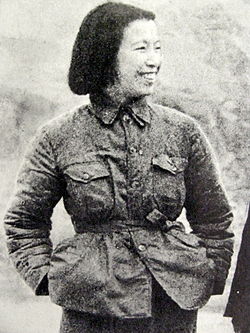 Jiang Qing was Mao Zedong’s third wife, and the most prominent member of the so-called
“Gang of Four” who played a prominent role in leading the
Great Proletarian Cultural Revolution and who attempted unsuccessfully
to continue the Chinese revolution after the death of Mao.
Jiang Qing was Mao Zedong’s third wife, and the most prominent member of the so-called
“Gang of Four” who played a prominent role in leading the
Great Proletarian Cultural Revolution and who attempted unsuccessfully
to continue the Chinese revolution after the death of Mao.
After completing elementary school she enrolled
in an acting school in Tai’an and at the age of 15 or 16 became part of an avant-garde theatrical
group in 1929. In Qingdao in 1930 she began to associate with the Communist Party, and became a
member in 1931. She was arrested for political activities and briefly imprisoned in 1933. In 1934
she married the film critic Ma Jiliang, and was divorced in 1937 after a scandalous affair. Not
long after the Sino-Japanese War broke out Jiang went to Yanan which was the central base of the
revolution. She worked at the Lu Xun Art Institute there, and met Mao. Within a year they were
married.
For many years Jiang Qing did not play much of a
public role (required, it is said, by the Party leadership which had not approved of her marriage
to Mao). In the early 1960s, however, she began to work on reforming the traditional Beijing
Opera, by instilling more up-to-date themes and revolutionary content into it. She played an
especially prominent role in promoting revolutionary art, literature, music, drama and films
during the GPCR. Many of the model revolutionary Chinese operas of that period were produced
with her guidance and direction. See: BEIJING
(PEKING) OPERA
It seems that she and the other top Party
leaders who tried to remain loyal to Marxism-Leninism, Mao Tsetung Thought [as our revolutionary
science was then called] failed to use the mass line that Mao
always strongly advocated, and failed to unite the great majority of the masses and the Party
members against the relatively small number revisionists and capitalist-roaders within the Party.
This is why Mao himself gave the friendly advice to this core of revolutionary leaders not to
form themselves into a “Gang of Four” (which is the origin of the phrase).
The revisionists within the CCP bided their time
until Mao died on September 9, 1976. Less than a month later, on October 6, 1976, Jiang Qing and
the other members of the “Gang of Four” were arrested and imprisoned. A show trial for them began
in 1980, and according to the revisionists only Jiang Qing bothered to mount any sort of defense.
She stated that she had obeyed the orders of Chairman Mao at all times and always tried to defend
Mao and his political line. She also made the famous statement that “I was Chairman Mao’s dog.
I bit whomever he asked me to bite.” At the conclusion of the trial in 1981, Jiang Qing was
sentenced to death. In 1983 her sentence was commuted to life imprisonment. While in prison she
developed throat cancer and in 1991 was released temporarily to a hospital. She reportedly
committed suicide before she could be returned to prison. It is claimed that she left a suicide
note which read:
“Today the revolution has been stolen by the revisionist clique of Deng,
Peng Zhen, and Yang Shangkun. Chairman Mao exterminated Liu Shaoqi, but not Deng, and the
result of this omission is that unending evils have been unleashed on the Chinese people
and nation. Chairman, your student and fighter is coming to see you!” —Jiang Qing,
as reported in the book by Ross Terrill, The White-Boned Demon (2000).
However, there are also suspicions that she was murdered by her revisionist jailers, to
prevent her from becoming a rallying point for Maoists. In that case her “suicide note” may have
merely been from something else she wrote, such as perhaps a journal.
For a long, well-researched article about Jiang
Qing and her struggles against revisionism, which is written from a Maoist perspective, see
“Chiang Ching: The Revolutionary Ambitions of a Communist Leader”, by Zafia Ryan, at:
https://www.bannedthought.net/International/RIM/AWTW/1993-19/Chiang_Ching.htm
“You have been wronged. Today we are separating into two worlds. I am
old and will soon die. May each keep his peace. These few words may be my last message
to you. Human life is limited, but revolution knows no bounds. In the struggle of the
past ten years I have tried to reach the peak of revolution, but I was not successful.
But you could reach the top. If you fail, you will plunge into a fathomless abyss. Your
body will shatter. Your bones will break.” —Said to be a prose poem, summation and
warning written by Mao shortly before his death and sent to Jiang Qing. [As posted by
Mike Ely on the Kasama-Threads website on Oct. 15, 2008.]
JOB OFFERS
Outside job offers (from other companies) to those who already have jobs have been declining for a
long time in the American economy. There may be a number of reasons for this, but two major reasons
seem to be the constant expansion of giant monopolies (or oligopolies)
and the collusion between these giant companies with either explicit or else tacit agreements not to
“poach” each-other’s workers, in order to keep the prevailing wages down. (See the summary of one
recent study on this topic below.) This is an example of the unity of interests of the bourgeoisie
against the working class, which often even overrules the advantages one company might derive out of
“stealing” another’s employees.
On the other hand, the more skilled and hard to
find a particular sort of worker might be, the more likely the individual interests of that one
company might come to overrule their collective bourgeois class interests. However, this implies that
if the labor force is gradually being “de-skilled” overall—as there is also reason to believe—then
the need for corporations to strongly compete with each other for workers is also diminishing. The
growth of the reserve army of the unemployed also diminishes the need for companies to try to
poach employees from each other.
“We quantify how structural changes in the U.S. labor market have contributed
to wage stagnation over the past four decades by weakening the job ladder. Using Current
Population Survey microdata from 1982–2023 and a partial-equilibrium job-ladder model, we
estimate that employed workers today are about half as likely to receive a better-paying outside
offer as they were in the 1980s. This decline is unlikely to reflect less efficient matching,
weaker labor demand, or changes in workers’ acceptance behavior. Instead, cross-state variation
is consistent with rising employer concentration and the growing use of noncompete agreements
having curtailed opportunities for job shopping. In a general equilibrium version of the model,
we find that these changes have reduced annual real wage growth by 0.68 percentage points—roughly
one-third of the post-1980 slowdown—with about two-thirds of the effect operating through
equilibrium wage setting rather than mechanical reallocation.” —Niklas Engbom, Aniket
Baksy & Daniele Caratelli, “The Long-Term Decline of the U.S. Job Ladder”, NBER Working Paper
34981, March 2026.
JOBLESS RECOVERY
A recovery from an economic recession in terms of renewed GDP growth
which is not matched (or only feebly so) in terms of job growth, and the hiring back of workers
who were laid off during the recession.
The first recession in the U.S. to be given this
description was that of 1990-91, though a recovery in jobs did eventually occur (as the so-called
“Dot.com” or “New Economy” bubble developed). This same phenomenon was even more pronounced in
the 2001 recession and its aftermath. Indeed, a considerable part of the very slow job recovery
after that recession was actually due to phony statistics rather than to actual job growth. But
the most extreme example so far of a jobless recovery has been in the aftermath of the
“Great Recession” of 2007-2009. A year and a half after
this recession is said to be over by bourgeois economists even the official
unemployment rate is still around 10%, and the actual
unemployment rate, including long-term discouraged workers who have given up looking for work,
is over 20%.
The fact that jobs are returning ever slower
after recessions, or even not at all, is due to two major factors:
1) The underlying contradictions of the capitalist
economy are becoming ever worse, and it is getting harder and harder to resolve them even
temporarily.
2) There is a long term trend under capitalism
to drastically improve productivity and to require ever fewer workers to produce all the goods
and services for which there is effective market demand. (This is sometimes called the problem
of automation.)
JOBS — Disappearing
See also:
COMPUTERS—and Unemployment,
ARTIFICIAL INTELLIGENCE,
AUTOMATION—The Claim that Automation Creates More Jobs than It Displaces
“The emerging automation wave that [Google CEO] Eric Schmidt called
attention to at Davos [in 2014] is going to replace millions of jobs and alter the nature
of many of those jobs that remain. Some technology experts like Ben Way expect a loss of
70 percent of existing jobs in the next three decades, with little hope that very many new
jobs will emerge to replace what is lost. University of Pennsylvania sociologist Randall
Collins expects an unemployment rate in the neighborhood of 50 percent. One need not
accept these predictions—they strike us as speculative if not extreme—to see that at the
very least what is about to transpire is going to put severe downward pressure on
wages and working conditions, which already are deplorable. ‘What does the “end of work”
mean, exactly?’ journalist Derek Thompson asked in a penetrating examination of
automation in a 2015 issue of the Atlantic. ‘It does not mean the imminence of
total unemployment, nor is the United States likely to face, say, 30 or 50 percent
unemployment within the next decade. Rather, technology could exert a slow but continual
downward pressure on the value and availability of work—that is, on wages and on the
share of prime-age workers with full-time jobs.’”
—Robert W. McChesney & John
Nichols, People Get Ready: The Fight Against a Jobless Economy and a Citizenless
Democracy (2016), p. 20. [It is interesting to see here that even many people who are
alarmed about disappearing jobs find it hard to understand just how many existing
jobs are going to disappear, and just how soon that will occur! —Ed.]
“We have developed a fairly definite idea that an employer’s business
is to eliminate work.” —Rexford G. Tugwell, Industry’s Coming of Age (NY:
1927), p. 37; quoted in Eugen Varga, The Decline of Capitalism (1928), p. 16.
[Tugwell was a liberal bourgeois
economist who became part of Franklin D. Roosevelt’s original “Brain Trust” which
developed policy recommendations resulting in Roosevelt’s “New Deal” program. It is true,
of course, that since the beginnings of capitalism it has been the goal of every capitalist
to produce goods with ever smaller amounts of work and ever fewer workers. These efforts
took one qualitative leap with the Industrial Revolution, and are now taking a much greater
and more profound qualitative leap with modern automation
and artificial intelligence. —Ed.]
“Robots could eliminate 75 million jobs globally by 2022 and create 133
million others, according to a World Economic Forum report released last year. Global
manufacturers could also face a potential shortage of 7.9 million workers by 2030, warns
a study released last year by the consulting firm Korn Ferry.” —Nick Leiber, “Early
Lessons in Robotics”, New York Times, June 7, 2019.
[Even while many bourgeois
economists now recognize that jobs are disappearing rapidly, and new jobs are coming
into existence at an ever slower pace, some bourgeois ideologists refuse to believe
that any of this could possibly be true! However where are the supposed “133 million”
new jobs going to be? In what industries? And the claim that there will be a shortage of
workers in manufacturing specifically is utter
nonsense given the decades-long decline in world manufacturing jobs that is overall only
speeding up. —Ed.]
“Tech jobs in the United States have declined by about 150,000 from 2022
through 2025.” —New York Times, “First to Be Disrupted by A.I.? Its Creators”,
April 6, 2026. [Indeed! It turns out that among the easy jobs to automate and eliminate
are those in programming and those related to producing Artificial Intelligence itself!
The demand for programming jobs, in particular, is already dropping like a rock! —Ed.]
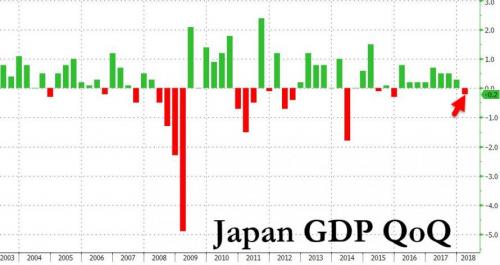 Around 1991 Japan entered a long period of intensified stagnation, a period of “in-and-out-of-recession”
with only weak recoveries in between the recessions. (See:
Around 1991 Japan entered a long period of intensified stagnation, a period of “in-and-out-of-recession”
with only weak recoveries in between the recessions. (See: 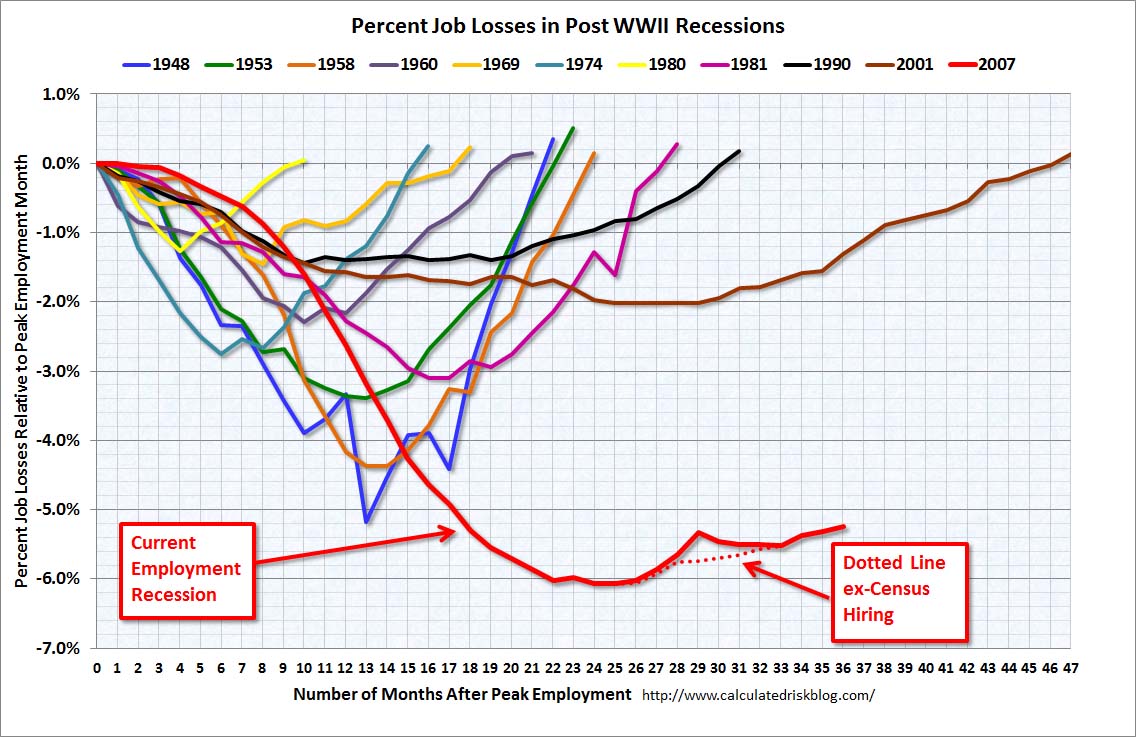 A graph showing the percentage of jobs lost during a recession beginning at the start of that
recession. The graph at the right (from the Calculated Risk website) shows the job loss curves
for all the U.S. recessions since World War II. Note that the fairly recent
A graph showing the percentage of jobs lost during a recession beginning at the start of that
recession. The graph at the right (from the Calculated Risk website) shows the job loss curves
for all the U.S. recessions since World War II. Note that the fairly recent