WHAMPOA MILITARY ACADEMY
A military school founded in May 1924 by Sun Yat-sen at the
suggestion of the Soviet Union and the Communist Party of China. Sun appointed
Chiang Kai-shek as president of the Academy, and
Zhou Enlai [Chou En-lai] as director of the Academy’s political
department. Unlike most military schools, Whampoa is said to have attached equal importance to
military training and political education; however, much of this political education was of a
nationalist patriotic flavor. Several Soviet Red Army officers, including General Vasily Blucher
[“Galen”], were invited to serve as military advisors at the school and to the KMT as a whole.
A large number of members of the CCP and its Youth League studied at this Academy.
See also:
BLUE SHIRTS
“[This] was a military school founded in 1924 by Dr. Sun Yat-sen with the
help of the Chinese Communist Party and the Soviet Union after he had organized the Kuomintang.
Located in Whampoa near Kwangchow [Guangzhou], it was jointly run by the Kuomintang and the
Communist Party until Chiang Kai-shek’s betrayal of the revolution in 1927.” —Note in Peking
Review, #11, March 11, 1977, p. 11.
WHAT IS TO BE DONE? [Book by Lenin]
An extremely important book by Lenin which was written at the end of 1901 and which first appeared
in early 1902, and whose full title was: What Is To Be Done? Burning Questions of Our Movement.
This book has played an important role in the establishment of communist parties not only in Russia,
but also in many other countries.
“In issue No. 12 (December [1901]) of Iskra, Lenin published his
article ‘A Talk with Defenders of Economism’ which he later called a conspectus of What
Is To Be Done? He wrote the Preface in February 1902 and early in March the book was
published by Dietz in Stuttgart. An announcement of its publication was printed in Iskra,
No. 18, March 10, 1902.
“What Is To Be Done? played an
important part in the struggle for a revolutionary Marxist party of the working class in Russia,
and in the victory of the Leninist Iskra trend in the committees and organizations of
the R.S.D.L.P. and at the Congress in 1903.
“In 1902 and 1903 the book was widely
distributed among the Social-Democratic organizations in Russia; it was found during police
searches and arrests of Social-Democrats in Kiev, Moscow, St. Petersburg, Nizhni-Novgorod,
Kazan, Odessa and other towns.” —Note 80, Lenin Selected Works, vol. 1 (1967).
“What is to be Done is a book of key importance for the Marxist
conception of the tasks of the working class party. To understand the circumstances in which it
was written, and as an aid to grasping its principal points, the reader should consult the
History of the C.P.S.U.(B.), Chapter I, Section 5 and Chapter II, Section 2.
“What is to be Done was directed
against those who in the early days after the establishment of a working class party in Russia
taught that the workers should engage in economic struggle only, concentrating on bread-and-butter
problems rather than political issues. Lenin saw in this trend the nucleus of opportunism in the
working class movement, of class collaboration.
“The ‘Economists,’ as they were called,
began their campaign by demanding ‘freedom of criticism’ in the party, attacking what they
called the ‘narrow political views’ of Lenin. The first chapter of What is to be Done is
accordingly devoted to the question of ‘Freedom of criticism.’ Lenin shows that the ‘freedom of
criticism’ demanded by the Economists means freedom to embrace bourgeois ideas instead of
Marxism, and that this opens the way to collaboration with the bourgeoisie. Of course, he says,
the Economists are ‘free’ to take the path of class collaboration, but not to drag the party
with them.
“Lenin shows that to confine the working
class movement to economic struggle alone means to give up the political struggle and so to
condemn the workers to eternal wage slavery. The Economists relied on the spontaneous movement
of the workers protesting against bad economic conditions. Lenin shows that to rely in this way
on spontaneity is ‘tailism’ (kvostism), i.e. it is to tail behind events, instead of
giving leadership. Political knowledge cannot arise in the working class movement spontaneously,
as a result of spontaneous economic struggle alone. Political knowledge, revolutionary theory,
must be introduced into the working class movement. The Economists belittled the role of theory.
But ‘without revolutionary theory there can be no revolutionary movement.’
“Lenin shows that the roots of opportunist
ideas and of opportunist policies in the labor movement lie in the attitude of relying on the
spontaneous movement and belittling the role of theory.
“In What is to be Done Lenin shows
concretely how to combine political and economic struggle. Working class political struggle
must be something much broader than mere ‘trade union politics.’ The workers must be concerned
with ‘the inter-relations between all the various classes,’ and must fight against every
manifestation of reaction. In advocating economic struggle alone, the Economists sank into
reformism, opportunism. But the struggle for reforms must be subordinated to the struggle for
for liberty and socialism.
“In What is to be Done Lenin also
deals with questions of party organization. He stresses the need for a centralized disciplined
organization, for the practical and theoretical training of revolutions, for a firm Marxist
theoretical basis.”
—Readers’ Guide to the Marxist Classics,
prepared and edited by Maurice Cornforth, (London: Lawrence & Wishart, 1953), pp. 47-48.
WHERE DO NEW THINGS COME FROM?
In answering this question the first essential bit of wisdom was stated by the ancient Roman
materialist philosopher Lucretius: Ex nihilo nihil fit. “Nothing can be made out of nothing.”
[From his great work De Rerum Natura, “The Nature of Things”.]
“So do new things arise ex nihilo, out of nothing? No, they arise
through the transformation of older things which had a different character, a different
essence (in the relevant respects). Thus ice does not arise out of nothing, but through the
transformation of something else, liquid water, under certain conditions (low temperatures).
Similarly, human beings did not suddenly appear out of nothing, nor out of some idealist
‘Godhead’, but rather we developed out of earlier forms of life, most recently from pre-human
ape-like hominids. And life itself did not originally ‘develop out of nothing’ (whatever that
might be taken to mean), but through the transformation of at least moderately complex
organizations of non-living chemical compounds.
“Sometimes we speak as though something
new and wonderful appeared out of the blue, out of nowhere, but really it is not true, and
when we stop to think about and investigate its origins this becomes clear. New things, and
changes in general, are a matter of the transformation of the old into the new, rather than
the miraculous creation of the new out of thin air.
“From this first basic and rather
obvious principle, we can derive a number of subsidiary principles, such as:
“1) To make something new, you
must start with something else which already exists, and find a way to transform it.
“2) Often there will be several
different existing things which can be transformed into more or less equivalent new things;
but...
“3) In these cases, one of the
existing things will almost always be more easily transformed into the new thing than any of
the others. (There’s almost always a ‘best way’ to proceed.)
“4) Thus a careful analysis must
be made of existing things to see what to start with in constructing the new thing.
“5) The old thing which can most
easily be transformed into the desired new thing may be quite unlike the new thing in important
respects. It may be glaringly deficient in the very characteristic that we are most interested
in, and thus be overlooked at first. (For example, it is vastly easier to transform an acorn
into an oak tree than it is to transform a maple tree into an oak tree—even though in many
respects the maple is much more like the full-grown oak than a little acorn is.)
“6) Since anything new is derived
from something old, it will still contain elements or aspects of the old thing.
“7) The only way the undesirable
remaining aspects of the old thing within the new thing can be eliminated is through a series
of further transformations. It is irrational to expect that something totally new can
be created through a single transformation. (Is anything ever really ‘totally new’? Certainly,
in the sense that its essential aspect(s) or characteristics may be completely new. But there
are always at least some other aspects of the thing which are not new. Thus there is
some little bit of truth to the point of view that ‘there is nothing new under the sun’, even
though it is essentially wrong.)
“Let us now apply these subsidiary
principles to a few of the many issues involved in social revolution. Why, for example, must
there be the transitional stage of socialism between capitalism and communism? It follows
immediately from principles 6 and 7. Socialism is the whole period during which a series of
transformations turns capitalism into communism.
“Next, how can the proletariat, which
originally and for long periods is unconscious of the need for revolution and of its
revolutionary role, come to be the revolutionary force which transforms society? Through its
own step-by-step transformation. From principle 1 we must find the ways to help transform the
proletariat into a conscious revolutionary force.” —Scott Harrison, excerpt from Chapter 31
of The Mass Line and the American Revolutionary Movement, online at:
http://www.massline.info/mlms/mlch31.htm
WHISTLE-BLOWER
A person who, in government or elsewhere, exposes a misdeed or crime, i.e., who “blows the whistle”
as a referee might do during a sports event to signal a foul. Although the authorities in capitalist
society claim that they want to prevent, stop and punish crimes and misdeeds, their frequent
hostility towards whistle-blowers shows their real attitude. The reason for this, of course, is that
most of these crimes and wrongdoings are being done by members of the ruling class itself who are
victimizing the workers and masses in one way or another. These are things the ruling class would
for the most part just as soon ignore or pretend do not exist at all.
“The Obama administration had waged what people across the political spectrum
were calling an unprecedented war on whistle-blowers. The president, who had campaigned on a
vow to have the ‘most transparent administration in history,’ specifically pledging to protect
whistle-blowers, whom he hailed as ‘noble’ and ‘courageous,’ had done exactly the opposite.
“Obama’s administration has prosecuted
more government leakers under the Espionage Act of 1917—a total of seven—than all previous
administrations in US history combined: in fact, more than double that total. The
Espionage Act was adopted during World War I to enable Woodrow Wilson to criminalize dissent
against the war, and its sanctions are severe: they include life in prison and even the death
penalty.” —Glenn Greenwald, No Place to Hide: Edward Snowden, the NSA, and the U.S.
Surveillance State (2014), p. 50.
WHITE-COLLAR WORKER
A person, usually working for a salary, whose work allows (or even requires) them to work in fancier
clothing, such as in white dress shirts with collars. “Blue-collar workers”, in contrast, usually have
to perform physical work, and under conditions where their clothing might become soiled or damaged,
and thus require sturdier and more protective forms of work clothes. The different types of work in
these two contrasting situations also typically leads to different types of class consciousness for
the two types of workers, with blue-collar workers generally having a more proletarian perspective,
while while-collar workers often have more social connections with, and sympathies towards, the
company’s top management and owners.
Some people seem to include top management within
the category of “white collar” employees, since they may dress similarly. However, they are clearly
not really “workers” in the Marxist sense, since the largest part of their income actually
derives from sharing in the profits which comes from exploiting the actual workers at the
company, both blue- and white-collar.
WHITE PHOSPHORUS
White phosphorus is a form (or “allotrope”) of the element phosphorus, P4, which ignites
spontaneously upon contact with oxygen. Once ignited, it burns at very high temperatures (reaching
about 815°C) and produces a thick, white, irritating smoke. It is extremely dangerous, and must be
used with great care in industry.
White phosphorus is incredibly dangerous to humans.
Its waxy texture allows it to stick to skin and clothing, where it continues to burn as long as it is
exposed to air, producing deep and severe thermal and chemical burns that can penetrate down to the
bone. Furthermore, inhaling the dense smoke it produces can cause acute respiratory tract damage, and
the chemical is highly toxic if it is absorbed into the bloodstream or ingested.
Nevertheless, White phosphorus is used by militaries
in artillery shells, mortars, and grenades to illuminate battlefields, generate dense smokescreens to
conceal troop movements, and create fires. In some cases it is used in fact as a form of chemical
warfare, though militaries virtually always deny that this is what they are doing. It is claimed by
militaries that the use of white phosphorus is “not” chemical warfare (and hence “not” a violation
of international law against chemical warfare), when it is used to provide battlefield illumination
or smokescreens. Moreover, it is claimed by militaries that their use of white phosphorus is heavily
restricted. Nevertheless, there have been numerous cases where the evidence seems to clearly show
otherwise. “Because of the horrific nature of its burns and its indiscriminate nature, using it as
an incendiary weapon in or near populated areas is widely considered a violation of international
humanitarian law.” [Much of the information in this entry was provided by Google’s AI assistant, as
of June 12, 2026.]
“The Israeli military has deployed white phosphorus, an incendiary substance
that can be extremely harmful, over populated areas in Lebanon in its battle against Hezbollah,
according to experts, aid groups and visual evidence collected by the New York Times.
“Distinctive smoke trails from this type
of munition were seen as recently as May 30 in Nabatieh, a city of roughly 40,000, in social
media footage verified by The Times, which was filmed as Israeli forces captured Beaufort Castle,
a landmark in the area.
“Other verified footage showed that white
phosphorus had been used in the vicinity of the coastal city of Tyre, as well as near three
small towns—Qlayaa, Khiam and Yohmor—in the months since fighting between Israel and Hezbollah,
the Iranian-backed militant group, began again in March. The latest fighting erupted after
Hezbollah fired rockets into northern Israel, following joint U.S.-Israeli strikes on Iran.
“Once exposed to air, white phosphorus
spontaneously ignites and is exceptionally difficult to extinguish.
“Often deployed by militaries to create
fires and smoke screens during combat, white phosphorus is not illegal in itself, but deploying
it deliberately against civilians or in an area populated by civilians violates the international
laws of war. Human rights advocates have raised concerns that civilians have been affected by the
Israeli military’s use of it.
“Israel denies using the substance in
violation of those laws. It is not clear for what purpose the Israeli military used white
phosphorus in these incidents....
“Israel’s deployment of white phosphorus
in populated areas has brought about scrutiny in the past....
“Israel has also deployed white phosphorus
in Gaza--in 2009, and in conflicts in Lebanon, including 1982 and 2006. In the year following
the Oct. 7, 2023, Hamas attacks on Israel, the Israeli military used white phosphorus more than
200 times in Lebanon, according to Ahmad Beydoun, an independent researcher who built a visual
database of its sightings in the country....
“According to the World Health Organization,
white phosphorus causes severe burns if it comes into contact with flesh. It can also cause
respiratory and eye injuries if inhaled.
“‘The harm that white phosphorus causes is
horrific,’ said Bonnie Docherty, a senior adviser at Human Rights Watch. ‘It inflicts burns that
can penetrate to the bone.’ The dense smoke it produces, she said, ‘causes severe respiratory
damage, and organ failure. Wounds can reignite when bandages are removed and remnants of the
substance are exposed to oxygen.’ White phosphorus can also set homes, cars, buildings, fields
and other objects on fire....
“Establishing that white phosphorus has
been used intentionally against civilians can be difficult. A Human Rights Watch report in 2009
found that the Israeli military had repeatedly used these munitions over densely populated parts
of Gaza. Four years later, after international pressure from rights organizations, the Israeli
military announced that it would significantly reduce its use of white phosphorus.” [However,
recent events in Lebanon indicate that this has not actually happened. —Ed.]
—Sanjana Varghese, “Visual Evidence
Suggests Israel’s Use of White Phosphorus in Lebanon”, New York Times, June 7, 2026.
WHITE TERROR
1. A period in some particular place, and during some
particular period, when anti-Communist political forces attack, suppress or murder Communists or
revolutionaries. Episodes of White Terror have been very common in the course of many revolutions,
including the Russian Revolution and the Chinese Revolution. The bourgeoisie and other reactionaries
are extraordinarily vicious and murderous.
2. [In Taiwan:] A four-decade period of political
repression beginning in 1949 when Chiang Kai-shek’s Guomindang [Kuomintang or KMT] forces fled to Taiwan
and began the systematic terrorization against any opposition there. Many tens of thousands of people
were murdered.
“Martial law, declared on Taiwan in May 1949, continued to be in effect after the
[Guomintang] central government relocated to Taiwan. It was also used as a way to suppress the
political opposition and was not repealed until 38 years later in 1987. During the White Terror,
as the period is known, 140,000 people were imprisoned or executed for being perceived as anti-KMT
or pro-Communist. Many citizens were arrested, tortured, imprisoned and executed for their real or
perceived link to the Chinese Communist Party. Since these people were mainly from the intellectual
and social elite, an entire generation of political and social leaders was decimated. In 1998, a
law was passed to create the ‘Compensation Foundation for Improper Verdicts’ which oversaw
compensation to White Terror victims and families. President Ma Ying-jeou made an official apology
in 2008, expressing hope that there would never be a tragedy similar to White Terror.” —Wikipedia
article on Taiwan, as of 10/28/22. [It is not very clear how families of people who have been
tortured and murdered can later ever be properly “compensated”. —Ed.]
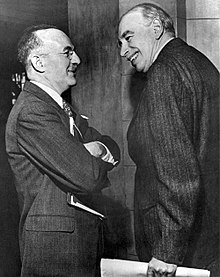 An American economist and important senior U.S. Treasury department official who played the leading
role at the Bretton Woods Conference in 1944 which set
up the economic structure for the U.S.-led imperialist bloc in the post-World War II period. This
bloc soon incorporated the defeated Axis imperialist countries of Germany, Italy and Japan into their
fold, and eventually, with the collapse of the state-capitalist Soviet Union in 1991 and the
transformation of China into a capitalist-imperialist country in the period after the death of Mao,
this “Western Bloc” has become the current single World
Imperialist System (for the time being).
An American economist and important senior U.S. Treasury department official who played the leading
role at the Bretton Woods Conference in 1944 which set
up the economic structure for the U.S.-led imperialist bloc in the post-World War II period. This
bloc soon incorporated the defeated Axis imperialist countries of Germany, Italy and Japan into their
fold, and eventually, with the collapse of the state-capitalist Soviet Union in 1991 and the
transformation of China into a capitalist-imperialist country in the period after the death of Mao,
this “Western Bloc” has become the current single World
Imperialist System (for the time being).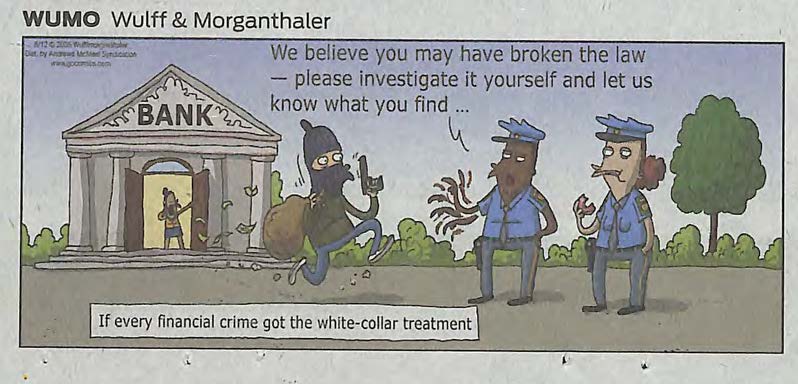 Crimes which are mostly committed by big-shot white-collar employees (see below) at corporations,
or else by the owners of such corporations themselves. Typically, these crimes involve much greater
amounts of money stolen; and in the rare cases where the perpetrator is actually arrested, they also
involve much more lenient penalties (if any). The reason for this leniency is obvious: It is the
ruling class which makes the laws, and they tend to let themselves off easy even when they are caught
breaking their own laws.
Crimes which are mostly committed by big-shot white-collar employees (see below) at corporations,
or else by the owners of such corporations themselves. Typically, these crimes involve much greater
amounts of money stolen; and in the rare cases where the perpetrator is actually arrested, they also
involve much more lenient penalties (if any). The reason for this leniency is obvious: It is the
ruling class which makes the laws, and they tend to let themselves off easy even when they are caught
breaking their own laws.