 African-American revolutionary who lived in exile in Cuba from 1984 until her death. The
U.S. government outrageously labelled her a “terrorist” and put a $2 million dollar price
on her head!
African-American revolutionary who lived in exile in Cuba from 1984 until her death. The
U.S. government outrageously labelled her a “terrorist” and put a $2 million dollar price
on her head!SHADOW BANKING SYSTEM
The part of the capitalist financial industry that performs the functions of banks without
formally calling themselves banks, especially facilitating various types of speculation,
and often without being regulated as banks by the government, including investment banking,
hedge funds, exotic securities operations by insurance companies, and the like. Moreover,
even many large banks which do call themselves banks and have their traditional
banking operations regulated, also now participate in these newer, more risky, and
unregulated (or less regulated) types of financial operations beyond the boundaries of
what used to be considered conservative mainstream banking, often through subsidiaries. Much
of this involves complex and semi-mysterious new derivatives
such as CDOs and credit default swaps,
and other financial shenanigans. All of this goes to make up the so-called “shadow banking
system” of contemporary finance capitalism.
One of the many reasons that “shadow
banking” is dangerous to the financial system is that these financial enterprises tend to
greatly increase overall liquidity by issuing securities that function similar to money
during stable periods but which then become much less liquid during a financial crisis
(when crisis-proof liquidity is desperately sought for). During a crash shadow banking
shrinks in size, overall true liquidity contracts, interest rates jump up, and investment
steeply and suddenly falls. This amplifies already existing effects in the standard banking
system and results in even greater financial instability than always and inherently exists
in any capitalist financial system.
“Our current system of financial regulation dates back to a time
when everything that functioned as a bank looked like a bank. As long as you
regulated big marble buildings with rows of tellers, you pretty much had things
nailed down.
“But today you don’t have to
look like a bank to be a bank. As Tim Geithner, the Treasury secretary, put it in
a widely cited speech last summer, banking is anything that involves financing
‘long-term risky and relatively illiquid assets’ with ‘very short-term liabilities.’
Cases in point: Bear Stearns and Lehman, both of which financed large investments
in risky securities primarily with short-term borrowing.
“And as Mr. Geithner pointed
out, by 2007 more than half of America’s banking, in this sense, was being handled
by a ‘parallel financial system’—others call it ‘shadow banking’—of largely
unregulated institutions. These non-bank banks, he ruefully noted, were ‘vulnerable
to a classic type of run, but without the protections such as deposit insurance that
the banking system has in place to reduce such risks.’
“When Lehman fell, we learned
just how vulnerable shadow banking was: a global run on the system brought the world
economy to its knees.” —Paul Krugman, “Out of the Shadows”, Op-Ed column in the
New York Times, June 19, 2009.
[While it would indeed be
more rational of the bourgeoisie to thoroughly regulate investment banking and other
types of “shadow banking”, the absence of this regulation was not the reason
for the financial crisis which struck so hard in 2008, nor will such regulations
prevent this sort of crisis in the future, as Geithner, Krugman, and bourgeois
economists in general imagine. They can’t understand or admit that such crises are
inherent developments of the capitalist mode of production. —Ed.]
“The Federal Reserve warned in its twice-annual report on America’s
financial stability that the government bond market could be primed for disruption, and
cautioned that financial firms that operate outside of traditional banks could increase
fragility in the system.
“Investors have been warning that
market conditions are becoming increasingly fraught nine months into the Fed’s fastest
rate-increase campaign [against inflation] since the 1980s....
“The ease of trading Treasury
securities, called liquidity, has been strained in recent months, which is making
analysts and investors nervous that the market could be primed for disruption. The Fed
attributed the decline in liquidity ‘primarily’ to volatility in interest rates and
economic uncertainty.
“‘The continued low level of market
depth means that liquidity remains more sensitive in the actions of liquidity providers
that use high-frequency trading strategies to replenish the order book rapidly,’ the
report said. That dependence could ‘be a source of fragility, making it more likely that
liquidity could further deteriorate sharply in response to future shocks.’” —Jeanna
Smialek & Joe Rennison, “In Report, Fed Frets About Shadow Banks and Liquidity in Market
for Treasuries”, New York Times, National Edition, Nov. 5, 2022.
[So, with the financial
“authorities” having learned little or nothing from the last time around, here we go
again! Although Shadow Banking is not the basic cause of capitalist financial crises,
it certainly makes them worse and more difficult to try to deal with. —Ed.]
SHAHEED
As most widely used in India, the word shaheed means “martyr”. Often also used as
an honored title with a martyred person’s name, as in “Shaheed Azad” or “Shaheed Comrade
Azad”. A Shaheed Diwas is a Martyr’s Day (day of honor and remembrance for fallen
revolutionaries), and Shaheed Saptah means Martyr’s Week.
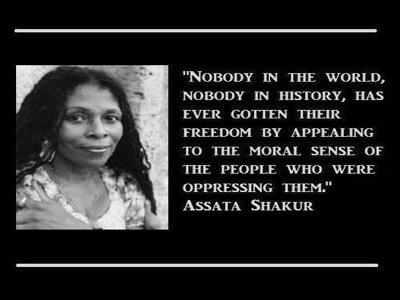
SHAKUR, Assata [Born: JoAnne Deborah Byron] (1947-2025)
African-American revolutionary who lived in exile in Cuba from 1984 until her death. The
U.S. government outrageously labelled her a “terrorist” and put a $2 million dollar price
on her head!
“My name is Assata Shakur, and I am a 20th century escaped slave.
Because of government persecution, I was left with no other choice than to flee
from the political repression, racism and violence that dominate the U.S.
government’s policy towards people of color. I am an ex-political prisoner, and I
have been living in exile in Cuba since 1984.
“I have been a political
activist most of my life, and although the U.S. government has done everything in
its power to criminalize me, I am not a criminal, nor have I ever been one. In the
1960s, I participated in various struggles: the black liberation movement, the
student rights movement, and the movement to end the war in Vietnam. I joined the
Black Panther Party. By 1969 the Black Panther Party had become the number one
organization targeted by the FBI’s COINTELPRO
program. Because the Black Panther Party demanded the total liberation of black
people, J. Edgar Hoover called it [the] ‘greatest threat to the internal security
of the country’ and vowed to destroy it and its leaders and activists....
“On May 2, 1973 I, along
with Zayd Malik Shakur and Sundiata Acoli were stopped on the New Jersey Turnpike,
supposedly for a ‘faulty tail light.’ Sundiata Acoli got out of the car to
determine why we were stopped. Zayd and I remained in the car. State trooper
Harper then came to the car, opened the door and began to question us. Because we
were black, and riding in a car with Vermont license plates, he claimed he became
‘suspicious.’ He then drew his gun, pointed it at us, and told us to put our hands
up in the air, in front of us where he could see them. I complied and in a split
second, there was a sound that came from outside the car, there was a sudden
movement, and I was shot once with my arms held up in the air, and then once again
from the back.
“Zayd Malik Shakur was later
killed, trooper Werner Foerster was killed, and even though trooper Harper admitted
that he shot and killed Zayd Malik Shakur, under the New Jersey felony murder law,
I was charged with killing both Zayd Malik Shakur, who was my closest friend and
comrade, and charged in the death of trooper Foerster. Never in my life have I
felt such grief. Zayd had vowed to protect me, and to help me to get to a safe
place, and it was clear that he had lost his life trying to protect both me and
Sundiata.... Neither Sundiata Acoli nor I ever received a fair trial.... In 1977,
I was convicted by an all-white jury and sentenced to life plus 33 years in
prison.
“In 1979, fearing that I
would be murdered in prison, and knowing that I would never receive any justice,
I was liberated from prison, aided by committed comrades who understood the depths
of the injustices in my case, and who were also extremely fearful for my life.”
—Assata Shakur, excerpts
from her life story in an open letter to the media (date unknown). The full
letter is available on the Counter Punch website at:
http://www.counterpunch.org/2014/12/30/an-open-letter-to-the-media/ and also
on the Frontlines of Revolutionary Struggle website at:
https://revolutionaryfrontlines.wordpress.com/2015/10/30/assata-shakur-i-am-a-20th-century-escaped-slave/#more-29289
SHAKUR, Tupac Amaru (1971-1996)
A famous deceased rapper and Black activist. Born to a member of the Black Panther Party.
[Assata Shakur (see above) was his God-mother and step-aunt.]
Shakur came to see how the American “justice” system oppresses people of color and the
poor, as well as seeing the inherent hypocrisy of the U.S. political and economic system.
He incorporated many of these insights into his music. He was often vilified by the media
and others for his lyrics that seemed to glorify violence and misogyny. Shakur inspired
many people with his uncompromising stances against injustice, but his analysis, while
incorporating some elements of class consciousness and strong denunciations of racism and
police brutality, never reached a very coherent and satisfying outcome. While his songs
often expressed the sentiments of people who have lost any confidence in the capitalist
system, he himself called for Blacks to make as much money as possible in order to achieve
equality, rather than calling for a broad working class movement to overthrow capitalism
itself. Thus his outlook was a rather eclectic mix of militancy against the worst
injustices of capitalism, and conformity to basic capitalist precepts like “the right to
get rich”.
Shakur was murdered in 1996, probably by
members of the Crips street gang. He is regarded as one of the greatest rap artists of
all time. —L.C.
SHANGHAI COOPERATION ORGANIZATION
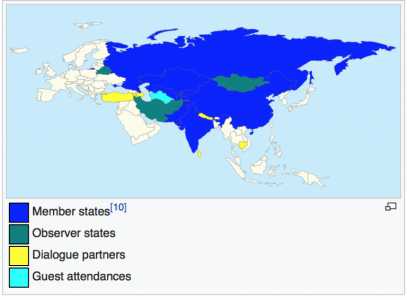 An important Eurasian political and economic bloc originally set up by China and Russia
together with the central Asian countries of Kazakhstan, Kyrgyzstan, Tajikistan and
Uzbekistan at a conference in Shanghai in 2006. Since its beginning it has been dominated
by China and Russia and its headquarters is in Beijing. The SCO has been playing a major
role in support of China’s Belt and Road trade expansion initiative as well as in helping
to expand the oil and gas pipeline transmission lines and other infrastructure linking the
member countries.
An important Eurasian political and economic bloc originally set up by China and Russia
together with the central Asian countries of Kazakhstan, Kyrgyzstan, Tajikistan and
Uzbekistan at a conference in Shanghai in 2006. Since its beginning it has been dominated
by China and Russia and its headquarters is in Beijing. The SCO has been playing a major
role in support of China’s Belt and Road trade expansion initiative as well as in helping
to expand the oil and gas pipeline transmission lines and other infrastructure linking the
member countries.
Although the SCO is not officially a
military alliance, it was set up as a conscious alternative and at least in potential
opposition to the U.S.-dominated “Western” imperialist alliance centered around NATO in
Europe and in Japan and South Korea in the Far East. In recent years the SCO has broadened
its cooperation into the military and intelligence spheres, and war games have been held
under its auspices.
On June 9, 2017, both India and Pakistan
joined the SCO in a very significant expansion of the organization. Iran is an Observer
Member and is expected to also become a full member soon. Several other countries may
follow. The SCO now already encompasses a vast region which includes about half of the
entire world’s population. The development of this organization is one of many recent
signs showing the rise of China, the renewed strength of Russia, and the
decline of the United States not only economically,
but also politically and even militarily.
SHAREHOLDERS
See:
CORPORATIONS—Shareholders Of
SHARIA or SHARIA LAW
Koranic law, or laws for civil society which are based on those specified or implied in the
Muslim religious book, the Qur’an [Koran]. The Arabic word ‘sharia’
is literally translated as “the way”.
SHAW, George Bernard (1856-1950)
A famous Irish playwright and author, who was strongly influenced by Marxism and a supporter
of the socialist Soviet Union, but who was also much influenced by revisionism. He was a
prominent member of the Fabian Society. It was said of
him that he was a good man who had unfortunately fallen among Fabians!
[Referring to his reading of Marx’s Capital in 1883:] “That was the turning point in my career. Marx was a revelation... He opened my eyes to the facts of history and civilization, gave me an entirely fresh conception of the universe, provided me with a purpose and a mission in life.... [Das Kapital] achieved the greatest feat of which a book is capable—that of changing the minds of people who read it.” —George Bernard Shaw, quoted in Francis Wheen, Marx’s Das Kapital (2006), p. 90.
“[Shaw is] very talented and witty as a belletrist but absolutely useless as an economist and politician, although honest and not a careerist.” —Engels, letter to Karl Kautsky, Sept. 4, 1892, in Selected Correspondence (London: 1965), p. 446.
SHELTER-IN-PLACE
1. To seek safety within the building one already
occupies, rather than to evacuate the area or seek a community emergency shelter. [Wikipedia]
2. Specifically in connection with the
Covid-19 pandemic, to self-isolate or self-quarantine oneself and
family in one’s own home, whether or not one might have the disease. As issued by the government:
a stay at home order.
The first such Covid-19 shelter-in-place order in
the U.S. was issued by six San Francisco Bay Area counties effective March 17, 2020. A similar
stay-at-home order was then issued by the California Governor for the whole state, effective March
19, 2020. Since then numerous other cities and states have issued similar orders, though as of
March 29 many other parts of the U.S. are not yet included. These orders, which initially were
more like half-requests, half-orders, without any enforcement, have required people to stay home;
to work from home if at all possible; to only leave home to work if their jobs are deemed necessary
and essential during the crisis; to only leave home to buy genuine necessities such as groceries
and medicine; and when they do leave home to carefully avoid all contact with other people by
trying to keep at least 6 feet away from them.
The terms “shelter-in-place” and “stay-at-home
order” were purposely chosen by the authorities as something gentler than the long existing prison
term “lockdown”, partly because they wanted (and have received) widespread voluntary cooperation
from the people, and partly because they planned for so many exceptions to the order that lockdown
seemed not to be the right term. In most places the orders have so far been generally honored by
the public, though some young people and others have begun to ignore them. In the parts of the U.S.
where Covid-19 is not yet rampant, and/or where because of the anti-scientific attitudes of people
which are widely promoted by Trump and the Republican Party the pandemic is still being
downplayed, there also seems to be less willingness to follow the stay-at-home orders when they
are issued—even if they are considerably weaker than elsewhere. Some jurisdictions with existing
orders are now beginning to levy fines and threaten jail for egregious violators.
One of the serious weaknesses of these stay-at-home
orders is that way too many people are exempted from them. The New York Times pointed out
that workers who make candy are considered “essential” (because they are in the food industry) and
are exempt. Trump even amended his mere advice for non-essential businesses to close by
agreeing with conservative demands that gun shops should stay open. Time magazine reported
that as of March 24, 2020, just 163 million Americans were ordered or advised to stay home.
[Issue dated April 6/April 13, 2020, p. 47.] On March 31, the New York
Times said that 248 million people were subject to these orders or “advice”. However, it is
questionable how these figures were even obtained. Probably the entire population in the areas
covered by the actual orders were included, without subtracting all the “essential and necessary”
people who were exempted. In any case, the total U.S. population as of 2018 was 327.2 million,
which shows that at the very least 80 million people were exempted from these orders at the end of
March 2020. Far beyond what was truly necessary.
It is interesting that the intended goal of both
the medical profession and the bourgeois politicians in the U.S., in issuing more and more of
these shelter-in-place orders, is not at all to really try to actually end the outbreak!
The authorities seem to feel that stopping the pandemic (even in just this one country) is
impossible—even though China appears to already have demonstrated that it really is quite possible
(despite their totally bureaucratic and inept initial responses which allowed it to get out of
control in the first place). Instead, the goal of these orders in the U.S. is just to try to keep
the corona virus from spreading so fast, so that hospitals and medical personal are not totally
swamped with patients they have no hope of treating. In other words, both the stated and actual
goal of the stay-at-home orders being issued is simply to “flatten
the curve”, or slow down the progression of the disease until some hoped for vaccine or cure
finally becomes available. Since neither of these is expected soon, this is a pathetically inadequate
response. Yes, these sporadic, partial, and weakly enforced stay-at-home orders are better than
nothing; but they will still mean that tens or hundreds of thousands of people in the U.S. will die
unnecessarily. This is yet another crime by the capitalist ruling class in America. [Revised:
April 2020.]
See also:
CONTACT-TRACING
SHIITE [Pronounced: she-ite]
The second largest branch of Islam, practiced by about 16% of Muslims around the world, but
locally dominant in Iran and other regions. Shiite Muslims believe that Ali, the son-in-law
of Mohammed, was the first caliph (or successor) to Mohammed.
See also:
SUNNI
SHIPBUILDING
“In the last 10 years, Chinese shipbuilders delivered 6,765 commercial ships, nearly half of global deliveries, according to data from BRS Shipbrokers. Japan delivered 3,130, South Korea 2,405 and the United States just 37.” —New York Times, “Facts of Interest”, June 6, 2025.
“Building a commercial shipping vessel in the United States can be five times as expensive as in Asia.” —New York Times, “Facts of Interest”, February 25, 2026.
SHIPPING
See:
OCEAN SHIPPING
SHIPPING COSTS
See: “LOGISTICS REVOLUTION” [Rachel
Slade quote]
SHOAH
Shoah is the Hebrew word meaning “catastrophe”. More specifically, it refers to the Nazi
genocide of nearly six million Jews which occurred during World War II. Most English speaking
countries use the term Holocaust to refer to this particular
episode of extreme genocide, but the term Shoah is said to be more common in Europe.
SHOOTINGS
See: SCHOOL SHOOTINGS
SHORT SALE (in Capitalist Housing Markets)
The sale of a house, or other piece of real estate, for less than the nominal “owner”
still owes on his or her mortgage. For example, a family might still owe $250,000 to the
bank when they are forced by capitalist economic circumstances (such as losing their jobs)
to sell their house for only $220,000. Of course the bank will receive that money, not the
nominal seller. The bank normally must approve such a sale, since it will probably take a
loss on its loan (in this case $30,000). Banks are sometimes willing to do this in order to
at least get back part of their mortgage loan.
Short sales are common after the
collapse of a major housing bubble, such as in the U.S.
during the period of the Great Recession. (As of
September 2009, there were about 1,000 short sales per month in the San Francisco Bay Area
alone, or about 14% of the houses being sold.)
The banks have only themselves to blame for this predicament since they foist off expensive
mortgages (including sub-prime mortgages) on people
who cannot possibly continue to meet their mortgage payments. Meanwhile, millions of people
lose their homes. The capitalist system simply cannot guarantee even such a basic thing as
a home for the masses of people.
SHORT SELLING (in Capitalist Stock or Commodities Markets)
Selling a financial asset such as a share of stock, or some uniform commodity, which the
seller does not actually own, but which he or she has only borrowed for the purpose.
Speculators do this when they expect the price to decline, and therefore expect to be able
to buy back the item after that price decline. They will then pocket the difference in
the selling and buying prices, after paying a fee to the broker who loaned them the stock
or commodity. If the price of the borrowed asset rises and does not fall, the
speculator will have to buy it back at a higher price, and will therefore suffer a loss.
In brief, selling short is one of a great many methods of speculative gambling that
financial capitalists have come up with.
So-called “naked short selling” is when
the speculator sells the asset before he even borrows it, on the assumption that
he will be able to borrow it before he has to actually deliver it. In the aftermath of
the financial crisis which developed in the fall of 2008 the U.S. Securities and Exchange
Commission prohibited (first temporarily and then permanently) naked short selling.
“SHORT TWENTIETH CENTURY”
A concept originated by Ivan Berend, former President of the Hungarian Academy of Sciences,
and then widely popularized by the liberal-radical (previously revisionist “Marxist”)
historian Eric Hobsbawm in his book The Age of Extremes: The Short Twentieth Century,
1914-1991 (1994), in contrast to what he called the “Long Nineteenth Century”
(1780s-1914). As delineated in the original sub-title of that book, the term “the Short
Twentieth Century” is meant to refer to the period from World War I and the Bolshevik
Revolution to the collapse of the Soviet Union in 1991. Hobsbawm claims that this period
“forms a coherent historical period that is now ended” (p. 5). This is indeed the way it
seemed to many in 1994; it was a way for liberals to partially agree with reactionaries
who believed that the era of socialist revolution was over. [See:
“END OF HISTORY”]
Of course it is true that the Soviet era
was an important one in world history. But from the genuinely Marxist standpoint it was
made up of two separate eras—the socialist period and the revisionist (state-capitalist)
period. It was the October Revolution and socialist period that is most important to us.
Even just a couple decades later, the final collapse of the USSR in 1991 no longer seems
to be quite the overwhelmingly important turning point that Hobsbaum thought it was.
Instead, as the world gradually slips into a new period of prolonged economic depression
there now appears to be a wholly different boundary to the preceding period of
history.
“SHORT-WORK” SYSTEM [in Germany]
See: KURZARBEIT
SHORTAGES
See also: SOVIET UNION—Economic Problems In
“SHRINK-FLATION”
A recent term to describe the more-and-more common corporate scheme to effectively raise
real prices for groceries and other goods by keeping the package prices constant while
putting less of the product in each package.
While this practice has no doubt occurred
at times since capitalism first began in a major way, it becomes especially common during
periods of more general inflationary pressures and when the capitalists are evoking anger
by raising prices. It is a way of partially hiding what they are doing.
“Grocery sellers have been quietly shrinking products to avoid raising prices for centuries, and experts think it has been an obvious corporate strategy since at least 1988.” —“Large Impact of Incredible Shrinking Groceries”, New York Times, March 2, 2024.
Dictionary Home Page and Letter Index