IDEALISM [In Philosophy]
The view that the “spiritual”, or mental, or non-material reality is primary, and that
material reality (if it exists at all) is secondary. One of the two great trends in the
history of philosophy, the other being its opposite,
materialism.
See also sub-topics below and:
MATERIALISM VS. IDEALISM,
SUBJECTIVE IDEALISM, and
Philosophical doggerel
about idealism.
“Disagreement with ‘common sense’ is the foul quirk of an
idealist.” —Lenin, criticizing Hegel for his slander against the materialism of
Epicurus, “Conspectus of Hegel’s Book Lectures on the History of Philosophy”
(1915), LCW 38:283. [Of course for us materialists the existence of the physical
world is the foundation of common sense, and those who deny that the material
world exists must of necessity be disagreeing with basic common sense. —S.H.]
IDEALISM — Origin Of
If you go far enough back into pre-history, there will be a time when human beings—or
our recent hominid ancestors—were not at all capable of abstract symbolic thought. And,
even today, the subtleties of abstraction are often a
difficult thing for many people to fully comprehend. If we can conceive of the concept
of “God”, must a God therefore actually exist? Some people still think so! And in churches,
movies and literature there is still a constant stream of indoctrination which succeeds
in getting millions of people to believe that “incantations” or “prayers” can magically
change the world.
Young children, in particular, are
often very confused by the difference between an object in the world and a picture of
it, or a model of it, or the name of that object in contrast to the object itself.
As the American psychologist Judy S. DeLoache and her colleagues have found in their
experiments, “young children often conflate the item and its symbol”. Moreover the full
appreciation of the difference between an abstract symbol for a thing, and the thing
itself, is something that develops by stages over time. By the age of around 18 months
babies generally begin to understand the difference between an object and a picture of
that object, but it still “takes several years for the nature of pictures to be
completely understood”. The relation of models of the world to the world itself is a
still more difficult thing for children to grasp. They show that young “children cannot
maintain the distinction between a symbol and its referent”. DeLoache concludes that “As
these various studies show, infants and young children are confused by many aspects of
symbols that seem intuitively obvious to adults.” [Cf. Judy S. DeLoache, “Mindful of
Symbols”, Scientific American, Aug. 2005.]
But adults, too, often have difficulties
in fully comprehending various types of more sophisticated abstractions. This is true
even among highly-educated people in bourgeois society. To this very day, there is
tremendous confusion and disagreement within bourgeois philosophy over the nature of
universals (such as the concept of “chairs”)
as opposed to individual physical things (such as some particular chair). These
sorts of confusions about the nature of abstraction are the intellectual source of
philosophical idealism. The more practical source, of course, is the desire of the ruling
classes to maintain their rule by promoting religion, in either primitive traditional
forms or idealized metaphysical forms.
“Primitive idealism: the universal (concept, idea) is a particular
being. This appears wild, monstrously (more accurately, childishly) stupid. But
is not modern idealism, Kant, Hegel, the idea of God, of the same nature
(absolutely of the same nature)? Tables, chairs and the ideas of table
and chair; the world and the idea of the world (God); thing and ‘noumen,’ the
unknowable ‘Thing-in-itself’; the connection of the earth and the sun, nature in
general—and law, logos, God. The dichotomy of human knowledge and the possibility
of idealism (=religion) are given already in the first, elementary
abstraction:
“The approach of the (human) mind to a particular thing, the taking
of a copy (= a concept) of it is not a simple, immediate act, a dead mirroring,
but one which is complex, split into two, zig-zag-like, which includes in it
the possibility of the flight of fantasy from life; more than that: the possibility
of the transformation (moreover, an unnoticeable transformation, of which man
is unaware) of the abstract concept, idea, into a fantasy (in the final
analysis = God).” —Lenin, “Conspectus of Aristotle’s Book Metaphysics” (1915),
LCW 38:372.
IDENTITY THEORY (In the Philosophy of Mind)
The view that mental states and processes are identical to the corresponding
neural states and processes in the brain that give rise to them. This is a common and
prominent type of naive materialism. Of course
there are indeed physical structures and processes in the brain which give rise to
mental phenomena such as thoughts, memories, feelings, etc. But while we are well
aware of these thoughts, memories, and feelings themselves we ordinarily have no
direct knowledge of the precise neural networks, structures and processes which give
rise to them. If our thoughts, memories and feelings were actually identical to
some physical neural structures and processes, then to be aware of one would be the
same as being aware of the other! In reality our awareness of mental phenomena is
only a high order internal indication or characterization of what are actually very
complex brain states and processes.
An analogy: For the image of an
automobile to appear on a TV screen, an enormously complex series of material
processes must occur in the video camera, the transmission equipment, and the TV
receiver set. It would be just as foolish to identify that image with all the
material structures and processes that allow it to be shown as it is to identify
my memory of that image with the complex brain processes which allow me to have
that memory. Our description of the specific TV image as “an automobile” is only a
high-level characterization of one aspect of the functioning of the TV equipment at
that moment, just as my memory of that image is only a high level characterization of
one aspect of the functioning of my brain at that moment.
See also:
ELIMINATIVE MATERIALISM
IDEOLOGICAL STRUGGLE — Within the Revolutionary Movement
“I cannot help recalling ... a conversation I happened to have at
the [2nd R.S.D.L.P.] Congress with one of the ‘Center’ delegates. ‘How oppressive
the atmosphere is at our Congress!’ he complained. ‘This bitter fighting, this
agitation one against the other, this biting controversy, this uncomradely
attitude!...’ ‘What a splendid thing our Congress is!’ I replied. ‘A free and open
struggle. Opinions have been stated. The shades have been revealed. The groups
have taken shape. Hands have been raised. A decision has been taken. A stage has
been passed. Forward! That’s the stuff for me! That’s life! That’s not like the
endless, tedious word-chopping of your intellectuals, which stops not because the
question has been settled, but because they are too tired to talk any more...’
“The comrade of the ‘Center’
stared at me in perplexity and shrugged his shoulders. We were talking different
languages.” —Lenin, “One Step Forward, Two Steps Back” (May 1904), LCW 7:347.
IDEOLOGY
The totality of political, legal, philosophical, religious, ethical and aesthetic views
of an age, a class, a group, or an individual, considered as a whole. As opposed to vague
and isolated ideas and feelings on these topics, ideology is usually considered to be
more or less coherent, developed and systematized.
See also:
WORLDVIEW
IMMISERATION OF THE PROLETARIAT
The increasing impoverishment of the working class and masses under capitalism. This is
both a historical observation and a prediction for the future by Marx and Engels in the
Communist Manifesto and also by Marx in Capital. Bourgeois ideologists have
claimed that this has not actually happened, and that the working class has improved its
lot substantially over the decades under capitalism. However there are several important
respects in which Marx’s statement about the immiseration of the working class is clearly
correct.
First, the statement was overall quite
correct for the history of capitalism up to the time at which Marx was writing. The advent
of capitalism and its early development certainly did lead to severe and often increasing
impoverishment of the masses in Europe especially (which was the focus of Marx’s
attention).
Second, while the working class has overall
become better off in the leading imperialist countries during the capitalist imperialist
era, this has come about mostly because of the capitalist desire to cool down the class
struggle at home while they drastically intensify the exploitation of the people in the
rest of the world. Thus on an overall international level the working people of the
world have indeed been further impoverished under capitalism. More than half the population
of the world at the present time lives in what can only be called serious poverty. (See:
WORLD POVERTY.)
Third, even within the advanced
capitalist and imperialist countries, there has been a relative impoverishment of
the working class and masses. That is, there has been a massive polarization of wealth in
the hands of bourgeoisie, while the economic welfare of the proletariat has improved at
a much slower pace. In other words, almost all of the new wealth produced by the working
class still goes to the capitalist class. Marx actually focused mostly on this relative
immiseration of the working class, rather than on their absolute immiseration.
This is something that the army of bourgeois critics of Marx almost totally ignore.
Fourth, while there have been periods of
diminishing poverty in many countries, there have also been periods of increasing poverty
in all countries. Moreover, the present period is one of those in which the
immiseration of the workers and masses in most places in the world is definitely increasing
as the world capitalist system sinks into its most severe economic crisis ever.
IMPERIALISM or CAPITALIST IMPERIALISM
The term ‘imperialism’ in traditional usage means the political and economic control or
domination of one country by another. In this general sense, Rome was an imperial power,
as was Persia and other ancient empires. However, within revolutionary Marxism the term
‘imperialism’ is generally used as a technical term to mean capitalist imperialism,
or the economic and political form that capitalism has taken during the period
since the late 19th century. Lenin defined imperialism as the highest and final stage of
capitalism, and used the term synonymously with monopoly capitalism.
Among the central characteristics of
capitalist imperialism are:
1) The rise of and near universal domination
of the capitalist economy by joint-stock corporations,
as opposed to individually-owned companies or partnerships.
2) A qualitative increase in the levels of
monopoly or oligopoly within
capitalist economies, especially within each major nation.
3) A qualitative increase in one or another
form of the globalization of capital. In the pre-World
War I period this often took place in the form of cartelization (international monopolies
or agreements among the monopolies from separate nations). In recent decades this has more
frequently taken place in the form of the rise of giant multinational
corporations (MNCs), which though nearly always politically based in a single country,
nevertheless operate and engage in plunder around the globe like international pirates.
4) A qualitative increase in the importance
of the export of capital (as compared with merely the export of commodities, though
that is of intensified importance as well).
5) A qualitative increase in the role of
the capitalist state in the management of the economy, and often the de facto merger of the
state with corporations (such as via bourgeois nationalization
of individual companies or industries for certain periods).
6) A qualitative expansion in the importance
of the financial aspects of capitalism, the financialization
of an ever-growing part of the economy, and the rise in importance of a
financial oligarchy at the apex of the bourgeois
ruling class structure.
7) A qualitative increase in the importance
of the domination and exploitation of other countries by a few militaristic imperialist
powers. This first took the form of outright colonialism, with virtually total economic
and political control of specific “Third World” countries by individual imperialist powers.
But this broke down during the second half of the 20th century, and was replaced with
neocolonialism, wherein the dominated countries are
nominally independent but still exploited and under the general control of foreign
imperialism via the medium of local agents of the imperialists (the
comprador capitalist class).
8) Politically, capitalist-imperialism is
overall a period of world strife, constant imperialist wars whereby the big powers seek to
establish, maintain, or re-establish control over other countries, and even some very
disastrous and devastating world wars among the imperialist countries and against socialist
countries. And, overall, and despite some periods of quiescence, it is a period of the
revolutionary upsurge of the people of the world against the capitalist-imperialist
system.
See also below, and:
NATURAL RESOURCE CURSE,
NEOCOLONIALISM,
U.S. IMPERIALISM,
WORLD IMPERIALIST SYSTEM
IMPERIALISM — Lenin’s Definition Of
[Intro to be added...]
“And so, without forgetting the conditional and relative value of
all definitions in general, which can never embrace all the concatenations of a
phenomenon in its complete development, we must give a definition of imperialism
that will include the following five of its basic features: 1) the concentration of
production and capital has developed to such a high stage that it has created
monopolies which play a decisive role in economic life; 2) the merging of bank
capital with industrial capital, and the creation, on the basis of this ‘finance
capital,’ of a financial oligarchy; 3) the export of capital as distinguished from
the export of commodities acquires exceptional importance; 4) the formation of
international monopolist capitalist combines which share the world among themselves,
and 5) the territorial division of the whole world among the biggest capitalist
powers is completed. Imperialism is capitalism in the stage of development in which
the dominance of monopolies and finance capital has established itself; in which
the export of capital has acquired pronounced importance; in which the division of
the world among the international trusts has begun; in which the division of all
territories of the globe among the biggest capitalist powers has been completed.”
—Lenin, “Imperialism, the Highest Stage of Capitalism: A Popular Outline” (1916),
(Peking: FLP, 1975), pp. 105-6; LCW 22:266-7.
IMPERIALISM — World System of
See: WORLD IMPERIALIST SYSTEM
“IMPERIALIST ECONOMISTS” [Political Trend among the Bolsheviks]
“Imperialist economists—Lenin’s designation for the
opportunists Bukharin, Pyatakov and Bosh in the Russian
Social-Democratic Labor Party (Bolsheviks) during the First World War. The
‘imperialist economists’ demanded that the Party delete the programmatic statement
on the right of nations to self-determination. They also came out against the entire
minimum programme of the R.S.D.L.P., which envisaged a struggle for democratic
reforms that would facilitate the preparation and transition to the socialist
revolution. Lenin laid bare the opportunistic essence of the position of Bukharin
and those sharing his views, its kinship with ‘economism’—the opportunistic trend in
Russian Social-Democracy at the end of the 19th century and the beginning of the
20th. Like the old ‘economists,’ who could not understand the need for the political
struggle of the working class under conditions of capitalism, the ‘imperialist
economists’ did not understand the significance of the struggle for democratic
reforms under conditions of imperialism.
“Certain views of the
‘imperialist economists’ were shared by Left Social-Democrats of Holland, America,
Poland, etc. That is why Lenin called ‘imperialist economism’ an ‘international
disease’ [LCW 35:254].
“A number of articles by
Lenin are devoted to a criticism of ‘imperialist economism’: ‘On the Incipient Trend
of “Imperialist Economism”’ [LCW 23:1-9]; ‘Reply to P. Kievsky (Y. Pyatakov)’ [LCW
23:10-15]; ‘A Caracature of Marxism and Imperialist Economism’ [LCW 23:16-64].”
—Note 155, LCW 38.
INCOME TAX
A tax on the income of individuals or companies. A progressive income tax is one
which taxes those with higher incomes at a higher tax rate. In the Communist
Manifesto Marx & Engels called for “a sharply progressive system of taxation” as
one of a number of means which might prove to be of use in transforming capitalism into
socialism. But as they noted, such a transformation—by whatever means—will only be
feasible once the revolutionary proletariat achieves full political power. Before then
any reforms along the lines of a progressive income tax will soon be undermined or
reversed by the ruling bourgeoisie.
“In the final decades of the nineteenth century, leaders of
corporations took huge payouts [from their companies] to establish huge fortunes.
One reaction was the passage of an income tax law in 1910 aimed exclusively at
only the richest Americans. Those richest Americans quickly developed a
counter-strategy to change the new income tax law.
“They succeeded and thereby
spread the burden of the income tax across the entire population, which eventually
undermined popular support of the income tax.” —Richard D. Wolff, Capitalism
Hits the Fan (2010), pp. 23-24.
INDEPENDENT LABOUR PARTY (Britain)
“Independent Labour Party (I.L.P.) was founded in Britain
in 1893 under the leadership of James Keir Hardie, Ramsay Macdonald and others. It
claimed itself politically independent of bourgeois parties but, as Lenin said,
‘it was independent only of socialism but very dependent on liberalism’.
“On the outbreak of the world
imperialist war of 1914-18 the I.L.P. issued an anti-war manifesto (August 13, 1914).
In February 1915 the I.L.P. delegates to the Conference of Socialists from the
‘Entente’ countries held in London supported the social-chauvinist resolution
adopted at the Conference. From then on the I.L.P. leaders used pacifist phrases to
cover up what was in fact a social-chauvinist position. In 1919, the I.L.P. leadership
yielded to the pressure of the leftward-moving rank and file and withdrew from the
Second International. In 1921 the I.L.P. joined the so-called Two-and-a-Half
International, but when the latter fell to pieces, returned to the Second
International. In 1921 the Left wing of the I.L.P. broke away from the Party and
joined the newly formed Communist Party of Great Britain.” —Note 47, Lenin: SW I
(1967).
| Language |
Linguistic
Family |
Speakers (2001)
(in millions) |
Location |
Comments |
| Hindi |
Indo-Aryan |
422 |
The “Hindi belt” in
northern India |
|
| Bengali |
Indo-Aryan
(eastern) |
83 |
W. Bengal, Assam, Jharkhand,
Tripura |
|
Telugu
(TEH-luh-goo) |
Dravidian
(south-central) |
74 |
Andhra Pradesh, Karnataka, Tamil
Nadu, Maharashtra, Orissa |
|
Marathi
(muh-RAW-tee) |
Indo-Aryan
(southern) |
72 |
Maharashtra, Karnataka, Madhya Pra-
desh, Gujarat, Andhra Pradesh, Goa |
|
Tamil
(TAH-mul) |
Dravidian
(southern) |
61 |
Tamil Nadu, Karnataka, Pondicherry,
Andhra Pradesh, Kerala, Maharashtra |
|
| Urdu |
Indo-Aryan
(central) |
52 |
Jammu & Kashmir, Andhra Pradesh
Delhi, Bihar, Uttar Pradesh |
Closely related to Hindi; also
widely spoken in Pakistan |
Gujarati
(goo-jah-RAW-tee) |
Indo-Aryan
(western) |
46 |
Gujarat, Maharashtra,
Tamil Nadu |
|
Kannada
(KAH-nuh-duh) |
Dravidian
(southern) |
38 |
Karnataka, Maharashtra,
Tamil Nadu, Goa |
Also known as Kanarese |
| Rajasthani |
Indo-Aryan
(central) |
36 |
Rajasthan, Gujarat,
Haryana and Punjab |
Includes numerous
dialects |
Malayalam
(mah-luh-YAW-lum) |
Dravidian
(southern) |
33 |
Kerala, Lakshadweep, Mahé,
Puducherry |
|
| Oriya |
Indo-Aryan
(eastern) |
33 |
Orissa |
|
Punjabi
(pun-JAW-bee) |
Indo-Aryan |
29 |
Punjab, Chandigarh, Delhi,
Haryana |
|
Assamese/
Axomiya |
Indo-Aryan
(eastern) |
13 |
Assam |
|
| Maithili |
Indo-Aryan
(eastern) |
12 |
Bihar |
Formerly sometimes viewed
as dialect of Hindi or Bengali |
| Santali |
Munda |
6.5 |
Chota Nagpur Plateau (Bihar,
Chattisgarh, Jharkhand, Orissa) |
Language of the
Santal tribals |
| Kashmiri |
Indo-Aryan
(Dardic sub-group) |
5.5 |
Jammu and Kashmir |
|
INDONESIA — Military Coup in 1965 — Role of Foreign Imperialism
The U.S. and British imperialists played major roles in encouraging, organizing, supporting,
and helping to give a propaganda cover to the murderous military coup in Indonesia in 1965.
[More to be added... ]
“In 1990, Kathy Kadane, an American agency journalist, made her name
when she revealed that in 1965 CIA officers had passed death sentences on five thousand
members of the the Indonesian Communist Party, the PKI, by handing their names to the
insurgent generals.... Britain was no less involved than the US in the coup against
Achmad Sukarno, the nationalist Indonesian leader who was willing to work with the PKI....
“On 5 October 1965, as the massacres
began, Sir Andrew Gilchrist, Britain’s Ambassador in Jakarta, told the Foreign Office: ‘I
have never concealed from you my belief that a little shooting in Indonesia would be an
essential preliminary to effective change.’ On the following day, the Foreign Office in
London replied: ‘The crucial question still remains whether the generals will pluck up
enough courage to take decisive action against the PKI.’ Gilchrist shared his superiors’
worry that the generals might be pussy liberals. Although the Army was ‘full of good
anti-Communist ideas’, he said, it was ‘reluctant to take, or incapable of taking,
effective action in the political field’. The Foreign Office resolved on a strategy. ‘It
seems pretty clear that the generals are going to need all the help they can get and
accept without being tagged as hopelessly pro-Western, if they are going to be able to
gain ascendancy over the Communists. In the short run, and while the present confusion
continues, we can hardly go wrong by tacitly backing the generals.’ It is difficult to
say how far British ‘help’ extended—the relevant files will be kept secret until well
into the next century.” —Nick Cohen, “Benetton Ethics”, London Review of Books,
July 2, 1998, p. 7.
“INEVITABLEISM”
The doctrine that something is inevitable, such as revolution in a certain country in a certain
period, or eventual world communism (with no explicit time period specified). The term
“inevitableism” itself has pejorative connotations and is generally used by those attacking
the idea that the possible event or development at issue is inevitable.
Marx, Engels, Lenin, Mao and most other major
creators and leaders of revolutionary Marxism have forcefully stated that many future things are
in fact inevitable (though they rarely indicate precise timeframes), including social revolution,
the eventual replacement of capitalism with socialism on a worldwide scale, the eventual
transformation of socialism into communism where classes no longer exist, and in the meanwhile
(while capitalism still exists), widespread poverty, major economic crises and interimperialist
contention and wars.
“The socialist system will eventually replace the capitalist system; this
is an objective law independent of human will. No matter how the reactionaries try to block
the advance of the wheel of history, sooner or later revolution will occur, and it is bound
to be victorious.” —Mao, “Speech at Moscow Airport” (November 2, 1957), Leung & Kau, eds.,
The Writings of Mao Zedong: 1949-1976, vol. II, p. 762.
However, more recently there have been ideological currents within even Marxism that have
denied that many or all of these things are inevitable! It is true of course that very few things
are “absolutely inevitable” with no conceivable possibility that they won’t occur! It is
conceivable, after all, that humanity might be wiped out by a giant asteroid striking the earth
next week, and in that case humanity will not get the chance to overthrow capitalism, introduce
world socialism, and transform that socialism into world communism.
But it seems to me that we should cut Marx,
Engels, et al., a little slack here, and understand their predictions that revolution, socialism
and communism are inevitable in a more reasonable way. It is in fact true that given a very
few assumed conditions, and specifically given that humanity continues to exist,
capitalism will eventually be overthrown and the world will institute first socialism and then
communism. Indeed, the overthrow of capitalism is itself one of the major conditions
required if humanity is to continue to exist! Either humanity gets rid of capitalism, or
capitalism will get rid of humanity (through nuclear war, environmental catastrophe, scientific
accident through recklessness due to the profit motive, or some combination of such genuine
dangers).
There is a tendency in modern bourgeois society
toward philosophical (or epistemological) agnosticism, and this
has also had some negative effects within Marxism itself. And part of this is to start thinking
that nothing significant can really be known about the future, and that revolution and communism
are not inevitable (even on reasonable assumptions). We must strongly resist this inroad of
bourgeois agnosticism and decadent pessimism within our revolutionary movement!
See also:
REVOLUTIONARY OPTIMISM,
TELEOLOGY
INFORMATION OVERLOAD
This is a common phenomenon in the modern world, especially since the widespread availability
of TV, computers and the Internet. The central difficulty with “information overload” is that
the great preponderance of the information that many people are being swamped with is just not
very important, reliable or useful. Worse yet, excessive attention to relatively unimportant
information can distract people from acquiring the most essential information. One way that
this happens is that people spend a lot of time “surfing the Internet” for what are actually
relatively trivial and transient facts and off-the-cuff opinions, while not putting in any
serious effort to acquire the scientific theories and perspectives that would allow them to
properly evaluate those facts and opinions. This results in a “dumbing down” of people’s
understanding of what is going on in the world and their ability to deal with it. This is a
problem for society in general, but it is especially so for young people who are the ones most
prone to spend so much time “texting”, visiting social networking sites and otherwise
surfing the Web, etc., and so little time reading serious books these days.
This is also becoming a serious problem in
the culture of the revolutionary left. Much more attention needs to be given to having formal
study groups and to serious study of revolutionary theory, especially the works of Marx,
Engels, Lenin and Mao.
INNOVATION-ONLY ECONOMIC MODEL
The bizarre theory of many American bourgeois economists that it no longer matters that
manufactoring is rapidly declining in the U.S. and shifting overseas, because supposedly most
of the world’s innovation and new ideas are still happening in the U.S. In reality, innovation,
and ideas for new or improved products, also soon shift to the new manufacturing centers.
“That innovation should always follow manufacturing is hardly surprising.
After all, manufacturers conduct 70 percent of all R&D [research and development] in the
United States. So what do we think will happen to all that R&D when those manufacturers
move offshore?
“The offshoring of innovation has
resulted in a sharp decline in overall R&D intensity in the United States—the percentage
of gross domestic product devoted to R&D—relative to the rest of the world. We once had
the most R&D-intensive economy in the world. Now we’re eighth.” —Henry R. Nothhaft, a
U.S. “entrepreneur” capitalist, lamenting the relative decline in R&D and innovation in
the U.S., “U.S. Outsourcing Prosperity”, San Francisco Chronicle, May 22, 2011,
p. F7.
INSTANT
A specific moment (or “point”) in time. This is an important mathematical abstraction which
has also become part of the conceptual machinery of virtually every human being.
“In contrasting average speed with instantaneous speed we have implicitly
utilized a distinction between interval and instant, which is vital for what follows. An
average speed is one that concerns what happens over an interval of time—3 hours,
5 seconds, one half second, and so forth. The interval may be small or large, but it does
represent the passage of a definite amount of time. We use the word instant, however, to
state the fact that something happens so fast that no time elapses. The event is momentary.
When we say, for example, that it is 3 o'clock, we refer to an instant, a precise moment.
If the lapse of time is pictured by length along a line, then an interval is represented
by a line segment, whereas an instant corresponds to a point. The notion of an instant,
although it is also used in everyday life, is strictly a mathematical idealization.”
—Morris Kline, Calculus: An Intuitive and Physical Approach, 2nd ed. (Dover, 1998
(1977)), p. 17.
INSTRUMENTALISM
1. [In the philosophy of mind:] The view that
mind and mental phenomena (such as thoughts, ideas, memories, hopes, etc.) are merely “convenient
fictions” which do not really objectively exist. Thus instrumentalism in this sense is a
type of naïve materialism similar to
eliminative materialism. But whereas that theory
claims mentalistic terms can and should be dispensed with entirely, instrumentalism admits that
mentalistic terminology is indispensable in our everyday vocabulary for describing, explaining
and predicting human behavior—even though (supposedly!) minds, ideas, memories, and other
mental things “don’t really exist”. (Yes; it’s an utterly ridiculous theory. It fails to
recognize that mentalistic terms are not only necessary but are entirely valid
high-level summaries of states of the functioning physical brain in its tremendous neuronal
complexity.)
2. [In ethics:] A term used to denigrate
interest-based, utility-based and similar
naturalistic theories of ethics by their (usually Kantian)
idealist opponents.
3. [In the philosophy of John Dewey:] The view
that concepts and theories are merely “instruments” or tools for dealing with a situation,
which cannot genuinely reflect the underlying reality, and cannot really be considered true or
false. Hence, a subjective idealist doctrine fully in
tune with the pragmatist spirit.
In recent years the RCPUSA
and those who have been around it have used the term in something like this third sense, though
often expressed more vaguely or crudely, as in Bob Avakian’s
comment: “By ‘instrumentalism’ here I mean torturing reality in the attempt to make a distorted
version of reality an instrument of certain aims.” [“Bringing Forward Another Way”, Fall 2006,
online at:
http://revcom.us/avakian/anotherway/index.htm] Mike Ely, among others, has pointed
out that Avakian himself “both condemns and practices instrumentalism”, and uses the method of
“manipulating people by fudging the truth” such as by putting forward apocalyptic predictions
of imminent revolution in the U.S., imminent Christian fascism, and the like, which surely
Avakian must have known were not actually true or reasonable.
INSURANCE
Insurance is simply a socially-approved-of form of gambling, wherein the person or company
taking out the insurance bets that something bad will happen, and the insurance company bets
that it won’t. When you buy fire insurance on your house, for example, you are betting that
the house will catch fire someday, and the insurance company is betting that it won’t. For you,
that is indeed gambling, because it is impossible to be sure whether or not your house will
catch fire. But it is a gamble that makes sense because if your house does catch fire,
at least you will receive a large payment from the insurance company that will hopefully allow
you to repair the damage or else build a new house. If your house never catches fire, then you
will still be out the premiums you paid to the insurance company; but, either way, you will
not have suffered a catastropic loss. That is why insurance is often a good idea for the
person buying it; it eliminates (or at least reduces) their risk of any catastrophic loss.
While buying insurance is a form of gambling
for the person buying the insurance, interestingly it is not really that much
of a gamble for the insurance company! This is because while the odds of your particular house
catching fire someday are unknown, and probably unknowable, the total number of houses
of your type catching fire in your region of the country over the course of an average year is
a quite stable and easily ascertainable statistical figure. If the insurance company insures a
large enough number of houses it will have a very good idea of the total insurance payments it
will have to pay out each year. For them it is not much of a gamble at all; it is actuarial
science.
“An insurance company, sanely directed, and making scores of thousands
of bets, is not gambling at all; it knows with sufficient accuracy at what age its
clients will die, how many of their houses will be burnt every year, how often their
houses will by broken into by burglars..., how much they will suffer from illness or
unemployment, and what births and deaths will cost them: in short, what will happen to
every thousand or ten thousand or a million people even when the company cannot tell
what will happen to any individual among them.” —George Bernard Shaw, “The Vice of
Gambling and the Virtue of Insurance”, in James R. Newman, The World of
Mathematics, vol. 3, 1956, p. 1527.
Insurance, therefore, is a way of socializing risk, of equalizing it across the population
of insured people. While this can be done in a half-assed fashion via private insurance
companies, this is not at all the best way to do it. First, the insurance companies demand to
make a profit, which is always absurdly large (and much of which is under the table, in the
form of huge salaries and stock benefits for the top managers, for example). Second, they
must compete with other insurance companies, which leads to huge marketing operations, vast
expenditures for advertising, and so forth. All of this is tremendously wasteful and greatly
raises insurance premiums beyond what they would otherwise be. On top of this, private
insurance companies regularly try to use all sorts of means to cheat claimants out of the
payments due them. (I.e., they are often guilty of various forms of fraud.)
Clearly, the best way of socializing risk,
and for all the people, is through a socialist government insurance program. It can
create an immense saving of labor in the administration of this insurance, by having only
one insurance agency, rather than dozens of competing companies. It can insure at the
actual cost of insuring, and not the bloated prices required by private profits and massive
advertising. The administration of insurance benefits can be streamlined, and there will no
longer be any reason to try to cheat people out of benefits that are due them. Here, as in
every other area, socialism/communism is necessary to run an insurance system that really
serves the interests of the people.
INSURANCE DEATH SPIRAL
A situation where an insurance company (or segment of the insurance industry) begins to lose
those of its customers who are least likely to file claims, leaving the company with a
higher proportion of policy holders who do file claims, which in turn forces them to raise
their rates, which then leads to the loss of more customers in a vicious feedback loop.
An insurance company or segment of the industry
(such as fire insurance or health insurance) normally insures a wide cross-section of the
public, that is, something close to a representative section of the public. Thus if 4%
of all the families in a country have a major health problem in an average year, and the health
insurance industry pays out major claims to 4% of their policy holders during the year, their policy
holders may be deemed a representative section of the population. The rates the health insurance
industry sets are based on their expectations of the rate of payout. But suppose economic hard
times come along (as they often do under capitalism), and more and more of those who are in
generally good health decide they have to drop their health insurance because they just can no
longer afford to pay the premiums. In this case the insurance companies will be paying out
claims on a greater percentage of policies and will have to raise their rates. This will force
more people to drop their health insurance, which once again leads to higher premiums.
This situation has actually developed in the
health insurance industry in the U.S. at the present time (early 2010), with sudden huge
premium increases being demanded by the insurance companies. They really do not want to raise
their rates just now because that might lead to more support for a national health care plan
which these insurance companies strongly oppose. But to keep their profits up, most of them are
now raising their rates anyway. (This is another example of how the interests of an individual
capitalist company often trump the interests of the whole industry or the interests of the
capitalist class as a whole!)
In a genuine socialist society there could be
no such thing as an insurance death spiral, since every person would automatically be covered
by reasonable health insurance and other forms of insurance. The insurance coverage would
automatically be “representative” of the whole population, since it would include the
whole population.
INTELLECTUALS — Remolding Of
“The question of the intellectuals is above all one of ideology, and it
is not helpful but harmful to resort to crude and heavy-handed measures for solving
ideological questions. The remoulding of the intellectuals, and especially the changing
of their world outlook, is a process that requires a long period of time. Our comrades
must understand that ideological remoulding involves long-term, patient and painstaking
work, and they must not attempt to change people’s ideology, which has been shaped over
decades of life by giving a few lectures or by holding a few meetings. Persuasion, not
coercion, is the only way to convince people. Coercion will never result in convincing
people. To try to make them submit by force simply won’t do. This kind of method is
permissible in dealing with the enemy, but absolutely impermissible in dealing with
comrades or friends. What if we don’t know how to convince others? Then we have to
learn. We must learn to conquer erroneous ideas through debate and reasoning.” —Mao,
“Speech at the Chinese Communist Party’s National Conference on Propaganda Work”,
March 12, 1957, SW5:432-3; online at:
https://www.marxists.org/reference/archive/mao/selected-works/volume-5/mswv5_59.htm
INTEREST (Monetary)
[Intro material to be added...]
“Interest is therefore nothing but a part of the profit (which,
in its turn, is itself nothing but surplus-value, unpaid labor), which the industrial
capitalist pays to the owner of the borrowed capital with which he ‘works’, either
exclusively or partially. Interest is a part of profit—of surplus-value—which,
established as a special category, is separated from the total profit under its own
name, a separation which is by no means based on its origin, but only on the manner in
which it is paid out or appropriated. Instead of being appropriated by the
industrial capitalist himself—although he is the person who at first holds the whole
surplus-value in his hands no matter how it may be distributed between himself and
other people under the names of rent, industrial profit and interest—this part of the
profit is deducted by the industrial capitalist from his own revenue and paid to the
owner of capital.” —Marx, TSV 3:470-1 [Addenda].
INTERESTS OF THE PEOPLE
The things which objectively benefit the people, especially considered overall and in the
long run. In MLM usage, this phrase assumes we are talking about the people in the
Maoist sense, that is, the proletariat and its allies, as opposed to the enemy (the
bourgeoisie and its agents and allies). The most central interest of the people in the
long run is the revolutionary transformation of capitalism into communism.
“Our point of departure is to serve the people whole-heartedly and
never for a moment divorce ourselves from the masses, to proceed in all cases from
the interests of the people and not from the interests of individuals or groups....
Communists must be ready at all times to stand up for the truth, because truth is in
the interests of the people; Communists must be ready at all times to correct their
mistakes, because mistakes are against the interests of the people.”
—Mao, “On Coalition Government” (April 24, 1945), SW 3:315.
“In a word, every comrade must be brought to understand that the
supreme test of the words and deeds of a Communist is whether they conform with the
highest interests and enjoy the support of the overwhelming majority of the people.”
—Mao, ibid, SW 3:316.
INTERESTS — Short-term versus Long-term
The things which benefit the people, their beneficial interests, may be either
short-term or long-term. Of course both are important. It is in the short-term interests
of a worker that he or she have a good dinner tonight. It is in the long-term interests
of the worker that his or her class makes social revolution, overthrows capitalism, and
seizes political power for the proletariat and its allies. Which is more important? Well,
we all recognize that long-term interests are in some sense more important, even though
if too many short-term interests are disregarded we might all die of starvation!
Both short-term and long-term interests must be addressed to some degree, even though
addressing long-term interests very often involves purposely ignoring some
short-term interests. That is just the way the world is. Satisfying our long-term needs
and interests typically involves sacrificing some of our short-term needs and interests.
“Policies of benevolence are of two kinds. One is concerned with
the people’s immediate interests. The other is concerned with their long-term
interests, such as resisting U.S. aggression and aiding Korea and building heavy
industry. The first is a policy of lesser benevolence and the second a policy of
greater benevolence. Both must be taken into consideration and it is wrong not to
do so. Where then is the emphasis to be placed? On the policy of greater benevolence.
At present the emphasis in our policy of benevolence should be on the construction
of heavy industry. Construction takes money. Therefore much as the livelihood of the
people needs to be improved, this cannot be done to any great extent for the time
being. In other words, while we do have to improve the people’s livelihood, we must
not make too much. To make allowance for the policy of lesser benevolence is to go
off the right track.
“Now some friends put lop-sided
stress on the policy of lesser benevolence; in effect, they wanted us to give up the
war to resist U.S. aggresssion and aid Korea, and now they want us to give up the
building of heavy industry. We must criticize this erroneous view.” —Mao, “Our Great
Victory in the War to Resist U.S. Aggression and Aid Korea and Our Future Tasks”
(Sept. 12, 1953), SW 5:119.
“INTERNATIONAL DIVISION OF LABOR” [Soviet Imperialist Doctrine]
A doctrine that was used by the social-imperialist Soviet Union to “justify” the restrictions
it placed on what other countries in its sphere of control could or had to
produce, based in reality mostly on what was of the greatest benefit to the Soviet economy
itself.
“‘International division of labor’ is a device by which the Soviet Union
squeezes and bleeds the ‘fraternal countries’ in what it calls the ‘socialist community.’
In the words of the renegade clique in the Kremlin, what the ‘community’ members should
or should not produce in the ‘international division of labor’ is determined by their
‘most favorable natural and economic conditions.’ Actually the ultimate decision hinges
on the needs of the Soviet state monopoly capital. The Soviet Union uses ‘international
division of labor’ to force some C.M.E.A. states to provide it
with primary agricultural and mining products and reduce some others to virtual processing
plants for the Soviet economy. According to the principles guiding ‘international division
of labor,’ products which are needed by a member country and conditions for whose manufacture
are available cannot be produced if they are not included in the ‘division of labor.’ On the
other hand, products listed in the ‘division of labor’ must be produced even if they are not
wanted in large quantities by a member country. The Soviet Union, however, is not subject
to these restrictions.” —Note in Peking Review, #46, Nov. 11, 1977, pp. 25-26.
INTERNATIONAL MONETARY FUND (IMF)
An international agency set up at the end of World War II by the victorious capitalist-imperialist
powers led by the United States whose purpose is to try to institutionalize the exploitation of
rest of the world by the imperialist powers controlling it, and at the same time to stabilize the
international financial system and deal with the serious financial problems that continually arise
within it. Although the fund officially became a specialized agency of the United Nations in 1947,
it continues to be dominated and controlled by the U.S. with the support of the other traditional
imperialist powers (especially Britain, France, Germany and Japan). In essence it is the
international bank which enforces the monetary dictates of these imperialist powers on the other
capitalist countries of the world. It is the central bank of the current
World Imperialist System.
Over the 70 years of its existence so far, the
IMF has focused on such things as resolving balance of payments deficits—especially on the part
of “Third World” countries—by forcing these countries to devalue
their currencies (thus making their products available more cheaply to the imperialist exploiters).
The IMF, therefore, is a major tool of the imperialists in continually intensifying their
exploitation of the workers of other countries. The IMF also puts heavy pressure on its member
countries to allow the full convertibility of their currencies into U.S. dollars and other
currencies—which again facilitates the transfer of profits to the imperialist ruling classes in
the dominant countries.
The IMF operates with the “carrot and the stick”
approach. It will issue loans to countries suffering major trade deficits which will allow them
to continue exporting their products—that’s the “carrot” part. But it then demands the devaluations
and/or other changes beneficial to foreign imperialism in exchange—that’s the “stick” part. However,
this whole technique is showing ever-increasing difficulties and strain. Although according to
bourgeois economic theory the forced devaluations should allow the indebted countries to eventually
run trade surpluses and pay off their debts, things are not actually working out this way. (One
basic fact that is ignored here is that all capitalist countries need to almost constantly
expand their debt levels in order to keep their economies going in the first place.)
On an international scale the IMF is currently the
primary “lender of last resort”. Thus the IMF has recently been the leading bank trying to cope
with the chronic and totally unsustainable debt growth in the world by itself becoming a major
source of “serial lending” (with new larger loans necessary in order to pay off older, smaller
loans), in a desperate attempt to keep the world economy functioning. Near the end of 2015 the
U.S. ratified an agreement to expand the capital of the IMF to improve its short-term prospects
of keeping the world financial system fairly stable. But at the same time it is forcing some rules
changes on the IMF that will make serial lending more difficult (at least with countries such as
Greece). Mixed signals such as this raise serious questions about how successful the IMF can be
in coming years, and it is certainly the case that the ever-greater expansion of world debt must
come to a crashing end at some point.
“INTERNATIONAL SOCIALIST OWNERSHIP” [Soviet Imperialist Doctrine]
Another doctrine that was used by the social-imperialist Soviet Union to “justify” Soviet
domination of the economies of other nominally “socialist” countries in its sphere of control.
This was actually an excuse to set up Soviet-controlled multinational (or
transnational) corporations which could freely operate in (and exploit) their “fraternal
countries”.
Now that China has become a capitalist imperialist
country it is of course doing the very same thing, though without bothering with most of the
phony “socialist” ideological trappings.
“Since the beginning of the 1970s, the Soviet social-imperialists have been
loudly preaching about establishing a ‘common ownership,’ or ‘international socialist
ownership’ in the ‘socialist community.’ The Soviet ruling clique asserted that
‘contradictions have arisen between one-nation ownership and the productive forces of an
increasing international nature.’ Therefore, to solve these contradictions, so their
argument goes, it is necessary to set up a ‘common ownership’ in the ‘community.’ The
Soviet-controlled C.M.E.A. has set up a number of ‘international
economic joint companies,’ among them the international atomic instrument joint company and
the international textile-machinery joint company. The Soviet Union has gathered into its
hands the power on all important issues and is monopolizing everthing in these ‘joint
companies’ for the purpose of directly controlling the key industrial departments of the
member states.” —Note in Peking Review, #46, Nov. 11, 1977, pp. 27.
INTERNATIONAL WORKINGMEN’S ASSOCIATION
[Afterwards often called the “First International”.] This was the first major organization
of the militant international proletariat. Marx played an important role in it. It was
founded in London in 1864, and held congresses in Geneva (1866), Lausanne (1867), Brussels
(1868), Basle (1869), and the Hague (1872). At its peak, the official journal of the IWA
said that it had 8 million members, though police reports claimed only 5 million.
The disruptions of the anarchists led by
Bakunin, especially after 1871, were a major factor leading to
the demise of the IWA. It formally disbanded in Philadelphia in 1876.
INTERNATIONALE (Song)
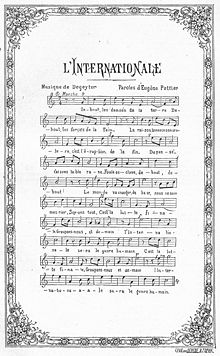 The Internationale is the anthem and fighting song of the international working
class. It is often sung by militant groups of workers and students while raising their
right clenched fists. The original French poem was written in June 1871, just after the fall
of the Paris Commune, by the French revolutionary
Eugène Pottier (1816–1887). The words were set to
original music by the worker/composer Pierre De Geyter (1848–1932) in 1888. The lyrics have
been translated into about 100 languages, and the song is widely sung around the world. Here
is the 2-stanza version of the translation (by Charles Kerr) which is most often sung in the
United States:
The Internationale is the anthem and fighting song of the international working
class. It is often sung by militant groups of workers and students while raising their
right clenched fists. The original French poem was written in June 1871, just after the fall
of the Paris Commune, by the French revolutionary
Eugène Pottier (1816–1887). The words were set to
original music by the worker/composer Pierre De Geyter (1848–1932) in 1888. The lyrics have
been translated into about 100 languages, and the song is widely sung around the world. Here
is the 2-stanza version of the translation (by Charles Kerr) which is most often sung in the
United States:
Arise, you prisoners of starvation!
Arise, you wretched of the earth!
For justice thunders condemnation:
A better world’s in birth!
No more tradition’s chains shall bind us,
Arise you slaves, no more in thrall!
The earth shall rise on new foundations:
We have been nought, we shall be all!
’Tis the final conflict,
Let each stand in his place.
The international working class
Shall be the human race
We want no condescending saviors
To rule us from their judgment hall,
We workers ask not for their favors
Let us consult for all:
To make the thief disgorge his booty
To free the spirit from its cell,
We must ourselves decide our duty,
We must decide, and do it well.
’Tis the final conflict,
Let each stand in his place.
The international working class
Shall be the human race
For further information about the Internationale see the
Wikipedia entry.
INTUITION PUMP
A term coined by the bourgeois philosopher Daniel Dennett to refer to little stories or
considerations which are “designed to provoke a heartfelt, table-thumping intuition—‘Yes, of
course, it has to be so!’—about whatever thesis is being defended.” [Dennett,
Intuition Pumps and Other Tools for Thinking (2013), pp. 5-6.] In other words,
something which promotes a specific viewpoint or theory in a particularly convincing sort of
way. A thought experiment is one sort of intuition
pump. The viewpoint or theory promoted may actually be correct or incorrect, good or bad,
and the specific intuition pump may therefore be something which serves a positive or negative
role in social discourse.
An example of an intuition pump with a negative
influence was the supposed “proof” of the existence of God before the scientific theory of
evolution was elaborated by Darwin: “How else to explain the existence of human beings and the
other animals and plants?” However, once evolutionary theory had been elaborated, it itself
became a powerful and positive intuition pump supporting the view that there is no good reason
to believe in God after all! (Note that even this specific positive intuition pump is by itself
not conclusive; it is conceivable that some “god” created life and human beings through the
means of evolution. A scientific proof that God definitely does not exist is
possible only by coming to understand that mind and mental phenomena are of necessity high
level ways of looking at (i.e., functions of) the activity of brains or their physical
equivalent, and therefore no “disembodied mind” (as God is supposed to be) can possibly exist.
Nevertheless, even just an understanding of the basic scientific principle of evolution already
goes a long way towards undercutting the ancient crude, semi-plausible rationale for believing
in God.)
INVENTION
The invention of new machines and new production techniques is something which is furthered
by the sociopolitical advancement of society. Invention was much fostered with the advent of
capitalism, was additionally fostered with the advent of capitalist-imperialism, and will be
fostered to an even greater degree under socialism and communism when workers and technicians
come to understand that their new ideas benefit both themselves and the people in general,
and not just a handful of capitalists!
“Competition becomes transformed into monopoly. The result is immense
progress in the socialization of production. In particular, the process of technical
invention and improvement becomes socialized.
“This is something quite different
from the old free competition between manufacturers, scattered and out of touch with
one another, and producing for an unknown market.” —Lenin, “Imperialism, the Highest
Stage of Capitalism”, LCW 22:205.
INVERSION [In contemporary corporate finance]
A method of avoiding taxes on corporate profits by buying up another company in a lower-tax
country, moving the headquarters of the combined company to that other country, and thus
“officially” becoming a foreign corporation. U.S. corporations with huge foreign profits
presently do not need to pay U.S. taxes on those profits until they “repatriate” the money
(i.e., send it back to the corporate headquarters in the U.S.). Inversion allows them to
avoid those and other taxes permanently.
As of late September 2014, at least 75 major
corporations (including the fast food giant, Burger King) have already pulled this inversion
scam and cheated the U.S. government out of billions of dollars in corporate taxes. Congress
has recently been debating whether to change the law to make this sort of tax cheating more
difficult, though many in Congress (who more directly represent these cheating corportions)
favor just lowering corporate taxes even further so that companies have no need to pull
this scam in the first place. (The U.S. corporate tax rate has already been lowered to an
official 35%; however, the plethora of tax loopholes means that most corporations pay a
much lower rate, many of them less than 10% and each year many corportions already pay no
taxes whatsoever.)
See also:
CORPORATE TAXES,
TAX LOOPHOLES
“INVERTED SPECTRUM”
This is a puzzle or sort of a thought experiment championed by those influenced by
philosophical idealism (as most of us have been to some degree in
this society!). It is often presented along these lines:
How do I know that others see what I call red when they look at
something that is red? Sure, they also call it red, but how do I know it
looks the same to them as red looks to me? Couldn’t they be having the
same subjective experience as I have when I look at blue things, for example? And
couldn’t they have the subjective experience of seeing “redness” when they look
at what we both call blue things?
In Chapter 23 of his book I Am A Strange Loop (NY: Basic Books, 2007), pages 333-338,
Douglas Hofstadter discusses this riddle at length and utterly demolishes it. (If this riddle
really bothers you, I suggest you go there for the full antidote! I’ll just refer to a few of
his points here.)
Hofstadter notes that those who are impressed by
this inverted spectrum argument make the unacknowledged assumption that “our experiences
of redness and blueness are totally disconnected from physics”. The feeling of a color,
they think, is some sort of individual invention which two different people could “invent” in
two entirely different ways. Actually, if two different people have senses which are more or
less equally capable of discriminating light of a certain color, and whose brains have neural
networks which signal when this specific color of light is detected, then there is every
reason to believe that the subjective experience of the two people is also equivalent. Why
would evolution have developed two wildly diverse subjective neural networks on top of
what is necessary to recognize and register the presence of a given color in an object? Moreover,
if the two people had developed these additional unnecessary subjective neural networks
(to reflect this differing subjective “redness” or “blueness”), this would be discoverable by
the close inspection of the two different brains. No such differences in brains have been
discovered, and no neurophysiologists really believe that they ever will be.
Hofstadter goes on to note that any presumed
difference in subjective feeling associated with the same color would therefore have to
be entirely unrelated to any physical structure of the brain or its neural networks. In other
words, the differences would have to be entirely in the realm of mind as opposed
to physical brains. Thus, this notion of the possibility of “inverted spectrums” (and of
generalizations of the idea encompassed under the name of “qualia”)
must of necessity imply a dualistic theory of mind and brain (matter). And
dualism, from the materialist perspective, and since it denies
that matter is the necessary basis for all mental phenomena, is merely a variety of philosophical
idealism.
INVESTMENT — Falling Corporate Rate Of
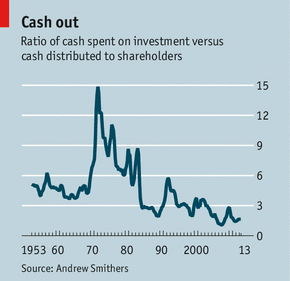 Corporations have the option of reinvesting their profits (by building new factories and
increasing production, etc.), or by distributing those profits to shareholders in the form of
dividends, or else by just building up piles of cash on hand. During boom times, when further
profits can easily be made by building new factories and expanding production, corporations
naturally put a greater proportion of their profits to that use. But during an overproduction
crisis, when corporations cannot even sell all that they can already produce, their strong
tendency is to avoid new productive investment, and to expand their dividends to shareholders
and to build up their excess cash in company bank accounts.
Corporations have the option of reinvesting their profits (by building new factories and
increasing production, etc.), or by distributing those profits to shareholders in the form of
dividends, or else by just building up piles of cash on hand. During boom times, when further
profits can easily be made by building new factories and expanding production, corporations
naturally put a greater proportion of their profits to that use. But during an overproduction
crisis, when corporations cannot even sell all that they can already produce, their strong
tendency is to avoid new productive investment, and to expand their dividends to shareholders
and to build up their excess cash in company bank accounts.
In the graph at the right, we see how the ratio
of corporate reinvestment of profits to the dividend distributions has declined in a major way
since the beginnings of the current U.S. and world capitalist overproduction crisis in the early
1970s. The continuing decline is especially pronounced over the past decade, which includes the
period of the “Great Recession” (which for the working
class still continues). Bourgeois publications such as the Economist claim that this low
and still falling rate of reinvestment is due to extraneous factors, such as incorrect
“incentives” given to corporate managers. But the real explanation is much simpler: It makes
no sense to build new factories when you can’t fully use all those you already have.
See also INVESTMENT STRIKE
below.
“INVISIBLE HAND”
The absurd idea that the public interest is best served if everyone looks out only for their
own private interests, and that the “public good” is somehow mysteriously generated out of
all that private selfishness by some “invisible hand”!
[More introductory comments to be added...]
“But it is only for the sake of profit that any man employs a capital in
the support of industry...
“As every individual, therefore,
endeavours as much as he can both to employ his capital in the support of domestic
industry, and so to direct that industry that its produce may be of the greatest value;
every individual necessarily labours to render the annual revenue of the society as great
as he can. He generally, indeed, neither intends to promote the public interest, nor knows
how much he is promoting it. By preferring the support of domestic to that of foreign
industry, he intends only his own security; and by directing that industry in such a
manner as its produce may be of the greatest value, he intends only his own gain, and he
is in this, as in many other cases, led by an invisible hand to promote an end which was
no part of his intention. Nor is it always the worse for the society that it was no part
of it. By pursuing his own interest he frequently promotes that of the society more
effectually than when he really intends to promote it. I have never known much good done
by those who affected to trade for the public good. It is an affectation, indeed, not
very common among merchants, and very few words need be employed in dissuading them from
it.” —Adam Smith, The Wealth of Nations (1776), Book IV, Chapter II, (Modern Library,
1937), p. 423.
IONIAN SCHOOL [Philosophy: 6th century BCE]
The Ionian School of ancient Greek philosophy (also known as the Ionic or Miletian school),
arose in the city of Miletus which was a trading and cultural center of the ancient world
located on the coast of Asia Minor. This was the earliest school of naturalistic materialism
in the history of Greek philosophy, and is also considered to be the first school of
scientific speculation about the nature of the world—i.e., one of the earliest sources of
ideas which could be reasonably viewed as early scientific theories. Its most famous
individuals were Thales, Anaximander
and Anaximenes.
Although they were materialists, the Ionians
were what we would now view as very naïve materialists,
and really had not much of any understanding of how mind and mental phenomena can be viewed as
arising from an appropriate complex organization of matter (a brain). Instead, they were
called hylozoists (those who “put life into matter”), and they seem to have believed
that all matter itself, at least in an elemental way, is actually capable of what we would now
call mental processes such as having feelings. In this way the Ionians could also be viewed as
early precursors of something like the sort of dualism that
Leibniz propounded, as much as true materialists in the modern
sense. This, however, is often characteristic of naïve materialism in general.
“Ionian science was an endeavor marked by a strong interest in uncovering
fundamental laws to explain natural phenomena, a tremendous milestone in the history of
human ideas. Their approach was rational and in many cases led to conclusions supprisingly
similar to what our more sophisticated methods have led us to believe today. It
represented a grand beginning. But over the centuries much of Ionian science would be
forgotten—only to be rediscovered or reinvented, sometimes more than once....
“Scholars in ancient Ionia were
among the first to explain natural phenomena through laws of nature rather than myth or
theology....
“As the Ionian influence spread,
there appeared others who saw that the universe possesses an internal order, one that
could be understood through observation and reason. Anaximander (ca. 610 BC-ca. 546 BC),
a friend and possibly a student of Thales, argued that since human infants are helpless
at birth, if the first human had somehow appeared on earth as an infant, it would not
have survived. In what may have been humanity’s first inkling of evolution, people,
Anaximander reasoned, must therefore have evolved from other animals whose young are
hardier.” —Stephen Hawking and Leonard Mlodinow, The Grand Design (2010), pp.
18-20.
IRAQ — U.S. War Against (2003-?)
 The U.S. imperialists, together with their junior partners including the British imperialists,
have attacked Iraq twice in recent decades, in order to seize better control of its oil
resources and to establish a military center for U.S. control of the whole Middle East. The
second and larger war and invasion, also known as the Second Gulf War, began on March 20,
2003, and as of late 2011 it still continues, though with a much reduced level of fighting at
the present time.
The U.S. imperialists, together with their junior partners including the British imperialists,
have attacked Iraq twice in recent decades, in order to seize better control of its oil
resources and to establish a military center for U.S. control of the whole Middle East. The
second and larger war and invasion, also known as the Second Gulf War, began on March 20,
2003, and as of late 2011 it still continues, though with a much reduced level of fighting at
the present time.
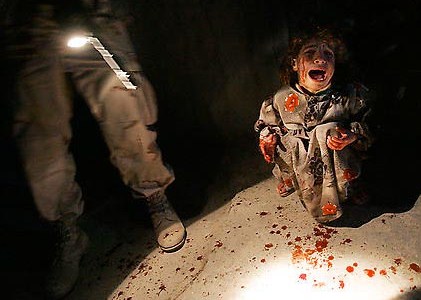
It is estimated that up to 1.2 million people
have died as a result of the war, from both the direct results of the invasion and occupation,
and from the sectarian conflict that then erupted between Sunnis, Shiites, Kurds and other
sections of the population. This figure apparently does not include the previous hundreds of
thousands of deaths, especially of Iraqi children, during the severe blockade of Iraq during
the 1990s and up until the 2003 invasion. In the photo at the right, 5-year old Samar Hassan
screams in terror, and is covered in her innocent parent’s blood, after U.S. troops fired on
their car and killed them in Tal Afar, Iraq, on the evening of Jan. 18, 2005. They were
merely taking their other child, Samar’s sick brother, to the hospital.
The stated goal of this war by the American
and British imperialists was to liquidate the threat to their interests posed by Iraqi leader
Saddam Hussein’s supposed arsenal of “weapons of mass destruction” (chemical, biological and,
“potentially” it was claimed, nuclear weapons). Despite exhaustive seaching, no such weapons
or weapons programs were found in Iraq after the invasion, and it became obvious that this
was a mere pretense, which perhaps the imperialists convinced themselves existed because they
needed some excuse to invade Iraq.
The real primary reasons for the attack and
invasion were quite obvious. Iraq is second only to Saudi Arabia in the Mideast in its proven
oil reserves. The U.S. State Department, in a memorandum as far back as 1945, termed the
Mideast as a “stupendous source of strategic power, and one of the greatest material prizes
in world history”. In addition it was necessary to move the U.S. military forces in the
region out of Saudi Arabia (after the violent attacks by Saudi militants in the U.S. on Sept.
11, 2001). What better place to move them than Iraq, with its huge oil resources, and—as a
plus—right next door to Iran, which the imperialists also expect to attack at some point.
There were also a number of less important additional reasons, such as their need to slap
down Saddam Hussein, a tyrant they had put in power in the first place, but who had grown too
big for his britches (too independent) in their eyes.
From the point of view of actually promoting
the interests and goals of U.S. and other foreign imperialism, this Iraq war and invasion has
been a major and extraordinary expensive failure. Far from quickly seizing control of Iraq
and the surrounding area, this imperialist intervention has further destabilized the entire
region. The offical figure for the U.S. funds spent or allocated on this war (as of Nov.
2010) was already more than $900 billion. Much of the actual cost, however, has been hidden
in the general military and other federal government budgets. The final tally, including all
the expenditures for health care for veterans, replacement of war materials used up in this
war, etc., will be at least $1.5 trillion, and some estimates run as high as $3 trillion. At
a time when the U.S. and world capitalist economic crisis is intensifying as never before,
this war has obviously been an extremely foolish one, even from the point of view of the
interests of the imperialists themselves!
ISOLATED FACTS
As Lenin often remarked, due to the complexity of most situations, and modern society as a
whole, it is always possible to find isolated facts to “prove” any theory whatsoever.
The truth arises not from isolated facts, but from an analysis developed from a
comprehensive evaluation of all the most
important facts. Those who try to understand complicated situations or structures on the basis
of isolated facts and very limited investigation will virtually never succeed.
“In order to depict this objective position one must not take examples
or isolated data (in view of the extreme complexity of the phenomena of social life it
is always possible to select any number of examples or separate data to prove any
proposition), but all the data on the basis of economic life in all
the belligerent countries and the whole world.” —Lenin, “Imperialism, the Highest
Stage of Capitalism” (1916), LCW 22:190. [Lenin is explaining here how the true class
nature of the inter-imperialist war then in progress had to be determined.]
“To make the picture a graphic one, to obtain a real picture
instead of a heap of disconnected, disjointed, and isolated facts and incidents, to put
a stop to the endless and senseless arguments over particular votings (who voted for whom
and who supported whom?), I have decided to try to depict all the basic types of
‘divisions’ at our Congress in the form of a diagram. This will probably seem
strange to a great many people, but I doubt whether any other method can be found that
would really generalise and summarise the results in the most complete and accurate manner
possible.” —Lenin, One Step Foreward, Two Steps Back: The Crisis in Our Party (1904),
LCW vol. 7, online at:
http://www.marxists.org/archive/lenin/works/1904/onestep/n.htm. [In this example
Lenin illustrates how a more comprehensive analysis than just “isolated facts” is
necessary in order to understand what had really happened at the Second Party Congress
of the RSDLP, who the different forces were, and so forth.]
“The Mensheviks and Socialist-Revolutionaries call themselves socialists,
but they are actually abettors of the counter-revolutionaries, abettors of the
landowners and capitalists. This was proved in practice not only by isolated facts, but
by two big periods in the history of the Russian revolution: (1) the Kerensky period, and
(2) the Kolchak period. Both times the Mensheviks and Socialist-Revolutionaries, while
professing to be ‘socialists’ and ‘democrats’, actually played the role of abettors of
the whiteguards. Are we then going to be so foolish as to believe them now they are
suggesting we let them ‘try again’, and call our permission a ‘united socialist (or
democratic) front’?” —Lenin, “Apropos of the Victory Over Kolchak” (Aug. 24, 1919), LCW
vol. 29, online at:
http://www.marxists.org/archive/lenin/works/1919/aug/24.htm. [In this example Lenin
illustrates how only a comprehensive evaluation of other political forces can allow a
correct decision to be made about whether to form an alliance with them.]
ITALY — 1920 WORKER’S UPRISING
“In September 1920, Italian steelworkers occupied their mills on the
initiative of their trade union, which was in conflict with the association of
industrialists. The movement started in Turin and Milan, then spread through Piedmond
and Northern Italy across the country, from the metallurgical industry to other
industries and to agriculture. In Sicily and in other areas peasants occupied the
land. The scope of the movement jeoparized the capitalist regime, but the reformist
leaders of the Socialist Party and the trade unions, terrified by the political
character of the movement, adopted a decision to confine it to within the trade unions
and prevent it from developing into a revolution. They also decided to start
negotiations with the industrialists.
“This was a hard blow at the
Italian workers’ movement and showed the leaders inability to lead the mass forces.
Fascism used the confusion within the working class to start its armed offensive in
Italy.” —Endnote 131, LCW 32.
“The revolution in Italy will run a different course from that in
Russia. It will start in a different way. How? Neither you nor we know. The Italian
Communists are not always Communists to a sufficient degree. Did a single Communist
show his mettle when the workers seized the factories in Italy? [This refers to the
events mentioned in endnote 131 above. —Ed.] No. At that time, there was as yet no
communism in Italy; there was a certain amount of anarchism, but no Marxian
communism. The latter has still to be created and the masses of the workers must be
imbued with it by means of the experience of the revolutionary struggle. And the
first step along this road is a final break with the Mensheviks, who for more than
twenty years have been collaborating and working with the bourgeois government.”
—Lenin, “Speech on the Italian Question” (at the Third Congress of the Communist
International, June 28, 1921), LCW 32:465.
IWW
See:
INDUSTRIAL WORKERS OF THE WORLD
Dictionary Home Page and Letter Index
MASSLINE.ORG Home Page