MALINOVSKY, Roman Vatslavovich (1876-1918)
A prominent trade union organizer, elected Bolshevik member to the Russian Duma [parliament],
member of the Bolshevik Central Committee, and the highest paid spy for the Tsarist secret
police, the notorious Okhrana.
Malinovsky had a dubious life right
from an early age. Born into a Roman Catholic peasant family in Russian Poland, he was
orphaned while quite young and turned to petty crime to survive. According to the Wikipedia,
in 1899—at the age of about 23—he was convicted of theft, rape and burglary.
We doubt if his lumpen criminal background was known to the
Russian Social Democratic Labor Party (RSDLP) when he began
associating with them after his jail term and a 4-year enlistment in the Russian army. (If
it was, they definitely should have been much more cautious about him.)
In 1906 Malinovsky was working as a lathe
operator at a factory in St. Petersburg, and also was a talented labor organizer for the
Metalworkers Union and joined the RSDLP. He was arrested by the Okhrana in 1909 and expelled
from St. Petersburg. He and his family then moved to Moscow where he was arrested again in
1910. This time, he accepted a deal with the Okhrana. For both his freedom and a fairly
substantial monthly salary (for the times) he became a agent for the Okhrana, with
instructions to further develop his ties with the RSDLP and especially the Bolshevik
faction. It is said that using information that Malinovsky provided, the Okhrana not only
learned the real names of many party members, the locations of party meetings, locations
of storage places for party literature, etc., but “was able to curtail almost all
meaningful Social Democratic activity in Moscow during 1910 and 1911.”
Malinovsky also provided the information to locate and arrest several important Bolsheviks
which led to their exile to Siberia, including Grigory Ordzhonikidze, Joseph Stalin and
Yakov Sverdlov.
In January 1912 Malinovsky showed up at
the Sixth Party Conference which Lenin had called in Prague, even though he was not an
authorized delegate. Lenin knew of him because of his good reputation in labor
organization work and, supposedly, was also impressed by his forceful personality. Lenin
therefore proposed that Malinovsky be elected to the Central Committee and also suggested
that he would be a good candidate for election to the next Duma as a representative of
the Moscow workers. “Backed by both the police and the party, Malinovsky was duly
elected in October 1912.” [Carter Elwood] In the Duma Malinovsky was a
“surprisingly eloquent” speaker and spokesman for the Bolshevik viewpoint. He also
used his immunity as a Duma member to raise funds for the Bolsheviks, to establish and
promote its legal newspapers and publishing operation, and so forth. (However, he also
served on the party commission set up to find and expose police agents in the party
ranks!) Because of Malinovsky’s considerable agitational effectiveness for the Bolsheviks,
and his other work for the party, the Okhrana became alarmed by the role he was playing.
Consequently they ordered him to resign his Duma seat, which he then did.
However, this unauthorized resignation—as
far as the Bolsheviks were concerned—and the obvious violation of party discipline,
immediately raised some serious questions about Malinovsky, and was a major embarrassment
for the Bolsheviks. Apparently it was the Menshevik leader Julius
Martov who in 1913 first condemned Malinovsky as a Tsarist spy. Lenin refused to
believe this at the time, but after his resignation from the Duma Malinovsky was removed
from his positions in the party and also expelled as a party member. Malinovsky had been
ordered by the Okhrana to help widen the split between the Bolsheviks and Mensheviks,
which he did. However, this meant that accusations coming from the Mensheviks of spying
for the Tsarist regime tended to sound like mere anti-Bolshevik partisanship. Moreover,
in Lenin’s view, the harsh line against the Mensheviks that Malinovsky took was more
than justified. These things probably account for Lenin’s reluctance to totally condemn
Malinovsky at first.
One source claims that after his
exposure Malinovsky fled to Germany, and when World War I broke out he was interned in
a POW camp there. Another source says that he was in the Russian army again during the
war, and was wounded and captured by the Germans in 1915 and then held in a POW camp.
Either way, after the war and the Bolshevik Revolution, Malinovsky returned to Russia,
and under a false name even tried to take part in the Petrograd Soviet! But Grigory
Zinoviev recognized him, and he was arrested and put on trial as a traitor to the
revolution. Lenin is said to have briefly attended the trial but did not testify, and
left muttering “What a swine he was!” Malinovsky was found guilty and executed.
One further note about the Malinovsky
affair: It has been claimed by some modern commentators that Malinovsky actually was a
double agent, and had been secretly working with Lenin all along. But there is no
evidence for this at all, even in the newly available files after the collapse of the
Soviet Union. And it makes no sense that Lenin would have participated in the serious
disruption of the party work in Moscow that Malinovsky enabled. This theory probably
comes about because Malinovsky really did seem to be somewhat politically schizoid,
simultaneously and conscientiously working for both the Bolsheviks and for the
Okhrana.
“In our case... the rapid alternation of legal and illegal work,
which made it necessary to keep the general staff—the leaders—under cover and
to cloak them in the greatest secrecy, sometimes gave rise to extremely dangerous
consequences. The worst of these was that in 1912 the agent provocateur
Malinovsky got into the Bolshevik Central Committee. He betrayed scores and
scores of the best and most loyal comrades, caused them to be sentenced to penal
servitude, and hastened the death of many of them. That he did not cause still
greater harm was due to the correct balance between legal and illegal work. As
member of the Party’s Central Committee and Duma deputy, Malinovsky was forced,
in order to gain our confidence, to help us establish legal daily papers, which
even under tsarism were able to wage a struggle against the Menshevik opportunism
and to spread the fundamentals of Bolshevism in a suitably disguised form. While,
on the one hand, Malinovsky sent scores and scores of the finest Bolsheviks to
penal servitude and death, he was obliged, with the other, to assist in the
education of scores and scores of thousands of new Bolsheviks through the medium
of the legal press.” —Lenin, “Left-Wing” Communism—An Infantile Disorder
(April-May 1920), LCW 31:45-46.
“Malinovsky was a prisoner of war in Germany. On his return to
Russia when the Bolsheviks were in power he was instantly put on trial and shot
by our workers. The Mensheviks attacked us most bitterly for our mistake—the
fact that an agent provocateur had become a member of the Central
Committee of our Party. But when, under Kerensky, we demanded the arrest and
trial of Rodzyanko, the Chairman of the Duma, because he had known, even before
the war, that Malinovsky was an agent provocateur and had not
informed the Trudoviks and the workers in the Duma, neither the Mensheviks
nor the Socialist-Revolutionaries in the Kerensky government supported our
demand, and Rodzyanko remained at large and made off unhindered to join Denikin.”
—Lenin, ibid. (footnote on same page).
MAO Zedong — Contributions of to Revolutionary Theory and Practice
Summing up Mao’s enormously important contributions to revolutionary thought and practice is no
small task. From the standpoint of revolutionary practice it is hard to believe that the great
Chinese Revolution which overthrew foreign imperialism and Chinese bureaucrat-comprador
capitalism in 1949 could have been successful without him, at least during that era. And it is
virtually impossible to imagine that the Great Proletarian Cultural
Revolution could have occurred at all without his personal initiation and direction of it.
Mao’s contributions to revolutionary theory lay behind both those great revolutions; in
philosophy and socialist political economy, as well as in revolutionary political and military
strategy. The outline here of Mao’s individual great contributions to Chinese and international
revolutionary theory and practice should therefore be viewed as both incomplete and
insufficiently elaborated.
1. Mao’s creation of the new
revolutionary strategy of People’s War:
It is true that peasant rebellions and guerrilla
warfare have a long history in China, and also occurred in Europe and elsewhere. But after the
success of the Bolshevik Revolution in Russia,
Marxist-Leninists the world over—with hardly any exceptions—were unable to conceive of any
proletarian revolutionary strategy except that of the “October
Road”; i.e., of a long period of mostly legal struggle leading to eventual insurrection in
the cities, and then most likely followed by a period of civil war. While Mao recognized very
well that this October Road strategy was still necessary and appropriate in advanced capitalist
countries, he analyzed the failure of this approach in China in the 1920s and came up with a
brand new strategy for proletarian revolution in mostly rural, largely feudal countries like
China—namely People’s War. This new strategy of the countryside first surrounding the cities
was successful not only in China, but also in Vietnam.
Included in this theory of People’s War are
some truly brilliant principles of revolutionary military strategy, the proper relationship of
the revolutionary army to the masses, and so forth. Many of these principles are also
applicable in other circumstances and in other types of revolutionary warfare.
2. The method of leadership of the
masses which Mao called “from the masses, to the masses” and which is also known as the
mass line:
This is the democratic method of finding out
from the masses themselves what their ideas are about how to promote their own struggle,
selecting the best of these ideas based on existing revolutionary theory, the revolutionary
goal, and a study of the objective situation, and then returning this political line of
action to the masses and leading them in struggle on this basis.
This method of leadership is perhaps the
single most characteristic feature of Maoist politics, and certainly the most striking aspect.
While it was to some degree implicit in Marxism all along, and was also used informally by
Lenin (as with his recognition of the importance of the soviets (councils) to the Russian
revolution, when they were created by the masses), it was only with Mao that this general
method of leadership was summed up theoretically and then systematically popularized among
the Communist Party members as the fundamental method of revolutionary leadership. This
leadership method played a huge role in the success of the 1949 Revolution and in the
socialist transformation of industry and agriculture. (It was less systematically used in
the GPCR, however, even though Mao himself called for it to be used as the “basic method”
in that revolution in the initial 16 points in the document which launched the GPCR.)
3. The establishment of genuine
socialist society in China during the period of the late 1950s, including in the
countryside:
It may seem obvious that if there is a
successful revolution in the name of the proletariat it will then proceed to really
establish socialism both in industry and in agriculture. However, most of the so-called
socialist revolutions in Eastern Europe after World War II did not really do this. In
industry their “socialism” just meant nationalization and having top-down economic
planning, which almost from the start became hard to distinguish from
state capitalism. It did not really extend, in any
serious way, to the control of workplaces by the workers there. Even worse,
collectivization in the countryside in Eastern Europe was a complete failure. In China,
however, Mao led the country not only in the nationalization of industry and the
establishment of socialist economic planning, but also strongly promoted the supervision
and control of workplaces and their policies by the working class itself, the requirement
that managers also take part in labor, and so forth. (These measures were then greatly
intensified during the GPCR.)
Even more tellingly, Mao led the genuine
collectivization struggle in the countryside into real socialism, culminating with the
creation of the People’s Communes. Because of the use of the mass line, this not only
improved upon what had previously been done in the Soviet Union, it was done in a vastly
more humane, democratic and successful way than Stalin’s brutal collectivization of
agriculture in the USSR.
4. The recognition that the class
struggle continues under socialism and through the entire period of the dictatorship of the
proletariat, and the promotion of serious revolutionary politics in this continuing
struggle:
In hindsight, the entire world proletarian
revolutionary movement looks rather naïve in initially supposing that the seizure of
power by the working class in a country and the consequent nationalization of industry,
along with the creation of economic planning, would by itself soon create a solid and
stable socialist society progressing steadily on the path to communism. Mao was one of the
first to recognize that this was not what was happening in the Soviet Union, and that China
was also in danger of following the capitalist path that Khrushchev and his followers had
pioneered there.
Mao then initiated the “Great Debate” with
the revisionist Soviet Union over the path forward. [Many of the documents
from the Chinese side in this debate are now available at:
http://www.bannedthought.net/China/MaoEra/GreatDebate/index.htm#GreatDebate]
This debate was of world importance in re-establishing Marxism-Leninism as a genuinely
communist movement.
5. Mao’s launching of the Great
Proletarian Cultural Revolution to stop those within the Communist Party of China itself,
who were on the capitalist road, from destroying socialism in China:
This is one of the most remarkable events
in all of revolutionary history; the leader of a revolutionary party launching a new
revolution against that very party because it had been captured (to a considerable
degree) by representatives of the class enemy.
The GPCR was successful for a decade, while
Mao was still alive, in preventing the capitalist-roaders from destroying socialism.
Unfortunately, after Mao died on September 9, 1976, these revisionists seized power in a
political coup d’etát, and soon turned China back into a capitalist country
again, and later even into a fully-fledged imperialist country. Nevertheless, our world
revolutionary movement, even though it is rather weak at the moment, has learned an
invaluable lesson from all this. Mao has alerted us to a very serious problem which we
will be much better prepared to deal with in the future. For one thing, the communist
parties we now create and develop will be concerned with this long term threat right from
the very beginning.
6. Mao’s contributions to
philosophy:
The Marxist philosophy of dialectical
materialism was created and summarized earlier by Marx, Engels and Lenin, and many of
the basic ideas included in it are actually traceable back to Hegel, Feuerbach, and the
French materialist philosophers of the Enlightenment.
Nevertheless, Mao’s contribution in this area was tremendous. He reconnected up
dialectical materialism to revolutionary politics in the intimate way that had not
occurred since Lenin. Marxist philosophy was changed from the more or less ideological
window dressing that it had become back into a true guide to understanding and changing
the world. Mao took dialectical materialism seriously! And because he did, and led quite
successful revolutionary struggle by doing so, we, his political descendants, also now
take dialectical materialism seriously.
7. Mao’s contributions to
socialist political economy:
Mao’s contributions in this area are quite
underappreciated. Mao did not write on the political economy of capitalism, but he
spent a large part of his life working out how exactly to transform capitalism into
socialism, and then eventually into communism. He analyzed what had gone wrong in
Soviet industry (such as the top down approach and the failure to use the mass line) and
in the rural collectivization efforts there and in Eastern Europe. And he kept China not
only socialist while he was alive, but undergoing significant periodic transformations in
the direction of communism. His pathbreaking efforts and successes in this area remain an
important part of his legacy for the entire world communist movement.
MAO — On Religion
See also:
MARXISM—As a Religion [Mao quote],
TAOISM [Mao quote]
“Primitive humans, yielding before the force of nature and capable only of
using simple tools, were unable to explain change in the environment and so turned to the
gods for help. This was the origin of religion and idealism....
“The science of history has proved to
humankind the materiality and law-like regularity of the world, and given rise to a
consciousness of the uselessness of the fantasies of religion and idealism, and resulted in
humankind’s arrival at materialism.” —Mao, “Lecture Notes on Dialectical Materialism” (1937),
in Nick Knight, Mao Zedong on Dialectical Materialism (1990), pp. 90 & 91.
“The theory of motion of dialectical materialism is first and foremost in
opposition to the idealism and religious deism of philosophy. The essence of all idealisms
and religious deisms resides in their refusal to recognize the material unity of the world;
they assume that the world’s motion and development are non-material, or were at the very
beginning non-material, and are the consequence of the operation of spirits or God’s
supernatural power. The German idealist philosopher Hegel believed that the contemporary
world had developed out of the so-called ‘World Idea’; and in China, the philosophy of the
Book of Changes and the moral theories of Song and Ming neo-Confucianism all
engendered views of the development of the world which were idealist. Christianity asserts
God created the world, and in Buddhism and the various Chinese fetishisms the motion and
development of the world’s myriad things is put down to the supernatural. All of these
explanations which contemplate motion divorced from matter are fundamentally incompatible
with dialectical materialism. Besides idealism and religion, all pre-Marxist materialism
and all present-day anti-Marxist mechanistic materialism, are proponents of materialist
theories of motion when it comes to discussing natural phenomena, but the moment social
phenomena are mentioned, they cannot but become divorced from material causes and revert to
spiritual causation.” —Mao, “Lecture Notes on Dialectical Materialism” (1937), ibid., p.
105.
“A man in China is usually subjected to the domination of three systems of
authority: (1) the state system (political authority), ranging from the national, provincial
and county government down to that of the township; (2) the clan system (clan authority),
ranging from the central ancestral temple and its branch temples down to the head of the
household; and (3) the supernatural system (religious authority), ranging from the King of
Hell down to the town and village gods belonging to the nether world, and from the Emperor
of Heaven down to all the various gods and spirits belonging to the celestial world. As for
women, in addition to being dominated by these three systems of authority, they are also
dominated by the men (the authority of the husband). These four authorities—political, clan,
religious and masculine—are the embodiment of the whole feudal-patriarchal system and
ideology, and are the four thick ropes binding the Chinese people, particularly the peasants.
How the peasants have overthrown the political authority of the landlords in the countryside
[in the liberated areas] has been described above. The political authority of the landlords
is the backbone of all the other systems of authority. With that overturned, the clan
authority, the religious auhority and the authority of the husband all begin to totter....
Everywhere religious authority totters as the peasant movement develops. In many places the
peasant associations have taken over the temples of the gods as their offices. Everywhere
they advocate the appropriation of temple property in order to start peasant schools and to
defray the expenses of the associations, calling it ‘public revenue from superstition’. In
Liling Country, prohibiting superstitious practices and smashing idols have become quite the
vogue. In its northern districts the peasants have prohibited the incense-burning processions
to propitiate the god of pestilence. There were many idols in the Taoist temple at Fupoling
in Lukou, but when extra room was needed for the district headquarters of the Kuomintang
[then in alliance with the CCP], they were all piled up in a corner, big and small together,
and no peasant raised any objection. Since then, sacrifices to the gods, the performance of
religious rites and the offering of sacred lamps have rarely been practised when a death
occurs in a family. Because the initiative in this matter was taken by the chairman of the
peasant association, Sun Hsiao-shan, he is hated by the local Taoist priests. In the Lungfeng
Nunnery in the North Third District, the peasants and primary school teachers chopped up the
wooden idols and actually used the wood to cook meat. More than thirty idols in the Tungfu
Monastery in the Southern District were burned by the students and peasants together, and
only two small images of Lord Pao [an ancient official known for his fairness] were snatched
up by an old peasant who said, ‘Don’t commit a sin!’ In places where the power of the peasants
is predominant, only the older peasants and the women still believe in the gods, the younger
peasants no longer doing so. Since the latter control the associations, the overthrow of
religious authority and the eradication of superstition are going on everywhere.”
—Mao, “Report on an Investigation of
the Peasant Movement in Hunan” (March 1927), SW 1:44-45.
“Furthermore, the imperialist powers have never slackened their efforts to
poison the minds of the Chinese people. This is their policy of cultural aggression. And it
is carried out through missionary work, through establishing hospitals and schools, publishing
newspapers and inducing Chinese students to study abroad. Their aim is to train intellectuals
who will serve their interests and to dupe the people.” —Mao (and comrades), “The Chinese
Revolution and the Chinese Communist Party” (December 1939), SW 2:312.
“In the field of political action Communists may form an anti-imperialist
and anti-feudal united front with some idealists and even religious people, but we can never
approve of their idealism or religious doctrines.” —Mao, “On New Democracy” (January 1940),
SW 2:381.
“The Communist Party of China is in full agreement with Dr. Sun’s policy on
nationalities as stated here.... Their spoken and written languages, their manners and customs
and their religious beliefs must be respected.” —Mao, “On Coalition Government” (April 24, 1945),
SW 3:306. Online at:
https://www.marxists.org/reference/archive/mao/selected-works/volume-3/mswv3_25.htm
“All religions are permitted in China’s Liberated Areas, in accordance with
the principle of freedom of religious belief. All believers in Protestantism, Catholicism,
Islamism, Buddhism and other faiths enjoy the protection of the people’s government so long
as they are abiding by its laws. Everyone is free to believe or not to believe; neither
compulsion nor discrimination is permitted.” —Mao, “On Coalition Government” (April 24, 1945),
SW 3:313. Online as indicated above.
“The Communist Party adopts the policy of protecting religion. Whether you
believe in religion or not and whether you believe in this religion or that religion, all of
you will be respected. The Party respects religious belief. This policy, as presently adopted,
will continue to be adopted in the future.” —Mao, comments to the Tibetan Goodwill Mission
(1952), Renmin Ribao [People’s Daily], November 22, 1952. [English translation
from Donald E. MacInnis, Religious Policy and Practice in Communist China (1972), p.
14.]
“In advocating freedom with leadership and democracy under centralized
guidance, we in no way mean that coercive measures should be taken to settle ideological
questions or questions involving the distinction between right and wrong among the people.
All attempts to use administrative orders or coercive measures to settle ideological questions
or questions of right and wrong are not only ineffective but harmful. We cannot abolish
religion by administrative order or force people not to believe in it. We cannot compel people
to give up idealism, any more than we can force them to embrace Marxism. The only way to
settle questions of an ideological nature or controversial issues among the people is by the
democratic method, the method of discussion, criticism, persuasion and education, and not by
the method of coercion or repression.” —Mao, “On the Correct Handling of Contradictions Among
the People” (Feb. 27, 1957), SW 5:389. Online at:
https://www.marxists.org/reference/archive/mao/selected-works/volume-5/mswv5_58.htm
MAO — Personality Cult
Around 1942, with the Rectification Movement
in the Chinese Communist Party which condemned the erroneous and disastrous earlier political lines
of Wang Ming and others, the early signs of a
personality cult began to arise around Mao Zedong. Of course
it is true that political lines are generally associated with prominent individual leaders, and
that goes for correct lines as well as incorrect lines. Thus there is always at least an implicit
commendation involved for those who have led in the adoption of political lines and policies which
have been proven successful. And it is also true that those who have led in the development of past
successful lines have earned the right to be carefully listened to when they propose additional
lines and policies in new situations. However, there is still the danger of starting to think that
political lines are correct because only that one person is capable of developing them, and
even that whatever that one person says in the future must also be correct.
While there were some signs of this sort of thing
in the CCP at least from 1942 on, it got taken to absurd extremes during the first few years of
the Great Proletarian Cultural Revolution (i.e., in the period 1966-1970).
For a while it was practically mandatory to refer to Mao as “the Great Leader Chairman Mao” if not
the fuller phrase “the Great Leader, the Great Supreme Commander, the Great Teacher and the Great
Helmsman Chairman Mao”. Successes in agriculture, industry, education and all spheres of life were
attributed to Mao or Mao Tsetung Thought. Mao badges were produced in huge numbers (possibly more
than 2 billion according to the Wikipedia) and it was practically obligatory to wear such badges
over one’s heart and to carry a copy of the “Little Red Book”
(Quotations from Chairman Mao Tse-tung).
It is said that people were also often required to recite quotations from Mao. Mao was in fact
treated almost as a living god by huge numbers of people.
Although these days most Maoists inside and outside
China tend to cringe at the most extreme manifestations of the Mao personality cult, it is still
widely defended as having been “necessary” for the most part. The argument in favor of promoting
the personality cult around Mao was that—given the strength and growing domination of the CCP by
the capitalist roaders—this was the only way to build a mass movement to expose and oust these
enemies from positions of power in the party and government. There was no doubt some considerable
truth to this, but it only pushes the central issue back a bit: How did it happen that things got
so out of hand in the first place?! Surely there must be some strong criticism of Mao and the
other genuine proletarian revolutionaries in the CCP for allowing this crisis situation to develop
to the point where a personality cult around Mao could be deemed necessary in order to re-establish
proletarian rule!
By far the worst promoter of the Mao cult was
Lin Biao, who among other things introduced the fad of constantly
waving the “Little Red Book”. And after Lin’s downfall the personality cult was soon drastically
cut back. The requirement that Mao badges be constantly worn soon diasappeared. Nevertheless, Mao
himself must receive the primary blame for promoting this personality cult around him, even though
he resisted some of the wildest aspects of it (see his letter below to Jiang Qing) and insisted
that it be greatly toned down during the last years of his life.
See also:
PERSONALITY CULT,
CULT (Political), and the long article
"Personality Cult: Is It
Necessary for Revolution?", by Ranganayakamma, written in 1983, and a discussion from 2007
occasioned by that article at:
http://www.massline.org/SingleSpark/Theory/P-Cult-Discuss1.htm
“The center is asking my permission to publish the speech given by my friend
[Lin Biao], and I shall agree.... I have doubts about some of his views. I have never believed
that my little red book contained so much spiritual power. When he praises it to heaven, the
whole country will do the same. It is all exaggerated.... (I have been pushed by them onto
Mount Liang [among the rebels]), and I cannot refuse my consent. To be forced to give it
against my convictions is something that has never happened to me in all my life.... I feel
sure of myself, yet I have doubts.... At the Hangzhou conference last April, I said that I
did not approve of the formulas my friend uses, but my words had no effect.... They have used
even worse expressions, they have exalted me to the heavens as the miracle of miracles....
I have become the Zhong Kui [a terrifying mythological character] of the XX century Communist
party.... I’ll break my bones in the fall.... If they have already demolished Marx and Lenin,
why not us, too—and with more reason? You should think about this and not let victory go to
your head.... Our task today is to knock out some of the rightist elements in the Party and
in the country (to knock all of them out would be impossible); in seven or eight years we
could launch a new campaign.... When can these lines be published?.... Perhaps the moment will
be after my death, when the Right will have appropriated the power.... The Right will exploit
my words to raise the black banner, but without much luck. Since the Chinese empire was overt
in 1911, the reaction has never been able to hold power for long. The Left, however, will use
my words toward organizing itself, and the Right will be overthrown...”
—Mao, in a letter to his wife Jiang
Qing, July 8, 1966. From Edoarda Masi, China Winter: Workers, Mandarins, and the Purge of
the Gang of Four (NY: 1982), p. 19. Originally from an English translation of the letter
in Issues and Studies, January 1973, pp. 94-96, and in the Yearbook of Chinese
Communism, 1973, pp. 2-3.
[Alas, it seems that the capitalist
roaders in China have held onto power much longer than Mao expected. —Ed.]
“We discussed my account of our last talk, in January 1965, in which I
had reported his [Mao’s] acknowledgement that there was indeed a ‘cult of personality’ in
China—and moreover there was reason for one. Some people [in China] had criticized me for
writing about that.
“So, he said, what if I had written
about a ‘cult of personality’ in China? There was such a thing. Why not write about it?
It was a fact ... those officials who had opposed my return to China in 1967 and 1968 had
belonged to an ultraleftist group which had seized the foreign ministry for a time, but
they were all cleared out long ago. At the time of our 1965 colloquy, Mao continued, a great
deal of power—over propaganda work within the provincial and local party committees, and
especially within the Peking Municipal Party Committee—had been out of his control. That
was why he had then stated that there was need for more personality cult, in order to
stimulate the masses to dismantle the anti-Mao party bureaucracy.
“Of course the personality cult had
been overdone. Today, things were different. It was hard, the chairman said, for people to
overcome the habits of 3,000 years of emperor-worshiping tradition. The so-called ‘Four
Greats’—those epithets applied to Mao himself: ‘Great Teacher, Great Leader, Great Supreme
Commander, Great Helmsman’—what a nuisance. They would all be elminated sooner or later.
Only the word ‘teacher’ would be retained—that is, simply schoolteacher. Mao had always
been a schoolteacher and still was one. He was a primary schoolteacher in Changsha even
before he was a Communist. All the rest of the titles would be declined.
“‘I often wonder,’ I said, ‘whether
those who shout Mao the loudest and wave the most banners are not—as some say—waving the
Red Flag in order to defeat the Red Flag.’
“Mao nodded. He said such people fell
into three categories. The first were sincere people. The second were those who drifted
with the tide—they conformed because everyone else shouted ‘Long live.’ The third
category were hypocrites. I was right not to be taken in by such stuff.”
—Edgar Snow, “A Conversation with
Mao Tse-tung”, Life magazine, April 30, 1971, p. 40. This article is online at:
http://www.bannedthought.net/China/Individuals/Snow-Edgar/EdgarSnow-Life-1971-April30.pdf
“MARKET SOCIALISM”
An attempt to combine “socialism” with capitalism, and in particular with the capitalist
commodity market (including the market for labor-power).
From the revolutionary Marxist (Marxist-Leninist-Maoist) perspective this makes no sense
whatsoever, because we define socialism as the transitional
stage between capitalism and
communism. But various types of
revisionist thinkers view “socialism” as merely a
modification of capitalism, and sometimes even such a slight modification that some of
them consider a lightly “regulated” capitalist welfare state (such as in Scandinavia)
to be “socialism”!
Clearly nothing like European
social democracy can be in any way viewed as genuine
socialism, either economically or politically. But couldn’t we imagine a society
where there are really no capitalists, but still separate, decentralized state-run
enterprises that use a market to sell commodities to each other, and sell mass-consumption
commodities to the people? Couldn’t there still be a labor market as well, with these
enterprises hiring workers, and even continuing to extract
surplus value from them—but then turning
all of this surplus value over to the state for the expansion of production and
for public purposes (education, health care, retirement benefits, and so forth), with no
“profits” going to any rich owners of the enterprises (because there are none)?
One important thing to seriously ponder in
a thought experiment of this kind is just how stable such a system would be. In
fact it would be extremely unstable, and would inevitably degenerate back into traditional
capitalism. There would still be foremen, supervisors, layers of management of plants and
enterprises, influential people running the government and the dominent political parties,
and so forth. And these people would soon develop (if they didn’t already have) special
interests of their own, both as individuals, and collectively as a new social class. In
other words class society would soon reassert itself, and we would soon be back in the
horrible capitalist world where we live today.
“But couldn’t we keep such tendencies
under control?” someone might ask. “Couldn’t we perhaps use the methods developed in Mao’s
China to have managers also engage in productive labor, to rotate streams of ordinary workers
into management and government positions for limited periods of time, etc. Couldn’t we even
engage in struggle against those who get too uppity and start to gather too many
private privileges and too much individual power, and so forth?” The answer is that this
sort of thing might work for a while, and will have to be made to work during the
relatively short socialist transition period to communism. But if society is organized in
such a way that these measures are permanently necessary, then an eventual breakdown
and return to capitalism is inevitable. The entire underlying material basis for capitalism
must be destroyed, and destroyed down to its lowest roots, if capitalism is itself to be
destroyed once and for all.
And here is where it is necessary to come
to understand the nature of bourgeois “right”,
and how it grows out of the commodity form itself. If you have commodities, if you have
commodity exchange, if you have the extraction of surplus value (even if for a time it
is somehow arranged that it is put to public uses), then eventually you will have
a complete system of capitalism again, because capitalism grows out of those
seeds.
What we revolutionary Marxists are trying
to do is to transform society so that classes no longer exist, so that class struggle no
longer needs to exist, and so that not even any “struggle” to prevent the development
of classes again is necessary any more! There is a way to do this, but it requires
uprooting capitalism completely, and on a world scale, down even to the existence of
commodity markets and the commodity form. And this is why we are also determined opponents
of any “market socialism” schemes.
The main motivation for favoring “market
socialism” comes from those who can only conceive of socialism in the form it took in the
Soviet Union, and view that failure as something that is inevitable in a “command economy”.
Thus they are straining their brains to think of another way to make socialism work. Well,
there is another way, a way that was outlined by Marx, Lenin and Mao. And that way is not
the state capitalism of the revisionist Soviet Union nor is it “market socialism”. Those
who champion that last scheme have just not investigated the problem deeply enough to
understand the inherent flaws in their proposals.
For those seeking to look into the question
of “market socialism” further, I suggest first seriously studying the great work by Marx,
“The Critique of the Gotha Programme” (1875) which is available online at:
http://www.marxists.org/archive/marx/works/1875/gotha/index.htm.
MARX, Karl (1818-1883)
The primary founder, along with Frederick Engels, of the science
of society and social revolution which is now customarily known as Marxism.
[Much more to be added...]
“As to myself, no credit is due to me for discovering either the
existence of classes in modern society or the struggle between them. Long before me
bourgeois historians had described the historical development of this class struggle
and bourgeois economists the economic anatomy of the classes. What I did that was new
was to demonstrate: 1) that the existence of classes is merely linked to
particular historical phases in the development of production, 2) that class
struggle necessarily leads to the dictatorship of the proletariat, 3) that this
dictatorship itself only constitutes the transition to the abolition of all classes
and to a classless society.” —Marx, Letter to Joseph Weydemeyer, March 5, 1852,
Marx-Engels Selected Correspondence (Moscow: 1975), p. 64; in a slightly different
translation in MECW 39:62.
“These two great discoveries, the materialist conception of history and
the revelation of the secret of capitalistic production through surplus-value, we owe to
Marx. With these discoveries socialism became a science. The next thing was to
work out all its details and relations.” —Engels, Anti-Dühring (1878),
MECW 25:27.
MARX — and Philosophy
As a young man Marx saw the need to study philosophy in order to begin to understand the world.
Unlike most who do so, and once he felt he understood the basic points of philosophy (which are
by no means inherently undecidable as bourgeois ideologists contend!), Marx then shifted his
focus of interest into politics and political economy. Not such a bad personal trajectory!
“In 1837 [at the age of 19] Marx ceased his literary pursuits, having
come to the conclusion that he can make no progress in any branch of science, for example,
jurisprudence, without first studying philosophy. Indeed, as Engels was to write later,
if one wishes to develop and perfect the capacity for theoretical thought, ‘there is as
yet no other means than the study of previous philosophy.’
“Marx attempted a critical
interpretation of the philosophy of Hegel, who then had a large following at Berlin
University. Marx was both attracted and repelled by Hegel. He was deeply impressed by
Hegel’s dialectic, by his attempt to grasp the world in its development, in motion, in
the struggle of opposites. He recognized in Hegel a gigantic philosopher who had dared
to draw into one philosophical system the entire development of the universe, the whole
of science and art. However, this system was idealistic in that, for Hegel, the creator
of the natural world was the ‘world spirit’, thus making the idea prime [primary] over
matter. Marx began to doubt whether Hegel was right, and in order to resolve these doubts
he turned to the source of philosophy, to the philosophers of Ancient Greece.
“From among the numerous
philosophical trends of antiquity, Marx chooses to examine the ideas of Democritus and
Epicurus. Both were materialists and moreover, developed the theory that matter is
composed of basic, indivisible particles—atoms. The fact that Marx selected the
philosophies of the major Greek atomists and materialists reveals the direction in
which he was moving in his search for a new world view. The Hegelian system could not
be superceded within the framework of idealism. No idealist philosophy could be of any
help in this regard. Only the age-old materialist tradition could offer a solution.
“Marx chose the philosophy of
Democritus and Epicurus as the theme of his doctor’s thesis, which he successfully
completed in 1841. This thesis reveals that, while Marx has not yet adopted a fully
materialist outlook, he is already dissatisfied with idealism. This work, together with
the preparatory manuscripts, contains a profound criticism of Hegel and his reactionary
followers, the so-called right-Hegelians. Marx also sharply criticizes the theoretical
basis of religion, in particular the principles used to prove the existence of God and
the immortality of the soul.
“In the last three years as a
student, Marx moves from a struggle against religious hypocrisy and religious morality to
a decisive rejection of religion. At that time, criticism of religion was one of the
forms of protest against the feudal-monarchical system in Prussia, which had the
blessing of the official church. Marx’s friends from the left-wing, more progressive
followers of Hegel (the so-called Young Hegelians) became enthusiastic critics of
religion and theology.
“[However,] purely theoretical
speculation did not satisfy the young doctor of philosophy. He wished to combine
philosophy with reality, that is, to take an active part in politics.”
—The Basics of Marxist-Leninist
Theory, ed. by G. N. Volkov, (Moscow: Progress, 1979), pp. 14-15.
MARX — “Promethean Impulse” Attributed to Marx
“Critics of Marx have sometimes noted a so-called Promethean strain
in his work—a belief in Man’s sovereignty over Nature, along with a faith in limitless
human progress. There is indeed such a current in his writings, as one might expect
from a nineteenth-century European intellectual. There was little concern with plastic
bags and carbon emissions around 1860. Besides, Nature sometimes needs to be subjugated.
Unless we build a lot of seawalls pretty quickly, we are in danger of losing Bangladesh.
Typhoid jabs are an exercise of human sovereignty over Nature. So are bridges and brain
surgery. Milking cows and building cities mean harnessing Nature to our own ends. The
idea that we should never seek to get the better of Nature is sentimental nonsense. Yet
even if we do need to get the better of it from time to time, we can do so only by that
sensitive attunement to its inner workings known as science.
“Marx himself sees this sentimentalism
(‘a childish attitude to nature,’ as he calls it) as reflecting a superstitious stance
to the natural world, in which we bow down before it as a superior power; and this
mystified relation to our surroundings reappears in modern times as what he calls the
fetishism of commodities. Once again, our lives are determined by alien powers, dead
bits of matter which have been imbued with a tyrannical form of life....
“As early as The German
Ideology, Marx is to be found including geographical and climatic factors in social
analysis. All historical analysis, he declares, ‘must set out from these natural bases
and their modification in the course of history through the action of men.’ He writes
in Capital of ‘socialized man, the associated producers, rationally regulating
their material interchange with nature and bringing it under common control, instead
of allowing it to rule them as a blind force.’ [Vol. 3, Int’l Publishers ed., 1967,
p. 102.] ‘Interchange’ rather than lordship, rational control rather than bullying
dominion, is what is at stake. In any case, Marx’s Prometheus (he was his favorite
classical character) is less a bullish champion of technology than a political rebel.
For Marx, as for Dante, Milton, Goethe, Blake, Beethoven and Byron, Prometheus
represents revolution, creative energy and a revolt against the gods.
“The charge that Marx is just
another Enlightenment rationalist out to plunder Nature in the name of Man is quite
false. Few Victorian thinkers have so strikingly prefigured modern environmentalism.”
—Terry Eagleton, Why Marx Was
Right (2011), pp. 226-8.
MARXISM — As a Religion
There are several important things to discuss in this connection: 1) The claim by anti-Marxists
(or the just plain ignorant) that Marxism is really just another religion in the same way that
Christianity, Islam, Hinduism, or any other religion is; and why this claim is simply not
true. 2) The fact that some people who call themselves Marxists do in actuality
treat Marxism as a religion. And, 3) The fact that sometimes actual scientific Marxists
have spoken in rather poetic terms of Marxism as a religion, which in part acknowledges that at
least sections of the masses look at Marxism in this way. We will discuss each of these three
issues in turn:
1) Marxism is the science of social
revolution and, as a science, it can in no way be considered a religion:
Many people in contemporary bourgeois society do not at all understand the difference between
science and non-scientific systems of belief, such as religions. For them, all “belief systems”
are more or less the same sort of thing. This shows their ignorance of science and the
scientific method. Belief can be founded on what others
just tell you (such as priests), on what you were raised to believe, or on the most fanciful
ideas that you came across somewhere. That sort of belief is religious, or
at least genuinely akin to religious belief. But belief can also be founded on careful thought
and investigation, on the summation of wide experience of not only your own but of many other
people as well, and on tests of ideas through social practice and scientific experiment. A body
of scientific theory can be developed in that way, and this has been done in the case of Marxism.
Marxist principles (beliefs) are always subject to rejection or revision if further investigation
and social experience requires us to do this. And indeed, Marxism has on many occasions been
modified or extended based on new experience in the world revolutionary struggle. [See however:
“RUPTURES” IN THE
DEVELOPMENT OF MARXISM] Thus viewing the theory of revolutionary Marxism
(Marxism-Leninism-Maoism) as a “religion” is either a mark of complete ignorance, or else an
outright bourgeois slander.
2) Unfortunately, however, some
people who call themselves Marxists do in fact tend to partially approach Marxist
scientific theory in sort of a religious way: This sorry fact reflects a situation in
present society where people are not trained to be scientific in general. It is dangerous for the
capitalist ruling class to promote skepticism in the educational system they control, or to
encourage thoughtful scientific investigation in any sphere, and especially so with regard
to human society. Even in the high schools where students are supposely learning something about
the sciences of chemistry, physics and biology, what the students are mostly actually taught are
a few of the established facts and principles that these sciences have discovered in the past. It
is extremely rare for any attention whatsoever to be paid to learning the scientific method, let
alone to inculcating the basic scientific approach to the investigation of the world into those
students. Even at the college level, education in the scientific method is woefully weak. Thus it
is no surprise that many young people, when they first turn to revolution, tend to view Marxist
theory in the same way they view the principles of chemistry and biology that they have hopefully
been exposed to; i.e., as a body of doctrine simply to be memorized.
Engels once pointed out that since socialism
had become a science it must be pursued as a science—that is, it must be studied. [See Engels
quote in: REVOLUTIONARY THEORY.]
And that is definitely true. But the full education of revolutionary Marxists also requires the
internalization of the scientific method, and the transformation of any lingering religious
approach to the body of Marxist theory into a genuinely scientific approach toward it.
3) On a very few occasions genuine
Marxists have spoken, in sort of a loose or poetic fashion, of Marxism as a “religion”:
How do we account for this?
Mao once remarked that “Not to have a correct
political orientation is like not having a soul.” [SW 5:405] But did that mean that Mao actually
believed in “souls” in the religious sense? Of course not! Similarly,
in his conversation with the French intellectual, André Malraux in 1965, Mao said:
“There is what one sees, and what one doesn’t see. Men do not like to bear
the burden of the Revolution throughout their lives. When I said ‘Chinese Marxism is the
religion of the people,’ I meant—but do you know how many communists there are in the
countryside? One per cent!—I meant that the communists express the Chinese people in a real
way if they remain faithful to the work upon which the whole of China has embarked as if on
another Long March. When we say, ‘We are the Sons of the People,’ China understands it as
she understood the phrase ‘Son of Heaven.’ The People has taken the place of the ancestors.
The People, not the victorious Communist party.
“The revolution freed the wife from
her husband, the son from his father, the farmer from his overlord. But for the benefit of
collectivity. The individualism of the West has no roots among the Chinese masses. The hope
of transformation, on the other hand, is a very powerful sentiment. A husband must stop
beating his wife in order to become a different man, who will be a member of the
party, or simply of his people’s commune, or of those which the army will set free: ‘Gods
are all right for the rich; the poor have the Eighth Route Army.’” —Mao, quoted in
Donald MacInnis, Religious Policy and Practice in Communist China (1972), pp. 17-18.
MASLOW, Abraham H. (1908-70)
A prominent American bourgeois psychologist who promoted a theory he called “self-actualization”
which he said he derived from studying those he considered to be well-functioning individuals.
According to this theory there is a hierarchy of human needs each of which must be met before
a person can achieve his or her full potential. These needs are, starting with the most
fundamental: physiological, security, love and belonging, esteem and status, and then
“actualization” (or the desire “to be all that you can be”, as the recent U.S. Army slogan
puts it). Maslow seemed not to understand at all that there is something very bourgeois in
focusing on one’s own individual self-cultivation, on one’s own career, on one’s own personal
“accomplishments”, and—indeed—on oneself rather than on important human goals and the
welfare of others!
Maslow is often considered to be the leader
of the so-called “Third Force” in the psychological field of his era; i.e., as an alternative
to both Freudianism and behaviorism.
This alternative is often called “humanist psychology”, and is clearly influenced by bourgeois
humanism, bourgeois individualism and also
existentialism. However, more recent psychology, especially
cognitive psychology, seems to have largely shed
itself of all three of these earlier “forces”. Maslow and his theories are now often viewed as
unduly reflecting his own society and class milieu, and are seldom referenced in more recent
psychological research.
“In place of the old bourgeois society, with its classes and class
antagonisms, we shall have an association, in which the free development of each is the
condition for the free development of all.” —Marx & Engels, Communist Manifesto
(1848), Chapter 2, final sentence.
[Here we see the communist approach,
of focusing not on our individual self-cultivation, but rather upon creating a better
society so that everyone can be “all that they can be”, and in a way that is
not at the expense of the welfare of others! —S.H.]
“MASS INCIDENTS” [In China]
This is the euphemism being used in present day capitalist China for the rapidly growing
number of incidents of collective protest, workers’ strikes, local refusals by the people
to follow the orders of the authorities, and other forms of social unrest. One Chinese
sociologist, Sun Liping, estimated the number of “mass incidents” in 2010 as 180,000.
There are many specific reasons for the
huge growth in the number of such events, including the typically very low pay of workers,
the exceedingly long hours of work, the dangerous working conditions, the lack of social
services, the especially poor treatment of migrant workers from the countryside, the
frequent outright theft of land from peasants, the high-handedness of the police and
authorities, widespread political corruption, worsening inflation, and many other such
things. On occasion the authorities will be forced to back down and grant some concessions,
but the more typical response is to further tighten “public security” (expanded police
forces and physical control over the masses). The Chinese government is expanding its
expenditure for “domestic security” by 12% in 2012 over the already high level in 2011, to
a total of $111 billion. (This is $5 billion more than China will be spending on
its military budget in 2012!) [Figures from the NY Times,
May 10, 2012.]
This increasing reliance on state violence
to control the masses will of course mean that many future “mass incidents” will themselves
be much more serious and much more violent. There are very good reasons for the growing
anxiety of the Chinese leaders about the ever increasing discontent among not only the
workers and peasants, but even among the new “middle class”.
“Scholars say the number of ‘mass incidents’—a vaguely defined official
measure of discontent that includes spontaneous citizen protests—has doubled since 2005.
The government stopped publicly reporting the total in 2006.” —Michael Wines, “As China
Talks of Change, Fear Rises on the Risks”, New York Times, July 17, 2012.
MASS LINE
The method of revolutionary leadership summarized by the phrase “from the masses, to
the masses”.
“Party committees at all levels must abide by the directions given by
Chairman Mao over the years, namely that they should thoroughly apply the mass line of
‘from the masses and to the masses’ and that they should be pupils before they become
teachers. They should try to avoid being one-sided or narrow. They should foster
materialist dialectics and oppose metaphysics and scholasticism.” —From
“Decision of
the Central Committee of the Chinese Communist Party Concerning the Great Proletarian
Cultural Revolution” (Adopted Aug. 8, 1966), Peking Review, #33, Aug. 12,
1966, p. 11. [This famous document was prepared under the direct supervision of Mao and
thus certainly shows what he himself meant by “the mass line”.]
“The mass line is the primary method of revolutionary leadership
of the masses, which is employed by the most conscious and best organized section of
the masses, the proletarian party. It is a reiterative method, applied over and over
again, which step by step advances the interests of the masses, and in particular their
central interest within bourgeois society, namely, advancing towards proletarian
revolution. Each iteration may be viewed as a three step process: 1) gathering the
diverse ideas of the masses; 2) processing or concentrating these ideas from the
perspective of revolutionary Marxism, in light of the long-term, ultimate interests of
the masses (which the masses themselves may sometimes only dimly perceive), and in
light of a scientific analysis of the objective situation; and 3) returning these
concentrated ideas to the masses in the form of a political line which will actually
advance the mass struggle toward revolution. Because the mass line starts with the
diverse ideas of the masses, and returns the concentrated ideas to the masses, it is
also known as the method of ‘from the masses, to the masses’. Though implicit in
Marxism from the beginning, the mass line was raised to the level of conscious theory
primarily by Mao Zedong.” —Scott H.,
The Mass Line and the American Revolutionary Movement, Chapter 43.
See also: MASS PERSPECTIVE below, and
ALGORITHM,
WILL OF THE PEOPLE
MATCHING SKILLS AND TASKS
In any collective endeavor the best results can be achieved if the various sub-tasks
to be done are assigned to, or are taken on by, the most appropriate people. That is to
say, it is important to match people’s skills as best we can to the tasks needing to be
done.
It is surprising how often this obvious
principle goes unappreciated by managers in capitalist corporations! Since most often
they are not workers themselves (and often never have been), bourgeois managers frequently
are ignorant of the specific skills that are required to accomplish some task, and are
often also ignorant of the different sets of skills that individual workers possess. Thus
they tend to view “their” workers as interchangeable parts.
Unfortunately, this tendency can also
exist within revolutionary parties, or at a socialist factory in a revolutionary society.
One of the many important reasons we need workers’ participation in management under
socialism is to avoid this problem. Similarly, this is one of the important reasons we
need to avoid commandism and arbitrary decision making,
without consultation among comrades, within the revolutionary movement.
“A worker-agitator who is at all gifted and ‘promising’ must not be
left to work eleven hours a day in a factory. We must arrange that he be maintained
by the Party; that he may go underground in good time; that he change the place of
his activity, if he is to enlarge his experience, widen his outlook, and be able to
hold out for at least a few years in the struggle against the gendarmes. As the
spontaneous rise of their movement becomes broader and deeper, the working-class
masses promote from their ranks not only an increasing number of talented agitators,
but also talented organizers, propagandists, and ‘practical workers’ in the best
sense of the term...” —Lenin, “What Is To Be Done?” (1902), chapter 4, section D,
LCW 5:472.
[As Lenin implies here, we must
seek out and further develop the skills of our comrades and of the masses, and help
them put those skills and capabilities to the best use in promoting the revolution!
—Ed.]
MATERIALISM VS. IDEALISM
This is the basic question, and the most fundamental dispute, in the entire history of
philosophy. Which is primary and which depends on the other: Matter or mind? For
us materialists, the answer is completely obvious: the material world exists independently of
anyone’s mental ideas and thoughts of it, and mind and mental phenomena are merely a set of
functional characteristics of certain complex organizations of matter (i.e., brains).
See also:
IDEALISM
“The spirit of materialism is intolerable to the idealist!!” —a
wonderfully ironic statement by Lenin while speaking specifically of Hegel’s discussion
of Democritus, “Conspectus of Hegel’s Book Lectures
on the History of Philosophy” (1915), LCW 38:267.
“Teacher: Si Fu, name the basic questions of philosophy.
“Si Fu: Are things external
to us, self-sufficient, independent of us, or are things in us, dependent on us,
non-existent without us?
“Teacher: Which opinion is
the correct one?
“Si Fu: There has been no
decision about it....
“Teacher: Why does the
question remain unresolved?
“Si Fu: The Congress which
was to have made the decision took place two hundred years ago at Mi Sang monastery,
which lies on the bank of the Yellow River. The question was: Is the Yellow River real
or does it exist only in people’s heads? But during the Congress the snow thawed in the
mountains and swept away the Mi Sang monastery with all the participants in the Congress.
So the proof that things exist externally to us, self-sufficiently, independently of us
was not finished....”
—Bertolt Brecht, Turandot,
Scene 4A.
MATERIALISM AND EMPIRIO-CRITICISM [Book]
This is a great philosophical work by Lenin which defends and develops scientific
materialism. It was written in 1908 and first published in May 1909. Its purpose was to
combat various Kantian, religious and other
idealist doctrines which were becoming popular among a certain
strata of the Russian revolutionary movement, including among some of the Bolsheviks.
In the late 19th century, physics
entered into a period of crisis with the discovery of radioactivity and other anomalies, and
the advent of the earliest quantum-related speculations. Thus some of the materialist
assumptions, that most physicists had explicitly or tacitly assumed, came into question,
especially by scientists and philosophers who had been strongly influenced by Kant or early
forms of positivism. These idealist theories spread beyond
physics and philosophy, and led to a resurgence of subjective
idealism among intellectuals. It was the intrusion of this trend into the revolutionary
movement itself that alarmed Lenin, and moved him to write this book.
Since at the beginning of the 21st
century Kantianism and various other forms of philosophical idealism are once again quite
rampant, even among some philosophers who claim to be Marxists or influenced by Marxism, and
since these people are misleading many young revolutionaries in the universities, it is all
the more important to once again promote the serious study of Lenin’s Materialism and
Empirio-Criticism.
“The book is the outcome of a prodigious amount of creative scientific
research carried out by Lenin during nine months. His main work on the book was carried
out in Geneva libraries, but in order to obtain a detailed knowledge of the modern
literature of philosophy and natural science he went in May 1908 to London, where he
worked for about a month in the library of the British Museum. The list of sources
quoted or mentioned by Lenin in his book exceeds 200 titles.
“In December 1908 Lenin went from
Geneva to Paris where he worked until April 1909 on correcting the proofs of his book.
He had to agree to tone down some passages of the work so as not to give the tsarist
censorship an excuse for prohibiting its publication. It was published in Russia under
great difficulties. Lenin insisted on the speedy issue of the book, stressing that ‘not
only literary but also serious political obligations’ were involved in its publication.
“Lenin’s work Materialism and
Empirio-criticism played a decisive part in combating the Machist revision of Marxism.
It enabled the philosophical ideas of Marxism to spread widely among the mass of party
members and helped the party activists and progressive workers to master dialectical and
historical materialism.
“This classical work of Lenin’s
has achieved a wide circulation in many countries, and has been published in over 20
languages.” —Note 11, LCW 14 [1968].
“Of this book by Lenin, A. A. Zhdanov wrote that ‘every sentence is like
a piercing sword, annihilating an opponent.’ It is a devastating attack against modern
idealism, a brilliant defence of the materialist standpoint, and a development of the
basic ideas of dialectical materialism in the light of scientific discovery.
“It was written in 1908 in the
period following the defeat of the 1905-7 Revolution in Russia. The reader should consult
the History of the C.P.S.U.(B), Chapter IV, Section I, in order to understand the
background.
“It was a time of great difficulty
for the revolutionary working class movement in Russia. Reaction was making savage
attacks upon the working class, and with this went an ideological offensive against
Marxism, which fashionable writers represented as being exploded and ‘out of date.’ This
situation affected a group of the party intellectuals. They began to write books and
articles claiming to ‘improve’ Marxism and to ‘bring it up to date’ in the light of
‘modern science,’ but in reality attacking its entire theoretical foundations.
“Lenin’s Materialism and
Empirio-Criticism was written against this group. It safeguarded the theoretical
treasure of Marxism from the revisionists and renegades. But more than that, it
provided a new materialist generalization of everything important and essential acquired
by science, and especially the natural sciences, since Engels’ death.
“The reader unused to philosophical
literature will find an initial difficulty in understanding some of the terms used in
this book, and the references to various bourgeois philosophers and scientists. The term
‘Empirio-Criticism’ is used to denote a whole sect of modern idealists. Lenin shows that
their theories are copied from those of the Anglo-Irish philosopher,
George Berkeley (1684-1753), who taught that material
things have no real existence and that nothing exists but the sensations in our own minds;
from the German philosopher Immanuel Kant (1724-1804), who taught
that we can have no knowledge of ‘things-in-themselves,’ which are mysterious and
unknowable; and from the Austrian scientist and philosopher Ernst
Mach (1838-1916), who taught that bodies were nothing but ‘complexes of sensations.’
Lenin’s references to and quotations from these philosophers and their modern followers
are, however, sufficiently detailed for the reader who follows the argument attentively
to understand what it is all about, even without prior knowledge.
“In Materialism and
Empirio-Criticism is contained:
“1. A devastating exposure of the
idealism of the modern ‘philosophy of science’ which pretends that matter existing
outside us is an abstraction and that what ‘really’ exists consists of ‘complexes of
sensations.’
“Ridiculing the ‘scientific’
pretensions of this philosophy, Lenin asks:
“‘Did Nature exist prior to man?’
“‘Does Man think with the help of
the brain?’
“Science answers ‘Yes’ to both
questions; and that means that matter objectively exists independent of and prior to
human consciousness and sensation.
“2. The clear assertion and
explanation of the most important features of the materialist conception of nature, in
particular—
The practical test
of knowledge;
The relationship
of relative and absolute truth;
The absolute
existence of matter, as the objective reality given to man in his sensations;
The objective
validity of causality and causal laws;
The objectivity
of space and time, as forms of all being.
“3. The analysis of the crisis in
modern physics, which arises from the contradiction between new discoveries and the
mechanistic ideas of ‘classical’ physics. Lenin shows how two trends arise in physics,
a materialist and an idealist trend. He exposes the sham pretensions of the latter and
demonstrates that ‘modern physics is in travail; it is giving birth to dialectical
materialism.’
“4. The demonstration of the
partisan character of all philosophy, of the irreconcilability of the struggle
of materialism against idealism. Lenin shows that Marxism is materialism, irreconcilably
opposed to every form of idealism and of attempted compromise between materialism and
idealism.” —Maurice Cornforth, Readers’ Guide to the Marxist Classics (1952),
pp. 27-28.
MATHEMATICAL OBJECT (or ENTITY)
This category includes the various kinds of numbers (natural numbers such as 1, 2, 3...),
integers, real numbers (i.e., numbers that can be represented as a ratio or fraction of
two integers), complex numbers, vectors, etc., and the various types of geometric
shapes (points, lines, planes, triangles, circles, pentagons, cubes, spheres, etc.), and so
forth. All of these kinds of entities are abstractions;
that is, they are concepts or ideal figures that have been abstracted out of objects or
collections that approximate them in some way in the physical world.
From pairs of things we have abstracted the
concept of the number 2; from trios we have abstracted the number 3; from very tiny specks and
motes we have abstracted the concept of a mathematical point; from things in a row or more or
less straight scratches and marks we have abstracted the concept of a straight line. Once a
stock of such elementary abstractions have been formed we can extend them and combine them.
Thus the number 31 can be comprehended even if we have never directly abstracted that
particular number from varying collections of 31 items. A regular equilateral 73-sided
two-dimensional figure can be contemplated (and recognized to approximate a circle) even if we
have never actually seen a close physical approximation of such a figure.
In the philosophy of mathematics there have
been many and continuing disputes about the actual (“ontological”)
nature of mathematical objects, along with disputes about the nature of abstractions in general.
In what sense can these entities be said to “exist”? Do they form part of “reality”, even
though they are not physical things? Such questions arise because people were (and often still
are) very confused by the nature of abstraction. As usual in philosophy, the two big camps
are materialism and idealism.
Mathematical idealism is often termed mathematical Platonism (see entry below).
We materialists view abstraction as being an
important and necessary way for human beings to think about and understand the world, meaning
primarily the physical world and human society. Our ability to form abstractions evolved in
our species (and to lesser degrees in other animal species on Earth) because this promoted
our survival. But we grant that some of the systems of abstractions we have created are so
complex, and the interrelationships among the different abstract elements are sometimes so
difficult to immediately grasp, that the thorough investigation of these abstract realms
often requires a tremendous amount of concentrated thought. This is especially the case in
mathematics. This is the “world of abstractions” that mathematicians (and others) often
imagine to be on an ontological par with the physical world.
There are indeed actual logical relationships
between mathematical objects, relationships which are not themselves arbitrary or
“mere human inventions”, but real relationships that derive from the definitions and logical
structure of those systems of abstract mathematical objects. On the one hand, humans did
create these abstract mathematical objects in their minds, but the mathematical objects they
created have objective characteristics. Other intelligent life somewhere in the universe,
which creates those same abstract mathematical objects, will come to the same mathematical
conclusions about them as we do—because the same logical relationships will hold between
those same abstract elements. We find that the sum of the interior angles of a two-dimensional
Euclidean triangle add up to 180 degrees, and so will they.
The branches of mathematics that we human
beings have created are not themselves “part” of the universe (except in the sense that the
representations of this mathematics, whether on paper or in our brains, has a physical
basis). If you list all the things that exist in the universe, the number 2 will not be
among them along with trees and chairs. But on the other hand, the systems of mathematical
abstraction do have objective logical relationships within them. The thorough exploration of
those objective logical relationships between these abstract mathematical “objects” is what
mathematics is all about.
MATHEMATICAL PLATONISM
One of a number of related views about the nature of mathematical
“objects” (such as numbers, points, lines, and triangles) and their properties and
inter-relationships, which are (or seem to be) along the lines of Platonism
in general. That is, ideas about mathematical abstractions which are examples of philosophical
idealism.
Platonists are philosophical idealists, who
hold that ideas (rather than matter) are primary in the world. Since mathematics is the
exploration of the logical interrelationships between certain sorts of abstractions (relating
primarily to quantity and form), and since abstractions are themselves ideas, mathematicians
have very often been seduced by Platonism. They often view abstract entities such as numbers
and geometric shapes as having an independent existence from the physical world (in addition
to physical objects). For example, the great British number theorist G. H. Hardy wrote:
“For me, and I suppose for most mathematicians, there is another
reality [besides ‘physical reality’ —SH], which I will call ‘mathematical reality’....
I believe that mathematical reality lies outside us, that our function is to discover or
observe it.” —G. H. Hardy, A Mathematician’s Apology (Cambridge University
Press, 1969), p. 123.]
Martin Gardner, the expert on mathematical games, put it this way in explaining why he is
an “unashamed Platonist” when it comes to mathematics:
“If all sentient beings in the universe disappeared, there would remain
a sense in which mathematical objects and theorems would continue to exist even though
there would be no one around to write or talk about them. Huge prime numbers would
continue to be prime even if no one had proved them prime.” —Martin Gardner, When You
Were a Tadpole and I Was a Fish (2009)]
The idealist flaw in the thinking here is that while prime numbers will still be prime
(whether or not anyone has yet proven this for particular numbers), numbers are
nevertheless not part of the world in the sense that atoms and planets and people are.
Numbers are intellectual abstractions, or mental constructs. And whether a number is prime
or not is a matter of a certain type of logical relationship of that number to the other
numbers.
The “worldly existence” of ideas,
abstractions, and indeed even numbers and geometric shapes, depends on the prior existence
of matter, if only in the form of thinkers who can generate such abstractions in their
mind/brain.
MATHEMATICS — And the World
[To be added... ]
See also:
MATHEMATICAL LAWS
“Profound study of nature is the most fertile source of mathematical
discoveries.” —Joseph Fourier (1768-1830), The Analytic Theory of Heat (1822).
“Mathematicians are only dealing with the structure of reasoning,
and they do not really care what they are talking about. They do not even need to
know what they are talking about.... But the physicist has meaning to all his
phrases.... In physics, you have to have an understanding of the connection of words
to the real world.” —Richard Feynman, The Character of Physical Law.
[Although there is some truth
to these claims about mathematics, especially with regard to the ever more abstract
forms of modern mathematics, in the quote below Engels reminds us that mathematics
itself got its start in the form of abstractions from the real world. —Ed.]
“But it is not at all true that in pure mathematics the mind deals
only with its own creations and imaginations. The concepts of number and figure have
not been derived from any source other than the world of reality. The ten fingers on
which men learnt to count, that is, to perform the first arithmetical operation, are
anything but a free creation of the mind. Counting requires not only objects that can
be counted, but also the ability to exclude all properties of the objects considered
except their number—and this ability is the product of a long historical development
based on experience.... Like all other sciences, mathematics arose out of the
needs of men: from the measurement of land and the content of vessels, from
the computation of time and from mechanics. But, as in every department of thought,
at a certain stage of development the laws, which were abstracted from the real
world, become divorced from the real world, and are set up against it as something
independent, as laws coming from outside, to which the world has to conform. That is
how things happened in society and in the state, and in this way, and not otherwise,
pure mathematics was subsequently applied to the world, although it is
borrowed from this same world and represents only one part of its forms of
interconnection—and it is only just because of this that it can be applied
at all.” —Engels, Anti-Dühring (1878), MECW 25:37.
MAXWELL’S EQUATIONS
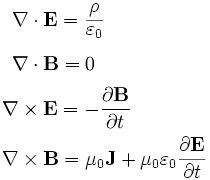 A set of four key equations which collectively organize and describe electromagnetism. The four
individual laws which these equations sum up were actually discovered earlier by other scientists,
but in 1861-62 James Clerk Maxwell brought these laws together in mathematical form in a way which
fully established the unity of electricity and magnetism in a clearer and more profound theoretical
way. Maxwell’s Equations have been formulated in various ways, but the modern method is to
formulate them in terms of partial differential equations in vector calculus, as shown in the
graphic at the right. These four equations represent in turn:
A set of four key equations which collectively organize and describe electromagnetism. The four
individual laws which these equations sum up were actually discovered earlier by other scientists,
but in 1861-62 James Clerk Maxwell brought these laws together in mathematical form in a way which
fully established the unity of electricity and magnetism in a clearer and more profound theoretical
way. Maxwell’s Equations have been formulated in various ways, but the modern method is to
formulate them in terms of partial differential equations in vector calculus, as shown in the
graphic at the right. These four equations represent in turn:
1. Gauss’s Law of Electricity: The electric
flux leaving a volume is proportional to the charge inside.
2. Gauss’s Law of Magnetism: No magnetic
monopoles exist; the total magnetic flux through a closed surface is zero.
3. Faraday’s Law of Induction: The voltage
induced in a closed loop is proportional to the rate of change of the magnetic flux that the loop
encloses.
4. Ampère’s Circuital Law with Maxwell’s
extension: The magnetic field induced around a closed loop is proportional to the electric current
plus displacement current (rate of change of the electric field) that the loop encloses.
A more thorough (and much more technical) discussion
of Maxwell’s Equations is available in the Wikipedia at:
https://en.wikipedia.org/wiki/Maxwell%27s_equations
“Although Maxwell’s equations are relatively simple, they daringly reorganize
our perception of nature, unifying electricity and magnetism and linking geometry, topology
and physics. They are essential to understanding the surrounding world. And as the first field
equations, they not only showed scientists a new way of approaching physics but also took them
on the first step towards a unification of the fundamental forces of nature.” —Robert P.
Crease, “The Greatest Equations Ever”, Physics World, Oct. 2004, online at:
http://physicsweb.org/articles/world/17/10/2/1
“The equations of electricity and magnetism that are today known as Maxwell’s
equations are not the equations originally written down by Maxwell; they are equations that
physicists settled on after decades of subsequent work by other physicists, notably the English
scientist Oliver Heaviside. They are understood today to be an approximation that is valid in
a limited context (that of weak, slowly varying electric and magnetic fields), but in this form
and in this limited context, they have survived for a century and may be expected to survive
indefinitely.” —Steven Weinberg, Nobel Prize winning physicist, “Sokal’s Hoax”, New York
Review of Books, Vol. XLIII, No. 13, pp. 11-15, Aug. 8, 1996.
“MAY FIFTEEN INCIDENT” [Japan, 1932]
“In October 1931, Japan’s reactionary military figures and Right-wing
militarists masterminded a coup with the aim of reorganizing the government. They intended
to install General Sadao Araki as Prime Minister to head a dictatorial military regime,
but their plan fell flat. In spite of that, pressure from the army which called for speeding
up militarization became all the more intense. Towards the end of the year, Tsuyoshi Inukai,
boss of the ‘Constitutional Political Friend’s Party’ (Seiyukai), came into power,
and Sadao Araki was appointed Minister of War. In 1932, people of all strata in Japan were
getting increasingly discontented with the government’s reactionary home and foreign
policies. Workers and peasants rose in struggle wave upon wave. Confronted with this
situation, the panic-stricken reactionary ruling circles tried to strengthen their fascist
rule.
“On May 15, 1932, the Right-wing
fascist group ‘Blood Pledge Society’ (Ketsumeidan), with the support of other
reactionary organizations, sparked off terrorist activities with another incident. A group
of young army and navy officers mustered by them broke into the residence of Prime Minister
Tsuyoshi Inukai and shot him. They also attacked the Metropolitan Police Agency. The
incident was designed to force the government to proclaim martial law so that a military
cabinet may be formed and a militarist system instituted. After the death of Inukai, Admiral
Makoto Saito, former Governor of Korea, formed a cabinet, again with Sadao Araki holding
the portfolio of War Minister. While quickening the tempo of militarization, the Saito
cabinet made big efforts to crack down on the people. Communists and progressives were
arrested and persecuted on a mass scale. On October 30, 1932 alone, 1,400 were arrested.
The Japanese people so came under a reign of fascist terror worse than ever.” —For Your
Reference note, Peking Review,
#50, Dec. 11, 1970, p. 14.
MAY FOURTH MOVEMENT
An important radical nationalist movement of Chinese students and intellectuals which grew
out of demonstrations by students at Tiananmen Square in Beijing on May 4, 1919. This
demonstration condemned both the unfair terms of the Versailles Treaty ending World War I
which granted significant territorial concessions from China to Japan, and also the weak
warlord government in control of Beijing which went along with this imperialist deal.
“‘May 4’ refers to May 4, 1919, when the anti-imperialist and anti-feudal
revolutionary movement broke out. In the first half of that year, Britain, France, the
United States, Japan, Italy and other imperialist countries that had emerged victorious
from World War I held a conference in Paris to divide the booty. A decision was adopted
which stipulated that Japan would take over all the privileges previously held by Germany
in China’s Shantung Province. On May 4 that year, the students in Peking took the lead
and held rallies and demonstrations to protest against the decision. When the government
of the Northern Warlords resorted to suppression, the Peking students suspended classes
in protest. Students in other parts of the country quickly rose to express their
solidarity. The Northern Warlord government made mass arrests in Peking, which aroused
still greater indignation among the people of the whole nation. The patriotic movement
so far participated [in] mainly by the intellectuals rapidly developed into a nationwide
movement participated [in] by the proletariat, petty bourgeoisie and bourgeoisie. As the
patriotic movement surged ahead, the new cultural movement against feudalism and for
science and democracy unfolded prior to the May 4th Movement developed into a mammoth
revolutionary cultural movement with the propagation of Marxism-Leninism as its main
current.
“After the founding of the People’s
Republic of China in 1949, May 4 was officially proclaimed China’s Youth Day.” —Footnote
in Peking Review, vol. 19, #22, p. 12, May 28, 1976.
MAY 16th ULTRA-LEFT GROUP
More formally known as the “May 16 Counterrevolutionary Clique”, the term adopted in August
1967 by the central leadership during the Great Proletarian Cultural
Revolution (GPCR) in China in condeming this group or trend. Originally this referred
only to a small group of college students in Beijing who called themselves the “Capital May
16 Red Guard Regiment”, named after the May 16 Circular of 1966 which was the formal beginning
of the GPCR (see entry above). This group secretly distributed leaflets and posted
big character posters condemning Premier
Zhou Enlai, calling him a “black back-stage
supporter of the February Adverse Current” and
a “shameful traitor of Mao Zedong Thought”, and said he had betrayed the spirit of the May
16 Circular. They proclaimed: “Thoroughly wreck the bourgeois headquarters! Hold Zhou Enlai
to account”.
Mao and the Central Cultural Revolution Small
Group directing the GPCR viewed this attack on Zhou as sectarian and disruptive of the unity
of the forces leading the Cultural Revolution. Consequently, a campaign was launched against
the Capital May 16 Red Guard Regiment and it was suppressed. The campaign then broadened and
went nationwide against similar ultra-left or sectarian trends, which were collectively
referred to as the “May 16th Ultra-Left Group”, or—in abbreviated form—as “Five-One-Six”.
Thus, ironically, “5-1-6” came from that point on to refer not to supporters of the
May 16 Circular, but rather to ultra-left or sectarian opponents of it.
In August 1967, when Mao was reading
Yao Wenyuan’s article “On Two Books by Tao Zhu”, he cited
the “May 16” group as an example of the counterrevolutionaries who, in Yao’s words, “shout
slogans that are extreme left in form but extreme right in essence, whip up the ill wind of
‘suspecting all,’ and bombard the proletarian headquarters.” Mao himself wrote: “The
organizers and manipulators of the so-called ‘May 16’ are just such a conspiratorial
counterrevolutionary clique and must be thoroughly exposed.”
Although the Chinese press referred to the
“May 16 Counterrevolutionary Clique” as a massive “conspiracy”, it is very doubtful that
there ever was any actual widespread (let alone nationwide) conspiracy. However, this does
not mean that there was not a genuine ultra-leftist sectarian trend within many Red
Guard organizations and elsewhere that was causing serious trouble and needed to be dealt
with. (This is sort of an inevitable result of relying on basically unguided and inexperienced
youth to become the leading force in a revolutionary movement, even for a limited period.)
In particular, this ultra-left trend created
considerable problems within China’s Foreign Ministry, and for China’s relations with other
countries. There were not only protests outside of many foreign embassies in Beijing, some
of those embassies were mildly damaged in attacks, with broken windows and their walls
covered with posters and graffiti. The Soviet and Indonesian embassies were partially burned.
In London there was actually a pitched battle between Chinese embassy personnel and London
police on August 29, 1967. Ultra-leftists within the Foreign Ministry took de facto control
of it, and provoked incidents and quarrels with over 30 countries, including not only the
USSR and old-line imperialist countries like Britain, but even “Third World” countries. In
June 1967 two Chinese-speaking diplomats of the Indian embassy were beaten by Red Guards at
the Beijing airport as they tried to leave the country after being expelled. Some Red Guards
even denounced North Korea’s Kim Il Sung as a “fat revisionist”; and though he may in fact
have actually been such a thing, this sort of “foreign policy” made things very difficult
for China economically and politically and drove it into extreme isolation. And, unfortunately,
this sort of infantile behavior eventually promoted a more rightist foreign policy than would
otherwise have been likely to develop. (This is a big general problem with ultra-leftism;
because of its absurd excesses which must be suppressed, the situation often tends to swing
too far in the other direction and even into revisionism.)
Chen Boda was
originally put in charge of dealing with the “May 16th Ultra-Left Group” but as the anti-“5-1-6”
campaign spread and became more generalized, he was accused of being a secret supporter of
those ultra-left ideas himself, and especially of making accusations against Zhou Enlai. Chen
then became a target of the campaign as well. However, he recovered from that criticism, as
did many others briefly targetted in the anti-“May 16” campaign. (It was Chen’s later close
association with Lin Biao which led to his complete downfall in
1970.) It is said that millions of others were accused of ultra-leftism too, and while this
was often overlooked later, over the long run this probably ended up considerably weakening
the left in China, and helping the capitalist roaders
overthrow the left after Mao’s death. This is another example of how ultra-leftism can play
into the hands of the rightists.
It seems like almost everyone else besides
Mao was also attacked at one time or another by various elements within this ultraleftist
trend, even some of the (so-called) “Gang of Four” themselves! “The ‘bombardment’ against
Zhang Chunqiao in February, 1968, came not only from the
Right, but also from the ultra-Left, a fairly strong group in Shanghai which had broken with
Zhang the year before because they considered him too moderate. This explains why the
librarian [an individual recounting his mistreatment by the ‘Gang of Four’ after their
downfall]—doubtless no ultraleftist himself—could have come to be associated with the May
Sixteenth group. The quarrels and hates between various currents of the Left in Shanghai were
without doubt exploited by the new leaders during the campaign against the Four, and were some
of the reasons that made impossible a coordinated resistance against the Right’s coup.”
[Edoarda Masi, China Winter (1978), p. 308.]
It is an actual fact that, as noted in
Peking Review during the GPCR [Jan. 6, 1967, p. 8] everyone in present-day
bourgeois society is really a target of the
revolution, including the members and leaders of the revolutionary party and, yes,
including even each one of us ourselves! However, it is also a fact that everyone is
not the enemy of the revolution, nor is everyone to be attacked and criticized at
every point in the revolution. Every revolution, to be successful, must unite the vast
majority against the small number of genuine die-hard enemies at that point. Later the
struggle may focus on different issues, and there will be different people to criticize and
different people who resist the changes which are necessary in society and in themselves. But
to make everyone the enemy is the mark of utter foolishness and infantilism, and will
inevitably lead to the complete failure of the revolution. A firm grasp of dialectics is
definitely called for here!
“[Mao] told me ... those officials who had opposed my return to China
in 1967 and 1968 had belonged to an ultraleft group which had seized the foreign
ministry for a time, but they were all cleared out long ago.” —Edgar Snow, from a
report of a conversation he had with Mao in December 1970, Life magazine,
April 30, 1971. Online at:
http://www.bannedthought.net/China/Individuals/Snow-Edgar/EdgarSnow-Life-1971-April30.pdf
MAZUMDAR, Charu (1918-72)
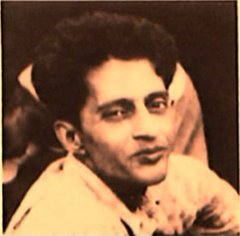 [His family name is also often transliterated from Bengali as “Majumdar”.]
A great revolutionary in India who was the leader of the famous armed Naxalbari uprising of
peasants in 1967, and one of the main founders of the modern Maoist movement in India. He led
in the formation of the Communist Party of India (Marxist-Leninist) in 1969 as a split-off
from the revisionist Communist Party of India (Marxist). In 1972
Mazumdar was captured and tortured to death by police, and the CPI(M-L) fractured into many
pieces. However, the current powerful and rapidly growing Maoist-led revolutionary movement
in India has come together from some of the segments of that old party together with other
Maoist forces who had remained outside of the original CPI(M-L).
Charu Mazumdar was born into a progressive
landlord family in Siliguri, West Bengal, in 1918. Even as a teenager Mazumdar rebelled
against social inequalities, and joined up with the All Bengal Students Association, which
was a group of petty-bourgeois nationalist revolutionaries affiliated with the Anusilan group.
By the age of 20 he had dropped out of college and joined the Congress Party, and became an
an organizer amoung bidi workers. He shifted further left
and joined the Communist Party of India, and worked in the Kisan Sabha, its peasant
organization, with the poor and oppressed peasants in Jalpaiguri and Darjeeling. An arrest
warrant was issued for him, and he had to go underground for the first time.
The CPI was banned at the beginning of
World War II, but Mazumdar continued his peasant organizing work and was elected to the
Jalpaiguri district committee of the CPI in 1942. In 1943, mostly because of the British
imperialist looting of so much of India’s grain and their indifference to the welfare of
the Indian people, a major famine broke out in West Bengal. [See:
Famines—Imperialist Caused] Mazumdar organized a
fairly successful ‘seizure of crops’ campaign by the peasants in Jalpaiguri during this
famine.
In 1946 Mazumdar joined and help lead
the Tebhaga Movement of peasants trying to keep
more of their harvests from the grasping hands of the landlords. This movement helped
shape his conception of revolutionary struggle, and also helped prepare the peasant
masses for future revolutionary struggle. Later Mazumdar worked among tea garden workers
in Darjeeling. In 1948 the CPI was banned by the government, and Mazumdar was imprisoned
for three years. In January 1954 he married fellow CPI member Lila Mazumdar Sengupta.
A growing ideological struggle within
the CPI developed after its Palghat Congress in 1956, and Mazumdar quickly gravitated
toward the revolutionary left wing. In 1962 he was again imprisoned for opposing the Nehru
government’s war against revolutionary China. In 1964 the CPI split, reflecting within
India the Sino-Soviet Split, and Mazumdar joined the breakaway CPI (Marxist). But he
disagreed with the CPI (Marxist)’s electoral policy and decision to postpone armed
struggle until some indefinite point in the far future.
During the mid-1960s Mazumdar organized a
left faction within the CPI (Marxist) in northern West Bengal. He was in poor health in
1964-65 but devoted this time, even while in jail, to studying and writing about the path
of the Indian revolution on the basis of Marxism-Leninism-Mao Tse-tung Thought. This led
to his very influential writings and speeches in the 1965-67 period, which were later
called the ‘Historic Eight Documents’.
In 1967 the CPI (Marxist) [or “CPM” as
it is generally known] betrayed the revolutionary movement by joining with the bourgeois
party, the Bangla Congress, in a coalition government in West Bengal. But on May 25 of
that same year Mazumdar showed there was another road possible by leading the peasants
in the vicinity of the village of Naxalbari in the Darjeeling district of West Bengal in
a historic uprising. The rebels annihilated a notorious police inspector, and took the
first step in launching the New Democratic revolution in India. The state government’s
Home Ministry, headed by the CPM leader Jyoti Basu, brutally suppressed this uprising,
and even murdered 11 women and 2 children in the process. But the ideology of “Naxalism”
spread rapidly and inspired revolutionaries around India and South Asia.
Many revolutionaries within the CPM, from
7 different Indian states, then set up what was originally called the All India
Coordination Committee of Revolutionaries (AICCR), on Nov. 12-13, 1967. This was renamed
the All India Coordination Committee of Communist Revolutionaries (AICCCR), and later
launched the Communist Party of India (Marxist-Leninist) as a new revolutionary party, on
April 2, 1969. Charu Mazumdar was its General Secretary. The CPI(M-L) held its first Party
Congress in Kolkata under strict underground conditions in 1970. Mazumdar was re-elected
General Secretary, and the Party Congress put forward its basic programme of protracted
people’s war, including the annihilation (killing) of class enemies.
Of course the Indian ruling class, both
in West Bengal and around the country, mounted a fierce crackdown on this new revolutionary
movement, and this reached a peak during and after 1971 when many key Naxalite leaders
were killed. Mazumdar was apparently betrayed by a renegade Party member, and was arrested
in Kolkata on July 16, 1972. He was taken to Kolkata police headquarters in the Lal Bazar
neighborhood where he underwent the most horrifying and cruel tortures. No one, not even
his family, his lawyer, or a doctor, was allowed to see him. He died at 4 a.m. on July 28,
while in police custody.
Although there were some secondary aspects
of Charu Mazumdar’s precise political line which were in error, including the prescription
that Mao Tse-tung should personally be considered the Chairman not only of the Chinese
Communist Party but also the CPI(M-L), Mazumdar was nevertheless a great revolutionary who
made extremely important contributions to the revolutionary movement in India and the
world. He is a martyr who is rightly well remembered and honored by our revolutionary
movement.
Much of the information
in this entry comes from
http://imp-personalities.blogspot.com/2007/09/charu-majumdar-father-of-naxalism.html
Many of Mazumdar’s political writings can be found in the Marxist Internet Archive at
http://www.marxists.org/reference/archive/mazumdar/
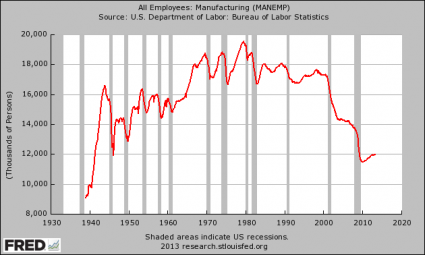 Manufacturing has been declining overall in the U.S. for decades, and this rate of decline has
increased in the new millennium (despite some short-term secondary ups and downs). The Bureau of
Labor Statistics Quarterly Census of Employment and Wages showed there were 398,887 private
manufacturing establishments in the U.S. in the first quarter of 2001. By the end of 2010, that
number had declined to 342,647, a drop of 56,240 facilities. In 2010 alone, 8,660 factories closed
down.
Manufacturing has been declining overall in the U.S. for decades, and this rate of decline has
increased in the new millennium (despite some short-term secondary ups and downs). The Bureau of
Labor Statistics Quarterly Census of Employment and Wages showed there were 398,887 private
manufacturing establishments in the U.S. in the first quarter of 2001. By the end of 2010, that
number had declined to 342,647, a drop of 56,240 facilities. In 2010 alone, 8,660 factories closed
down.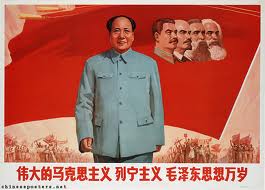 The name most commonly used in the West for a style of formal clothing commonly worn by Mao Zedong
and other Chinese leaders during the Mao era, but which was actually created at the request of
The name most commonly used in the West for a style of formal clothing commonly worn by Mao Zedong
and other Chinese leaders during the Mao era, but which was actually created at the request of