G-20 (Group of Twenty Finance Ministers and Central Bank Governors)
An expanded forum created by the G-7 (see above) in 1999, for consultations on the international
financial system and the world capitalist economy, and for coordination of national economic
policies. It consists of the biggest developed and “emerging” world economies which represent
90% of global GNP, 80% of world trade (including European Union internal trade), and roughly
two-thirds of the world population. Its members are: Argentina, Australia, Brazil, Canada,
China, France, Germany, India, Indonesia, Italy, Japan, South Korea, Mexico, Russia, Saudi
Arabia, South Africa, Turkey, the U.S., the United Kingdom and the European Union.
Before 2009, the G-20 was subordinate to the G-7
in importance. But because of the growing economic power of China and other members of the G-20
who are not members of the G-7, in late September 2009, in the midst of the intensified world
economic crisis, the G-20 was formally designated as the primary international consultation and
coordination body for the economic policies of the major capitalist countries.
GENERAL CRISIS OF CAPITALISM THESIS
The General Crisis of Capitalism Thesis (GCC) is the theory that the entire period of
capitalist-imperialism is one of overall economic and political crisis of a much more extensive
and profound sort than the periodic industrial crises that Marx talked about in the pre-monopoly
era. The GCC thesis is an extension and rather simplistic and mechanical systemization of Lenin’s
views in his famous 1916 pamphlet, Imperialism: The Highest Stage of Capitalism. The GCC
thesis was originally developed by the Comintern in the 1920s and 1930s, but continues to be
supported to this day by some Communist parties and by some individual Marxists. However, the
thesis has also been strongly criticized by other Marxists.
“Lenin’s basic point of view was that the imperialist era is the final
stage of capitalism, an era during which all the contradictions of capitalism become
enormously concentrated and intensified, and therefore an era of interimperialist war, of
economic crisis, and of proletarian revolution. And, actually, looking back at the past
century, this does not seem to be too bad a summary of what has actually happened—though
clearly the era is not yet over and the process is by no means complete.
“Nevertheless, it is now clear that
the imperialist era is stretching out to be a whole lot longer than Lenin envisioned, and
that within this long historical epoch there are fairly long sub-periods of war or of
relative peace, of economic crisis or of relative economic good times (for the bourgeoisie
anyway), and of revolution or of relative political quiescence. Consequently the old
formula of the imperialist epoch being characterized as one long general crisis of
capitalism no longer seems correct. It now appears much too simplistic.
“In fact, it has become quite obvious
that the capitalist business cycle continues to operate in the imperialist era. That is,
there continue to be booms, busts, depressions (or recessions) and recoveries. It is true
that the proper analysis of this business cycle in the imperialist era is still subject to
dispute. Some people say recessions are now generally much milder (except for the
Great Depression of the 1930s of course!),
others talk about short waves and long waves, and still others have quite different
theories....
“But however one views the development
of the business cycle over the past century, it is undeniable that there was at least one
long overall boom in the capitalist world—the quarter-century period after World War II.
Thus, from the point of view of economics, at least, it seems really wrong to say that
the entire imperialist era has been one of a ‘general crisis of capitalism’.
“I should note that most modern (post
World War II) theorists of the GCC thesis do not deny that the business cycle continues to
exist in the imperialist era, nor that there are still booms as well as busts. But this was
not the view of most of the Comintern theorists of the GCC back in the 1930s; they did
see the Great Depression as an integral part of the general crisis of capitalism. But in
light of the long capitalist recovery after World War II, GCC theorists these days are
forced to say that the general crisis of capitalism is not the same as one long capitalist
economic crisis.” —Adapted from Scott H.,
“Comments on Sison’s
‘Contradictions in the World Capitalist System and the Necessity of Socialist Revolution’”
(Jan. 23, 2002).
But, despite drawing a distinction between the GCC and periodic industrial crises, modern GCC
theorists still see intensified economic problems as a very important part of the general crisis
of capitalism. For example, the Soviet revisionist writer V. Trepelkov wrote that there are four
“major features” of the general crisis of capitalism:
1. “[T]he world is divided into two opposing socio-economic systems, the
socialist and capitalist ones…. [T]he change in the alignment of forces in favor of socialism
is the most significant manifestation of the increasingly deepening general crisis of
capitalism…. The contradiction between the two opposing social systems is the principal
contradiction of the modern era.”
2. “[T]he crisis of the colonial
system, a crisis which at a definite stage develops into its breakdown…. A large group of
countries that have won political independence are now fighting for their economic
independence. Some have opted for the non-capitalist road of development….”
3. “[T]he aggravation of the internal
economic contradictions of the imperialist countries, and the heightening of economic
instability and decay. This makes itself felt in sharp fluctuations in the growth rates,
in disproportionate economic development, in increasingly frequent crises, in constant
under-loading [perhaps this just means the gross underutilization of existing factories
—S.H.], in chronic unemployment, in runaway inflation, in the crisis of international
monetary relations, in militarization of the economy, etc.”
4. “[T]he crisis of bourgeois
politics and ideology.” [From V. Trepelkov, General Crisis of Capitalism (Moscow:
Progress Publishers, 1983), pp. 21-25.]
However, if we look at each of these four “features” we find serious problems for the GCC
thesis:
“With regard to point 1), the world was not really divided into a
socialist sphere and a capitalist sphere in 1983 when Trepelkov’s book was published, nor
is it today. The so-called ‘socialist camp’ at that time was really a competing
state-capitalist camp. And a mere 6 or 8 years later much of this so-called ‘socialist
camp’, including the Soviet Union itself, fell apart completely.
“Feature 2), with regard to the
crisis of the colonial system, also has some problems. It is true that old-style open
colonialism had a world-wide crisis which led to its nearly universal replacement with
neo-colonialism. But the completion of this great (but superficial) change actually led to
a lot of demoralization (because neo-colonialism is really little better), and probably
even to an overall reduction in anti-imperialist struggle around the world for a time. Of
course I don’t say that there cannot be struggle in the neo-colonies for ‘economic
independence’, but so far this struggle has been mostly under the leadership of national
bourgeois forces—which is why it has been so pathetically weak and ineffective. And as for
seeking economic independence by some ‘non-capitalist’, but also non-socialist, road—that
is certainly a dead-end pipe dream.
“Anti-imperialist struggle, at one
level or another, is a permanent feature of the imperialist era. And as such, it might
well be described as a permanent problem for imperialism. But none of this necessarily
means that imperialism is in a permanent ‘general crisis’.
“Let me skip feature 3) for a moment
and go on to feature 4), ‘the crisis of bourgeois politics and ideology’. Well, of course,
there have been many political crises over the past few decades, but bad as this has been
in the ‘West’, it has been worse in the Soviet sphere—which ended up collapsing completely.
This general crisis, which is supposed to be ‘a process in which more and more
countries depart from capitalism’ has turned out to be more of a general crisis of
revisionism, wherein more and more revisionist countries revert to Western-style
capitalism. And while there has indeed also been considerable ideological ferment in the
‘West’, actually Western ideologists have been riding relatively high in the saddle in
recent years. So much so, in fact, that some of them have proclaimed the ‘end of ideology’
and even the ‘end of history’! Unfortunately, the bigger ideological crisis has been
within the ranks of revolutionaries and Marxists, many of whom have been losing their
bearings. (It is bitter to recognize things like this, but it is the truth of the matter.)
“So really, if you want to defend the
GCC thesis today, it must all come down to ‘feature 3)’, the aggravation of economic
contradictions in the capitalist world. And here too there are great problems for the GCC
thesis. Here’s one big problem: If this serious aggravation of economic problems is not due
to the same contradictions which bring about ‘ordinary crises’, then what is it due to? That
should be a really embarrassing question for ‘modern’ GCC theorists, if they were ever to
consider it. Neither Marx, nor Lenin, nor Soviet revisionist economists, nor anybody else
(as far as I know), has ever given an answer to this question. And in fact, Lenin said
exactly the opposite—that the contradictions of the imperialist era are the very same
contradictions as racked capitalism beforehand, but now greatly intensified. So
while the GCC theorists started out by denying that the GCC is the same as a capitalist
economic crisis, in the end that is pretty much all that is left of their doctrine after
the invalid and now-discredited political points are thrown out.
“It is true, of course, that we can
no longer look at capitalist crises in the same way we did in the 19th century.
We are forced by plain and obvious facts to recognize that there are both short term
fluctuations in the capitalist economy (still usually called ‘business cycles’) and
longer-term, broader ups and downs, such as the Great Depression, the post-World War II boom,
and the 35-year-long slowdown that began in the early 1970s. And, once again, the very fact
that there are also longer-term ups and downs is fatal for the GCC claim of permanent
general crisis.
“The old Comintern theory of the
‘general crisis of capitalism’ cannot be upheld in either its 1930s form, nor its ‘modern’
form. It is a failed, and even incoherent theory, once you start to look at it carefully.
Reality is much more complex than that simple theory comprehends.” —Extracts from Scott H.,
“Comments on Sison’s
‘Contradictions in the World Capitalist System and the Necessity of Socialist Revolution’”
(Jan. 23, 2002). See that essay for further criticism of the GCC thesis.
GEORGE, Henry (1839-97)
A liberal-radical journalist and economist (of sorts), best known for his book Progress
and Poverty (1877-79), which put forward the naïve notion that poverty could be
eliminated through the implimentation of the so-called “single tax” on the value of land
exclusive of any improvements on it, and the abolition of all other taxes including those
on “industry” (capitalist companies). Although he was clearly something of a crackpot, he
had a quite substantial following for a time in the late 19th century.
“Theoretically the man [Henry George] is utterly backward. He
understands nothing about the nature of surplus value, and so engages in
speculations—which follow the English model but even fall short of the English—about
the portions of surplus value that have attained independent existence, i.e., the
relation of profit, rent, interest, etc. His fundamental dogma is that everything
would be all right if rent were paid to the state. (You will find payment of
this kind also among the transitional measures included in the Communist
Manifesto.) This idea originated with the bourgeois economists; it was first put
forward ... by the earliest radical disciples of Ricardo, just after his
death....
“But the first person to turn
this desideratum of the radical English bourgeois economists into a
socialist panacea, to declare this procedure to be the solution of the
antagonisms involved in the present mode of production, was Colins, an old
ex-officer of Napoleon’s Hussars, born in Belgium, who ... presented bulky volumes
about this ‘discovery’ of his to the world.... [Marx then goes on to mention some
of the followers of Colins, and others who embraced the same panacea.]
“All these ‘Socialists’ since
Colins have this much in common, that they leave wage labor and hence
capitalist production in existence and try to bamboozle themselves or the
world into believing that by transforming rent of land into a tax payable to the
state all the evils of capitalist production would vanish of themselves.
The whole thing is thus simply a socialistically decked-out attempt to save
capitalist rule and actually re-establish it on an even wider basis
than its present one.
“This cloven hoof—which is at
the same time an ass’s hoof—peeps out unmistakably from the declamations of Henry
George too. It is the more unpardonable in him because he ought on the contrary to
have asked himself the question: How did it happen that in the United States, where,
relatively, that is compared with civilized Europe, the land was accessible to the
great masses of the people and still is, to a certain degree (again relatively),
capitalist economy and the corresponding enslavement of the working class have
developed more rapidly and more shamelessly than in any other
country?
“On the other hand, George’s
book, and also the sensation it has created among you, is significant because it
is a first though unsuccessful effort at emancipation from orthodox political
economy....” —Marx, Letter to Friedrich Adolph Sorge in Hoboken, N.J., June 20,
1881. From Marx-Engels: Selected Correspondence (Moscow: 1975), pp. 322-3.
[In a different translation in MECW 46:99-101.]
GLOBALIZATION
[Intro material to be added... ]
“The need of a constantly expanding market for its products chases
the bourgeoisie over the whole surface of the globe. It must nestle everywhere,
settle everywhere, establish connections everywhere.
“The bourgeoisie has through
its exploitation of the world market given a cosmopolitan character to production
and consumption in every country. To the great chagrin of Reactionists, it has
drawn from under the feet of industry the national ground on which it stood. All
old-established national industries have been destroyed or are daily being
destroyed. They are dislodged by new industries, whose introduction becomes a life
and death question for all civilized nations, by industries that no longer work up
indigenous raw material, but raw material drawn from the remotest zones; industries
whose products are consumed, not only at home, but in every quarter of the globe.
In place of the old wants, satisfied by the production of the country, we find new
wants, requiring for their satisfaction the products of distant lands and climes.
In place of the old local and national seclusion and self-sufficiency, we have
intercourse in every direction, universal inter-dependence of nations. And as in
material, so also in intellectual production. The intellectual creations of
individual nations become common property. National one-sidedness and
narrow-mindedness become more and more impossible, and from the numerous national
and local literatures, there arises a world literature.
“The bourgeoisie, by the
rapid improvement of all instruments of production, by the immensely facilitated
means of communication, draws all, even the most barbarian, nations into civilization.
The cheap prices of its commodities are the heavy artillery with which it batters
down all Chinese walls, with which it forces the barbarians’ intensely obstinate
hatred of foreigners to capitulate. It compels all nations, on pain of extinction,
to adopt the bourgeois mode of production; it compels them to introduce what it
calls civilization into their midst, i.e., to become bourgeois themselves. In one
word, it creates a world after its own image.” —Marx & Engels, Manifesto of the
Communist Party, Ch. I: MECW 6:487-8.
GOLDEN RULE
The “Golden Rule” is the precept that you should treat other people
the way you wish to be treated. This is an extremely popular ethical theory among
both religious and non-religious people. It is one of many conflicting ethical
theories that are explicit or implicit in the Bible, which quotes Jesus as saying in
the Sermon on the Mount: “Therefore all things whatsoever ye would that men should
do to you, do ye even so to them.” [Matthew 7:12] One of the ethical theories in the
Bible that is inconsistent with this is that of “an eye for an eye”: “And if any
mischief follow, then thou shalt give life for life, Eye for eye, tooth for tooth,
hand for hand, foot for foot, Burning for burning, wound for wound, stripe for
stripe.” [Exodus 21:23-25]
Although my grandmother once
assured me that the King James version of the Bible was “God’s own language”, these
days you usually hear the Golden Rule expressed something like this: “Do unto others
as you would have them do unto you.” Incidentally, the Golden Rule is not exclusively
(or even originally) a Christian precept. It has been a common theory in many diverse
cultures, going way, way back. Confucius, for example, said “What you do not desire,
do not effect on others” (even though that principle conflicts with some of his other
principles).
It is amazing how little sense
the Golden Rule makes when you actually think about it critically. (Of course
hardly anybody ever does! They repeat it without much thinking.) You should
treat people the way you wish to be treated… OK, what if you really wish to be treated
as boss, or king? Should you then treat all other people as your “boss”
or as “kings”, bowing and scraping in abject obedience? Or consider a slave master: He
would have others (his slaves at least) treat him as master, while he treats them as
slaves. In light of the Golden Rule, should he start treating his slaves as his masters,
and encourage them to treat him as their slave? (This might be poetic justice, but it
would still hardly be the ideal moral society!)
Or what about masochists? Should
they inflict pain on others just because that’s the way these totally screwed up people
themselves want to be treated? Or what about someone who expects, and even wants,
others to be cheats and crooks, because he figures he is better at it and will come
out ahead in any completely dog-eat-dog world? There are people like that, you know.
(We live in a capitalist society, after all!) Does he then have a moral license to
proceed with his chicanery and fraud?
George Bernard Shaw wrote “Do not
do unto others as you would that they should do unto you. Their tastes may not be the
same.” He was putting it in a humorous fashion, but there is some real truth behind his
statement. Schopenhauer put it even better: “Don’t do to others what you wouldn’t
like done to yourself. This is, perhaps, one of those arguments that prove, or
rather ask, too much. For a prisoner might address it to a judge.”
The basic problem with the Golden
Rule is that it assumes that people are already moral, or basically so—which is
very far from always being the case. If you are a good, fair and reasonable
person, you will want good, fair and reasonable things done to you. And in that
case it is indeed generally reasonable to say that you should do to others as you
would have them do unto you. But if you are not already a good, fair and
reasonable person, you may not yourself wish others to treat you in a good
(moral), fair and reasonable way. And in that case it is very wrong for you to
treat others as you would have them treat you. This is such an obvious point that it is
really astounding that all the champions of the Golden Rule never seem to have even an
inkling of it! —S.H., An Introduction to the Marxist-Leninist-Maoist Class Interest
Theory of Ethics, Chapter 1, section 1.2B, from the draft of 6/14/07 as posted at:
http://www.massline.org/Philosophy/ScottH/MLM-Ethics-Ch1-2.pdf
GOULD, Stephen Jay (1941-2002)
American liberal-radical paleontologist and evolutionary biologist, best known for his
long-running series of erudite and literary essays about evolution in Natural History
magazine.
Together with Niles Eldridge, Gould developed
the theory of punctuated equilibrium, which modifies
the traditional Darwinian conception of uniformly gradual evolution by pointing out that within
that overall gradualness there are occasional periods of relatively rapid evolutionary change in
which new species can arise after long periods of relative stasis. Punctuated equilibrium is one
example of the recognition of the importance of qualitative
leaps (or dialectical leaps) in science, which Marx established as a fundamental principle
of materialist dialectics. And, indeed, punctuated equilibrium was apparently suggested to Gould
by his radical upbringing. (His father was a Marxist.) When pro-gradualist critics lampooned the
theory of punctuated equilibrium as “evolution by jerks”, Gould shot back by referring to his
critics’ theory as “evolution by creeps”!
Gould was a powerful opponent of
sociobiology and its supposedly sanitized reincarnation,
“evolutionary psychology”, and criticized these
bourgeois perversions of biology for their “deterministic view of human society and human
action.” He pointed out that there was little actual evidence for genetic or other forms of
biological determinism, and that such views
merely represented the cultural or class biases of their supporters. Gould also pointed out that
adaptive behaviors are often passed on through human culture and not genetics. He of course
recognized that the genetic and biological foundation of human beings and our brains certainly
can and do affect our behavior, but appropriately insisted that our biological makeup allows
for a very broad range of actual behavior. This flexibility “permits us to be aggressive
or peaceful, dominant or submissive, spiteful or generous… Violence, sexism, and general
nastiness are biological since they represent one subset of a possible range of behaviors. But
peacefulness, equality, and kindness are just as biological—and we may see their influence
increase if we can create social structures that permit them to flourish.” Gould is also to be
praised for his opposition to racist and sexist notions presented in the supposed form of
“science”. See especially his important book Mismeasure of Man (1981).
Gould was an important advocate of evolutionary
science, and an effective and important critic of creationism
and other religious attacks on biology. However, his rejection of Marxism sometimes led him into
serious error when he wandered into other topics (as when he promoted the classless notion that
the Golden Rule should be viewed as the foundation of morality, rather
than the Marxist view that class interests form that foundation). And like many prominent
intellectuals in bourgeois society he feared appearing to be “too radical”, and thus failed to
critize religion in general even though he did strongly criticize religious attempts to
oppose or distort evolutionary biology specifically.
The worst example of this was in his theory of
“non-overlapping magisteria” in the book Rock of Ages (1999) which absurdly claimed that
there need be no true conflict between science and religion. According to Gould the “magisterium
[or sphere] of science” covers the “empirical realm”, while the “magisterium of religion” covers
questions of “ultimate meaning” and morality. He claims that these two “magisteria” do not
overlap and should not poach in each other’s legitimate domain. In reality morality too has an
objective basis in the collective group interests of people (or, in class society, in class
interests), and ethics therefore has its basis in science just as the theories in biology or
physics do. Furthermore, all religion is deeply opposed to at least some parts of science.
The nearly universal religious claim that there are one or more immaterial gods, for example, is
opposed to modern cognitive psychology which explicates mind as a set of functional aspects of
material matter (brains) and which therefore denies even the possibility of any such thing as a
“disembodied mind”.
While Gould played a very positive role in the
defense of evolutionary science, his bourgeois idealist conceptions in psychology led him into
major errors in other spheres. It is unfortunate that he was not a more consistent
materialist.
GRAMSCI, Antonio (1891-1937)
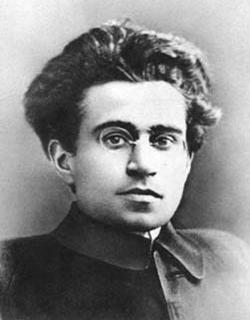 Italian Communist leader and theoretician. Raised on the impoverished island of Sardinia,
a scholarship allowed him to attend Turin University where he was a brilliant student, but
where he was also unfortunately strongly influenced by the liberal idealist philosopher,
Benedetto Croce. In 1913 he joined the Socialist Party. In 1919
he helped found the left-wing newspaper, L’Ordine Nuovo, and was active in promoting
workers’ councils (“Soviets”) in factories, which were
inspired by the Bolshevik Revolution in Russia.
He became more and more critical of the reformist ideas of the Socialist Party and helped
to form the Communist Party of Italy in 1921. Gramsci was the Italian representative at the
meeting of the Third International in Moscow in
1922, and worked for the Comintern in Moscow and Vienna in
1922-24. In 1924 he was elected to the Italian parliament and returned to Italy to became
the top leader of the CPI.
Italian Communist leader and theoretician. Raised on the impoverished island of Sardinia,
a scholarship allowed him to attend Turin University where he was a brilliant student, but
where he was also unfortunately strongly influenced by the liberal idealist philosopher,
Benedetto Croce. In 1913 he joined the Socialist Party. In 1919
he helped found the left-wing newspaper, L’Ordine Nuovo, and was active in promoting
workers’ councils (“Soviets”) in factories, which were
inspired by the Bolshevik Revolution in Russia.
He became more and more critical of the reformist ideas of the Socialist Party and helped
to form the Communist Party of Italy in 1921. Gramsci was the Italian representative at the
meeting of the Third International in Moscow in
1922, and worked for the Comintern in Moscow and Vienna in
1922-24. In 1924 he was elected to the Italian parliament and returned to Italy to became
the top leader of the CPI.
Mussolini was now in power, and he and his
Fascist regime banned the Communist Party in 1926. Gramsci himself was arrested and spent the
rest of his life in prison. Ironically, his great reputation today, especially in Left academia,
derives from his time in prison where he wrote 34 notebooks, containing over 2000 printed
pages. There are some difficulties in reading these notebooks both because they were just
Gramsci’s own notes, with multiple notebooks being worked on simultaneously, and not
something written for publication, and because of the prison authorities who prevented
him from writing in a way that might be used to “inflame the masses”. This forced Gramsci
to frequently write in an academic and obscure style, and to resort to
Aesopian language, as when he uses the phrase “modern
theory” where he simply means “Marxism”.
Gramsci’s focus in his notebooks on intellectuals and
their role in society, and on literature and culture, of course appeals to academics today,
and explains in part his continuing popularity there. His discussion of the capitalist
state is weak, certainly compared to Lenin’s firm class position
on the issue.
Since he was living in a prison in a Fascist
country, and the Communist Party was mostly suppressed, he did not think the sort of
revolutionary strategy employed by the Bolsheviks in Russia was fully appropriate there.
Instead of such a frontal assault (insurrection), he thought there was the necessity of a
long-term war of attrition, or a “war of position” (like the trench warfare of World War I),
to prepare the way for proletarian revolution. Gramsci’s much discussed notion of
hegemony seems to be related to this, the long-term struggle
between the ideological hegemony of the ruling class and a hoped for alternative ideological
hegemony of the working class forming around its revolutionary party. While in the advanced
capitalist countries there is in fact the necessity for laying the groundwork for an
eventual revolutionary uprising through patient work of organizing and education over
a long period, there is also the danger that in doing so that eventual goal of revolution
will become merely window dressing for reformism and revisionism. This perhaps shows why
academic revisionists are so attracted to Gramsci: they see this possibility not as a
danger at all, but rather more as a welcome perpetual postponement of revolution.
“Pessimism of the Intellect; Optimism of the Will” —A slogan, probably
authored by Gramsci himself, which appeared regularly on the masthead of L’Ordine
Nuovo, the newspaper he edited.
GREAT CAPITALIST MASS EXTINCTION
The currently intensifying great mass extinction of
animals and plants which is being caused primarily by the capitalist system and rule, which
values corporate profits far higher than it does the protection of nature and the environment
for the continued overall benefit of humanity.
Even most biologists imbued with bourgeois
ideology admit that we are already in a period of a great mass extinction of species, but tend
to blame this on “humanity” in general, or over-population, or governmental ignorance, etc.
In other words, even the liberals among them seldom recognize the systemic causes of this
extinction episode, let alone the central responsibility of the capitalist class for it. It is
true that excessive human population growth is secondarily to blame for this mass extinction.
But by far the most important factor is still that the ruling bourgeoisie just does not give
a damn, and while they are in control of world they refuse to take any serious steps to stop
this ever-expanding annihilation of plant and animal species. It is already clear that
this mass extinction will very likely be one of the greatest in the entire history of the
Earth, which includes some very large die-offs many millions of years ago. Indeed, it is not
entirely clear whether our own species, Homo sapiens, will survive the capitalist
era.
“Populations of plants, insects and birds in the U.K. have dropped
precipitously in the past 40 years—more evidence that the world is in the midst of its
sixth mass extinction. The previous one wiped out the dinosaurs.” —Science
magazine, March 19, 2004; quoted in Scientific American, May 2004, p. 40.
GREAT DEPRESSION OF THE 1930s — The Great Unwinding (1929-1933)
Major depressions take a fair amount of time to develop. As mentioned in the general entry
above, in the spring of 1929 there was only the beginnings of a fairly mild recession. Even
after the financial Crash of 1929 (in the autumn) the
immediate condition of the overall economy was still only that of mild to moderate recession.
But over the next 4 years the crisis continued to develop and the overall economy continued
to seriously decline. Unemployment jumped up from 3.2% in 1929 to 24.9% in 1933. And during
this period more than 9,000 banks either suspended operations or completely closed down. A
large part of the entire U.S. financial system had in effect collapsed.
“The great severity of the banking crises in the Great Depression is
well known to students of the period. The percentages of operating banks which failed
in each year from 1930 to 1933 inclusive were 5.6, 10.5, 7.8, and 12.9; because of
failures and mergers, the number of banks operating at the end of 1933 was only just
above half the number that existed in 1929. Banks that survived experienced heavy
losses.” —Ben Bernanke, Essays on the Great Depression (2000), p. 44.
There was a huge amount of debt built up in the U.S. economy during the boom years of
the 1920s, and because of both increased debt and falling incomes during the Depression the
ratio of debt servicing to national income went up from 9% in 1929 to 19.8% in 1932-33. In
a 1934 survey of home owners with mortgages in 22 different cities, the default rate ranged
from a low of 21% (in Richmond, VA) to a high of 62% (in Cleveland). In more than half of
the cities the default rate was above 38%. The percentages of those behind in their rent on
rented properties was even higher. The financial status of farmers was worse still, and by
the beginning of 1933 45% of all U.S. farms were delinquent in their mortgage payments.
State and local governments were also in serious debt trouble, with 37 cities with populations
greater than 30,000 people and 3 states defaulting on their debt by March 1934. [Bernanke,
op. cit., p. 46.]
The strong deflation
during the Depression served to amplify the debt burdens (because the debt had to be repaid
in currency that had become more valuable and harder to come by). But contrary to the opinions
of some bourgeois economists this deflation was not the primary cause of these intensifying
problems during the first 4 years of the Depression. Bernanke notes that “Although the
deflation of the 1930’s was unusually protracted, there had been a similar episode as recently
as 1921-22 which had not led to mass insolvency.” [Ibid., pp. 46-47.]
The situation with corporate profits during
this period of the unwinding of the economy into deep depression is interesting. The aggregate
corporate profits before taxes were negative in 1931 and 1932, and after-tax retained profits
were negative for all the years from 1930 to 1933. However, the biggest corporations (those
with more than $50 million in assets) maintained positive profits through this entire period!
[Bernanke, ibid.]
The index of industrial production, which stood
at 114 in July 1929 gradually fell to just 53 in July 1932, then picked up just slightly for a
few months before falling back to 54 in March 1933. Thus industrial production had fallen to
less than half its level before the Depression began. [Bernanke, op. cit., pp. 48-49.]
Similar events were occurring in all the other
major capitalist countries, though—interestingly—many of them (including Britain and France)
did not have major banking crises. Most bourgeois economists are quite puzzled by this fact,
since they falsely believe that financial crises were the “cause” of the depression in “the
real economy”.
GREAT DEPRESSION OF THE 1930s — Relapse of 1937-38 in the U.S.
As mentioned in the main article above about the Great Depression, there was a weak and partial
recovery in the U.S. from 1933 until 1937, and then a relapse due to the government cutting
back on the budget deficits which had eased the crisis somewhat. This deficit financing was
inadequate to actually bring the U.S. economy back to the level it had reached before the
Depression began, and when it was cut back the economic decline once again resumed.
“The recovery from the Depression is often described as slow because
America did not return to full employment until after the outbreak of the second world
war. But the truth is the recovery in the four years after Franklin Roosevelt took office
in 1933 was incredibly rapid. Annual real GDP growth averaged over 9%. Unemployment fell
from 25% to 14%. The second world war aside, the United States has never experienced
such sustained, rapid growth.
“However, that growth was halted
by a second severe downturn in 1937-38, when unemployment surged again to 19%. The
fundamental cause of this second recession was an unfortunate, and largely inadvertent,
switch to contractionary fiscal and monetary policy. One source of the growth in 1936
was that Congress had overridden Mr Roosevelt’s veto and passed a large bonus for
veterans of the first world war. In 1937, this fiscal stimulus disappeared. In addition,
social-security taxes were collected for the first time. These factors reduced the
deficit by roughly 2.5% of GDP, exerting significant contractionary pressure.”
—Christina Romer, “Economic Focus: The Lessons of 1937”, The Economist, June
20, 2009, p. 82.
[Romer is an American bourgeois
economist and supposedly an expert on the Great Depression. Her point about how “rapid”
the “recovery” was from 1933-1936 is ridiculous! Of course it could be fairly fast
compared to the normal expansion of the economy in boom periods because most of the
idle factories still existed and it was simply a matter of putting people back to work
through government spending. Romer does mention here some of the means by which the
government deficits were reduced in 1937, but she does not mention the even more important
reason—that Roosevelt and his advisers simply did not understand the necessity of
deficits for keeping the economy going and they were actually trying to reduce
them! (This is why Roosevelt vetoed the veteran’s bonus bill.) Romer went on to
mention the “contractionary monetary policy” that the Federal Reserve began to follow in
1936, which was also a (small) factor in the ensuing relapse. But this was of much
less importance than the contractionary fiscal (deficit) policy, and it is a weakness of
her analysis that she seems to put it on a par. And although Romer’s main point in the
article is that “fiscal stimulus” (deficits) should not be withdrawn “too soon”, she
completely fails to understand that in a developing depression it cannot be withdrawn
at all! Indeed, a major part of her article stressed the importance of eventually
reducing those deficits! That is, she—along with all Keynesian-school economists—thinks
that “the pump can be primed” through fiscal
deficits, and the deficits can then be ended. Romer, along with all other bourgeois
economists, doesn’t even begin to understand that it was not Keynesian deficits
which ended the Great Depression—not even the colossal deficits during World War II
itself, but rather the massive destruction of capital during the war that really
brought the Depression to an end and kept it from resuming after the end of the war and
the end of those huge war deficits. —S.H.]
GREAT LEAP FORWARD
A mass campaign in Maoist China launched in late 1958 and designed to swiftly raise China’s
economic production and technique, especially in the countryside. While the revolutionary
fervor it arose did have a substantial positive effect in some regards, this same fervor—along
with inadequate overall supervision of the movement and serious sabotage by capitalist-roaders
within the Communist Party—led to some major short-term problems including serious famine in
some parts of the country. Local Party officials were frequently reporting bountiful harvests
when in fact the harvests were poor. Overall the GLF was not a success either economically or
politically, though it was also not quite the unmitigated total disaster that anti-Communist
writers have often claimed. It did, however, serve to partially discredit Mao and the CCP in
the eyes of the masses for a brief period. The GLF was officially ended in 1961.
“[India] had, in terms of morbidity, mortality and longevity, suffered
an excess in mortality over China of close to 4 [million] a year during the same period
[of the Great Leap Forward]… Thus, in this one geographical area alone, more deaths
resulted from ‘this failed capitalist experiment’ (more than 100 million by 1980) than
can be contributed to the ‘failed communist experiment’ all over the world since 1917.”
—Amartya Sen, Nobel Prize winning economist, quoted in Antony Black, ‘Black propaganda’,
Guardian Weekly, Feb. 24, 2000.
GREAT PROLETARIAN CULTURAL REVOLUTION (GPCR)
A great revolutionary movement in socialist China during the Mao period which sought,
initially, just to transform the cultural and ideological sphere of society, but developed
into a full-scale social revolution wherein the revolutionary proletariat and its allies
led by Mao overthrew the revisionists and capitalist-roaders who had seized considerable
power in the government of China and within the Communist Party of China itself, and which
re-established proletarian revolutionary power for a decade.
The peak years of the Cultural Revolution
were 1966-69, but the preliminary developments started earlier, and in some respects the
GPCR continued until Mao’s death in September 1976. One important article in Peking
Review states that “In 1963, under the personal guidance of Chairman Mao, the revolution
in literature and art was launched in China, marked mainly by the reform of the dramatic
arts; this was, in fact, the beginning of the great proletarian cultural revolution.”
[“Carry the Great
Proletarian Cultural Revolution Through to the End”, Peking Review, Jan. 1,
1967, p. 8.] But the GPCR as a truly mass phenomenon began in the spring of 1966. ...
The GPCR consisted of struggle,
criticism and repudiation and of transformation: “The struggle to overthrow
those persons in authority who are taking the capitalist road, the criticism and repudiation
of the reactionary bourgeois academic ‘authorities’ and the ideology of the bourgeoisie
and all other exploiting classes, and the transformation of education, literature and art,
and all other parts of the superstructure that do not correspond to the socialist economic
base.” [ibid., p. 9].
The highest individual target of the GPCR
was Liu Shaoqi, who was appropriately labelled “China’s
Khrushchev”, and was eventually dismissed from his positions and expelled from the CCP. But
contrary to Western bourgeois analyses, the GPCR was not just about getting rid of a few
revisionists like Liu; its goal and purpose was to change Chinese socialist society so that
people like Liu could not arise and achieve high power in the Party and government in the
first place.
[More to be added... ]
See also entries below.
GREAT PROLETARIAN CULTURAL REVOLUTION — Violence In
As revolutions go, the GPCR was relatively peaceful. But there was some violence that
occurred during the course of it, most of which was instigated among young
Red Guards by the reactionaries in order to discredit the
revolution. The 16-points guidelines laid down by Mao and the CCP Central Committee in
May 1966 explicitly stated that the method to be used was that of reason and persuasion,
and that coercion and violence were not to be used.
“The most important plot and scheme of the very small number of
persons who stubbornly persist in the bourgeois reactionary line is to incite the
masses to struggle against each other. They have secretly organized and manipulated
some people and mass organizations, whom they have hoodwinked, to suppress the
revolution, protect themselves, and to provoke conflicts in which coercion or force
are used in a vain attempt to create confusion. They spread rumors, turned black
into white and shifted the blame for the evil they had done behind people’s backs
on to the proletarian revolutionaries, labelling the latter with the ‘bourgeois
reactionary line.’”
—“Carry the
Great Proletarian Cultural Revolution Through to the End”, an editorial summing
up the GPCR in 1966 and laying out its goals for 1967, Peking Review, vol. 10,
#1, Jan. 1, 1967, p. 10.
GREENSPAN, Alan (1926- )
American bourgeois economist who served as Chairman of the Federal Reserve from 1987 to
2006. Greenspan was a longtime disciple of the notorious bourgeois philosopher of
self-interest and selfishness, Ayn Rand. He even authored
several essays in her book, Capitalism: The Unknown Ideal, including one defending
the gold standard.
As Chairman of the Fed, Greenspan mostly
promoted the expansion of credit bubbles, and all sorts of risky behavior by investors
and ordinary people. In one speech in February 2004, he promoted the very dangerous
adjustable rate mortgages (ARMs) for home buyers, that now are a
major factor in many of them losing their homes. At the time of his speech interest rates
were very low and were bound to rise later. In fact, just a few months after the speech
Greenspan himself, as head of the Fed, began massively raising interest rates, which had
the effect of hugely increasing mortgage payments for those with ARMs. The inability of
many home “owners” to keep up with their adjustable rate mortgage payments is considered
to be one of the major factors bringing the subprime
mortgage crisis to a head in 2007-2008.
In another speech, in April 2005,
Greenspan openly praised the rise of the subprime mortgage industry:
“Innovation has brought about a multitude of new products, such as
subprime loans and niche credit programs for immigrants. Such developments are
representative of the market responses that have driven the financial services
industry throughout the history of our country … With these advances in technology,
lenders have taken advantage of credit-scoring models and other techniques for
efficiently extending credit to a broader spectrum of consumers. … Where once
more-marginal applicants would simply have been denied credit, lenders are now able
to quite efficiently judge the risk posed by individual applicants and to price that
risk appropriately. These improvements have led to rapid growth in subprime mortgage
lending; indeed, today subprime mortgages account for roughly 10 percent of the
number of all mortgages outstanding, up from just 1 or 2 percent in the early 1990s.”
—Alan Greenspan, “Consumer Finance”, April 8, 2005. Federal Reserve System’s Fourth
Annual Community Affairs Research Conference. Federal Reserve Board.
This wondrous new subprime mortgage industry began to collapse in March 2007, and led
to the more general financial crisis of the fall of 2008. Thus Greenspan is appropriately
criticized for his role in the collapse of the housing bubble and for “engineering” that
housing bubble to begin with. However, it is true that if Greenspan had not engineered
that new bubble, the economy would simply have begun collapsing a few years sooner than
it did. Under capitalism it is only bubbles that keep the
economy going! Thus the basic fault here lies not with individuals like Greenspan, but
with the capitalist system of production itself.
Nevertheless, it is true that Greenspan
promoted all sorts of highly risky financial behavior that was bound to come crashing
down eventually. He never met a new type of derivative that
he didn’t like. He didn’t really believe in any form of regulation, and when potential
problems were pointed out he often recommended “self-regulation” (i.e., no regulation of
Wall Street at all). But the financial crisis in the fall of 2008 did shake him a bit.
Referring to his free-market ideology, Greenspan said: “I have found
a flaw. I don’t know how significant or permanent it is. But I have been very distressed
by that fact.” Rep. Henry Waxman (D-CA) then pressed him to clarify his words. “In other
words, you found that your view of the world, your ideology, was not right, it was not
working,” Waxman said. “Absolutely, precisely,” Greenspan replied. “You know, that’s
precisely the reason I was shocked, because I have been going for 40 years or more with
very considerable evidence that it was working exceptionally well.” [From the Wikipedia
article on Greenspan, as of 8/28/09. Greenspan went on to admit his error in opposing
the regulation of derivatives and also admitted that financial institutions were not
protecting investors as well as he expected. But what he refused to budge on was his
general faith in the “free market” and the capitalist system in general, which are
the real sources of all these financial and economic problems. Bourgeois economists
are simply unable to learn the most essential lessons!]
As for Mr [Paul] Samuelson’s friend of 50 years, Alan Greenspan, once
chairman of the Federal Reserve, “the trouble is that he had been an Ayn Rander”—a
devotee of laissez-faire capitalism. “You can take the boy out of the cult but you
can’t take the cult out of the boy,” Mr Samuelson told the Atlantic [magazine]
this summer. “He actually had [an] instruction, probably pinned on the wall: ‘Nothing
from this office should go forth which discredits the capitalist system. Greed is
good.’” [From The Economist, Dec. 19, 2009, p. 130.]
GRESHAM’S LAW
“Bad money drives out good money.” Originally put forward when there were gold and silver
coins in circulation, where the idea was that people will first spend the coins where some
of the gold or silver was shaved off, and tend to hang on to the coins in better condition.
This observation has been generalized to many modern “financial instruments” in capitalist
society, where, for example, even if two assets have the same nominal value, people will
preferentially tend to hang on to those assets which they think have the greater inherent
value.
GREYHOUNDS
An elite paramilitary commando force in Andhra Pradesh, Orissa and other states in eastern
India, which was created in 1989 in order to suppress the Naxalites
(Maoist revolutionaries). Over the past 5 years, through their ruthlessness and attacks on
the population, they have caused a temporary setback to the revolution in the one state
of Andhra Pradesh. The greyhounds are one of the highest paid police forces in all of India,
even better paid than the elite National Security Guard. Much of their success in A.P. in
the 2004-2009 period, however, has been due to a combination of violence toward the people
and secret paid informants at the village level. The Greyhound force numbers around 2,500,
and usually moves in small bands of 15-25 commandos. They are specially trained for deep
forest pursuit and combat. However, they can also be defeated by the revolutionary forces.
In July 2008, 35 elite Greyhound commandos on a motor launch were attacked and killed by
revolutionaries in Orissa state, which was a huge setback to their operations.
GROSS CAPITAL FORMATION
The amount spent during some given period (such as one year) on new fixed productive assets
in the economy. However, in current bourgeois usage this is a somewhat broader category which
includes not only new fixed productive assets (such as factories, machinery, mines,
transportation and communication facilities, etc.), but also schools, hospitals, offices
for non-productive workers, and private residential dwellings. It should always be kept in
mind that the bourgeois concept of capital differs to some degree from the Marxist
concept!
GROSS DOMESTIC INCOME (GDI)
The total wages, profits and taxes within the economy of a country or region for a given period
(often one year). In theory this is equal to the Gross Domestic Product (see entry below), but
is measured independently and often the two figures differ considerably. Many of the economists
who pay close attention to such things now believe that trends in GDI provide a better indication
than trends in GDP for the short-term direction of the overall economy.
“By the light of GDI, the American economy looks a bit more pallid.
According to the income measure, activity slowed at a 7.3% annual rate in the fourth
quarter of 2008. GDP, meanwhile, recorded a 5.4% drop. And in the third quarter of 2009 ...
GDI continued to contract while GDP notched up the increase that led many economists to
announce the end of the recession.
“The picture painted by GDI throughout
the downturn is one of an economy substantially weaker than indicated by GDP: one more in
line with the employment data and with the experience of most Americans.” —The Economist,
“Unemployment Figures: Slow Going”, March 13, 2010, p. 36.
GROSS DOMESTIC PRODUCT (GDP)
The total value (expressed in dollars or some other currency) of all the goods and services
produced and sold within an economy during a given period (usually one year).
A more formal definition of the term, as used
by the World Bank, is: “The sum of gross value added by all
resident producers in the economy plus any product taxes (less subsidies) not included in
the value of the products. It is calculated using purchaser prices and without deductions for
the depreciation of fabricated assets or for the depletion and degradation of natural
resources.”
See also:
GLOBAL GDP
GROSS DOMESTIC PRODUCT — Declining Growth Rates Of
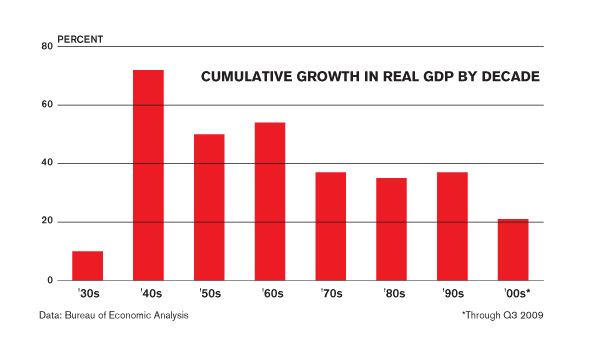 The growth rate of GDP has fallen overall in all the advanced capitalist countries ever since
the early 1970s. Roughly speaking, the growth rate has been less than half of what it was
during the previous quarter century period (the post-World War II boom).
The growth rate of GDP has fallen overall in all the advanced capitalist countries ever since
the early 1970s. Roughly speaking, the growth rate has been less than half of what it was
during the previous quarter century period (the post-World War II boom).
But in addition to this overall qualitative
drop in the growth rate of GDP, there has also been a roughly continuous fall in GDP growth from
decade to decade since the 1940s. The graph at the right shows this for the United States. [More
to be added...]
GROSS NATIONAL INCOME (GNI)
The World Bank Atlas (2004) defines GNI as “GDP plus net receipts of primary income
(compensation of employees and property income) from abroad.” However, strictly speaking, GNI
is actually Gross Domestic Income plus net receipts from
abroad. So in theory GNI is equivalent to GNP, though it is measured independently and may
therefore differ somewhat.
GROSS NATIONAL PRODUCT (GNP)
Gross Domestic Product together with net property income from abroad. A generation ago GNP
was used as the primary overall statistic by the U.S. government in describing its economy
and those of other nations. Since the U.S. was receiving tremendous income from abroad,
referring to GNP rather than GDP made the U.S. internal economy look better than it was.
However, as other countries began to receive more and more income from the property their
capitalists own in the U.S., this statistical advantage began to disappear. So the U.S.
switched over to the system that other countries were using, discussing its economy in terms
of GDP rather than GNP.
GSE
See: GOVERNMENT SPONSORED ENTERPRISE
GUATEMALA
[To be added... ]
See also:
ARBENZ GUZMÁN, Jacobo
GUESDE, Jules (1845-1922)
One of the founders and leaders of the Socialist Party of France and of the Second
International. Before World War I he led the the Left wing of the Socialist Party, but at
the beginning of the war he entered the French bourgeois government. (See also
GUESDISTS below.)
GUESDISTS
The Left socialists in France during the period before World War I.
“Guesdists—followers of Jules Guesde
and Paul Lafargue. They constituted a Left Marxist trend that stood for the independent
revolutionary politics of the French proletariat. They retained the name of Workers’
Party of France and remained true to the Havre Party Programme adopted in 1880, the
theoretical part of which was written by Marx. They had considerable influence in French
industrial centers and united the progressive elements of the French working class. In
1901 the Guesdists founded the Socialist Party of France.” —Footnote 46, Lenin: SW I (1967).
GUEVARA, Ernesto “Che” (1928-67)
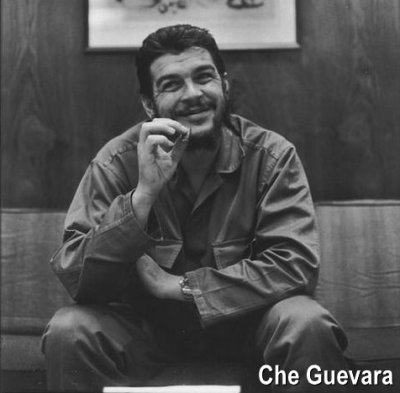 Famous Argentinian Marxist revolutionary who played an important role in the Cuban
Revolution, and through a firm internationalist perspective attempted to help promote
revolutions throughout the world. While in many respects a great and appropriately honored
revolutionary, some of his political views and theories were seriously wrong, and even led to
disaster both for others and himself. (See: FOCO
THEORY.)
Famous Argentinian Marxist revolutionary who played an important role in the Cuban
Revolution, and through a firm internationalist perspective attempted to help promote
revolutions throughout the world. While in many respects a great and appropriately honored
revolutionary, some of his political views and theories were seriously wrong, and even led to
disaster both for others and himself. (See: FOCO
THEORY.)
In 1951 Che took a year off from his
medical studies and travelled around South America on a motorcycle. He later wrote up
his experiences in his Motorcycle Diaries, eventually made into a well-known and
excellent film. Che was transformed by the horrible poverty and conditions of the people
that he saw on this trip, and soon came to understand that the great inequalities of
wealth in Latin America were due to the domination of capitalism, neocolonialism and
imperialism. He graduated with a medical degree from the University of Buenos Aires in
1953.
Che participated in the social reform
program of the government of Jacobo Arbenz Guzmán in Guatemala, and the 1954 CIA-organized
overthrow of that democratically elected government further radicalized him.
Che met Fidel Castro in Mexico and joined
his 26th of July Movement. He was with Castro in December 1956 when they “invaded” Cuba and
then set up guerrilla operations in the Sierra Maestra mountains. Che played an important
leading role in the two years of low-level guerrilla warfare in Cuba. This guerrilla
warfare was one of the factors that led to the collapse of the Batista dictatorship around
January 1, 1959.
Che also played an important role in the
first years of the Cuban revolutionary government. He served at various times as Minister
of Industry, president of the national bank, and a high-level Cuban diplomat. He played
an important role in agreeing to bring Soviet nuclear-armed missiles to Cuba, about which
President John F. Kennedy and U.S. imperialism came very close to starting a nuclear world
war.
While Castro tended to lean toward Soviet
revisionist ideology (as well as toward the Soviet Union for economic support and military
protection), Che was more ambivalent and on a few questions took a position closer to
that of Maoism. Che always firmly upheld the need for revolutionary armed struggle, though
it seems he did not fully appreciate the importance of the peasantry in Third World
countries. However, for him moral incentives under socialism were much more important than
material incentives. He argued that it was necessary to work toward forging a new political
consciousness, or toward creating a “new man”, as a means of promoting socialist production,
whereas revisionists typically argue that production must be hugely expanded first before
any progress toward creating a “new man” can be achieved (or even be seriously attempted).
Perhaps partly because of the intensifying
Sino-Soviet split and Castro’s siding with the revisionists, Che gradually became more
and more disatisfied with his role in the Cuban government. Finally, in 1965 he resigned
from all roles in that government and first headed off to the Congo (Kinshasa) in Africa
to participate in revolutionary guerrilla warfare there. After that failed, he headed to
South America, and made another attempt at his foco
strategy in Bolivia. This failed even more disastrously. In 1967 Che was captured by
the Bolivian Army (with the help of the CIA), and was then secretly tortured and
executed. It was the sad end to the life of a sincere and dedicated revolutionary.
But even in death, Che Guevara still
serves the world revolution as an honored and respected martyr. He is perhaps as famous
and influential today as he has been at any time since the late 1960s.
See also the important 1985 essay,
“Guevara, Debray, and Armed Revisionism”, by Lenny Wolff, at
http://www.bannedthought.net/Cuba-Che/Guevara/Guevara-Debray-Wolff.pdf for a
strongly critical appraisal of Che, Régis Debray, and focoism.
GUOMINDANG (GMD) [Old Style: KUOMINTANG (KMT)]
The Nationalist Party in China. It was organized in 1912 by Sun Yat-sen and became a major
bourgeois nationalist political force in China. After Sun Yat-sen died, Chiang Kai-shek
became its dominant leader in 1928, and after that the Party took on more and more of a
comprador and big bureaucrat capitalist character. The GMD, in control of the government
of China, waged war against the Communist Party of China for decades and was defeated and
expelled from the mainland in 1949. For decades after that it still retained power in
Taiwan.
Dictionary Home Page and Letter Index
MASSLINE.ORG Home Page
 The nom de guerre of Muppala Lakshmana Rao, the General Secretary of the Communist
Party of India (Maoist). According to sources on the Internet, he was born in Beerpur village
in Sarangapur mandal (“township”) in Karimnagar district of Andhra Pradesh, and became a
teacher there. While in college in Warangal he met Maoist leaders Nalla Adi Reddy and
Kondapalli Seetharamaiah and joined the Naxalite movement. He was one of the early members
of the Communist Party of India (Marxist-Leninist) People’s War and eventually became the
General Secretary of the party. When that party merged with the Maoist Communist Centre of
India in September 2004 to form the CPI(Maoist), Ganapathy became the General Secretary of
the unified party.
The nom de guerre of Muppala Lakshmana Rao, the General Secretary of the Communist
Party of India (Maoist). According to sources on the Internet, he was born in Beerpur village
in Sarangapur mandal (“township”) in Karimnagar district of Andhra Pradesh, and became a
teacher there. While in college in Warangal he met Maoist leaders Nalla Adi Reddy and
Kondapalli Seetharamaiah and joined the Naxalite movement. He was one of the early members
of the Communist Party of India (Marxist-Leninist) People’s War and eventually became the
General Secretary of the party. When that party merged with the Maoist Communist Centre of
India in September 2004 to form the CPI(Maoist), Ganapathy became the General Secretary of
the unified party.