LABOR ARISTOCRACY
This is the very best-paid and privileged stratum of the proletariat, which has arisen mostly
within imperialist countries in the last century and a half. These are most often skilled
workers, whose special training gives them greater bargaining power with the capitalists with
regard to wages and benefits, especially where they are organized into strong craft unions.
In the richest imperialist countries, such as the U.S., some workers in the labor aristocracy
may even acquire some significant investments, such as rental property, stocks and bonds,
though the dominant part of their income is still from wages. (Only a very few people from
this stratum will actually break out of the working class entirely, even during boom
periods.)
However, it is still only possible for this
labor aristocracy to be as large as it is, and to receive as high wages and benefits as it
does along with acquiring some savings and investments in some cases, because of the
exploitation of large parts of the world by the imperialist ruling class. That international
exploitation leads to constant imperialist wars, and it is necessary for the ruling class to
pacify at least a major section of its workers at home with some small part of the wealth it
rips off from foreign countries (and from the “Third World” in particular).
The labor aristocracy, in turn, tends to
strongly support the bourgeoisie politically, and has in general an extremely low level of
proletarian class consciousness. In effect, this section of the working class has made an
accommodation with the capitalist-imperialists.
But in periods of serious economic crisis,
such as the U.S. and most of world capitalism are now in once again, the bourgeoisie is
finding it necessary to take back more and more of the higher wages and benefits it once could
easily afford to grant to a part of the working class. This is having the effect of reducing
the size of the labor aristocracy in the U.S. and most countries (though it is still growing
rapidly in one country—China). As the world capitalist crisis develops further, much of the
embourgeoised labor aristocracy will be once again driven down and reproletarianized.
“... the English proletariat is actually becoming more and more bourgeois,
so that the ultimate aim of this most bourgeois of all nations would appear to be the
possession, alongside the bourgeoisie, of a bourgeois aristocracy and a bourgeois
proletariat. In the case of a nation which exploits the entire world this is, of course,
justified to some extent.” —Engels, Letter to Marx, Oct. 7, 1858, MECW 40:343, online at:
http://www.marxists.org/archive/marx/works/1858/letters/58_10_07.htm.
“This aristocracy of labor, which at that time earned tolerably good
wages, boxed itself up in narrow self-interest craft unions, and isolated itself from the
mass of the proletariat, while in politics it supported the liberal bourgeoisie.” —Lenin,
“Harry Quelch”, Sept. 12, 1913, LCW 19:370, online at:
http://www.marxists.org/archive/lenin/works/1913/sep/12.htm. [Lenin is speaking of
Britain, specifically.]
“But it would be dogmatic and wrong to believe that the labor aristocracy
always sides with the bourgeoisie. Historical events have demonstrated that it is not only
economic conditions which determine the political behavior of workers. Workers are able
to suffer adverse conditions for a very long time, in fact they even get used to them.
Dissatisfaction is caused primarily by a worsening of conditions, especially by a
rapid worsening. The same also applies to the labor aristocracy. It holds the side of the
bourgeoisie so long as its economic privileges are stable, but, if its position sharply
deteriorates, it may become an active participant in the revolutionary struggle. This
happened in Hungary in 1918-19 before the establishment of the dictatorship of the
proletariat when a sharp inflation plunged down the living standard of the workers.
Skilled workers who were receiving the highest rates reacted far more vehemently to the
worsening of their position than did badly paid workers. They joined the Communist Party
and often played a leading role in the fight to overthrow the bourgeoisie. Similar
developments were observed in the workers’ revolutionary movement in Germany.” —Eugen
Varga, Politico-Economic Problems of Capitalism (1968), p. 127.
[While what Varga says here may be
true in exceptional circumstances, there is also the possibility in modern society that
an outraged labor aristocracy, which suddenly comes under economic attack because of a
severe capitalist crisis, may also turn in its ideological confusion to support a fascist
movement (along with a major section of the petty-bourgeoisie). Moreover, even the
possibility of a section of the labor aristocracy under attack joining the revolutionary
movement depends on there being a serious and active revolutionary movement in the
first place, which can only be built up from nothing by focusing primarily on the lower
strata of the working class. —S.H.]
LABOR POWER
“By labor-power or capacity for labor is to be understood the aggregate of those
mental and physical capabilities existing in a human being, which he exercises
whenever he produces a use-value of any description.” —Marx, Capital, vol. I,
ch. 6: (International, p. 167; Penguin, p. 270.) “A commodity which its possessor, the
wage-worker, sells to capital.” —Marx, “Wage Labor and Capital”, (MECW 9:202, as edited
in Engels’s 1891 edition.)
Labor power is therefore the worker’s
ability to work, which is what is sold to the capitalist for the wages received.
Labor power is not the same as labor itself, however! As everyone is aware,
once the capitalists sell the products that the workers produce, and even after paying
the workers their wages (which means the market value of their labor power), they
still have a large surplus left over from which they take their profits. The
fact that the actual labor of the workers generates this additional
surplus value beyond the workers’ wages (i.e., beyond
the value of their labor power) means that the real implicit value of their actual
labor must greatly exceed the value of what they sell to the capitalists, their
labor power. And therefore labor power and labor must be carefully distinguished
if we are to understand the source of the capitalists’ profits.
The distinction between labor power and
labor is often confusing for those new to Marxist political economy. In addition to
Chapter 6
of Volume I of Marx’s Capital, another good place to go to clear up this confusion
is to carefully read Engels’s 1891 edition of Marx’s pamphlet, “Wage Labor and Capital”
and especially Engels’s introduction where he goes into the difference between labor power
and labor quite thoroughly. This edition is available in an inexpensive paperback from
International Publishers, and available online at
http://www.marxists.org/archive/marx/works/1847/wage-labour/index.htm.
Engels’s introduction is also available separately in MECW 27:194-201.
LABOR THEORY OF VALUE (LTV)
The fundamental theory in political economy, put forth by Marx, that the economic
value of any commodity
in a capitalist system of production is proportional to the average
socially necessary labor time that it
takes to produce that commodity. Thus if the average labor time necessary to produce a
certain type of overcoat is 25 times as great as the average labor time it takes to produce
a loaf of bread, the coat will have a value 25 times as great as that of the loaf. Marx,
however, understands full well that the actual prices of that
type of coat and that sort of loaf of bread might vary somewhat from this ratio for a
variety of reasons. But the analytical foundation, and most basic explanation for the
difference in the prices of the two commodities will still lie in the different quantities
of labor time necessary to make each.
Classical political economy also agreed
with this theory (in Ricardo, for example), at least in rough
outlines. But modern bourgeois economists reject it because they are loath to admit that
the working class, working on the products of nature, produces all value. They try instead
to explain value in terms of marginal supply and
demand, and so forth. But this leaves the usual fairly uniform differences in value
between the coat and the loaf of bread as quite mysterious. Alternately, they attempt to
explain the differences in value in terms of differing prices of production, but this begs
the question since they cannot supply any independent explanation for why prices of
production themselves differ!
All Marxists, or at least all those who
we care to consider as genuine Marxists in the sphere of political economy, agree with
the basic labor theory of value as briefly outline above. However, there are some secondary
aspects of the precise theory of value as put forward by Marx, about which even Marxists
can disagree. Marx, for example, said that only human labor, and only human labor
employed in the current production process, can create new
(surplus) value. Thus Marx does not seem to allow for the production of surplus value
by non-humans under any circumstances whatsoever. (See:
ANDROID THOUGHT EXPERIMENT ) Moreover,
Marx claimed that if a worker makes a machine and then uses that machine to produce
some commodity, only the labor time spent using the machine contributes to the
surplus value generated in the final commodity. An alternate view (which I for one hold)
is that the machine also allows the worker using it to continually reuse the labor
which went into making the machine, and therefore that both the new labor and the
re-used older labor will contribute to surplus value being generated in the final commodity.
For more on this, see the entry below. —S.H.
LABOR THEORY OF VALUE — Revised Form
This is a modified version of the labor theory of value (LTV) from that put forward by Marx.
It agrees with the fundamental proposition that the value
of a commodity produced in a capitalist system of production is solely due to the average
socially necessary labor time required
to produce that commodity. But it disagrees with Marx in that it views machinery as a way
of reusing the time spent in past labor (making the machine), and hence as also contributing
to surplus value along with the current labor time
expended. Here is the argument for making this modification:
“1) There is nothing mysterious nor magical about human labor
that can make it alone capable of generating surplus value in a system of
capitalist production. (Marx never adequately explained just why only human
beings supposedly have this capability, and thus left it all very mysterious.
He did say that human labor differs from animal efforts in that it is
conscious and purposeful, but
he did not explain why that makes any difference in this regard.) There must
be a good answer to the question, ‘Why is human labor able to produce surplus
value?’ It is incumbent on Marxist political economy to state precisely what the
answer to this question is.
“2) Furthermore, it is not
human creativity or intelligence that explains why human labor can generate surplus
value. (Some labor that generates surplus value requires very little
intelligence and shows virtually no creativity, such as certain types of extremely
repetitive assembly line work. And, on the other hand, some machinery already
demonstrates considerable intelligence and sometimes even some creativity—though
artificial creativity is much rarer so far, and is mostly confined to software, such
as certain expert systems.)
“3) Moreover, there is
no single specific human capability which, when exercised, alone is
able to generate surplus value. (On the contrary, there is an indefinitely large
number of actual things human workers can do which can generate surplus value, and
new ones are constantly being developed as production processes change.)
“4) Moreover, even now a
great many of these specific things which humans can do, and which generate surplus
value, can also be done by machines. (And in historical terms, machines are being
rapidly improved in the abilities to replace human beings in more and more types of
work.)
“5) All the sorts of
things that human beings can do which create surplus value come in degrees, from
very crude and primitive efforts to the highly skilled and sophisticated. This is
why we first see machines replacing the cruder forms of human labor, and then—as
the machines are improved—ever more sophisticated forms of human labor of the same
type.
“6) The thing that really
explains why human beings are able to generate surplus value is simply that human
beings can be ‘used over and over’ in the capitalist production process. (I.e., they
are not used up in the production of any commodity, as raw materials are.)
“7) But if the last principle
is true, then anything else that is used in the production process, without
being used up in each output commodity (i.e., tools and machinery), should also
contribute to surplus value.
“8) However, machines and
tools themselves were created by past human labor, and in fact all commodities that
presently exist are in the final analysis the result of the application of direct
or indirect human labor in various forms to the natural products of the world
around us.
“9) It is in general
impossible to quantitatively compare goods (or commodities) by comparing their
use values, since use values are so diverse, tend to
be unrelated to each other, and depend on the diverse and ever changing needs and
subjective desires of different individuals. (Whether a loaf of bread or a warm
coat is of greater use value to a person depends on the situation.)
“10) But there is an
underlying basis, and only one such feasible basis, for quantifying the differences
in exchange values for different commodities: the socially necessary labor
times incorporated into them. (So far this means just human labor, though
if androids are ever constructed, or if sentient aliens were to show up on earth
and also become workers, it would then include their labor.) Moreover, the labor
considered here must include not only the direct labor, but also the
properly apportioned indirect, or past labor contributed both in
the form of raw materials and tools & machinery. (The actual exchange values we
see, however, may be adjusted from this total socially necessary labor time for
various reasons, but the underlying labor time still forms the primary basis for
these exchange values.)
“11) Thus the labor theory
of value (LTV) remains essential in political economy. (Systems, like Sraffa’s,
that derive output prices directly from input quantities and prices (including
labor-power prices) may be technically possible, but are irrelevant here.
Political economy needs to explain a lot more than one price in terms of others.
For example it needs to explain how exploitation occurs and the deep reasons for
capitalist economic crises. (Furthermore, all prices themselves implicitly
relate to socially necessary labor times; the fact that a car costs $20,000 is
meaningless except within the framework where workers are paid definite amounts
for an hour of their labor time.) Sraffaian economics obscures such things. We
need to stay true to a profoundly political economics, a political economy
that clearly exposes the genuine human relationships at the bottom of
things.)
“12) But Marx’s specific
version of the LTV needs to be modified in one major way: It is not only
current labor which produces surplus value in a system of capitalist
production, but also the continuing use of past labor (embodied in tools
and machines). Modifying the LTV in this way allows us to resolve otherwise
insurmountable logical and conceptual problems in traditional Marxist political
economy. This revised LTV is far more coherent and defensible, but retains the
essential aspects of the traditional Marxist explanations for exploitation, the
source of capitalist profits, the underlying source of capitalist overproduction
crises as arising from the exploitation of labor in the capitalist production
process itself, and so forth.” —Scott Harrison, adapted from “Letter to Frank S.
about the labor theory of value” (Dec. 8, 2003), online at:
http://www.massline.org/PolitEcon/ScottH/Let_LTV.htm
LABOR UNIONS: U. S. — Long-term Decline Of
For many decades the size and strength of U.S. labor unions has been in a long-term decline.
Union membership, as a percentage of the labor force, has declined tremendously. As of 2012
the percentage of American workers in unions fell to 11.3%, the lowest since 1916 when it
was 11.2%. In private industry the figures were even worse: the percentage of unionized
workers was only 6.6%.
American trade unionism since the 1930s, at
least, has been virtually entirely a reformist movement, attempting to improve the lot of
workers economically but within the capitalist system. In no way was it a
revolutionary movement working toward the overthrow of capitalism. It made some economic
advances for a while, but as it became more and more bourgeois it also became less and less
militant. It members failed to comprehend that the gains in wages and benefits won through
unions, like all reformist gains under capitalism, are never secure and permanent. Eventually
the ruling class will succeed in striping away those gains and driving the workers down
again, especially when the developing economic crisis of its own capitalist system forces
it to do so.
LABOR’S SHARE OF PRODUCTION (In the U.S.)
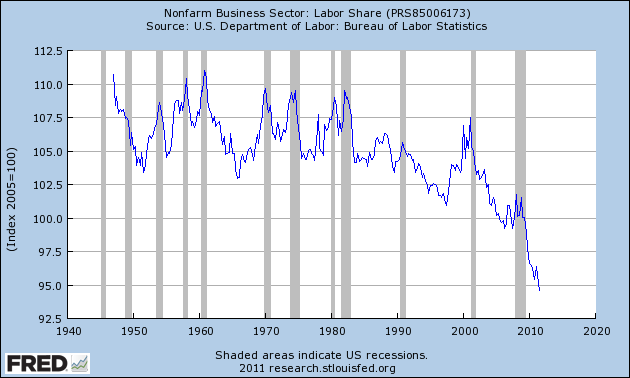 Since labor, applied to the resources of nature, is responsible for the production of
all wealth, by rights “labor’s share” of what is produced should be 100%.
But not only does the very tiny capitalist class take a very large percentage of what
is produced in the U.S. every year, over time they have been taking an ever-greater
percentage of it. Considering all the goods and services produced in the country (i.e.,
Gross Domestic Product), in 1974 the millions of employees of
all kinds added together received just 59% of the total. By 2009, that had fallen to
just 55%. In other words, the working class, which makes up over 90% of the population,
barely receives half of what it produces. And actually the situation is much worse even
than that, since these figures are grossly exaggerated. For example, many capitalists,
including even the CEO’s of giant corporations, are themselves counted as “employees”!
It is likely that the real situation is that the working class, even in this extremely
wealthy country, receives considerably less than half of what it produces each year.
Moreover, these figures are for gross income. After the government extracts all its many
taxes (much of which goes for imperialist wars and other things which benefit the rich
rather than the poor), the fraction of the wealth produced by the workers that they
actually are allowed to keep is even further reduced! And low as this percentage
now is, over time it is getting ever smaller. [The statistics here come from the
“Economics Scene” column, by David R. Francis, The Christian Science Monitor,
Feb. 21, 2010, p. 23.]
Since labor, applied to the resources of nature, is responsible for the production of
all wealth, by rights “labor’s share” of what is produced should be 100%.
But not only does the very tiny capitalist class take a very large percentage of what
is produced in the U.S. every year, over time they have been taking an ever-greater
percentage of it. Considering all the goods and services produced in the country (i.e.,
Gross Domestic Product), in 1974 the millions of employees of
all kinds added together received just 59% of the total. By 2009, that had fallen to
just 55%. In other words, the working class, which makes up over 90% of the population,
barely receives half of what it produces. And actually the situation is much worse even
than that, since these figures are grossly exaggerated. For example, many capitalists,
including even the CEO’s of giant corporations, are themselves counted as “employees”!
It is likely that the real situation is that the working class, even in this extremely
wealthy country, receives considerably less than half of what it produces each year.
Moreover, these figures are for gross income. After the government extracts all its many
taxes (much of which goes for imperialist wars and other things which benefit the rich
rather than the poor), the fraction of the wealth produced by the workers that they
actually are allowed to keep is even further reduced! And low as this percentage
now is, over time it is getting ever smaller. [The statistics here come from the
“Economics Scene” column, by David R. Francis, The Christian Science Monitor,
Feb. 21, 2010, p. 23.]
The chart at the above right (from the St.
Louis branch of the Federal Reserve) shows an index value comparing the share of national
income received by labor from year to year (with 2005 being arbitrarily set to 100). As
is evident, labor’s share of income is sinking like a rock, and is now at historic lows.
LAISSEZ-FAIRE [Pronounced: lassay fair]
[From the French, meaning “to let people do as they please”.] The bourgeois doctrine
which opposes any governmental interference in the economy beyond that necessary to
maintain peace and sacred capitalist property rights. This was well-nigh universally
accepted by bourgeois economists in the 19th century, especially after
John Stuart Mill popularized it in his Principles
of Political Economy in 1848. However, during the imperialist era, and especially
during the Great Depression of the 1930s, much of
the bourgeoisie and many of its apologists came to appreciate that much government
intervention in the economy on behalf of the capitalists was highly desirable, and
even necessary for the continuation of capitalism. In particular
Keynesian economists argued that the capitalist economy had
to be carefully “managed”, and even the more traditional economists of the
“neo-classical synthesis” school all
recognized that the government at least needed to manage interest rates, the money supply,
and so forth. After the stablization of capitalism for a long period after World War II,
laissez-faire (in a somewhat less pure form) came back into fashion again, often under
the new name (for much the same old ideas), neo-liberalism.
It is really only with the financial crash of 2008 and the deepening crisis leading toward
the development of a new depression that bourgeois economists are once again
starting to question their doctrine of near total faith in the virtues of laissez-faire
and the “free market”.
LAO ZI [also Romanized as Lao Tzu and Lao-Tse]
(6th century BCE)
Chinese philosopher and sage, the original source of Taoism.
Lao Zi (which literally means “the old master”) inspired the semi-religious Taoist book
Tao-te-Ching (“The Way of Power”) which was compiled some 300 years after his
death, and which teaches self-sufficiency, simplicity and detachment. From the Marxist
standpoint, Lao Zi is of interest mostly because of the primitive, but intriguing,
dialectics that he put forward, and also his faith in the people. For example, consider
this fine statement attributed to him, which sounds very much like the Maoist
mass line:
“Go to the people.
Live with them.
Learn from them...
Start with what they know;
Build with what they have.
But with the best leaders,
When the work is done,
The task accomplished,
The people will say,
We have done this ourselves!”
LASSALLE, Ferdinand (1825-1864)
German journalist, lawyer, and petty-bourgeois socialist.
“Lassalle was a German petty-bourgeois socialist who played an
active part in organizing (in 1863) the General Association of German Workers, a
political organization that existed up to 1875. The programmatic demands of the
Association were formulated by Lassalle in a number of articles and speeches.
Lassalle regarded the state as a supra-class organization and, in conformity with
that philosophically idealist view, believed that the Prussian state could be
utilized to solve the social problem through the setting up of producers’
co-operatives with its aid. Marx said that Lassalle advocated a ‘Royal-Prussian
state socialism’. Lassalle directed the workers towards peaceful, parliamentary
forms of struggle, believing that the introduction of universal suffrage would
make Prussia a ‘free people’s state’. To obtain universal suffrage he promised
Bismarck the support of his Association against the liberal opposition and also
in the implementation of Bismarck’s plan to reunite Germany ‘from above’ under
the hegemony of Prussia. Lassalle repudiated the revolutionary class struggle,
denied the importance of trade unions and of strike action, ignored the
international tasks of the working class, and infected the German workers with
nationalist ideas. His contemptuous attitude towards the peasantry, which he
regarded as a reactionary force, did much damage to the German working-class
movement. Marx and Engels fought his harmful utopian dogmatism and his reformist
views. Their criticism helped free the German workers from the influence of
Lassallean opportunism.” —Note 140 to LCW vol. 5, pp. 558-559.
LATHI [Pronounced: lah-tee, or lah-thee (to
rhyme with catty or Cathy)]
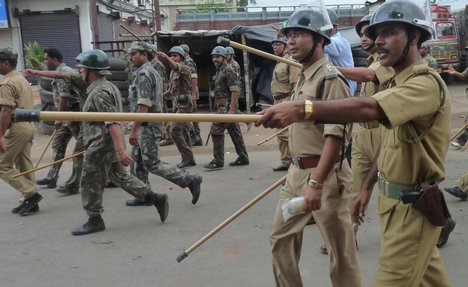 [From Hindi and related languages:] A stick or cane, typically 3 or 4 feet long, used
in a type of martial arts in India (often with longer sticks), but more commonly today
known because of its use by police forces to force submission by the masses. Lathis
are typically made of wood or very strong cane and often have a sturdy metal cap on the
end. Blows from them can cause serious injury and sometimes even death. Britain, when
it controlled India as a colony, first introduced lathis as a police weapon. They also
developed what is known as the lathi charge (or sometimes as one word,
lathicharge), where rows of police charge the protesting masses in military
fashion and viciously beat them.
[From Hindi and related languages:] A stick or cane, typically 3 or 4 feet long, used
in a type of martial arts in India (often with longer sticks), but more commonly today
known because of its use by police forces to force submission by the masses. Lathis
are typically made of wood or very strong cane and often have a sturdy metal cap on the
end. Blows from them can cause serious injury and sometimes even death. Britain, when
it controlled India as a colony, first introduced lathis as a police weapon. They also
developed what is known as the lathi charge (or sometimes as one word,
lathicharge), where rows of police charge the protesting masses in military
fashion and viciously beat them.
“In modern times, lathi is the primary weapon of the Indian riot
police along with helmets, shields, tear gas and other methods. Policemen are
trained in highly co-ordinated drill movements which can leave many of the rioters
crippled. This drill has been quite controversial among human rights activists so
in many places the police do not follow the drill but hit in such a way to disperse
the crowds. Security guards and police officers often carry a lathi along with or
in place of firearms. They prefer lathi for their ease of use and comparative
safety and only resort to firearms in situations when lathi cannot be used
efficiently.” —Wikipedia article on lathis.
LAZARUS, Sylvain (1943- )
A radical bourgeois French sociologist, anthropologist and political theorist, and longtime
political and philosophical associate of the “post-Maoist”
Continental philosopher
Alain Badiou. In his youth he was strongly influenced by
the May 1968 uprisings in France and by the Great Proletarian Cultural
Revolution in China. In late 1969 he (along with Badiou and others) founded the Union
des communists de France marxiste-léniniste (UCFML) which was a nominally
“Maoist” organization. (I.e., the intellectuals in this small sectarian group were
enthusiastic about Mao and the GPCR, insofar as they actually knew much about them.)
In 1981, using the nom de plume Paul
Sandevince, Lazarus published a piece entitled “Notes de travail sur le post-léninisme”
[“Working Notes on Post-Leninism”] in which he openly talked about his deep dissatisfaction
with many essential principles of Marxism-Leninism, and called for a new type of “post-Leninist”
political party. In 1985, after the collapse of the UCFML, Lazarus, Badiou and some of the
others formed a new group they called L’Organisation Politique, which did not consider
itself to be a revolutionary political party nor to be working toward the creation of one.
Its only mass practice was around a few reformist issues (especially promoting the rights of
immigrants in France). The OP itself fizzled out, and apparently completely disappeared by
2007 at the latest.
By the year 2001 Lazarus and Badiou were openly
rejecting the need for any proletarian class perspective whatsoever in politics, as well as
the need for any revolutionary party of any sort. (See the BADIOU entry
for quotes about this.) No doubt Lazarus and his friends once had some youthful revolutionary
spirit, but that has long since disappeared. Indeed, it seems quite unlikely that they were
ever really genuine Maoist revolutionaries in the first place.
LEAGUE OF RUSSIAN REVOLUTIONARY SOCIAL-DEMOCRACY ABROAD
“The League of Russian Revolutionary Social-Democracy Abroad
was founded in October 1901 on Lenin’s initiative, incorporating the Iskra-Zarya
organization abroad and the Sotsial-Demokrat organization (which included the
Emancipation of Labor group). The
objects of the League were to propagate the dieas of revolutionary Social-Democracy
and help to build a militant Social-Democratic organization. Actually, the League was
the foreign representative of the Iskra organization. It recruited supporters
for Iskra among Social-Democrats living abroad, gave the paper material support,
organized its delivery to Russia, and punblished popular Marxist literature. The
Second Party Congress endorsed the League as the sole Party organization abroad, with
the status of a Party committee and the obligation of working under the Central
Committee’s direction and control.
“After the Second Party Congress,
the Mensheviks entrenched themselves in the League and used it in their fight against
Lenin and the Bolsheviks. At the Second Congress of the League, in October 1903, they
adopted new League Rules that ran counter to the Party Rules adopted at the Party
Congress. From that time on the League was a bulwark of Menshevism. It continued in
existence until 1905.” —Note 15, LCW 7.
LEAGUE OF STRUGGLE FOR THE EMANCIPATION OF THE WORKING CLASS
“The League of Struggle for the Emancipation of the Working
Class was organized by Lenin in the autumn of 1895; it embraced about twenty
Marxist workers’ study circles in St. Petersburg. The work of the League of Struggle
was organized in its entirety on principles of centralism and strict discipline. The
League was headed by a Central Group consisting of V. I. Lenin, A. A. Vaneyev, P. K.
Zaporozhets, G. M. Krzhizhanovsky, N. K. Krupskaya,
L. Martov (Y. O. Tsederbaum), M. A. Zilvin, V. V. Starkov
and others. Direct leadership was in the hands of a group of five headed by Lenin.
The organization was divided into district groups. Advanced, class-conscious workers
(I. V. Babushkin, V. A. Shelgunov and others) linked these groups with the factories.
At the factories there were organizers who gathered information and distributed
literature; workers’ study circles were set up at the biggest establishments.
“The League of Struggle was the
first organization in Russia to combine socialism with the working-class movement.
The League guided the working-class movement, linking up the economic struggle of the
workers with the struggle against tsarism, it published leaflets and pamphlets for
the workers. Lenin was the editor of the League’s publications and preparations for
the issue of a working-class newspaper, Rabocheye Dyelo, were made under his
leadership. The influence of the League of Struggle spread far beyond St. Petersburg.
Following its example, workers’ study circles were united into Leagues of Struggle
in Moscow, Kiev, Ekaterinoslav and other towns and regions of Russia.
“In December 1895, the tsarist
government dealt the League a heavy blow. During the night of December 8-9 (December
20-21 New Style) a considerable number of League members were arrested, Lenin among
them; the first issue of Rabocheye Dyelo that was ready for the press was
seized.
“At the first meeting held
after the arrests it was decided to call the organization of St. Petersburg
Social-Democrats the League of Struggle for the Emancipation of the Working
Class. As an answer to the arrest of Lenin and the other members of the League,
those who escaped arrest issued a leaflet on a political theme; it was written by
workers.
“While Lenin was in prison he
continued to guide the work of the League, to help with advice; he sent letters and
leaflets written in cipher out of prison and wrote the pamphlet ‘Strikes’ (this
manuscript has not been discovered), and ‘Draft and Explanation of a Programme for
the Social-Democratic Party’ (LCW 2:93-121).
“The St. Petersburg League of
Struggle for the Emancipation of the Working Class was important, to use Lenin’s
definition, because it was the germ of a revolutionary party that took its support
from the working class and led the class struggle of the proletariat. In the latter
half of 1898 the League fell into the hands of the Economists
who planted the ideas of trade-unionism and Bernsteinism
on Russian soil through their newspaper Rabochaya Mysl. In 1898, however, the
old members of the League who had escaped arrest took part in preparing the way for the
First Congress of the R.S.D.L.P. and in drawing up the Manifesto of that Congress, thus
continuing the traditions of Lenin’s League of Struggle.” —Note 119, Lenin SW1
(1967).
LEFT vs. “LEFT”
Since the days of the great French Revolution
the left has referred to those in politics who want progressive change in the
interests of the people, rather than maintaining the status quo or even change backward
in a reactionary direction. However, within the revolutionary Marxist milieu, the
left refers to genuine revolutionaries and not mere reformers. For Marxists,
the “left” or “leftist”, when it is in scare-quotes like that, refers not to the genuine
left, but rather to the phony, so-called “left” which is actually opposed to revolution,
or else to “ultra-leftists” whose inappropriate slogans and actions will not actually
lead the situation forward to revolution.
Thus what a particular individual means
by the left or leftist depends on their own political views (and specifically
whether they are a true and rational revolutionary or not).
“Guard against ‘Left’ and Right deviations. Some people say, ‘It is
better to be on the “Left” than on the Right,’ a remark repeated by many comrades. In
fact, there are many who say to themselves that ‘It is better to be on the Right than
on the “Left”’, but they don’t say it aloud. Only those who are honest say so openly.
So there are these two opinions. What is ‘Left’? To move far ahead of the times, to
outpace current developments, to be rash in action and in matters of principle and
policy and to hit out indiscriminately in struggles and controversies—these are
‘Left’ deviations and are no good. To fall behind the times, to fail to keep pace
with current developments and to be lacking in militancy—these are Right deviations
and are no good either. In our Party there are people who prefer to be on the ‘Left’,
and then there are also quite a few who prefer to be on the Right or to take a
position right of center. Neither is good. We must wage a struggle on both fronts,
combating both ‘Left’ and Right deviations.” —Mao, “Speeches at the National
Conference of the Communist Party of China: Concluding Speech” (March 31, 1955),
SW 5:167.
“LEFT-WING” COMMUNISM
This term designates different groups of erring Communists (or communist-minded people),
often semi-anarchists, at different times and places.
1) The group within the Bolsheviks in 1918
who opposed the Treaty of Brest-Litovsk signed in December 1917 which ended World War I
between Germany and Russia. This included Nikolai Bukharin,
Karl Radek and G. L. Pyatakov. Leon Trotsky also opposed
this Treaty, and is sometimes included within this group of “left-wing” communists, and is
sometimes mentioned separately from them. This whole group correctly recognized that the
Treaty was a bitter pill, but failed to understand that the survival of the Revolution
depended on accepting it. The Seventh Congress of the Party in March 1918 rejected the
position of this group.
2) The trend within the fledgling
international Communist movement after the success of the Bolshevik Revolution and the
end of World War I, especially in Germany and other European countries. This is the trend
Lenin strongly criticized in his pamphlet, “Left-Wing” Communism—An Infantile Disorder
(see entry below).
3) Similar semi-anarchist, ultra-“leftist”,
or propaganda-oriented trends and groups which are totally divorced from mass struggle, at
other times and places.
“LEISURE AGE”
Apologists for capitalism have periodically predicted that, “in the future”, capitalism
will be producing so much with so little effort by the workers, that there will be a
“golden age of leisure”. However, despite all the productivity improvements during the
capitalist era, and the immense productive capacity of capitalism (much of which is
not even used!), somehow this age of leisure never seems to dawn. The trend is actually
now for people to work longer and longer hours; that is, for those who have jobs at
all. The only life of comfortable leisure under capitalism is for those who own the means
of production; the “leisure” of the long-term or permanently unemployed is mostly a life
of misery.
“In the 1970s there was much talk of an imminent ‘leisure age’ in
which, thanks to automation, we would scarcely work at all—and a spate of books
brooding earnestly on how we would fill our new spare time without becoming
hopelessly lethargic. Anybody spotting one of these forgotten tracts in a second-hand
bookshop today would laugh incredulously. The average British employee now puts in
80,224 hours over his or her working life, as against 69,000 hours in 1981. Far from
losing the work ethic, we seem ever more enslaved by it. The new vogue is for books
that ask anxiously how we can achieve a ‘work-life balance’ in an age when many
people have no time for anything beyond labour and sleep.” —Francis Wheen,
Marx’s Das Kapital: A Biography (2006), p. 59.
LENIN — On the Agrarian Question
“In his writings on the agrarian question, Lenin provides, in the
first place, an analysis of the laws of development of capitalism in agriculture,
based on a wealth of statistical information from European countries and from the
U.S.A.
“This analysis is to be found
in his writings:
Capitalism in
Agriculture.
The Agrarian
Question and the ‘Critics’ of Marx.
New Data on
the Laws of Development of Capitalism in Agriculture.
The Agrarian
Programme of Social Democracy in the First Russian Revolution.
“These writings are difficult to
follow unless the reader has previous acquaintance with the main ideas of Marxist
economics. They are an important continuation and application of the principles of
Marx’s Capital. They constitute an indispensable part of Marxist studies
particularly for those concerned with agricultural questions. They are all polemical
in style, being directed against writers who either denied the capitalist development
of agriculture altogether or misrepresented its laws of development.
“In Capitalism in Agriculture,
Lenin deals with a Narodnik writer who had criticized Kautsky’s book on the agrarian
question (written at a time when Kautsky was still a Marxist). Lenin makes clear a
number of fundamental characteristics of the development of capitalism in agriculture—the
proportion of constant to variable capital increases in agriculture, as in industry;
there takes place a concentration of land-ownership in the hands of landlords and
mortgage corporations; large-scale production supplants small-scale, not merely by
increase in the area of farms but also by increase of intensity of production on a
small area; there is a growth of wage labor and of the utilization of machinery. He
then shows further how the development of capitalist agriculture is hampered by various
difficulties and contradictions, particularly ground rent, the growth of the urban at
the expense of rural population, and competition of cheap grain from newly developed
areas overseas where the producers are not burdened by ground rent.
“The same questions are again
taken up in The Agrarian Question and the ‘Critics’ of Marx. Here, after a
fundamental explanation of the fallacy of the so-called ‘law’ of diminishing returns,
and an exposition of the Marxist theory of ground rent, Lenin deals especially with
the question of large-scale versus small-scale farming, exposing the error of those
who imagine that small farming is more ‘progressive.’
“New Data on the Laws of
Development of Capitalism in Agriculture brings out further the points already
explained by means of a profound analysis of the development of agriculture in the
United States. Amongst other points emphasized both in this and the previous articles
is the essentially capitalist character of agricultural co-operation, in a capitalist
state, through farmers’ co-operative associations. [But see also Lenin On
Co-operation.]
“In The Agrarian Programme
of Social Democracy in the First Russian Revolution, 1905-7, Lenin gives a
detailed analysis of the existing system of land ownership in Russia and of the
tasks of the agrarian revolution in Russia.
“The key issues are confiscation
of the estates of the landlords and nationalization of the land. Lenin proves that
the nationalization of the land, in a capitalist state, does not destroy capitalism
in agriculture but, on the contrary, by removing the main obstacles to the free
investment of capital in agriculture, furthers its development. This point is
developed in Chapter III, which also contains a simply exposition of the Marxist
theory of ground rent....
“Two writings by Lenin dealing
with the agrarian question in pre-revolutionary Russia must be noted here, in
addition to the treatment of the development of capitalism in Russian agriculture
contained in the relevant chapters of [Lenin’s book] The Development of Capitalism
in Russia.
“In The Agrarian Question in
Russia at the End of the Nineteenth Century, Lenin gives a detailed analysis of
the types of farming in Russia and of their development, of the classes, of the
process of division of the peasants, and concludes that two alternative paths of
development were open to Russian agriculture—the ‘Russian’ path, through the growth
of kulak farming, or the ‘American’ path, through the nationalization of the land.
This analysis provided the basis for the agrarian programme of Russian
Social-Democracy, including its demand, voiced later, for the nationalization of
the land.
“In the booklet To the Rural
Poor published in 1903 for illegal distribution amongst the peasants, we find
a model of the simple, popular and forceful presentation of the party’s whole
economic and class analysis and programme of action.”
—Maurice Cornforth, Readers’
Guide to the Marxist Classics (1953), pp. 41-42.
LENIN — On Mass Democracy and the Mass Line
A fact not commonly recognized, even by many Maoists today, is that Lenin had a great
appreciation for the wisdom and abilities of the masses, for the importance of mass
democracy, for the central role of the masses in making revolution, and even a grasp
(perhaps mostly intuitively) of what became known in Maoist China as “the
mass line” method of revolutionary leadership.
[More to be added.]
“[O]n the one hand the character of the Soviets guarantees that
all these new reforms will be introduced only when an overwhelming majority of the
people has clearly and firmly realized the practical need for them; on the other
hand their character guarantees that the reforms will not be sponsored by the
police and officials, but will be carried out by way of voluntary participation of
the organized and armed masses of the proletariat and peasantry in the management
of their own affairs.” —Lenin, “Resolution on the Current Situation”, May 16 (3),
1917, LCW 24:311.
[These are quite similar to
the basic points that Mao made when he said that: “There are two principles here:
one is the actual needs of the masses rather than what we fancy they need, and the
other is the wishes of the masses, who must make up their own minds instead of our
making up their minds for them.” —Mao, Quotations, ch. XI; originally from
“The United Front in Cultural Work” (Oct. 30, 1944), SW 3:236-7.]
LENINISM
The further development and extension or modification of Marxism which is attributed
(either correctly or incorrectly) to V. I. Lenin. The term ‘Marxism-Leninism’ refers to
the science of revolutionary Marxism which includes the contributions of Lenin (as
well as those of Marx, Engels and others), while the term ‘Leninism’ itself tends to
focus more on those elements of Marxism-Leninism which are attributable (properly or
not) to Lenin specifically and not primarily to Marx and Engels. Thus those who
imagine that Marx was a bourgeois humanist and Lenin was not, will see a larger part of
Marxism-Leninism (as it is usually understood) as being due to Lenin, than those who
see more agreement between the ideas of Marx and Lenin in the first place. Therefore,
what is counted as distinctively ‘Leninist’ depends on the speaker’s notion of what
Marxism itself was properly viewed as before Lenin, as well as their notion of
how Lenin influenced and/or developed Marxism.
Leninism as it should be properly
understood by revolutionary Marxists includes at least these main overall points:
1) The application of Marxism to the
particular cirmstances and conditions of Russia;
2) The regeneration of Marxism as a
revolutionary theory after its degeneration into bourgeois reformism in
the Second International after the death of Marx and Engels;
3) The further development of
Marxism in the changed conditions of the new capitalist-imperialist era, and with the
successful October Revolution in Russia. And within this 3rd point, the
following main sub-points:
a) The recognition that
capitalist-imperialism was a whole new stage of capitalism, that it necessarily
involved both predatory wars and inter-imperialist wars, and that it represented a
further diseased and moribund social system which had become ripe for revolution,
including wars of national liberation in imperialist colonies.
b) A greater emphasis on the role of
the revolutionary proletarian party, along with a somewhat different conception of
the character of such a party (as a party of professional revolutionaries organized
on the basis of democratic centralism);
c) The actual direction of a
proletarian revolution and the implementation of the first major dictatorship of the
proletariat, and in the course of that developing many of the essential principles
of proletarian rule.
See also entries below.
“To expound Leninism means to expound the distinctive and new in
the works of Lenin that Lenin contributed to the general treasury of Marxism and
that is naturally connected with his name.” —Stalin, “The Foundations of Leninism”,
lectures delivered at the Sverdlov University, April-May 1924, Works 6:71.
“It is usual to point to the exceptionally militant and exceptionally
revolutionary character of Leninism. This is quite correct. But this specific feature
of Leninism is due to two causes: firstly, to the fact that Leninism emerged from
the proletarian revolution, the imprint of which it cannot but bear; secondly, to the
fact that it grew and became strong in clashes with the opportunism of the Second
International, the fight against which was and remains an essential preliminary
condition for a successful fight against capitalism. It must not be forgotten that
between Marx and Engels, on the one hand, and Lenin, on the other, there lies a whole
period of undivided domination of the opportunism of the Second International, and
the ruthless struggle against this opportunism could not but constitute one of the
most important tasks of Leninism.” —Stalin, ibid., Works 6:73-74.
LENINISM — Bourgeois Conception Of
Bourgeois writers often recognize, to some limited degree, some of the elements of
Leninism as we revolutionary Marxists understand it. (See entry above.) In particular
they often recognize the greatly increased attention Leninism gives to colonial or
semi-colonial countries, to the potential role for earlier revolutions that Leninists
see there, to the revolutionary potential of the peasantry, and so forth. They
sometimes even tie this loosely together with some partial recognition of imperialism
(though never as something inherent in modern capitalism!). But the one
thing that bourgeois writers most focus on in their discussion of what they
call “Leninism”, to the point where everything else is almost totally obscured, is
the nature and role of the Leninist party.
This conception of Leninism starts
with some actual elements of Lenin’s ideas about a revolutionary party, though it
tends to grossly distort or exaggerate them as follows:
1) The working class and masses are
presumed to be seldom, if ever, spontaneously revolutionary;
2) The working class is presumed to
be only capable of reformist or trade union consciousness on its own;
3) A revolutionary party is viewed
as absolutely essential in all circumstances to bring revolutionary ideas to the
workers and masses from the outside, and to lead them in a revolutionary
direction;
4) This party must be composed of
carefully and thoroughly trained, full-time professional revolutionaries;
5) The party must be tightly
organized and highly disciplined according to the principles of democratic
centralism—which the bourgeois ideologists assume must really be highly authoritarian
and totally undemocratic;
6) This party must be viewed as the
vanguard of the proletariat, even when it is first formed by a small number
of people, because only through its leadership can the masses make revolution;
7) This party, will institute what
it calls the “dictatorship of the proletariat” when it achieves power, but this will
actually be a dictatorship of the party (and ultimately of the top party leadership)
over the masses, and must inevitably operate in a “totalitarian”, fascist manner.
8) And finally, under this bourgeois
conception of Leninism, when the party actually is in power in one or more countries,
it will be bent on total world conquest.
Well! That is the bourgeois
conception of Leninism! This is obviously a total parody of Lenin’s ideas and of
genuine Leninism. Points 1 and 2 are already quite exaggerated; Lenin never claimed
that there were no spontaneous revolutionary ideas among the masses! He was well aware
of the great Paris Commune, for example, which was
created by a spontaneous uprising. Lenin only argued that the dominant forms of
spontaneity in bourgeois society are indeed reformist
in perspective, and that therefore the most class conscious section of the
masses, which constitutes itself into a proletarian party, must of course provide
leadership for the whole revolutionary movement.
Point 3 is distorted in at least two
major ways: First, there are times (such as during the Great
Proletarian Cultural Revolution in China) when the party has lost its way
and must itself be corrected and reconstituted by the revolutionary masses. Second, most
of the revolutionary ideas which the party brings to the masses do not really
come from “the outside”, but instead from among the masses themselves through the use
of Marxist summation and the method of the mass line.
Point 4 is basically true of genuine
Leninism; we do seek to build a party whose core, at least, is composed of
carefully trained professional revolutionaries. We also insist, however, that this
party have very close ties to the masses, that in socialist society (at least) party
members also spend substantial time participating in labor, and that the masses keep a
close eye upon the party and supervise it, so that it always remains working in
their interests! It is also true, as point 5 in the bourgeois conception of
Leninism has it, that a Leninist party should be highly organized and highly disciplined.
However, a true Leninist party actually takes the democracy aspect of democratic
centralism seriously and even insists that democracy must be the principal
aspect.
With regard to point 6: There has
indeed been a very wrong tendency in many new or small MLM parties, which are not yet
even in much contact with the masses in their country, to falsely view themselves as
a “vanguard”. A true vanguard is a party that is
actually out front and really leading the masses in struggle, and in
the direction of social revolution. This is very different than any self-proclaimed
miniscule phony “vanguard”.
In point 7 the bourgeois ideologues
of course conclude that any dictatorship over their class and their
supposed inalienable rights, must in fact be a vicious, totalitarian dictatorship
over the people as a whole. But what genuine Leninism (and Marxism!) means by the
dictatorship of the proletariat
is a society in which the working class and broad masses have full and complete
democratic rights, far more so than they have under
bourgeois democracy for example. No party
which exercises dictatorship over the people is a Leninist party, no matter
what it calls itself. Yes, revisionism in
power does this (as in Soviet Union from at least the mid-1950s on), but we actual
Leninists are deadly opponents of these revisionists.
And finally, with respect to point
8, we Leninists are indeed determined to bring about social revolution everywhere
in the world, and create world communism. Of course this is something very different
than “world conquest” in the sense the bourgeoisie understands it! Anyway, this is
actually nothing new in Leninism; Marx and Engels proclaimed this goal in the
Communist Manifesto long before Lenin was even born.
So the bourgeois conception of
“Leninism” is a complete distortion of the real thing. It is an almost complete lie
and slander of Lenin, which starts from small distortions and builds toward total
nonsense. It is true that Leninism does give more emphasis to the leading role of
the party than does Marx or Engels, and does have a somewhat different conception
of what such a party must be like. But, first, this is a natural development and
extension of the ideas of Marx and Engels, and second, this is only one aspect of
Leninism as it should be properly understood.
LÉVI-STRAUSS, Claude (1908-2009)
A prominent bourgeois anthropologist and sociologist, often considered in academic circles to
be the “father” of modern anthropology. He was influenced by linguistics, geology, Freudian
psychoanalysis and possibly to some limited extent by Marxism (as he himself claimed). He
introduced the concepts of “structuralism” from linguistics
and geology into anthropology and sociology, where it became an intellectual fad for a short
period.
One aspect of “structuralism” in anthropology,
as Lévi-Strauss understood it, was that all societies follow certain universal patterns
of thought and behavior. This is the sort of principle that obviously has some validity
to it, but which can easily be pushed to unreasonable extremes. A progressive aspect of this
way of looking at human culture is that it opposed the traditional attitudes towards native
peoples as being biologically “primitive” and having “savage” or “primitive” mental capabilities.
A less positive aspect of this way of looking at culture is that it tended to lead to the
“postmodern” idea that all worldviews
are “equally valid”, and that more modern forms of society are not really more advanced than
those of primitive societies. While it is true that the people in hunter-gatherer society,
for example, are not biologically primitive, their societies definitely are primitive,
and their traditional conceptions of the world are also definitely primitive as compared with a
modern scientific outlook.
Lévi-Strauss not only had a great
influence within anthropology and sociology, he also influenced the intellectual and academic
communities in general, especially in literary theory and Continental philosophy. Unfortunately,
this influence proved to be mostly negative.
LGBT
An acronym which refers to people who are lesbian, gay (homosexual), bisexual or transgender.
A recent (early 2013) Gallup poll of more than
200,000 Americans found that 3.5% of the population identifies as being within this group of
people.
In class society there has long been tremendous
oppression and mistreatment by the authorities and by the rest of the populace against LGBT
people, including even outright murder of them. In recent decades there have been some positive
changes in the attitudes of people in most advanced capitalist countries in this regard, but
LGBT people still suffer great inequality and mistreatment even in the more enlightened countries.
Of course, where there is oppression there is resistence, and the struggle for LGBT rights has
already become substantial in many countries.
Variations on this acronym include: LGBTQ
(which includes people who prefer to identify themselves as queer); LGBTQQ (which
further includes people who are questioning their own gender identity); and LGBTI
(which includes intersex individuals, i.e. those with a physical combination of both male
and female genitalia).
“LGBT is an initialism that collectively refers to the lesbian, gay, bisexual,
and transgender community. In use since the 1990s, the term LGBT is an adaptation of the
initialism LGB, which itself started replacing the phrase gay community beginning in the
mid-to-late 1980s, which many within the community in question felt did not accurately represent
all those to whom it referred. The initialism has become mainstream as a self-designation and
has been adopted by the majority of sexuality and gender identity-based community centers and
media in the United States and some other English-speaking countries.
“The term LGBT is intended to emphasize a
diversity of sexuality and gender identity-based cultures and is sometimes used to refer to
anyone who is non-heterosexual or non-cisgender instead of exclusively to people who are lesbian,
gay, bisexual, or transgender. To recognize this inclusion, a popular variant adds the letter Q
for those who identify as queer and/or are questioning their sexual identity as LGBTQ, recorded
since 1996.” —Wikipedia entry for ‘LGBT’ (accessed March 17, 2013).
LI Da (1890-1966)
One of the earliest and most important Marxist philosophers and disseminators of Marxist
theory more generally in China. He was a founding member of the Communist Party of China and
played an important role in the Marxist education of Party members, including Mao Zedong.
From their already existing Japanese translations, Li Da retranslated many Russian and German
works on philosophy and Marxist theory into Chinese. Li’s own most important work was his
Elements of Sociology (1st ed., 1935), which is said to have had a great influence
on Mao. In the young Soviet Union there were some major struggles in philosophy, and by the
1930s a standard “New Philosophy” became dominant there. Li Da helped popularize that
standardized version of Marxist philosophy and theory in China.
During the Great
Proletarian Cultural Revolution Li Da was heavily criticized for having failed to
proclaim the absolute and total originality of Mao’s contributions to Marxist philosophy
and theory. However, Mao—like everyone else—had to learn a lot of his theoretical views from
his predecessors. Mao did make great contributions to Marxism, but he was able to do so in
part because of the earlier great ideas he learned from Marx, Engels, Lenin and others.
An important book about Li Da is: Li Da
and Marxist Philosophy in China (1996), by Nick Knight.
In March 1966, Li Da responded to Lin Biao’s theory that Mao Zedong
Thought was the pinnacle of Marxist-Leninist theory in characteristically forthright
manner. On being informed—possibly rather nervously—by one of his research assistants
that this theory originated from Vice Chairman Lin, Li responded:
“I realize that, and I don’t
agree! This notion of a ‘pinnacle’ is unscientific, and does not conform to dialectics.
Marxism-Leninism is developmental, and so is Mao Zedong Thought. If you compare them
to a pinnacle, then there is no direction in which they can develop from there. How
can Marxism-Leninism have a ‘pinnacle’? I can’t agree with violations of dialectics,
regardless of who utters it.”
—From Nick Knight, Li Da and
Marxist Philosophy in China (1996), p. 23. [While strictly speaking Li Da was
correct here, he might better have recognized that revolutionary theory can very well
reach temporary “pinnacles” as of a given time, which later can and should be
surpassed. Revolutionary theory, too, advances by periodic leaps which must be
recognized and defended. —S.H.]
LI Tso-p’eng (1916-?)
A General and high ranking political cadre in the People’s Liberation Army of China, who is known
both as the author of an influential article summing up one aspect of Mao’s military concepts
“Strategy: One Against Ten, Tactics: Ten Against One” (1964), and also later for his conspiratorial
involvement in the failed coup attempt by Lin Biao.
The Strategy and Tactics article appeared in an
abridged English translation in Peking Review,
1965, issues #15 & #16, and was also issued as a 43-page pamphlet in English in 1966. Excerpts
from it were published in the RIM magazine, A World to Win, #16 in 1991, online at:
http://www.bannedthought.net/International/RIM/AWTW/1991-16/strategy_One_Against_Ten_Tactics.htm
(The AWTW editors seemed not to be aware of Li’s role in the conspiracy to overthrow
and even murder Mao!)
From 1967 until his downfall immediately following
the attempted military coup by Lin Biao, General Li Tso-p’eng was the 1st political commissar of the
Navy. He had authority over the naval air base at Shanhaikuan and aided Lin and his family and
closest circle in their escape by air from that base. (However, the plane crashed in Mongolia, and
all aboard it were killed.) Li himself was soon arrested and then brought to trial for his
substantial role in the conspiracy.
“Seeing that his scheme had been exposed and that his last day was coming, Lin
Piao hurriedly took his wife and son and a few diehard cohorts to escape to the enemy, betraying
the Party and the state. In the early morning of 2:30, September 13, 1971, the Trident jet No.
256 carrying them crashed in the vicinity of Ondor Han in Mongolia. Lin Piao, Yeh Chun, Lin
Li-kuo [Lin Biao’s son], and all other renegades and aboard were burned to death. Their death,
however, could not expiate all their crimes. After Lin Piao’s unsuccessful betrayal and defection,
Huang Yung-sheng, Wu Fa-hsien, Li Tso-p’eng, and Ch’iu Hui-tso destroyed many evidences
to cover up their own criminal acts.” —“Document No. 24 of the CCP Central Committee,” a Party
document about the whole Lin Biao conspiracy, June 1972. [Emphasis added.]
LIBERALISM [U.S. bourgeois political sense]
[To be added...]
“Though it is difficult to recall, there was a time when liberalism
was identified with cheerfulness.... At the high-water mark of its recent political
influence, liberalism is depressed, disappointed, deflated.” —Michael Gerson, a
bourgeois commentator, in the Washington Post; quoted in The Week, Oct.
8, 2010, p. 16. [Although Gerson himself is a conservative, even most political liberals
themselves today show little confidence in their own perspective, and very little
enthusiasm or hope that a significantly better world will come about through the
implimentation of the policies of their elected leaders. They are suffering a crisis of
faith because of the long-term failure of their own program, and the obvious fact that
it has arrived at a dead end. —S.H.]
LIBERATION THEOLOGY
A movement that developed primarily in Roman Catholic countries during the world political
radicalizations of the 1960s, and is sometimes considered to be a form of Christian socialism.
It seeks to reinterpret Christian doctrine and activities from the perspective of the poor,
downtrodden and oppressed, and thus has a pro lower class political character as well as a
religious character. Theologians of this school view poverty itself as the result of sin,
the sin of exploitation by the capitalists and the sin of the class war that the rich wage
against the poor. Liberation theology was especially popular for a time in Latin American
countries which had formerly been colonies, and which it viewed as still suffering from
“post-colonial deprivation”.
One of the founders of liberation theology
was the Peruvian Dominican theologian, Gustavo Gutiérrez Merina (1928- ), who sought
to blend Marxism with Catholic social thought. His book, A Theology of Liberation:
History, Politics, Salvation (1971), was very influential among liberal Latin American
Catholics. Another influential work in this sphere was Liberation Theology, by the
Brazilians Leonardo and Clodovis Boff.
While basically just a Catholic reformist
movement there were a few cases of guerrilla warfare engaged in by renegade Catholic priests
and their associates. From the 1970s on liberation theology spread to some African countries,
where it focused on condemning apartheid and other forms of racism. Liberation theology also
inspired similar reformist trends such as Black theology, gay theology, etc. While liberation
theology still exists, especially in Brazil, it seems to have lost much of its original
radical force. In part this is due to the ferocious crackdown on this trend by
ultra-reactionary popes and the Catholic hierarchy.
“When I give food to the poor, they call me a saint. When I ask
why the poor have no food, they call me a communist.” —Dom Hélder Câmara,
a Brazilian Archbishop.
LIFE — Origin Of
Specific details surrounding the origin of life are appropriate to the sciences of chemistry
and biology, and not revolutionary science. But, as materialists we view the origin of
life as having been of necessity a natural process, based originally on natural chemical
and physical processes.
“With regard to the origin of life, therefore, up to the present,
natural science is only able to say with certainty that it must have been the result
of chemical action.” —Engels, Anti-Dühring (1878), MECW 25:68.
“If life and death cannot be transformed into each other, then please
tell me where living things come from. Originally there was only non-living matter on
earth, and living things did not come into existence until later, when they were
transformed from non-living matter, that is, dead matter.” —Mao, “Talks at a Conference
of Secretaries of Provincial, Municipal and Autonomous Region Party Committees” (Talk of
January 27, 1957), SW 5:368.
LIN Biao [Old style: LIN Piao] (1908-71)
High-ranking military and political leader in revolutionary China who proved to be the
worst sort of careerist, and who betrayed the revolution and even attempted to assassinate
Mao.
Lin was born in Wuhan, in Hubei province,
and was the son of a factory owner. He was educated at the Wampoa Military Academy where
he became radicalized. When he graduated in 1926 he joined up with the Communist Party to
fight the Guomindang. He became commander of the Northeast People’s Liberation Army in
1945. In 1959 he was appointed Minister of Defense, and—apparently just for careerist
motives—made a very strong show of supporting Mao and opposing the capitalist-roaders
during the early years of the Great Proletarian Cultural
Revolution. This led to his appointment as the Vice-Chairman of the Party at the 9th
Party Congress in 1969, and Mao’s designated heir. But by 1971, Lin’s health was
deteriorating, and there were hints that he might be removed as Mao’s designated successor.
Fearing his personal grandiose career hopes were flitting away, and along with his son and
a few close supporters, he drew up a plan with the code name “Project 571” to assassinate
Mao during a train journey from Shanghai to Beijing, and then seize power in a military
coup. This plot was uncovered, and in September 1971 Lin tried to escape by air to the
revisionist Soviet Union. However, his plane crashed in Mongolia and he was killed.
In the years after his death a massive
political campaign to criticize Lin Biao together with Confucius took place in China.
There are indeed many lessons to be learned about how, especially after the seizure of
political power, the revolutionary proletariat must be alert for careerists and
unprincipled opportunists. Not only must communists be trained to be “honest and above
board” in putting forward their own views, but revolutionary parties must carefully avoid
awarding and promoting those who are mere opportunist toadies. “Yes men” are far more
dangerous to the revolution than those who at times honestly and openly disagree with the
party leadership. In reality, we should be highly suspicious of those who never
disagree with us! Either such people are just not thinking on their own, or else they
have ulterior motives for always agreeing with us. Either way, they should never be
promoted to high office in a revolutionary party or government.
See also:
ANTI-LIN BIAO, ANTI-CONFUCIUS
CAMPAIGN
LIQUIDATIONISM
1. The dissolution, termination or purposeful destruction of a revolutionary party
by those who are no longer revolutionaries, or the advocacy of such action. This has
sometimes been advocated by revisionists within socialist or communist parties on the
supposed grounds that social revolution is no longer necessary, and therefore that
revolutionary parties to lead such a revolution are no longer necessary. Obviously this
is an extreme form of right opportunism and betrayal of
the revolutionary goal.
2. The termination of the revolutionary struggle by those who have become revisionists
(whether or not this also involves formally dissolving the revolutionary party that had
been leading such a struggle). In many cases the revolutionary party is not actually
dissolved, but instead it is transformed into a reformist or other type of bourgeois
party.
“Liquidationism—an opportunist trend that spread among the
Menshevik Social-Democrats after the defeat of the 1905-07 Revolution [in Russia].
“The liquidators demanded the
dissolution of the illegal party of the working class. Summoning the workers to give
up the struggle against tsarism, they intended calling a non-Party ‘labor congress’
to establish an opportunist ‘broad’ labor party which, abandoning revolutionary slogans,
would engage only in the legal activity permitted by the tsarist government. Lenin and
other Bolsheviks ceaselessly exposed this betrayal of the revolution by the liquidators.
The policy of the liquidators was not supported by the workers. The Prague Conference
of the R.S.D.L.P. which took place in January 1912 expelled them from the Party.”
—Note 7, LCW 17.
LIU Shaoqi [Oldstyle: LIU Shao-ch’i] (1898-1969)
High ranking member of the Chinese Communist Party who during the period of socialism was
the leader of those in the Party taking the capitalist road toward the restoration of
capitalism in China. He was overthrown by the Maoist revolutionaries during the
Great Proletarian Cultural Revolution.
Liu was born in Hunan Province to a
moderately rich, land-owning peasant family. He was educated in Changsha and Shanghai
(where he learned Russian). In 1921-22 he went to study in Moscow, and while there joined
the newly-formed CCP. He returned to China and became a labor organizer in Shanghai. His
orientation was always more toward the cities than the countryside. He was elected to the
CCP Politburo in 1934 and became its expert on matters of organization and Party structure.
In 1939 he wrote his notorious book on “self-cultivation”, How to Be a Good Communist.
In 1943 he became Secretary General of the Party, then Vice-Chairman in 1949. While Mao was
still Chairman of the CCP, Liu became Chairman of the People’s Republic of China in 1958
(i.e., head of state).
Liu advocated and did his best to institute
all sorts of “reforms” tending in the direction of restoring capitalism, such as promoting
production above political consciousness; financial incentives and bonuses (as opposed to
moral incentives); easing of the restrictions on the market economy (rather than tightening
them and steadily restricting the “law of value”); promoting
rewards for “loyal cadres” and special treatment for the children of high Party officials;
and, in general, promotion of a new privileged strata within the Party and State. As the
Great Proletarian Cultural Revolution developed in the late 1960s Liu led the sly and
semi-camouflaged resistence to it. This had the effect of more and more turning the GPCR
against him and his minions as its primary target. In 1967 Liu was informally removed
from power, and in October 1968 he was formally “expelled from the Party forever, and
stripped of all his positions in and outside the CCP.” He died in November 1969 while
under house-arrest back in Hunan. In 1980 he was “rehabilitated” by Deng
Xiaoping’s gang of revisionists who seized control of the CCP after Mao’s death in
1976.
A sympathetic bourgeois biographer,
Lowell Dittmer, said of him: “Liu’s life may be viewed as an attempt to combine order with
revolution and equality with economic efficiency and technocratic values.” But for Liu
“order” meant a turn toward bourgeois rule, “equality” meant an end to class struggle, and
“efficiency and technocratic values” meant the capitalist marketplace. Liu Shaoqi was
not a personal opportunist; he was quite sincere and dedicated in his advocacy of
revisionism. He was all the more insidious and dangerous
to the cause of communist revolution because of this.
LIU Qing [Old style: LIU Ching] (1916-78)
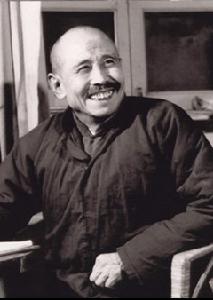 Chinese revolutionary writer, born in Wubu County, Yulin, northern Shaanxi Province, originally
named Liu Yunhua. Liu is the author of numerous writings, including novels, short stories and
articles, most of which are still only available in Chinese. He joined the Chinese Communist
Party in 1936, at the age of twenty. Two of his novels have been translated into English.
Wall of Bronze, a fairly short book, enjoyed great popularity and was reprinted some
thirteen times in China from 1951 to 1976. The Builders, a much longer work, likewise
presents a fascinating, inspiring and deeply probing examination of daily life in a northern
Shaanxi village. (Both novels give the author’s name as “Ching.”)
Chinese revolutionary writer, born in Wubu County, Yulin, northern Shaanxi Province, originally
named Liu Yunhua. Liu is the author of numerous writings, including novels, short stories and
articles, most of which are still only available in Chinese. He joined the Chinese Communist
Party in 1936, at the age of twenty. Two of his novels have been translated into English.
Wall of Bronze, a fairly short book, enjoyed great popularity and was reprinted some
thirteen times in China from 1951 to 1976. The Builders, a much longer work, likewise
presents a fascinating, inspiring and deeply probing examination of daily life in a northern
Shaanxi village. (Both novels give the author’s name as “Ching.”)
“After the land was distributed among the tillers in the Land Reform
of the early fifties, two kinds of ‘builders’ appeared in China’s countryside. One wanted
to go it alone, to build up his family fortunes in the old way, looking out only for his
personal interests. The other wanted to build a society that would benefit all the people,
to form together, helping one another, advancing in stages from mutual-aid teams to
co-operatives, and on to more advanced forms. This novel describes the struggle between
these two trends.
“Liu Ching probes deeply into the
characters who populate his fascinating book: Liang Sheng-pao, the determined young
peasant who fights to make mutual aid a success; his father, old Liang the Third, who
wants only to build the fortunes of his own family; the pretty Kai-hsia, Sheng-pao’s
sweetheart, who is confused about her role in the new society; prosperous peasants who
connive to wreck the socialistic advance; poor peasants who rally round the standard that
is leading them forward ....” (from from the back cover of The Builders)
Both of these works leave no room for doubt that Liu was himself a “builder” of the socialist
road. Yet his life appears to have become deeply troubled during the Cultural Revolution. A
Chinese language wiki-style website provides some information (see
http://www.hudong.com/wiki/%E6%9F%B3%E9%9D%92
[English translation needed]). Liu’s wife was killed, and he was put in prison from 1967
to 1969. In 1972, Zhou Enlai personally intervened to order that Liu be cared for; by this time,
however, he was already in poor health, and his powerful writing abilities had been disrupted
by emotional and physical strain. Liu died on June 13, 1978. Close to the people, an extremely
formidable observer and critic of bourgeois individualism and capitalistic tendencies, as well
as a champion of collectivism, hard work, self-reliance, initiative, daring, you name it —
virtually all of the social values of the Mao era — it stands to reason that he and his work
would have been thorns in the side of Mao’s opponents. Much remains to be learned from and about
Liu Qing. —JDL/XYJ
See also “A Writer’s Profile: Taking Roots Among
the People,” Peking Review, #38, Sept. 22, 1978, 15-17. Online at:
http://www.massline.org/PekingReview/PR1978/PR1978-38.pdf
“LIVING FROM PAYCHECK TO PAYCHECK”
A pithy phrase that describes the economic situation of huge numbers of workers and families
in America and elsewhere in the world. Hundreds of millions of people have so little savings
and so little margin of error, that if they lose their jobs they become unable to pay their
mortgages or rent, or their car payments, or their credit card bills. Thus they quickly
become vulnerable to losing their homes or apartments, and cars and other possessions. And
in many cases they are forced to move in with their parents or friends, or of even being
forced to live out on the streets.
Bourgeois moralists say that this is the
fault of these people themselves, for “not saving for a rainy day”, for getting themselves
too deep into debt, and so forth. While it is true that people have not been saving money,
who is it that has been telling people that the good life is theirs for the taking and that
they should go out and spend all their money? The very same bourgeoisie. And while it is
true that people have gone way deeper into debt than they certainly should have, who has
told them that this is OK, and bent over backwards in order to make it easy for people to
do this? Again, the same bourgeoisie. To keep their system going the bourgeoisie absolutely
needs working-class people to spend their money and to go ever deeper into debt. In
effect, their economic system requires these things in order to function at all. But,
of course, this eventually leads to economic disaster and to real misery for the ordinary
people.
“Even before the crisis hit, 70% of Americans were living from
paycheck to paycheck.” —John Hope Bryant, Bloomberg Businessweek, April 25,
2010, p. 68. This article claims, however, that this problem is mostly due to people’s
“financial illiteracy”, which is just another way of blaming them for the inherent
problem with the capitalist system—that workers are not (and cannot be) paid enough to
buy back all that they produce for the capitalists. —S.H.]
“50 percent of American households are so ‘financially fragile’ that
they say they certainly could not or probably could not come up with $2,000 to pay an
unexpected expense, according to the National Bureau of Economic Research.” —Item from
the Wall Street Journal, reprinted in The Week, June 24, 2011, p. 20.
LOCKE, John (1632-1704)
English empiricist philosopher. He was a proponent of the idealist notion of
“natural rights” in ethics and politics, and was a major
influence on those who founded the United States.
Locke also wrote on political economy, and
as Marx said, “championed the new bourgeoisie in every way, taking the side of the
industrialists against the working class and against the paupers, the merchants against the
old-fashioned usurers, the financial aristocracy against the governments that were in debt,
and he even demonstrated in one of his books that the bourgeois way of thinking was the
normal one for human beings.” [Marx, quoted in an appendix to TSV, 3:592.]
See also:
Philosophical doggerel about
Locke.
LOCKHEED MARTIN CORPORATION
A giant American corporation, and the nation’s largest defense contractor. This is one of
the best illustrations of what is known as the Pentagon
System, wherein the U.S. government promotes the welfare of supposedly private
corporations. Lockheed Martin is at the centre of the grotesquely bloated miltary trough.
The F-22, a military plane manufactured by
the company and that has been in development since the 1980s, has now become so horribly
overpriced that not even the world’s premier imperialist power can afford to maintain a
fleet of very many of them, and the Obama administration has terminated production, citing
the ridiculous cost involved. This was something that the company tried hard to prevent, by
spreading the manufacturing of the plane around the country and in many different
Congressional districts, and tying employment in these areas with the plane’s procurement
by the Air Force, thereby deliberately making itself “too big to fail” (in the lingo of the
so-called financial crisis). Some military experts even complain that the aircraft will
diminish US power because it is too complex and prone to unforeseen problems, which requires
more maintenance time, fewer flight hours for pilots, etc, and will not even be deployed in
sufficient numbers to provide very much of a strategic advantage to US imperialism.
Likewise, Lockheed Martin’s other fighter
jet, the F-35, has been harshly criticized as being too compromised due, ironically, to its
promise of being a cost cutting aircraft. (The Marine version is capable of vertical/short
take-off and landing, but this imposes design constraints on the Air Force and Navy versions,
which require ad-hoc modifications to make them competent in their assigned roles. To fix
the inevitable problems emanating from a fundamentally unsound design, its costs have also
ballooned wildly). This entire fiasco shows quite clearly what Marx said of the bourgeoisie
being a “hostile band of brothers”: the capitalist class has overall interests that bring it
together, but each capitalist tries to gain a short-term advantage over its rivals, even if
this might jeopardize the system as a whole (in this case, the vitality of American military
power). —L.C.
LOGIC—Formal
[To be added.... ]
“It has been said that the relationship of formal logic to dialectics
is like the relationship between elementary mathematics and higher mathematics. This
is a formulation which should be studied further. Formal logic is concerned with the
form of thought, and is concerned to ensure that there is no contradiction between
successive stages in an argument. It is a specialized science. Any kind of writing must
make use of formal logic.
“Formal logic does not concern
itself with major premises: it is incapable of so doing. The Kuomintang call us
‘bandits’. ‘Communists are bandits’, ‘Chang San is a communist’, therefore ‘Chang San
is a bandit’. We say ‘The Kuomintang are bandits’, ‘Chiang Kai-shek is Kuomintang’,
therefore we say ‘Chiang Kai-shek is a bandit’. Both of these syllogisms are in
accordance with formal logic.
“One cannot acquire much fresh
knowledge through formal logic. Naturally one can draw inferences, but the conclusion
is still enshrined in the major premise. At present some people confuse formal logic
and dialectics. This is incorrect.” —Mao, “Speech at Hangchow” (Dec. 21, 1965), in
Stuart Schram, ed., Chairman Mao Talks to the People (1974), pp. 240-241.
“[T]he many books which have been and are still being written on
logic provide abundant proof that here, too, final and ultimate truths are much
more sparsely sown than some people believe.” —Engels, Anti-Dühring (1878),
MECW 25:84.
LONG-TERM CAPITAL MANAGEMENT
A rich and powerful super-speculative U.S. hedge fund that collapsed
in 1998 and had to be bailed out by a consortium of giant
banks under the supervision by, and pressure from, the U.S. Federal
Reserve. It is said that if it had not been bailed out, there would likely have been a
chain-reaction failure of many big banks and possibly the entire U.S. financial system.
Long-Term Capital Management was founded in 1993 and was
immediately hailed as the most impressive, and most “brilliantly managed”, hedge fund in history.
It was led by the rich Wall Street figure, John Meriwether, and included among its other leading
partners two winners of the (phony) “Nobel Prize in Economics”, Myron Scholes and Robert C. Merton.
These and other bourgeois financial and mathematical geniuses had supposedly discovered some
full-proof methods of sophisticated arbitrage that would allow LTCM
to extract billions of dollars of profits from the rest of the financial system. It worked for a
few years, and had annual profits of more than 40%. But then, when the
Asian (and Russian) Financial Crisis of 1997-98 hit,
the huge bets made by LTCM on the value of speculative bonds turned out to be wrong guesses. In
less than four months in 1998 LTCM lost $4.6 billion. Most of this money was owed to giant U.S.
banks. So it took a massive bailout to prevent a general collapse. LTCM was finally closed down
for good in early 2000.
LOTTERIES
“Lotteries, now run by most of our 50 states, are disguised forms of
taxation that fall most heavily on those least able to pay. In today’s economic crisis,
state leaders face rising resistance to taxation from everyone. Therefore, many of them
plan to expand lotteries even more, hoping that no one realizes they represent a kind
of masked tax. In the elegant words of conservative South Carolina State Senator Robert
Ford, reported by the Associated Press, ‘Gambling ain’t no blight on society.’ To fight
them, we need first to expose state lotteries as disguised and very unfair taxation.
“... Duke University researchers
in 1999 found that the more education one has the less one spends on lottery
tickets: dropouts averaged $700 annually compared to college graduate’s $178; and that
those from households with annual incomes below $25,000 spent an average of nearly $600
per year on lottery tickets, while those from households earning over $100,000 averaged
$289; blacks spent an average of $998, while whites spent $210.
“Put simply, lotteries take the
most from those who can least afford them. Thus, still another study of state lotteries
concluded: ‘We find that the implicit tax is regressive in virtually all cases.’ Instead
of taxing those most able to pay, state leaders use lotteries to disguise a regressive
tax that targets the middle and even more the poor. Just as the richest were getting
much richer from 2001 to 2006, the middle and poor were getting more heavily taxed by
means of lotteries....
“Lotteries are also powerful
ideological and political weapons. They reinforce notions that individual acts—buying
lottery tickets—are appropriate responses to society’s economic problems. Lotteries
help to distract people from collective action to solve the economic crisis by changing
society. Lotteries’ massive advertising shows an audacity of hype: shifting people from
hope for the social fruits of collective action to hope for the personal fruits of
individual gambling.” —Richard D. Wolff, Capitalism Hits the Fan (2010), pp.
165-167.
LU Xun [Old style: LU Hsun] (1881-1936)
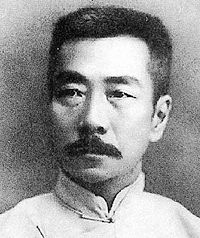 A great Chinese writer, probably the greatest of the Twentieth Century, and also a firm and
very influential revolutionary. He is widely viewed as the most prominent individual in modern
Chinese literature.
A great Chinese writer, probably the greatest of the Twentieth Century, and also a firm and
very influential revolutionary. He is widely viewed as the most prominent individual in modern
Chinese literature.
Lu Xun was the pen name of Zhou Shuren [or
Chou Shu-jen in the older Wade-Giles transliteration]. He wrote in baihua (the
vernacular) as well as in classical Chinese, and seems to have been the very first serious
writer to do so. Lu Xun wrote short stories, essays and poetry and was an editor, translator
and critic. He also led the important Chinese League of Left-Wing Writers in Shanghai during
the 1930s.
While not himself a member of the Chinese
Communist Party, Lu Xun strongly sympathized and cooperated with the Party and supported its
revolutionary struggle. Mao Zedong and the CCP always very much appreciated his writing and
political work, and after the liberation of China in 1949 the revolutionary government
published and strongly promoted his works.
Lu Xun’s fictional works are now easily
available in English, as with the 2009 anthology, The Real Story of Ah-Q and Other Tales
of China: The Complete Fiction of Lu Xun, which the scholar Jeffrey Wasserstrom said
“could be considered the most significant Penguin Classic ever published.” However, perhaps
even more interesting for revolutionaries is the Selected Works of Lu Hsun in 4
volumes (Peking: Foreign Languages Press, 1960), and other volumes from China, which
include many of his political essays, articles and letters.
See also: “For Your Reference: Lu
Hsun: Brief Biographical Notes”
,
LUDWIG FEUERBACH AND THE END OF CLASSICAL GERMAN PHILOSOPHY [Book]
An important philosophical work by Engels, first published in 1886. This work is available
online in several places, including:
http://www.marxists.org/archive/marx/works/1886/ludwig-feuerbach/index.htm
“In Ludwig Feuerbach (the full title is Ludwig Feuerbach and
the Outcome of Classical German Philosophy) Engels shows how the advance was made from
Hegelian idealist dialectics to materialist dialectics, and from mechanical to dialectical
materialism.
“Feuerbach
was a German philosopher of the mid-19th Century who turned from Hegelian idealism to
materialism, and whose work had a big influence on Marx and Engels. This book by Engels,
published in 1888, was originally written as a review article on a book on Feuerbach by
C. N. Starke.
“The following are its principal contents.
“1. Engels explains the basic difference
between materialism and idealism. It arises from the question—which is prior, spirit or
nature? Idealism says that spirit is prior to nature. Materialism says that nature is
prior to spirit. Material being is prior to mind and ideas.
“Modern idealism has been specially
concerned with the question whether we can gain reliable knowledge of material things, of
the external world, and concludes that such knowledge is impossible. Engels refutes this
view, and shows that practice demonstrates that our ideas can and do constitute a true
reflection of external material reality.
“2. He shows that the materialism of the
past was mechanical materialism. Its great limitations were
(a) that it conceived of
the motion of matter as exclusively mechanical motion, and could not grasp other forms of
motion of matter, such as chemical or living processes;
(b) that it could give
no account of development and evolution, either in nature or, still less, in history and
human society.
“3. He explains the essence of Hegel’s
philosophy and of the advance from Hegel to dialectical materialism. Hegel considered
every process of change and development as being a mere reflection of the self-development
of the ‘Absolute Idea,’ which ‘does not only exist, where unknown, from eternity, but is
also the actual living soul of the whole existing world.’ Marxism threw over such
‘idealist fancies’ and ‘resolved to comprehend the real world, nature and history, just
as it presents itself to everyone who approaches it free from preconceived idealist
fancies.’
“Engels shows that dialectical materialism
regards the world as a complex of processes, not as a collection of ‘ready-made things.’
Dialectics is ‘the science of the general laws of motion both of the external world and
of human thought.’
“4. He discusses the essential ideas of
historical materialism, as the application of dialectical materialism to the sphere of
human society. He shows that the driving force of history is the class struggle, and that
classes and class struggles are rooted in economic conditions. He goes on to discuss the
economic foundations of the development of the state and of law, and then of political
and social ideology, of religion, philosophy, etc.
“In criticising Feuerbach’s ‘philosophy
of religion and ethics,’ Engels attacks the approach which deals with abstractions such
as ‘humanity,’ instead of with ‘real living men as participants of history.’
“As appendix are added Marx’s eleven
Theses on Feuerbach, notes by Marx in 1845
in which he summarized his own ideas as opposed to mechanical materialism.” —Maurice
Cornforth, ed., Readers’ Guide to the Marxist Classics (1952), pp. 25-26.
LYING
To make a false statement with the intent to deceive, or to purposely mislead someone
into believing a falsehood. Most of the time, and in most circumstances, this is not a
good thing, of course. And we revolutionaries should specifically make it a general
principle not to lie to either our comrades or to the masses. However, there are times
when lying is both necessary and completely moral, as when lying to the enemies of the
people prevents the occurrence of some serious harm. Amazingly enough, there have been some
idealist philosophers (especially Kant) who have not been able to
understand this elementary truth!
See also:
CATEGORICAL IMPERATIVE
“I would not break my word even to save humanity.” —Johann Gottlieb
Fichte, quoted in Raymond Smullyan, The Tao is Silent (1977), p. 126. [Fichte
was a disciple of Kant, and this quote is a great example of how fantastically stupid
Kantians and others who think in terms of absolute moral
maxims can be! —S.H.]
“One ought always to lie when one can do good by it.” —Mark Twain,
“On the Decay of the Art of Lying” (1882). [Expressing a much more sensible point of
view! —S.H.]
LYNCHINGS — Political
“On the night of April 4, 1918, nearly a year to the day that the
United States entered World War I, Robert Paul Prager, a 30-year-old German immigrant,
and by some accounts a radical socialist, was lynched by a mob of ‘patriots’ outside
Collinsville, Ill., a small market center and coal-mining town of 4,000, located 12
miles across the river from St. Louis.
“Prager was a sacrificial lamb, a
casualty of the wartime madness. His lynching was an extreme case, but it was not an
aberration. In the months leading up to America’s entry into the war and during the
year and a half that the nation was an active participant, the federal government
whipped the American public into a superpatriotic froth with a calculated program of
propaganda, and attacks on German aliens and German Americans were all too common.”
—Jay Feldman, “U.S. government has long history of whipping up fears and repression”,
Sacramento Bee, Aug. 21, 2011, p. E3. This article was adapted from Feldman’s
book, Manufacturing Hysteria: A History of Scapegoating, Surveillance, and Secrecy
in Modern America (2011).
LYSENKOISM
This is a term that has come to mean something like letting political wishful
thinking triumph over scientific fact, or even letting politics dominate and determine
what scientific truth “actually is”.
In the Soviet Union under Stalin and
Khrushchev, the agronomist Trofim Lysenko (see above) propagated a quack theory of genetics
based on the supposed inheritance of acquired characteristics. However, even before
the discovery of the central role of DNA in inheritance, the science of biology (and
genetics specifically) had determined that (at least normally) there is no such thing as
the inheritance of acquired characteristics. The giraffe’s neck is long not because its
ancestors stretched theirs during their lifetimes, but because the ancestors with naturally
longer necks survived, while those with shorter necks died before they could reproduce.
(Counterpoint: Recent research seems to show that there really are some exceptional
circumstances where there can be some inheritance of acquired characteristics, as with
certain bacteria, but the fact remains that even if this is so it is only in highly
atypical situations.) There were prominent geneticists in the Soviet Union who knew this
full well, such as Nikolai Vavilov, and who were persecuted and sometimes imprisoned for
their Mendelian views by Lysenko and the Soviet government. (Vavilov himself was arrested
in 1940 and is said to have died of starvation in a Siberian labor camp around 1943.)
Lysenko was welcome to his own opinions about genetics, but the persecution of those who
disagreed with him was the crime, which was made much worse by the support of Stalin (and
later Khrushchev) and the force of the state.
It is not entirely clear, however, how much
direct damage Lysenko and his theories actually did to Soviet agriculture, though certainly
there was some significant damage over the long run due to his disruption of genetic
research. There were many other problems in agriculture, some of them probably much more
important. For example, the brutal “top-down” method of agricultural collectivization
carried out by Stalin in the 1930s led to the death of many peasants, the destruction
of much of the livestock and to serious crop shortages. The continuing failure to use
the mass line to mobilize the peasants to work in their own
collective interests remained a major obstacle to the expansion of agricultural production.
And insufficient industrial support was also given to agriculture over a period of decades.
Unfortunately the Lysenko episode has led
to some widespread invalid conclusions, even among some Marxists, such as that any
“government interference” in science is unjustified, and that scientists and other experts
should be basically unrestricted in their activities. Of course any government will
appropriately promote and fund those scientists and those theories which it has confidence
in. And any government would be within its rights to restrict certain kinds of experiments
or technologies for which there is good reason to believe that there are serious potential
dangers for the people. Moreover, a socialist government in particular, will certainly
find it necessary to criticize bourgeois ideas that scientists, just as any other segment
of society, may still promote.
However, it is true that socialist society
should also allow, especially in the natural sciences, “a hundred flowers to bloom, and a
hundred schools of thought to content” (as Mao poetically put it). In looking at the
experience of socialism in both the Soviet Union and China it seems clear that overall
there was not enough freedom of thought and expression in the sciences, nor was
there sufficient allowance (and even encouragement!) of new and minority ideas and
views. On the other hand it, it was certainly necessary and correct to strongly criticize
views and theories insofar as they had a bourgeois ideological component, and sometimes
this was also insufficient! Of course this will generally be much more central and
important in the social sciences than in the natural sciences.
See also:
INSTRUMENTALISM
Dictionary Home Page and Letter Index
MASSLINE.ORG Home Page
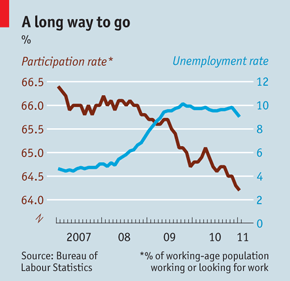 [According to the U.S. government:] The percentage of the total non-insitutionalized working-age
population of a country or region that is in the officially defined labor force (see above);
that is, the percentage which is either working or else is unemployed but actively looking for
work (as admitted by the government).
[According to the U.S. government:] The percentage of the total non-insitutionalized working-age
population of a country or region that is in the officially defined labor force (see above);
that is, the percentage which is either working or else is unemployed but actively looking for
work (as admitted by the government).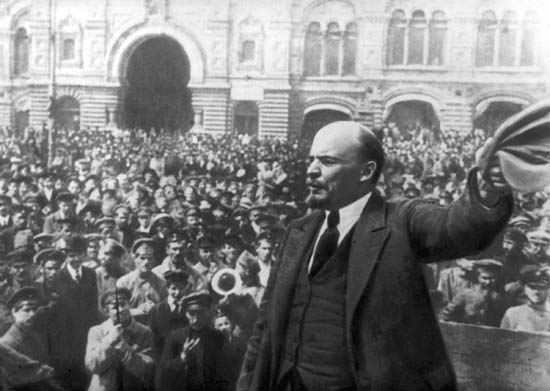 [To be added...]
 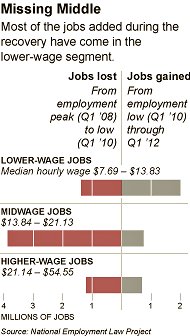 In recent years, in the U.S. and many other countries, the new jobs that have opened up pay much
lower wages than the jobs which have been lost. Consequently, not only are there fewer
jobs, but even those jobs which are created pay substantially lower wages on average. (And this
is without even taking into account the much greater decline in, or even total elimination of,
health, retirement and other benefits especially in new jobs in recent years.) This strong
tendency towards the elimination of the better paying jobs is sometimes called the hollowing
out of the work force. More straight-forwardly, it is yet further evidence that in the U.S.
and overall in the world as a whole, the working class is being rapidly driven down.
In recent years, in the U.S. and many other countries, the new jobs that have opened up pay much
lower wages than the jobs which have been lost. Consequently, not only are there fewer
jobs, but even those jobs which are created pay substantially lower wages on average. (And this
is without even taking into account the much greater decline in, or even total elimination of,
health, retirement and other benefits especially in new jobs in recent years.) This strong
tendency towards the elimination of the better paying jobs is sometimes called the hollowing
out of the work force. More straight-forwardly, it is yet further evidence that in the U.S.
and overall in the world as a whole, the working class is being rapidly driven down.