“TALKS AT THE YENAN FORUM ON LITERATURE AND ART”
A famous work by Mao Zedong first published in May 1942 and included in volume III of
the Selected Works of Mao Tsetung. It is on the Internet in English at several
places including
http://www.marx2mao.com/Mao/YFLA42.html and
http://www.marxists.org/reference/archive/mao/selected-works/volume-3/mswv3_08.htm
.
The Forum on Literature and Art took
place during the month of May 1942, and Mao himself gave two presentations, an Introduction
on May 2nd, and a longer Concluding speech on May 23rd. Mao stressed the importance of art
serving the interests of the masses of people and especially their revolutionary interests.
He talked about these key questions in art and literature:
The problem of class stand, stressing
that art should take the standpoint of the proletariat and masses, and that CCP members
should promote the political line of the Party in their art work;
The problem of attitude, that art
should criticize the enemy and support the people in their struggles;
The problem of audience, that our art
is for the workers and the masses, rather than for the rich and privileged classes;
The problem of work, meaning that
those engaged in art and literature should merge with the masses, get to know their needs
and situation, and learn from the masses how to reach the masses with their art; and
The problem of study, that artists
and writers must study Marxism-Leninism so that their work will be richer in content and
more correct in orientation.
The “Talks...” were especially strong with
regard to the need for artists and writers to share the life of the masses so that they will
be better able to reflect the real situation in society. And this work even includes one of
Mao’s earliest statements of the basic idea of the mass line:
“Revolutionary statesmen, the political specialists who know the science or art of
revolutionary politics, are simply the leaders of millions upon millions of statesmen—the
masses. Their task is to collect the opinions of these mass statesmen, sift and refine them,
and return them to the masses, who then take them and put them into practice.”
For a further discussion of this important
work, and its context, see: “For Your Reference: About ‘Talks at the Yenan Forum on
Literature and Art’”, Peking Review, vol. 15, #20, May 19, 1972, available at:
http://www.massline.org/PekingReview/PR1972/PR1972-20b.htm
TANGIBLE PROPERTY
Assets which can be touched or felt, including homes, stores, factories, machinery, raw
materials purchased, vehicles, livestock, etc., as opposed to intangible property such
as stocks, bonds, savings accounts, cash, accounts receivable, intellectual property, and
so forth.
In capitalist societies tangible property is
taxed, often heavily so, while intangible property is normally not taxed at all. Thus there
are property taxes on homes, but no property taxes on stocks and bonds owned. Why is this, do
you suppose? The rich man owns a lot more tangible property than does a poor man, of course.
But a much higher proportion of the wealth of the rich man is in the form of intangible
property, in stocks, bonds, bank accounts, and so forth. That is why those things are not
taxed! The bourgeoisie runs society in its own class interests, after all! (It is true that
there are taxes on income from both tangible and intangible property, but not on the
intangible property itself. And even with regard to income taxes, the tax code is loaded with
a vast number of loopholes for the rich.)
TAX LOOPHOLES
Loopholes are special exceptions in the tax code which allows those who qualify
(virtually always corporations and special categories of rich people) to escape paying part
of their taxes. Politicians are bribed (usually in the form of “campaign donations”) by the
rich to include the loopholes which will benefit those bribing them. The fact that the tax
code is now so enormously complex and full of tens of thousands of loopholes speaks for
itself as to who is in control of the American government.
See also:
CORPORATE TAXES, INVERSION
“The federal tax code, which was 400 pages long in 1913, has swollen
to about 70,000. Americans now spend 7.6 billion hours a year grappling with an
incomprehensible tangle of deductions, loopholes, and arcane reporting requirements.
That is the equivalent of 3.8 million skilled workers toiling full-time, year-round,
just to handle the paperwork. By this measure, the tax-compliance industry is six times
larger than car-making....
“Every wrinkle in the tax code
represents a favor to some group.... A typical loophole has passionate defenders but
no opponents. Those who benefit from it, benefit a lot. Those who would gain from its
repeal (i.e., taxpayers in general), have never heard of it. So the mess gets ever
messier. Happy April 15th.” —The Economist, April 10, 2010, p. 35.
TERRORISM — By the Revolutionary Proletariat
[Intro to be added... ]
“And the victorious party [in a revolution] must maintain its rule by
means of the terror which its arms inspire in the reactionaries. Would the Paris
Commune have lasted more than a day if it had not used the authority of the armed
people against the bourgeoisie? Cannot we, on the contrary, blame it for having made
too little use of that authority?” —Engels, quote in Lenin, “Proletarian Revolution
and the Renegade Kautsky” (Oct.-Nov. 1918), LCW 28:251. (I have not yet tracked this
down to its original source in Engels’ writings. —S.H.)
“OK yes, I believe that a revolution is impossible without terror,
precisely because the right will resort to terror to stop it. That brings up another
aspect of revolution, which is this: to succeed a revolution must go all the way. No
stopping midstream. The right will always use terror to foil it, so the revolution
must use terror to stop it.” —Jean-Paul Sartre, interviewed by John Gerassi, quoted in
Joseph Walsh, “Sartre: Conversations with a ‘Bourgeois Revolutionary’”, Monthly
Review, June 2010, p. 61.
THE LIFE OF WU HSUN [New style: THE LIFE OF WU XUN]
A reactionary Chinese movie, the criticism of which played an important role in getting the
Great Proletarian Cultural Revolution underway. This motion picture
was begun by the Guomindang’s [Kuomintang’s] Central Film Studio, but remained unfinished when
the GMD was forced out of power in the great Chinese Revolution in 1949. The film was then
completed and promoted by the revisionists Zhou Yang [Old style: Chou Yang] and Hsia Yen within
the CCP after the victory of the Revolution. Zhou Yang, Liu Shaoqi’s leading agent in the field
of culture, called it “one of the best Chinese films” and journalists inside and outside the
Party were ordered to write hundreds of articles praising it.
Wu Xun (or Wu Hsun) (1838-1896), himself, was born
into a very poor family in Shandong. He had no education and worked in semi-slavery for landlords,
and later became a beggar. But he diligently saved and invested his money and through astute
business dealings eventually became a rich man and a landlord himself. While he was known for his
philanthropy, the portion of his riches that he gave away of course came from his own much larger
exploitation of peasants and workers. Thus a film glorifying such a person is hardly something
that a real communist would make or promote. [See:
PHILANTHROPY]
Chiang Kai-shek and the GMD highly praised the
deeds of Wu Xun from 1934 on, as part of their cultural indoctrination efforts called the “New
Life Movement”. Wu’s story was told in comic books, and statues were erected to him in many
primary schools around the country. And even after the Liberation of the country, when this
film about Wu Xun was finished, the newspapers were filled with articles praising the movie and
lauding Wu Xun for his philanthropy and portraying him as a model for the masses.
Mao himself initiated the first major criticism
of this film in his editorial in Renmin Ribao [People’s Daily] entitled “Give
Serious Attention to the Discussion of the Film The Life of Wu Hsun” (May 20, 1951):
“The questions raised by The Life of Wu Hsun are fundamental in
character. Living in the era of the Chinese people’s great struggle against foreign aggressors
and the domestic reactionary feudal rulers towards the end of the Ching Dynasty, people like
Wu Hsun did not lift a finger to disturb the tiniest fragment of the feudal economic base or
its superstructure. On the contrary, they worked fanatically to spread feudal culture and,
moreover, sedulously fawned upon the reactionary feudal rulers in order to acquire the status
they themselves lacked for spreading feudal culture. Ought we to praise such vile conduct?
Can we ever tolerate such vile conduct being praised to the masses, especially when such
praise flaunts the revolutionary flag of ‘serving the people’ and is underlined by exploiting
the failure of the revolutionary peasant struggle? To approve or tolerate such praise means
to approve or tolerate reactionary propaganda vilifying the revolutionary struggle of the
peasants, the history of China, and the Chinese nation, and to regard such propaganda as
justified....
“Is it not a fact that reactionary
bourgeois ideas have found their way into the militant Communist Party? Where on earth is
the Marxism which certain Communists claim to have grasped?” —Quoted in
“The
Class Struggle in China’s Ideological Sphere” [PDF: 872 KB], in Peking Review,
issue #37, Sept. 7, 1969.
But that was way back in 1951. How did it come about that this episode served in part to help
initiate the Cultural Revolution in the mid-1960s? It was because the revisionists did not really
change their ways. Further reactionary works, such as the historical drama
“Hai Rui Dismissed From Office”, continued to
appear, and formed a definite reactionary pattern. When Yao Wenyuan, at the urging of Mao and
Jiang Qing, criticized “Hai Rui Dismissed...” in 1965, this opened
a floodgate of revolutionary criticism against all such reactionary cultural works, going back to
the founding of the People’s Republic. And it led eventually to the criticism of those at the top
(led by Liu Shaoqi) who had promoted and protected this sinister current.
THEORIES OF SURPLUS VALUE [“Volume IV of Capital”]
A major part of the economic manuscripts left by Marx at his death which was intended to
become volume IV of his great work Capital. Although
the fourth volume of Capital that Marx hoped to publish was expected by him to be
primarily historical, the actual manuscripts he left of TSV include many passages of great
importance to the theory of Marxist political economy. TSV is thus an extremely
important, though often neglected, part of Marx’s writings on political economy. It contains
many points not fully elaborated in the first three volumes, as well as a detailed
history and criticism of the crucially important topic of surplus
value as it was originally developed by classical bourgeois economists.
TSV was not published, even in German, until
the first decade of the 20th century. The first of the three volumes of TSV, which
were all edited (poorly and tendentiously!) by Karl Kautsky, appeared in 1904, the second in
1905, and the third not until 1910. Prior to their publication other Marxist writers on political
economy—including Lenin—did not have access to Marx’s complete theory on a number of key
topics, most notably with regard to Marx’s criticism of “Say’s Law”.
More accurate editions of the three volumes of TSV, based on Marx’s original manuscripts, were
published in German in 1956, 1959 and 1962. The versions of these three volumes in English
translation (from Progress Publishers in Moscow) did not appear until 1963, 1968 and 1971,
respectively. The late publication of TSV, the dubious reliability of its first German
edition, and its relative neglect even since its proper publication, have all created serious
problems for Marxist political economy, especially in Britain and the United States.
“First, a manuscript entitled Zur Kritik der politishen Oekonomie,
... written in August 1861 to June 1863. It is the continuation of a work of the same
title, the first part of which appeared in Berlin, in 1859.... The themes treated in Book
II [volume II of Capital] and very many of those which are treated later, in Book
III [volume III of Capital], are not yet arranged separately. They are treated in
passing, to be specific, in the section which makes up the main body of the manuscript,
viz., pages 220-972 (Notebooks VI-XV), entitled ‘Theories of Surplus-Value.’ This section
contains a detailed critical history of the pith and marrow of Political Economy, the
theory of surplus-value and develops parallel with it, in polemics against predecessors,
most of the points later investigated separately and in their logical connection in the
manuscript for Books II and III. After eliminating the numerous passages covered by Books
II and III I intend to publish the critical part of this manuscript as Capital,
Book IV. This manuscript, valuable though it is, could be used only very little in the
present edition of Book II.” —Engels, Preface to Marx’s Capital, Vol. II,
(International: 1967), p. 2. [Engels died before he was able to follow through with this
plan to publish TSV as volume IV of Capital.]
[Speaking of Kautsky’s edition of TSV in 1904-1910:] “In this edition
the basic principles of the scientific publication of a text were violated and there
were distortions of a number of the tenets of Marxism.” —Note 36, Lenin: Selected
Works, vol. 3 (Moscow: Progress, 1967).
“THEORY OF PRODUCTIVE FORCES”
Various related revisionist theories whose central dogma is that the establishment of socialism
and then communism depends entirely, or at least to a very large degree, upon the prior
expansion of the productive forces to a very advanced
level, under some form of capitalism. (Whether that is to be Western-style monopoly capitalism;
or state capitalism of a form like that in the Soviet Union
during the revisionist period; or some type of so-called “market
socialism”; or whatever.)
The productive forces are the material
means of production (factories, machinery, raw
materials, etc.) together with human labor of an appropriate quality and capability. Thus
certainly the productive forces must have reached some reasonable level of development before
socialism (let alone communism) can first be established. No sensible person imagines that
genuine socialism (in the modern Marxist sense) could have been established in ancient times,
for example, or before the capitalist era.
But the “theory of productive forces” goes well
beyond that recognition; it insists that even in the present world, after centuries of capitalist
production, socialism (and communism) are still not possible unless the productive forces are
further expanded to a major degree. The essence of this reactionary theory, therefore, is
that, “at least in our country”, 1) the productive forces have not yet been developed to the
point where socialism can be successfully established; and 2) that the productive forces cannot
be further and rapidly developed under any sort of socialism which can be established at the
present time. In other words, those who uphold this revisionist theory view the continuation of
capitalism as still essential “at the present time”.
This theory has been especially prominent among
revisionists in poorly developed countries (the “Third World”). But
it has even been championed by some people in the more advanced capitalist countries. The theory,
after all, first developed at the end of the 19th century in one of the leading capitalist
countries, Germany, where it was championed by Eduard
Bernstein and Karl Kautsky among others.
“The renegade, hidden traitor and scab Liu Shao-chi consistently advocated
the reactionary ‘theory of productive forces.’ According to this fallacy, socialist
revolution is impossible and the socialist road cannot be taken in any country where
capitalism is not highly developed and the productive forces have not reached a high level.
Before the seizure of political power by the proletariat, he advocated this theory to
forbid the proletariat from rising to make revolution and seizing political power. After
the seizure of power, he raised it to oppose socialist transformation in a futile effort
to lead China on the road of capitalism. When the socialist transformation of the ownership
of the means of production was completed in the main, he continued to advocate this theory
in a clandestine attempt to restore capitalism.” —Hung Hsueh-ping, “The Essence of ‘Theory
of Productive Forces’ is to Oppose Proletarian Revolution”,
Peking Review, #38, Sept. 19, 1969.
“Bernstein first put forward this fallacy in 1899 in his book The
Premises of Socialism and the Tasks of the Social-Democracy. He maintained that with
the highly developed social productive forces, capitalism would grow into socialism
peacefully. Therefore, he said, revolution by armed force would become a meaningless
phrase. He arbitrarily declared that the victory of socialism could only depend on the
general social progress, especially on the increase of social wealth or the growth of
social productive forces accompanied by the maturity of the working class in terms of
knowledge and morality. He concluded: As for the capitalist system, it should not be
destroyed but should be helped to further develop.” —Kao Hung, “From Bernstein to Liu
Shao-chi”, Peking Review, #38, Sept.
19, 1969.
THIERS, Louis Adolphe (1797-1877)
“A reactionary bourgeois politician, traitor to his country and butcher
who suppressed the Paris Commune uprising in French
history. Minister of Internal Affairs in 1834, he stamped out the people’s uprising in
Lyon. Immediately after becoming head of the bourgeois government in February 1871, he
sent reactionary troops to disarm the Paris people. Following the armed uprising by the
proletariat of Paris on March 18, he fled to Versailles. Colluding with
Bismarck and mustering reactionary forces, he strangled
the Paris Commune revolution. Marx referred to Thiers as ‘a master in small state roguery,
a virtuoso in perjury and treason, a craftsman in all the petty strategems, cunning
devices, and base perfidies of parliamentary party-warfare; never scrupling, when out of
office, to fan a revolution, and to stifle it in blood when at the helm of the state.’”
—Explanatory note accompanying an article on the Paris Commune, Peking Review, vol.
14, #13, March 26, 1971.
THINK TANK
 A nominally non-government institute which engages in political advocacy with respect to
government policies in areas such as social issues, economics, international imperialist
strategy, military issues, the best political strategy for the ruling class within the
country (or often the best strategy for just for one section of that ruling class),
and so forth, and which prepares “research studies” to support the views and policies it
favors. Think tanks are therefore, and with only the rarest exceptions, operations run by
and for the capitalist ruling class, or one of its contending sections. The government
itself supports these think tanks in many ways, including through providing them with
lucrative contracts for “research”, and by exempting them from paying taxes by calling them
non-profit organizations (even when they openly work to promote greater profits for
capitalist corporations). Sometimes the government will directly set up a think tank, or
provide it with ongoing general funding under one pretext or another.
A nominally non-government institute which engages in political advocacy with respect to
government policies in areas such as social issues, economics, international imperialist
strategy, military issues, the best political strategy for the ruling class within the
country (or often the best strategy for just for one section of that ruling class),
and so forth, and which prepares “research studies” to support the views and policies it
favors. Think tanks are therefore, and with only the rarest exceptions, operations run by
and for the capitalist ruling class, or one of its contending sections. The government
itself supports these think tanks in many ways, including through providing them with
lucrative contracts for “research”, and by exempting them from paying taxes by calling them
non-profit organizations (even when they openly work to promote greater profits for
capitalist corporations). Sometimes the government will directly set up a think tank, or
provide it with ongoing general funding under one pretext or another.
One of the earliest think tanks was the
Institute for Defence and Security Studies founded in London in 1831. But think tanks have
truly mushroomed as key parts of the system of bourgeois rule mostly since World War II,
and especially in the United States. The term “think tank” itself originated in American
slang in World War II and came into general consciousness in the U.S. in the 1950s. The
archetypical, and one of the most prominent think tanks, is the RAND Corporation, which was
founded under the sponsorship of the U.S. Air Force as an offshoot of the Douglas Aircraft
Corporation shortly after World War II. During the Cold War, and since then, the number of
think tanks in the U.S. and around the world has skyrocketed; by 2006 there were at least
4,500 them in the world, mostly focused on international affairs, foreign policy, and
“security” matters (military issues and how to keep the restless population under control).
Some of the many prominent U.S. bourgeois
think tanks include:
* American Enterprise Institute —
A right-wing counterpart to the slightly “left”-wing Brookings Institution. One of the loudest
proponents of neoliberalism.
* Brookings Institution (one of
the oldest U.S. think tanks, founded in 1916) — Quintessentially an “establishment” institution
which describes itself as non-partisan, but which sometimes seems to lean toward the
Democratic Party.
* Cato Institute — Promotes
dogmatic libertarian “free market” doctrines and policies.
* Center for American Progress —
Promotes more politically liberal bourgeois policies than most think tanks.
* Heritage Foundation — Promotes
right-wing “conservative” doctrines and policies.
* RAND Corporation — In effect
this has been a major research arm of the U.S. government, focused especially on military and
“security” matters, but extending far beyond that scope.
“THIRD WORLD”
A term introduced by the French economist Alfred Sauvy in 1952 to refer collectively to
all the non-industrial nations of the world. Due to the Cold
War, many people soon reinterpreted the “Third World” to mean those countries which
were aligned neither with the Western imperialist bloc (headed by the United States) nor
with the “Socialist bloc” (headed by the Soviet Union). Under this interpretation the
“Third World” became nearly synonymous with “non-aligned countries”. It was later during
this Cold War period that the Communist Party of China put forward the largely incorrect
“Three Worlds” Theory, in which the term the “Third
World” was contrasted to the “First World” (the two superpowers) and the “Second World”
(the other imperialist or advanced capitalist countries). This moved the term back
closer to its original meaning, but not quite completely so—since it was then also a
political term as well as an economic designation. Since the explicit and enthusiastic
promulgation of the “Three Worlds” Theory by the Chinese revisionists beginning soon
after Mao’s death, most revolutionary Marxists have rejected that theory (at least in its
usual notorious form). But because of its association with that erroneous theory, the term
“Third World” was also shunned by many revolutionary Marxists for a long period.
However, since the collapse of the
revisionist Soviet Union and its bloc, and the end of the Cold War, the term “Third World”
has shifted back to something even closer to its original meaning: Those countries
which are largely undeveloped economically. There have been attempts (by bourgeois
writers) to replace the term “Third World” with the euphemistic term “developing countries”,
but most such countries are not really “developing” economically very much at all, since
they remain so greatly under the control of and exploitation by the imperialist nations.
The term “undeveloped countries” would be better, but it also has some possible implications
that these countries are culturally undeveloped which is totally false and
slanderous. Thus many people are once again using the term “the Third World” to mean these
economically undeveloped countries. Unfortunately, other people still use the term in
somewhat different ways, which means that it remains somewhat ambiguous.
The term “semicolonial countries” is better,
but somewhat outdated; more appropriate today would be “neocolonial countries”. But in many
countries these terms are not widely understood by the masses.
In short, there are difficulties in
picking the most appropriate short terms or phrases to replace the “Third World” in the
sense of meaning those countries which are largely undeveloped economically, or in the
closely related sense of those countries which are exploited and oppressed by imperialism.
Perhaps the most appropriate phrases today, depending on the precise sense we mean, are:
1) “the economically undeveloped countries”; 2) “the exploited and oppressed countries”;
3) “the neocolonies” or “the neocolonial countries”. When we do use the term “Third
World” we should be sure that our audience understands it in the same way we do.
We should also be aware that there can
be intermediate or transitional forms, between imperialist countries and countries
exploited and oppressed by imperialism. China today, for example, is both still exploited
by foreign imperialism and at the same time a rising new imperialist power which exploits
other countries itself. It was once a “Third World” country; but though large sections of
the population are still very poor, with the massive expansion of industry in China and the
shift of so much world production to that country, that characterization no long seems at
all appropriate.
See also:
DEPENDENT COUNTRIES
“THREE-IN-ONE” REVOLUTIONARY COMMITTEES
A provisional form of revolutionary rule developed in China in 1968 during the
Great Proletarian Cultural Revolution, when political power was
re-captured from the revisionists and capitalist-roaders within the Communist Party of China
and the Chinese government. The three-in-one revolutionary committees consisted of a combination
of revolutionary cadres, representatives of the People’s Liberation Army and representatives of
the revolutionary masses.
“In every place or unit where power must be seized, it is necessary
to carry out the policy of the revolutionary ‘three-in-one’ combination in establishing
a provisional organ of power which is revolutionary and representative and enjoys
proletarian authority. This organ of power should preferably be called the Revolutionary
Committee.” —Mao, quoted in Peking Review, #43, Oct. 25, 1968, p. 21.
“There are three elements in the basic experience of the revolutionary
committee: It embraces representatives of the revolutionary cadres, representatives of
the armed forces and representatives of the revolutionary masses, constituting a
revolutionary ‘three-in-one’ combination. The revolutionary committee should exercise
unified leadership, eliminate duplication in the administrative structure, follow the
the policy of ‘better troops and simpler administration’ and organize a revolutionized
leading group which links itself with the masses.” —Mao, quoted in Peking Review,
#43, Oct. 25, 1968, p. 21.
“THREE WORLDS” THEORY
The name given to several related versions of a geo-political theory, some of which are
mostly correct (or innocuous), but the worst versions of which are very wrong and dangerous
indeed! This theory starts from the straightforward recognition that the countries of the
world in the 1970s could be analyzed as consisting of three distinct groups: The First
World, consisting of the two superpowers, the United States and the revisionist Soviet
Union, both of which were imperialist countries seeking to totally dominate and exploit the
world in their own interests; the Second World, consisting of the other junior
imperialist or advanced capitalist countries; and the Third World, consisting of all
the other countries, including most of the countries of Asia, Africa and Latin America, which
were dominated and exploited by imperialism, especially by the two superpowers. So far there
is nothing very contentious in this theory, and pretty much every sophisticated person (except
for the supporters of one or the other superpower) understood the world situation in roughly
this way at the time. Mao, for example, is quoted as saying to a leader of some unidentified
Third World country in February 1974:
“In my view, the United States and the Soviet Union form the first
world. Japan, Europe and Canada, the middle section, belong to the second world. We
are the third world.... The third world has a huge population. With the exception of
Japan, Asia belongs to the third world. The whole of Africa belongs to the third world,
and Latin America too.” —Mao, quoted in Peking Review, #45, Nov. 4, 1977, p. 11.
The important question, however, is exactly what use was (or is) to be made of this 3-way
analysis? Mao sought to make use of it to help create a united front of Third World countries
against the two superpower imperialist countries. That was no doubt reasonable and correct.
But some subsidiary views and uses of this theory, that Mao certainly didn’t agree with or
approve of, are quite another matter!
The countries of the “second world” were
viewed as having a dual nature. On the one hand they shared in the exploitation of the Third
World, but on the other hand they were also pushed around (to various degrees) by the two
superpowers. This led to the notion that at least some of these “second world” countries might
be won over to joining a united front against the two superpowers, at least on some matters.
This was unrealistic with regard to most issues, however. The first goal of all
imperialist countries is to defend the imperialist system.
This notion of being able to enlist the
support of some “second world” junior imperialist countries in a united front against
imperialism had as much persuasiveness as it did at that time only because there were then
two superpowers in the “first world”, and the real goal was more and more to unite
all other countries, imperialist or not, against just one of those superpowers, the revisionist
social-imperialist Soviet Union. In effect the “three
worlds theory” actually became a “four worlds theory”: one enemy superpower, one lesser-evil
superpower, other junior imperialist countries, and all the other countries of the world—the
“third world”. Given that the Soviet Union was on the verge of a military attack on China at
the time it was understandable that China should look at things this way. But this was still
not the basis for a revolutionary strategy of the people of the world against imperialism in
general.
Much worse, however, was the tendency to
support reactionary Third World regimes (as part of building a “united front” against the
superpowers) instead of supporting the revolutionary masses in those countries in
their efforts to overthrow those regimes! In theory, both of these rather contradictory
things could be done simultaneously, but somehow even in revolutionary China the former seemed
often to take precedence over the later. The tendency was to refrain from (or soft-pedal)
criticizing the crimes of these reactionary regimes against their own people, and to be
excessively cozy with Third World tyrants and imperialist lackies such as the Shah of Iran and
the dictator Ferdinand Marcos of the Philippines. While building a united front of countries
against imperialism is a good idea, that idea is perverted if it only amounts to being friendly
towards lacky regimes completely controlled by the imperialists.
This in turn led to much confusion among
revolutionary forces in these Third World countries. It is true that “state-to-state” relations
are one thing and “party-to-party” relations are another thing. But this
“Bandung spirit” of building a united front of Third
World countries against imperialism seems to have helped promote seriously erroneous shifts in
political line by some nominally Communist or revolutionary parties. One of the most notorious
cases occurred in Indonesia where the KPI backed the bourgeois nationalist regime of Sukarno
(rather than arming the masses as they should have been doing at that time), and were then
destroyed in 1965 in a reactionary military coup and nationwide massacre directed by the CIA.
The “Three Worlds Theory”, in one form or
another, was part of the thinking that lay behind the de facto foreign policy of the Chinese
government for decades. While Zhou Enlai was alive, he was in charge of it. Aspects of it were
criticized at times by Mao, and were also criticized during the Great
Proletarian Cultural Revolution, and by the so-called “Gang
of Four”. But after Mao’s death in September 1976, there was a huge burst of enthusiasm for
the theory and the more anti-revolutionary policies it led to. Of course to cover themselves,
the Chinese revisionists attributed this theory entirely to Mao personally, including its worst
aspects and policies that Mao would have certainly opposed. The most thorough presentation of
the theory by the CCP was in the long article “Chairman Mao’s Theory of the Differentiation of
the Three Worlds Is a Major Contribution to Marxism-Leninism”, in Peking Review, #45,
Nov. 4, 1977, online at:
http://www.massline.org/PekingReview/PR1977/PR1977-45-ThreeWorldsTheory.pdf [PDF: 34 pages,
4,411 KB]. (Readers should be forewarned that some aspects of this theory as presented
there sound pretty good in abstract terms; many of the disastrous problems associated with it
are due to how it is actually invariably applied in practice.)
While the revisionist Soviet Union is now
long gone, something like the Three Worlds Theory still exists in various forms. One expression
of it is the common (but erroneous) view among many revolutionaries around the world that U.S.
imperialism, as the only remaining superpower, is the only foreign enemy to focus on in
anti-imperialist or revolutionary work. A corollary view is that other imperialist countries,
such as Britain and France, are of little concern in anti-imperialist work, and might even be
united with and supported at times in opposition to the United States. And China is often not
yet recognized as an imperialist country at all, even though in reality it is already
the second most important and powerful imperialist country in the world, and is rapidly rising
while U.S. imperialism is clearly declining and becoming more and more vulnerable, especially
economically.
Other views which have commonalities with the
“Three Worlds” Theory are World Systems Theory, and
the “Triad” conception (of Samir Amin) which also fail to recognize
China as a rapidly strengthening imperialist power.
See also:
“THIRD WORLD”
“Even during the 1970-1973 period, the CCP’s view of the international
situation had serious problems. Its position was that the two superpowers (the U.S. and
the Soviet Union — ‘the first world’) were the principal enemies on a world scale; the
Western imperialists and Japan (the ‘second world’) were part of an international united
front against the superpowers; and the “peoples and countries of the third world’ were
the most reliable revolutionary force in opposing the superpowers.
“As a perspective for the world’s
revolutionary movement, this analysis was flawed. It detached the U.S. and Soviet
Union from the imperialist system as a whole; it downplayed the reactionary nature of the
other imperialist countries in Western Europe, Japan, Canada and Oceania; and it advanced
a classless conception of nationalism by lumping together the oppressed peoples of Asia,
Africa and Latin America with their rulers, who had limited contradictions, if at all,
with one or another imperialist power.
“Some of the problems with the
‘three worlds perspective’ were reflected in a widely quoted statement attributed to Mao,
‘Countries want independence, nations want liberation, and the people want revolution.’
Mao’s eclectic statement, which tended to place struggles of Third World countries for
national independence on a par with revolutionary movements, shared some aspects of the
Bandung line associated with Zhou in the 1950s and 1960s.
“... While Mao advocated tactical
unity in some areas with the U.S. in order to deal with the Soviet threat to China, after
1973 Deng and Zhou sought to implement a strategic alliance and political
understanding with U.S. imperialism. This took the form of the fully developed ‘Three Worlds
Theory.”....
“As a result of the dominant position
achieved by the revisionist forces after 1973, China began to withdrew support for
revolutionary movements in the Third World. Parades of U.S. puppets were honored in Beijing
for their contributions to ‘the struggle against Soviet hegemonism.’ In 1975, the Chinese
government supported the U.S. and South African-backed UNITA in the Angolan civil war —
in the name of defeating the Soviet Union’s attempts to gain a strategic foothold in Africa
through its support for the MPLA.
“In the Middle East, China’s prior
support for revolutionary movements was reversed. Chinese aid to revolutionary forces in
the Gulf States was dropped in favor of diplomatic ties with Oman. Another sign of this
reversal of Chinese foreign policy was a speech by Foreign Minister Qiao Guanhua in 1975 in
which he said that China was reconciled to the existence of Israel as a ‘fait accompli.’....
“Thus, the counter-revolutionary
developments in Chinese foreign policy in the mid-1970s were a direct outgrowth of the Three
Worlds Theory and the revisionists in the CCP who spawned it. This threw many Maoist parties
and organizations around the world into a tailspin, from which most never recovered.”
—Excerpts from pages 30-34 of the excellent article, “Chinese Foreign Policy during the
Maoist Era and its Lessons for Today”, by the MLM Revolutionary Study Group in the U.S.
(January 2007), online at
http://www.mlmrsg.com/attachments/051_ChForPol-Final-4-09.pdf
“An important weakness of the ‘three worlds perspective’ was that it did
not make a correct analysis of the imperialist system as a whole. This theoretical framework
sowed confusion about the nature of the ‘Second World’—the other Western imperialist
powers–and exaggerated their conflicts with the U.S. This perspective was reshaped by Deng
and other revisionists into the Three Worlds Theory, which asserted that the West European
and Asian imperialist powers played a progressive role in the world by defending their
national independence against the Soviet Union, the “most dangerous” imperialist superpower.
This essentially called on revolutionary and Maoist forces, especially in Western Europe,
to support, or stop opposing, their own bourgeoisies and various oppressor regimes which
opposed the Soviet Union.” —Ibid., p. 38.
“TOO BIG TO FAIL”
Capitalism is an unstable system in many respects, and specifically competitive capitalism
is unstable in that there are powerful forces which tend to transform it in the direction
of monopoly, as Marx pointed out long ago. When severe economic crises develop, however,
this creates additional major problems. It is no longer a question of a number of fairly
inconsequential small companies going bankrupt, but now a question of some extremely large
banks and other corporations failing. Some of these large corporations are now so important
for the economy that their failure would lead to such drastic repercussions that the
capitalist class in general has been forced to declare them “too big to fail”. In other
words, it is forced to use its control of the state to bail
out these giant banks and other corporations which it deems “too big to fail”.
In the Panic of 2008-9, which is part of
the overall still-developing profound world capitalist economic crisis, the U.S. government
has already spent literally trillions of dollars in both temporary and permanent bailouts
of banks and corporations which it considered “too big to fail”. This has become a major
feature of the crisis and will remain so from now on.
“By dividing the whole circulation [of bank notes] into a greater
number of parts, the failure of any one [banking] company, an accident which, in the
course of things, must sometimes happen, becomes of less consequence to the public.”
—Adam Smith, The Wealth of Nations, Book II, Ch. II, (Modern Library, 1937), p.
313. [What Adam Smith did not understand, however, is that the growth of monopoly is
in the interests of the most important and influential capitalists, who therefore
also normally control the bourgeois state. Thus even if there are nominal laws
against monopoly, there will eventually come to be giant monopolistic (or at least
oligopolistic) corporations whose failure would indeed be tremendously disruptive to
the entire capitalist economy. Therefore it is inevitable that banks and corporations
“too big to fail” arise, and that the bourgeois state will then bail them out and prop
them up when they get into financial difficulty. It is today a petty-bourgeois pipe
dream to think that corporations can be kept small and inconsequential enough so that
their individual failures really do not matter.]
TRADE UNIONISM (As Merely Reformist Struggle)
[To be added... ]
See also:
LABOR UNIONS
“For a number of years the English workers’ movement has been going
round and round bootlessly in a confined circle of strikes for wages and the
reduction of working hours—not, mark you, as an expedient and a means of propaganda
and organization, but as the ultimate aim. Both on principle and statutorily the
trades unions actually exclude any political action and hence participation in any
general activity on the part of the working class as a class. Politically the
workers are divided into Conservatives and Liberal-Radicals, into supporters of a
Disraeli (Beaconsfield) administration and supporters of a Gladstone administration.
So one can speak of a workers’ movement here only to the extent that strikes take
place which, victorious or otherwise, do not advance the movement by one single
step. In my view only harm can come of inflating strikes such as these into struggles
of world-historical importance (as does the Freiheit
here), strikes which were, moreover, as often as not deliberately engineered by the
capitalists in the late years of depression so as to have an excuse for closing down
their factories, strikes in which the working class makes no progress whatsoever. No
attempt should be made to conceal the fact that at this moment a genuine workers’
movement in the continental sense is non-existent here...” —Engels, draft of a letter
to Eduard Bernstein, June 17, 1879, MECW 45:360-1.
“... any subservience to the spontaneity of the mass movement
and any degrading of Social-Democratic [Communist] politics to the level of
trade-unionist politics mean preparing the ground for converting the working-class
movement into an instrument of bourgeois democracy. The spontaneous working-class
movement is by itself able to create (and inevitably does create) only trade-unionism,
and working-class trade-unionist politics is precisely working-class bourgeois
politics. The fact that the working class participates in the political struggle,
and even in the [bourgeois democratic] political revolution, does not in itself make
its politics Social-Democratic [socialist/communist] politics.” —Lenin, “What Is To
Be Done?” (1902), LCW 5:437.
TRANS-PACIFIC PARTNERSHIP
A Pacific regional “free trade” proposal which the U.S. Obama Administration is currently
attempting to get set up and ratified. This proposal goes beyond the World
Trade Organization [WTO] agreements and requirements, and focuses especially on issues such
as easing legal regulations and border controls which interfere with trade between countries.
The TPP is slated to include the U.S., Australia, Japan and a number of other Pacific countries,
but not China! The goal of the TPP proposal is to try to slow down China’s ever-growing
exports. I.e., this agreement, while officially for the purpose of promoting “free trade” among
all Pacific nations, is actually conceived as a trade-war measure directed against China. If
it goes into effect (and China remains barred from membership) it is expected to negatively
impact Chinese exports, but this impact will likely be fairly modest. As of late 2015 the TPP
has been formally agreed on but has still not been ratified by the legislative bodies of all
the countries involved. Because of the serious political divisions in the U.S. ruling class,
even its own Congress is not guaranteed to approve it!
“The most glaring [fault of the Trans-Pacific Partnership] is that
China, the largest Pacific Rim trading nation and the world’s top exporter, was
deliberately left out by America. As a result, TPP is the near-equivalent of NAFTA
without the United States. It is a protectionist regional device to contain China’s
further rise as the world’s number one trading nation.
“The share of world trade of the
pact’s two biggest countries, America and Japan, has been declining for some time in
world and Pacific exports, because of the spectacular rise of China. TPP confirms
once again that Washington’s China policy is less about win-win situations and more
about seeking zero-sum outcomes, in this case by creating an integrated counter-weight
to China in East Asia. The deal was designed to establish America as a leader in
Pacific trade.
“The WTO does not describe
regional trading deals as preferential trade agreements for nothing: one implicit
objective is to discriminate against non-members. The pact’s signatories would be
wise to leave the door open to newcomers, including China.”
—Istvan Dobozi, former lead
economist at the World Bank, in a letter to the editors of The Economist,
Oct. 24, 2015, p. 16.
TRICKLE DOWN THEORY
A ridiculous notion championed by many defenders of capitalism that if we allow the rich
to become even richer they will invest more, hire more workers, raise salaries, and thus
indirectly increase the wealth of people at the bottom of society as well. The wealth will
supposedly “trickle down” from the rich to the poor.
This theory is not only erroneous from a
theoretical standpoint, it has over and over been shown to be totally false in practice.
“The most striking number in the U.S. Census Bureau’s Sept. 17 [2013]
report on income and poverty isn’t about poverty. It’s about middle-class, working
America. According to the Census, American men who work full time year-round earned less
in real terms in 2012 than they did in 1973.
“So much for a rising tide lifting
all boats. Gross domestic product has nearly tripled since 1973, when President Richard
Nixon was still flashing his V sign, but the gains have gone mostly to the people at the
top.”
—Peter Coy, “The Trickle Down Has
All But Dried Up”, Bloomberg BusinessWeek, Sept. 20, 2013, pp. 18-19. The article
goes on to report that real income for American men declined by 4% between 1973
and 2012. American women workers increased their real wages somewhat over that period
(as more employment opportunities opened up for them, but they also now make less in
real wages than they did in 2001. Of course the overall situation for the working class
is even worse than these figures suggest, since a growing percentage of the U.S.
population is now unable to find employment at all.
TRIFFIN DILEMMA (or PARADOX)
A contradiction that develops between conflicting economic goals with regard to the amount of
currency in circulation when that currency (e.g., the U.S. dollar) is used both as a national
currency and as an international reserve currency by other countries. For example, the quantity
of dollars in circulation may need to be restricted in order to lower inflation rates in the
U.S., while other countries may at the same time need more dollars as reserves to promote
international trade and to protect their own economies. Even if inflation at home is not a
problem, other countries may insist that something be done about the enormous U.S. trade deficits
that occur when dollars are held overseas as reserves and are not used to buy American goods.
Although this potential problem should have been
obvious from the start (when the Bretton Woods international
financial system was agreed to in 1944), it was first explicitly noted by the Belgian-American
bourgeois economist Robert Triffin in the 1960s. The problem is in a way quite ironic! For the
most part the U.S. has benefitted tremendously by having its currency be so important as an
international reserve. It has allowed the U.S. to hugely exploit the rest of the world (including
other advanced capitalist countries) by buying goods in dollars which then to a great degree are
never redeemed for goods produced in America. In effect the rest of the world has given the U.S.
an enormous amount of expensive goods for free!
The “Triffin Paradox” developed, however, in
part from the huge abuse of this great advantage by the U.S. At times there are greater influxes
of Euro-dollars and other dollars held overseas back into the U.S. to buy American goods (which
can cause the dollar to fall in value). And even when that is not occurring, the U.S. got so
dependent on running huge Federal government deficits to keep its own economy going that
inflation at times has gotten quite alarming. (This was especially the case during the
“Great Inflation” of the 1970s and early 1980s, though
it will eventually recur again in a much more dangerous way.) This in turn reduces the value of
the foreign reserves in dollars that other countries are holding, much to their displeasure.
It is obviously ridiculous to have an international
financial system wherein some goals require an increase flow of dollars out of the U.S., and other
goals require an increased flow of dollars back into the U.S.!
“As Francis Warnock (professor at the University of Virginia’s Darden School
of Business) points out in a paper for the Council On Foreign Relations, in 2010, the US
confronted a dilemma first identified in 1960 by the Belgian-born Yale economist Robert
Triffin.
“To supply the world’s risk-free asset,
the country at the heart of the international monetary system has to run a current account
deficit. In doing so, it becomes more indebted to foreigners until the risk-free asset ceases
to be risk-free.” —Wikipedia entry on the “Triffin Dilemma” (accessed Feb. 11, 2013).
TROTSKY, Leon [Lev Davidovich Bronstein] (1879-1940)
Long-time centrist between Bolshevism and Menshevism and
opponent of Lenin, who finally joined the Bolshevik Party not long before the October
Revolution, and who played an important role in the Russian Revolution for a period of
time. After Lenin’s death he led first the internal opposition, and later the external
opposition from exile, against Stalin.
In the 1905 Revolution Trotsky became
president of the first Soviet in St. Petersburg. After
joining the Bolsheviks in 1917 and taking part in the October Revolution he became
commissar for foreign affairs and conducted negotiations with the Germans for the peace
treaty at Brest-Litovsk. However Trotsky himself opposed that treaty. Later as commissar
for war he led in expanding the Red Army from a small initial core into a large fighting
force and in conducting the civil war against the Whites (anti-Bolshevik forces). In
1920-21 he opposed Lenin’s policy on the trade unions and engaged in harmful factional
activity which threatened the unity of the Bolshevik Party. At the Tenth Party Congress,
Lenin pushed through a resolution and change in the composition of the Central Committee
which greatly weakened Trotsky’s position.
After Lenin’s death in 1924, one of the
central struggles was over the issue of “socialism in one country”. With the defeat of
the socialist revolutions in the West (especially in Germany), it became necessary to
try to consolidate socialism in Russia alone for a period, a policy which Stalin
supported, but which Trotsky strongly opposed under the slogan of “permanent revolution”.
This adventurist policy which Trotsky supported at the time would very likely have led
to the early demise of revolutionary Russia. This program also cost Trotsky a lot of
support in his leadership struggle with Stalin, and he soon lost out completely. In 1927
Trotsky was expelled from the Communist Party (Bolsheviks), and in 1929 he was banished
from the Soviet Union.
In exile Trotsky tried to build up and
lead a world revolutionary force (the “Fourth International”) in opposition to the
Comintern and the Communist movement. Many of his accusations against Stalin, such as
that Stalin was bureaucratic, anti-democratic and authoritarian were largely correct
(although Trotsky had those same strong tendencies himself!). In 1940 a supporter of
Stalin murdered Trotsky with a mountain-climber’s ice ax while he was in exile in
Mexico.
“When he [Trotsky] was playing against this surreptitious
master [Stalin], did he ever stand a chance? It is difficult to believe that he
did. He was, as I have hinted, an intellectual’s politician, not a politician’s.
He was arrogant, he was a wonderful phrase-maker, he was good at points of
dramatic action. But, as with Churchill (there are some resemblances), his
judgment, over most of his career, tended to be brilliantly wrong. In politics,
particularly in the life-and-death politics of revolution, you can’t afford to
be brilliantly wrong. He had opposed Lenin on most issues during the years before
1917. His colleagues hadn’t forgotten that anti-Bolshevik past. Further, he was
liable to sway himself with his own eloquence.... He was a brave and dashing
extemporizer: but when it came to steady administrative policies, he could
suddenly swing into a bureaucratic rigidity stiffer than any of the others....
“No, I don’t believe he
could ever have made it. If by a fluke he had done, he wouldn’t have lasted
long.” —C. P. Snow, Variety of Men (1971), p. 255.
TROTSKYITE or TROTSKYIST
Followers and supporters of Trotsky generally call themselves “Trotskyists”. However,
the term which was long used for them within the International Communist Movement was
“Trotskyites”. Because those who strongly disagreed with Trotsky and Trotskyism were
the ones to use the term “Trotskyite”, it immediately developed very strong negative
connotations. This is one of the reasons that Trotskyists themselves strenuously object
to being called Trotskyites! Here’s a little ditty on the topic I wrote some years back,
entitled “Easily Insulted”:
The Trotskyite stepped up to say:
“You’ve got it wrong again today!
You’re really making me quite pissed;
The proper term is Trotskyist!”
In the last couple decades, however, within the very weak American revolutionary
movement there has been a small tendency toward starting to reject some of the excessive
organizational sectarianism of the past. (Possibly in part because of less firm ideological
education in all the various left trends. In other words, there may also be a negative
aspect to this!) And this has meant, in part, a toning down of mutually perceived insults
such as “Trotskyite” and “Stalinist”. On the one hand we often do need to work together
with people we strongly disagree with on other issues; on the other hand, there is a
strong tendency toward liberalism (in the Maoist
sense) in the contemporary revolutionary movement, a reluctance to make criticisms where
they are actually appropriate, and to view just criticisms and accurate characterizations
as “insults”. Personally, my old habit was to use the term “Trotskyite” rather than
“Trotskyist”, but to be more polite I am trying to switch over to the latter. Still, for
me, the connotations are exactly the same, whichever term is used! —S.H.
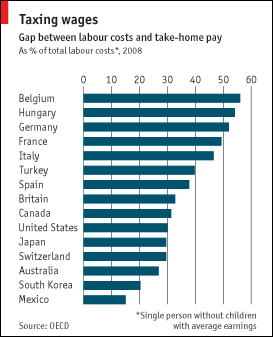 A term used mostly in bourgeois economics to indicate one or another type of distortion in
economic choices caused by a tax. The most frequently mentioned type of tax wedge is the
difference between the cost of a worker’s wages to the employer, and what the worker actually
receives as take-home pay. The national, state and local governments deduct substantial
parts of a worker’s gross pay for income taxes, Social Security taxes, unemployment and
disability taxes, and so forth. Thus the worker’s net pay, i.e., what they actually
receive in their pay checks, is very much smaller.
A term used mostly in bourgeois economics to indicate one or another type of distortion in
economic choices caused by a tax. The most frequently mentioned type of tax wedge is the
difference between the cost of a worker’s wages to the employer, and what the worker actually
receives as take-home pay. The national, state and local governments deduct substantial
parts of a worker’s gross pay for income taxes, Social Security taxes, unemployment and
disability taxes, and so forth. Thus the worker’s net pay, i.e., what they actually
receive in their pay checks, is very much smaller. It has long been known that the
 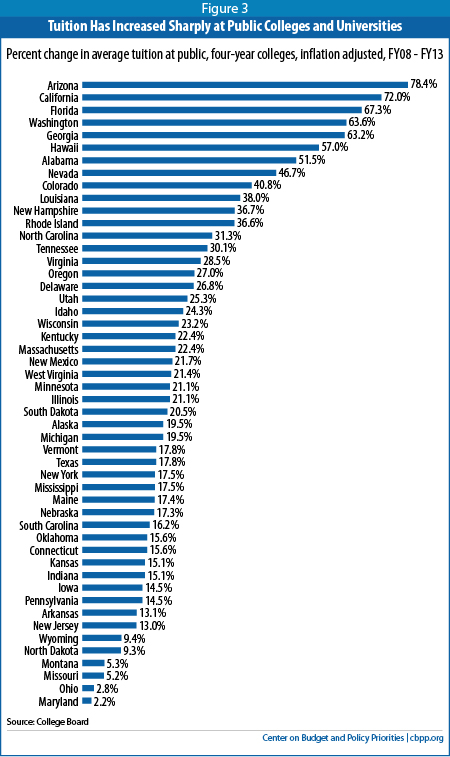 College tuition in the U.S. has been zooming up very rapidly for many years. But this rate
of increase has accelerated even more since the U.S. and world capitalist economic crisis
took a turn for the worse in 2008.
College tuition in the U.S. has been zooming up very rapidly for many years. But this rate
of increase has accelerated even more since the U.S. and world capitalist economic crisis
took a turn for the worse in 2008.
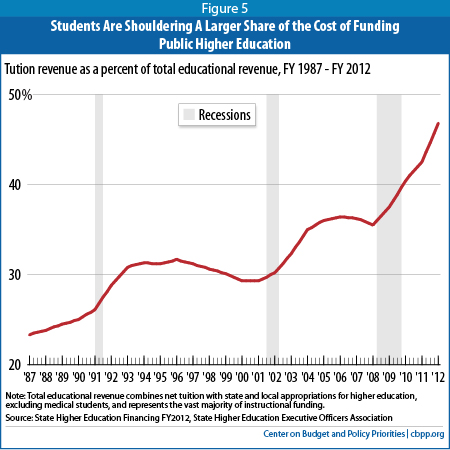 The chart at the right is from the report
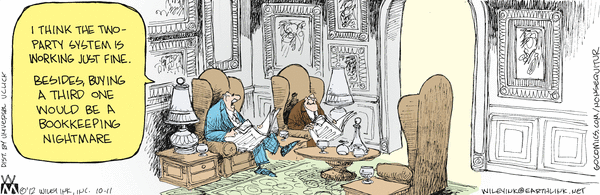 An arrangement in bourgeois society wherein a single social class rules through not just a
single political party, but rather through two primary parties which both
represent that same class. These two parties work co-operatively in a “bi-partisan” way
when their overall class interests are at issue, but divide and contend when it comes to
matters on which the ruling capitalist class is itself divided. Ruling in this way also
makes it easier for the bourgeoisie to fool the masses into thinking that they actually
control society through a democratic process. Actually, however, the “democracy” is real
only with regard to questions on which the bourgeoisie is itself split. In the U.S., for
example, the masses are still under the complete control of the exploiting capitalist
class whether the Democratic or Republican party wins an election.
An arrangement in bourgeois society wherein a single social class rules through not just a
single political party, but rather through two primary parties which both
represent that same class. These two parties work co-operatively in a “bi-partisan” way
when their overall class interests are at issue, but divide and contend when it comes to
matters on which the ruling capitalist class is itself divided. Ruling in this way also
makes it easier for the bourgeoisie to fool the masses into thinking that they actually
control society through a democratic process. Actually, however, the “democracy” is real
only with regard to questions on which the bourgeoisie is itself split. In the U.S., for
example, the masses are still under the complete control of the exploiting capitalist
class whether the Democratic or Republican party wins an election.