BADIOU, Alain (1937- )
A very confused and grossly overrated French petty-bourgeois political radical and
idealist (non-materialist) philosopher of sorts, who once
considered himself to be a “Maoist”, and still likes to associate himself with what some of his
admirers call “post-Maoism”.
Badiou was strongly influenced by, and somewhat
further radicalized by, the great student uprising in France in the spring of 1968. In 1970 he
was the founder and leader of the Groupe pour la Fondation de l’Union des Communistes de
France Marxistes Léninistes, more commonly called the UCFML [Union of Communists of
France Marxist-Leninist], one of several nominally Maoist organizations in France in that period.
He is now a member of L’Organisation Politique which he and some friends founded in 1985
after the dissolution of the UCFML. This group supports immigrant rights and other reforms.
However, Badiou no longer believes that there needs to be, or should be, a revolutionary
political party in order to transform society!
“Up to the end of the 1970s, my friends and I defended the idea that an
emancipatory politics presumed some kind of political party. Today we are developing a
completely different idea, which we call ‘politics without party’.” —Alain Badiou,
Ethics: An Essay on the Understanding of Evil, trans. by Peter Hallward, (Verso,
2001), p. 95. (In the interview appendix.)
Even more absurdly, Badiou now explicitly renounces the class perspective in politics
and ideology, and refuses to even think in terms of the proletariat versus the bourgeoisie!
“The second thing that has changed over these last twenty years concerns
the status of class. For a long time we were faithful to the idea of a class politics, a
class state, and so on. Today we think that political initiatives which present themselves
as representations of a class have given everything they had to give.” —Alain Badiou,
ibid., p. 97.
Badiou’s philosophical views are strongly influenced by Kant,
Althusser’s corruption of Marxism and by Lacanian psychoanalysis, along with mathematical set
theory. (What a mish-mash!) Badiou is sometimes called an adherent of the “anti-postmodern”
strand of continental philosophy. However, for the most part his philosophical ideas are nearly
impossible to describe in any intelligeable fashion, since they are almost completely incoherent.
But whatever his philosophical views are, exactly, it is clear that he is not a materialist. One
commentator argues that Badiou’s philosophy can be regarded as a contemporary reinterpretation
of Platonism.
Badiou’s views on ethics are a blend of Kant,
classless nihilism, and his usual general incoherence. [See my commentary: “Alain Badiou: A
Pseudo-Maoist Obscurantist”, at:
http://www.massline.org/Philosophy/ScottH/BadiouAndEthics.pdf. —S.H.]
Oddly enough, for a person who is obviously not
a Marxist nor even a real revolutionary, Badiou and his views have recently become something of
a fad within radical movements led by intellectuals, not only in North America, but also in
desperately poor and exploited countries like India, the Democratic Republic of the Congo and
South Africa! Even some revolutionary Marxists have been attracted to him, though it only serves
to discredit their own good judgment! Just how much in politics and philosophy can we possibly
have to learn from someone who rejects the class perspective, rejects the need for a revolutionary
party (and apparently also for any actual revolution), and who derives his own ideas mostly from
either bourgeois ideologists directly, or else from revisionist distorters of Marxism?!
See also: “Badiou, St. Paul, and the Mass Line”
at:
http://www.massline.info/Misc/BadiouMassLine.pdf
BAKUNINISTS
“Followers of Mikhail Bakunin, an anarchist theoretician and implacable
enemy of Marxism and scientific socialism. The Bakuninists conducted a stubborn struggle
against Marxist theory and the Marxist tactics of the working-class movement. The basic
postulate of Bakuninism was the rejection of all forms of [the] state, including that of
the dictatorship of the proletariat. The Bakuninists did not understand the historic role
of the proletariat. Bakunin propounded the idea of class ‘levelling’, the alliance of
‘free associations’ from below. A secret revolutionary society consisting of ‘outstanding
people’ would lead popular revolts that were to begin immediately. In Russia, for example,
the Bakuninists assumed that the peasantry were ready to start an immediate revolt. Their
tactics of conspiracy, immediate revolts and terrorist acts was sheer gambling and was
contrary to the Marxist theory of insurrection. Bakuninism was one of the sources from
which the Narodniks drew their ideology.” —Note 9 in Lenin,
Selected Works, vol. I (Moscow: 1967).
For further information about Bakunin and his followers see: Marx & Engels, “The Alliance
of Socialist Democracy and the Working Men’s International Association” (1873); Engels, “The
Bakuninists at Work” (1873); Engels, “Emigré Literature” (1875); and Lenin, “On the
Provisional Revolutionary Government” (LCW 8:461-81).
BANDH
[From the Hindi word meaning “closed”.] A term for what is usually a one-day general strike in
India and other countries in south Asia. Bandhs are generally called either by major political
parties, or at least usually represent major concerns of a large section of the population. They
tend to be very effective, with shops being closed, transportion nearly completely closed down,
the streets empty, and so forth. While observance of bandhs is generally voluntary, sometimes
force is used against those who ignore them. It often happens that governments order the
population to ignore bandhs, but people seldom pay much attention to this. Bandhs have been
illegal in India itself since 1998, but they are still common. Sometimes even large cities are
brought to almost a complete standstill. Bandhs are most frequent in cities where there are the
largest numbers of poor and harshly oppressed people. In the Indian state of West Bengal there
are as many as 50 bandhs each year. Bandhs are a very powerful form of mass protest, but they
are not the same as labor strikes or “hartals”, which can go on for much longer periods. However,
where bandhs are illegal they sometimes still occur under the name of hartals.
BANDUNG CONFERENCE
The first conference of the “non-aligned” Afro-Asian countries which occurred in Bandung, Indonesia
from April 18-24, 1955. The countries attending, including the People’s Republic of China, were
“non-aligned” in the sense that they were not in the camp of either superpower, the U.S. or the
U.S.S.R. The countries at the Bandung Conference did not want to be caught up in the constant
contention between the two superpowers, and were opposed to the domination of either imperialist
superpower. Moreover, they were concerned about the possibility of superpower attacks on other
countries, and especially the danger of a U.S. attack on China, which was quite serious at that
time.
[More to be added...]
BANK
A financial institution whose primary activity is the borrowing and lending of money. Banks borrow
from the general public, both individuals and businesses, who become depositors in the bank.
The banks normally pay only a rather low rate of interest to borrow this money. (Checking accounts
usually pay no interest at all.) They then loan out money to others at a higher rate of interest,
which is usually the main source of their profits. These loans are to businesses and also to
individual people (for mortgages, car loans, and other purposes). To the extent that the bank
interest income from loans comes from capitalist companies, the banks share in the
surplus value generated by the workers at those companies. The
banks centralize idle cash, not only from capitalist corporations but also a great many smaller
deposits from workers and other non-capitalists, and serve the necessary capitalist function of
accumulating and turning many isolated quantitities of idle money into large chunks of money
capital available to companies to use in continuing and expanding production.
Commercial banks may be either general
purpose or focus their activity mostly on certain areas of banking, such as savings banks
(or “savings & loans” institutions) which specialize in gathering the savings of many small
depositors and in issuing mortgages. Merchant banks specialize in servicing financial needs
of businesses and promoting trade, including international trade. Investment banks specialize
in handling transactions of large corporations and the rich, including loaning them large sums of
money, handling their investments for them, helping arrange mergers and acquisitions of other
companies, arranging for IPOs and so forth.
Central banks are government banks whose
primary purposes are to supervise the commercial banks, regulate the money supply, and to try to
keep the overall economy running smoothly. They do not accept deposits from individuals. The U.S.
central bank is the Federal Reserve. Others include the Bank
of England and the Bank of Japan. The European Central Bank regulates the monetary policy of
those countries using the Euro currency.
Finally, there are a few international banks
(meaning not those commercial banks which operate internationally, but rather banks set up by
associations of many nations which try to regulate the world financial system). Most notably there
is the International Monetary Fund, which is a crude sort of world central
bank, and the World Bank, which is a world investment bank that in
theory, at least, tries to promote economic development in more economically backward (i.e., more
exploited!) nations. Both of these are tightly controlled by the imperialist powers, especially
the United States.
See also entries below and:
MONEY CREATION BY COMMERCIAL BANKS,
ZOMBIE BANK
BANK CAPITAL
There are two main senses of this term: 1) the capital supplied by those who established the
bank and the capital required to keep it functioning (either from actual business requirements
or from legal requirements); and 2) all the capital concentrated in the bank, including
both that supplied by the owners of the bank, and the much larger amount supplied by the
depositors in the bank. In the writings of Marx and other Marxists, bank capital is most
often used in this second sense, while in the discussions by bourgeois economists about banks,
the term is most often used in the first sense.
In the first sense, bank capital is the
capital required to establish and keep operating a bank. Banks make their profits through
borrowing money from depositors and lending it out at a higher rate of interest to their
loan customers. However, at times depositors also wish to withdraw their money and banks must
have some money capital on hand to pay them back. The amount required varies from time to time,
but the banks must have enough money on hand to deal with all normal situations. (During
exceptional situations, such as a financial crisis, the bank may borrow temporarily from the
central bank—the Federal Reserve in the U.S.—to tide it
over.)
In the second sense, the basic function of
bank capital is as a source of new capital for the active capitalists in industry to
expand production and thus to further increase the extraction of
surplus value from the working class. This aggregation and
centralization of idle money and its transformation into new capital is an essential process
under capitalism.
See also:
FINANCIAL CAPITAL
BANKRUPTCY
A legal arrangement or status of a company (or individual) which is unable to pay its debts.
Bankruptcy proceedings may be started by either the insolvent debtor, or by one or more of the
creditors to which money is owed. Once the legal system (i.e., a judge) rules that the company
(or person) is bankrupt, a receiver is appointed by the judge to seize and then sell
some or all of the remaining assets and to use the funds to repay the creditors to the extent
possible.
With regard to companies, there are two main
types of bankruptcy in the United States: Chapter 7 bankruptcy and Chapter 11 bankruptcy. In the
former, the company is “liquidated” (closed down and all its assets are sold off for the benefit
of the creditors). In a Chapter 11 bankruptcy, an attempt is made to reorganize the company so
that it can continue in business and eventually pay its debts. For the time being the company
is protected against the claims for payment by its creditors. Both forms of bankruptcy are
often used to screw the workers at these companies: labor contracts are often voided, as are
the company’s obligations to pay pension benefits, etc.
BAREFOOT DOCTOR
[In China during the Mao era, and especially during the Great Proletarian
Cultural Revolution:] A para-medical worker with only limited formal training who provided
medical services, sometimes only part-time, primarily in rural areas where there were as yet
almost no doctors available to the people. They promoted hygiene, preventive health care, and
family planning, and treated common injuries and illnesses. They acted as the primary health-care
providers at the grass-roots level and brought the first wave of medical care to millions of
people who never before had access to any at all.
“Many people say, yes, you’ve got all these para-medical workers, but
what kind of level have they got? What kind of doctors are they really? Do they really
look after the health of the people? This raises very big questions, including the
question of what attributes a doctor should have.
“Some people think that the most
important attributes are to have a lot of degrees, to have gone through a lot of specialist
courses, to have a good bed-side manner, and so on. I’m not belittling the importance of
professional skill, and mastery of modern techniques. But in my opinion, the most important
attribute that any doctor can possibly have is the determination to put the interests of
his patients before everything else, to devote his whole life to the service of his
patients, of his fellow men. If he has this drive, if he has this motivation, he’s a good
doctor. And if he doesn’t have it he falls short of being a good doctor no matter what his
technical or professional level is.
“Peasant doctors have this
determination to be of service to their fellow men. To whatever degree their technical or
professional knowledge falls short of the ideal, that can be put right in time. And will
be put right in time. Because to have a sense of responsibility towards your patients means
that you also have the determination to equip yourself with the knowledge and skills to
serve their needs. It’s part of the same thing.
“So I say to those good people who
say, ah well, what kind of doctors are they? they don’t really count—I say they do
count. I say this is the kind of doctor of the future—this is not an expedient, this is
not just a stop-gap measure. This is how doctors of the future will be trained, rooted
among the people. They will come from the people, they will be motivated by a desire to
serve the people, they will not be separated from the people, by their income, their dress,
their motor cars, where they live, or anything else. They’ll merge with the people and
serve them to the best of their ability.” —Dr. Joshua Horn, “The Mass Line”, a wonderful
1971 speech available in full at:
http://www.massline.info/China/JHorn-ML.htm
BARTER
The exchange of commodities for each other without using the medium of money.
For example, someone might trade a TV set for a piece of furniture. Or on the international
level, one country might trade a number of tons of iron ore for a certain large number of
bushels of wheat.
Barter began in prehistoric times, before
money even existed yet. The origin of money, in fact, lies in the tendency to compare the
value of different bartered goods to a standard commodity (such as gold) which is relatively
rare, indestructable, portable, and so forth. In the modern world, large-scale barter between
nations is often an indication that no stable or otherwise acceptable common currency is
available to smooth the transaction. Within a country, barter is sometimes used between
individuals or companies to hide income and thus avoid paying taxes on that income.
BASE AND SUPERSTRUCTURE
Concepts of historical materialism: The base
(or “basis”, or “economic base”) is the totality of the underlying relations of production in
a given society, or in other words, the underlying economic structure; the superstructure
is the totality of all the social phenomena which ultimately arise from this base and depend
upon it, but nevertheless also tend to influence the base in its turn. The superstructure
therefore includes social consciousness (including
all forms of ideology), human social relationships other than
those which constitute the relations of production, and institutions and organizations that
make up society, such as the State, political parties, law courts,
churches, etc.
BASEL MANIFESTO (1912)
“A Manifesto on war adopted unanimously by an Extraordinary Congress of
the 2nd International held in Basle [or Basel] (Switzerland) on November 24-25, 1912. The
Manifesto pointed out the predatory aims of the war the imperialists were preparing and
called upon the workers of all countries to wage a resolute struggle against war. The Basle
Manifesto repeated the propositions of the resolution adopted by the Stuttgart Congress of
the 2nd International in 1907, moved by Lenin and Rosa Luxemburg, that if an imperialist
war should break out, socialists should take advantage of the economic and political crisis
created by the war to prepare for a socialist revolution. When the World War broke out in
1914, the leaders of the 2nd International, Kautsky, Vandervelde and others, who had voted
for the Manifesto, consigned it to oblivion and began to support their imperialist
governments.” —Note 24, Lenin, SW 3 (1967).
BASTARD KEYNESIANISM
A term coined by Joan Robinson to refer to various other
bourgeois economists (especially Americans such as Paul Samuelson)
who adopted aspects of the Keynesian perspective but crudely distorted
it in the direction of standard neoclassical bourgeois
economics, especially by covertly restoring the supposed validity of “Say’s
Law”. The “bastards” distorted Keynes by arguing that, given a certain level of savings, the
government could ensure enough investment, which Robinson found little different than the
neoclassical claim that savings determines investment, and which ignored the effect of insufficient
market demand (underconsumption) upon investment. Robinson complained that Keynes’ concept of
“effective demand” had been abandoned and also that there was little concern for understanding
what capital actually was.
“Say’s Law implied that there could not be a deficiency of demand; the
bastard Keynesian doctrine takes the rate of saving as knowable and then through fiscal
and monetary policy arranges an equal amount of investment, thus restoring Say’s Law.
[Robinson says:] ‘Under its shelter all the old doctrines creep back again, even the
doctrine that any given stock of capital will provide employment for any amount of labor
at the appropriate equilibrium level.’” —Marjorie Shepherd Turner, Joan Robinson and
the Americans (M.E. Sharpe, 1989, p. 111.)
BEAUTY
The qualities or collection of qualities in a person or thing which gives great pleasure to the
senses and thus stirs ones emotions. In the 19th century beauty was considered
to be the exclusive, or else by far the main, concern in the philosophy of art. But over the past
century aesthetics has expanded to include a great many other
concerns, such as questions about what sort of thing a work of art is, why art is so important to
human beings and why it has such a great impact on us, what the relation is between art and society,
and so forth. Even the answer to the question “What makes a work of art a good work?”, which was
formerly assumed to be simply beauty has now been greatly expanded to include things such
as the effect of the work upon society, the degree to which the work influences other artists, etc.
In short, beauty, while still quite important in aesthetics, is no longer all-important.
BELL, Daniel (1919-2011)
American bourgeois sociologist best known for his theories of so-called “post-industrialism”
(a term which he coined). His early career was spent as a journalist on various establishment
magazines, including 10 years working for the corporate business magazine Fortune.
A favorite theme in bourgeois sociology is
that capitalist ideology has triumphed for all time and that all other ideologies, and
especially Marxism, are now “dead”. The ruling class therefore welcomed with open arms his
influential book The End of Ideology (1960) which proclaimed the “exhaustion” of
non-bourgeois ideas. His obituary in the Economist (Feb. 5, 2011) wryly noted, however,
that “His timing could hardly have been worse: the 1960s was one of the most ideologically
charged decades in American history.” And, indeed, we are now once again entering another period
of rising anti-capitalist ideology, as is inevitable when capitalism sinks into crisis.
In his book The Coming of Post-Industrial
Society (1973), Bell noted the ongoing relative expansion of service industries (as compared
with manufacturing), the growth of technology industries (as compared with old-line industries),
the rise of what are now often called “knowledge workers” (as opposed to blue-collar and
clerical workers), and the waning of the class struggle in the United States. The first and
second of these trends were indeed occurring, but in characterizing this as the rise of
“post-industrial society” Bell failed to appreciate the absolutely essential nature of the
continuing manufacturing base in any economy. The long-term gradual destruction of the
manufacturing base in the United States, which has been going on for decades now, has become
one major aspect of its extremely serious structural crisis.
Bell’s third idea, about the rise of “knowledge
workers” was also true for a time. But we are now in a period when even “knowledge work” is in
very serious decline in the U.S. One reason is the offshoring
of more and more of this work overseas. The other, deeper, reason is that computers are now
leading to the automation of not just manufacturing and clerical jobs, but also ever-growing
numbers of “high-tech” jobs. Bell’s fourth idea, about the decline of the class struggle in
the U.S. also reflected a temporary phenomenon, which was only possible because of the expansion
of American imperialism and the intensified exploitation of other countries. In recent decades,
and especially since the collapse of the “New Economy” bubble around 2001, the ruling class
has been forced to spread around ever fewer crumbs from the imperialist banquet table to the
U.S. working class. In general Bell recognized some contemporary socioeconomic trends circa
1970, but did not begin to understand the limits of those trends.
Bell’s book The Cultural Contradictions of
Capitalism (1976) worries that capitalist culture promotes insatiable desires for endless
self-gratification by people, which might destroy the work ethic which he, like Max Weber,
claims was a major factor in the development of capitalism. In fact, this type of unrestrained
consumerism has helped promote huge debt bubbles which have allowed capitalism to avoid sinking
into a new depression for as long as it has. Capitalism needs debt bubbles to function
at all, and a culture which promotes such bubbles is therefore also necessary to it—despite
the obvious fact that all such bubbles must burst in the end.
Daniel Bell considered himself to be a social
democrat at least through the 1970s, and as late as 1978 wrote that “I am a socialist in
economics, a liberal in politics, and a conservative in culture.” However, this was always the
absurdly phony “socialism” of those who think that socialism is compatible with capitalism. Bell
served on a couple Presidential advisory commissions in the 1960s and 1970s, and was a life-long
ideologist of the bourgeoisie. He was always totally opposed to genuine socialism and social
revolution.
BELL’S THEOREM
A logical demonstration, derived by physicist John S. Bell, from the axioms and postulates of
quantum mechanics, that one or the other of the following
two options must be true:
1) We must deny that particles (and other, larger
quantum mechanical entities) have any definite properties until they are measured; or
2) We must allow that the separate and
isolated particles in the universe are somehow connected with others distantly located in a way
which allows instantaneous communication between them. (This option seems to violate
Special Relativity.)
Bell’s Theorem has been used to argue for the
absurd Copenhagen Interpretation of quantum
mechanics and against any possible validity for the
Hidden-Variables Interpretation. Obviously
neither option is very palatable to materialists, though perhaps the second is slightly less
repulsive than the first.)
However, several lines of opposition to the
conclusions of Bell’s Theorem are possible. For example, the conclusions seem to only hold
within the framework of quantum mechanics. If there is some way to investigate particles
(or other aspects of the physical world) in a non-quantum-mechanical way, then Bell’s Theorem
may not even apply. Moreover, we know that in the macro world we have all sorts of ways of
investigating reality in non-quantum-mechanical ways. The issue would then be whether or not
there are similar methods to investigate the micro world.
Another possible line of opposition to Bell’s
Theorem may lie in simply rejecting or reformulating one or more of the axioms and postulates
that Bell used to prove his theorem.
Yet another line of attack on this apparently
idealist theorem is to demand some coherent explanation of what “measurement” is supposed to
amount to in quantum mechanics. (This has never yet been completely clarified.) We should by no
means just assume that Bell’s Theorem is actually sound and applicable to all of reality.
Personally, I’m quite sure that one of these forms of criticism of the Theorem will shoot it
down in the end.
BENTHAM, Jeremy (1748-1832)
English moral philosopher and judicial reformer, and one of the main founders of
utilitarianism. Bentham, more than anyone, was responsible
for giving utilitarianism its bourgeois, hedonist twist.
Marx appropriately calls Bentham “an
arch-Philistine” and an “insipid, pedantic, leather-tongued oracle of the ordinary bourgeois
intelligence of the 19th century”. In a footnote he adds: “With the dryest naivete
he [Bentham] takes the modern shopkeeper, especially the English shopkeeper, as the normal man.
Whatever is useful to this queer normal man, and to his world, is abolutely useful. This
yard-measure, then, he applies to past, present, and future.... [Bentham is] a genius in the
way of bourgeois stupidity.” —Marx, Capital, vol. I, ch. XXIV, sect. 5: (International,
pp. 609-610; Penguin, pp. 758-9.)
See also:
Philosophical doggerel
about Bentham.
BERNANKE, Ben (1953- )
A prominent American bourgeois economist who was appointed by President George W. Bush to
succeed Alan Greenspan as Chairman of the Board of Governors of the
Federal Reserve System on February 1, 2006.
Four years later President Obama reappointed Bernanke for a second 4-year term. Bernanke has
overseen the Federal Reserves’s greatest increase in power since its initial creation in 1913.
But he was incapable of preventing (or to this point resolving) the great financial crisis
that developed so ferociously in the fall of 2008.
Bernanke is supposed to be one of the
greatest “authorities” on the financial and economic aspects of the
Great Depression of the 1930s, but as the following
quotation shows, he doesn’t even understand the basic cause of that Depression. In
a speech in honor of the ultra-reactionary bourgeois economist, Milton Friedman, he said:
“Let me end my talk by abusing slightly my status as an official
representative of the Federal Reserve. I would like to say to Milton and Anna [Schwartz,
Friedman’s coauthor]: Regarding the Great Depression. You’re right, we did it. We’re
very sorry. But thanks to you, we won’t do it again.” —FRB Speech: Remarks by Governor
Ben S. Bernanke, At the Conference to Honor Milton Friedman, University of Chicago,
Chicago, Illinois, November 8, 2002.
Thus Bernanke does not even recognize that depressions are inherent in the
capitalist mode of production! Instead, like most bourgeois economists, he thinks the (last)
Great Depression was entirely due to “mistakes” on the part of government officials. Meanwhile,
he is in charge of the U.S. economy as it stumbles in the direction of the next Great
Depression! While the massive Keynesianism of both the Bush and Obama administrations, which
Bernanke supported, is indeed mitigating the current crisis for a while and to a degree,
that crisis is still developing, and—with ups and downs—will continue to do so. In the
end Bernanke and his fellow bourgeois economists will be left scratching their heads and
wondering, “What the hell happened?!”
BETHUNE, Norman (1890-1939)
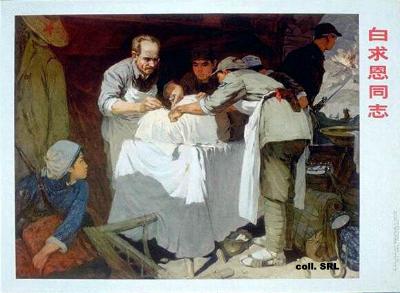 Norman Bethune was a Canadian surgeon and Communist who worked in Spain in support of the
Republic during the Spanish Civil War, and who later went to China to work in the medical
core of what became the People’s Liberation Army. He died in China in 1939 of blood poisoning
after nicking himself with a scalpel during a long day of operations on wounded soldiers.
Norman Bethune was a Canadian surgeon and Communist who worked in Spain in support of the
Republic during the Spanish Civil War, and who later went to China to work in the medical
core of what became the People’s Liberation Army. He died in China in 1939 of blood poisoning
after nicking himself with a scalpel during a long day of operations on wounded soldiers.
In his early medical career in Canada he
recognized that many of the greatest health problems arose because poor people did not have
adequate access to the health care system; from the failure of the health system to focus on
preventive medicine; and from other consequences of the capitalist social system in general.
During the Great Depression of the 1930s Bethune
frequently sought out the poor and provided them with free medical care. He was also one of
the earliest advocates of a national health care system for everyone (“socialized medicine”).
While in Spain he developed the world’s first
mobile medical unit which administered blood-transfusions and operated on soldiers near the
front lines, thus saving many lives. In China he further developed this idea into more complete
mobile surgical hospitals which saved the lives of a great many revolutionary soldiers. (Other
armies later copied this idea, including the United States Army which developed its “Mobile
Army Surgical Hospital” (M.A.S.H.) units late in World War II and more extensively in Korea
and other imperialist wars.)
After his death, Mao Zedong immortalized
Bethune’s internationalist revolutionary spirit in a very famous essay, “In Memory of Norman
Bethune” [available online at:
http://www.marxists.org/reference/archive/mao/selected-works/volume-2/mswv2_25.htm ].
Ever since then Norman Bethune has been an inspiration to both the Chinese people, and to all
Communists around the world.
“[Comrade Norman Bethune] arrived in Yenan in the spring of last year,
went to work in the Wutai Mountains, and to our great sorrow died a martyr at his post.
What kind of spirit is this that makes a foreigner selflessly adopt the cause of the
Chinese people’s liberation as his own? It is the spirit of internationalism, the spirit
of communism, from which every Chinese Communist must learn....
“Comrade Bethune and I met only
once. Afterwards he wrote me many letters. But I was busy, and I wrote him only one
letter and do not even know if he ever received it. I am deeply grieved over his death.
Now we are all commemorating him, which shows how profoundly his spirit inspires everyone.
We must all learn the spirit of absolute selflessness from him. With this spirit everyone
can be very useful to the people. A man’s ability may be great or small, but if he has
this spirit, he is already noble-minded and pure, a man of moral integrity and above
vulgar interests, a man who is of value to the people.” —Mao, “In Memory of Norman
Bethune” (Dec. 21, 1939), SW2:337-8.
BHOODAN ANDOLAN [“Land Gift Movement”]
A voluntary land reform movement in India started by Archarya Vinoba Bhave in 1951. It was
launched in the same naïve spirit of the philosophy of Mohandas K. Gandhi, and begged
the landlords to simply give some of their excess land to the landless poor. A few did so,
out of guilt or to appear beneficent or else from fear that they might otherwise lose all of
their land through mass violence. However, compared to the great need for land by the poor,
only a pittance was donated. Moreover, much of the donated land was of poor quality, and
actually unsuitable for agriculture. Even worse, much of the supposedly “donated” land was
actually given in name only, with the rich landlords retaining possession and control in
reality.
For a recent Times of India report
(Dec. 10, 2009) describing how farmers who have supposedly been the “beneficiaries” of this
“Land Gift Movement” are now completely disillusioned and turning to revolution, see:
“Bhoodan Farmers Ready to Emulate Maoists”
BIG CHARACTER POSTER
A poster containing large Chinese characters which made them easy to read from a distance.
They played an important role during the Chinese revolution, especially during the
Great Proletarian Cultural Revolution. Upon their initial
appearence during the GPCR the revisionist leaning high Party members tried to prohibit
big character posters, but Mao’s support for them and their authors, and his general
support for the masses speaking out and mass democracy, forced the revisionists to slink
away and keep quiet.
“The big-character poster is an extremely useful new type of
weapon. It can be used in cities and the countryside, in factories, co-operatives,
shops, government and other organizations, schools, army units and streets, in
short, wherever the masses are. Now that it has been used widely, people should go
on using it constantly.” —Mao, “Introducing a Co-operative” (April 15, 1958).
BLACK MARKET
The buying or selling of commodities under illegal circumstances. The goods sold may be
stolen or smuggled, or have escaped government taxes, or be priced outside the bounds
of current law (when price controls exist), or may consist of things (such as certain
drugs or types of weapons) which the government has made illegal for ordinary people to
possess.
In recent decades the dominant currency
used in many black markets overseas has been the American dollar. By the 1990s about 75%
of all U.S. $100 bills in circulation were overseas. It is thought that the production of
very convincing counterfeit $100 bills, largely for use in such black markets, is what
forced the U.S. government to redesign that bill in 1996. (The currency used in illegal
black markets mostly comes from, and eventually gets redeposited into, “legitimate”
commercial banks.) The black market within the U.S. itself may account for as much as 10%
of GDP, but in many Third World countries it is thought to be a much higher percentage
than that.
BLANQUI, Louis Auguste (1805-1881)
Dedicated French revolutionary and utopian communist. He was the leader of a succession of
secret revolutionary societies, participated in several conspiracies to seize political
power, and as a consequence of the failure of these plots ended up spending over 36 years
in prison. It has aptly been said of him that whenever a revolutionary upsurge struck
France Louis Blanqui was not a leader of it—because he was already in prison! Marx
and Engels admired Blanqui for his revolutionary enthusiasm and dedication, but they strongly
criticized him for his conspiratorial strategy and failure to understand the necessity of
organizing the masses for revolution, and making the revolution a mass-based phenomenon.
Blanqui himself had little knowledge about how to organize the masses, had little faith in
them or their potential, and actually did not really trust the masses. He thought that once
one of his conspiratorial plots was successful he would still not be able to fully trust
the masses for some time or institute democracy. In this he showed his pronounced
paternalistic attitudes toward the people. (That is not a
complement!)
“The Blanquists, Lenin wrote, expected ‘that mankind will be
emancipated from wage-slavery, not by the proletarian class struggle, but through a
conspiracy hatched by a small minority of intellectuals’. Substituting actions by a
secret clique of conspirators for the work of a revolutionary party, they did not take
into account the actual situation required for a victorious uprising and neglected
links with the masses.” —Note 66, Lenin, SW 3 (1967).
BOGDANOV, Alexander [Pronounced: bog-DAN-ov]
[Pseudonym of Alexander A. Malinovsky] (1873-1928)
Russian philosopher and economist, writer and Social Democrat. He joined the Bolsheviks in
1903, but was expelled in 1909 because of his anti-Marxist views and activities. (See:
OTZOVISM.) Although he started out as
a vague sort of materialist, he soon veered into a doctrine known as
Energism. Then he supported the extreme
empiricist and subjective
idealist doctrines of Ernst Mach. Next, his confused
attempts to overcome the conceptual difficulties of Machism led him to create a kind of
objective idealist theory of knowledge which he called “Empirio-Monism”. (He published a 3
volume work with that title in the years 1904-06.) After that he moved into other areas and
tried to formulate a theory he called “tectology”, a supposed universal organization science
(somewhat like the later theories by others which are known as “cybernetics” and “systems
theory”). But throughout this whole long and strange intellectual odyssey he stood opposed to
dialectical materialism, and was strongly criticized by Lenin for this (including in Lenin’s
1908 book, Materialism and
Empirio-Criticism).
In 1917 Bogdanov was a founder and the leader
of the “Proletkult” organization which sought to promote
proletarian culture, but which also proclaimed the necessity for the total replacement of all
existing cultural forms with “completely new” proletarian forms of culture. This view too was
strongly criticized by Lenin.
Bogdanov’s writings had made a very strong
impression on Nikolai Bukharin, who was one of the top theoreticians
of the Bolsheviks at the time, and on many others as well. Partly for this reason Bogdanov
had quite a reputation himself as a Marxist theoretician by 1917, despite his idealistic
theories which had been exposed by Lenin earlier. In 1920 Lenin re-published his book
Materialism and Empirio-Criticism in order to combat this renewed idealist trend
centered around Bogdanov in the revolutionary movement. At the same time, the Russian
Communist Party (Bolsheviks) established more political control over the Bogdanov’s
Proletkult organization, which had developed its own line partly opposed to that of the
party.
BOURGEOIS DEMOCRACY
The form of capitalist society in which the
dictatorship of the bourgeoisie is camouflaged by superficial (i.e., fundamentally false)
democratic forms. One favorite technique is to alternate rule between two different bourgeois
political parties, both of which represent the fundamental interests of the capitalists and
which differ only on secondary questions on which the capitalists themselves are not in
agreement. The masses are accorded a minor role in deciding which of these two basically
indistinguishable parties (from the proletarian point of view) shall administer capitalist
power in any given period, in order to give them the illusion that they are controlling
society. Whenever bourgeois rule is seriously threatened the capitalists dispense with the
camouflage and resort to fascism.
“Bourgeois democracy, although a great historical advance in comparison
with medievalism, always remains, and under capitalism is bound to remain, restricted,
truncated, false and hypocritical, a paradise for the rich and a snare and deception for
the exploited, for the poor.” —Lenin, “The Proletarian Revolution and the Renegade
Kautsky” (Oct.-Nov. 1918), LCW 28:243.
“There is not a single state, however democratic, which has no
loopholes or reservations in its constitution guaranteeing the bourgeoisie the
possibility of dispatching troops against the workers, of proclaiming martial law,
and so forth, in case of a ‘violation of public order’, and actually in case the
exploited class ‘violates’ its position of slavery and tries to behave in a non-slavish
manner.” —Lenin, ibid., LCW 28:244.
BOURGEOISIE—Past Revolutionary Role Of
While the bourgeoisie, or capitalist class, is today the most reactionary and
anti-revolutionary class, and the class that stands in the way of social progress, this was
not always so. In its youth the bourgeoisie led in the struggle against feudalism in Europe,
and in that long past age actually played a most revolutionary role in society.
“Modern industry has established the world market, for which the
discovery of America paved the way. This market has given an immense development to
commerce, to navigation, to communications by land. This development has, in its turn,
reacted on the extension of industry; and in proportion as industry, commerce, navigation,
railways extended, in the same proportion the bourgeoisie developed, increased its
capital, and pushed into the background every class handed down from the Middle Ages.
“We see, therefore, how the modern
bourgeoisie is itself the product of a long course of development, of a series of
revolutions in the modes of production and of exchange.
“Each step in the development of the
bourgeoisie was accompanied by a corresponding political advance of that class.” —Marx
& Engels, Manifesto of the Communist Party (1848), MECW 6:486.
“The bourgeoisie, historically, has played a most revolutionary part.
“The bourgeoisie, wherever it has got
the upper hand, has put an end to all feudal, patriarchal, idyllic relations. It has
pitilessly torn asunder the motley feudal ties that bound man to his ‘natural superiors’,
and has left remaining no other nexus between man and man than naked self-interest, than
callous ‘cash payment’. It has drowned the most heavenly ecstasies of religious fervor,
of chivalrous enthusiasm, of philistine sentimentalism, in the icy water of egotistical
calculation. It has resolved personal worth into exchange value, and in place of the
numberless indefeasible chartered freedoms, has set up that single, unconscionable
freedom—Free Trade. In one word, for exploitation, veiled by religious and political
illusions, it has substituted naked, shameless, direct, brutal exploitation.” —Marx
& Engels, ibid., MECW 6:486-7.
BREAKDOWN THEORY
The theory, found at various places in the writings of Marx and Engels and less frequently
in later Marxists, that capitalist economic crises will get worse and worse, and eventually
lead to a breakdown of the whole capitalist system. Of course this does not imply that
the system will break down regardless of what the working class and masses do! It tacitly
assumes that really bad economic conditions, along with the other miseries of capitalism (such
as war), will lead the proletariat to take conscious revolutionary action to overthrow the
capitalists and take power itself.
The breakdown theory was totally
rejected by revisionists, starting with Eduard Bernstein,
and also by “centrists”. But during long periods of general economic
stability and more or less short and mild recessions, the theory has also often been rejected by
various Marxist revolutionaries. During the Great
Depression of the 1930s, however, the breakdown theory came back in vogue, often in the
form of the theory of the General Crisis of Capitalism. During the
long post-World War II boom, and even during the decades of the Long
Slowdown beginning in the early 1970s, the breakdown theory once again fell into disrepute
among most Marxists. But starting in 2008, with many Marxists beginning to recognize the
possibility or even certainty of a new depression on the horizon, one which some of us
predict will be even worse and much more prolonged than that of the 1930s, the breakdown theory
is once again starting to make a lot of sense.
BRENTANO, Franz (1838-1917)
Austrian idealist philosopher and psychologist who produced his own
metaphysical system, distinct from that of Kant,
which was “permeated with the spirit of theism and Catholic scholasticism”. Like Kant’s metaphysics,
however, it was a very strongly agnostic theory,
which claimed that we cannot know the true nature of reality which lies behind our perceptions. He
is famous (or notorious?) for the absurd idealist claim that Wahrnehmung ist Falschnehmung
(“perception is misconception”).
Brentano re-introduced the concept of “intentionality”
into philosophy from the Medieval Scholastics. However, as with
the terminology of other idealist metaphysicians, it is not at all clear what he means by the term
exactly, even though it is evidently a key concept for him. In claiming that all mentality is
intentional he seems to be saying that mentality orients itself toward some real or imagined object
and expresses an attitude towards that object. Brentano was a strong influence on a number of other
bourgeois philosophers including Edmund Husserl, as well as on the
early development of psychology.
BREST-LITOVSK TREATY
The peace treaty between Soviet Russia and the German bloc (Germany, Austria-Hungary, Turkey and
Bulgaria), which was signed on March 3, 1918 at Brest-Litovsk.
“The terms of the treaty were extremely harsh for Soviet Russia; Poland,
the whole of the Baltic area and part of Byelorussia came under German control. The Ukraine
was separated from the Soviet Republic and converted into a state dependent on Germany.
Turkey received Kars, Batum and Ardaghan. In August 1918, Germany forced on Russia a
supplementary treaty on economic questions by which the Soviet state had to pay a large
indemnity: 1,500 million rubles in gold and bank-notes, and 1,000 million in goods. After
the revolution in November 1918 in Germany, which overthrew the monarchical regime, the
All-Russia Central Executive Committee on November 13 annulled the predatory Brest
treaty.” —Note 11 to Lenin, SW 3 (1967).
BRETTON WOODS SYSTEM
The basic post-World War II international monetary system between countries which was agreed
upon in 1944 at a conference at Bretton Woods, a resort in New Hampshire, by the Allied
capitalist powers who went on to achieve victory in the war. At that time, after a prolonged
period of depression and world war, the U.S. held most of the gold bullion in the world, so
the foundation of the new system was the U.S. dollar which was pegged to gold. All other
currencies of capitalist countries were then fixed against the dollar.
However, over the next quarter century, as the
economies of other countries (including the defeated Axis countries of Germany, Japan and Italy)
recovered and more rapidly developed than the U.S., the holdings of gold by the U.S. declined
rapidly. If nothing was done the U.S. would soon be depleted of gold and the whole system would
collapse. In 1971, President Nixon unilaterally abandoned the Bretton Woods system by
removing the connection between the U.S. dollar and gold (i.e., refusing to exchange dollars
held by foreign governments for gold anymore). Since the Bretton Woods system collapsed, the
currencies of the major capitalist countries have generally had floating exchange rates with
each other. (Many minor currencies, however, have still been pegged to the dollar, with
re-pegging as necessary when the imperialist exploitation of these countries, and consequent
financial crises there, leads to a fall in the perceived value of their currencies.)
The Bretton Woods conference also led to the
creation of the International Monetary Fund (IMF) and the World Bank, which from the start have
served the interests of the major Western imperialist countries, and especially the U.S.
BREZHNEV, Leonid (1906-1982)
The colorless state-capitalist bureaucrat who succeeded Khrushchev
as boss of the revisionist Soviet Union in 1964. He held the post of General Secretary of the
Communist Party of the Soviet Union from 1964 until his death. Corruption grew exponentially
in the country during this period and Brezhnev—though well aware of this fact—made no serious
effort to stop it. By giving the excuse that no one could live just on their own wages, he even
further promoted corruption both among the new bourgeois ruling class and also, to some extent,
within the working class!
While the military power of the revisionist
USSR grew massively during Brezhnev’s reign, the state-capitalist economy more and more slipped
into serious stagnation and crisis. This long-deepening economic crisis eventually undermined
the Soviet Union to such an extent that it collapsed completely in 1991. Brezhnev was also
responsible for the disastrous social-imperialist
invasion of Afghanistan in 1979 that became the equivalent of the U.S. military disaster in
Vietnam.
“Here is a book so dull that a whirling dervish could read himself to
sleep with it.... If it were read in the open air, birds would fall stunned from the
sky.” —Clive James, beginning a review of Leonid Brezhnev’s memoir.
BRIC
The term “BRIC” is frequently used, especially in bourgeois business and economic circles, to
refer collectively to the following four countries and their economies: Brazil, Russia, India
and China. These four countries, and especially China, have been expanding their economies at
a fairly rapid pace over the last decade or two, which is making them more and more important
in the world economy. Russia, though, has been the weakest of the four economies (especially
since the price of oil dropped down from its recent peak in the mid-2000s).
BROWDER, Earl (1891-1973)
A revisionist leader of the Communist Party USA, who was the General Secretary of the Party
from 1930 to 1945, and was finally expelled in 1946.
During the 1930s Browder enthusiastically
embraced the “popular front” tactic promoted by the Comintern, and interpreted this to mean
open support for President Franklin Delano Roosevelt and his New Deal. He and the CPUSA merely
pushed for additional reforms within this framework. Browder made one or more secret trips to
the Soviet Union during that decade, and in 1940 was sent to prison for having used a false
passport. Roosevelt pardoned him after 14 months when the U.S. entered World War II and the
Soviet Union became its ally. During the war Browder became the leading champion of Rightist
and revisionist ideas within the Party. Browder often seemed far more enthusiastic about the
1776 American bourgeois revolution than about any future socialist revolution:
“[Browder] argued that the Declaration of Independence foreshadowed
the Communist Manifesto and extolled Jefferson and Lincoln as exemplars of American
radicalism. The party played ‘Yankee Doodle’ at its meetings, decked its platforms in
the Stars and Stripes, and adopted the slogan: ‘Communism is 20th-Century
Americanism.’” —From a book review by the bourgeois writer Michael J. Ybarra,
Washington Monthly, July-August, 1997.
From December 1943 onward Browder advocated a revisionist-capitulationist line in a number
of speeches and articles and in April 1944 published his book Teheran: Our Path in War and
Peace which served as his overall Rightist programme. Disagreeing with Lenin’s
characterization of imperialism as monopolistic, decadent and moribund capitalism, Browder
claimed that U.S. capitalism “retains some of the characteristics of a young capitalism”
and that there was a “common interest” between the proletariat and the big bourgeoisie in the
U.S. On this basis he pleaded for the safeguarding of the system of giant monopoly capitalist
corporations and even suggested that this class conciliation might put an end to economic
crises! In May 1944, in a despicable act of liquidationism, Browder presided over the formal
dissolution of the Communist Party and its reconstitution as a non-Party organization, the
Communist Political Association. Long before Khrushchev, Browder also declared that communism
and capitalism could peacefully co-exist.
Although there was some disgruntlement within
the CPUSA/CPA about Browder’s views and actions, it took foreign criticism to get rid of him.
In 1945, Jacques Duclos, a prominent leader of the Communist Party of France, and probably
acting at the behest of Stalin, published an article criticizing Browder and Browderism. A
powerful opposition to Browder then developed under the leadership of William Z. Foster. In
June 1945 the CPA passed a resolution denouncing Browder’s political line, and in July of
that year a special national convention re-established the CPUSA with Foster as Party
Chairman. Browder was expelled from the Party in February 1946 because he persisted in his
stand, and because he openly supported the imperialist policies of the Truman Administration
and engaged in factional activity within the Party.
Outside the Party, Browder continued to
champion the same ultra-revisionist line and proudly proclaimed that “the American Communists
had thrived as champions of domestic reform” while he was in charge. Browder was correct in
saying that the CPUSA was dominated by Moscow, but the main reason he objected to this was
that he wanted an even more revisionist-capitulationist political line. Curiously enough,
Browder had apparently facilitated Soviet spying in the U.S., and even his own sister was
a Soviet spy in Europe. Despite his later complaints, he seems to have had much more loyalty
toward the Soviet Union than he did toward the central principles of Marxism-Leninism.
BUKHARIN, Nikolai Ivanovich (1888-1938)
One of the long-time prominent leaders and theoreticians of the Communists in Russia. He
was born in Moscow, and joined the Bolshevik faction of the Russian Social-Democratic Labor
Party in 1906. In 1912 he became one of the editors of Pravda. While he had a number
of disagreements with Lenin, Lenin still highly valued him. At the time of Lenin’s death in
1924 Bukharin was one of the three most prominent leaders of the Communist Party (along with
Stalin and Trotsky). From 1926 to
1929 he played a prominent role in the Executive Committee of the
Communist International. In 1934 he became editor of
Izvestia, but in 1937 Stalin had him arrested on charges of conspiring with followers
of Trotsky (which was almost certainly false). After a show trial, he was executed in 1938.
[More to be added...]
See also:
EQUILIBRIUM THEORY,
HISTORICAL MATERIALISM [Book]
“There are interesting parallels between Bukharin’s relationship to
Lenin and Edward Bernstein’s to Engels. Bernstein, too, was a close collaborator and
almost like an adopted son to the aging leader of the movement. Like Bukharin, he
developed the older man’s intellectual legacy, as he understood it, into a highly
controversial doctrine shaking orthodox Marxism to its very foundations. In both cases,
the departure is in the direction of greater flexibility, tolerance, moderation, and
democratization. In developing Lenin’s last articles and speeches into a more coherent
program, Bukharin laid the groundwork for an interpretation of communism which allows
for gradualism, and balanced growth, a mixed economy, pluralism, polycentrism, and the
desirability of an open, democratic political system. Bukharin is therefore the most
important link between Leninism and what might today be called reform communism. His
ideas are an important early statement of ideas expressed today in such currents as
Titoism, Libermanism, East European ‘Revisionism,’ Jay Lovestone’s doctrine of
American exceptionalism, as well as Togliatti’s notion of polycentrism. In short,
Bukharin is the most important early spokesman of a gradualist wing within communism,
the proponent of an almost Fabian program of moderation...” —Alfred G. Meyer,
Introduction to an edition of Bukharin’s book, Historical Materialism: A System of
Sociology (Univ. of Michigan Press, 1969). [This sort of acclaim by a bourgeois
liberal is just the sort of thing that makes us revolutionary Marxists all the more
suspicious and critical of Bukharin! —S.H.]
BUND, The
“The General Jewish Workers’ Union of Lithuania, Poland, and Russia;
founded in 1897, it embraced mainly the Jewish artisans in the western regions of Russia.
The Bund joined the Russian Social-Democratic Labor Party at its First Congress in March
1898. At the Second Congress of the R.S.D.L.P. Bund delegates insisted on the recognition
of their organization as the sole representative of the Jewish proletariat in Russia. The
Congress rejected this organizational nationalism, whereupon the Bund withdrew from the
Party.
“In 1906, following the Fourth
(‘Unity’) Congress, the Bund reaffiliated with the R.S.D.L.P. The Bundists constantly
supported the Mensheviks and waged an incessant struggle against the Bolsheviks. Despite
its formal affiliation with the R.S.D.L.P., the Bund remained an organization of
bourgeois-nationalist character. As opposed to the Bolshevik programmatic demand for the
right of nations to self-determination, the Bund put forward the demand for
cultural-national autonomy. During the First World War of 1914-18 the Bund took the
stand of social-chauvinism. In 1917 the Bund supported the counter-revolutionary
Provisional Government and fought on the side of the enemies of the October Socialist
Revolution. During the Civil War, prominent Bundists joined forces with the
counter-revolution. At the same time, a turn began among the rank and file in favor of
support to the Soviet Government. When the victory of the dictatorship of the proletariat
over the internal counter-revolution and foreign intervention became apparent, the Bund
declared its abandonment of the struggle against the Soviet system. In March 1921, the
Bund dissolved itself and part of the membership joined the Russian Communist Party
(Bolsheviks) as new members.” —Note 97, LCW 5:551-552.
BUREAUCRACY — Under Socialism
[Intro to be added...]
“Immediately arrest Kogan, a member of the Kursk Central Purchasing
Board, for refusing to help 120 starving workers from Moscow and sending them away
empty-handed. This to be published in the newspapers and by leaflet, so that all
employees of the central purchasing boards and food organizations should know that
formal and bureaucratic attitudes to work and incapacity to help starving workers will
earn severe reprisals, up to and including shooting.” —Lenin, Telegram to the Kursk
Extraordinary Commission (Jan. 6, 1919), during the civil war and famine; LCW 36:499.
BURGFRIEDEN
The policy of class-collaboration which the Social Democratic Party of
Germany (SPD) came to with the German bourgeoisie during World War I.
“Burgfrieden—literally ‘fortress peace’ or ‘castle peace’ but more
accurately ‘party truce’—is a German term used for the political truce the Social
Democratic Party of Germany and the other political parties agreed to during World War I.
The trade unions refrained from striking, the SPD voted for war credits in the Reichstag
and the parties agreed not to criticize the government and its war. There were several
reasons for the Burgfrieden politics: the Social Democrats believed it was their
patriotic duty to support the government in war; they were afraid of government
repression should they protest against the war; they feared living under an autocratic
Russian Czar more than the German constitutional monarchy and its Kaiser; and they hoped
to achieve political reforms after the war, including the abrogation of the inequitable
three-class voting system, by cooperating with the government.
“The only SPD member of parliament
to vote against war credits in the second session was Karl Liebknecht. In the third
session on March 20, 1915, Otto Rühle joined him. Over the course of the war the
number of SPD politicians opposed to the war steadily increased. Their resistance
against the Burgfrieden politics led to the expulsion of Liebknecht, Rosa Luxemburg,
Clara Zetkin, and others from the SPD. These went on to found the Spartacus League, the
Independent Social Democratic Party of Germany (USPD), and the Communist Party of
Germany (KPD).
“The only trade union to refuse
the Burgfrieden was the Free Association of German Trade Unions (FVdG), which would
later become the Free Workers’ Union of Germany (FAUD).” —Wikipedia article
“Burgfrieden” [as of 7/6/11].
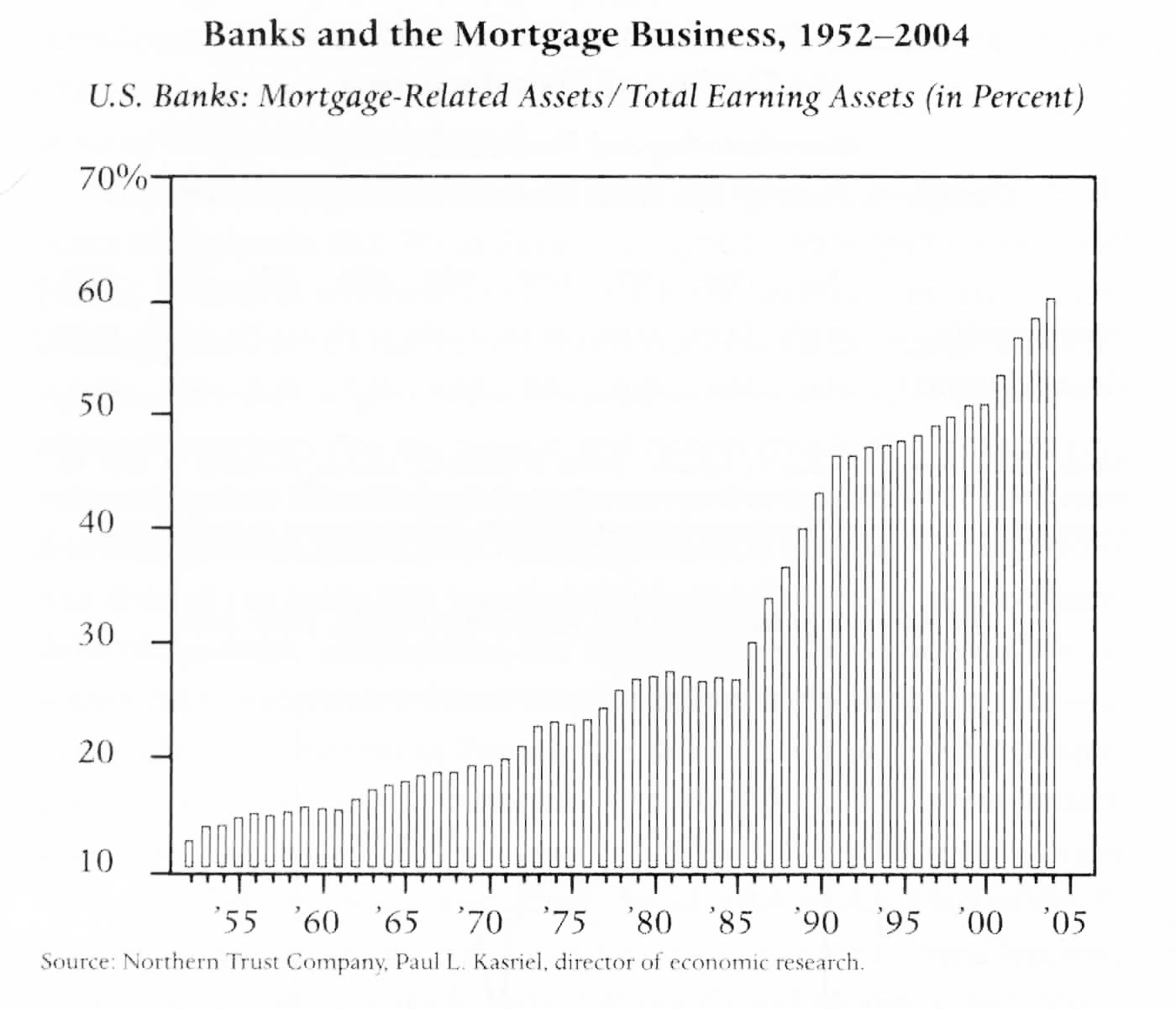 Over the past 60 years, and especially since the mid-1980s, mortgages and mortgage securities
have formed an ever-growing percentage of bank assets, and have contributed an ever-growing
percentage of bank profits. (See graph at right for the situation in the U.S. from 1952 to
2004.)
Over the past 60 years, and especially since the mid-1980s, mortgages and mortgage securities
have formed an ever-growing percentage of bank assets, and have contributed an ever-growing
percentage of bank profits. (See graph at right for the situation in the U.S. from 1952 to
2004.)