WAGE
[As used by Marx:] The price of labor-power.
Wages may be paid for employing labor-power
by the hour (or other period of time), or as a piece-wage (a set price for the
labor-power used to complete each unit of work done). But either way, the labor-power
which is sold by the worker to the capitalist is (normally) sold at or near its actual
value (i.e., its “value” considered as a technical term
within Marx’s theory of capitalist political economy). Nevertheless, the worker’s actual
labor creates more value in terms of his or her output than the value of his
labor-power which he/she sells to the capitalist for wages. This
surplus value is the source of the capitalist’s profit.
In other words, the wage paid by the
capitalist to the worker does equal the value of his or her labor-power, but it does
not at all equal the value of his or her actual labor. This distinction between
labor and labor-power, while confusing at first, is thus critical in coming to understand how
the capitalist exploitation of workers occurs.
While, strictly speaking, wages should be
considered to be the price of labor-power, it is also possible to analyze either wages
or the work day as a whole in terms of the actual labor the worker performs (and the
full value that it generates). From this point of view the worker is only paid for part of
his or her day’s work, say for 3 hours of the 8 hours actually worked, and works for free for
the capitalist for the other 5 hours. Of course capitalists prefer that you do not
analyze things this way!
Wages are discussed in depth by Marx in
Capital, Vol. I, part 6. It is important for every Marxist to study this section of
capital until they are quite clear on the basic concepts and can help explain them to
others.
WAGES — Falling
[Intro to be added...]
“Men who do have jobs are getting paid less. After accounting for
inflation, median wages for men between 30 and 50 dropped 27 percent—to $33,000 a
year—from 1969 to 2009, according to an analysis by Michael Greenstone, a
Massachusetts Institute of Technology economics professor who was chief economist
for Obama’s Council of Economic Advisors. ‘That takes men and puts them back at
their earnings capacity of the 1950s,’ Greenstone says. ‘That has staggering
implications.’” —“The Slow Disappearance of the American Working Man”, Bloomberg
Business Week, Aug. 29-Sept. 4, 2011, p. 26.
WALL STREET
The center of the financial district in New York City, and—by extension—a nickname for
the entire financial industry in the U.S.
“Wall Street owns the country. It is no longer a government of the
people, by the people and for the people, but a government of Wall Street, by Wall
Street and for Wall Street.” —Mary Lease, a populist reformer speaking on behalf of
the Farmers’ Alliance in 1890, quoted in Bruce Levine, Who Built America?
(1947), p. 147.
“If we are Rome, Wall Street’s our Coliseum.” —Paul Farrell,
business news reporter with MarketWatch.com, August 2007.
“When as a child I first read stories of brokers jumping to their
deaths after the 1929 Wall Street crash, I thought they were meant to illustrate
the humanity of the situation. After reading about people’s anger at bailing out
banks [in this latest financial crisis], I now understand that they were actually a
manifestation of what the public wanted to see: the villains having the deceny to do
themselves in.” —Harald Anderson, letter to the editor, The Economist, Feb. 13,
2010.
WAR—“Who Started It?”
[Intro material to be added... ]
“All philistines and all stupid and ignorant yokels argue in the same
way as the renegade Kautsky supporters, Longuet supporters,
Turati and Co.: ‘The enemy has invaded my country, I don’t
care about anything else.’
“The socialist, the revolutionary
proletarian, the internationalist, argues differently. He says: ‘The character of the
war (whether it is reactionary or revolutionary) does not depend on who the attacker
was, or in whose country the “enemy” is stationed; it depends on what class is
waging the war, and on what politics this war is a continuation of. If the war is a
reactionary, imperialist war, that is, if it is being waged by two world groups of the
imperialist, rapacious, predatory, reactionary bourgeoisie, then every bourgeoisie
(even of the smallest country) becomes a participant in the plunder, and my duty
as a representative of the revolutionary proletariat is to prepare for the world
proletarian revolution as the only escape from the horrors of a world
slaughter. I must argue, not from the point of view of “my” country (for that is the
argument of a wretched, stupid, petty-bourgeois nationalist who does not realize that
he is only a plaything in the hands of the imperialist bourgeoisie), but from the point
of view of my share in the preparation, in the propaganda, and in the
acceleration of the world proletarian revolution.’” —Lenin, “Proletarian Revolution
and the Renegade Kautsky” (Oct.-Nov. 1918), LCW 28:286-7.
WAR COMMUNISM
The period in revolutionary Russia from around mid-1918 until March 1921 when in the midst
of civil war and foreign military invasions, the new Soviet state was forced to employ drastic
economic measures, and ones which would otherwise have at least been viewed as very premature,
in order to defeat the enemies of the revolution. Lenin and the Bolsheviks sought to muster
all the economic resources in the areas they controlled for the war effort and almost all
industrial enterprises were nationalized. Strenuous efforts were made to centralize the
management of production and distribution to the maximum degree possible within the social
chaos then prevailing.
In this desperate situation all private trade
was officially banned (though it continued illegally to a considerable extent) and a
surplus-appropriation system was put into place in which the peasants were forced to sell all
surplus agricultural products to the state at set prices. Because of the massive destruction
and dislocations of the war a rationing system was established
and widespread labor conscription and the leveling of wages was introduced. Although the
outcome of the military and political struggle was close, these policies did allow the
Bolsheviks to prevail.
It was by no means the original intention of
Lenin and the Bolsheviks to immediately introduce socialism after achieving state power.
“Everybody agrees that the immediate introduction of socialism in Russia is impossible,” he
wrote in June 1917 [LCW 25:69]. And in December 1917, after the seizure of power, he still
wrote that “There was not and could not be a definite plan for the organization of economic
life.” [LCW 26:366] But the civil war and foreign invasions forced their hand.
Lenin and most of the other Bolshevik leaders
seem to have expected that once War Communism was firmly established it would continue in
place, only somewhat modified, even after the civil war was won and the foreign invaders
were pushed out. However, it became obvious to Lenin, at least, that the increasingly
desperate economic situation would not allow this. During the war the peasantry put up with
a lot of harsh treatment, and even the confiscation of their agricultural products, because
they feared the return of the landlords if the Bolsheviks were defeated. But black market
activity had mushroomed and the people in the countryside were hungry, cold, exhausted and
none too healthy—disease was widespread. Many city people had fled to the countryside
during the civil war and were in the same serious situation there themselves. The peasants
were now unwilling to produce goods that would simply be requisitioned from them without any
real payment, and even some rebellions broke out. Most factories in the cities had closed
down because of the lack of materials, fuel and available workers. In short the economic
situation was even more desperate once the civil war ended. On top of this the Kronstadt
Revolt of sailors which occurred during the Tenth Party Congress (March 1921) really shocked
the Bolsheviks.
Lenin also acknowledged that mistakes had
been made during the period of War Communism, and particularly in the treatment of the
peasantry. Clearly a temporary retreat back to capitalism in both the countryside and the
city was now necessary. (Although in industry the form it mostly took was worker-supervised
state capitalism.) This retreat was
necessary in order to preserve the worker-peasant alliance that was the backbone of the
revolution.
Just as there was resistance—even within
the Bolshevik party—to the establishment of War Communism, there was even more resistance to
the temporary retreat from it which became known as the New Economic
Policy (NEP). Lenin had great difficulty in convincing the party to go along with this
retreat, and he might not have been successful if it was not for the Kronstadt Rebellion
which so alarmed the party. And once the NEP was in place for a few years, there was likewise
some major resistance from the right wing of the party to abandoning it! Lenin always argued
that Marxism requires a “concrete analysis of concrete conditions” and every truly necessary
change in political or economic policy in a revolution is met with resistance and the need
for another round of struggle.
“WAR ON DRUGS”
A cynical, decades-long program conducted by the U.S. government in the name of “fighting”
illegal narcotics. The real aim is to control and regiment the population, particularly the
Black and lower working class population, and to act as a cover for continued U.S. interference
in the internal affairs of other countries. In the words of Noam Chomsky, the aim of the war
on drugs is to find a solution to the “superfluous people” who were left out of Ronald
Reagan’s free-market fundamentalist reforms. Actually, the war started under Richard Nixon,
but it gained both momentum and ideological clout during Reagan’s presidency, and continues
to this day in roughly this spirit.
The war on drugs reveals with unusual clarity
the class component of state policy. Those who have been imprisoned are predominantly Black
and Latino working class people, thrown behind bars on charges that would not even count as
criminal offences in many other major capitalist states. The people who benefit most greatly
from the flow and trafficking of narcotics remain relatively unscathed. Firstly, they are
often themselves members of the ruling class or are closely linked to them, and hence can
afford better legal representation in the event that they are caught; they can also distance
themselves from the grubby business “on the ground” by hiring underlings to do their dirty
work; they can hide their transactions more effectively (Noam Chomsky, writing around the
time of the U.S. invasion of Panama, asked sardonically why George Bush did not also order
commando raids on major New York banks, who were known to be benefitting from keeping drug
money); etc.
Secondly, the war on drugs is characterized
by an enormous amount of corruption. The police officers and detectives who staff narcotics
bureaus and drug task-forces are themselves often in the pay of, or are in collusion with,
drug dealers and traffickers. Thus, the people that they tend to actually target will be
easy pickings, i.e. those who have already been stigmatized with the image of immersion in
a drug-infested culture.
The war on drugs also incorporates the
anti-cartel program in Mexico, which has experienced a horrific spiral in violence between
the state and powerful drug cartels there (which have now become so powerful that state
employees regularly complain that their resources and equipment are inferior to those of the
cartels!). Ironically, many experts agree that the power of these criminal organizations is
aided by anti-drug policies in the US, which has taken such an inflexible line on drugs such
as marijuana that the demand from within the U.S. supplies a ready market for the cartels, who
battle viciously for hegemony of transit routes to the United States.
Another front in the war on drugs involves
the very bloody civil war in Colombia, an ongoing, decades-long struggle between nominally
Marxist guerillas called the FARC-EP (Fuerzas Armadas Revolucionarias de Colombia – Ejército
del Pueblo, or Revolutionary Armed Forces of Colombia – People’s Army) and the Colombian
state and its capitalist-landlord benefactors. The Colombian military has benefitted from
aid and training providing by the U.S. government, which claims that this assistance is
primarily for the purpose of executing an anti-drug effort. However, even the U.S. government’s
own agencies and research bodies affiliated with it (like the RAND Corporation) acknowledge
that the FARC-EP plays a relatively minor role in the drug trade, and that the right-wing
paramilitaries (allied both to the landlords and the official military) are by far the geater
participants and beneficiaries of narcotics trafficking and production (indeed, the
involvement of the Colombian government puts the FARC-EP’s collusion to shame); the RAND
Corporation also found treatment programs to be much more cost effective than interdiction.
The militarization of the drug war, then, is clearly something that primarily serves purposes
other than fighting drugs! In Colombia, the U.S. involvement is simply counter-insurgency
against a leftist group fighting the capitalist-landlord configuration that controls the state
there.
Colombia is also a key U.S. ally in the region,
which has seen the coming into office of various left-leaning governments, notably those of
Hugo Chavez in Venezuela and Evo Morales in Bolivia. The Colombian state continues to be an
important strategic resource for U.S. imperialist interference in the affairs of Latin America.
Interestingly, Colombia is also where the U.S. government, then under the leadership of John F.
Kennedy, initiated its policy of reorienting Latin American militaries from their hitherto
role of “hemispheric defense” to “internal security” (fascist repression). This template was
then adopted by the bourgeoisies in other Latin American countries, which experienced a
series of bloody coups and militariy dictatorships, virtually all of which were supported by
the United States. Now that the pretext of the Cold War has been lifted, the war on drugs
provides the required cover for U.S. intervention. The guerilla threat has little to do with
narcotics; the FARC-EP are much more troublesome in the sense of their targeting of oil
pipelines and occupation of mineral-rich areas that the government wants to open up to
exploitation by multinational corporations. Colombia, incidentally, has by far the worst
human rights record in the Western hemisphere, and one of the world’s largest internally
displaced populations. This is the true face of the war on drugs, largely hidden from view of
American audiences, who are more accustomed to associating this campaign with what they are
shown on TV shows about police, crime dramas, etc. —L.C.
“WAR ON TERROR”
An ongoing program by the American and other imperialist states around the world to “combat”
and “defeat” terrorism. This purported aim is necessarily completely ridiculous, as capitalist
states are themselves the biggest perpetrators and supporters of terrorism in the world, and
there is certainly no talk of ending that! Nevetheless, this program does target certain
terrorist organizations who oppose the strategic interests of U.S. imperialism, particularly
Islamist groups in the Middle East who want to expel the Western presence in their countries.
The war on terror has both a law enforcement
and a military component. The latter aspect has actually contributed to a sharp increase in
terrorism (at least in such places as Iraq and Afghanistan that have been targeted and
destabilized by imperialism), as anticipated by some agencies of the U.S. government itself. It
has, however, acted as a cover for an expansion of state power over its own population, through
increased powers of electronic surveillance and wiretapping, arrest and detention, the
criminalization of protest, the furtherance of a type of quasi-fascist public discourse about
“values” and “civilization”, the increasing normalization of torture, and a further expansion
of military spending at the expense of urgently needed social programs. The war on terror has
also been used by dictatorial regimes to increase their bargaining power and prestige with the
imperialists, as they can present themselves as valuable and necessary bullwarks against
Islamist extremism while continuing to rob and terrorize their own people.
The law enforcement aspect of the war has
yielded some successes in the stated aim of neutralizing terrorist cells in the imperialist
centers, but the broader war, which is overwhelmingly militarized, has been spectacularly
stupid and self-defeating from the point of view of achieving the bourgeoisie’s more central
aims (and, ironically, will probably come to undermine the law enforcement aspect, given the
hatred generated by military action and occupation). The countries and communities that are
targeted by the war on terror invariably end up becoming even more distrustful and hateful of
the U.S. government; they correctly perceive what liberal bourgeois commentators and other
“experts” can’t: that the invasions and occupations undertaken in the name of fighting
terrorism are actually criminal operations aimed at controlling natural resources and gaining
geopolitical leverage. In many cases these actions even lead to large segments of the
population actively assisting groups who fight against the invasions, and who thus come to earn
the designation “terrorist”, whether or not they are involved in killing civilians. However,
it should be noted that even the term “civilian” can mean different things. People who are
collaborating with the occupation, for example, can technically be civilians, and such people
have certainly become the targets of insurgent attacks. In Iraq, for example, entire segments
of the population supported armed groups who were fighting against and killing American troops;
even the comprador state now in power in Bagdhad has insisted that the U.S. military leave their
country because acquiescing to American demands has simply become too embarrassing!
On the other hand, of course, the U.S. government
has no choice, when other measures fail, to engage in these aggressive actions if it is to
maintain its control of strategically important parts of the world. Thus whatever the
imperialists do will eventually blow up in their faces (unfortunately, at the cost of hundreds
of thousands and even millions of working class and peasant lives). This is yet another example
of capitalism’s contradictions: capitalist-imperialism cannot possibly serve both the
fundamental interests of the people it represents (i.e the ruling class in the imperialist
states, and secondarily the comprador bourgeoisie in the dominated countries) and the masses
that it is bullying and harrassing. This elementary fact is completely lost on liberal
bourgeois comentators, who believe that the root cause of antagonism between U.S. imperialism
and the world’s masses orginates in “errors” made by U.S. presidential administrations, military
commanders, etc! Thus we hear these commentators talk about things like the U.S. “commitment”
to the people of Iraq (as though that were the focus and driving force of its criminal
enterprise in that country), while ignoring the very reasons for the invasion and devastation
of that country. These commentators simply cannot bring themselves to acknowledge what the
internal record of their own favored state says about the actual reasons and ambitions
propelling imperial policy.
The war on terror, needless to say, has killed
far more people than the terrorists it is purportedly trying to root out. Interestingly, many
of the same terrorists being captured and killed were once in cahoots with the CIA in
Afghanistan during the war against the Soviets, when the United States was funneling weapons
and money to the religious fundamentalist forces of the mujahedeen. This covert operation was
the most expensive in CIA history, and involved the cooperation and further financial backing
of the clerical-fascist regime in Saudi Arabia and the fascist military dictatorship in
Pakistan (which was funding its involvement partly through drug trafficking). It is also a
massive source of corruption and waste. But its useful features for the bourgeoisie—ideological
and police-state regimentation of the population in times of increasing hardship for the
workers, and a cover for further imperialist intervention—are so great that the bourgeoisie is
quite willing to overlook these negative aspects and keep promoting it as, at worst, a
“necessary evil”, but more often as a “moral duty”.
More recently, the United States has made
increased use of “unmanned aerial vehicles” or “drones” (remote
controlled aircraft carrying bombs), particularly in Pakistan. One of Barack Obama’s first
actions as President was to order a drone strike in a Pakistani village where some militants
were thought to be present. The attack wiped out dozens of civilians. The drone program in
Pakistan has killed hundreds of civilians over the past few years, angering and inflaming both
the Pakistani masses and rotten Pakistani government (who, if for no other reason than
self-preservation, have had to make a show of condemning these examples of U.S. terrorism and
mass murder).
U.S. policy makers have indicated that the war
on terror may last for decades more, if not indefinitely. Conveniently, this is also the
timeframe in which China, the United States’ premier imperialist competitor, is expected to
increasingly flex its military and economic muscle. A perpetual war on terror provides an
excellent pretext to keep ramping up military spending and garrisoning the planet with
military bases and naval forces, though an eventual full-blown “Cold War” with China will do
the job just as nicely! —L.C.
See also:
TARGETED KILLING
WATER MARGIN
A 14th century Chinese novel, written in the vernacular, about a peasant war near the end of
the Northern Song [Old style: Sung] Dynasty (960-1127 CE). This novel is also known as Outlaws
of the Marsh, All Men are Brothers, and by other names. It is attributed to Shi Nai’an
and is often viewed as one of the four great classical Chinese novels.
The leader of the peasant uprising in this novel
is Chao Gai [Chao Kai]. After his death, Song Jiang [Sung Chiang], a representative of the
landlord class who has wormed his way into the ranks of the peasant army, grabs the leadership
and surrenders to the emperor. Mao and other Chinese revolutionaries sometimes made reference to
this novel.
“The merit of the book Water Margin lies precisely in the portrayal
of capitulation. It serves as teaching material by negative example to help all the people
recognize capitulationsists.” —Mao, quoted in Peking Review, #6, Feb. 4, 1977, p.
16.
WAVE-PARTICLE DUALITY
A central aspect (dogma?) of the theory of quantum mechanics
that maintains that light and all other matter simultaneously has characteristics which
must be understood by assuming that it is a wave, and other characteristics which must be
understood by assuming that it is composed of discrete particles. The idea of wave-particle
duality was first formulated for electro-magnetic radiation (light) by early quantum physicists
such as Max Planck and Niels Bohr, and for matter in general by
the British physicist Louis de Broglie, and is now the standard view within quantum mechanics.
However, some physicists (such as Richard Feynman) have denied that this is really true.
“I want to emphasize that light comes in this form—particles. It is
very important to know that light behaves like particles, especially for those of you
who have gone to school, where you were probably told something about light behaving
like waves. I’m telling you the way it does behave—like particles.
“You might say that it’s just the
photomultiplier that detects light as particles, but no, every instrument that has been
designed to be sensitive enough to detect weak light has always ended up discovering the
same thing: light is made of particles.” —Richard Feynman, QED: The Strange Theory of
Light and Matter (1985), p. 15.
“This strange phenomenon of partial reflection by two surfaces can be
explained for intense light by a theory of waves, but the wave theory cannot explain how
the detector makes equally loud clicks as the light gets dimmer. Quantum electrodynamics
‘resolves’ this wave-particle duality by saying that light is made of particles (as
Newton originally thought), but the price of this great advancement of science is a
retreat by physics to the position of being able to calculate only the probability
that a photon will hit a detector, without offering a good model of how it actually
happens.” —Richard Feynman, ibid., pp. 36-37.
WEAKEST LINK
The point in a chain at which it is most vulnerable to breaking. For those seeking to break
the chain, this is a point to be concentrated on. For those seeking to keep the whole chain
together, this is also a point to be concentrated on!
“In science, our knowledge is only as strong as the weakest link in
the chain of understanding.” —Stephen Rothman, a prominent (non-Marxist) American
biologist, Lessons From the Living Cell (2002), p. 17.
WEALTH DISTRIBUTION — In the U.S.
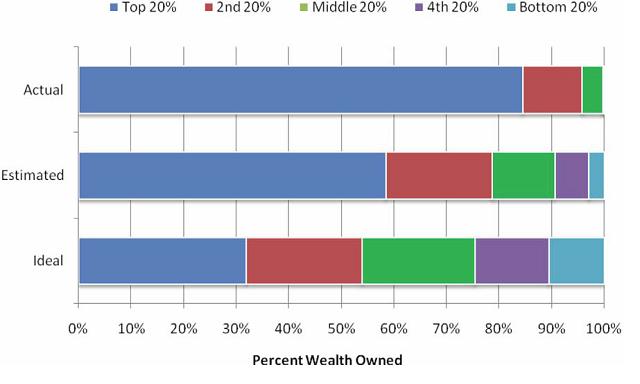 The graphic at the right shows the actual United States wealth distribution (in quintiles), i.e.,
the proportion of wealth that the top 20% of the population owns, the proportion owned by the
next 20%, and so forth. Also shown is what the average American thinks the wealth
distribution is, and what the average American (even in this bourgeois society) thinks it
really ought to be. Note that Americans are greatly underestimating the proportion of
all wealth that the top 20% owns (in reality about 84%), and vastly overestimating the
wealth that the bottom 20% owns. (Because of their extremely small percentage share of total
wealth, both the “4th 20%” value (0.2%) and the “Bottom 20%” value (0.1%) are not even visible
in the “Actual” distribution.) [From: Michael Norton & Dan Ariely, “Building
a Better America—One Wealth Quintile at a Time”, Perspectives on Psychological Science,
vol. 6, #1 (2011).]
The graphic at the right shows the actual United States wealth distribution (in quintiles), i.e.,
the proportion of wealth that the top 20% of the population owns, the proportion owned by the
next 20%, and so forth. Also shown is what the average American thinks the wealth
distribution is, and what the average American (even in this bourgeois society) thinks it
really ought to be. Note that Americans are greatly underestimating the proportion of
all wealth that the top 20% owns (in reality about 84%), and vastly overestimating the
wealth that the bottom 20% owns. (Because of their extremely small percentage share of total
wealth, both the “4th 20%” value (0.2%) and the “Bottom 20%” value (0.1%) are not even visible
in the “Actual” distribution.) [From: Michael Norton & Dan Ariely, “Building
a Better America—One Wealth Quintile at a Time”, Perspectives on Psychological Science,
vol. 6, #1 (2011).]
Moreover, even within the top 20% of the
population the wealth is very concentrated in the top few percent. Some estimates indicate
that the top 1% of the U.S. population, the biggest bourgeoisie, owns nearly 50% of all the
wealth. [J. B. Davies, et al., “The global pattern of household wealth”,
Journal of International Development, vol. 117 (2009).] The concentration of
wealth in the U.S. today tops even that of 1929, just before the Great Depression of the
1930s!
“The top hundredth of 1 percent of U.S. taxpayers—that’s 16,000 people—have
a combined net worth of $6 trillion. That’s as much as the bottom two-thirds of the
population. Meanwhile, a quarter of American families say they have no money in a checking
or savings account to cover an emergency, according to Bankrate.com.” —Peter Coy, “An
Immodest Proposal”, Bloomberg BusinessWeek, April 4-14, 2014, p. 10.
WEALTH EFFECT
The correlation between an individual’s actual personal wealth, or more typically their
perceived wealth, and their willingness to buy things and go further into debt. People
in contemporary capitalist societies have been conditioned to borrow and spend more when they
feel that their net wealth is increasing—even if they still have very large debts.
During the U.S. housing bubble of the years
2003-2007, for example, the fact that the market value of homes was increasing rapidly for a
few years led many people to take out a second mortgage, or refinance their existing mortgage
with a cash-out option (i.e., to get an additional loan from the bank in return for signing
over more of the value of their house to the bank). This seemed like a good idea to them at
the time, because the capitalist media led them to believe that home prices would continue to
rise indefinitely (and therefore that their net wealth would continue increasing indefinitely).
Since the housing bubble popped, and the “Great Recession”
hit, millions of these people have already lost their homes. As is nearly always the case in
the end, the “wealth effect” turned out to be a dangerous illusion for the mass of working-class
people.
“Economists have only recently devoted serious study to how a decline in
housing prices affects consumer spending, not least because this is the first decline in
the average price of an American home since the Great Depression [of the 1930s]. A 2007
review of existing research by the Congressional Budget Office reported that people reduce
spending by $20 to $70 a year for every $1,000 decline in the value of their homes.
“This [negative] ‘wealth effect’ is
significantly larger for changes in home equity than in the value of other investments,
such as stocks, apparently because people regard changes in housing prices as more likely
to endure.” —“Gloom Grips Consumers, and It May Be Home Prices”, New York Times,
Oct. 18, 2011.
WEATHER UNDERGROUND ORGANIZATION
A very small but notorious U.S. revolutionary organization of student orgins which existed
from 1969 to 1977, with little in the way of developed revolutionary theory, no mass
practice and no mass base. It is known mostly for its initial violent demonstration in
Chicago in October 1969 against the U.S. imperialist war of aggression against Vietnam (the
“Days of Rage”), and its sporadic and very counter-productive
campaign of bombings of U.S. government buildings up through the mid-1970s.
The WUO was originally a faction of the
Students for a Democratic Society (SDS), the tiny faction in control
of the SDS National Office in its last days. (Indeed, their antics were major factors
in wrecking what remained of SDS and making those its last days.) Like most of SDS, the
Weatherman faction was quite marked by its white, petty-bourgeois origin and makeup. While
it did take a very strong stand against U.S. imperialism, and also strong stands in favor of
Black liberation and women’s liberation, it had little or no connection with the working
class, and seemed not even to want any such connection. It was more aligned with the
youth counter-culture. Thus one of its characteristic capers was to aid a jailbreak and
escape for Timothy Leary, the LSD drug guru!
For the most part the bombings it carried
out were symbolic and did little actual damage. In one case they blew up a woman’s bathroom
in the Pentagon, for example. These bombings were an expression of the helpless rage that
those unconnected to mass movements often feel against oppressive governments. Looking back
at those days, one former member of the group expressed their frustration this way:
“We felt that doing nothing in a period of repressive violence is
itself a form of violence. That’s really the part that I think is the hardest for
people to understand. If you sit in your house, live your white life and go to your
white job, and allow the country that you live in to murder people and to commit
genocide, and you sit there and you don’t do anything about it, that’s violence.”
—Naomi Jaffe, in the documentary The Weather Underground, produced by Carrie
Lozano and directed by Bill Siegel and Sam Green, 2003.
The terrible crimes of capitalist-imperialism do indeed demand a response! The trouble
was that what the WUO decided to do was actually extremely counter-productive. The occasional
bombings they engaged in did no serious harm at all to the U.S. government. And they had the
effect of turning large numbers of ordinary American people, including students, more
against the anti-war movement and any idea of revolution, than towards it. By
thus finishing off SDS as a mass student organization they made it more difficult both to
build the anti-war movement and to educate more young revolutionaries.
In December 1969, the Chicago police and
FBI raided the apartment of local Black Panter leader Fred Hampton, killing Hampton in his
sleep (he had been drugged by a police agent) and Mark Clark, and wounding three other
people. In early 1970, in response to this unprovoked murderous raid, the WUO issued a
“Declaration of War” against the U.S. government, shifting to underground, covert activities
only. This declaration was however mere posturing. It was more rage by helpless individuals
cut off from any mass base actually capable of changing the situation.
While always very small, by 1976 the FBI
estimated that the WUO was down to less than 30 active members. They completely disbanded
by the end of 1977, and many of them turned themselves in to the authorities.
See also:
PRAIRIE FIRE ORGANIZING COMMITTEE
WEATHERMAN
The original name of the Weather Underground anarchist-like
revolutionary organization.
WEBER, Max (1864-1920)
German bourgeois sociologist, born in Erfurt and educated at universities in Heidelberg,
Berlin and Göttingen. He began his professorial career by teaching law in Berlin in 1892,
switched to teaching political economy at Freiburg in 1894, and then economics at Heidelberg
in 1897. (All bourgeois economics, of course.) He did not actually consider himself to be a
sociologist until near the end of his life. In 1897 he suffered a serious mental breakdown and
did no significant work for about four years. Then, for a number of years he was mostly an
unaffiliated private scholar, working on a wide variety of topics. In 1918 Weber accepted the
chair of sociology at the University of Vienna, and finally in 1919 took over the chair of
sociology at Munich.
Max Weber (along with
Émile Durkheim) is widely regarded as one of the
principal founders of “modern sociology”, which from its beginning as an intellectual area of
study at universities was created and developed in contrast and opposition to Marxism. The
philosophical basis that Weber provided for this new subject of academic “sociology” was
neo-Kantianism, of the school associated with Wilhelm Windelband and Heinrich Rickert in late
19th century Germany. This philosophy drew a total distinction between “phenomena”, or the
external world we perceive, and
“noumena”, or the perceiving mind or consciousness. Weber
considered this distinction to be the difference between the basis for natural science and
social science, and this confirms the fundamental philosophical idealism
of Weberian sociology. For example, one of the conclusions Weber drew on this Kantian philosophical
basis, was that sociology could not establish any scientific laws (as is done in physics,
chemistry and biology), but rather only to try to give some plausible explanations for social
developments in their particular historical contexts. Despite this denial of any true scientific
laws in sociology, Weber did suppose that the “probabilities” of human action (such as that people
are likely to act rationally much of the time) allow for some limited understanding of society.
Similarly, Weber promoted the Kantian value/fact
dichotomy which is still so widespread in bourgeois “social science”, and claimed for example
that there is no rational basis for determining moral goals—though he did acknowledge that there
are rational ways to proceed once one set of goals or another are adopted. Of course, for
revolutionary Marxists the setting of moral (and political) goals is a simple and very rational
matter: we say that those things which are in the real beneficial
interests of the proletariat and masses are good and rational goals, including the
central goal of making social revolution upon which so many other goals depend. [See:
Class Interest Theory of Ethics] Like all
Kantians, Weber was opposed to what they snidely call “instrumental rationality” in ethics. For
them paying any attention to what benefits people, let alone classes of people, has no
bearing at all on ethics!
It is difficult for a revolutionary Marxist to
find much of anything whatsoever of real value in Weber’s voluminous writings. Sometimes he just
makes abstract classifications that really don’t explain anything. (Such as his division of
social action into four categories: “traditional action” undertaken because of
long-established cultural norms; “affective action” driven by emotions; “value-rational” action
directed towards achieving social values; and “end-rational action” or “instrumental action”.
Or consider his superficial discussion of “domination” in society, where he focuses on
distinguishing three types of authority: “traditional”, “charismatic”, and “legal-rational”.
What really is the value of such “analysis”?)
Other times Weber is focused on cutting the heart
out of Marxist categories, as when he talks about social “classes” but perverts the idea to mean
various things other than the relationship of groups of people to the means of production.
(In some places he defines “classes” as groups of people defined by the possession of various
skills and other marketable assets, or talks about “housing classes” which include owner-occupants,
tenants/renters, etc.) Similarly he talks about “status groups”, ethnic groups, and numerous
other ways of classifying people, but almost always avoids our Marxist concept of social
classes.)
One of Weber’s best-known theses is that of the
“Protestant ethic”, which supposedly explains why capitalism developed in Europe. (But compare
this superficial theory to the discussions of Marx and other Marxists who go into great depth
about how and why feudalism developed into capitalism.)
There are disputes within academic sociology as
to exactly what Weber’s political view were. Weber’s criticisms of socialism always either
entirely misunderstand what genuine socialism is, or else purposely distort what it is, as in
his claim that socialism inevitably aggravates the problem of bureaucracy. Some argue that Weber
was a proto-fascist; others that he was more of a liberal. The fact that his writings can be
read to support either view already says something very negative indeed about him! One thing is
very clear, however: he was a bourgeois ideologist to his very core. It is strange that even
today, and even on the so-called “left”, there continues to be some interest in his reactionary
views.
“I am a member of the bourgeois class, feel myself to be such, and have
been brought up on its opinions and ideals.” —Max Weber, 1895, quoted in Franco Moretti,
The Bourgeois: Between History and Literature (2014).
“WESTERN MARXISM”
A petty-bourgeois distortion of Marxism which has developed at universities in capitalist
countries in the “Western” part of the world. The revolutionary heart of Marxism is virtually
entirely cut out in this milieu, and the major focus is the sphere of culture, which is discussed
in pretentious academic and esoteric language. So-called “Western Marxism” reflects decadent
bourgeois ideology far more than it does Marxism. My advice is that you don’t waste your time
with this sort of garbage; it can only corrupt your brain. —S.H.
“Western Marxists therefore placed far greater emphasis on the importance
of what Marx called superstructure—culture, institutions, language—in the political
process, so much so that consideration of the economic base sometimes disappeared
altogether. Unable to change the world, they concentrated on interpreting it through
what became known as ‘cultural studies’—which established its own hegemony on many
university campuses in the final decades of the twentieth century, transforming the study
of history, geography, sociology, anthropology and literature....
“That realm [of the superstructure]
was defined far more broadly than Marx ever imagined. It encompassed any and every sort
of cultural commodity—a pair of winklepicker shoes, a newspaper photograph, a pop record
and a packet of breakfast cereal were all ‘texts’ that could be ‘read’. The critique of
mass culture from early theorists influenced by the Frankfurt
school was gradually supplanted by a study of the different ways in which people receive
and interpret these everyday texts. As cultural studies took a ‘linguistic turn’—evolving
through structuralism, post-structuralism,
deconstruction and then
postmodernism—it often seemed a way of evading politics
altogether, even though many of its practitioners continued to call themselves Marxists.
The logic of their playful insistence that there were no certainties or realities led
ultimately to a free-floating, value-free relativism which
could celebrate both American pop cultural and medieval superstition without a qualm.
Despite their scorn for grand historical narratives and general laws of nature, many seemed
to accept the enduring success of capitalism as an immutable fact of life. Their subversive
impulses sought refuge in marginal spaces where the victors’ dominance seemed less secure:
hence their enthusiasm for the exotic and unincorporable, from UFO conspiracy theories to
sado-masochistic fetishes. A fascination with the pleasures of consumption (TV soap
operas, shopping malls, mass-market kitsch) displaced the traditional Marxist focus on
the conditions of material production.... No systematic critique of monopoly capitalism
could be achieved since capitalism was itself a fiction, like truth, justice, law and all
other ‘linguistic constructs’.” —Francis Wheen, Marx’s Das Kapital (2006), pp.
105-7.
WHAMPOA MILITARY ACADEMY
A military school founded in May 1924 by Sun Yat-sen at the
suggestion of the Soviet Union and the Communist Party of China. Sun appointed
Chiang Kai-shek as president of the Academy, and
Zhou Enlai [Chou En-lai] as director of the Academy’s political
department. Unlike most military schools, Whampoa is said to have attached equal importance to
military training and political education; however, much of this political education was of a
nationalist patriotic flavor. Several Soviet Red Army officers, including General Vasily Blucher
[“Galen”], were invited to serve as military advisors at the school and to the KMT as a whole.
A large number of members of the CCP and its Youth League studied at this Academy.
“[This] was a military school founded in 1924 by Dr. Sun Yat-sen with the
help of the Chinese Communist Party and the Soviet Union after he had organized the Kuomintang.
Located in Whampoa near Kwangchow [Guangzhou], it was jointly run by the Kuomintang and the
Communist Party until Chiang Kai-shek’s betrayal of the revolution in 1927.” —Note in Peking
Review, #11, March 11, 1977, p. 11.
WHAT IS TO BE DONE? [Book by Lenin]
An extremely important book by Lenin which was written at the end of 1901 and which first appeared
in early 1902, and whose full title was: What Is To Be Done? Burning Questions of Our Movement.
This book has played an important role in the establishment of communist parties not only in Russia,
but also in many other countries.
“In issue No. 12 (December [1901]) of Iskra, Lenin published his
article ‘A Talk with Defenders of Economism’ which he later called a conspectus of What
Is To Be Done? He wrote the Preface in February 1902 and early in March the book was
published by Dietz in Stuttgart. An announcement of its publication was printed in Iskra,
No. 18, March 10, 1902.
“What Is To Be Done? played an
important part in the struggle for a revolutionary Marxist party of the working class in Russia,
and in the victory of the Leninist Iskra trend in the committees and organizations of
the R.S.D.L.P. and at the Congress in 1903.
“In 1902 and 1903 the book was widely
distributed among the Social-Democratic organizations in Russia; it was found during police
searches and arrests of Social-Democrats in Kiev, Moscow, St. Petersburg, Nizhni-Novgorod,
Kazan, Odessa and other towns.” —Note 80, Lenin Selected Works, vol. 1 (1967).
“What is to be Done is a book of key importance for the Marxist
conception of the tasks of the working class party. To understand the circumstances in which it
was written, and as an aid to grasping its principal points, the reader should consult the
History of the C.P.S.U.(B.), Chapter I, Section 5 and Chapter II, Section 2.
“What is to be Done was directed
against those who in the early days after the establishment of a working class party in Russia
taught that the workers should engage in economic struggle only, concentrating on bread-and-butter
problems rather than political issues. Lenin saw in this trend the nucleus of opportunism in the
working class movement, of class collaboration.
“The ‘Economists,’ as they were called,
began their campaign by demanding ‘freedom of criticism’ in the party, attacking what they
called the ‘narrow political views’ of Lenin. The first chapter of What is to be Done is
accordingly devoted to the question of ‘Freedom of criticism.’ Lenin shows that the ‘freedom of
criticism’ demanded by the Economists means freedom to embrace bourgeois ideas instead of
Marxism, and that this opens the way to collaboration with the bourgeoisie. Of course, he says,
the Economists are ‘free’ to take the path of class collaboration, but not to drag the party
with them.
“Lenin shows that to confine the working
class movement to economic struggle alone means to give up the political struggle and so to
condemn the workers to eternal wage slavery. The Economists relied on the spontaneous movement
of the workers protesting against bad economic conditions. Lenin shows that to rely in this way
on spontaneity is ‘tailism’ (kvostism), i.e. it is to tail behind events, instead of
giving leadership. Political knowledge cannot arise in the working class movement spontaneously,
as a result of spontaneous economic struggle alone. Political knowledge, revolutionary theory,
must be introduced into the working class movement. The Economists belittled the role of theory.
But ‘without revolutionary theory there can be no revolutionary movement.’
“Lenin shows that the roots of opportunist
ideas and of opportunist policies in the labour movement lie in the attitude of relying on the
spontaneous movement and belittling the role of theory.
“In What is to be Done Lenin shows
concretely how to combine political and economic struggle. Working class political struggle
must be something much broader than mere ‘trade union politics.’ The workers must be concerned
with ‘the inter-relations between all the various classes,’ and must fight against every
manifestation of reaction. In advocating economic struggle alone, the Economists sank into
reformism, opportunism. But the struggle for reforms must be subordinated to the struggle for
for liberty and socialism.
“In What is to be Done Lenin also
deals with questions of party organization. He stresses the need for a centralized disciplined
organization, for the practical and theoretical training of revolutions, for a firm Marxist
theoretical basis.”
—Readers’ Guide to the Marxist Classics,
prepared and edited by Maurice Cornforth, (London: Lawrence & Wishart, 1953), pp. 47-48.
WHERE DO NEW THINGS COME FROM?
In answering this question the first essential bit of wisdom was stated by the ancient Roman
materialist philosopher Lucretius: Ex nihilo nihil fit. “Nothing can be made out of nothing.”
[From his great work De Rerum Natura, “The Nature of Things”.]
“So do new things arise ex nihilo, out of nothing? No, they arise
through the transformation of older things which had a different character, a different
essence (in the relevant respects). Thus ice does not arise out of nothing, but through the
transformation of something else, liquid water, under certain conditions (low temperatures).
Similarly, human beings did not suddenly appear out of nothing, nor out of some idealist
‘Godhead’, but rather we developed out of earlier forms of life, most recently from pre-human
ape-like hominids. And life itself did not originally ‘develop out of nothing’ (whatever that
might be taken to mean), but through the transformation of at least moderately complex
organizations of non-living chemical compounds.
“Sometimes we speak as though something
new and wonderful appeared out of the blue, out of nowhere, but really it is not true, and
when we stop to think about and investigate its origins this becomes clear. New things, and
changes in general, are a matter of the transformation of the old into the new, rather than
the miraculous creation of the new out of thin air.
“From this first basic and rather
obvious principle, we can derive a number of subsidiary principles, such as:
“1) To make something new, you
must start with something else which already exists, and find a way to transform it.
“2) Often there will be several
different existing things which can be transformed into more or less equivalent new things;
but...
“3) In these cases, one of the
existing things will almost always be more easily transformed into the new thing than any of
the others. (There’s almost always a ‘best way’ to proceed.)
“4) Thus a careful analysis must
be made of existing things to see what to start with in constructing the new thing.
“5) The old thing which can most
easily be transformed into the desired new thing may be quite unlike the new thing in important
respects. It may be glaringly deficient in the very characteristic that we are most interested
in, and thus be overlooked at first. (For example, it is vastly easier to transform an acorn
into an oak tree than it is to transform a maple tree into an oak tree—even though in many
respects the maple is much more like the full-grown oak than a little acorn is.)
“6) Since anything new is derived
from something old, it will still contain elements or aspects of the old thing.
“7) The only way the undesirable
remaining aspects of the old thing within the new thing can be eliminated is through a series
of further transformations. It is irrational to expect that something totally new can
be created through a single transformation. (Is anything ever really ‘totally new’? Certainly,
in the sense that its essential aspect(s) or characteristics may be completely new. But there
are always at least some other aspects of the thing which are not new. Thus there is
some little bit of truth to the point of view that ‘there is nothing new under the sun’, even
though it is essentially wrong.)
“Let us now apply these subsidiary
principles to a few of the many issues involved in social revolution. Why, for example, must
there be the transitional stage of socialism between capitalism and communism? It follows
immediately from principles 6 and 7. Socialism is the whole period during which a series of
transformations turns capitalism into communism.
“Next, how can the proletariat, which
originally and for long periods is unconscious of the need for revolution and of its
revolutionary role, come to be the revolutionary force which transforms society? Through its
own step-by-step transformation. From principle 1 we must find the ways to help transform the
proletariat into a conscious revolutionary force.” —Scott Harrison, excerpt from Chapter 31
of The Mass Line and the American Revolutionary Movement, online at:
http://www.massline.info/mlms/mlch31.htm
WILHELM II (1859-1941)
German emperor from 1888-1918 and 9th king of Prussia.
“Kaiser Wilhelm, the last emperor of the German empire and grandson of
of Wilhelm I, ascended the throne in 1888. When he was emperor, Germany developed and
became a powerful imperialist country with its industrial production ranking second only
to the United States. Acting in the interests of the bourgeoisie and junkers (big
landlords), this empire was actively engaged in arms expansion and war preparations and
stepped up its aggression and expansion overseas.
“To contend with the old-line
imperialist powers for world domination, the German imperialists headed by Wilhelm II
provoked World War I (1914-18). In November 1918 a revolution took place in Germany and
Wilhelm II was forced to step down and flee to Holland where he lived in exile. He died
in 1941.” —Reference note, Peking Review, #45, Nov. 4, 1977, p. 42.
WILL OF THE PEOPLE
There are two sayings that are worth carefully considering and comparing. The first is something
I once found in a fortune cookie, and which expresses the essential democratic ideal: “The will
of the people is the best law.” But here’s a little different idea that is also very good:
“Salus populi suprema est lex.” [The good of the people is the highest
law.] —Marcus Tullius Cicero, De Legibus, III, 3, 8.
So which is it then? Should the highest law be the “good of the people” or the “will of the
people”? Obviously there is a lot to be said for both views. But if we are forced to choose
between them, the “good of the people” has to be the highest ethical and political principle,
since after all, people do not always choose to do what is actually in their own best interests.
On the other hand, Cicero’s statement can be interpreted in a very
paternalistic manner, and those who rule paternalistically can
easily start to promote their own self-interest rather than the interests of the masses. For this
reason, over the long run the safest place for important political decisions to be made, is by
the people themselves.
So our solution to this puzzle must be along
these lines: To allow (and indeed insist on) basic democracy among the masses while at
the same time finding a way for those who better understand the real and long-term interests
of the people, and how those interests can best be satisfied, to educate them about this and
help them to avoid working against their own true interests.
Fortunately Marxism-Leninism-Maoism has found
a brilliant way to do just this. A political party to educate and lead the masses must be drawn
from among the masses and must constantly refresh itself with the best new representatives from
the masses. Such a party must devote itself to studying society scientifically, and carefully
studying the objective situation. And such a party must itself be constantly supervised by the
masses it leads, always be open to mass criticism, and always be willing to purge elements who
start to think only of their own personal welfare and interests. But most of all, such a party
must lead the masses in a truly democratic way, using the mass line
method of leadership. This is our way of combining democracy and the wisdom that comes
from all the previous experience and investigations of people throughout history. —S.H.
“To link oneself with the masses, one must act in accordance with the
needs and wishes of the masses. All work done for the masses must start from their needs
and not from the desire of any individual, however well-intentioned. It often happens that
objectively the masses need a certain change, but subjectively they are not yet conscious
of the need, not yet willing or determined to make the change. In such cases, we should
wait patiently. We should not make the change until, through our work, most of the masses
have become conscious of the need and are willing and determined to carry it out. Otherwise
we shall isolate ourselves from the masses. Unless they are conscious and willing, any kind
of work that requires their participation will turn out to be a mere formality and will
fail. ... There are two principles here: one is the actual needs of the masses rather than
what we fancy they need, and the other is the wishes of the masses, who must make up their
own minds instead of our making up their minds for them.” —Mao, Quotations, ch. XI;
originally from “The United Front in Cultural Work” (Oct. 30, 1944), SW 3:236-7.
WILLIAMS, Robert F. (1925-1996)
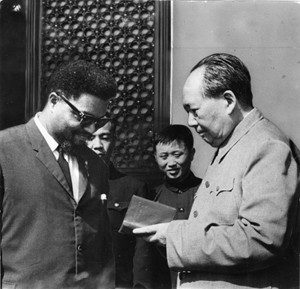 A radical American civil rights leader and proponent of armed self-defence for
African-Americans being terrorized by not only the Ku Klux Klan and individual racists, but
also sometimes by the local, state and national governments of the U.S. When Williams was
a boy his grandmother, a former slave, gave him the rifle that his grandfather had used to
defend himself in an earlier period. Williams became president of the Monroe, North Carolina
chapter of the NAACP in the 1950s and 60s. He also organized the Black Armed Guard to defend
the local Black community against KKK attacks. His 1962 book, Negroes with Guns,
further promoted armed self-defense, and served to inspire many others, most notably Huey
Newton and the Black Panther Party.
A radical American civil rights leader and proponent of armed self-defence for
African-Americans being terrorized by not only the Ku Klux Klan and individual racists, but
also sometimes by the local, state and national governments of the U.S. When Williams was
a boy his grandmother, a former slave, gave him the rifle that his grandfather had used to
defend himself in an earlier period. Williams became president of the Monroe, North Carolina
chapter of the NAACP in the 1950s and 60s. He also organized the Black Armed Guard to defend
the local Black community against KKK attacks. His 1962 book, Negroes with Guns,
further promoted armed self-defense, and served to inspire many others, most notably Huey
Newton and the Black Panther Party.
During a period of high racial tensions in
the area, a white couple linked to the KKK was stopped by an angry crowd of Blacks. Williams
escorted them away from the potential trouble and sheltered them in his own home. Ironically,
the state then charged him with kidnapping! Since there was no hope for a fair trial nor any
kind of justice, Williams fled the country and went to Cuba. From there he made regular
radio broadcasts to Southern Blacks on “Radio Free Dixie”, a station he established with the
help of Fidel Castro’s government. This station’s signal was hypocritically jammed by the
U.S. at the same time they condemned Cuba for jamming U.S. propaganda broadcasts directed
against that country!
The NAACP, Black religious leaders such as
Martin Luther King, the liberal white civil rights movement, and even the revisionist
(so-called) Communist Party, USA, all opposed Blacks arming themselves in self-defense
against racist attacks. In a 1964 letter to his lawyer, Conrad Lynn, Williams wrote that
“... the U.S.C.P. has openly come out against my position on the
Negro struggle. In fact, the party has sent special representatives here [to Cuba]
to sabotage my work on behalf of U.S. Negro liberation. They are pestering the Cubans
to remove me from the radio, ban THE CRUSADER [a newspaper Williams published] and to
take a number of other steps in what they call ‘cutting Williams down to size.’...
“The whole thing is due to the
fact that I absolutely refuse to take direction from Gus Hall’s idiots... I hope to
depart from here, if possible, soon. I am writing you to stand by in case I am turned
over to the FBI...”
In 1965 Williams and his wife left Cuba to settle in China, where he was warmly welcomed.
He was, however, never a Marxist or a communist. In August 1966, during the Cultural
Revolution, he and the Communist Party of China organized a major demonstration against
the continuing discrimination and oppression of Black people in the U.S. His
speech on that
occasion appeared in the Chinese publication Peking Review. In 1968 he was invited
home to the U.S. by Conrad Lynn and other supporters in order to run for U.S. president!
But he wisely decided that until he could reasonably be assured that he would not be sent
to prison he should not return. He did return to the U.S. in late 1969, where in the period
of warming relations between the U.S. and China his knowledge of China was welcomed at the
Center for Chinese Studies at the University of Michigan. There were continuing attempts
to extradite him to North Carolina, however, and this finally happened in 1976. However, by
then there was significant support for him from the left and from Blacks, and the charges
against him were soon dropped. In the years that followed Williams continued to work at the
Center for Chinese Studies. He died of Hodgkin’s disease in 1996.
For more information and a list of further
sources, see the Wikipedia
entry about Robert Williams, from which much of the material here has been taken.
WITHERING AWAY OF THE STATE
The Marxist conception that the class struggle, and the proletarian state which
enforces the rule of the proletariat over the bourgeoisie after the socialist revolution,
will gradually “wither away” and cease to exist.
The revolutionary Marxist view is that
every state is the organized agency of one
social class which exists for the purpose of maintaining by force
(“when necessary”) its own dictatorship over one or more other classes. Specifically, our
view is that the socialist state exists to exercize the dictatorship of the proletariat
over the remnants of the bourgeoisie it overthrew as well as over any new bourgeois elements
that might arise in the early stages of the new socialist society. But we intend to organize
that socialist society so that it will gradually transform the class outlook of the older
generations, and even more importantly, bring up the new generations with socialist and
communist consciousness. This will be done through both educational means, and by continually
transforming the relations of production and distribution in the direction of communism.
Before too many decades pass there will no longer be any bourgeoisie left and there will no
longer even be any basis for the creation of new bourgeois outlooks. By that point there will
no longer be any need or use for the dictatorship of the proletariat, or for the state at
all, and it will cease to exist.
Of course there will still need to be social
organization, the planning and organization of production, the organization of education,
health services, and so forth. However, this will be handled by the agencies of communist
civil society, and there will no longer be any agencies of
force whose task is the suppression of one class by another. That is, the
state—properly speaking—will have ceased to exist.
WOLFF, Richard D. (1942- )
American Marxist-influenced economist who promotes a liberal-radical form of
syndicalism. For many years he taught economics at the
University of Massachusetts, Amherst. Since his retirement in 2008, he has continued writing
and speaking about economics and the U.S. and world economic crisis, and has taught frequent
classes at the Brecht Forum in New York City. He is also loosely associated with the
Monthly Review School, and has posted a series of articles on
the MR blog site. Many of his articles and video lectures are available on his own website at
http://rdwolff.com/ Politically,
Wolff has been part of various reformist projects; he was a founding member of the Green
Party in New Haven, Connecticut, and was its mayoral candidate in 1985.
Wolff seems to avoid using the word
‘syndicalism’ to describe the form of socioeconomic society that he promotes, as if he is
trying to hide or deny that characterization. However, there is no mistaking that syndicalism
aptly describes his views. We see this in his focus on the central role of the “board of
directors” under modern corporate capitalism—and, supposedly, under what he calls socialism!
He doesn’t explain how all the workers at some large corporation could themselves simply
become a new board of directors for the company. More importantly, he seems to be trying to
avoid any discussion about how the whole economy of a post-capitalist society could be
coordinated and managed. This first gives the impression that he has some sort of mystical
or magical conception of how the masses might be able to run not just one company but the
whole of society, immediately and directly, without a party or a state, etc.
However, the reason that Wolff usually does
not think any mention is needed of how this overall economic organization of society might
occur under socialism is that he tacitly assumes that the exchange of commodities will
continue forever under some type of market socialism.
Sometimes this is more overt, as in his statement that “commodity production has nothing to
do with capitalism... nothing”. [From his “Intensive Introduction to
Marxian Economics” video lectures, 2009.] Thus he thinks capitalism can be ended
without ending commodity production and the exchange of commodities in the marketplace. This
is, most essentially, why Wolff is not really a Marxist. The perpetual continuation of the
law of value is required in his scheme. And this in turn
means that the germ of an inevitable return to the present form of capitalism in inherent
in his scheme as well! Capitalism cannot be completely and permanently gotten rid of while
any form of commodity exchange still exists as the basic form of economic distribution, as
Marx was the first to point out.
Philosophically Wolff is an
epistemological agnostic, as evidenced by
his bizarre claim that there are no right or wrong theories in economics, and that Marxist
political economy is just “different” from bourgeois political economy. He is a partisan of
the vague philosophical notion of “overdetermination”,
which argues that there are a whole host of causes of things—which is another way of opposing
the view that there are very definite specific causes of things. He openly proclaims his
support for “non-determinism” in economics, and in general. He is also an implicit
philosophical amoralist, as with his apparent claim that all criticism of capitalism from a
moral perspective is invalid. (This view is often falsely attributed to Marx.)
All of Wolff’s conceptions, in philosophy,
political economy and politics, are highly eclectic. One
example of this is his strong advocacy of Freudian
psychoanalysis, which is a pseudoscience. Also demonstrating this electicism, Wolff was
one of the principal founders of the academic group, the Association of Economic and Social
Analysis, in 1988, and has been an editor of and contributor to its
revisionist journal Rethinking Marxism.
Much of Wolff’s economic writing has been
done in collaboration with Stephen Resnick, and they claim to have developed a “new
approach” to political economy. The two central thrusts of this “new approach” are
supposedly a focus on social class (which of course initially derives from Marx, but which
they reinterpret based on the writings of Louis Althusser
and Étienne Balibar) and, secondly, an opposition to “economic determinism” (which reflects
an idealist philosophical perspective). The result, therefore, is quite far removed from
genuinely Marxist political economy.
Even Wolff’s definition of capital itself
is a bourgeois distortion of Marx; he states that “capital equals money used to make more
money; this is all capital is”. [Ibid.] It is true that the basic
way to analyze capitalist production is with the M-C-C’-M circuit of capital (as Wolff
does.) But nevertheless, the vast bulk of productive capital at any time does not exist in
the form of money, but rather in the form of factories, machinery, raw material, etc. One of
the big problems that people in bourgeois society have in coming to comprehend how capitalism
works is that they do not really understand what Marx means by (productive) capital. Instead
of focusing on factories and machines, they tend to think of just money, and—worse yet—of
what Marx called fictitious capital (such as stock
market “values”). Wolff does his students a tremendous disservice by reinforcing that
bourgeois bias. Wolff goes on to say that in any society “technically we have land, machinery
and capital”. This is definitely not Marx’s view of what capital is! For him, industrial
capital (at least) only exists within the capitalist mode of production. Capital is that
which allows the capitalists to exploit their workers by extracting surplus value from them
in a very definite mode of production. Of course we can talk about “capital” under socialism
or communism too, but it is then a very different concept.
Wolff also fails to fully and correctly bring
out the fundamental causes of capitalist economic crises. He attributes crises to a fall of
real wages and the consequent increase in debt on the part of the workers. This implies (very
falsely) that capitalist crises would not occur if real wages were not cut. Wolff doesn’t
seem to understand at all how the very existence of the extraction of
surplus value (and the expropriation of it by the
capitalists) is the real root cause of crises. Similarly, Wolff’s suggestion that the
capitalists are able to “manage” crises by simply switching back and forth between private
capitalism and state capitalism is at best a very limited half-truth. He doesn’t seem to
understand Marx’s view that the real resolution of crises involves the destruction of excess
capital.
Richard Wolff has helped introduce many
young people to some aspects of Marxism, and in a country as politically backward as the
United States is today this is no doubt a good thing. But unfortunately, in the process of
introducing Marx to students he also distorts Marx, and socialism, in some most essential
respects. Marx was, if anything, a communist revolutionary; but Wolff is only a reformist
syndicalist.
WORK (Political Work by Revolutionaries)
See also:
HARD WORK
“Now, a few more words about our work. Some comrades present will be
leaving for the front. Many, full of enthusiasm, are vying with each other for the
opportunity to go to work there, and this active and fervent spirit is very valuable.
But there are also a few comrades who have mistaken ideas, who don’t think of the many
difficulties to be overcome, but believe that everything will be plain sailing at the
front and that they will have an easier time than in Yenan. Are there people who think
that way? I believe there are. I advise such comrades to correct their ideas. If one
goes, it is to work. What is work? Work is struggle. There are difficulties and
problems in those places for us to overcome and solve. We go there to work and
struggle to overcome these difficulties. A good comrade is one who is more eager to
go where the difficulties are greater. The work in those places is hard.” —Mao,
“On the Chungking Negotiations” (Oct. 17, 1945), SW 4:58.
WORLD CONTRADICTIONS—FUNDAMENTAL
The most basic dialectical contradictions in human society for the whole world, and therefore,
those contradictions which are driving world social development. The most fundamental of all
world contradictions is that between social production and private appropriation, or—in
political terms—between the proletariat and the bourgeoisie. But there are also major world
contradictions between the imperialist powers and the nations they exploit and oppress, and
among the imperialist nations themselves.
“What are the fundamental contradictions in the contemporary world?
Marxist-Leninists consistently hold that they are:
the contradiction between the
socialist camp and the imperialist camp;
the contradiction between the
proletariat and the bourgeoisie in the imperialist countries;
the contradiction between the
oppressed nations and imperialism; and
the contradictions among
imperialist countries and among monopoly capitalist groups.”
—A Proposal Concerning the General
Line of the International Communist Movement: The letter of the Central Committee of the
Communist Party of China in reply to the letter of the Central Committee of the Communist
Party of the Soviet Union of March 30, 1963 (Peking: Foreign Languages Press, 1963),
p. 6.
Since the time that was written, the “socialist camp” has unfortunately disintegrated and
collapsed (for now). But the other three world political contradictions all still exist, and
are now even intensifying once again. In addition, we should these days add yet another
major world contradiction: that between the rapidly intensifying capitalist destruction of the
environment and the desire of the people to maintain the world in a livable condition.
WORLD HUNGER
Hunger in the world today is an extremely widespread and serious problem, as the statistics
listed below from the United Nations World Food Programme demonstrate. Why does such
widespread hunger and even starvation until death still exist in the world today? It is for
one reason only: the continued existence of capitalism, which is a viciously murderous system
even if we ignore its constant imperialist wars.
“Hunger Statistics:
“Every year, authors, journalists,
teachers, researchers, schoolchildren and students ask us for statistics about hunger
and malnutrition. To help answer these questions, we’ve compiled a list of useful facts
and figures on world hunger.
1 Some 795 million
people in the world do not have enough food to lead a healthy active life. That’s about
one in nine people on earth.
2 The vast majority
of the world’s hungry people live in developing countries, where 12.9 percent of the
population is undernourished.
3 Asia is the
continent with the most hungry people—two thirds of the total. The percentage in
southern Asia has fallen in recent years but in western Asia it has increased
slightly.
4 Sub-Saharan
Africa is the region with the highest prevalence (percentage of population) of hunger.
One person in four there is undernourished.
5 Poor nutrition
causes nearly half (45%) of deaths in children under five—3.1 million children each
year.
6 One out of six
children—roughly 100 million—in developing countries is underweight.
7 One in four of
the world’s children are stunted. In developing countries the proportion can rise to
one in three.
8 If women farmers
had the same access to resources as men, the number of hungry in the world could be
reduced by up to 150 million.
9 66 million primary
school-age children attend classes hungry across the developing world, with 23 million
in Africa alone.
10 WFP calculates
that US$3.2 billion is needed per year to reach all 66 million hungry school-age
children.”
—From the U.N. World Food
Programme web site at https://www.wfp.org/hunger/stats/
(accessed Jan. 29, 2016).
[We see from these figures that
the U.S. alone could easily eliminate all the hunger and malnutrition of all the
school-age children in the entire world for much less than it spends each week
on its imperialist wars. But none of the fucking politicians in either the Democratic
or Republican parties would even consider proposing such a thing! —S.H.]
WORLD IMPERIALIST SYSTEM
The modified neocolonial system of imperialism set up at
the end of World War II by the U.S. and its capitalist-imperialist allies, along with its
central institutions including the International Monetary Fund (IMF),
the World Bank, and what eventually became the World
Trade Organization (WTO).
The first step in the transformation of the
World War II Allied bloc of imperialists into the present world imperialist system
was the admission of the defeated Axis powers of West Germany, Italy and Japan into these
institutions. At this point the “Allied Bloc” became the so-called “Western Bloc” (despite
the inclusion of Japan).
At the end of World War II there were also
a few countries completely outside the control of all the imperialist powers: most notably
the socialist Soviet Union, but also a number of other Eastern European countries which
had been liberated from the Nazis by the Sovet Red Army and/or by their own revolutionary
efforts. In 1949 the great Chinese Revolution led by Mao Zedong also freed China from
imperialist control. However, in the mid-1950s a new bourgeoisie led by Khrushchev captured
the Soviet Union and transformed socialism back into capitalism, in the form of
state-capitalism and social-imperialism (socialism in name, imperialism in actuality). At
this point, and until the end of the Cold War with the collapse of the USSR and its sphere
in 1989-1991, there were two separate imperialist systems: the Western Bloc and the
Soviet Bloc. And China was outside of both.
However, when the Soviet Union and its
bloc collapsed, Russia and the other countries from that once competing bloc also joined
the IMF, World Bank and WTO. Similarly, the capitalist roaders in China seized power there
after Mao’s death and China then joined these same world imperialist institutions. At this
point there was truly only one World Imperialist System.
[More to be added, including a discussion
about internal contradictions which seem to be leading in the direction of breaking the
current World Imperialist System apart once again.]
WORLDVIEW (or WORLD OUTLOOK)
A worldview, or world outlook, or Weltanshauung [in German], is some
distinctive way of viewing the world and/or human society. Examples include the worldviews of
native peoples in the Amazon forest, the dominant worldview of polytheistic slave society of
ancient Rome, the contemporary Christian fundamentalist worldview, the mechanical materialist
worldview of some scientists, and the more fully scientific dialectical materialist worldview
of revolutionary Marxists. Philosophically, these very different worldviews fall into two
categories, idealist worldviews and materialist worldviews. From a political
perspective, worldviews are associated with the interests and outlook of one or another social
class.
Sometimes rather small differences in outlook
are characterized as “differing worldviews”, such as the sets of different views that Republicans
and Democrats have in the U.S. today, and lie behind the so-called “culture wars” between them.
Of course, from our Marxist point of view, these are just relatively minor variations on a theme,
with both being philosophically idealist (for the most part), and also obviously bourgeois (in
that they reflect the attitudes of the American capitalist-imperialists). The profoundly different
worldviews are those which have, in the one case, an idealist philosophical outlook and which
represent the class interests of the ruling bourgeoisie, or in the other case, a scientific
materialist philosophical outlook and which solidly represents the class interests of the
revolutionary proletariat.
Every worldview has a certain “inner logic” or
inner “rationality” or “way of thinking” to it. In the case of a scientific worldview this
inner rationality will indeed be truly rational, at least in its essentials. But in the
case of religious, bourgeois, or other non-scientific worldviews, it would be more correct to
describe this as a quasi-rationality or pseudo-rationality. For example, in a religious worldview,
which assumes the existence of a God and human “souls”, it will seem to
make sense within that worldview that heaven and hell also exist, as places where these
“souls” go after they leave the human body when it dies. Of course in the Marxist
scientific materialist worldview this is all complete nonsense, since (for one thing) there can
be no such things as “disembodied” minds or “souls” to begin with, and therefore no such things
as gods and devils (let alone realms where these fantastic entities “rule”).
Being truly rational involves not only reasoning
in a logical way, based on facts and evidence, but also having a scientific materialist worldview
which allows and promotes this.
See also:
REMOLDING ONE’S WORLDVIEW
WORLD WAR I
[Intro to be added... ]
“It is proved in the pamphlet that the war of 1914-18 was imperialist
(that is, an annexationist, predatory, war of plunder) on the part of both sides; it was
a war for the division of the world, for the partition and repartition of colonies and
spheres of influence of finance capital, etc.” —Lenin, “Preface to the French and German
Editions” (July 6, 1920), Imperialism: The Highest Stage of Capitalism, LCW
22:189-190.
“By the end of the 19th century the European security order was
disintegrating, pulled apart by nationalism, imperialism and globalisation. The empires
were like tigers, which even when threatened with extinction will not co-operate.”
—“Russia and the first world war:
Blindly over the brink”, a review of the book Towards the Flame: Empire, War and the
End of Tsarist Russia (2015), The Economist, May 16, 2015, p. 76.
WORLD WAR I — Late U.S. Entry Into the War
“World War I broke out in July 1914 between two imperialist blocs—the
Allied Powers (England, France and Russia) and the Central Powers (Germany, Italy and
Austria)—all scheming to redivide the world. Although it first declared its ‘neutrality,’
the Wilson government (1913-1921) in the U.S. was actually ‘sitting on the mountaintop
watching the tigers fight,’ letting the two sides slaughter and exploit each other so
that it could get the spoils. When the belligerents had fought to the point of
exhaustion and the war was drawing to a close, the U.S. saw its opportunity, tore off
its mask of ‘neutrality,’ and in April 1917 declared war on Germany, thus becoming a
victor in the war at very little cost. It took advantage of the deadlock between the
two imperialist power blocs in Europe to drive British and German influence out of
Latin America and secure its own ‘back yard.’” —Shih Chan, A Brief History of the
United States (Peking: 1972), p. 23, available online in English translation at:
http://www.bannedthought.net/China/MaoEra/Pubs/History/A-Brief-History-of-the-United-States-Shih-Chan-1972.pdf
WORLD WAR II — Beginning Of
In the U.S., and for Eurocentric or even narrower America-centric reasons, World War II is
usually considered to have started with the Nazi invasion of Poland on September 1, 1939, or
even only with the Japanese attack on Pearl Harbor on December 7, 1941, which brought the U.S.
into the war. A much better case can be made that this world war actually started with the
Japanese imperialist attack on Shenyang, China on September 18, 1931. Other major episodes of
this war before 1939 include fascist Italy’s invasion of Eithiopia in 1935; German and Italian
military intervention in Spain in 1936; and the Japanese occupation of Beijing and Shanghai in
1937.
“People all over the world, including Chinese, Eithiopians and Spaniards,
waged anti-fascist wars from 1931 onwards. Further, September 1931 through September 1939
saw wars breaking out from the Straits of Gibraltar in the West to Shanghai in the East,
involving 500 million people, a quarter of the world population at that time.” —Henan
Shida Zuebao [Journal of Henan Normal University], #4, 1982. [Quoted in Beijing
Review, issue #3, Jan. 17, 1983, p. 26.]
WORLD WAR II — Defeat of Fascism
“Only the temporary and bizarre alliance of liberal capitalism and
communism in self-defense against this [fascist] challenger saved democracy, for the
victory over Hitler’s Germany was essentially won, and could only have been won, by
the Red Army.” —Eric Hobsbaum, The Age of Extremes: A History of the World,
1914-1991 (1994), p. 7. [Of course the “democracy” referred to here is only
bourgeois democracy. —S.H.]
WORLD WAR II — Predictions Of
Marxists, from Lenin on, recognized that with the semi-stabilization of capitalism after
World War I that another imperialist world war would occur before too many years, and that
imperialist wars are inherent in capitalist-imperialism as a system. Here are some specific
predictions:
[Comments by the liberal American journalist George Seldes writing in
1929. He had interviewed Lenin in the early 1920s, sometime before his death in early
1924.]
“On another occasion he [Lenin]
showed the same stubborn prejudices which characterize all the revolutionary leaders.
“‘When is the war between Japan
and America coming?’ he asked. He was assured there would be no war because there are
no causes for war. ‘But there must be war,’ he insisted, ‘because capitalist countries
cannot exist without wars.’” —George Seldes, You Can’t Print That!, (Garden City,
NY: Garden City Publishing Co., 1929), p. 221. [Of course events proved Lenin to be
extremely prescient about a future war which very few others at the time saw coming;
and George Seldes proved to be a liberal fool! —S.H.]
“Instead of the stability and super-imperialism foretold by the
reformists, we see the greatest disintegration, the greatest instability in capitalism
today, both in its economic substructure and in its political-social and ideological
superstructure. The contradictions are becoming sharper and are making straight for a
new imperialist war, either of the imperialists against the Soviet Union or of the
imperialists among themselves, to determine the re-division of the world (a combination
of both is possible).” —Eugen Varga, The Decline of Capitalism (London: Communist
Party of Great Britain, 1928), p. 15.
WRITING FOR THE MASSES
The primary principle in writing for the masses is to write in such a way that you can be
easily and correctly understood. This means writing in plain and straight-forward language
and avoiding technical terms and jargon as much as possible. Lenin put it quite strongly:
“You must write for the masses without using terms that require a glossary.”
[“Once Again on the Trade Unions, the Current Situation and the Mistakes of Trotsky and
Bukharin” (Jan. 25, 1921), LCW 32:81.]
On the other hand, Marxism-Leninism-Maoism
is a revolutionary science which itself does employ quite a large number of technical terms.
To mention just a very few: social class,
democratic centralism,
dictatorship of the proletariat, and
even such commonplace but still socially disputed terms as
revolution, socialism
and communism. To master this science it is indeed necessary
to come to understand the terminology in which it is most generally and concisely expressed.
And for this educational purpose glossaries and dictionaries are highly useful and
perhaps even necessary.
But though the tasks of education and
political leadership do overlap, they are not the same. In our work of political leadership
of the broad masses we simply cannot assume that the masses already understand our technical
Marxist terminology. Instead of talking about the “dictatorship of the proletariat” we
should talk in everyday terms such as “the rule of the people” or “the rule of the working
class”. And it is in fact frequently necessary to spell out what we really mean when
we use such “ordinary” but still very contentious words as ‘democracy’, ‘revolution’ and
‘socialism’.
WU DE [Old style: WU TEH] (1913-1995)
A fairly high-level cadre of the Chinese Communist Party who took an active part in the
Great Proletarian Cultural Revolution, but then supported
Hua Guofeng after Mao’s death and turned against the so-called
“Gang of Four”. Later he was himself removed from real power
as the revisionists directed by Deng Xiaoping tightened their
control. His trajectory seems to be a sad example of how someone who is basically a
good revolutionary, but who is unfortunately rather naïve (and perhaps overly upset by
personal slights against him), can be used by sinister reactionary forces against the revolution
itself.
“Wu joined the Communist Party of China in 1933, and organized strikes and
other workers’ actions in the Tangshan area. After the eruption of the Sino-Japanese War (or
‘War of Resistance Against Japan’, as it is called in communist literature), he organized the
Hebei Anti-Japanese Army, committing it to guerrilla warfare in the northern regions. In 1940
he was appointed head of a working commission under the Central Committee of the Communist
Party of China to oversee activity behind enemy lines. After the war, he served as Party
secretary for Tangshan.
“After the communist victory of 1949,
Wu De was moved to Tianjin, where he served as Mayor from 1952 to 1955. Afterwards he was
appointed first secretary of the CPC Provincial Committee of Jilin....
“Wu served in this position until the
Cultural Revolution started in 1966. As Mao Zedong insisted that the Beijing Municipal
Committee needed to be reorganized without Peng Zhen, who contested the policies of the
Cultural Revolution, on June 4 the Central Committee transferred Wu De to the capital as
second secretary of the CPC Municipal Committee, ranking immediately beneath First Secretary
Li Xuefeng. During their leadership, the two of them ordered the suspension of classes of
Beijing universities to allow students to fully concentrate on the Cultural Revolution. In
1967 he became a vice-chairman of the Beijing Revolutionary Committee, and was elected member
of the CPC Central Committee in 1969.
“As Mao Zedong clashed with Lin Biao
and Chen Boda at the Central Committee plenum held in Lushan in 1970, Wu De advised him to
act swiftly in order to avoid trouble within the People’s Liberation Army. He said: ‘The
Chairman must act personally ... believing in the possibility to enlighten a lot of people
united under the great leader Chairman Mao.’ From this moment on, Mao praised Wu De, calling
him ‘virtuous’ (playing on Wu De’s first name, whose character ... means ‘virtuous’). Lin’s
death in the air crash following his attempted coup in 1971 enforced Wu’s position. He was
proclaimed head of the Cultural Group Under the State Council, a sort of temporary Minister
of Culture.
“After Xie Fuzhi’s death in 1972, Wu De
took over as chairman of the Beijing Revolutionary Committee and concurrently first secretary
of the CPC Beijing Committee. In 1973 he was admitted into the CPC Politburo. He took [an]
active part [in] the ‘Criticize Lin Biao, Criticize Confucius’ campaign, but Jiang Qing,
believing he wanted to mislead the movement, criticized him, bringing forth his hostility
towards the Gang of Four.
“In 1975, he was a vice-chairman of the
Standing Committee of the National People’s Congress. Wu De actively struggled against a
rehabilitated Deng Xiaoping and worked to promote Hua Guofeng as Mao’s successor. He advocated
repression of the 1976 Tiananmen Incident, earning the ironic nickname of ‘no virtue’ [from
the bourgeois democrats]. In October of the same year, he played a role in the arrest of the
Gang of Four.
“The rise of Deng Xiaoping and the ouster
of the Gang of Four marked the beginning of a repudiation of the Cultural Revolution. Though
initially an important part of Hua Guofeng’s leadership, Wu De was openly criticized at the
Third Plenary Session of the 11th CPC Central Committee and lost his Politburo seat. In 1980,
along with Chen Xilian and other Maoists, he was purged and resigned his post in the NPC
Standing Committee.
“Despite his participation to the
Cultural Revolution, his role in removing the Gang of Four earned him a powerless position in
the Central Advisory Commission. He died in Beijing in 1995.” —Wikipedia entry for Wu De,
accessed on April 16, 2012.
WU HAN (1909-69)
A non-Marxist historian specializing in the Ming Dynasty whose play Hai
Rui Dismissed from Office was strongly criticized by Maoists in 1965, thus providing one of
the important sparks for the initiation of the Great Proletarian Cultural
Revolution in China.
In the 1940s Wu Han became a leading member of the
Democratic League, originally a “non-aligned Third Force” between the Communist Party of China and
the ruling Guomindang [Kuomintang] led by Chiang Kai-shek. As part of the
United Front against the GMD, after the 1949 Revolution he was invited by the CCP to become a Vice
Mayor of Beijing in charge of education and cultural affairs. Even during periods of clampdowns on
rightists, Wu Han was protected by the revisionists within the CCP, including Peng Chen (the Mayor
of Beijing) and Liu Shaoqi. During this period Wu began using
historical figures in an allegorical way to comment on contemporary politics. It is said that he
became a secret member of the CCP in the mid-1950s, though this was only made known to a few top
members of the Party.
Wu Han first wrote his play about the Ming Dynasty
official Hai Rui (or Hai Jui, in the old Wade-Giles system) in the 1950s. It is not known to us if it
had any allegorical purpose at that time. However, he revised the play many times, and specifically
reissued it in 1961 after the downfall of China’s Minister of Defense Peng Dehuai (old-style: Peng
Teh-huai) in 1959. At this point the allegory was clear. As Mao expressed it, “The crucial point
[of the play] is ‘dismissed from office.’ The Emperor Chia Ching dismissed Hai Jui from office, and
in 1959 we dismissed Peng Teh-huai. And Peng Teh-huai is ‘Hai Jui’.” [Quoted in Peking Review,
Sept. 7, 1969, p. 17.]
However, for a long time not much came of this.
Then in November 1965, Yao Wenyuan (who later became one of the
so-called “Gang of Four”) wrote an important article strongly criticizing the Hai Rui Dismissed
from Office play, and exposing what it was really all about politically. At first the rightists
tried to suppress Yao’s article, or ignore it, but the uproar soon got out of their control. It
marked an opening salvo in the Cultural Revolution.
Wu Han then admitted “ideological mistakes”, but
denied that he was a counter-revolutionary. But the controversy developed further over the next
several months, and Wu was eventually jailed. He died in prison that same year. It is not known
whether he died of mistreatment there or from bad health. (He had recurrent tuberculosis.)
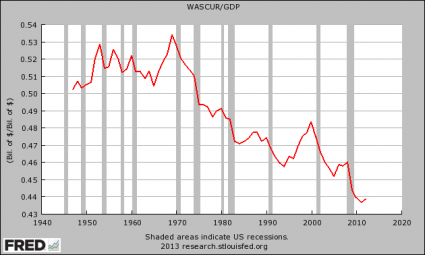 In the United States and most other capitalist countries the portion of
GDP which has been going to wages and salaries has been falling
rapidly for many decades now, even though this includes the huge salaries of corporate
bigshots and managers. While the working class is being driven down, more and more money is
going to corporate profits, banks, Wall Street firms, and other parts of the financial system,
which is ever more predatory upon the economy and the people. The Federal Reserve graph at the
right shows the large decline in the ratio of wages and salaries to U.S. GDP since around 1970.
In the United States and most other capitalist countries the portion of
GDP which has been going to wages and salaries has been falling
rapidly for many decades now, even though this includes the huge salaries of corporate
bigshots and managers. While the working class is being driven down, more and more money is
going to corporate profits, banks, Wall Street firms, and other parts of the financial system,
which is ever more predatory upon the economy and the people. The Federal Reserve graph at the
right shows the large decline in the ratio of wages and salaries to U.S. GDP since around 1970.