DELEVERAGING
[Capitalist finance:] The repayment (often forced) of debt which has been acquired in
order to expand the amount of money invested, or to directly expand the amount employed in
the continuation or expansion of capitalist production. Leveraging
means using borrowed money to speculate (“invest”) or in order for a capitalist to continue
or expand production beyond what is possible through the use of his own profits. Sometimes
when a loan comes due it is impossible to “roll it over” (extend it for an additional
period), or to obtain an alternative loan. This is especially apt to occur during a
financial crisis. In such a situation there is a forced deleveraging, or in other
words a forced reduction in credit that itself has an additional negative impact on the
economy. Just as leveraging can promote the more rapid expansion of the economy during a
boom, deleveraging can develop into a vicious cycle which serves to more rapidly unwind an
economy and bring it to its knees during and following a financial crisis.
“Deleveraging is an ugly word for a painful process. But few things
matter more for the world economy than whether, and how fast, the rich world’s
borrowing is cut back. History suggests that severe financial crises are usually
followed by long periods of debt reduction—in which credit falls relative to the
size of the economy. This time, too, that process is under way. Banks have been
furiously reducing leverage. Consumer credit in America has fallen for ten
consecutive months, the largest and longest drop on record....
“[In an extensive study of
numerous past cases of deleveraging] the deleveraging came through a prolonged
period of belt-tightening, where credit grew more slowly than output. The message
from these episodes is sobering. Typically deleveraging began about two years after
the beginning of the financial crisis and lasted for six to seven years. In almost
every case output shrank for the first two or three years of the process...
“Worse, there are several
reasons why today’s mess could be more protracted than previous episodes. First,
the scale of the indebtedness is higher.... Second, the number of countries
afflicted simultaneously means that rapid expansions of exports, which have supported
output in the past, are harder to achieve. Third, big increases in public debt, while
cushioning demand in the short term, increase the overall debt reduction that will
eventually be needed.... Investors may worry about the sustainability of public debt
long before private-debt reduction is over, forcing a lot of belts to be tightened
at once. The most painful bits of deleveraging could well lie ahead.” —“Economic
Focus: Digging Out of Debt”, The Economist, Jan. 16, 2010, p. 76.
DEMAGOGUES
“... I will never tire of repeating that demagogues are the worst
enemies of the working class. The worst enemies, because they arouse base instincts
in the masses, because the unenlightened worker is unable to recognize his enemies
in men who represent themselves, and sometimes sincerely so, as his friends. The
worst enemies, because in the period of disunity and vacillation, when our movement
is just beginning to take shape, nothing is easier than to employ demagogic methods
to mislead the masses, who can realize their error only later by bitter experience.”
—Lenin, “What Is To Be Done?” (1902), LCW 5:463.
DEMOCRACY — As a Means to an End
“Democracy sometimes seems to be an end, but it is in fact only a means.” —Mao, quoted
in Peking Review, vol. 10, #1, Jan. 1, 1967, p. 13. But what ends then is it a means
to? Widespread and genuine democracy is one of the primary means by which the proletariat
and the broad masses become able to satisfy their own material and non-material interests,
including their highest political interest, to further revolutionize society, to overthrow
the capitalist system, and to create first socialism, and then communism. Democracy is
valuable first of all, and above all, because it is an indispensable means to this
end.
DEMOCRATIC CENTRALISM
Democratic centralism is the central organizational principle in Marxist-Leninist-Maoist
parties. Within socialist society democratic centralism is also implemented among the
people as a whole—though of necessity in a somewhat looser fashion.
The core centralist elements of
democratic centralism within the Party were summed up by Mao this way:
“We must affirm anew the discipline of the Party, namely:
(1) the individual
is subordinate to the organization;
(2) the minority
is subordinate to the majority;
(3) the lower level
is subordinate to the higher level; and
(4) the entire
membership is subordinate to the Central Committee.
“Whoever violates these articles of
discipline disrupts Party unity.”
—Mao, Quotations from Chairman
Mao Tse-tung, section “XXVI. Discipline”, 1st ed. (1966), p. 255. Edited wording
from the original source in “The Role of the Chinese Communist Party in the National
War” (Oct. 1938), SW2:203-4.
However, those who seem to believe that these are the only basic elements of
democratic centralism are ignoring or rejecting the equally important core democratic
elements within this organizational principle (in addition to majority rule). Both among
the masses and within the Party people do have the right and even the obligation to form
their own ideas, raise suggestions and criticisms, and to reserve their views even if they
cannot be convinced through argument that they are wrong about something.
“It seems that some of our comrades still don’t understand
democratic centralism....
“There should be full democracy both
inside and outside the Party, that is, democratic centralism should be practised in
earnest in both spheres. Problems should be brought out into the open frankly and
masses allowed to speak out, speak out even if we are going to be abused.” —Mao,
“Talk at an Enlarged Working Conference Convened by the Central Committee of the
Communist Party of China” (Jan. 30, 1962), which appeared in Peking Review,
#27 (July 7, 1978) [online at:
http://www.massline.org/PekingReview/PR1978/PR1978-27-MaoTalk.pdf]
Those who understand only the centralist elements of democratic centralism don’t really
understand what democratic centralism is for! To sum it up in a single sentence:
Democratic centralism is the organizational principle that allows people to work
together in a unified fashion toward a common goal, even when they have different
individual ideas about what should be done! Intelligent people consciously and
willingly put themselves under the centralist or disciplinary aspects of democratic
centralism even knowing that some mistakes will be made because they understand
that this will overall and in general tremendously help the Party and the working
class as a whole work in a united way and make revolution. This makes perfect sense as
long as we have confidence in the masses, and confidence in that specific Party, to
eventually correct any mistakes they do make along the way.
The profound idea behind democratic
centralism is that only the working class and the Party working together in a
(more-or-less) unified fashion have the power to change the world, and that if we are
serious about changing the world we have to often subordinate our own individual or
small group ideas about what to do to those of the majority and the Party leadership.
Even in those occasional cases where we have good reason to think they are wrong and we
as individuals or the minority have better ideas, it is still better to follow the
majority and the leadership in order to preserve our overall unity of action.
It must be said, however, that what
has historically been called “democratic centralism” by many parties has actually
been far more centralist than democratic. The democratic aspect of democratic centralism
has all too often been downplayed, if not entirely eliminated. This has especially been
the case in revisionist parties and in cult-like parties on
the “left” (such as the Revolutionary Communist
Party, USA), neither of which values any independence of mind among its members or
among the masses. Unfortunately, the same was largely true in Stalin’s Communist Party
of the Soviet Union.
However, Lenin and Mao understood very
well that the independence of mind among the membership of a revolutionary party is not
a negative thing, but actually a very good thing—providing it can be arranged so that
these different ideas do not disrupt the Party’s ability to lead the masses in struggle
against the enemy. And that is the purpose of true democratic centralism.
“An individual sometimes wins over the majority. This is because
truth is sometimes in one person’s hands only. Truth is sometimes in the hands of
a minority, as when Marxism was in Marx’s hands alone. Lenin said that you have
to have the spirit of going against the current. Party committees at every level
ought to consider views from many quarters; they ought to listen to the opinion
of the majority and also those of the minority and others. There ought to be
created within the Party an atmosphere of speaking out and of correcting
shortcomings.” —Mao, “Talk at the Seventh Plenum of the Eighth Central
Committee”, April 1959, Miscellany of Mao Tsetung Thought, (Arlington, VA:
Joint Publications Research Service, 1974), p. 176.
Only those who favor both independence of mind on the part of individual
Party members and the masses and also unified action on the part of the Party
and the masses as a whole (and which is not impaired by this widespread independence of
thought), understand the real reason why genuine democratic centralism is so important
and so absolutely necessary.
See also:
UNITE—Don’t Split
DEMOCRATIC CENTRALISM — Bourgeois Conceptions Of
1. The preservation of orthodoxy:
An organizational principle designed to secure and preserve the virtually absolute
acceptance of, and genuine agreement with, all the ideas and positions of the top leaders
of a political party.
In reality the purpose of genuine
democratic centralism (D-C) is not to secure total agreement and total unity of
ideas of the membership of the party with those of the leadership, but rather to allow
(and even encourage!) differences of opinion while nevertheless securing the genuine
willingness and determination of the members to try their best to implement the political
line among the masses which was determined by the leadership of the party. (Critics of
D-C completely fail to understand this important difference.)
2. The absence of any real democracy:
The total despotism of the leadership of a party over the membership, with no genuine
democratic input from the masses and the membership to the leaders, and no obligation
whatsoever of the leadership to listen to the ideas and desires of the masses and the
membership.
As noted in the main entry on democratic
centralism above, there have been parties which have actually operated in somewhat this
way, and which have totally distorted D-C in this way. We Marxist-Leninist-Maoists reject
and denounce this total negation of democratic centralism.
3. To enforce party discipline:
The principles of democratic centralism summarized by Mao in the entry above do definitely
state that the minority is subordinate to the majority, that the lower bodies of the party
are subordinate to the higher bodies, and that the whole party is subordinate to the
Central Committee. This does of course present a system of party discipline.
However this party discipline exists for
a definite political purpose: To allow the party to act in a unified collective
way even though its members will have their own individual ideas about the best way
to proceed in any situation. To say that the point of D-C is to enforce party
discipline is to disingenuously ignore the real political point of it.
4. Existing for security purposes:
Another eroneous conception of democratic centralism, which is actually more often put
forward by young revolutionaries who haven’t yet grasped the basic political reason
for D-C rather than by academic bourgeois critics of Leninism, is that its central purpose
is to help keep the leadership, membership, and organizational structure of the party
protected from ruling class spying and attacks.
Of course any revolutionary party does
have to seriously concern itself with security issues, since the enemy seeks to disrupt
our work among the masses, and even—at times—to arrest or kill us. The party will need to
have secure channels of communications between its members and between its leaders and
membership. In will likely need to operate on a “need to know” basis, with regard to
organizational structure, who precisely are members in other areas of work, and so forth.
Lenin remarked that the first reason for the existence of the party is so that
revolutionaries will know who they can fully trust in helping them to carry out
their work. [July 1, 1921; LCW 32:474]
Having genuine D-C and a firm discipline within a party can of course greatly help promote
better security. However, this is not the primary purpose of D-C. To repeat once again,
the revolutionary party requires democratic centralism so that different people,
who inevitably have somewhat different ideas about what to do, can settle on a unified
plan of action (while reserving their own individual opinions) and work together in the
most effective way to advance the revolution.
If the primary purpose of democratic
centralism within some party is for security, then it will almost inevitably be a false
D-C, with a downplaying of its political purpose, and most likely the negation of the
democratic aspect of genuine D-C. This is what happened in the RU/RCP, for example, as
the following quote brings out. (And moreover, in the RU/RCP even the security focus was
a dismal failure.):
“The RU/RCP prided itself, and had among the wider left, a certain
reputation for a solid security culture. Certainly the remarks of people like Larry
Goff, on its rigorous discipline are telling. The paradox, of course, is that this
came from Goff, the informant [to the FBI]. Indeed for all its extolling of
discipline and adhering to democratic centralism, it was too often the case—and
this from the very beginning—that the two entities with the fullest understanding
of the group were the small number of leaders at the top of the organization and
the FBI. While such principles of discipline could be effective, in potential, in
keeping certain matters secret, the fact of informants at the top of the
organization meant that such practices were too often nothing more than an exercise.
Worse it created the perilous situation where RU/RCP cadre and supporters knew far
less about the group than the Bureau did.” —Aaron Leonard & Connor Gallagher,
Heavy Radicals: The FBI’s Secret War on America’s Maoists (2014), p. 248.
[For our purposes here, what
is most noteworthy is not the incompentence of the RU/RCP in selecting their
leadership and in keeping government spies out, but rather the implicit conception
of democratic centralism as being for the purpose of security. In my opinion
this not only reflects the view of the authors of this book, it also of the leaders
of the RU/RCP itself. That organization never understood and promoted the essential
role of democracy in true democratic centralism, and—indeed—never really understood
the basic political purpose of democratic centralism at all. —S.H.]
“DEMOCRATIC SOCIALISM”
So-called “democratic socialism” is in fact neither socialism
nor truly democratic. It is another name for what in Europe
is called “social democracy”, or in other words,
capitalism with some superficial (and temporary) welfare reforms. Originally,
“democratic socialism” or “social democracy” also meant that the capitalist state
nationalized some major industries such as steel and
railroads; in other words, the term originally referred to a mixed form of capitalism
with both private industry and a sphere of state
capitalism. Both spheres, private corporations and state-owned industries, were
nevertheless under the total control of the capitalist ruling class, and functioned
primarily for their individual or collective benefit. Over time, state capitalism proved
to be even less useful (and less profitable) to the ruling class than private monopoly
capitalism, so in recent decades those who still call themselves “democratic socialists”
no longer even support the partial bourgeois nationalization of industry. The only mystery
is why they still want to call themselves “socialists” at all! Perhaps it is part of their
continuing need to fool the masses about what socialism really is.
“I don’t believe government should own the means of production,
but I do believe that the middle class and the working families who produce the
wealth of America deserve a fair deal.” —Senator Bernie Sanders, who calls
himself a “democratic socialist”, in a speech a Georgetown University, Nov. 19,
2015, online at:
https://www.washingtonpost.com/blogs/plum-line/wp/2015/11/20/how-bernie-sanders-is-mainstreaming-democratic-socialism/?tid=a_inl
DENG Xiaoping (Old style: Teng Hsiao-p’ing) (1904-1997)
Capitalist-roader within the Chinese Communist Party, who after Mao’s death led the
revisionist dismantling of socialism in China and the return to capitalism.
[More to be added.]
“This person does not grasp class struggle; he has never referred
to this key link. Still his theme of ‘white cat, black cat,’ making no distinction
between imperialism and Marxism.” —Mao, speaking of Deng Xiaoping, quoted in Chin
Chih-po, “Denial of the Difference Between Socialism and Capitalism is Not Allowed:
Repudiate the Theme about ‘White Cat, Black Cat’”, Peking Review, #16, April
16, 1976), p. 18. Online at
http://www.massline.org/PekingReview/PR1976/PR1976-16e.htm (single article in
HTML format) or
http://www.massline.org/PekingReview/PR1976/PR1976-16.pdf (full issue in PDF
image format).
DEPENDENCY THEORY
The social theory that maintains that the “core” countries of the world exploit the raw
materials, cheap labor and other resources of the “periphery” (the
“Third World”), and that the net flow of wealth is from
the periphery to the core. There are both Marxist and non-Marxist versions of this theory,
though the non-Marxist or only semi-Marxist versions have been the most prominent over the
past few decades.
We Marxists understand that the
impoverishment of Third World countries is simply one major aspect of
capitalist imperialism at work, and that the central key
to understanding how imperialist countries extract wealth from the countries they control
or dominate has to start with a clear understanding of how capitalism itself functions
(through the extraction of surplus value at the work
place). Of course we also understand that there are additional mechanisms whereby the
bourgeoisies of imperialist countries exploit the people of Third World countries, such as
through manipulating the terms of trade to their own advantage.
But the currently most prominent versions
of dependency theory, especially those associated with what is known as
“world-systems theory”, downplay or ignore the
existence of social classes, and the inherent nature of capitalism as an exploitative
economic system, and focus almost entirely on secondary issues such as unfavorable terms
of trade. Moreover they think mostly in terms of rich countries exploiting poor countries,
rather than the capitalist ruling classes exploiting people both at home and abroad. The
central view of this version of dependency theory is that the “peripheral countries” are
impoverished and the “core countries” are enriched virtually entirely by the way that these
countries are integrated with each other through the world market. Thus the explicit or
implicit “solution” that many of these theorists put forward is more along the lines of
setting up high tariffs and promoting the growth of local industries (and thus the local
bourgeoisie), rather than promoting anti-capitalist and anti-imperialist struggle
through means such as people’s war and/or revolutionary insurrection.
See also:
PREBISCH THESIS
DEPENDENT COUNTRIES
The term “dependent countries” is frequently used, and is usually intended by those on the
Left to mean those countries which—because of imperialist domination or interference—have
little ability to act or develop their economies independently. However, “dependent
countries” might instead be misconstrued to imply that these countries are somehow
dependent on the largesse or economic “support” of the imperialist countries, when
in fact the situation is just the other way around, and the imperialist countries are to a
considerable degree actually dependent upon the exploitation of economically less
developed countries! Furthermore, in some respects, even various second-tier imperialist
countries are “dependent” on the top-dog imperialists (the U.S.). Thus Germany and Japan,
which are certainly imperialist countries, are currently dependent on U.S. military
domination of the world for their ability to join in with the U.S. in its economic
exploitation of many other countries. Similarly, the terms “dominated” or “subordinate”
countries are not entirely satisfactory in all contexts since the top-dog U.S. imperialists
also dominate and subordinate other imperialist countries, at least to a degree.
See also:
DEPENDENCY THEORY,
“THIRD WORLD”
DEPRESSION (Economics)
Up until the Great Depression of the 1930s,
the term ‘depression’ just meant the low phase of any industrial cycle. (Marx called the four
phases of such a cycle the boom, crisis, depression, and recovery
stages.) However, the Great Depression of the 1930s was so severe that bourgeois economists
have not wanted to use the term ‘depression’ for the milder economic crises that have
occurred since then. Instead, they came up with the word ‘recession’.
The term ‘depression’ is now mostly avoided by bourgeois commentators, but when pressed they
define it in rather crude and unscientific terms as “something comparable to the Great
Depression”, that is, an economic crisis which lasts for at least several years, in which the
unemployment rate approaches 25% at its peak (as it did in the U.S. in 1933), and so forth.
Sometimes their definitions are even more arbitrary and vague, such as: “A recession is
a widespread decline in GDP, employment, and trade lasting from six months to a year; a
depression is a sustained, multi-year contraction in economic activity.”
In a more scientific approach, from a Marxist
standpoint, a depression is simply a capitalist overproduction crisis in which all
the major contradictions come to a head, while a recession is a “short-circuited” economic
crisis, in which the government is able to intervene and stop the collapse, with only some of the
more surface contradictions actually coming to a head. For more on this see: “Chapter 5: The
Industrial Cycle has Split In Two!” of my work in progress An Introductory Explanation of Capitalist
Economic Cycles at:
http://www.massline.org/PolitEcon/crises/Crises05.htm, and my letter “Is it a ‘Depression’?”,
at:
http://www.massline.org/PolitEcon/ScottH/CurrentCrisis/IsItADepression.htm
(Feb. 2009) in which I predict that within a relatively short period the current economic crisis
will develop into the Second Great Depression. —S.H.
See also:
LONG DEPRESSION (1873-1896)
DERIVATIVE (Capitalist Finance)
A tradable financial security whose current exchange price derives from the actual
or expected price of some underlying real asset such as a commodity, ownership shares of a
company, other securities (such as mortgages or corporate bonds), or a currency (such as
the dollar). Examples of derivatives are: futures contracts for shares of stocks, currency
exchange futures, futures on stock market indexes, options,
swaps, warrants, and CDOs.
In general, derivatives are ways of
gambling over the future price of some real asset. For example, a speculator entering into
a contract to buy 100 shares of stock in a company six months from now at $50/each, is
betting that in six months the going price will be above $50/share, so that he will
then be able to buy the stock at the $50 price and immediately sell it at the higher
price, thus making a profit. (Of course if the price of the stock goes down in that six
month period he will end up taking a loss.)
Bourgeois economic theory says that it is
reasonable and justified to allow this sort of gambling on the grounds that a judicious
use of derivatives can serve as a form of insurance to
safeguard those who currently own, or who in the future will need to buy commodities and
other real assets, from unexpected price fluctuations and so forth. However, the flaw in
this argument is that while this sort of thing can indeed decrease the dangers of market
risk for that company, it is only possible because of the increased risks
transmitted to the other speculators. Moreover, since the stock market, at least, is itself
in effect a giant Ponzi scheme, allowing derivatives based on stock prices is a means which
serves to amplify this Ponzi aspect. For reasons like this, derivatives serve to hugely
increase the speculative and precarious nature of modern financial capitalism. There are,
however, enormous profits to be made in the meanwhile, so derivatives will never be
eliminated or even be completely brought under control. They will exist as long as
capitalism does.
According to the New York Times, as
of July 15, 2009, the “derivatives market now represents transactions with a face value of
$600 trillion”. It is not clear, however, that even this colossal sum includes all
the securities which should properly be counted as derivatives!
“The rapidly growing trade in derivatives poses a ‘mega-catastrophic
risk.’ ...[F]or the economy, derivatives are financial weapons of mass destruction
that could harm not only their buyers and sellers, but the whole economic system.”
—Warren Buffett, billionaire capitalist investor, in the 2002 Annual Report of his
company Berkshire Hathaway.
DERRIDA, Jacques (Pronounced in English: der-ree-DAH) (1930-2004)
A French bourgeois philosopher of the postmodern school,
and founder of the deconstructionist movement within it. Those into
contemporary bourgeois Continental philosophy sometimes claim
that Derrida was one of the greatest philosophers of the 20th century. But none of them have
been able to state (in intelligible words) just what his supposed “great contributions” were.
One of the most characteristic traits of intellectual
phonies like Derrida is that they try to hide their triviality or vacuity by being purposefully
obscure. Michel Foucault, whose lectures Derrida once attended, (and
who himself had little of value to contribute to philosophy) described Derrida’s method as “terrorist
obscurantism” and explained it this way:
“He writes so obscurely you can’t tell what he’s saying, that’s the obscurantism
part, and then when you criticize him, he can always say, ‘You didn’t understand me; you’re an
idiot.’ That’s the terrorism part.” —Michel Foucault, comment to John Searle, “Reality Principles:
An Interview with John R. Searle”, Reason magazine, February 2000, online at:
http://www.reason.com/news/show/27599.html.
Many others have similarly criticized Derrida and modern French bourgeois philosophy in general for
such obscurantism. Noam Chomsky, for example, said that Derrida used
“pretentious rhetoric” to obscure the simplicity of his ideas and that doing so was characteristic of a
broad group of people within the Parisian intellectual community.
Some academic “leftists” consider Derrida to have been
a man of the left. It is true that he was strongly criticized by various conservative bourgeois
philosophers (like Searle and Quine), but Derrida himself was merely a liberal
bourgeois intellectual. He opposed the Vietnam War and apartheid in South Africa, and he initially
supported the student uprising in France in 1968 (but then backed away). But he was not a revolutionary
and certainly not a Marxist. The infatuation in “left” academia for phonies like Derrida only serves to
discredit them!
DESCARTES, René (1596-1650)
Usually considered to be the first “modern” philosopher, because he broke with the
sterile dogmatism of the Scholastics, and introduced the
“method of doubt”. Although he himself was a dualist, he played
a major role in helping to inspire a materialist trend of thought.
See also:
Philosophical doggerel
on Descartes.
“...Descartes’s monumental decision [was] that the body and the
immortal soul should be considered separately. This allowed the bodies of both humans
and beasts to be examined in wholly physical terms for the first time. Descartes saw
the human body as a machine, much like a child’s mechanical toy. It was from this
perspective that he proposed that all living things, their soulful nature excepted,
are made of ordinary matter. In his view, living bodies were the same as inanimate
objects except in the details of their incarnations. As a consequence, they obeyed
the same laws.” —Stephen Rothman, a prominent (non-Marxist) American biologist,
Lessons From the Living Cell (2002), pp. 22-23.
DESI
[From Sanskrit ‘desh’ (“country”); in Hindi and other modern South Asian languages, “a person from South Asia”:]
A term for a person or culture of the
countries of South Asia, including especially India, Pakistan, Sri Lanka and Bangladesh.
Most frequently today, and especially in countries outside that region, Desis
refers to those people in the diaspora, i.e., those from South Asia now living in other
countries around the world. There are large numbers of Desis in the U.S., Britain, Canada,
South Africa, and many other countries in Asia and the Middle East.
DETERMINISM
The materialist view that all phenomena have definite natural causes. Often confused with
fatalism. The opposite of determinism is
indeterminism.
See also:
FREE WILL,
COMPATIBILISM
“The point is that this is one of the favorite hobby-horses of the
subjective philosopher—the idea of the conflict between determinism and morality,
between historical necessity and the significance of the individual. He [the Narodnik
Mikhailovsky] has filled reams of paper on the subject and has uttered an infinite
amount of sentimental, philistine nonsense in order to settle this conflict in favor
of morality and the role of the individual. Actually, there is no conflict here at
all: it has been invented by Mr. Mikhailovsky, who feared (not without reason) that
determinism would cut the ground from under the philistine morality he loves so
dearly. The idea of determinism, which postulates that human acts are necessitated
and rejects the absurd tale about free will, in no way
destroys man’s reason or conscience, or appraisal of his actions. Quite the contrary,
only the determinist view makes a strict and correct appraisal possible instead of
attributing everything you please to free will. Similarly, the idea of historical
necessity does not in the least undermine the role of the individual in history: all
history is made up of the actions of individuals, who are undoubtedly active figures.
The real question that arises in appraising the social activity of an individual is:
what conditions ensure the success of his actions, what guarantee is there that these
actions will not remain an isolated act lost in a welter of contrary acts?” —Lenin,
“What the ‘Friends of the People’ Are” (1894), LCW 1:159. [Note that Lenin is
criticizing “free will” only in the sense of
anti-determinism, and not in the sense of humans being able to make choices. —S.H.]
“Far from assuming fatalism, determinism in fact provides a basis
for reasonable action.” —Lenin, “The Economic Content of Narodism” (1894), LCW 1:420.
DEVELOPMENT [Philosophical Concept]
[Intro to be added...]
“Many people confuse dialectics with the doctrine of development;
dialectics is, in fact, such a doctrine. However, it differs substantially from the
vulgar ‘theory of evolution’, which is based completely on the principle that
neither Nature nor history proceeds in leaps and that all changes in the world
take place by degrees. Hegel had already shown that, understood in such a way,
the doctrine of development was unsound and ridiculous.” —G. V. Plekhanov,
“Fundamental Problems of Marxism” (1907), Int’l Publishers ed. (1971), p. 45; SPW
3:139.
“The identity [or unity] of opposites is the recognition
(discovery) of the contradictory, mutually exclusive, opposite tendencies
in all phenomena and process of nature (including mind and society).
The condition for the knowledge of all processes of the world in their
‘self-movement,’ in their spontaneous development, in their real life, is
the knowledge of them as a unity of opposites. Development is the ‘struggle’ of
opposites. The two basic (or two possible? or two historically observable?)
conceptions of development (evolution) are: development as decrease and increase,
as repetition, and development as a unity of opposites (the division of a
unity into mutually exclusive opposites and their reciprocal relation).” —Lenin,
“On the Question of Dialectics” (1915), LCW 38:359-360.
“With the ‘principle of development’ in the twentieth century
(indeed, at the end of the nineteenth century also) ‘all are agreed.’ Yes, but
this superficial, not thought out, accidental, philistine ‘agreement’ is an
agreement of such a kind as stifles and vulgarizes the truth. — If
everything develops, then everything passes from one into another, for development
as is well known is not a simple, universal and eternal growth, enlargement
(respective diminution), etc. — If that is so, then, in the first place, evolution
has to be understood more exactly, as the arising and passing away of
everything, as mutual transitions. — And, in the second place, if everything
develops, does not that apply also to the most general concepts and
categories of thought? If not, it means that thinking is not connected
with being. If it does, it means that there is a dialectics of concepts and a
dialectics of cognition which has objective significance.” —Lenin, “Conspectus of
Hegel’s Book Lectures on the History of Philosophy” (1915), LCW 38:255-6.
DIAGNOSTIC AND STATISTICAL MANUAL (DSM)
“In the absence of ... physical measures [for the diagnosis of
mental diseases], the American Psychiatric Association (APA) developed a
psychiatrists’ ‘bible’—the Diagnostic and Statistical Manual (DSM)—from the
sales of which the APA makes a handsome profit. First published in 1952 and
currently going through its fifth revision, it is essentially a catalogue of
reported signs and symptoms which form the basis of the classification of mental
and nervous system diseases, categories often influenced by the raced [racial]
and gendered values of the psychiatrists themselves. Not infrequently this
resulted in inappropriate diagnosis and prescription. One conspicuous example was
the classification of women experiencing the menopause as pathologically anxious
and depressed, leading to the widespread over-prescription of diazepam, an
addictive drug. Homosexuality, originally listed by DSM as a disorder, was only
declassified in 1973 with the rise of the gay and lesbian movements, and removed
from subsequent DSM editions. Old disorders disappear or are renamed. Minimal
Brain Dysfunction becomes Attention Deficit Hyperactivity Disorder; Multiple
Personality Disorder becomes Dissociative Identity Disorder; Manic-Depression
becomes Bipolar Disorder. New diagnoses such as Panic Disorder and Post-Traumatic
Stress Disorder appear. Depending on which boxes are ticked, a diagnosis is made
and a drug prescribed. The US origins of the manual lie not only in the expanding
categories developed through psychiatric research but in the requirements of an
intensely marketized medical system in which clinicians can only provide
treatment if the symptoms presented to them are classified as fundable by medical
insurance.” —Hilary & Steven Rose, Genes, Cells and Brains: The Promethean
Promises of the New Biology (2014), pp. 256-7.
DIALECTICAL LEAPS — Popular Terms For and Conceptions Of
Here are some of the terms often heard which seem to be grasping at one or more aspects
of what we Marxists mean by dialectical leaps:
Qualitative leap
Sea change
Tipping point
Tectonic shift
Inflection point
What all these (and sometimes other) terms
seem to be most centrally getting at is that in nature and all spheres of human life, we
often find relatively sudden, and relatively large, changes in some process or situation.
The term qualitative leap emphasizes that this often entails a fundamental change
in the nature of the thing. The term sea change is more limited in that it seems
only to emphasize a change in magnitude. The term tipping point once again seems to
suggest some qualitative change, or else some major change in the direction of a
process. The term tectonic shift invokes the image of a sudden massive earthquake.
An inflection point, in popular discourse, is similar to a tipping point.
[In mathematics an inflection point is a point on a curve which separates an arc
with a concave curve upward from an arc with a concave curve downward (or, in other words,
the isolated points where the second derivative of the function equals zero.)]
Other terms which sometimes have similar
connotations are: crisis, coming to a head, snapping, bursting, explosion, etc. Many of
these terms emphasize the suddenness of the change, as well as the magnitude.
See also:
CONJUNCTURE
DIALECTICS
The most abstract or general scientific laws or principles governing the development of
nature, society and thought. The most basic and important of these principles is the law
of contradiction in things, the conception of things and processes as a unity of opposites.
[More to be added...]
See also nearby related entries, and:
CHANGE,
CONTRADICTION—Dialectical,
DEVELOPMENT,
HEGELIAN TRIADS,
NEGATION (In Dialectics),
NEGATION OF THE NEGATION,
ONE-INTO-TWO,
QUALITATIVE LEAP,
SUBLATION
“Dialectics, however, is nothing more than the science of the general
laws of motion and development of nature, human society and thought.” —Engels,
Anti-Dühring (1878), MECW 25:131.
“In brief, dialectics can be defined as the doctrine of the unity of
opposites. This embodies the essence of dialectics, but it requires explanations and
development.” —Lenin, “Conspectus of Hegel’s Book The Science of Logic” (1914),
LCW 38:223.
“Dialectics in the proper sense [i.e., as opposed to Hegel’s idealist
conception] is the study of contradiction in the very essence of objects: not
only are appearances transitory, mobile, fluid, demarcated only by conventional
boundaries, but the essence of things is so as well.” —Lenin, “Conspectus of
Hegel’s Book Lectures on the History of Philosophy” (1915), LCW 38:253-4.
“We want gradually to disseminate dialectics, and to ask everyone
gradually to learn the use of the scientific dialectical method.” —Mao, quoted in
Peking Review, #47, Nov. 20, 1970, p. 2.
DIALECTICS — ANCIENT
[To be added... ]
“The old Greek philosophers were all born natural dialecticians,
and Aristotle, the most encyclopedic intellect of them, had already analyzed the
most essential forms of dialectic thought.” —Engels, Anti-Dürhing,
MECW 25:21.
“When we consider and reflect upon nature at large or the history
of mankind or our own intellectual activity, at first we see the picture of an endless
entanglement of relations and reactions in which nothing remains what, where and as
it was, but everything moves, changes, comes into being and passes away. This
primitive, naive but intrinsically correct conception of the world is that of ancient
Greek philosophy, and was first clearly formulated by Heraclitus: everything is and
is not, for everything is fluid, is constantly changing, constantly coming
into being and passing away.” —Engels, ibid.
DICTATORSHIP OF THE PROLETARIAT
Proletarian rule. “The revolutionary dictatorship of the proletariat is rule won and
maintained by the use of violence by the proletariat against the bourgeoisie, rule that
is unrestricted by any laws.” —Lenin, LCW 28:236.
See also:
CLASS STRUGGLE—In Socialist Society
“The indispensable characteristic, the necessary condition of dictatorship
is the forcible suppression of the exploiters as a class, and, consequently,
the infringement of ‘pure democracy’, i.e., of equality and freedom, in regard
to that class.” —Lenin, “Proletarian Revolution and the Renegade Kautsky”
(Oct.-Nov. 1918), LCW 28:256.
“The exploiters and reactionaries are, under any circumstance, the
minority while the exploited and revolutionaries are the majority. Therefore the
dictatorship of the former is un-justifiable, whereas that of the latter is fully
justifiable.” —Mao, directive regarding the Cultural Revolution, June 17, 1966.
SW9:405.
DICTATORSHIP OF THE PROLETARIAT — Proletarian Democracy Within
[Intro material to be added... ]
“Chairman Mao teaches us that there should be democracy within the ranks
of the people and dictatorship over the reactionaries. The dictatorship of the proletariat
is the safeguard for the implementation of extensive proletarian democracy. Extensive
proletarian democracy in turn is aimed at consolidating the dictatorship of the proletariat.
Without extensive proletarian democracy, there is the danger that the dictatorship of the
proletariat will turn into the dictatorship of the bourgeoisie. Without the dicatatorship
of the proletariat there can be no proletarian democracy. There cannot even be democracy
on a small scale, let alone extensive democracy. In the course of the great proletarian
cultural revolution, our organs of proletarian dictatorship must resolutely and
unswervingly guarantee the democratic rights of the people and guarantee that free airing
of views, the posting of big-character posters, great debates, and the large-scale
exchange of revolutionary experience proceed in a normal way.”
— “Carry the Great
Proletarian Cultural Revolution Through to the End”, a joint New Year’s editorial of
Renmin Ribao [People’s Daily] and Hongqi [Red Flag], Jan. 1, 1967,
Peking Review, vol. 10, #1, Jan. 1, 1967, pp. 13-14.
DIETZGEN, Joseph (1828-1888)
German tannery worker, Social-Democrat, and self-educated philosopher who arrived at the basic
principles of dialectical materialism independently of Marx and Engels.
For some of Lenin’s comments commending Dietzgen
and in defense of him, and also some very secondary criticisms, see sections of his Materialism
and Empirio-Criticism (1908) and his article “Twenty-Fifth Anniversary of the Death of Joseph
Dietzgen” (May 5, 1913) (LCW 19:79-82).
“Dietzgen wrote at a time when simplified, vulgarized materialism
was most widespread. Dietzgen, therefore, laid his greatest stress on the historical changes
that had taken place in materialism, on the dialectical character of materialism,
that is, on the need to support the point of view of development, to understand that all
human knowledge is relative, to understand the multilateral connections between, and
interdependence of, all phenomena in the universe, and to develop the materialism of natural
history to a materialist conception of history.
“Because he lays so much stress on
the relativity of human knowledge, Dietzgen often becomes confused and makes incorrect
concessions to idealism and agnosticism....
“By and large, however, Dietzgen was
a materialist. He was an enemy of clericalism and agnosticism.” —Lenin, “Twenty-Fifth
Anniversary of the Death of Joseph Dietzgen” (May 5, 1913) (LCW 19:80). [In my opinion
Lenin’s observation about the connection of too great an emphasis on the relativity of
human knowledge to idealism and agnosticism is positively brilliant! —S.H.]
DIRECT DEMOCRACY
The immediate, direct participation of everybody in a mass assembly to determine what to
do, rather than selecting representatives to decide. It is also usually assumed that everyone at
this big meeting is on a completely equal basis, with an equal right to speak and be heard. This
tacitly implies that there are no formal leaders. It may also sometimes imply that no one person
has a right to say too much (thus limiting the role of even informal leaders!).
This is the original meaning of the word ‘democracy’,
as it existed during some periods in some ancient Greek city states, such as Athens. (Of course,
in ancient Greece this democracy was not extended to women, let alone to slaves.)
Because of the practical impossibilities of bringing
too large a group of people together in “one big assembly”, direct democracy is only really feasible
for relatively small groups. (For example, it would be totally absurd to attempt to bring all the
people living in Chicago together in one big assembly to create the laws for that city, let alone
all the people in Illinois, or all the people in the U.S.) For this reason, democracy has come to
mean representative democracy, where different local groups select their representatives, who
then meet together to make decisions and pass laws.
In class society, however, the representatives soon
become not the representatives of all the people in their district or area, but actually only
the representatives of the ruling class. In capitalist society, of course, this means that nearly
always the supposed “people’s representatives” actually represent the capitalist class (or, as the
current euphemism has it, “the 1%”). As is frequently joked (or perhaps only bitterly half
joked), America has the best politicians that money can buy. Of course there are many methods by
which only representatives are selected who act on behalf of the ruling class, and direct bribery
is only one of them. Another way, for example, is to make being elected to office so expensive that
only the rich or those strongly backed by the rich stand any chance at all.
Because representative democracy in the modern
capitalist state has become a complete and obvious fraud to so many of us, with little or no real
actual democratic content left at all, there have developed strong feelings among anarchists and
others that the only form of democracy that can be genuine is direct democracy. This confuses
the situation that definitely exists in capitalist society with what could in fact exist in
socialist or communist society. Even under socialism it will still be essential for the people to
keep a close eye on their chosen representatives (and also other leaders such as those in the
leading revolutionary party), but it will no longer be virtually impossible for those representatives
to truly represent the interests of the people.
DISCIPLINE — Of the Proletarian Revolutionary Party
“As a current of political thought and as a political party, Bolshevism has
existed since 1903. Only the history of Bolshevism during the entire period of its
existence can satisfactorily explain why it has been able to build up and maintain, under
most difficult conditions, the iron discipline needed for the victory of the proletariat.
“The first questions to arise are: how
is the discipline of the proletariat’s revolutionary party maintained? How is it tested? How
is it reinforced? First, by the class-consciousness of the proletarian vanguard and by its
devotion to the revolution, by its tenacity, self-sacrifice and heroism. Second, by its
ability to link up, maintain the closest contact, and—if you wish—merge, in certain measure,
with the broadest masses of the working people—primarily with the proletariat, but also
with the non-proletarian masses of working people. Third, by the correctness of the
political leadership exercised by this vanguard, by the correctness of its political strategy
and tactics, provided the broad masses have seen, from their own experience, that they
are correct. Without these conditions, discipline in a revolutionary party really capable of
being the party of the advanced class, whose mission it is to overthrow the bourgeoisie and
transform the whole of society, cannot be achieved. Without these conditions, all attempts to
establish discipline inevitably fall flat and end up in phrasemongering and clowning. On the
other hand, these conditions cannot emerge at once. They are created only by prolonged effort
and hard-won experience. Their creation is facilitated by a correct revolutionary theory,
which, in its turn, is not a dogma, but assumes final shape only in close connection with the
practical activity of a truly mass and truly revolutionary movement.” —Lenin, “‘Left-Wing’
Communism—An Infantile Disorder” (April-May 1920), LCW 31:24-25.
DIVIDENDS
Payments to the owners of stocks or similar investments. This money comes ultimately from the
profits of the corporation, which in turn are a portion (usually quite a small portion) of the
surplus value generated by the workers employed (i.e.,
directly exploited) by that corporation.
There appears to be a long-term trend in modern
capitalism for dividends to fall as a percentage of the company profits. The average percentage
payout of officially stated profits (real profits are much higher and hidden in various ways,
such as in the form of benefits to top managers), for the companies in the Standard & Poor’s
500-stock index in the U.S. as of Oct. 4, 2011, was 2.31%. This represented only 27% of stated
profits in the 2nd quarter of 2011, which was down from 30% of profits in 2008, and well below
the 30-year average of 41%. This is despite the fact that U.S. corporations now have record
hoards of undistributed profits, totaling $2.77 trillion, with few good options for new
investments. [Bloomberg Businessweek, Oct. 17-23, 2011, p. 60.]
In addition, more and more companies do not pay
dividends at all, even when they are making huge profits. Google, for example, has $39 billion
in cash, and Apple Corporation holds $76 billion (including long-term financial investments).
Neither pays a dividend. Why would ordinary investors buy shares in companies that don’t pay
dividends? The answer is that the stock market is primarily a gambling house, and “investors”
(i.e. speculators) primarily buy shares on the hope that the price of those shares will go up.
But the fact is that a declining share of the surplus value extracted by modern corporations
actually goes to the official “owners” of them (let alone to the workers who produce that
wealth); it is instead more and more appropriated by the top management of the companies, and
by banks and financial institutions. Modern capitalism is more and more parasitic, even
according to the logic of bourgeois economic theory.
DIVISION OF LABOR
A characteristic feature of industrial production [Cf. Marx, TSV, 3:271.] in which there is
specialization in the production process, where the tasks are divided up into simpler and more
repetitive smaller tasks, and individual workers are assigned to do just one or a few of these
simpler smaller tasks.
“Division of labor is, in one sense, nothing but coexisting
labor, that is, the coexistence of different kinds of labor which are
represented in different kinds of products or rather commodities. The division
of labor in the capitalist sense, as the breaking down of the particular labor which
produces a definite commodity into a series of simple and co-ordinated operations divided
up amongst different workers, presupposes the division of labor within society outside the
workshop, as separation of occupations. On the other hand, it [division of labor]
increases it [separation of occupations]. The product is increasingly produced as a
commodity in the strict sense of the word, its exchange-value becomes the more independent
of its immediate existence as use-value—in other words its production becomes more and more
independent of its consumption by the producers.... The division of labor within
the workshop is one of the methods used in this mass production and consequently
in the production of the product [as a commodity]. Thus the division of labor within the
workshop is based on the division of occupations in society.” —Marx, TSV, 3:268-9.
DOCTRINE
The body of principles in a branch of knowledge or system of belief. Note that the word ‘doctrine’
is not in itself pejorative in most contexts; all systems of knowledge or belief have doctrines,
including Marxism. (Compare this with the word ‘doctrinaire’ which means dogmatic, and is
definitely pejorative!)
“Our doctrine—said Engels, referring to himself and his famous friend—is
not a dogma, but a guide to action. This classical statement stresses with remarkable force
and expressiveness that aspect of Marxism which is very often lost sight of. And by losing
sight of it, we turn Marxism into something one-sided, distorted and lifeless; we deprive
it of its life blood; we undermine its basic theoretical foundations—dialectics, the
doctrine of historical development, all-embracing and full of contradictions; we undermine
its connection with the definite practical tasks of the epoch, which may change with every
new turn of history.” —Lenin, “Certain Features of the Historical Development of Marxism”
(Dec. 23, 1910), LCW 17:39.
DREYFUS CASE
“The Dreyfus case—a provocative trial organized in 1894 by the
reactionary-monarchist circles of the French militarists. On trial was Alfred Dreyfus,
a Jewish officer of the French General Staff, falsely accused of espionage and high
treason. Dreyfus’s conviction—he was condemned to life imprisonment—was used by the
French reactionaries to rouse anti-Semitism and to attack the republican regime and
democratic liberties. When, in 1898, socialists and progressive bourgeois democrats
such as Emile Zola, Jean Jaurès, and Anatole France launched a campaign for
Dreyfus’s re-trial, the case became a major political issue and split the country into
two camps—the republicans and democrats on the one hand, and a bloc of monarchists,
clericals, anti-Semites and nationalists, on the other. Under the pressure of public
opinion, Dreyfus was released in 1899, and in 1906 was acquitted by the Court of
Cassation and reinstated in the Army.” —Note 39, LCW 31.
DRONE [Pilotless Aircraft]
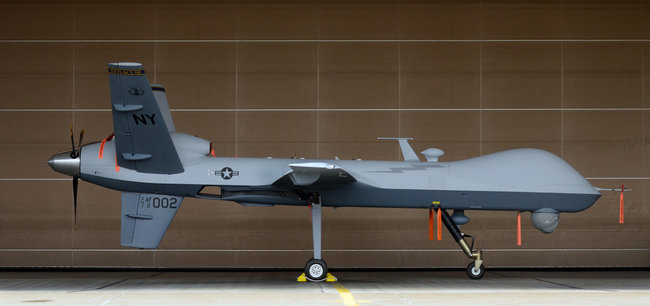 An aircraft which flies itself, or much more commonly at present, an aircraft remotely controlled
by a pilot who is not onboard it. The U.S. military has in recent years utilized rapidly
increasing numbers of drone warplanes as a major part of its endless imperialist wars, especially
in Afghanistan. These drones are most often controlled by U.S. pilots sitting in comfortable
air-conditioned buildings at Air Force bases in the United States, including in Nevada, New
Mexico and near Syracuse, New York. When these remote killers spot a group of possible “enemies”,
they shoot missiles from the drone aircraft down on them. Although they claim to be trying to
avoid women and children, this often results in the murder of large numbers of civilians,
including women and children. In any case, it is an extremely dehumanized method of mass murder.
After their days of slaughter of often a dozen or more people at a time, the U.S. pilots head
home for a comfortable evening with their own families.
An aircraft which flies itself, or much more commonly at present, an aircraft remotely controlled
by a pilot who is not onboard it. The U.S. military has in recent years utilized rapidly
increasing numbers of drone warplanes as a major part of its endless imperialist wars, especially
in Afghanistan. These drones are most often controlled by U.S. pilots sitting in comfortable
air-conditioned buildings at Air Force bases in the United States, including in Nevada, New
Mexico and near Syracuse, New York. When these remote killers spot a group of possible “enemies”,
they shoot missiles from the drone aircraft down on them. Although they claim to be trying to
avoid women and children, this often results in the murder of large numbers of civilians,
including women and children. In any case, it is an extremely dehumanized method of mass murder.
After their days of slaughter of often a dozen or more people at a time, the U.S. pilots head
home for a comfortable evening with their own families.
See also:
YEMEN — U.S. Imperialist Drone Warfare In,
TORTURE — By U.S. Government

“HANCOCK FIELD AIR NATIONAL GUARD BASE, N.Y. — From his computer console
here in the Syracuse suburbs, Col. D. Scott Brenton remotely flies a Reaper drone that
beams back hundreds of hours of live video of insurgents, his intended targets, going
about their daily lives 7,000 miles away in Afghanistan. Sometimes he and his team watch
the same family compound for weeks.
“‘I see mothers with children, I see
fathers with children, I see fathers with mothers, I see kids playing soccer,’ Colonel
Brenton said.
“When the call comes for him to fire
a missile and kill a militant—and only, Colonel Brenton said, when the women and children
are not around—the hair on the back of his neck stands up, just as it did when he used to
line up targets in his F-16 fighter jet.
“Afterward, just like the old days, he
compartmentalizes. ‘I feel no emotional attachment to the enemy,’ he said. ‘I have a duty,
and I execute the duty.’ ...
“The Air Force now has more than
1,300 drone pilots, about 300 less than it needs, stationed at 13 or more bases across
the United States. They fly the unmanned aircraft mostly in Afghanistan. (The numbers
do not include the classified program of the C.I.A., which conducts drone strikes in
Pakistan, Somalia and Yemen.) Although the Afghan war is winding down, the military
expects drones to help compensate for fewer troops on the ground.
“By 2015, the Pentagon projects
that the Air Force will need more than 2,000 drone pilots for combat air patrols operating
24 hours a day worldwide. The Air Force is already training more drone pilots—350 last
year—than fighter and bomber pilots combined.” —Elisabeth Bumiller, “A Day Job Waiting
for a Kill Shot a World Away”, New York Times, July 29, 2012.
DU BOIS, W[illiam] E[dward] B[urghardt] [Pronounced: doo-BOYZ] (1868-1963)
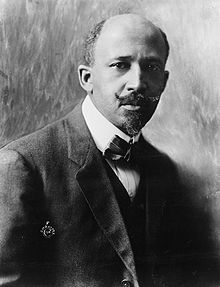 An influential African-American intellectual, sociologist, historian and civil rights activist,
who was born in Massachusetts. Du Bois studied with William James at Harvard and at the University
of Berlin (where Max Weber was an admirer). He was the first African-American to earn a doctorate
(from Harvard University in 1895), and then became a professor at Atlanta University. He published
the first systematic sociological studies of African-American communities.
An influential African-American intellectual, sociologist, historian and civil rights activist,
who was born in Massachusetts. Du Bois studied with William James at Harvard and at the University
of Berlin (where Max Weber was an admirer). He was the first African-American to earn a doctorate
(from Harvard University in 1895), and then became a professor at Atlanta University. He published
the first systematic sociological studies of African-American communities.
Du Bois was a nationally prominent leader of the
civil rights movement. While Booker T. Washington proposed what was known as the “Atlanta Compromise”,
that Southern Blacks would work and submit to white political rule in return for basic educational
and economic opportunities, Du Bois insisted on full equality with whites. He also worked for
increased political represenation by Blacks, which, however, he thought could be best brought about
by the African-American intellectual elite, “the talented tenth”. He was a co-founder of the National
Association for the Advancement of Colored People (NAACP) in 1909, and served for a long period as
the editor of its journal.
“Racism was the main target of Du Bois’s polemics, and he strongly protested
against lynching, Jim Crow laws, and discrimination in education and employment. His cause
included colored persons everywhere, particularly Africans and Asians in their struggles against
colonialism and imperialism. He was a proponent of Pan-Africanism and helped organize several
Pan-African Congresses to free African colonies from European powers. Du Bois made several trips
to Europe, Africa and Asia. After World War I, he surveyed the experiences of American black
soldiers in France and documented widespread bigotry in the United States military.” —From the
Wikipedia entry on Du Bois, from which some other information here is also taken.
W. E. B. Du Bois wrote many books and articles. His work The Philadelphia Negro (1899)
comprehensively discusses what more recent bourgeois sociologists call the Black urban “underclass”.
One of his most famous works was The Souls of Black Folks (1899/1903), a collection of his
essays. There he presents the theory of dual consciousness which shows the influence of William
James’s ideas about the psychological self. Du Bois remarked that “it is a peculiar sensation, this
double-consciousness, this sense of always looking at one’s self through the eyes of others, of
measuring one’s soul by the tape of a world that looks on in amused contempt and pity. One feels
this twoness—an American, a negro; two souls, two thoughts, two unreconciled strivings; two warring
ideals in one dark body, whose dogged strength keeps it from being torn asunder.”
What is often described as his magum opus, Black
Reconstruction in America, was published in 1935. In it he effectively challenged the then
prevailing racist theory that Blacks were responsible for the social failures of the Reconstruction
period after the Civil War.
Du Bois did have some serious shortcomings, many of
them along the lines of any person who struggles for social equality without fully challenging
the basic framework of bourgeois society. For example he supported the participation of American
Blacks in World War I as a means of promoting equality for Blacks. He was much criticized on the Left
for supporting an inter-imperialist war, and rightly so. Du Bois did believe that capitalism was the
primary root cause of racism, and he was generally sympathetic to socialism, though it is doubtful
if he had a clear idea what that would really mean, let alone how to bring it about. (In his very
old age he joined the hopelessly revisionist Communist Party, U.S.A.)
He was also a strong activist for peace and nuclear disarmament. But he was never a revolutionary
Marxist.
In 1961, two years before his death, he moved to
Ghana and renounced his U.S. citizenship. He had had enough of racism in the U.S., and perhaps felt
too old and weary to effectively continue his long fight against it.
DUAL POWER
A political situation in certain places and periods of time (always quite short) in which
different and antagonistic social classes each have a share of
state power. In such a situation each of the contending classes works to secure total state
power for itself, while attempting to deny the enemy class with any share of power whatsoever.
This is why dual power is so tremendously unstable and short-lived.
One example of dual power was the situation in
Russia after the “February Revolution” (in March
1917!) overthrowing the Tsar, and lasting until the “October
Revolution” (in November 1917!), when the Bolsheviks led by Lenin seized complete
power for the working class. During this period of about 8 months, there was official power
in the hands of the “Provisional Government”, but very extensive de facto power in the
hands of the Soviets (councils) of workers, peasants and soldiers.
For example, while the Provisional Government was nominally in charge of the Russian army, in
reality most army units would generally only obey government orders if they were also OK’d by
their local Soviet.
It is often said that the current situation
in Nepal, since the end of the People’s War in 2006, is also a period of dual power. In this
case the Nepal Army is under the control of the feudal-capitalist alliance, but there still
exists a separate army, the People’s Liberation Army, which is controlled by the Unified
Communist Party of Nepal (Maoist). Similarly, the UCPN(M) is the largest party in the
Constituent Assembly (which is serving as the interim parliament), though it doesn’t have a
majority. Since major decisions require a two-thirds majority, there is in effect stalemate
there as well as militarily. This is obviously also a very unstable situation, and one of
these class forces will fairly soon overthrow the other. It is so far unclear which will
triumph.
DUALISM
The philosophical theory that both matter and
mind exist, but that they are “completely independent” aspects of the
world, and that neither depends on the other or is an outgrowth or development of the other.
Consequently this is supposed to be a middle position between
materialism and idealism. However,
from the Marxist, materialist standpoint dualism is itself a type of idealism, since it also
denies the primacy of matter.
One irresolvable conundrum for dualism is the
simple question of how someone can raise their arm when they decide to do so. This is a clear
case of a mental cause resulting in a physical or material result, and is totally
inexplicable if mind and matter are imagined to be “completely independent” things. It can only
be explained if we understand mental phenomena such as decisions to be a sort of
abstract functional characterization of what at bottom are really ongoing physical, material
processes in the brain and body.
One famous version of dualism was
Leibniz’s attempt to explain both mind and matter by means of a
single mysterious “substance” he called “monads”.
Interestingly, despite its philosophical
absurdity and fundamental disagreement with materialism, dualism historically played a positive
role in the promotion of materialist thought. One of its earliest proponents was
René Descartes, who argued that the body and “soul” should be
considered independently. This allowed him to discuss the body itself in materialist terms, as
a machine, and led others to do the same. Eventually scientifically inclined people came to
realize that there was no further need for or even room for any such thing as a
soul.
See also:
EPIPHENOMENALISM,
OCCASIONALISM,
PSYCHOPHYSICAL PARALLELISM, and
Philosophical doggerel about
dualism.
DUNS SCOTUS, John (c. 1266-1308)
John Duns, the Scot, was an early scholastic philosopher/theologian
of the Roman Catholic Church. He focused mostly on metaphysics,
especially in relation to the “nature and reality” of God, and other major “transcendental”
categories such as being or existence, the true, the good, causation,
and so forth. He was a nominalist, and hence a representative of
an early and very partial expression of materialism in the Middle Ages.
Although called the doctor subtilis (“subtle
doctor”) in his own day, in a more enlightened later age his followers were called “Dunsmen”—from
which is derived the modern word ‘dunce’!
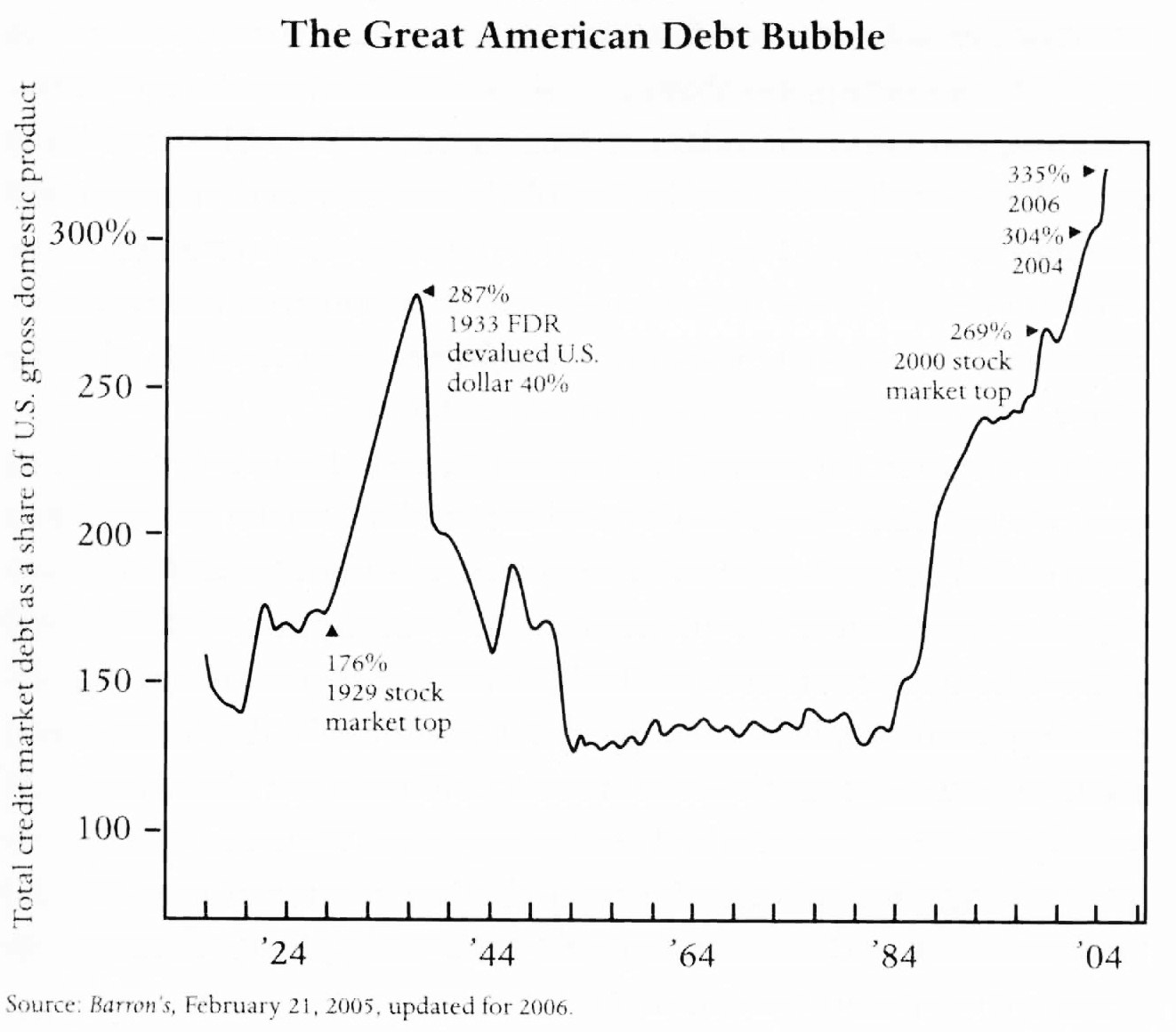 [Intro to be added...]
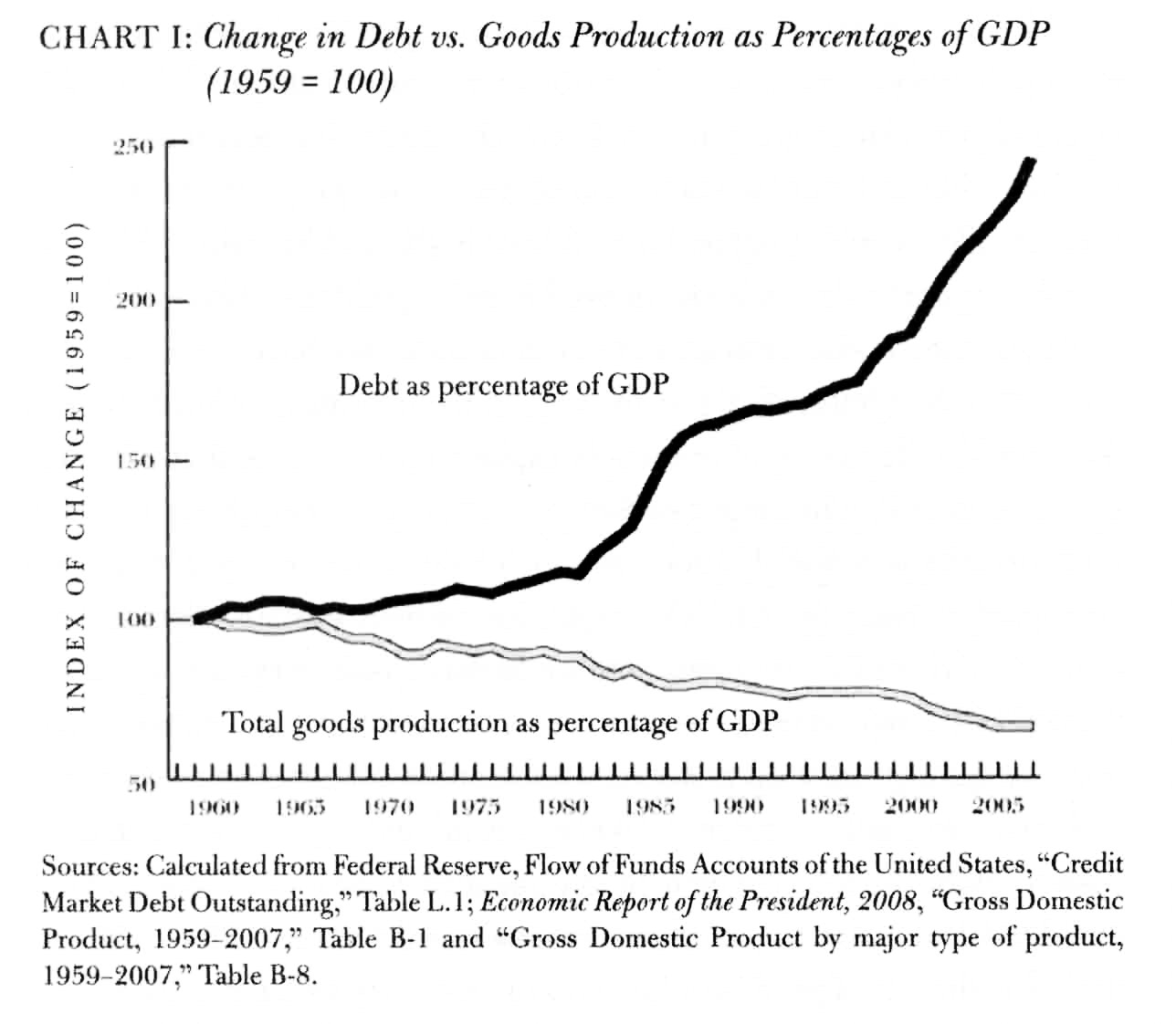 The comparative ratios of debt to GDP and goods production to GDP, as they develop over
time. In the graph at the right we see that in the U.S. economy debt has been climbing
ever faster in relation to GDP, while the production of goods (as opposed to financial
and other services) has been falling as a percentage of GDP. [From: John Bellamy Foster
& Fred Magdoff, The Great Financial Crisis (2009), p. 20.] This was a sure sign
of impending financial crisis.
The comparative ratios of debt to GDP and goods production to GDP, as they develop over
time. In the graph at the right we see that in the U.S. economy debt has been climbing
ever faster in relation to GDP, while the production of goods (as opposed to financial
and other services) has been falling as a percentage of GDP. [From: John Bellamy Foster
& Fred Magdoff, The Great Financial Crisis (2009), p. 20.] This was a sure sign
of impending financial crisis.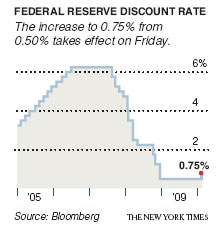 The discount rate is the interest rate that the