HOMUNCULUS
1. [In the long-discredited theory known
as “preformationism”:] A very tiny adult human being that in past ages was naïvely
believed to inhabit a sperm cell and which supposedly became a mature individual merely
through merging with an egg cell and then increasing in size.
2. [In the philosophy of mind:] The
equally naïve theory that there is something like an entire “little man” inside a
human head who processes incoming information from the senses and comprehends it. This
leads to an infinite regress, since presumably that little man would require an
even smaller little man in his head, and so forth! This theory arose because
people could not yet make sense out of how ideas and other mental phenomena arise in the
functioning of a material brain.
“Many of us ... imagine a little person inside the head watching
sensory inputs, then telling the muscles what to do. It took a long time for
scientists to realize that ascribing thought to a little person inside the head is
the equivalent of asking, ‘What makes a car move?’ and answering, ‘Another little
car inside’ rather than ‘An engine.’ But to explain thinking, it is all too easy to
argue in a circle. And that classic beginner’s mistake is not always innocuous; it
sets you up to view a fertilized egg as also containing a little person inside.”
—William H. Calvin, “The Fate of the Soul”, Natural History, June 2004, p.
55. [Calvin suggests elsewhere in this article that this naïve conception is
one of the reasons that many people oppose abortion
and wrongly view it as being a form of “murder”. —S.H.]
HORIZONTALIDAD
See also the HORIZONTALISM entry below.
“The term ‘horizontalism,’ from the Spanish horizontalidad,
was first used in Argentina after the 2001 popular rebellion there. In what we can
now see was a dress rehearsal for the current global [Occupy] movements, Argentines,
during an economic crisis, went out into the streets by the hundreds of thousands.
Banging pots and pans (cacerolado) and serenading officials with ‘Que se
vayan todos, que no quede ni uno solo’ (‘They all must go, not even one should
remain’), the protesters forced out five consecutive governments. In the process
they formed the first neighborhood assemblies grounded in horizontalidad,
a word that had not been used previously. Movement participants described
horizontalidad as the most natural way to listen and to connect to one
another. They rejected representative democracy and the empowerment of leaders that
such delegation of authority entailed, for this kind of politics was thought to have
caused the crisis in the first place. The spirit of horizontalidad
simultaneously emerged in workplaces and movements of the unemployed and then into
the fabric of countless social relationships, where it was seen as a tool to create
more participatory and freer spaces for all—a process of awakening and empowerment
similar to that which Eduardo Galeano portrays as occurring in Utopia.
Horizontalidad has since become a word and expression used throughout the
world to describe social movements seeking self-management, autonomy and direct
democracy.” —Marina Sitrin, “Horizontalism and the Occupy Movements”, Dissent
magazine, Spring 2012. (Ms. Sitrin is one of the theorists of the
Occupy Movement.)
[While the absence of genuine
democracy in Argentina and the entire world as it exists today is certainly an
extremely serious problem, the commentary above misdiagnosed this as the basic
“cause" of the Argentine economic crisis. The real fundamental causes are the
workings of the capitalist-imperialist system, and the exploitation of many of the
lesser developed “Third World” countries by the imperialist powers, currently led
by the United States. The lack of genuine democracy in Argentina and the world is
itself another consequence of imperialist bourgeois class rule. The economic and
social problems in Argentina—including the absence of real democracy—cannot be
overcome until Argentina undergoes an anti-imperialist, socialist revolution.
[While it is true that the
spontaneous movement of the masses in Argentina did depose several governments in
turn, in the end this movement dissipated and the bourgeoisie reestablished full
control. The rebellion collapsed, and no successful revolution proved to be possible
in the absence of serious revolutionary organization and leadership. See the entry
immediately below on HORIZONTALISM for more on this topic.
—S.H.]
HORIZONTALISM [In Politics]
An anarchist-like theory that argues that there need not be, or even “cannot be”,
any central leaders, leadership bodies, or developed structure to successful people’s
movements and social revolutions. Instead, this theory envisions that all decisions will
be made via “direct democracy”, where everyone
concerned participates in person, without any representatives or leaders. Something like
this theory has often been implicit in traditional anarchist thinking, though the term
‘horizontalism’ itself first arose in Argentina in 2001 [horizontalidad: see above
entry], and has mostly been popularized since then by individuals seeking to draw grand
theories from the very limited initial euphoric experience of the
Occupy Movement in the U.S. and similar spontaneous
mass movements in other countries (especially Spain and Greece). Such “horizontalist”
practice has never been successful in achieving any major and lasting goal, any place in
the world. Instead, it is a phenomenon often associated with spontaneous mass movements,
which inevitably fall apart and end in disillusioned failure for the masses who were
involved.
Marina Sitrin, a theorist who developed
within the Occupy Movement in the U.S., presents the argument for horizontalism this way:
“The intention of the thousands of assemblies taking place around
the United States [in the Occupy Movement], as well as in Greece and Spain, where I
have been most recently, is to open spaces for people to voice their concerns and
desires—and to do so in a directly democratic way. These movements emerged in
response to a growing crisis, the heart of which is a lack of democracy. People do
not feel represented by the governments that claim to speak in their name. The
Occupy movements are not based on creating either a program or a political party that
will put forward a plan for others to follow. Their purpose is not to determine ‘the’
path that a particular country should take but to create the space for a conversation
in which all can participate and in which all can determine together what the future
should look like. At the same time, these movements are attempting to prefigure that
future society in their present social relationships.
“The Occupy
movements throughout the United States, Spain, and Greece all have sought to use direct
democracy to create horizontal, nonhierarchical social relationships that would allow
participants to openly engage with each other. The term ‘horizontalism,’ from the
Spanish horizontalidad, was first used in Argentina after the 2001 popular
rebellion there.... [See the entry above for more on Argentina.]
“In addition to cultivating
horizontalidad, Occupy movements have also created new territories in which
forms of direct democracy can flourish. The alternative structures and actions of the
Occupy movement have emerged in these new geographic spaces of assembly. Here basic
necessities, such as food, legal support, and medical care are coordinated. Novel
actions have included the occupation of homes in the United States to prevent
evictions and of cash offices in hospitals in Greece so people do not have to pay the
newly imposed cost of health care. Towns and cities across the United States have
created barter networks, generated alternative adjudication processes, and instituted
free childcare. I know of one village in Northern California where people are using
an alternative currency and another town outside Albany, N.Y., that has set up a free
medical clinic. This is all self-organized horizontally.
“... [T]he Occupy movements will
continue to grow. The question for the future is not how to create a plan for what a
better country will look like, but how to deepen and broaden the assemblies taking
place and how to enhance participatory democracy in the process.
“... [W]hile there are many
challenges ahead, the Occupy movements have been and will continue to be successful.”
—Marina Sitrin, “Horizontalism and the Occupy Movements”, Dissent magazine,
Spring 2012.
Unfortunately, even as Ms. Sitrin was writing, the Occupy movement was falling apart,
and in the year and more since then it has virtually disappeared. Of course the Occupy
movement was a very positive thing, and there are many lessons to be learned from it. But
one of the most important of these lessons is that organization and leadership must develop
from the mass movement if that movement is ever to be successful over the long run. When
you look at Ms. Sitrin’s presentation there are many striking aspects to it. First, it
is remarkable how much of it is really only liberal utopianism. It posits changing
society without really changing it all that much. It doesn’t mention capitalism or
socialism! It doesn’t even mention social classes! It tacitly supposes that capitalist
society can be reformed into some utopian paradise, and that the rulers of society will
allow this to happen without resorting to violence to stop it. It imagines that this can
all be accomplished even without mass organization, even without any leadership arising
from the masses, even without a revolutionary party, and even without an actual social
revolution!
Well, it is easy to laugh at the total
naïvete of this theory of “horizontalism”, and its petty-bourgeois class basis. How
a world of billions of people could operate by constant “direct democracy” and without
any leadership or organization is absolutely incomprehensible. But there is behind such
horizontalist fantasies a valid worry: How can we trust our leaders and our representatives
to really represent the interests of the people, and to truly lead us in satisfying those
interests over the long term? People like Ms. Sitrin and most of those thousands who were
in the Occupy movement have very correctly given up on the establishment Democratic
and Republican parties in the U.S. They quite properly do not trust those parties, and
their “leadership”, to represent the interests of the working class and ordinary people.
They see the rich, “the 1%”, are running things in their own interests, and they also see
the failure of revisionist regimes of the Soviet Union and contemporary capitalist China
to do things in any fundamentally different way.
But what they don’t see is that there is
another way of generating leaders and organization from the masses and the mass movement.
What they don’t see is that there are methods of leadership (especially the
mass line) through which such a leadership can lead the
mass movement in a truly democratic way. And what they don’t see is that the people can
be educated to keep a close eye on their leaders, to rotate them from the masses, and to
knock them down again if they even begin to put their own interests above those of the
people. They don’t know about the Great Proletarian Cultural Revolution in China, and
what has been learned from that about how to do an even better job of governing our
leaders in the future. These are some of the important things we need to explain to the
people in the course of demonstrating them in our own revolutionary practice. —S.H.
“Not a single class in history has achieved power without producing
its political leaders, its prominent representatives able to organize a movement and
lead it.” —Lenin, “Urgent Tasks of Our Movement” (1900), LCW 4:370.
HORN, Joshua S. (1914-1975)
“Dr. Joshua S. Horn lived and worked in China from 1954 to 1969 as
an outstanding surgeon and an involved political person, serving the people through
a firm understanding of the unity of politics and medicine.
“Active in the English workers’
struggles of the 1930s, Dr. Horn visited China in 1937 as a ship’s doctor after
giving up a lectureship in anatomy at Cambridge. In 1939 he joined the British
Communist Party. While serving as a surgeon during World War II he developed a
special interest in traumatology, the treatment of severe injuries.
“In 1954 he left a secure post
as a consultant surgeon in England and went to China with his family to make what
he thought would be his ‘best political contribution.’ His book Away With All
Pests, which describes the achievements of revolutionary medicine in China, is
a fine memorial to his work and the development of his political consciousness. Its
publication, like his other writings and his extensive speaking tours throughout the
United States and Europe, helped build friendship with China. In word and deed he
set an example of internationalism.
“Dr. Horn died on December 17,
1975, in Peking after a long illness. His friends will remember him for his sense
of humor, his liveliness, his enthusiasm, and the revolutionary outlook that
inspired his work and service.”
—D. Sipe, adapted from his
obituary about Joshua Horn, in New China magazine, vol. 2, no. 1, June 1976,
p. 4.
HOUSE UN-AMERICAN ACTIVITIES COMMITTEE
A committee of the U.S. Congress which focused on attacking communists and even liberal
reformists. The viciousness of this committee was matched only by its remarkable ignorance.
“Although not as famous as its later McCarthy hearings, the 1938 HUAC
testimony had memorable moments. For example, at one point a congressman asked whether
Elizabethan playwright Christopher Marlowe was a Communist and inquired if ‘Mr.
Euripides’ was guilty of teaching class consciousness.” —Michael Edmonds, Wisconsin
History magazine, Spring 2011, p. 48; original transcripts in Investigation of
Un-American Propaganda Activities in the United States: Hearings, vol. 4, U.S. Gov.
Printing Office, 1938-1944, pp. 2857-8.
[Question from the HUAC Committee:] “Do you have the opportunity to
inject into your plays... the beliefs of communism?”
[Joseph Papp:] “Sir, the plays we
do are Shakespeare’s plays... I cannot control the writings of Shakespeare.”
—Testimony at a HUAC hearing in
June 1958; quoted in Newsweek, Nov. 23, 2009, p. 55.
HOUSEHOLD INCOME
 The total income of all the workers in a given household, from all sources (including
not only wages, but also interest and investment income). (Gross income is the
income before the payment of income taxes; net income is after the payment of
income taxes. Usually the unqualified term “household income” means gross household
income.)
The total income of all the workers in a given household, from all sources (including
not only wages, but also interest and investment income). (Gross income is the
income before the payment of income taxes; net income is after the payment of
income taxes. Usually the unqualified term “household income” means gross household
income.)
The “average household income” is the
total of all household income for the country or region divided by the number of
households. The “median household income” is the value for which 50% of all households
have a greater income and 50% have a smaller income. For most purposes the median income
is a much better social indicator since the average income is generally grossly skewed
in capitalist society because of the vast incomes of the small number of very rich
households (the bourgeoisie).
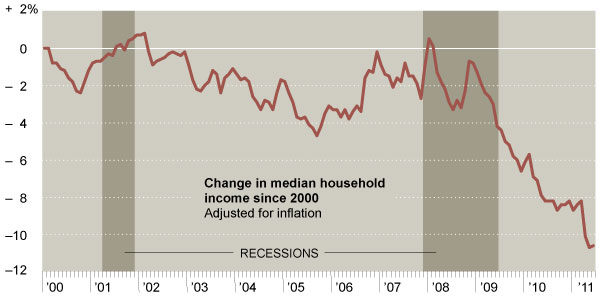
The graph at the right shows the
percentage change in the median household income in the U.S. since 2000. Note that the
rate of decline has been speeding up as the current economic crisis intensifies.
Household income is not the same as
personal income, since there is typically more than one person in a household.
The term family income is often used as a synonym for household income, though
the U.S. Census Bureau defines household income in a slightly broader way (and
including all those who live in the same home even if they are not part of a single
family).
“The economic boom that peaked in 2007 represented the first time
that median real (that is, inflation-adjusted) incomes did not recover to their
previous peak before declining into the next recession. More ominously, family
incomes have yet to recover, even though the recession ended three and a half years
ago. That has brought the total decline in real incomes to nearly 9 percent since
2000. So where has the economic growth from the recovery gone? Much of it has gone
to corporate profits, as companies took advantage of the high unemployment rate and
the ability to shift production globally to hold down wages in the United States.”
—Steven Rattner, “America in 2012, as Told in Charts”, New York Times, Dec.
31, 2012.
HOUSING BUBBLE
An asset bubble in the prices of houses. In other words,
a tremendous and unjustified rise in the prices of houses due to massive government
financial support and/or one form of private speculation or another.
In the 1997-2007 period in the U.S., for
example, and especially in the latter years from 2003-2007, many speculators began buying
houses—often not in order to live in them themselves—but in order to sell them again later
after the prices rose some more. Even for many of those who did live in these houses
in the meantime, this was close to pure speculation, which was promoted by banks and the
government through low or non-existent down payments and very low interest rates. This
particular housing bubble was also promoted by banks through
securitization of mortgages in the form of
CDOs. This allowed the banks to escape any risk on the mortgages
they had already issued, and continue to issue new risky mortgages to those with
“sub-prime” (poor) credit.
Housing bubbles, like all asset bubbles,
always pop eventually, and the 1997-2007 bubble began to pop in late 2007. (House prices
actually peaked in 2006, but at first the declines were quite small.) However, even though
episodes of bubble popping can be dramatic, it takes time for them to completely deflate.
Sometimes they are even partially reinflated for a while. Thus while the recent U.S.
housing bubble has considerably deflated from its peak, it is still a substantial bubble.
For that reason, the government is going to great lengths (and great expense) to try to
“prop up” the housing market, or, in other words to try to reinflate the present housing
bubble. “The government is literally plowing trillions of dollars into the U.S. mortgage
market to keep it afloat”, said Guy D. Cecala, publisher of Inside Mortgage Finance
in October 2009.
Housing bubbles are a common development
in advanced capitalist countries in the imperialist era. There was a huge housing bubble
which popped in the Great Depression of the 1930s and a bigger bubble which popped in the
late 1980s-early 1990s with the Savings & Loan
Crisis. But by far the biggest housing bubble, especially in the U.S. but also in
Britain, Spain and other countries, is the current one which is by no means resolved yet.
“Should we let housing prices fall? Many smart people say we should.
It seems increasingly clear that we must. For how long can the government prop them
up? Are we never to have a private market in mortgages again? Yet what happens if we
let them fall? Arguably many banks would once again be ‘under water.’ Enthusiasm for
another set of bailouts is weak, to say the least. Our government would end up
nationalizing these banks and it still would be on the hook for their debts. The blow
to confidence would be a major one. I increasingly believe there is no easy way out
of this dilemma and it is a major reason why the U.S. economy remains stuck. Housing
prices must fall, yet ... housing prices must not fall.” —Tyler Cowen, a bourgeois
commentator, on the website MarginalRevolution.com, Sept. 8, 2010; as quoted in
The Week, Sept. 24, 2010, p. 48.
[This is one of the many specific
contradictions that the U.S. capitalist economy has gotten itself into. About 80% of
U.S. bank loans are in the form of mortgages, and for many decades now the heavy
government promotion of housing debt is one of the major factors that has been keeping
the economy from sinking into a new depression. So they must continue to promote
this housing bubble. But it is getting ever more difficult and costly to do so, and
the bubble must more completely collapse in the end. That is their current
predicament. —S.H.]
“Since 1997, we have lived through the biggest real estate bubble in
United States history—followed by the most calamitous decline in housing prices that
the country has ever seen.
“Fundamental factors like
inflation and construction costs affect home prices, of course. But the radical shifts
in housing prices in recent years were caused mainly by investor-induced speculation....
“The great housing bubble of the
2000s was diffused widely through the population and didn’t owe its beginnings to any
single promotional scheme. The bubble became so big apparently because of a number of
kinds of financial promotion—of subprime mortgages, no-down-payment mortgages,
securitized mortgages and other innovations.” —Robert J. Shiller, “Before Housing
Bubbles, There Was Land Fever”, New York Times, April 20, 2013. [Shiller is
a bourgeois economist and a leading expert on housing prices.]
HOUSING QUESTION, The [Pamphlet by Engels]
A collection of articles, soon also issued as a pamphlet, that Engels wrote in 1872-1873
for the publication Volkstaat about the serious housing shortage for workers in
Germany at that time. These articles also examined the various reformist nostrums proposed
for dealing with this problem, and criticized and exposed them and their proponents. His
central point was that a policy of housing reforms cannot possibly replace the revolutionary
program of the proletariat because “it is not that the solution of the housing question
simultaneously solves the social question, but that only by the solution of the social
question, that is, by the abolition of the capitalist mode of production, is the solution
of the housing question made possible.”
This work by Engels is available online
at:
http://www.marxists.org/archive/marx/works/1872/housing-question/index.htm
“In this book Engels deals with a secondary consequence of the economic
law of development of capitalism—the housing question. He shows how not only bad and
unhealthy housing, but a housing shortage and high rents, affecting not only the working
class but large sections of the middle class also, result from the rapid development of
industrial capitalism. He discusses various schemes proposed for solving the housing
problem, and concludes that this problem is integrally connected with capitalism and that
only by the ending of capitalism will the housing question be finally solved.
“It first appeared in the form of
three articles in the German socialist press in 1872—when the industrial boom following
the end of the Franco-Prussian War, and the rapid growth of cities, had made the housing
problem loom large in Germany. The articles are strongly polemical in character—directed
against petty-bourgeois socialists (revivers of the discredited ideas of Proudhon) who
were pushing the housing question into the forefront and pretending that their quack
remedies for it would transform society.
“What are the principal questions
dealt with in the articles?
“1. Engels exposes the
fallacy of those socialists who fancy they can transform capitalism by a few legal
reforms.
“2. Engels deals with the
proposal to solve the housing problem by ensuring that every worker shall own ‘his own
little house.’ He shows that this is a utopia, and moreover not a socialist proposal
but a thoroughly reaactionary proposal. And in this connection he explains the true
economic relation between landlord and tenant and the nature of house rent. The
landlord-tenant relation is not like the relation between capitalist and worker, but is
based on an ordinary sale and purchase transaction between two citizens. The landlord
sells the use of the house to the tenant.
“3. Engels proves that the
capitalists, while forced to agree to various steps to alleviate the housing problem, do
not want to solve it; and that housing schemes initiated by the capitalist state do not
solve it either. He enters in some detail into questions of building societies, state
aid for housing, factory housing schemes, town planning.
“4. Engels shows how, with
the seizure of power by the proletariat, exiting housing can be utilized for the benefit
of the working class; and he shows how the eventual solution of the housing question
will be bound up with the abolition of the antithesis between town and countryside.”
—Maurice Cornforth, Readers’
Guide to the Marxist Classics (London: 1952), pp.39-40.
HUA GUOFENG [Old style: HUA KUO-FENG] (1921-2008)
The designated successor to Mao Zedong as the Chairman of the Chinese Communist Party, who was
also the Premier of China and thus for several years the top leader of both the Party and
government of China. He performed ineptly, arrested or alienated the more Maoist forces in the
Party, and was outmaneuvered in the struggle for power by the more bourgeois reactionary forces
led by Deng Xiaoping.
“Hua Guofeng” was his Party
name (or nom de guerre); his real name was Su Zhu. He was born into a family of poor peasants
and completed primary school, but probably received no further formal education. He joined the
revolutionary ranks in 1935 when the Communist forces reached his area following the Long March.
His early career was as a cadre in Hunan province and he was involved in directing land reform
work there in the early to mid-1950s. Hua served as Party secretary in the province beginning in
1970.
During the Cultural Revolution Hua, with the
support of Zhou Enlai, was named to the preparatory group for the establishment of the new
Revolutionary Committee of Hunan. He was first elected as a member of the Central Committee of
the CCP at the Ninth Party Congress in 1969. In 1973 he became a member of the Politburo, and
was then appointed Deputy Premier and head of public security (1975-76). After Zhou Enlai’s
death in January 1976, Hua Guofeng became Premier. In his last days Mao designated Hua to
succeed him as Party Chairman. In addition to the Premiership and Party Chairman position, he
also was soon designated as the Chairman of the Central Military Commission, thus holding all
the top formal positions of power in his hands.
The official story is that the “Gang of Four”,
Mao’s closest followers including his widow Jiang Qing, were planning a coup to overthrow
Hua and his associates, but that Hua pre-empted this by arresting the “Gang of Four” and their
top supporters. [It is still not completely clear what the precise actual situation was then,
but the fact remains that Hua arrested and overthrew the “Gang of Four” in his own coup
supported by the reactionary forces.]
Hua Guofeng then brought the Cultural Revolution
to a complete end and began reversing some of its policies. It seems he was attempting to move
the economy back toward the Soviet-style bureaucratic and commandist form of the late 1950s in
China. However these backward steps were not enough for the more bourgeois forces in the Party,
and especially for Deng Xiaoping who also hungered for yet another return to personal power.
With the support of the large number of national bourgeois forces still within the CCP, Deng
outmaneuvered the hapless Hua and forced him into early retirement. Hua was forced to resign as
Premier in 1980 and was formally replaced as Party Chairman in September 1982.
Despite the major and prolonged campaigns within
the CCP during the 1966-1976 period against capitalist roaders, they were still a very strong
presence in the Party. This was because so many non-Marxist nationalists had joined the Party
during the anti-imperialist struggles and the period of the New Democratic Revolution. Probably
the only way a bourgeois restoration could have been avoided over the long run was to keep the
Cultural Revolution going at one level or another on a more or less permanent basis. Hua did
not understand that it was essential to do this.
From a historical standpoint Hua Guofeng must
be viewed as a somewhat pathetic transitional figure whose own insufficient grasp of Marxism
and insufficient revolutionary zeal ended up playing into the hands of Deng Xiaoping and the
bourgeoisie.
HUKOU SYSTEM
The system of household registration and residency permits in China which dates back to
ancient times, but which has also been a prominent feature of the People’s Republic of China.
A registration record officially identifies a person as a resident of some locality and
includes other information including the person’s parents, spouse, and date of birth. In
Chinese the formal name of this system is huji, and a hukou is the residency
status of a person. But informally, hukou is also the name for the system, and that
is what this registration system is called in English.
In 1958 the PRC officially promulgated the
family registration system to establish some general social stability and to control the
movement of people from rural to urban areas. During the socialist period the government
was attempting to keep the migration from the countryside to the cities from occurring in
a premature and disorderly fashion. In general, the movement to the cities was limited to
the workers and families needed to fill the new jobs which were opening up in the rapidly
expanding socialist industries there.
In recent decades, since the restoration
of capitalism in China, the hukou system has been officially kept in place. But to
accomodate both local and multinational capitalist corporations, and their need for cheap
labor from the countryside, it has generally not been enforced. This has led to tens of
millions of migrant workers living technically illegally in the cities, and having no
rights to public housing, education, and other social benefits there. This has created a
massive and growing social problem of gross discrimination against migrant workers. Since
migrant workers are not allowed to enroll their children in urban schools, most of these
children must remain with their grandparents or other relatives in the countryside, which
means they are in effect forcibly separated from their parents. By 2005 there were as many
as 130 million of these “home-staying children”, as they are called in China, with parents
living away from them in distant cities.
In many respects, the lives of migrant
workers in China are similar to that of illegal migrant workers in the U.S. and other
“advanced” capitalist countries. They are needed and exploited by urban capitalists, but
they are paid extremely low wages and are denied many rights and benefits that other
people have. This discrimination against well over a hundred million migrant workers in
China is one of several important factors leading to rapidly increasing social unrest.
In recent years, although the central government loosened its control over the hukou
system, it mostly just transferred this control and discrimination to the local
governments. And although the movement of people to the cities became unofficially allowed,
the super-exploitation and discrimination against them that awaited them there was as bad
as ever. That part of the hukou system still continued unabated.
However, in December 2013 the Chinese
government announced that it would be ending the hukou system, some aspects of it
immediately, and some aspects gradually over time. This is being done for several reasons.
The increased social unrest caused by mistreated migrant workers in the cities was
seriously worrying the ruling class. And the government has somewhat changed direction by
even more strongly promoting urbanization. It came to the conclusion that it would
actually promote economic development to increase the speed of
urbanization in China. This view may have some
partial validity to it, though it also may well end up promoting the creation of massive
slums in China if more and more of the millions of rural people being rapidly moved to the
cities are unable to find jobs.
HUMAN KNOWLEDGE
See also:
AGNOSTICISM, KNOWLEDGE,
REFLECTION THEORY,
THEORY OF KNOWLEDGE
“For the most valuable result ... would be that it should make us
extremely distrustful of our present knowledge, inasmuch as in all probability we
are just about at the beginning of human history, and the generations which will
put us right are likely to be far more numerous than those whose knowledge
we—often enough with a considerable degree of contempt—have the opportunity to
correct.” —Engels, Anti-Dühring (1878), MECW 25:80.
“But as for the sovereign validity of the knowledge obtained by
each individual thought, we all know that there can be no talk of such a thing,
and that all previous experience shows that without exception such knowledge always
contains much more that is capable of being improved upon than that which cannot be
improved upon, or is correct.” —Engels, ibid.
“Human knowledge is not (or does not follow) a straight line, but
a curve, which endlessly approximates a series of circles, a spiral. Any fragment,
segment, section of this curve can be transformed (transformed one-sidedly) into an
independent, complete, straight line, which then (if one does not see the wood for
the trees) leads into the quagmore, into clerical obscurantism (where it is
anchored by the class interests of the ruling classes). Rectilinearity and
one-sidedness, woodenness and petrification, subjectivism and subjective
blindness—voilà the epistemological roots of idealism. And clerical
obscurantism (=philosophical idealism), of course, has epistemological roots,
it is not groundless; it is a sterile flower undoubtedly, but a sterile
flower that grows on the living tree of living, fertile, genuine, powerful,
omnipotent, objective, absolute human knowledge.” —Lenin, “On the Question of
Dialectics” (1915), LCW 38:363.
HUME’S PARADOX
The supposed mystery that a small class of rulers can (most of the time!) manage to control
and govern the vastly more numerous masses who they exploit and oppress. Here is the
euphemistic way that Hume himself originally put it (of course without any reference to
social classes or exploitation!):
“Nothing appears more surprising to those who consider human affairs
with a philosophical eye, than the easiness with which the many are governed by the
few.” —David Hume, The First Principles of Government (1742).
While certainly regretable, Hume’s “Paradox” should not be too surprising to Marxists
who understand that one of the basic principles of historical
materialism is that the dominant ideas of any age are those of the ruling class. While
the rule of “the few” over “the many” can unfortunately last for a long time, in historical
terms the rule of the exploiters and oppressors is still precarious. All it takes is one
grand moment of revolution to topple the bastards!
HYNDMAN, Henry Mayers (1842-1921)
A founder and leader of the Social-Democratic
Federation in Britain and later one of the founders of the British Socialist Party.
Hyndman was always one of the leaders of the Right wing of the socialist movement in Britain
and a complete opportunist. In 1916 he was expelled from the
BSP for putting out propaganda in support of the imperialist war. He was also hostile to the
October Revolution in Russia and supported imperialist intervention by the West against Soviet
Russia.
“Although Hyndman was a talented writer and public speaker, many members
of the SDF questioned his leadership qualities. He was extremely authoritarian and tried
to restrict internal debate about party policy. At an SDF meeting on 27 December 1884,
the executive voted by a majority of two (10-8), that it had no confidence in Hyndman.
When he refused to resign, some members, including William Morris and Eleanor Marx, left
the party.
“In the 1885 General Election,
Hyndman and Henry Hyde Champion, without consulting their colleagues, accepted £340 from
the Tories to run parliamentary candidates in Hampstead and Kensington, the objective
being to split the Liberal vote and therefore enabling the Conservative candidate to win.
This ploy failed, and the two SDF’s candidates won only a total of 59 votes. The story
leaked out, and the political reputation of both men suffered from the idea that they
were willing to accept ‘Tory Gold’.” —From the Wikipedia article on Hyndman (as of
Feb. 28, 2010).
HYPOTHESIS
[As used in science:] A tentative assumption made in order to draw out and test its logical
or empirical consequences. [Merriam Webster’s Collegiate Dictionary,
10th ed.] Quite often competing hypotheses are developed, only one of which will
eventually be proven correct or at least become the generally accepted theory
explaining the phenomena in question.
“HYPOTHESIS, THEORY, LAW mean a formula derived by inference from
scientific data that explains a principle operating in nature. HYPOTHESIS implies
insufficient evidence to provide more than a tentative explanation [a hypothesis
explaining the extinction of the dinosaurs]. THEORY implies a greater range of
evidence and greater likelihood of truth [the theory of evolution]. LAW implies
a statement of order and relation in nature that has been found to be invariable under
the same conditions [the law of gravitation].” —From the entry for HYPOTHESIS
in Merriam Webster’s Collegiate Dictionary, 10th ed.
[The use of these terms in Marxist
discourse is generally the same or very similar to this. However, on a few occasions
Marx referred to tendencies as “laws”, as in Part 3 of Volume III of
Capital, “The Law of the Tendency of the Rate of Profit to Fall”. A few modern
Marxists, under the influence of postmodernist
ideology, have gone so far as to claim that most or even all laws in social
science are “only tendencies”! See: SCIENTIFIC
LAWS—As Mere Tendencies. Nearly all Marxists, however, use the words HYPOTHESIS
and THEORY pretty much the same as they are generally used in modern science. —S.H.]
“The form of development of natural science, in so far as it thinks,
is the hypothesis. A new fact is observed which makes impossible the previous
method of explaining the facts belonging to the same group. From this moment onwards
new methods of explanation are required – at first based on only a limited number of
facts and observations. Further observational material weeds out these hypotheses,
doing away with some and correcting others, until finally the law is established in
a pure form. If one should wait until the material for a law was in a pure form,
it would mean suspending the process of thought in investigation until then and, if
only for this, reason, the law would never come into being.
“The number and succession of
hypotheses supplanting one another – given the lack of logical and dialectical
education among natural scientists – easily gives rise to the idea that we cannot know
the essence of things (Haller and Goethe). This is not peculiar to natural
science since all human knowledge develops in a much twisted curve; and in the
historical sciences also, including philosophy, theories displace one another, from
which, however, nobody concludes that formal logic, for instance, is nonsense.”
—Engels, Dialectics of Nature (1883), “Notes and Fragments”, online at:
http://www.marxists.org/archive/marx/works/1883/don/ch07c.htm
HYSTERESIS
[As used in recent bourgeois economics:] The lingering effects of a
recession which continue to retard economic growth years
after the recession is officially deemed to be over.
As bourgeois economists define recessions,
they are “over” when production (GDP) starts to increase again,
even if the rate of increase is very slow, and even if production still has not reached the
level that existed before the recession began! However, this is being called “hysteresis”
only when over a longer multi-year period the rate of GDP growth still does not fully
recover and remains significantly lower than the rate of growth before the recession began.
In particular, the term is being used in the aftermath of the
Great Recession which is officially dated from December
2007 to the summer of 2009. For bourgeois economists, economic growth since then has been
puzzlingly sluggish and they are struggling to understand why that is. They invoke the
unscientific concept of “potential output” under
capitalism, comparing what rates of growth actually are to what they imagine they “should
be” or “would be” if the crisis had not arisen.
Standard bourgeois theory has no good
explanation for this hysteresis or lingering retardation of the capitalist economy, hence
all the scratching of heads that is now going on. However, the answer is actually rather
obvious from the Marxist standpoint: the overproduction
crisis is simply not truly over. According to Marx, capitalist economic crises are
resolved by the development of new markets (where that is possible) or else through the
destruction of the great excess of productive capital which has accumulated since the
previous crisis. If those things cannot be done, or at least not fully done, then the crisis
will continue indefinitely, at one level or another.
“Many macroeconomics textbooks describe recessions as temporary
declines in aggregate demand, when actual output drops below potential output, followed
by a recovery period when output returns to potential. However, a number of studies of
deep recessions around the world find that recessions have highly persistent effects on
output. These effects, sometimes labeled ‘hysteresis,’ could arise because a recession
reduces capital accumulation, scars workers who lose their jobs, and disrupts the
economic activities that produce technological progress.
“Experience since the global
financial crisis and Great Recession of 2008-09 has strengthened the evidence for
long-term effects of recessions, since output in many countries is still highly
depressed in 2014, with many forecasters predicting little recovery in the next five
years....
“In Long-Term Damage from the
Great Recession in OECD Countries (NBER Working Paper No. 20185), Laurence M. Ball
uses OECD estimates of potential output in 23 countries to quantify the long-term
damage from the Great Recession.... Ball finds that the recent recessions have had
dire effects on economies’ productive capacity, as measured by OECD and IMF estimates
of potential output. In most countries, the fall in potential relative to its
pre-crisis trend has been almost as large as the fall in actual output. Consequently,
the countries with the deepest recessions have also experienced the greatest long-term
damage. By aggregating the 23 countries in his sample, the author finds that the loss
of potential output relative to the pre-crisis path is 8.4 percent in 2015. To
appreciate the size of this loss, note that Germany accounts for 8.2 percent of the
aggregate economy. The total damage from the Great Recession is slightly larger than
the loss if Germany’s entire economy disappeared.” —Les Picker, NBER Digest,
November 2014. [NBER is an important association of U.S.
bourgeois economists.]
Dictionary Home Page and Letter Index
MASSLINE.ORG Home Page
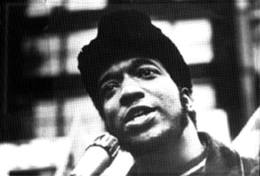 An important young African-American revolutionary and leading member of the
Black Panther Party who was assassinated at the age of
21 by Chicago police and the FBI in a notorious joint attack on December
4, 1969. Hampton was an inspiring and effective revolutionary leader, and the U.S. government was
desperate to put an end to his speaking and organizing work. Hampton had been drugged by an
undercover FBI agent and was sound asleep when the attack on his apartment occurred:
An important young African-American revolutionary and leading member of the
Black Panther Party who was assassinated at the age of
21 by Chicago police and the FBI in a notorious joint attack on December
4, 1969. Hampton was an inspiring and effective revolutionary leader, and the U.S. government was
desperate to put an end to his speaking and organizing work. Hampton had been drugged by an
undercover FBI agent and was sound asleep when the attack on his apartment occurred: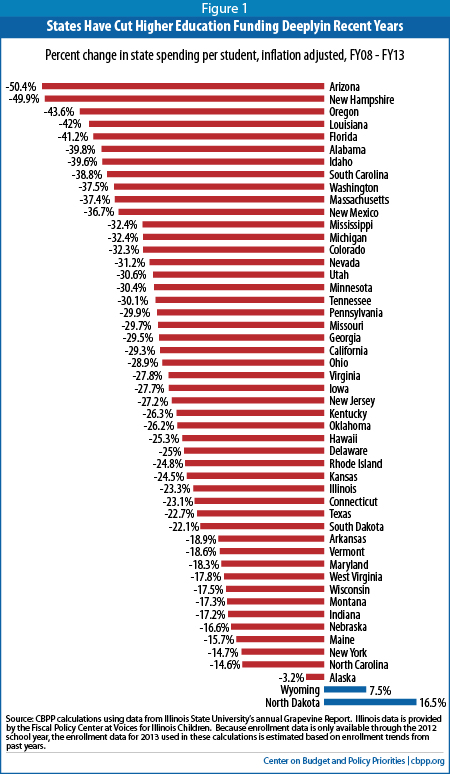 The long developing economic crisis of capitalism took a major turn for the worse beginning
in 2008. This has affected more and more aspects of society. In the chart at the right, from
the Center on Budget and Policy
Priorities, we see just one of the ways in which American education has been slashed
because of the crisis, and the resolve of the ruling class to take out the crisis on the backs
of the people rather than trim their record corporate profits. Only two states have been able
to increase their higher education funding per student during this period, the two small states
that have a (temporary) oil-shale boom.
The long developing economic crisis of capitalism took a major turn for the worse beginning
in 2008. This has affected more and more aspects of society. In the chart at the right, from
the Center on Budget and Policy
Priorities, we see just one of the ways in which American education has been slashed
because of the crisis, and the resolve of the ruling class to take out the crisis on the backs
of the people rather than trim their record corporate profits. Only two states have been able
to increase their higher education funding per student during this period, the two small states
that have a (temporary) oil-shale boom.